Introduction
Delirium is a frequent accompaniment of acute illness, occurring in 11–50% of hospitalized older adults (Lipowski, Reference Lipowski1987; Siddiqi et al., Reference Siddiqi, House and Holmes2006). Delirious individuals undergo acute changes in cognitive functioning characterized by reduced ability to sustain attention, disorganized thinking, disorientation, delusions, perceptual disturbances, impaired memory, speech, psychomotor activity, and sleep (Lipowski, Reference Lipowski1987; American Psychiatric Association, 1994). Delirium is also associated with multiple adverse outcomes including increased length and cost of hospitalization, functional and cognitive decline, institutionalization, and mortality (Francis and Kapoor, Reference Francis and Kapoor1992; Rockwood et al., Reference Rockwood, Cosway, Carver, Jarrett, Stadnyk and Fisk1999; Marcantonio et al., Reference Marcantonio, Flacker, Michaels and Resnick2000; McCusker et al., Reference McCusker, Cole, Abrahamowicz, Primeau and Belzile2002; Pitkälä et al., Reference Pitkälä, Laurila, Strandberg and Tilvis2005; Adamis et al., Reference Adamis, Treloar, Martin and MacDonald2006; Inouye, Reference Inouye2006).
Although it is well accepted that delirious individuals as a whole do worse than non-delirious hospitalized individuals, it is not well understood why some individuals recover from their delirium while others do not (Andrew et al., Reference Andrew, Freter and Rockwood2005). Delirium has been described as a potentially reversible condition with treatment of the underlying condition (Lipowski, Reference Lipowski1987; Rockwood, Reference Rockwood1989). However, as demonstrated in a recent systematic review (Cole et al., Reference Cole, Ciampi, Belzile and Zhong2009), delirium symptoms often persist at discharge or beyond (Marcantonio et al., Reference Marcantonio, Flacker, Michaels and Resnick2000; Kelly et al., Reference Kelly, Zisselman, Cutillo-Schmitter, Reichard, Payne and Denman2001; Kiely et al., Reference Kiely, Bergmann, Jones, Murphy, Orav and Marcantonio2004; Adamis et al., Reference Adamis, Treloar, Martin and MacDonald2006). The duration of a delirium episode is variable, with studies reporting delirium lasting 60 days or more (Koponen et al., Reference Koponen, Stenbäck, Mattila, Soininen, Reinikainen and Riekkinen1989; Manos and Wu, Reference Manos and Wu1997). Persistent delirium symptoms are also associated with a diminished ability to perform basic and instrumental activities of daily living compared to an individual's baseline (pre-delirious) abilities and increased mortality (Marcantonio et al., Reference Marcantonio, Flacker, Michaels and Resnick2000; McCusker et al., Reference McCusker, Cole, Dendukuri, Han and Belzile2003, Kiely et al., Reference Kiely, Jones, Bergmann, Murphy, Orav and Marcantonio2006; Reference Kiely2009; Cole et al., Reference Cole, Ciampi, Belzile and Zhong2009).
In today's medical environment, in which there is constant pressure to discharge individuals quickly from acute care, there is often not enough time to observe delirious individuals to determine whether their delirium will resolve. Clinicians often have to inform family members of the potential for recovery and make decisions about potential rehabilitation and/or other discharge destinations. Unfortunately, little is known about how to predict whether a delirious individual will recover from their delirium. The purpose of this paper is to review systematically what is known about the factors associated with the persistence of delirium.
Methods
PubMed was searched for English or French studies (1960 to February 2009) using the Medical Subject Heading (MeSH) “delirium” or “confusion” and “prognosis” or “risk factors”. Using this same search strategy, Medline, CINAHL, Embase, PsychoInfo and the Cochrane databases were also searched. Manual searches of the references of retrieved articles were also conducted. Both authors independently performed these searches.
Inclusion/exclusion criteria
Citations (titles and abstracts) were reviewed independently by both authors and selected for review of the full-text article based on their potential to meet the inclusion criteria as described below. Each author independently reviewed the full-text articles for inclusion. All disagreements were resolved by consensus. When required the authors also attempted to contact original authors of included articles for additional information.
Studies were included in the review if they: (i) included original data on adult patients (19 years or older); (ii) compared at least two groups of delirious patients in delirium duration or persistence with observation periods extending up to six months after the onset of delirium; (iii) prospectively diagnosed delirium with the Diagnostic and Statistical Manual of Mental Disorders (DSM) III or IV criteria (American Psychiatric Association, 1987; 1994) or a scale derived from and validated against the DSM criteria; (iv) defined delirium duration as the time at which delirium was no longer present according to DSM or a DSM-derived and validated scale; (v) enrolled patients consecutively; and (vi) provided results on statistical significance between the measure of delirium duration and the independent variable (any non-therapeutic prognostic variable). Intervention studies could be included if the intervention had no effect on delirium duration or if results were adjusted for intervention status.
Studies were excluded from the review when they: (i) only provided data on comparisons between delirious patients and another patient group, which included non-delirious patients; (ii) did not use DSM or DSM-derived and validated criteria to diagnose delirium and how long it lasted; or (iii) used retrospective methods to diagnose delirium.
Data extraction
Information was collected on: (i) type of patient population; (ii) the effective sample size (i.e. the number of delirious individuals being compared, which may not be the same as the entire study sample if the study also included non-delirious controls); (iii) which comparator variables were assessed and how these were measured; (iv) study findings (bivariate or multivariate analyses); and (v) how and when delirium duration was defined. Studies were further divided according to whether they assessed delirium duration in the short-term (within three months of delirium diagnosis) or in the longer-term (at three to six months after delirium diagnosis). For the purposes of this review, data from studies on the effect of a specific comparator variable on delirium duration were included in the results tables when the effect of the comparator variable was assessed in at least two studies (comparator variables that were assessed in only one study were not included). Data were extracted by one author (MD) and reviewed by the second author.
Statistics
Although no pooling of data was conducted, simple statistics were abstracted from the individual studies where available. Odds ratios (ORs), HRs (hazard ratios), relative risks (RRs), and confidence intervals (or if unavailable, p-values) were abstracted when provided by the original studies. Generally (see Tables 2 and 3), ORs (or other measures of strengths of association) for delirium persistence were listed. If ORs were not provided but adequate data were available, the ORs were calculated (i.e. odds of persistence given risk factor / odds of persistence without risk factor). As presented in Table 4, one of the studies provided HRs for delirium resolution and ORs for delirium resolution from other studies were listed. If studies included in this table provided ORs for delirium persistence (instead of resolution), ORs were calculated for resolution as 1/OR for persistence.
Study quality assessment
According to the evidence-based medicine (EBM) working group (Guyatt et al., Reference Guyatt, Drummond, Meade and Cook2002), four criteria can be used to judge the validity of prognostic studies: (i) whether a representative patient population is enrolled; (ii) whether there was an objective and unbiased outcome assessment; (iii) whether there was adequate follow-up; and (iv) whether the two groups being compared are homogenous with respect to prognostic risk. The inclusion criteria for this review mandated consecutive enrollment (albeit in differing patient populations), and the use of a DSM (or Confusion Assessment Method) derived measure of delirium duration. In this manner, the first two criteria for validity were consistently met across included studies (although blinding was rarely commented upon in the studies). The last two criteria were not uniformly met by all studies. The extent of follow-up was not always commented upon in studies. Homogeneity of prognostic risk, which was judged by whether studies performed multivariable analyses incorporating other possible risk factors, was also not always addressed. These methodological features are therefore discussed when looking at the quality of individual studies. Both authors also independently judged studies using a rating scale similar to that used by Elie and colleagues (Reference Elie, Cole, Primeau and Bellavance1998) in their systematic review of delirium risk factors. With this scale, studies are specifically assessed on whether they provide an adequate description of: (i) patient groups; (ii) selection process; (iii) methods to characterize both groups; (iv) methods to define risk factors; (v) presence of blinding; (vi) study power; (vii) confidence intervals and strength of association; and (viii) adjustment for confounders. This latter criterion was felt to be similar to one of the EBM-working group criteria (i.e. whether the groups are homogenous with respect to prognostic risk).
Results
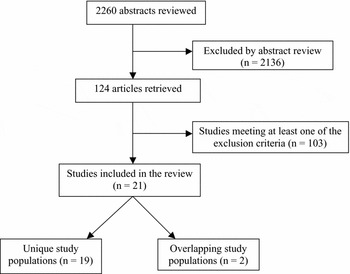
A total of 2260 citations (titles and abstracts) were reviewed, from which 124 articles were retrieved for full-text review (see Figure 1). The level of initial agreement between authors in the studies to be retained for the review was 89% (κ = 0.72; Streiner, Reference Streiner1995). After consensus discussion, 103 articles were excluded, leaving 21 articles that met the inclusion criteria, of which 19 involved the enrollment of unique study populations. Two studies overlapped in some part of their patient populations (McCusker et al., Reference McCusker, Cole, Dendukuri, Han and Belzile2003; Cole et al., Reference Cole, McCusker, Ciampi and Dyachenko2007).
Selection of studies for review

Methodological features
There was generally good agreement between both authors on study quality (κ = 0.74), and methodological features. All of the included studies were observational. All provided adequate descriptions of the study population profiles and excluded individuals unable to communicate because of medical conditions such as aphasia or language limitations. All studies characterized the selection process (consecutive enrollment), and had structured definitions of the two groups (persistent or resolved delirium). Studies differed in how they measured risk (prognostic) factors, with some, but not all, studies using specific criteria to measure prognostic factors. Only three studies (16%) reported on blinding (McCusker et al., Reference McCusker, Cole, Dendukuri, Han and Belzile2003; Cole et al., Reference Cole, McCusker, Ciampi and Dyachenko2007; Inouye et al., Reference Inouye, Zhang, Jones, Kiely, Yang and Marcantonio2007). None of the studies provided information on the sample size needed to detect differences in delirium duration and many studies had primary objectives other then looking at determinants of delirium duration.
When looking specifically at the dependent variable – delirium duration – all of the studies provided information on clinically significant associations. Three studies (Koponen et al., Reference Koponen, Stenbäck, Mattila, Soininen, Reinikainen and Riekkinen1989; Adamis et al., Reference Adamis, Treloar, Martin and MacDonald2006; Leonard et al., Reference Leonard2008) did not provide an estimate of (or enough data to calculate) the strength of association, such as an odds ratio, relative risk, hazard ratio, or difference of means. Six studies (29%) reported confidence intervals around some of the variables assessed and their associations with delirium duration (Levkoff et al., Reference Levkoff1994; Lawlor, Reference Lawlor2000; Kiely et al., Reference Kiely, Bergmann, Jones, Murphy, Orav and Marcantonio2004; Cole et al., Reference Cole, McCusker, Ciampi and Dyachenko2007; Inouye et al., Reference Inouye, Zhang, Jones, Kiely, Yang and Marcantonio2007; Sagawa et al., Reference Sagawa, Akechi, Okuyama, Uchida and Furukawa2009). Seven (33%) conducted multivariate or adjusted analyses when looking specifically at determinants of duration (Lawlor et al., Reference Lawlor2000; Breitbart et al., Reference Breitbart, Tremblay and Gibson2002; Kiely et al., Reference Kiely, Bergmann, Jones, Murphy, Orav and Marcantonio2004; Adamis et al., Reference Adamis, Treloar, Martin, Gregson, Hamilton and MacDonald2007; Cole et al., Reference Cole, McCusker, Ciampi and Dyachenko2007; Leonard et al., Reference Leonard2008; Sagawa et al., Reference Sagawa, Akechi, Okuyama, Uchida and Furukawa2009). Selection bias was minimized because consecutive enrollment was required for all of the studies reviewed.
Information on loss to follow-up of delirious individuals because of death, acute hospitalization or other causes was described in six (29%) studies (Oloffson et al., Reference Olofsson, Weitzner, Valentine, Baile and Meyers1996; Camus et al., Reference Camus, Gonthier, Dubos, Schwed and Simeone2000; McCusker et al., Reference McCusker, Cole, Dendukuri, Han and Belzile2003; Kiely et al., Reference Kiely, Bergmann, Jones, Murphy, Orav and Marcantonio2004; Speciale et al., Reference Speciale, Bellelli, Lucchi and Trabucchi2007; Sagawa et al., Reference Sagawa, Akechi, Okuyama, Uchida and Furukawa2009), and ranged from 4% to 50%. Loss to follow-up from death specifically ranged from 5% to 26%. Six (29%) studies included data on individuals who had died (Rudberg et al., Reference Rudberg, Pompei, Foreman, Ross and Cassel1997; Lawlor et al., Reference Lawlor2000; Kelly et al., Reference Kelly, Zisselman, Cutillo-Schmitter, Reichard, Payne and Denman2001; Adamis et al., Reference Adamis, Treloar, Martin and MacDonald2006; Reference Adamis, Treloar, Martin, Gregson, Hamilton and MacDonald2007; Leonard et al., Reference Leonard2008). Participation rates were provided in four studies (16%) (Levkoff et al., Reference Levkoff1994; Kiely et al., Reference Kiely, Bergmann, Jones, Murphy, Orav and Marcantonio2004; McAvay et al., Reference McAvay2006, Inouye et al., Reference Inouye, Zhang, Jones, Kiely, Yang and Marcantonio2007). In one of these studies, participation rates were provided in an earlier publication (Levkoff et al., Reference Levkoff1992). However, three of these studies (Levkoff et al., Reference Levkoff1994; McAvay et al., Reference McAvay2006, Inouye et al., Reference Inouye, Zhang, Jones, Kiely, Yang and Marcantonio2007) included non-delirious individuals in the non-participation or refusal rate, thus making it difficult to know the participation rates of specifically delirious individuals.
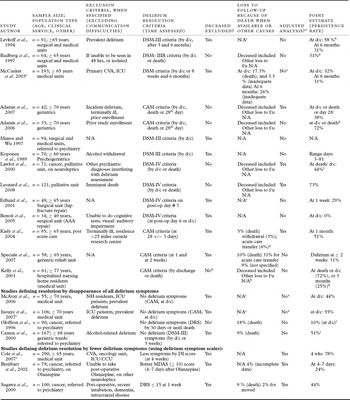
All of the studies involved hospitalized in-patients, although they enrolled different populations including medical, geriatric or surgical patients, mixed surgical and medical, psychiatric (or referred to psychiatry services), hospitalized nursing home patients, individuals with cancer or in palliative care units, and patients from a post-acute care or rehabilitation setting (see Table 1). Only one study included patients from an intensive care unit (Oloffson et al., Reference Olofsson, Weitzner, Valentine, Baile and Meyers1996). All of the studies enrolling general mixed medical-surgical or medical patients enrolled older adults (i.e. they had lower age limits). One of the included studies (Inouye et al., Reference Inouye, Zhang, Jones, Kiely, Yang and Marcantonio2007) described a derivation and validation cohort. Associations related to the validation cohort included non-delirious individuals; consequently, only data from the derivation cohort are included. The studies that did not have any age restrictions included those involving patients undergoing elective abdominal aortic aneurysm surgery (Benoit et al., Reference Benoit2005), or surgical and medical patients referred to psychiatric consultation services (Manos and Wu, Reference Manos and Wu1997), and all the studies on cancer or palliative patients (Oloffson et al., Reference Olofsson, Weitzner, Valentine, Baile and Meyers1996; Lawlor et al., Reference Lawlor2000; Breitbart et al., Reference Breitbart, Tremblay and Gibson2002; Leonard et al., Reference Leonard2008; Sagawa et al., Reference Sagawa, Akechi, Okuyama, Uchida and Furukawa2009). Given the heterogeneity of study populations and settings, no attempt was made to pool the results of the studies.
Summary of included studies

AAA = abdominal aortic aneurysm; age restriction: Y = Yes; N = No; CAM = Confusion Assessment Measure; CCU = critical care unit; CVA = cerebrovascular accident (stroke); d/c = discharge; DI = Delirium Index; DRS = Delirium Rating Scale; DSM = Diagnostic and Statistical Manual of Mental Disorders; f/u = follow-up; ICU = intensive care unit; MDAS = Memorial Delirium Assessment Scale; N/A = not available; NH = nursing home; (+) = positive.
aAdjusted analysis specifically applies to the outcome of delirium duration (some studies may have applied adjusted analyses for other outcomes, or included non-delirious individuals, but are only listed as providing adjusted analyses if they did this for delirium duration and only included delirious individuals).
bIncludes persistent (27%) and recurrent (31%) delirium; persistence data reported in another publication, Levkoff et al., Reference Levkoff1992.
cLoss to follow-up rate for death (or other causes) was provided, but included non-delirious individuals (also enrolled in study).
dCalculated rate (DSM/CAM positive delirium occurring up to 2 days prior to d/c or death.
eThese 2 studies overlapped in some included patients, although their definitions for delirium resolution differed.
fThis refers to the per-patient rate of delirium persistence not the persistence rate per delirious episode (recurrent episodes counted toward non-reversed.
gStudy also provided refusal rate (25%) and percentage of substitute decision-makers (15%) who could not be contacted.
hThe persistence rate at 3 months in this study did not include deceased individuals (the persistence rate at discharge did include deceased individuals).
iOnly used data from validation cohort.
jAlthough patients were assessed until death, they were excluded from persistence data analysis.
Studies also varied in how they defined delirium duration (Table 1), although all looked at presence or absence of delirium at time of discharge or at 2–8 weeks after delirium diagnosis (three studies also included delirium status at 3–6 months after hospital discharge). In some instances, studies also reported recurrence of delirium. As the actual duration of delirium is unknown, for the purposes of this review individuals with recurrent delirium were classified as having “persistent” (instead of “resolved”) delirium.
Some studies used categorical measures (e.g. percentage delirious at a pre-specified time point) while others counted the number of delirium days. Some of the studies assessed for delirium until death or discharge (Rudberg et al., Reference Rudberg, Pompei, Foreman, Ross and Cassel1997; Lawlor et al., Reference Lawlor2000; Kelly et al., Reference Kelly, Zisselman, Cutillo-Schmitter, Reichard, Payne and Denman2001; Adamis et al., Reference Adamis, Treloar, Martin and MacDonald2006; Reference Adamis, Treloar, Martin, Gregson, Hamilton and MacDonald2007; Leonard et al., Reference Leonard2008), whereas other studies included only individuals with data at two separate time points or excluded deceased individuals. Fourteen studies defined duration as when delirium resolved according to the DSM or Confusion Assessment Method (CAM; Inouye et al., Reference Inouye, van Dyck, Alessi, Balkin, Siegal and Horwitz1990) criteria, and four studies defined delirium resolution when all delirium symptoms had dissipated (Oloffson et al., Reference Olofsson, Weitzner, Valentine, Baile and Meyers1996; Camus et al., Reference Camus, Gonthier, Dubos, Schwed and Simeone2000; McAvay et al., Reference McAvay2006; Inouye et al, Reference Inouye, Zhang, Jones, Kiely, Yang and Marcantonio2007). Three studies (Breitbart et al., Reference Breitbart, Tremblay and Gibson2002; Cole et al., Reference Cole, McCusker, Ciampi and Dyachenko2007; Sagawa et al., Reference Sagawa, Akechi, Okuyama, Uchida and Furukawa2009) defined delirium resolution by improvements in delirium symptom scale scores such as the Delirium Index (DI; McCusker et al., Reference McCusker, Cole, Bellavance and Primeau1998; Cole et al., Reference Cole, McCusker, Ciampi and Dyachenko2007), the Memorial Delirium Assessment Scale, MDAS (Breitbart et al., Reference Breitbart, Rosenfeld, Roth, Smith, Cohen and Passik1997; Breitbart et al., Reference Breitbart, Tremblay and Gibson2002) or the Delirium Rating Scale (DRS; Trzepacz et al., Reference Trzepacz, Baker and Greenhouse1988; Oloffson et al., Reference Olofsson, Weitzner, Valentine, Baile and Meyers1996; Sagawa et al., Reference Sagawa, Akechi, Okuyama, Uchida and Furukawa2009).
Overall persistence rates of delirium varied from 0% to 78%. In studies that included data on deceased individuals and used lack of CAM or DSM criteria to define delirium resolution, persistence rates between 31% and 72% were reported. One study involving younger elective abdominal aortic aneurysm patients (Benoit et al., Reference Benoit2005) reported complete resolution of DSM-defined delirium at discharge. Excluding this study, other studies (Edlund et al., Reference Edlund, Lundström, Brännström, Bucht and Gustafson2001; Kiely et al., Reference Kiely, Bergmann, Jones, Murphy, Orav and Marcantonio2004; Speciale et al., Reference Speciale, Bellelli, Lucchi and Trabucchi2007) that used cessation of DSM or CAM criteria to define when delirium had resolved (and excluded deceased individuals) reported persistence rates between 29% and 55% at discharge or at 1–8 weeks after delirium diagnosis. Studies that defined delirium resolution by recovery of all delirium symptoms reported persistence rates between 10% and 55%, and those that defined resolution by fewer delirium symptoms reported persistence rates between 24% and 78%. Two studies assessed delirium persistence six months after diagnosis, by the presence of DSM or CAM criteria, and both found persistence rates around 30% (McCusker et al., Reference McCusker, Cole, Dendukuri, Han and Belzile2003; Levkoff et al., Reference Levkoff1994). One study reported persistence of DSM-defined delirium in 25% of living individuals three months after hospital discharge (Kelly et al., Reference Kelly, Zisselman, Cutillo-Schmitter, Reichard, Payne and Denman2001).
The studies also varied in the dependent variables they assessed. Specific comparator variables that were assessed for their association with delirium duration in at least two studies are summarized in Tables 2–4. Comparator variables could be classified into three broad categories: baseline patient characteristics, characteristics of the delirious state, and the nature of the underlying putative causative factor.
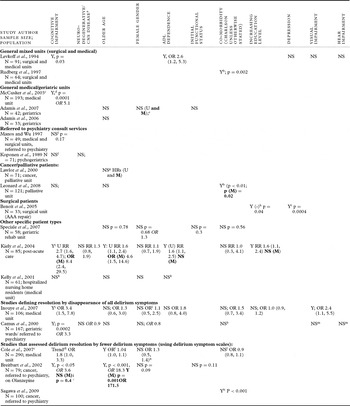
Statistically significant associations between patient characteristics and prolonged delirium duration while in hospital. Multivariate analyses are indicated by (M); all others are univariate (U)

AAA = Abdominal Aortic Aneurysm; CNS = Central Nervous System; Y = Yes; N = No; ; Trend = p ≤ 0.1; (+) = positive association.
Odds OR = calculated Ratio; OR = provided by study; Bolded OR (HR or RR) or p-values represent ORs (HRs, RRs), or p-values from multivariable analysis; NS = not significant.
aCNS diseases based on documentation in medical record.
bUsed number of diagnoses to define co-morbidity.
cWith overlapping populations (although studies defined delirium resolution differently).
dInformant Questionnaire of Cognitive Decline in the Elderly.
eAuthors did multivariable analysis with gender and IGF-1 and possession of APO ɛ4, on a sub-sample of the study (n = 17); the multivariable analysis was NS, but the association with gender did approach significance (p = 0.066).
fDSM criteria.
gHazard ratios (HR) and confidence intervals for reversibility of delirium provided by authors for older age: univariate HR 0.67 (0.3, 1.2); multivariate HR 1.0 (0.4,2.2).
hHigh education associated with shorter delirium.
iMeasured using Geriatric Depression Scale.
jBlessed Scale for dementia.
kUsed data in Minimum Data Set for nursing homes.
lOR of persistence if female (and associated confidence intervals) calculated as 1/OR for persistence if male (as provided in the study); similarly OR for persistence calculated as 1/OR for reversing for risk factors age, Charlson co-morbidity scale, and dementia in Cole et al., Reference Cole, McCusker, Ciampi and Dyachenko2007.
mVisual and hearing impairment were combined in this study and found to not be associated with persistence.
nContacted authors to confirm OR and confidence intervals.
°Multivariate analysis controlled for age, and other variables. Contacted authors who confirmed that in the multivariable analysis, despite being non-significant the direction of association was positive between dementia and delirium irreversibility, despite the OR listed in the study.
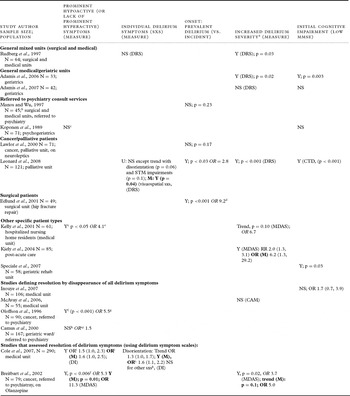
Statistically significant associations between delirium characteristics and prolonged delirium duration while in hospital (assessed up to two months after diagnosis). Multivariate analyses are indicated by (M); all others are univariate (U)

Odds OR = calculated Ratio; OR = provided by study; bolded OR (HR) or p-values represent ORs (HRs), or p-values from multivariable analysis.
CTD = Cognitive Test for Delirium; DRS = Delirium Rating Scale; MDAS = Memorial Delirium Assessment Scale; DI = Delirium Index score; STM = Short Term Memory; CAM = Confusion Assessment Method; Y = Yes; N = No; Trend = p ≤ 0.1; NS = not significant.
aDelirium severity was measured: as mean (Rudberg et al., Reference Rudberg, Pompei, Foreman, Ross and Cassel1997, Adamis et al., Reference Adamis, Treloar, Martin, Gregson, Hamilton and MacDonald2007), or at the time of initial (Leonard et al., Reference Leonard2008; Breitbart et al., Reference Breitbart, Tremblay and Gibson2002; Kiely et al., Reference Kiely, Bergmann, Jones, Murphy, Orav and Marcantonio2004; Kelly et al., Reference Kelly, Zisselman, Cutillo-Schmitter, Reichard, Payne and Denman2001; McAvay et al., Reference McAvay2006) or second delirium assessments (Adamis et al., Reference Adamis, Treloar, Martin and MacDonald2006).
bOnly assessed association in medical sub-group.
cUsed clinical impressions to define hypo-, hyper-, mixed or neither subtypes of delirium.
dOR for delirium lasting beyond 1 week.
eCompared hypoactive against (hyperactive or mixed).
fCompared (hypoactive or neither or mixed) to hyperactive symptoms.
gExcluded deceased when OR was calculated.
hUsed Delirium symptom checklist to derive a score (OR refers to prominent hypoactive symptoms).
iOR of recovery if hyperactive symptoms present provided by study.
jAnalyses controlled for dementia.
kThe reader is referred to the original study for detailed ORs associated with the various delirium symptoms.
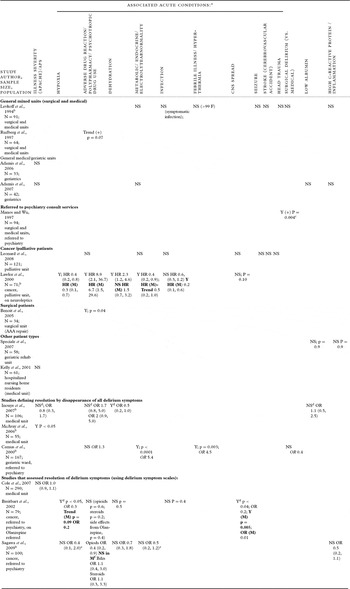
Statistically significant associations between illness characteristics and reversibility of delirium, as assessed up to 2 months after onset (all univariate, U, unless specifically stated as multivariate, M)

OR = calculated odds ratio; OR = provided by study; bolded OR (HR) or p-values represent ORs (HRs), or p-values from multivariable analysis.
a Often not defined in studies except occasionally; specific definitions for studies, when provided follow below.
b Temporal association was stipulated in establishing causation, or only incident cases of delirium were enrolled.
Y = Yes; N = No; Trend: p ≤ 0.1; (+) = positive association; (−) = negative association (means that with the condition there was slower resolution of delirium); NS = not significant; APS = acute physiology score (Knaus et al., Reference Knaus, Draper, Wagner and Zimmerman1985).
c Used survival (of delirium) curve to calculate p-value.
d Study provided OR of having prolonged delirium with risk factor- to convert this to association with reversibility 1/OR (for prolonged delirium) was used.
e <10% of sample had hypoxia/ hypercalcemia.
f Multivariable analysis controlled for performance status, clinical stage of cancer, age and gender.
Study definitions where provided:
(1) Hypoxia: Lawlor et al., Reference Lawlor2000 and Sagawa et al., Reference Sagawa, Akechi, Okuyama, Uchida and Furukawa2009: oximetry <90% on room air or requiring oxygen (2 l) to maintain saturation ≥90%
(2) Adverse drug reactions/ polypharmacy/ psychotropic drug use: Breitbart et al., Reference Breitbart, Tremblay and Gibson2002: opiods, steroids, or side effects to Olanzepine; Lawlor et al., Reference Lawlor2000: opioids and non-opioids (methylphenidate, methotrimeprazine, anticholinergic drugs, SSRIs, theophylline, tricyclic antidepressants, haloperidol, benzodiazepines); Sagawa et al., Reference Sagawa, Akechi, Okuyama, Uchida and Furukawa2009 assessed opioids, benzodiazepines (bdzs) and steroid side effects; Leonard study: frequency of prescription of: antipsychotics, antidepresssants, psychostimulants, steroids, opioids and benzodiazepines; Inouye et al.: ≥3 new drugs (psychotropic OR = 2 (95% CI: 0.9, 5.0), or general drugs OR = 1.7 (95% CI: 0.8, 5.0)) in one day prior to delirium; Benoit et al., Reference Benoit2005: general psychotropic drug use not otherwise specified prior to surgery; Rudberg et al., Reference Rudberg, Pompei, Foreman, Ross and Cassel1997: polypharmacy defined by: average number of medications, or prescribed drugs.
(3) Dehydration: Inouye et al., Reference Inouye, Zhang, Jones, Kiely, Yang and Marcantonio2007: elevated BUN/Creatinine ratio; Lawlor et al., Reference Lawlor2000: Increased Creatinine (>115μmol/l) and BUN (>8 mmol/l) without GI bleed, or Increased BUN (>8 mmol/l) or Creatinine (>115 μmol/l) which responds to hydration (returning to reference range or a 30% decrease) OR hyper (>150 mmol/l) / hypo (<130 mmol/l)- natremia responsive to hydration (returning to reference range or >130 mmol/l).
Sagawa et al., Reference Sagawa, Akechi, Okuyama, Uchida and Furukawa2009: Creatinine >1.3 or urea nitrogen level >20 mg/dl (in absence of gastrointestinal bleeding with hydration) or sodium >150 mmol/l or <130 mmol/l.
(4) Metabolic/ endocrine/ electrolyte abnormalities: Lawlor et al., Reference Lawlor2000: persistent creatinine elevation (>150 μmol/l) or hypoglycemia (glucose <4 mmol.l), or hypomagnesemia (Mg <0.7 mmol/l), or aspartate transaminase >40 U/l or alanaine aminotransferase >50 U/l or bilirubin >20, 000 μmol/l, or corrected calcium >2.6 mmol/l; Levkoff et al., Reference Levkoff1994: hyponatremia/ hypernatremia, and hypo or hyperglycemia; Sagawa et al.: any of: aspartate aminotranferase >40 U/l, alanine aminotransferase >50 U/l, bilirubin >1.1 mg/dl, persistent Creatinine >1.7 mg/dl, glucose <72 mg/dl; Sagawa also assessed calcium (corrected for albumin) >10.4 mg/dl (NS): OR = 0.5, (0.3, 3.0); Adamis et al., Reference Adamis, Treloar, Martin, Gregson, Hamilton and MacDonald2007: calcium level.
(5) Infection: Lawlor et al., Reference Lawlor2000: non-respiratory infection.
(6) Inflammation or high CRP: high CRP: Speciale et al., Reference Speciale, Bellelli, Lucchi and Trabucchi2007; Adamis et al., Reference Adamis, Treloar, Martin, Gregson, Hamilton and MacDonald2007; abnormal WBC: Levkoff et al., Reference Levkoff1994; high WBC or high CRP (>0.4 mg/dl): Sagawa, et al. Reference Sagawa, Akechi, Okuyama, Uchida and Furukawa2009.
(7) CNS spread/Intracranial factor: Lawlor et al., Reference Lawlor2000: improvement in delirium within 5 days of initiating steroid treatment or within 4 weeks of radiotherapy or chemotherapy for brain tumor.
Patient baseline characteristics as determinants of delirium duration
Patient baseline characteristics that were assessed in at least two studies, with regards to their association with delirium duration, included: premorbid dementia or cognitive impairment, presence of any neurodegenerative disease, advanced age, gender, baseline or admission functional dependence, medical comorbidity, education level, history of depression, and visual or hearing impairment (Table 2).
Baseline dementia or cognitive impairment and neurodegenerative disease
Baseline dementia was defined differently across studies. Some studies used dementia scales (Koponen et al., Reference Koponen, Stenbäck, Mattila, Soininen, Reinikainen and Riekkinen1989; McCusker et al., Reference McCusker, Cole, Dendukuri, Han and Belzile2003; Kiely et al., Reference Kiely, Bergmann, Jones, Murphy, Orav and Marcantonio2004; Inouye et al., Reference Inouye, Zhang, Jones, Kiely, Yang and Marcantonio2007; Cole et al., Reference Cole, McCusker, Ciampi and Dyachenko2007) such as the Blessed Dementia Scale (Blessed et al., Reference Blessed, Tomlinson and Roth1968), the Informant Questionnaire of Cognitive Decline in the Elderly (IQCODE; Jorm, Reference Jorm1994), or the DSM criteria; one study (Kelly et al., Reference Kelly, Zisselman, Cutillo-Schmitter, Reichard, Payne and Denman2001) used data from the nursing home Minimum Data Set (MDS; Lawton et al., Reference Lawton, Casten, Parmelee, van Haitsma, Corn and Kleban1998), and some studies relied on whether or not dementia was noted in the medical record (Levkoff et al., Reference Levkoff1994; Camus et al., Reference Camus, Gonthier, Dubos, Schwed and Simeone2000; Breitbart et al., Reference Breitbart, Tremblay and Gibson2002).
Dementia was found to be associated with persistent DSM- or CAM-defined delirium at discharge or up to eight weeks after delirium diagnosis in three studies, in mixed surgical/medical (Levkoff et al., Reference Levkoff1994), general medical (McCusker et al., Reference McCusker, Cole, Dendukuri, Han and Belzile2003), and post-acute care (Kiely et al., Reference Kiely, Bergmann, Jones, Murphy, Orav and Marcantonio2004) settings (the latter study found associations in both univariate and multivariate analyses). Two studies found that lack of dementia was associated with complete reversal of all delirium symptoms (Camus et al., Reference Camus, Gonthier, Dubos, Schwed and Simeone2000; Inouye et al., Reference Inouye, Zhang, Jones, Kiely, Yang and Marcantonio2007). Two studies that assessed improvement of delirium symptoms using delirium symptom scales found either an association (Breitbart et al., Reference Breitbart, Tremblay and Gibson2002) or a trend towards slower improvement in dementia (Cole et al., Reference Cole, McCusker, Ciampi and Dyachenko2007). In one of these studies, involving adult cancer patients of all age ranges treated with Olanzepine (Breitbart et al., Reference Breitbart, Tremblay and Gibson2002), dementia was associated with prolonged delirium symptoms in the bivariate but not the multivariate analysis (which controlled for age). The three studies that did not find a statistically significant association between dementia and prolonged delirium were studies that enrolled psychiatric inpatients, or patients referred to psychiatric consultation services (Koponen et al., Reference Koponen, Stenbäck, Mattila, Soininen, Reinikainen and Riekkinen1989; Manos and Wu, Reference Manos and Wu1997) and one study enrolling hospitalized nursing home patients (Kelly et al., Reference Kelly, Zisselman, Cutillo-Schmitter, Reichard, Payne and Denman2001); in the latter study, more than 95% of study participants had a prior history of cognitive problems, likely decreasing the power of finding such an association. When provided, based on six studies, strengths of association at discharge (or by eight weeks) between dementia and persistent delirium ranged from an OR of 1.8–8.4. At six months’ follow-up, one study found no association between dementia and delirium persistence in a mixed surgical/medical population (Levkoff et al., Reference Levkoff1994), although one study in medical inpatients did find an association (McCusker et al., Reference McCusker, Cole, Dendukuri, Han and Belzile2003; calculated OR of 6.5 at six months of persistence).
The presence of any neurodegenerative disease as determined from the medical record (e.g. stroke, disease of the central nervous system not otherwise specified, or Parkinson's disease) was not associated with persistent delirium at discharge (or by 3–4 weeks) in three studies in psychiatric or geriatric (Camus et al., Reference Camus, Gonthier, Dubos, Schwed and Simeone2000; Koponen et al., Reference Koponen, Stenbäck, Mattila, Soininen, Reinikainen and Riekkinen1989) or post-acute care patients (Kiely et al., Reference Kiely, Bergmann, Jones, Murphy, Orav and Marcantonio2004).
Age, gender and education level
Age was not associated with prolonged delirium in seven studies (Camus et al., Reference Camus, Gonthier, Dubos, Schwed and Simeone2000; Lawlor et al., Reference Lawlor2000; Kelly et al., Reference Kelly, Zisselman, Cutillo-Schmitter, Reichard, Payne and Denman2001; Adamis et al., Reference Adamis, Treloar, Martin and MacDonald2006; Reference Adamis, Treloar, Martin, Gregson, Hamilton and MacDonald2007; Inouye et al., Reference Inouye, Zhang, Jones, Kiely, Yang and Marcantonio2007; Speciale et al., Reference Speciale, Bellelli, Lucchi and Trabucchi2007). However, one study suggested an association between older age and persistent CAM-defined delirium in both uni- and multivariate analyses (Kiely et al., Reference Kiely, Bergmann, Jones, Murphy, Orav and Marcantonio2004). Two studies showed an association between older age and persistent delirium symptoms on delirium scales in older medical inpatients (Cole et al., Reference Cole, McCusker, Ciampi and Dyachenko2007) and in cancer patients (Breitbart et al., Reference Breitbart, Tremblay and Gibson2002). The latter study did not have any age restriction in participants and showed a very large association in the multivariate analysis. Based on five studies, a wide range of strengths of association (HRs or ORs) were seen from 1 to 171. Gender did not affect delirium duration. (Camus et al., Reference Camus, Gonthier, Dubos, Schwed and Simeone2000; Kelly et al., Reference Kelly, Zisselman, Cutillo-Schmitter, Reichard, Payne and Denman2001; Kiely et al., Reference Kiely, Bergmann, Jones, Murphy, Orav and Marcantonio2004; Breitbart et al., Reference Breitbart, Tremblay and Gibson2002; Adamis et al., Reference Adamis, Treloar, Martin, Gregson, Hamilton and MacDonald2007; Cole et al., Reference Cole, McCusker, Ciampi and Dyachenko2007; Inouye et al., Reference Inouye, Zhang, Jones, Kiely, Yang and Marcantonio2007; Speciale et al., Reference Speciale, Bellelli, Lucchi and Trabucchi2007). ORs across five studies between female gender and persistence ranged from 0.8 to 1.3. Educational level and delirium duration were inversely associated in one study (Benoit et al., Reference Benoit2005) in patients undergoing abdominal aortic aneurysm repair, and positively associated in another study (in bivariate but not in multivariate analyses; Kiely et al., Reference Kiely, Bergmann, Jones, Murphy, Orav and Marcantonio2004), or not associated with each other (in medical patients; Inouye et al., Reference Inouye, Zhang, Jones, Kiely, Yang and Marcantonio2007).
Other factors
The association between functional dependence and delirium duration varied across studies. Some studies assessed the association of pre-hospital functional dependence (assessed through caregiver-based questionnaires), whereas others measured initial functional status on individuals at study enrollment. These were differentiated because the latter measured functional status when already delirious and may differ from baseline, pre-hospital functional ability. In one study (Adamis et al., Reference Adamis, Treloar, Martin and MacDonald2006), it was not clear when functional status was assessed. Three studies (Breitbart et al., Reference Breitbart, Tremblay and Gibson2002; Adamis et al., Reference Adamis, Treloar, Martin, Gregson, Hamilton and MacDonald2007; Speciale et al., Reference Speciale, Bellelli, Lucchi and Trabucchi2007), which measured functional status at the time of enrollment into the study, using the Barthel scale (Mahoney and Barthel, Reference Mahoney and Barthel1965) in an aging and rehabilitation ward (Speciale et al., Reference Speciale, Bellelli, Lucchi and Trabucchi2007) and in an acute geriatric ward (Adamis et al., Reference Adamis, Treloar, Martin, Gregson, Hamilton and MacDonald2007) or the Karnofsky scale (in cancer patients; Breitbart et al., Reference Breitbart, Tremblay and Gibson2002), did not find initial functional status to be associated with either longer duration of CAM-defined delirium or delirium symptoms (latter measured in Breitbart et al., Reference Breitbart, Tremblay and Gibson2002) during hospitalization.
In the studies that assessed pre-hospital functional status, two studies, one in mixed surgical/medical patients (Levkoff et al., Reference Levkoff1994) and the other in the post-acute care setting (Kiely et al., Reference Kiely, Bergmann, Jones, Murphy, Orav and Marcantonio2004), found an association between ADL-dependence and persistent CAM- or DSM-defined delirium. Two studies, one conducted in a medical population (Inouye et al., Reference Inouye, Zhang, Jones, Kiely, Yang and Marcantonio2007; assessed for complete resolution of delirium symptoms) and the other in a nursing home population (Kelly et al., Reference Kelly, Zisselman, Cutillo-Schmitter, Reichard, Payne and Denman2001) did not find such an association. In the latter study, functional information, elicited through the nursing home MDS database, revealed that all participants were dependent for at least one ADL so the effect of functional dependence on delirium duration may have been difficult to assess. In one of the positive studies (Kiely et al., Reference Kiely, Bergmann, Jones, Murphy, Orav and Marcantonio2004), baseline functional dependence was not associated with increased delirium duration in multivariate analyses. The strengths of association between pre-hospital functional dependence and persistent delirium from three studies ranged from 1.8 to 2.6 (2 ORs and 1 RR).
Comorbidity measured using the Charlson scale (Charlson et al., Reference Charlson, Pompei, Ales and MacKenzie1987) was not associated with persistent delirium (Kiely et al., Reference Kiely, Bergmann, Jones, Murphy, Orav and Marcantonio2004; Inouye et al., Reference Inouye, Zhang, Jones, Kiely, Yang and Marcantonio2007; Speciale et al., Reference Speciale, Bellelli, Lucchi and Trabucchi2007; Cole et al., Reference Cole, McCusker, Ciampi and Dyachenko2007). However, three out of four studies suggested that increasing numbers of diagnoses are associated with increased delirium duration in the mixed medical/surgical (Rudberg et al., Reference Rudberg, Pompei, Foreman, Ross and Cassel1997) and palliative or cancer populations (Leonard et al., Reference Leonard2008; Sagawa et al., Reference Sagawa, Akechi, Okuyama, Uchida and Furukawa2009); one study did not find an association between increasing medical diagnoses and delirium symptom resolution (Camus et al., Reference Camus, Gonthier, Dubos, Schwed and Simeone2000).
Depression was either positively (Benoit et al., Reference Benoit2005) associated with longer delirium or not (Levkoff et al., Reference Levkoff1994). Visual impairment was associated with longer delirium in hospital in one study (Inouye et al., Reference Inouye, Zhang, Jones, Kiely, Yang and Marcantonio2007) but not in two others (Levkoff et al., Reference Levkoff1994; Camus et al., Reference Camus, Gonthier, Dubos, Schwed and Simeone2000). Information on visual impairment in the latter two studies was elicited from the patient's chart. Chart-elicited hearing impairment was not associated with persistent delirium at discharge (Levkoff et al., Reference Levkoff1994; Camus et al., Reference Camus, Gonthier, Dubos, Schwed and Simeone2000).
Specific characteristics of the delirious state as predictors of delirium duration
The delirious state was characterized in some studies by the delirium sub-type (hypoactive, hyperactive, mixed or neither), the presence of other specific delirium symptoms, delirium severity (measured with severity scales), delirium onset (whether prevalent or incident), and the extent of initial cognitive impairment (see Table 3).
Similar to findings of a prior review (de Rooji et al., Reference de Rooij, Schuurmans, van der Mast and Levi2005), we found that studies often defined delirium subtypes (hypoactive, hyperactive, mixed or neither) differently. Some used DSM-validated scales such as the Delirium Rating Scale (DRS; Trzepacz et al., Reference Trzepacz, Baker and Greenhouse1988), the Memorial Delirium Assessment Scale (MDAS; Breitbart et al., Reference Breitbart, Rosenfeld, Roth, Smith, Cohen and Passik1997) or the Delirium Index (DI; McCusker et al., Reference McCusker, Cole, Bellavance and Primeau1998) to measure hypoactive or hyperactive symptoms. One study used a delirium symptom checklist to derive a mean score of hypoactive or hyperactive symptoms to categorize delirium subtype (Camus et al., Reference Camus, Gonthier, Dubos, Schwed and Simeone2000) while other studies used clinical judgment to define subtypes (Koponen et al., Reference Koponen, Stenbäck, Mattila, Soininen, Reinikainen and Riekkinen1989; Oloffson et al., Reference Olofsson, Weitzner, Valentine, Baile and Meyers1996; Kelly et al., Reference Kelly, Zisselman, Cutillo-Schmitter, Reichard, Payne and Denman2001). Nonetheless, four out of six studies found hypoactive (or lack of hyperactive) symptoms to be associated with persistent delirium symptoms in medical (Cole et al., Reference Cole, McCusker, Ciampi and Dyachenko2007), cancer (Oloffson et al., Reference Olofsson, Weitzner, Valentine, Baile and Meyers1996; Breitbart et al., Reference Breitbart, Tremblay and Gibson2002) or nursing home residents (Kelly et al., Reference Kelly, Zisselman, Cutillo-Schmitter, Reichard, Payne and Denman2001), at discharge or at one month after delirium diagnosis. There were two studies that did not find an association between CAM- or DSM-defined persistent delirium and hypoactive symptoms; one was conducted in a psychiatry unit (Koponen et al., Reference Koponen, Stenbäck, Mattila, Soininen, Reinikainen and Riekkinen1989), and the other included patients both from a geriatric unit and those referred to psychiatry (Camus et al., Reference Camus, Gonthier, Dubos, Schwed and Simeone2000). Based on five studies, the OR of persistence in the presence of hypoactive symptoms (or the absence of hyperactivity) ranged from 1.5 to 11.3. The three studies (Rudberg et al., Reference Rudberg, Pompei, Foreman, Ross and Cassel1997; Cole et al., Reference Cole, McCusker, Ciampi and Dyachenko2007; Leonard et al., Reference Leonard2008) that assessed the presence of disorientation, perceptual disturbances, or other specific delirium symptoms using DSM-derived scales did not find consistent associations between specific delirium symptoms and persistent delirium, or delirium symptoms.
Out of eight studies that measured delirium severity, five found an association between increased delirium severity and prolonged DSM- or CAM-defined delirium (Rudberg et al., Reference Rudberg, Pompei, Foreman, Ross and Cassel1997; Kiely et al., Reference Kiely, Bergmann, Jones, Murphy, Orav and Marcantonio2004; Adamis et al., Reference Adamis, Treloar, Martin and MacDonald2006; Leonard et al., Reference Leonard2008) or delirium symptoms (Breitbart et al., Reference Breitbart, Tremblay and Gibson2002). Two of these studies conducted multivariate analyses and measured severity with the MDAS (Breitbart et al., Reference Breitbart, Tremblay and Gibson2002; Kiely et al., Reference Kiely, Bergmann, Jones, Murphy, Orav and Marcantonio2004); in one of these studies (Kiely et al., Reference Kiely, Bergmann, Jones, Murphy, Orav and Marcantonio2004), both bivariate and multivariate analyses yielded an association with prolonged (defined by CAM criteria) delirium, whereas the other study found a trend for an association with persistent delirium symptoms in the multivariate analysis (Breitbart et al., Reference Breitbart, Tremblay and Gibson2002). Three studies out of four (Rudberg et al., Reference Rudberg, Pompei, Foreman, Ross and Cassel1997; Adamis et al., Reference Adamis, Treloar, Martin and MacDonald2006; Reference Adamis, Treloar, Martin, Gregson, Hamilton and MacDonald2007; Leonard et al., Reference Leonard2008) that used the DRS (Trzepacz et al., Reference Trzepacz, Baker and Greenhouse1988) found bivariate associations between increased severity and delirium duration. One study on nursing home patients found a trend towards increased MDAS severity scores and delirium duration (Kelly et al., Reference Kelly, Zisselman, Cutillo-Schmitter, Reichard, Payne and Denman2001). One negative study (McAvay et al., Reference McAvay2006) used an alternate method (neither the MDAS, not the DRS) to measure severity. Most studies measured delirium severity early in the course of delirium, although two studies did use the mean of delirium severity scores (Rudberg et al., Reference Rudberg, Pompei, Foreman, Ross and Cassel1997; Adamis et al., Reference Adamis, Treloar, Martin, Gregson, Hamilton and MacDonald2007). Based on three studies, the OR of persistence with more severe delirium, measured with the MDAS ranged from 5.0 to 6.7.
Prevalent delirium was associated with longer lasting delirium in a study of delirious hip fracture (Edlund et al., Reference Edlund, Lundström, Brännström, Bucht and Gustafson2001) and palliative patients (Leonard et al., Reference Leonard2008) but not in two other studies involving referred medical/surgical (Manos and Wu, Reference Manos and Wu1997) or cancer patients (Lawlor et al., Reference Lawlor2000).
A lower initial level of cognitive impairment, as assessed by the score on the Mini-mental State Examination (MMSE) (measured while delirious in hospital) or measured with the Cognitive Test in Delirium (Hart et al., Reference Hart, Levenson, Sessler, Best, Schwartz and Rutherford1996) was associated with longer delirium in three studies, conducted in geriatric care units (Adamis et al., Reference Adamis, Treloar, Martin and MacDonald2006), rehabilitation care units (Speciale et al., Reference Speciale, Bellelli, Lucchi and Trabucchi2007) and palliative care units (Leonard et al., Reference Leonard2008), but this was not confirmed in three other studies among medical or geriatric inpatients (Inouye et al., Reference Inouye, Zhang, Jones, Kiely, Yang and Marcantonio2007; Adamis et al., Reference Adamis, Treloar, Martin, Gregson, Hamilton and MacDonald2007) or in patients referred for psychiatric consultation (Koponen et al., Reference Koponen, Stenbäck, Mattila, Soininen, Reinikainen and Riekkinen1989).
Underlying disease effects on delirium duration
Delirium is a non-specific symptom complex associated with multiple illnesses. As a consequence of the non-specific nature of delirium, elucidating the exact underlying contributory cause(s) can be difficult. Most of the studies that looked at the effect of the putative underlying acute illnesses used diagnoses listed in medical records, although they did not always specify how the acute illnesses were defined (see Table 4). In some cases, studies specifically stipulated the need for a temporal relation between the underlying acute condition and occurrence of delirium, or they enrolled individuals only with incident delirium, who may have had the associated illness prior to or concurrently with delirium onset (Levkoff et al., Reference Levkoff1994; Camus et al., Reference Camus, Gonthier, Dubos, Schwed and Simeone2000; Lawlor et al., Reference Lawlor2000; McAvay et al., Reference McAvay2006; Inouye et al., Reference Inouye, Zhang, Jones, Kiely, Yang and Marcantonio2007; Sagawa et al., Reference Sagawa, Akechi, Okuyama, Uchida and Furukawa2009).
In general, the studies by Adamis et al. (Reference Adamis, Treloar, Martin and MacDonald2006; Reference Adamis, Treloar, Martin, Gregson, Hamilton and MacDonald2007), Cole et al. (Reference Cole, McCusker, Ciampi and Dyachenko2007), Inouye et al. (Reference Inouye, Zhang, Jones, Kiely, Yang and Marcantonio2007) and Kelly et al. (Reference Kelly, Zisselman, Cutillo-Schmitter, Reichard, Payne and Denman2001) found that severity of illness measured with the APACHE or APS scale (Knaus et al., Reference Knaus, Draper, Wagner and Zimmerman1985) did not affect the rate of resolution of delirium, although one study (McAvay et al., Reference McAvay2006) suggested that higher APACHE scores are associated with faster resolution of delirium.
Hypoxic conditions were associated, in bivariate analyses, with lack of resolution of delirium or delirium symptoms in two studies involving cancer patients (Lawlor et al., Reference Lawlor2000; Breitbart et al., Reference Breitbart, Tremblay and Gibson2002;); multivariate analyses either confirmed an association (Lawlor et al., Reference Lawlor2000) or a trend toward an association (Breitbart et al., Reference Breitbart, Tremblay and Gibson2002, p = 0.09) between persistent delirium (or delirium symptoms) and hypoxia. However this was not confirmed in another study (Sagawa et al., Reference Sagawa, Akechi, Okuyama, Uchida and Furukawa2009) of cancer patients, although fewer than 10% of individuals had hypoxic conditions in the latter study. ORs or HRs of delirium resolution in these three studies for hypoxic conditions ranged from 0.2 to 0.4.
There was little evidence for an association between delirium duration and infectious causes (Levkoff et al., Reference Levkoff1994; Lawlor et al., Reference Lawlor2000; Breitbart et al., Reference Breitbart, Tremblay and Gibson2002; Leonard et al., Reference Leonard2008), abnormal serum albumin levels (Adamis et al., Reference Adamis, Treloar, Martin, Gregson, Hamilton and MacDonald2007; Inouye et al., Reference Inouye, Zhang, Jones, Kiely, Yang and Marcantonio2007; Speciale et al., Reference Speciale, Bellelli, Lucchi and Trabucchi2007), seizure (Levkoff et al., Reference Levkoff1994; Leonard et al., Reference Leonard2008), cerebrovascular accident (Levkoff et al., Reference Levkoff1994; Leonard et al., Reference Leonard2008) or head trauma (Levkoff et al., Reference Levkoff1994; Leonard et al., Reference Leonard2008). There was also little evidence for an association with high C-reactive protein (Adamis et al., Reference Adamis, Treloar, Martin, Gregson, Hamilton and MacDonald2007; Speciale et al., Reference Speciale, Bellelli, Lucchi and Trabucchi2007) or inflammation as measured by high white blood cell count (Levkoff et al., Reference Levkoff1994; Sagawa et al., Reference Sagawa, Akechi, Okuyama, Uchida and Furukawa2009).
There were less consistent findings for other putative causes for delirium, such as adverse drug reactions. Drug causes were defined differently across studies with some studies looking at general or psychotropic drugs not otherwise specified (Rudberg et al., Reference Rudberg, Pompei, Foreman, Ross and Cassel1997; Camus et al., Reference Camus, Gonthier, Dubos, Schwed and Simeone2000; Inouye et al., Reference Inouye, Zhang, Jones, Kiely, Yang and Marcantonio2007), whereas other studies specifically assessed certain drug types such as neuroleptics, narcotics, benzodiazepines and steroids (Lawlor et al., Reference Lawlor2000; Breitbart et al., Reference Breitbart, Tremblay and Gibson2002; Leonard et al., Reference Leonard2008; Sagawa et al., Reference Sagawa, Akechi, Okuyama, Uchida and Furukawa2009). Some studies looked at numbers of drugs (Rudberg et al., Reference Rudberg, Pompei, Foreman, Ross and Cassel1997) or the number of new drugs prescribed prior to delirium onset (Inouye et al., Reference Inouye, Zhang, Jones, Kiely, Yang and Marcantonio2007). Results of studies assessing associations between drug causes of delirium and delirium duration were quite variable, with some reporting an association with slower (Benoit et al., Reference Benoit2005) or faster resolving delirium (Lawlor et al., Reference Lawlor2000), or a trend towards this (Rudberg et al., Reference Rudberg, Pompei, Foreman, Ross and Cassel1997), and others reporting no association (Camus et al., Reference Camus, Gonthier, Dubos, Schwed and Simeone2000; Breitbart et al., Reference Breitbart, Tremblay and Gibson2002; Inouye et al., Reference Inouye, Zhang, Jones, Kiely, Yang and Marcantonio2007; Leonard et al., Reference Leonard2008; Sagawa et al., Reference Sagawa, Akechi, Okuyama, Uchida and Furukawa2009). There were also inconsistent findings from studies that assessed whether delirium duration differed when there was CNS involvement from cancer (Lawlor et al., Reference Lawlor2000; Breitbart et al., Reference Breitbart, Tremblay and Gibson2002; Leonard et al., Reference Leonard2008), dehydration (Lawlor et al., Reference Lawlor2000; Breitbart et al., Reference Breitbart, Tremblay and Gibson2002; Inouye et al., Reference Inouye, Zhang, Jones, Kiely, Yang and Marcantonio2007; Sagawa et al., Reference Sagawa, Akechi, Okuyama, Uchida and Furukawa2009), and metabolic, endocrine or electrolyte disorders (Levkoff et al., Reference Levkoff1994; Camus et al., Reference Camus, Gonthier, Dubos, Schwed and Simeone2000; Lawlor et al., Reference Lawlor2000; Adamis et al., Reference Adamis, Treloar, Martin, Gregson, Hamilton and MacDonald2007; Leonard et al., Reference Leonard2008; Sagawa et al., Reference Sagawa, Akechi, Okuyama, Uchida and Furukawa2009). Studies also often differed in how these entities were defined.
Discussion
Systematic reviews of delirium are hampered by the heterogeneity of delirium. Multiple causative factors have been linked to delirium, thereby making it a non-specific syndrome (Lipowski, Reference Lipowski1987; Rockwood, Reference Rockwood1989) which can be experienced by very different patient populations, have highly variable natural histories (Rudberg et al., Reference Rudberg, Pompei, Foreman, Ross and Cassel1997) and be associated with multiple adverse outcomes. Nonetheless, efforts to summarize what is known about various aspects of delirium are important to guide future studies and improve our understanding of delirium.
We systematically reviewed the literature to assess what is known about factors impacting on delirium duration or persistence. Persistent delirium has been associated with functional limitations and death (Marcantonio et al., Reference Marcantonio, Flacker, Michaels and Resnick2000; McCusker et al., Reference McCusker, Cole, Dendukuri, Han and Belzile2003; Speciale et al., Reference Speciale, Bellelli, Lucchi and Trabucchi2007; Kiely et al., Reference Kiely2009; Cole et al., Reference Cole, Ciampi, Belzile and Zhong2009), thus suggesting that delirium duration is an important outcome. Results must, however, be interpreted with caution. Many of the reported findings represent post hoc analyses of larger delirium studies, which had other primary study objectives, with small sample sizes, and many did not control for confounding factors or report confidence intervals. As such, results should be regarded as strictly hypothesis generating rather than providing answers. The studies also varied in the populations they enrolled, their interventions or management protocols, how they defined when delirium had resolved and their comparator variables, thereby making pooling difficult.
We limited the follow-up to a relatively short period (up to six months after delirium onset). Although the expected duration of delirium is unknown, it was felt that given the baseline vulnerability of delirious individuals (Inouye and Charpentier, Reference Inouye and Charpentier1996), these individuals would be at risk of suffering from other intercurrent illnesses (Maracantonio et al., Reference Marcantonio2005), with longer time periods of observation, which could introduce even greater heterogeneity into the review findings.
Similar to what has been reported in a recent systematic review (Cole et al., Reference Cole, Ciampi, Belzile and Zhong2009), studies in this review support the fact that persistence of delirium at discharge or at one to eight weeks after diagnosis is common, regardless of which definition is used for delirium resolution, ranging from 0% in one study of elective abdominal aortic aneurysm patients to 10–78% in other inpatient populations. Generally higher rates were observed when deceased individuals were included. When DSM or CAM criteria were used to define when delirium ends, persistence rates were found in survivors of around 30% at six months after diagnosis.
Dementia was found in many studies to increase the duration of delirium across diverse clinical settings. This was not always observed in studies of patients referred to psychiatry consultation services, or the hospitalized nursing home population, possibly reflecting a referral bias and the predominance of dementia in the nursing home population. In one study of adult cancer patients (not restricted to the elderly population), dementia was not found to be associated with persistence in multivariate analyses when factors such as age were controlled for. This may reflect the well-established association between dementia and older age, possibly causing collinearity in multivariate analyses. Although we did not pool results, ORs between dementia and delirium persistence ranged from slightly more than 1 to 8 or more. Advanced age was associated in some studies, although not all, with prolonged delirium, but strengths of association varied greatly across studies. Pre-hospital functional dependence may also herald someone at risk of having sustained delirium symptoms, although not all studies confirmed this. Functional status, measured while already delirious in hospital, was not associated with the length of the delirious episode. Comorbidity, measured with the Charlson Index, and gender did not correlate with length of a delirious episode, although when comorbidity was measured with diagnostic counts it was often found to be associated with longer delirium.
Our review also suggests that aspects of the symptomatology of the delirious state may be helpful prognostically. Increasing delirium severity, measured with scales such as the Memorial Delirium Assessment Scale or the Delirium Rating Scale, was also associated with increased duration of the delirium (ORs in the 5–7 range). Despite the differences in how delirium subtypes were defined across studies, hypoactive symptoms were also suggested in some to indicate a propensity for longer lasting delirium (ORs ranging from slightly more than 1 to 11 or more).
In spite of the inherent difficulties in establishing what acute illness may be contributing to delirium, most studies suggested that severity of illness had little impact on delirium duration but that hypoxic conditions, at least in the cancer population, were associated with prolonged delirium (ORs or HRs of reversing in the 0.2–0.4 range). Differences in how studies defined other causative factors may partially contribute to differences found across studies when looking at other variables.
Findings from our review are consistent with the possibility that delirium in a demented individual may have a different natural history, possibly lasting longer, than delirium in a cognitively intact individual. However, studies have also suggested that dementia in a delirious individual is not associated with (Kelly et al., Reference Kelly, Zisselman, Cutillo-Schmitter, Reichard, Payne and Denman2001; Andrew et al., Reference Andrew, Freter and Rockwood2005) and may even be protective against (McCusker et al., Reference McCusker, Cole, Abrahamowicz, Primeau and Belzile2002; Pitkälä et al., Reference Pitkälä, Laurila, Strandberg and Tilvis2005; Kiely et al., Reference Kiely, Jones, Bergmann and Marcantonio2007) increased mortality compared to non-demented delirious individuals. This may reflect the ease with which a demented individual becomes delirious, regardless of the noxiousness of the inciting insult (the noxiousness of the insult may directly impact on mortality); conversely, it may take longer for the full delirium syndrome in a demented individual to dissipate.
Our review also suggests that measuring delirium severity may assist in determining whether a delirious episode is likely to persist at least until discharge. Other studies have suggested that increasing delirium severity is also associated with increased mortality (Kelly et al., Reference Kelly, Zisselman, Cutillo-Schmitter, Reichard, Payne and Denman2001; Reference Kiely, Bergmann, Jones, Murphy, Orav and Marcantonio2007; McCusker et al., Reference McCusker, Cole, Abrahamowicz, Primeau and Belzile2002). Taken together, this suggests that a measure of delirium severity may assist in prognostication, and should routinely be checked when delirium is diagnosed. This also supports the APA's Practice Guidelines on delirium (American Psychiatric Association, 1999).
Hypoxia in cancer patients was associated with prolonged delirium duration in two out of three studies (the negative study had few hypoxic individuals, but showed a similar strength of association). Another study, not included in this review, reported that decreased oxygen saturation in delirious cancer patients was associated with increased 30-day mortality, compared to delirious cancer patients with normal oxygen saturation (Tuma and DeAngelis, Reference Tuma and DeAngelis2000). In two other previously published studies of delirious inpatients, correction of hypoxemia (as opposed to correction of other acute illnesses) was not always associated with improvement of delirium (Rockwood, Reference Rockwood1989) in the medical setting and cancer setting (Morita et al., Reference Morita, Tsunoda, Inoue and Chihara2001). All of these are consistent with the possibility that hypoxia itself carries a poorer prognosis, or that, alternatively, the delirious brain may be particularly susceptible to further irreversible damage from hypoxia. This deserves further study as it may offer insights into mechanisms of poor recovery after delirium.
Further research is needed to elucidate the role of certain variables or characteristics in predicting poor recovery from delirium in older hospitalized medically ill adults. Such information can be used to develop and validate a prognostic model to predict poor recovery after the occurrence of delirium. This may enable clinicians to make evidenced-based management decisions and guide future interventional research aimed at decreasing adverse outcomes associated with delirium.
Study limitations
This study should be viewed as strictly hypothesis-generating. All of the included studies were observational and some had small sample sizes. Included studies were required to meet certain methodological criteria in order to be included such as the use of a valid definition of the two groups (persistent or resolved delirium), consecutive enrollment (to limit selection bias), and the requirement of some reporting of statistical significance. However, delirium duration was often not the primary outcome of interest but rather a secondary outcome or a post-hoc analysis, and most of the included studies did not adjust for confounders or use multivariate analyses when assessing variables associated with delirium persistence. If we had restricted our review to include only those studies that reported adjusted results we would not have had enough studies to derive hypothesis-generating questions. Instead, we chose to highlight the studies that did use multivariable or adjusted analyses so that readers would be aware of when adjusted analyses were done. Adjusted analyses, although generally preferred, can have some limitations, including collinearity, and are more likely to be under-powered to detect subtle associations (compared to bivariate analyses). Another potential drawback stems from the inclusion of so many different patient populations. Although this does increase generalizibility, it may also make the studies too heterogeneous for conclusions to be drawn safely from them. No attempt was therefore made to pool results.
Conclusions
Our review provides a first essential step to understanding the heterogeneity of delirium by assessing what is known broadly about determinants of delirium persistence. Findings should be viewed as hypothesis-generating. Results suggest that there may be some variables, including patient baseline characteristics (dementia, number of comorbid conditions), characteristics of the delirious state (the hypoactive subtype and increasing delirium severity) and the underlying acute illness (hypoxia), which may have prognostic significance. Results from this review should help to guide future studies around management and prognosis of this common and devastating condition.
Conflict of interest
None.
Description of authors' roles
Monidipa Dasgupta was responsible for study concept and design. Both Mondipa Dasgupta and Loretta M. Hillier were responsible for the literature searches, quantitative data extraction and analysis and manuscript preparation.