Introduction
Efforts to identify genetic risk factors for schizophrenia using linkage and association studies have identified several candidate genes. Among these, the gene encoding the regulator of G protein signaling subtype 4 (RGS4), located on chromosome 1q23-3, has been proposed as a possible susceptibility gene for schizophrenia in a microarray gene expression study (Mirnics et al. Reference Mirnics, Middleton, Stanwood, Lewis and Levitt2001) and in association studies (Chowdari et al. Reference Chowdari, Mirnics, Semwal, Wood, Lawrence, Bhatia, Deshpande, Thelma, Ferrell, Middleton, Devlin, Levitt, Lewis and Nimgaonkar2002). RGS4 belongs to the regulator of G protein signaling family and is the most widely distributed and highly expressed protein of this family in the brain. Binding to G-protein-coupled receptors (GPCRs), it modulates intracellular signaling, thus attenuating the intensity and duration of signal transduction (Watson et al. Reference Watson, Linder, Druey, Kehrl and Blumer1996) for receptors belonging to dopamine, gamma-aminobutyric acid (GABA), glutamate and serotonin neurotransmitter systems (Harrison & Weinberger, Reference Harrison and Weinberger2005).
The original reports linking RGS4 to schizophrenia have been replicated by several studies (Williams et al. Reference Williams, Preece, Spurlock, Norton, Williams, McCreadie, Buckland, Sharkey, Chowdari, Zammit, Nimgaonkar, Kirov, Owen and O'Donovan2004; Prasad et al. Reference Prasad, Chowdari, Nimgaonkar, Talkowski, Lewis and Keshavan2005; So et al. Reference So, Chen, Chen, Cheung, Li and Sham2008), although the associated alleles often differed, but not by others (Guo et al. Reference Guo, Tang, Shi, Huang, Xi, Xu, Feng and He2006; Ishiguro et al. Reference Ishiguro, Horiuchi, Koga, Inada, Iwata, Ozaki, Ujike, Muratake, Someya and Arinami2006). This inconsistency is discussed in a review by Talkowski et al. (Reference Talkowski, Chowdari, Lewis and Nimgaonkar2006), suggesting a modest association between RGS4 polymorphisms and schizophrenia while emphasizing the need for alternative research strategies.
The multiple genes and the gene–environment interaction linked to the disorder, in addition to its clinical heterogeneity, might underlie this inconsistency. In an attempt to overcome the obstacle of clinical heterogeneity, So et al. (Reference So, Chen, Chen, Cheung, Li and Sham2008) focused on the association of RGS4 polymorphisms with phenotypic subgroups of schizophrenia, whereas other studies have tried to link RGS4 polymorphisms to specific clinical manifestations (Bakker et al. Reference Bakker, Hoogendoorn, Hendriks, Verzijlbergen, Caron, Verduijn, Selten, Pearson, Kahn and Sinke2007; Lane et al. Reference Lane, Liu, Huang, Chang, Wu, Huang and Tsai2008) and response to treatment (Lane et al. Reference Lane, Liu, Huang, Chang, Wu, Huang and Tsai2008). Another way to deal with the problem of clinical heterogeneity of schizophrenia involves the use of endophenotypes. Schizophrenia endophenotypes, as initially defined by Gottesman & Gould (Reference Gottesman and Gould2003), are quantitative, heritable, trait-related, laboratory-assessed deficits that are identified in patients and their unaffected relatives. The idea behind the use of endophenotypes is that specific deficits are associated with specific protein changes that are due to discrete genetic abnormalities (Braff et al. Reference Braff, Freedman, Schork and Gottesman2007).
Different schizophrenia endophenotypes have been proposed, including structural and functional brain abnormalities, and also sensory processing, neurophysiological and neuropsychological measures. A few studies have assessed the relationship between RGS4 SNPs variations and schizophrenia endophenotypes. Prasad et al. (Reference Prasad, Chowdari, Nimgaonkar, Talkowski, Lewis and Keshavan2005) linked RGS4 polymorphisms to structural abnormalities in the dorsolateral prefrontal cortex (DLPFC), whereas Buckholtz et al. (Reference Buckholtz, Meyer-Lindenberg, Honea, Straub, Pezawas, Egan, Vakkalanka, Kolachana, Verchinski, Sust, Mattay, Weinberger and Callicott2007) associated specific gene variations not only with structural but also with functional abnormalities (working memory). In a recent study by Prasad et al. (Reference Prasad, Almasy, Gur, Gur, Pogue-Geile, Chowdari, Talkowski and Nimgaonkar2010), RGS4 polymorphisms were associated with variations in cognitive functions such as spatial, verbal and facial memory. Finally, we have reported the association of two common risk alleles of RGS4 (SNP4 and SNP18) with an increase in negative schizotypal personality traits in a large population of healthy young males (Stefanis et al. Reference Stefanis, Trikalinos, Avramopoulos, Smyrnis, Evdokimidis, Ntzani, Hatzimanolis, Ioannidis and Stefanis2008). In the same study we reported an association of SNP18 with antisaccade error rate, but the relationship of the same gene SNP variations to a wide range of other oculomotor endophenotypes was not investigated. Oculomotor dysfunction endophenotypes such as smooth eye pursuit, antisaccade and active eye fixation are among the most extensively studied candidate endophenotypes for schizophrenia (Calkins & Iacono, Reference Calkins and Iacono2000).
Eye movement dysfunction in schizophrenia has been associated with impairment in frontal cortical networks. Previous studies have also linked RGS4 to prefrontal structural abnormalities (Prasad et al. Reference Prasad, Chowdari, Nimgaonkar, Talkowski, Lewis and Keshavan2005) or functions related to prefrontal integrity such as working memory (Buckholtz et al. Reference Buckholtz, Meyer-Lindenberg, Honea, Straub, Pezawas, Egan, Vakkalanka, Kolachana, Verchinski, Sust, Mattay, Weinberger and Callicott2007). Mirnics et al. (Reference Mirnics, Middleton, Stanwood, Lewis and Levitt2001) reported decreased levels of RGS4 mRNA in the DLPFC in post-mortem brains of subjects with schizophrenia. These reports led to our hypothesis that RGS4 gene variations might be associated with oculomotor performance. The positive findings linking RGS4 SNP18 to antisaccade error rate in our initial exploratory analysis (Stefanis et al. Reference Stefanis, Trikalinos, Avramopoulos, Smyrnis, Evdokimidis, Ntzani, Hatzimanolis, Ioannidis and Stefanis2008) further supported our hypothesis.
In the present study we systematically examined the possible association of four RGS4 gene SNPs with a range of different oculomotor endophenotypes including smooth eye pursuit, antisaccade and active eye fixation, in a large sample of young Greek army conscripts (assessed in the Athens Study for Psychosis Proneness and Incidence of Schizophrenia, ASPIS). To our knowledge, this is the first study to examine the association of RGS4 and these psychosis spectrum endophenotypes, which are considered as quantitative traits in a continuum ranging from normality to disorder in the general population (Johns & van Os, Reference Johns and van Os2001).
We selected the four SNPs reported originally by Chowdari et al. (Reference Chowdari, Mirnics, Semwal, Wood, Lawrence, Bhatia, Deshpande, Thelma, Ferrell, Middleton, Devlin, Levitt, Lewis and Nimgaonkar2002), namely SNP1 (rs10917670), SNP4 (rs951436), SNP7 (rs951439) and SNP18 (rs2661319). These SNPs have been assessed practically in all subsequent association studies on this gene (Talkowski et al. Reference Talkowski, Chowdari, Lewis and Nimgaonkar2006). The oculomotor variables used were chosen from a large oculomotor battery according to a meta-analysis that measured the candidacy as endophenotypes of several eye movement parameters in different eye movement tasks (Calkins et al. Reference Calkins, Iacono and Ones2008). In previous studies we have reported on the relationship of catechol-O-methyl transferase (COMT) gene variations to cognitive and psychological endophenotypes (Avramopoulos et al. Reference Avramopoulos, Stefanis, Hantoumi, Smyrnis, Evdokimidis and Stefanis2002), and also on the effects of other schizophrenia candidate genes, including RGS4, on schizotypy and cognitive endophenotypes from this sample (Stefanis et al. Reference Stefanis, Trikalinos, Avramopoulos, Smyrnis, Evdokimidis, Ntzani, Ioannidis and Stefanis2007, Reference Stefanis, Trikalinos, Avramopoulos, Smyrnis, Evdokimidis, Ntzani, Hatzimanolis, Ioannidis and Stefanis2008). Finally, in a recent study we reported that neuregulin-1 (NRG1) genotype variations were related to smooth eye pursuit variations (Smyrnis et al. Reference Smyrnis, Kattoulas, Stefanis, Avramopoulos, Stefanis and Evdokimidis2011). Our aim in the current study was to investigate whether RGS4 gene variations are related to variations in several oculomotor indices of performance, thus validating the role of RGS4 as a schizophrenia candidate gene.
Method
Participants
This study used the oculomotor dataset from the ASPIS sample described in our previous studies (Smyrnis et al. Reference Smyrnis, Evdokimidis, Stefanis, Constantinidis, Avramopoulos, Theleritis, Paximadis, Efstratiadis, Kastrinakis and Stefanis2002, Reference Smyrnis, Kattoulas, Evdokimidis, Stefanis, Avramopoulos, Pantes, Theleritis and Stefanis2004, Reference Smyrnis, Evdokimidis, Mantas, Kattoulas, Stefanis, Constantinidis, Avramopoulos and Stefanis2007, Reference Smyrnis, Kattoulas, Stefanis, Avramopoulos, Stefanis and Evdokimidis2011). The ASPIS sample consists of 2243 young male conscripts aged 18–24 years (mean age 20.7, s.d.=1.9) who were recruited from the Greek Air Force in the years 1998–2000. Army service is obligatory in Greece, so subjects from all socio-economic status and educational levels were included. The mean duration of education for the subjects was 12.2 years (s.d.=2.23). All conscripts were initially examined by an army medical committee. Individuals with ophthalmic problems, such as very low visual acuity (below 20–40 best corrected) or strabismus, had already been excluded from the population of conscripts from which our sample originated. Therefore, we did not perform an optometric evaluation of the conscripts before testing them. The same was true for individuals with other known major medical problems, including major psychiatric disorders.
The subjects performed a battery of eye movement (smooth eye pursuit, saccade, antisaccade, visual fixation) and cognitive tasks, and they also completed questionnaires for a detailed psychometric analysis (Smyrnis et al. Reference Smyrnis, Kattoulas, Evdokimidis, Stefanis, Avramopoulos, Pantes, Theleritis and Stefanis2004). The data on the psychometric characteristics of the current sample, including schizotypy and also state anxiety and depression, were published in our previous reports (Stefanis et al. Reference Stefanis, Smyrnis, Avramopoulos, Evdokimidis, Ntzoufras and Stefanis2004a, Reference Stefanis, Van Os, Avramopoulos, Smyrnis, Evdokimidis, Hantoumi and Stefanisb). DNA was extracted from mouthwash provided by each individual (Avramopoulos et al. Reference Avramopoulos, Stefanis, Hantoumi, Smyrnis, Evdokimidis and Stefanis2002). All data from the ASPIS sample have been codified using a unique number code for each subject and the link to personal identification of these subjects has been destroyed.
Eye movement measurement and task procedures
A detailed description of the apparatus used for eye movement measurements has been presented in previous reports (Smyrnis et al. Reference Smyrnis, Evdokimidis, Stefanis, Avramopoulos, Constantinidis, Stavropoulos and Stefanis2003). Eye movements were recorded from the right eye only using the IRIS SCALAR® infrared device. A 12-bit A/D converter was used for data acquisition (Advantech® PC-Lab Card 818L). Eye movement data were sampled at 600 Hz and stored on the PC hard disk for off-line data processing.
The subjects performed the smooth eye pursuit task (Smyrnis et al. Reference Smyrnis, Evdokimidis, Mantas, Kattoulas, Stefanis, Constantinidis, Avramopoulos and Stefanis2007), the saccade and antisaccade tasks (Smyrnis et al. Reference Smyrnis, Evdokimidis, Stefanis, Constantinidis, Avramopoulos, Theleritis, Paximadis, Efstratiadis, Kastrinakis and Stefanis2002) and three fixation tasks (with no distracting stimuli, with distracting stimuli and fixation with no visual target; Smyrnis et al. Reference Smyrnis, Kattoulas, Evdokimidis, Stefanis, Avramopoulos, Pantes, Theleritis and Stefanis2004). The detailed task procedures are described in the Supplementary Method (available online).
Eye movement parameters
The details for measuring the eye movement parameters and their definitions for each task are described in the online Supplementary Method (see also Smyrnis, Reference Smyrnis2008).
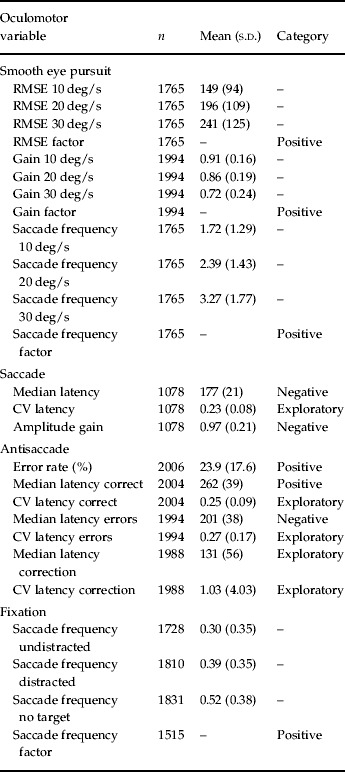
Table 1 presents all of the oculomotor variables that were measured in the ASPIS sample. We used the data from the meta-analysis of Calkins et al. (Reference Calkins, Iacono and Ones2008) to categorize these variables, as reported in our previous work (Smyrnis et al. Reference Smyrnis, Kattoulas, Stefanis, Avramopoulos, Stefanis and Evdokimidis2011). The variables defined as positive were those for which there was evidence of dysfunction in healthy schizophrenia relatives in the above-mentioned meta-analysis. The variables defined as negative were those for which there was no evidence of dysfunction in relatives of schizophrenia patients in the same meta-analysis. All other variables for which there was some evidence for their candidacy and that were not included in the meta-analysis were defined as exploratory.
Oculomotor variables and their categorization

CV, Coefficient of variation; RMSE, root mean square error; s.d., standard deviation.
RMSE measurements are in arbitrary units of AD converter measuring eye movement and target movement signals; all saccade frequency measurements are in saccade number per second (Hz); all median latencies are measured in milliseconds.
Correlations between the oculomotor variables from different tasks used in our analysis are presented in Supplementary Table S1 (available online). As observed, these correlations are weak, with the exception of the correlation of the median latency of saccades in the saccade task and the median latency of erroneous prosaccades in the antisaccade task. This correlation is predicted from the neurophysiological models for the antisaccade task proposing that the erroneous prosaccade is in fact the expression of the visually guided saccadic command to the target that is finally not suppressed in order for the correct antisaccade to be expressed.
DNA extraction and genotyping
Mouthwash samples for DNA extraction were selected as described previously (Avramopoulos et al. Reference Avramopoulos, Stefanis, Hantoumi, Smyrnis, Evdokimidis and Stefanis2002) to obtain a better procedure acceptance rate. The following four SNPs were genotyped for RGS4: SNP1 (rs10917670), SNP4 (rs951436), SNP7 (rs951439) and SNP18 (rs2661319) (Chowdari et al. Reference Chowdari, Mirnics, Semwal, Wood, Lawrence, Bhatia, Deshpande, Thelma, Ferrell, Middleton, Devlin, Levitt, Lewis and Nimgaonkar2002).
All genotyping was performed blind to phenotype measures (Stefanis et al. Reference Stefanis, Trikalinos, Avramopoulos, Smyrnis, Evdokimidis, Ntzani, Ioannidis and Stefanis2007). Genotyping for RGS4 was performed by K-Biosciences (UK) (www.kbioscience.co.uk/) using a competitive allele-specific polymerase chain reaction (PCR) system (CASP).
The frequencies in the ASPIS sample of each of the four SNPs that were genotyped did not deviate significantly from Hardy–Weinberg equilibrium (Stefanis et al. Reference Stefanis, Trikalinos, Avramopoulos, Smyrnis, Evdokimidis, Ntzani, Hatzimanolis, Ioannidis and Stefanis2008 and online Supplementary Table S2).
Data analysis
The major problem encountered in analysing this dataset was the issue of multiple comparisons in the interpretation of both positive and negative results. To address this issue we proceeded in the analysis in a stepwise fashion. In the first step an exploratory analysis was used to identify significant relationships between each of the oculomotor variables and each of the SNPs. The exploratory analysis used the allele load regression model. According to the classification of the oculomotor variables, a valid outcome of this exploratory analysis should be to identify significant relationships only for positive and/or exploratory variables (Table 1). The next step was to confirm the positive results of the exploratory analysis using two non-parametric procedures, a bootstrap and a permutation test. The next step involved another approach using a global analysis of the data with structural equation modeling. This analysis bypassed the multiple comparison issue. A haplotype analysis was also performed.
Allele load model
The effect of each of the four RGS4 SNPs on each of the primary oculomotor variables was investigated using an allele load regression model. In this model a simple linear regression was performed for each SNP and primary oculomotor variable (Table 1). For the analysis of each oculomotor variable, all available data were used, excluding missing cases, as shown in Table 1. The SNP was the independent predictor variable and the oculomotor variable was the dependent variable. According to the allele load model, the SNP variable could take one of three values: 0 if the risk allele was absent, 1 if one copy of the risk allele was present, and 2 if two copies of the risk allele were present for the particular individual (risk alleles where chosen in accordance with the definition by Chowdari et al. Reference Chowdari, Mirnics, Semwal, Wood, Lawrence, Bhatia, Deshpande, Thelma, Ferrell, Middleton, Devlin, Levitt, Lewis and Nimgaonkar2002, namely the T allele for RGS4SNP4, and the A alleles for RGS4SNP1, RGS4SNP7 and RGS4SNP18). Thus the regression model was the following:

where b is the coefficient of the allele load effect. Based on our a priori hypothesis for categorizing the oculomotor variables into positive, exploratory and negative, we selected a p value of 0.05 for testing the association of the positive variables with each SNP. These are the variables that are considered by a priori evidence as the best oculomotor schizophrenia candidate endophenotypes. For the negative variables we also did not correct for multiple comparisons. The rationale here was that any significant association of an SNP with one of these variables is against the hypothesis that the SNP is related to the schizophrenia spectrum and should no longer be considered. Finally, for the exploratory variables we corrected the p value for multiple comparisons based on the test proposed by Conneely & Boehnke (Reference Conneely and Boehnke2007).
Bootstrap and permutation tests
As in our previous study (Smyrnis et al. Reference Smyrnis, Kattoulas, Stefanis, Avramopoulos, Stefanis and Evdokimidis2011), all significant effects in the exploratory allele load regression analysis were confirmed using two non-parametric procedures, a bootstrap and a permutation test (for details see the online Supplementary Method).
Structural equation modeling
Structural equation modeling was used to model the effects of the RGS4 SNPs on the antisaccade and the smooth eye pursuit phenotype variables. A subsample (n=1127) was used for this analysis, including subjects who had valid data for genotype, antisaccade and smooth pursuit indices. This analysis provides a tool for studying simultaneously the effect of multiple independent variables on multiple dependent variables using a set of assumptions for how the two sets of variables are connected. Thus, this analysis bypasses the problem of multiple testing and the consequent problem of adjusting significance levels. To define the structural equation model, the ‘exogenous’ variables, which are the independent factors, have to be identified. The exogenous variables in turn affect the ‘endogenous’ variables, which are the dependent variables. We chose as exogenous variables the SNP allele loads for RGS4 SNPs. These affected the endogenous variables, which were the oculomotor variables. The model also allows the specification of ‘latent’ variables, which reflect a conceptual reduction of measured variables, called ‘manifest’ variables. A series of consecutive models were tested and compared using goodness-of-fit and information criteria as presented in the Supplementary Method. Thus, for the exogenous manifest SNP variables, the best model led to the identification of a single latent genotype variable reflecting the variations in RGS4 SNPs. The same procedure reduction led to the identification of a single endogenous latent oculomotor variable for antisaccade performance. Each endogenous latent variable reflected the variation of the corresponding manifest variables. The details of the model application and the comparison of different models are presented in the Supplementary Method.
Haplotype analysis
Phase 2.1 software (Stephens et al. Reference Stephens, Smith and Donnelly2001; Stephens & Scheet, Reference Stephens and Scheet2005) was used to derive haplotype estimates for each subject in the ASPIS population. A set of the most common haplotypes was defined in the population as those haplotypes that exceeded the 5% frequency. Supplementary Table S3 presents the frequencies for the most common haplotypes in the ASPIS sample. Then for each subject we used the best pair subset of haplotypes given as an output in phase 2.1 to derive an estimate of haplotype load (0: no copies of the particular haplotype, 1: one copy, and 2: two copies) for each one of the most common haplotypes. The effects of a particular haplotype load on an oculomotor variable were then tested using the following linear regression model:

where b is the coefficient of the specific haplotype load effect and its significance was tested by a t test with significance level at 0.05.
Results
Allele load model and bootstrap–permutation tests
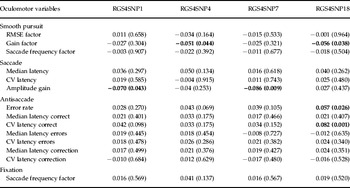
The allele load regression analysis of the four single SNPs on positive, negative and exploratory oculomotor variables resulted in some significant effects (presented in Table 2 along with the resulting p values for all regressions performed). The first was the effect of RGS4SNP4 and RGS4SNP18 on the smooth eye pursuit gain factor (β=−0.05, F 1,1531=4.054, p=0.044 for RGS4SNP4 and β=−0.06, F 1,1364=4.292, p=0.038 for RGS4SNP18). The effect was confirmed using both the bootstrap test (for RGS4SNP4: p=0.02, for RGS4SNP18: p=0.019) and the permutation test (for RGS4SNP4: p=0.022, for RGS4SNP18: p=0.019). It should be noted that the smooth eye pursuit gain factor was negatively correlated with the score for each individual pursuit speed; thus a negative β in the regression indicates that the T allele of RGS4SNP4 is related to an increase in smooth eye pursuit gain. The same is true for the A allele of RGS4SNP18. Thus, both risk alleles seem to be linked with a better performance in the smooth pursuit task. Further analysis for each target speed separately showed that the effect was significant only for the low target speed of 10 deg/s (for RGS4SNP4: β=0.054, F 1,1531=4.45, p=0.035, for RGS4SNP18: β=0.063, F 1,1364=5.431, p=0.02) and not for the medium target speed of 20 deg/s (for RGS4SNP4: β=0.0367, F 1,1531=2.062, p=0.151, for RGS4SNP18: β=0.034, F 1,1364=1.604, p=0.205) or the high target speed of 30 deg/s (for RGS4SNP4: β=0.042, F 1,1531=2.731, p=0.099, for RGS4SNP18: β=0.047, F 1,1364=3.045, p=0.08).
Regression analysis of the four single SNPs on positive, negative and exploratory oculomotor variables

SNP, Single nucleotide polymorphism; RMSE, root mean square error; CV, coefficient of variation.
The table presents the β and p values (in parentheses) for each regression of each SNP on every one of the oculomotor variables using the additive model. Significant correlations (p<0.05, uncorrected value) are indicated in bold.
As shown in Table 2, another significant effect was of RGS4SNP1 on the saccade amplitude gain (β=−0.07, F 1,842=4.11, p=0.042), and also RGS4SNP7 on saccade amplitude gain (β=−0.086, F 1,917=6.794, p=0.009). Because this oculomotor variable is not related to schizophrenia, no further analysis was performed for this correlation.
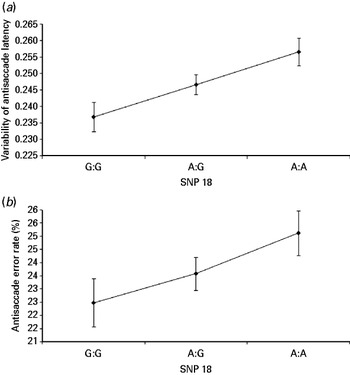
Finally, RGS4SNP18 had a significant effect on both antisaccade error rate (β=0.057, F 1,1528=4.983, p=0.026) and the coefficient of variation (CV) of the correct antisaccade latency (β=0.082, F 1,1528=10.382, p=0.001). Based on our a priori hypothesis on the categorization of oculomotor variables into positive (strong evidence for schizophrenia spectrum candidacy), exploratory (weak evidence for schizophrenia spectrum candidacy) and negative (evidence for non-candidacy), we used a correction for multiple comparisons for correlated variables to test the significance of the effect of RGS4SNP18 on the CV of the correct antisaccade latency (exploratory variable) (see Method). The corrected p value for 44 tests (six positive and five exploratory variables times four SNPs) was 0.03. Even when using all 56 tests (six positive and five exploratory and three negative variables times four SNPs), the corrected p value remained significant at 0.04. The effects of RGS4SNP18 on the error rate and the CV of antisaccade latency were also confirmed using both the bootstrap test (for the error rate: p=0.012, for the CV of the correct antisaccade latency: p=0.0004) and the permutation test (for the error rate: p=0.013, for the CV of the correct antisaccade latency: p=0.0006). The A allele of RGS4SNP18 was associated with an increase in both the antisaccade error rate and the variation of the correct antisaccade latency (Fig. 1).
Allele dose effect of SNP18 on (a) the variability of antisaccade latency and (b) the antisaccade error rate. Error bars represent standard errors of the means.

Structural equation modeling
This analysis was based on specific hypotheses of how genetic variability was related to phenotype variability. Initially, we tested the effect of all four SNPs on antisaccade and pursuit oculomotor performance indices (general model). We excluded the fixation indices based on the absence of an effect on the single SNP analysis and on our a priori hypothesis that RGS4 is related to prefrontal cortical function. The involvement of prefrontal cortex in the antisaccade and smooth eye pursuit tasks is well documented in the literature (discussed later). The exogenous latent variable was the RGS4 gene loading on the relevant SNPs (exogenous manifest variables). Two endogenous latent variables were formed: smooth pursuit and antisaccade. The smooth pursuit variable loaded on the corresponding nine endogenous manifest variables (root mean square error, gain and saccade frequency for each target speed) whereas the antisaccade latent variable loaded on the antisaccade error rate, the mean latency for correct antisaccades and the variability of latency for correct antisaccades. In a second model attempt (oculomotor specific), the pursuit latent endogenous variable loaded only on the corresponding pursuit gain variables (for the three pursuit speeds) based again on the results of the allele load SNP analysis. In the third model (SNP specific), the gene latent exogenous variable loaded only on the RGS4SNP4 and RGS4SNP18 SNPs. The exclusion of RGS4SNP1 and RGS4SNP7 was based on the findings of our previous study on the absence of an effect of these SNPs on schizophrenia spectrum endophenotypes (see Introduction) and also on the association of these SNPs with the negative oculomotor variables in the allele load model analysis. The fourth model combined the restrictions of the second and third models (SNP and oculomotor specific) and finally the fifth model (antisaccade) was even more restricted, with only the antisaccade latent endogenous variable being used.
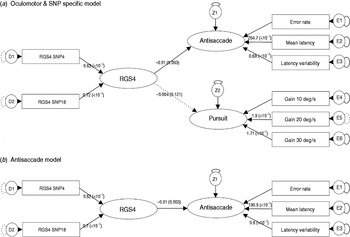
The structural equation model estimation process converged normally for all models. The comparison of the five models (see Supplementary Method and Supplementary Table 4) showed that only the oculomotor and SNP-specific model and the antisaccade model provided a good fit to the data by all criteria; these are presented graphically in Fig. 2. Direct comparison of these two models confirmed that the antisaccade model was better by all goodness-of-fit and information theoretic measures (see Supplementary Table S4). For all models tested, the SNP exogenous manifest variables loaded significantly on the RGS4 genotype latent variable and similarly the endogenous manifest oculomotor variables loaded significantly on their corresponding endogenous latent variables. In the four models that tested both the pursuit and antisaccade relationship to RGS4, the association between the gene latent variable and the smooth pursuit latent variable was not significant, whereas the association between the gene variable and the antisaccade latent variable was always highly significant (see Fig. 2). Similarly, for the antisaccade model the association of the RGS4 gene variable with the antisaccade latent variable was again highly significant (Fig. 2).
(a) Path diagram of the oculomotor and single nucleotide polymorphism (SNP)-specific structural equation model. The exogenous manifest variables (rectangles) were the rare allele loads of the additive model for each SNP. These variables loaded (arrows) on one exogenous latent variable (ellipse), denoted ‘RGS4’. The endogenous manifest variables (rectangles), namely the antisaccade error rate, mean latency and variability of latency, loaded (arrow) on one endogenous latent variable (ellipse), denoted ‘Antisaccade’. The smooth pursuit root gain variables for the three pursuit speeds (10, 20, 30 deg/s) loaded (arrows) on one latent endogenous variable (ellipse), denoted ‘Pursuit’. Finally, the exogenous latent variable ‘RGS4’ loaded (arrows) on the two endogenous latent variables ‘Antisaccade’ and ‘Pursuit’. The model also included residual variables for all exogenous manifest variables (D1 and D2), residual variables for all endogenous manifest variables (E1–E6) and disturbances for all endogenous latent variables (Z1 and Z2), which all loaded on their respective variables (small ellipses). Solid arrows indicate significant factor estimates whereas broken arrows indicate non-significant factor estimates at the level of p=0.05. The factor loading estimates and their respective p values (in parentheses) are depicted by a number on the line. (b) Path diagram of the antisaccade structural equation model. The description is the same as for the previous model with the omission of the pursuit endogenous latent variable with the corresponding endogenous manifest variables.

Haplotype analysis
Haplotype analysis was performed using all four SNPs (see Method). The GGGG was the most frequent haplotype in the ASPIS sample, closely followed by the ATAA haplotype (Supplementary Table S3). There were no significant effects of these haplotypes on smooth eye pursuit gain factor, antisaccade error rate, the CV of the correct antisaccade latency or the saccade frequency in the fixation task with distracters.
Discussion
The ASPIS sample consists of a large population of apparently healthy young Greek army conscripts, which, although limited by age and gender, can be considered as representative of the Greek population as far as genetic variation is concerned (Avramopoulos et al. Reference Avramopoulos, Stefanis, Hantoumi, Smyrnis, Evdokimidis and Stefanis2002). It should be noted that military service is obligatory in Greece and thus all males of Greek origin from all areas must participate, barring disabilities. As such, the military provides not only a large pool of subjects but also a highly representative one. This sample is a fairly homogeneous one because, in contrast to other European and American populations, in Greece we had a significant influx of immigrants in only the past two decades. This did not influence the ASPIS population as all subjects were born before 1980, thus minimizing possible stratification effects.
In the present study we tried to identify possible associations between variations in the RGS4 gene and a wide range of oculomotor variables. To overcome the obstacle of multiple comparisons imposed by the large number of oculomotor variables assessed, we grouped these variables (see Method; Calkins et al. Reference Calkins, Iacono and Ones2008; Smyrnis et al. Reference Smyrnis, Kattoulas, Stefanis, Avramopoulos, Stefanis and Evdokimidis2011) into a set of six positive parameters (three for the smooth eye pursuit task, two for the antisaccade task and one for the three fixation tasks), a set of three negative parameters (two for the saccade task and one for the antisaccade task), and a set of exploratory parameters. According to this categorization we considered as meaningful only the relationship of RGS4 genotype variations to schizophrenia-related eye movement endophenotypes defined as positive. Relationship to endophenotypes defined as exploratory were also considered to warrant further exploration.
The initial SNP analysis showed that RGS4SNP4 and RGS4SNP18 were associated with two positive (smooth eye pursuit gain factor and antisaccade error rate) and one exploratory oculomotor variable (CV of the correct antisaccade latency). The other two SNPs (RGS4SNP1 and RGS4SNP7) were associated with one oculomotor parameter (saccade gain), which is negative for schizophrenia, and they were not analyzed further.
A positive relationship of the A load of RGS4SNP18 to increased antisaccade error rate was observed. This effect was nominally significant but did not survive correction for multiple comparisons. Nevertheless, this association was predicted by our a priori hypothesis. We have already reported this finding as part of our initial report (Stefanis et al. Reference Stefanis, Trikalinos, Avramopoulos, Smyrnis, Evdokimidis, Ntzani, Hatzimanolis, Ioannidis and Stefanis2008). We further validated the original finding, showing that this relationship survived the rigorous non-parametric permutation and bootstrap tests. This finding is in accordance with relevant literature considering the specific allele as a risk allele for schizophrenia (Williams et al. Reference Williams, Preece, Spurlock, Norton, Williams, McCreadie, Buckland, Sharkey, Chowdari, Zammit, Nimgaonkar, Kirov, Owen and O'Donovan2004; Prasad et al. Reference Prasad, Chowdari, Nimgaonkar, Talkowski, Lewis and Keshavan2005, Reference Prasad, Almasy, Gur, Gur, Pogue-Geile, Chowdari, Talkowski and Nimgaonkar2010; Buckholtz et al. Reference Buckholtz, Meyer-Lindenberg, Honea, Straub, Pezawas, Egan, Vakkalanka, Kolachana, Verchinski, Sust, Mattay, Weinberger and Callicott2007). The antisaccade task execution requires higher-order cognitive processes (i.e. reflexive saccade inhibition), presumably governed by the prefrontal cortex (Curtis et al. Reference Curtis, Calkins and Iacono2001). The increased error rate observed in schizophrenia patients has been viewed as an indication of dorsolateral prefrontal cortical dysfunction in the disorder (Curtis et al. Reference Curtis, Calkins and Iacono2001). Imaging (McDowell et al. Reference McDowell, Brown, Paulus, Martinez, Stewart, Dubowitz and Braff2002) and event-related potential (Klein et al. Reference Klein, Heinks, Andresen, Berg and Moritz2000) studies in schizophrenia patients and healthy individuals provided further support for this hypothesis. The specific allele for which a significant relationship was observed with antisaccade error rate in this study has been found in previous reports to be linked to structural alterations in the DLPFC volumes (Prasad et al. Reference Prasad, Chowdari, Nimgaonkar, Talkowski, Lewis and Keshavan2005) and also to decreased frontoparietal and frontotemporal function and volume (Buckholtz et al. Reference Buckholtz, Meyer-Lindenberg, Honea, Straub, Pezawas, Egan, Vakkalanka, Kolachana, Verchinski, Sust, Mattay, Weinberger and Callicott2007).
A positive relationship of A load of RGS4SNP18 to the variation in the correct antisaccade latency was also observed and remained even when corrected for multiple comparisons. Although the antisaccade latency variation is considered an exploratory measure according to the Calkins et al. (Reference Calkins, Iacono and Ones2008) meta-analysis, several studies (Schwartz et al. Reference Schwartz, Carr, Munich, Glauber, Lesser and Murray1989; Vinogradov et al. Reference Vinogradov, Poole, Willis-Shore, Ober and Shenaut1998; Smyrnis et al. Reference Smyrnis, Karantinos, Malogiannis, Theleritis, Mantas, Stefanis, Hatzimanolis and Evdokimidis2009) reported, in a variety of different tasks, a specific increase in latency variability but not mean latency, leading to a hypothesis that increased variation in response latency might be a distinct deficit in schizophrenia spectrum disorders that is not related to the well-known psychomotor slowing (Nuechterlein, Reference Nuechterlein1977). In one study (Smyrnis et al. Reference Smyrnis, Karantinos, Malogiannis, Theleritis, Mantas, Stefanis, Hatzimanolis and Evdokimidis2009) we observed a significant increase in the variability of saccade latency for patients with schizophrenia compared to healthy subjects in a simple task of visually guided saccades, whereas mean saccadic latency was not increased. Haraldsson et al. (Reference Haraldsson, Ettinger, Magnusdottir, Sigmundsson, Sigurdsson and Petursson2008) also reported a significant increase in the variance of antisaccade latency in schizophrenia patients. Finally, we have observed that antisaccade error rate was significantly correlated with the variability of antisaccade latency and this correlation was more pronounced in individuals with high schizotypy (Smyrnis et al. Reference Smyrnis, Evdokimidis, Stefanis, Avramopoulos, Constantinidis, Stavropoulos and Stefanis2003), and also in patients with schizophrenia (data not published), suggesting that these endophenotypes might be closely related in schizophrenia.
Finally, the single SNP analysis showed a relationship of the T allele load of RGS4SNP4 and A allele load of RGS4SNP18 to an increase in smooth eye pursuit gain. Again these associations were nominally significant and did not survive the correction for multiple comparisons. According to previous literature, both alleles are considered as risk alleles for schizophrenia (Williams et al. Reference Williams, Preece, Spurlock, Norton, Williams, McCreadie, Buckland, Sharkey, Chowdari, Zammit, Nimgaonkar, Kirov, Owen and O'Donovan2004; Prasad et al. Reference Prasad, Chowdari, Nimgaonkar, Talkowski, Lewis and Keshavan2005; Buckholtz et al. Reference Buckholtz, Meyer-Lindenberg, Honea, Straub, Pezawas, Egan, Vakkalanka, Kolachana, Verchinski, Sust, Mattay, Weinberger and Callicott2007). As such, we would expect to find that those alleles would be related to a decrease in the smooth eye pursuit gain, which is opposite to the observed relationship. This result was difficult to interpret further in the single SNP analysis.
The use of structural equation modeling provided further insight into the relationship between genetic variation and behavior, helping to dissolve the ambiguities raised by the initial single SNP analysis concerning the association of the RGS4 gene and oculomotor function. In all models, RGS4 genotype variations significantly predicted antisaccade but not smooth eye pursuit performance. The RGS4 gene has been specifically linked to prefrontal alterations, either anatomical or functional (Prasad et al. Reference Prasad, Chowdari, Nimgaonkar, Talkowski, Lewis and Keshavan2005; Buckholtz et al. Reference Buckholtz, Meyer-Lindenberg, Honea, Straub, Pezawas, Egan, Vakkalanka, Kolachana, Verchinski, Sust, Mattay, Weinberger and Callicott2007). It is also known from neuroimaging studies that smooth eye pursuit performance activates an extended network of cortical and subcortical areas including the frontal eye, supplementary eye, intraparietal sulcus, precuneous, extrastriate areas (medial temporal cortex and medial superior temporal cortex) and the cingulate cortex (O'Driscoll et al. Reference O'Driscoll, Wolv, Benkelfat, Benkelfat, Florencio, Lal and Evans2000). By contrast, the antisaccade task is specifically related to prefrontal cortical function, as discussed earlier. Based on this evidence we would expect a specific relationship of RGS4 with antisaccade performance but not with pursuit performance because only the antisaccade is associated specifically with prefrontal activity. Previous studies confirmed that variations in the COMT gene, involved in the regulation of prefrontal dopamine levels, were not related to smooth eye pursuit performance (Thaker et al. Reference Thaker, Wonodi, Avila, Hong and Stine2004; Haraldsson et al. Reference Haraldsson, Ettinger, Magnusdottir, Sigmundsson, Sigurdsson, Ingason and Petursson2009). By contrast, our previous study on the effect of NRG1 gene variations on oculomotor endophenotypes confirmed a relationship of this gene to smooth eye pursuit but not to antisaccade performance (Smyrnis et al. Reference Smyrnis, Kattoulas, Stefanis, Avramopoulos, Stefanis and Evdokimidis2011). Neuregulin is a protein that has a crucial role in functions including neuronal growth, myelination, migration and synaptic plasticity (Falls, Reference Falls2003); thus its functional gene variations would be expected to have non-specific effects in many, and possibly even all, cortical areas of the adult brain. Such a widespread effect could disrupt functioning in large neuronal networks such as those involved in smooth eye pursuit function. Summarizing these results, it could be hypothesized that different oculomotor endophenotypes are related to variation in different genes, providing a variety of gene–behavior interaction patterns. This could then lead to possible investigation of the different emerging patterns of gene–behavior interaction, and identification of the common and specific genetic substrates for each of these endophenotypes with the use of genome-wide association studies (GWAS). It should be stressed that there are possible candidate gene interactions that cannot be observed through the current analysis. Future work could assess possible statistical epistasis between RGS4 gene variation and SNPs in other schizophrenia candidate genes, especially those that have been shown to be associated with oculomotor performance or to influence the efficiency of prefrontal cortex processing, such as NRG1 (Smyrnis et al. Reference Smyrnis, Kattoulas, Stefanis, Avramopoulos, Stefanis and Evdokimidis2011) and COMT (Avramopoulos et al. Reference Avramopoulos, Stefanis, Hantoumi, Smyrnis, Evdokimidis and Stefanis2002). This is an interesting point of future research on present data, demanding appropriate statistical models (Nikodemus et al. Reference Nicodemus, Kolachana, Vakkalanka, Straub, Giegling, Egan, Rujescu and Weinberger2007).
In conclusion, this study has shown that RGS4 genotype variations, and RGS4SNP18 in particular, are related to inhibitory control of saccadic eye movements, which is considered to be a measure of prefrontal cortical function. These results, in accordance with previous findings, suggest that RGS4 gene variations mediate their effect on schizophrenia through prefrontal cortical function.
Note
Supplementary material accompanies this paper on the Journal's website (http://journals.cambridge.org/psm).
Acknowledgments
Funding for this research was provided by the General Secretariat of Research and Technology of the Greek Ministry of Development (EKBAN97 to N.C.S.).
Declaration of Interest
None.