Introduction
The present ‘unwritten constitution’ is an anachronism riddled with references to our ancient past, unsuited to the social and political democracy of the 21st century and future aspirations of its people. It fails to give primacy to the sovereignty of the people and discourages popular participation in the political process.Footnote 1
Written constitutions have played a significant – if not a pre-eminent – role in the establishment of democracy and the continuation of democratic rights and principles … or so the story goes. And the UK, with its unwritten constitution, historic monarchy and ‘untenable’ principle of parliamentary sovereignty,Footnote 2 is the perfect example of a nation stuck in the past, unable to transform itself into the contemporary conception of a truly democratic nation-state, complete with the primary symbol (ie, a written constitution) that virtually all such states now possess. Well, there may in fact be good reason for not doing so.
If anything was ever in vogue in democratic and constitutional theory, constitutions would surely be it; at no point in history have the countries of the world had so many constitutions in place.Footnote 3 Ever since the drafting of the US Constitution in 1789 democracies – and even non-democracies,Footnote 4 for that matter – have increasingly felt the need to pen a written constitution, even if only in symbolic form. Much of this constitutional desire has come within the last half-century, or post-war era.Footnote 5 But political philosophy has long held that such documents are ‘antecedent to government’,Footnote 6 and many in legal philosophy note that constitutions are essential to the rule of law and the protection of basic human rights.Footnote 7 Some have gone so far as to say that the idea of a contemporary founding or ‘fundamental [political] transformation’ not incorporating a written constitution would be ‘unthinkable’; and in the current climate, they are probably right.Footnote 8 Nevertheless, without such a document in place, the UK contains a well-established rule of law, protection of human rights, and – even after the Brexit referendum and more constitutional change in Britain – a functioning government. Given these circumstances, one may ask why calls frequently arise for Britain to draft a codified constitution. Here the answer is straightforward: because the desire for constitutional change is a time-honoured democratic tradition.Footnote 9
But would a written constitution persuade citizens to get more involved in the political process, as the Commons report quoted above asserts? Before a more detailed assessment can take place, however, the statement needs to be further scrutinised. It notes that the current constitution is ‘riddled with references to our ancient past’, which is portrayed as negative. But, it is unclear why these references should be viewed in such a manner. Would a written Constitution not explicitly mention Magna Carta, the Bill of Rights 1689 or the Acts of Union 1707? The 1958 French Constitution, for instance, explicitly mentions the Declaration of the Rights of Man 1789.Footnote 10 Additionally, an argument can be made that such historical contextual acknowledgement is the most important – and indeed, the most celebrated – part of the USA's antiquated Constitution.Footnote 11 Thus a criticism such as this seems unwarranted, or entirely misplaced. Further, the clause ‘unsuited to the … future aspirations of its people’ also connects to the discouragement of ‘popular participation in the political process’. As is evidenced below, declarations of aspirations and ambitions – which are often present in preambles and bills of rights – have often been associated with ‘invigorating’ or ‘inspiring’ the populace. A further invigoration method is constitutional acknowledgement that ‘the people’ are sovereign. The current UK constitution does not guarantee this, and such a sovereignty ‘failing’ appears to be an especially significant factor in discouraging political participation. Taken altogether, the complementary statements imply that if the UK had a ‘modern’ constitution that included state aspirations and which provided ultimate sovereignty to the people, then popular participation in the democratic process would be encouraged. This is a bold, and unsubstantiated, claim.
This article questions whether constitutions and bills of rights are indeed the invigorating, democracy-reinforcing mechanisms they are frequently portrayed as. Although such esteemed democratic ‘necessities’ provide citizens with a national symbol, the entrenchment of rights and perhaps a minimal understanding of governmental relationships, this piece argues that they do not ‘invigorate’ polities in the manner that constitutional theorists and others have suggested. It is primarily concerned with one main issue regarding such revered texts: whether new constitutions and bills of rights (including major constitutional amendments) serve to invigorate democracies, thus leading to higher democratic participation (ie, higher voting levels). After all, if the claim is that constitutions and bills of rights are inspiring, value-laden, and aspirational documents capable of empowering citizens with ultimate sovereignty, then it is fitting to connect such claims with democratic performance. It is certainly acknowledged, however, that democratic participation – especially today – goes beyond voting, and can manifest in social movements, public consultations, or digital engagement (eg, e-petitions), among other things. Arguments could be put forward that some of these developments may be more important than voting, and could have more of an impact on a state's constitutional politics. Nevertheless, the connection between constitutions, bills of rights, and voting is important, and requires further investigation.
The paper proceeds as follows. First, the connection between constitutions, bills of rights, and democracy is discussed, and evidence is presented that scholars have connected such documents not only to a healthy political system and increased democratic participation, but also to ‘inspiring’ or invigorating the populace. The following section discusses the practical aspects surrounding constitutions and voter turnout, stressing that measuring this relationship is an inherently difficult process. It also further justifies why the relationship is important, and should be studied within the UK and elsewhere. The methods section (Section 3) provides the hypotheses and explains how the empirical analysis was conducted. The following three sections primarily use case studies, in addition to supporting empirical evidence, to demonstrate the effects of implementing constitutions, bills of rights, and constitutional amendments on voter turnout. The final section discusses some of the implications of this provisional study, and calls for more research into this area of constitutional assessment. It concludes by noting that although constitutions and bills of rights often appear to be democracy-reinforcing mechanisms, ultimately – and surprisingly in some cases – they could also contain democracy-hindering downsides.
1. Constitutions, bills of rights and democracy
Constitutions are essentially the ‘dummy's guide’ to understanding state operation: they may reveal some essential features, but one will hardly understand state processes through consulting them. Nevertheless, they are widely considered the first port of call for comparative legal scholars and are said to contain the fundamental law essential to the establishment and operation of states. Constitutional theorists have laid out a number of functions that constitutions serve, including: setting forth constitutional values; entrenching constitutional rights; conferring and limiting powers of government; delineating the structure and operations of the state;Footnote 12 and even generating endless democratic debate.Footnote 13 These functions have been extensively written about and are indeed endlessly debated. And yet, constitutions would be relatively dull devices if they possessed only legal significance.
Although debate over constitutional success or failure has been a long-running strand of academic investigation, only recently has ‘constitutional performance’ become a more sophisticated sub-topic of constitutional theory. Recent texts have analysed why national constitutions endure,Footnote 14 what constitutions should do,Footnote 15 and how constitutions should be assessed.Footnote 16 This important development has led not only to a more robust discussion regarding constitutional success, but also to a more widespread empirical analysis of constitutions more generally, including how long they last, which types of rights are provided for, and what specific factors we should take into consideration (eg levels of democracy, political stability, economic performance, or crisis propensity).Footnote 17 Much recent scholarship has strayed beyond traditional doctrinal and philosophical approaches to explore the social and political elements of constitutions.Footnote 18 After all, ‘one cannot understand constitutions simply from the perspective of settlement’ alone.Footnote 19 These perspectives extend into the field of constitutional possibility; and what an alluring space it is. Here scholars have gone beyond constitution as symbolFootnote 20 concluding that modern constitutional texts are ‘performative’, in the sense that ‘they perform an action, rather than only describe an event or make a statement’.Footnote 21 Loughlin recently noted this, emphasising ‘the manner in which constitutions can harness the power of narrative, symbol, ritual and myth to project an account of political existence in ways that shape – and re-shape – political reality’.Footnote 22 Although some may challenge the statistical evaluation of constitutional success,Footnote 23 this paper aligns with and expands on the empirical aspects of constitutional performance, proving a novel inquiry into the relationship between new constitutions, bills of rights, and constitutional amendments with voter turnout.
This renewed focus on constitutional performance has on many occasions touched on or insinuated a relationship between constitutions and voter turnout, although these efforts have not done so as directly as this paper does. Dixon and Landau state that ‘[a] central function of a written constitution is to enhance the stability of the political system’, and that a competitive democracy requires this ‘minimum core of a democratic constitution’ to endure if a constitution is to be successful, emphasising the democratic vote.Footnote 24 Hardin also argues that constitutions can (or should) provide for the successful coordination of society and politics.Footnote 25 Ginsburg and Huq take these arguments further, stressing that ‘in democratic contexts, [constitutions] can also help facilitate participatory politics’, and that ‘[f]idelity to the constitution provides a normative justification for democratic participation’.Footnote 26 These statements appear similar to the Commons Committee statement at the beginning of this article.
Claims regarding additional ‘constitutional possibilities’ can make such texts appear powerfully tempting: Blackburn has claimed that such a document may ‘bring government and the governed closer together’,Footnote 27 and could ‘strengthen public confidence and trust in the political system’ by better educating citizens.Footnote 28 Given that modern constitutions are cloaked in values and aspirations, King maintains that constitutions can be viewed as ‘mission statements’.Footnote 29 Recent focus on including citizens in the drafting process has demonstrated a number of benefits, such as decreased state violence,Footnote 30 stronger citizen constitutional attachment,Footnote 31 even a longer constitutional lifespan.Footnote 32 Further, the narrative component, which may incorporate a nation's history, can sometimes act as ‘a source of inspiration’ for citizens.Footnote 33 Landemore notes that great constitutions include such ‘inspirational’ features, including that they are ‘beautifully written and likely to generate emotions such as love and admiration among its own people and beyond, among current and future generations’.Footnote 34 Ultimately, the notion that there may be something ‘sacred or irrational’ in the very ‘nature of constitutions’Footnote 35 is a long-held belief that much constitutional scholarship has perpetuated.Footnote 36
A popular performative mechanism located within constitutions is preambles, which as an expressive component can ‘narrate the nation's past and envision its future’.Footnote 37 King has noted that such devices can provide ‘normative guidance and the institutional declaration of key variables’,Footnote 38 while Levinson states that they express ‘the ostensible “essence” of the people or nation’, and on occasion can be ‘inspiring’.Footnote 39 Even though the ‘justiciability’ of preambles within states remains relatively low, it is the expressive elements of these intriguing devices that scholars – and indeed many countries – have found so empowering, and therefore so useful. By incorporating narrative, history, values and aspirations, preambles are the primary places in which constitutions can ‘offer alternative perceptions of reality’.Footnote 40 Thus if constitutions can – or have the potential to – inspire people, strengthen public confidence, capture the ‘essence’ of a citizenry, and even be looked at as sacred, then their importance goes well beyond legal significance. Indeed, under certain conditions their political significance may rival or even supersede their legal significance.
Additionally, and perhaps most importantly, contemporary ‘we the people’ democratic constitutions – at least in theory – provide sovereignty to the citizens (ie ‘popular sovereignty’).Footnote 41 It is this focus on sovereignty, as opposed to democracy, that is ‘the language of constitutions’.Footnote 42 Although the constitutional reality under such claims varies,Footnote 43 the ‘we the people’ refrain often gives the impression that – even within representative democracies with strong judicial review – it is the people who are central to establishing government; it is the people who provide governmental legitimacy; and it is the people who ultimately hold state power. Indeed the rise of popular sovereignty and democratic constitutions throughout the years has been an international force, and such language now adorns a plethora of constitutions throughout the world.Footnote 44 Bold claims regarding this ‘we the people’ factor have also been made, especially in relation to the foundational elements and the composition of the state's narrative. Lerner recognises the foundational function as the second major role of constitutions, observing that they ‘provide the citizenry with a sense of ownership and authorship, a sense that “We the people” includes me’.Footnote 45 These words echo those from Ackerman's definitive work on the subject, where he noted that, ‘the narrative we tell ourselves about our Constitution's roots is a deeply significant act of collective self-definition; its continual re-telling plays a critical role in the ongoing construction of national identity’.Footnote 46 He further emphasises that, ‘[t]o discover the Constitution is to discover an important part of oneself’.Footnote 47
This ‘we the people’ feature, perhaps more than any other constitutional characteristic, is important in understanding the connection between constitutions and voting – after all, the Commons report explicitly connected the failure to ‘give primacy to the sovereignty of the people’ and the discouragement of participation in the political process. Indeed, in the vast majority of ‘we the people’ constitutions the most significant power citizens hold remains at the ballot box (during local and national elections, at referendums, etc), where the people can have their most significant influence: voting for candidates, laws or initiatives that will either preserve the status quo or bring about desired change. Rarely do ‘we the people’ constitutions provide an all-encompassing form of direct democracy; the vast majority of them establish representative government that incorporates regular elections. Therefore when constitutions proclaim ‘we the people’, in most instances they mean, ‘we the democratic voters’.
Although the UK is a parliamentary democracy, and the people hold significant power, it is also the case that the UK operates on the principle of parliamentary sovereignty: that is, Parliament is the highest legal authority within the state, and parliamentary sovereignty is the underlying principle of the constitution.Footnote 48 This principle of Parliament being the highest state authority, as opposed to ‘the people’, has in itself led some to call for a written constitution.Footnote 49 As the Commons Committee observed,
In a democracy the people, not Parliament, are sovereign … Parliamentary sovereignty is an anachronism in the democratic era, and needs replacing by a written constitution that expresses the sovereignty of the people and circumscribes the powers and duties of members of Parliament in both Houses.Footnote 50
But there are significant difficulties with claiming that the answer lies in a ‘we the people’ democratic constitution. I have previously argued that the notion of parliamentary sovereignty does not impede the notion of popular sovereignty; in fact, it likely complements and strengthens it.Footnote 51 Additionally, many constitutions based around popular sovereignty provide ultimate authority to the courts (ie, unelected officials) to determine what is constitutional or unconstitutional in a given state, thus obscuring – even turning on its head – the very notion of ‘we the people’ foundations.Footnote 52 How such a prominent hypocritical feature of democratic constitutions continues to flourish speaks volumes about the duality of these contemporary documents, and perhaps even about contemporary democracies: ‘sovereign’ citizens seem willing, even keen, to accept significant constraints on their power. This insight is important for the empirical analysis and further discussion below.
Some recent literature from a group of critical constitutionalists has cautioned against the downsides of constitutions and hinted at the possibility that they may be democracy-hindering (as opposed to democracy-reinforcing) mechanisms,Footnote 53 or could mislead citizens into thinking that they are the definitive power-bearers in society.Footnote 54 Fascinating constitutional scholarship has emerged here, such as the exploitation of sham constitutions,Footnote 55 the decline of the once-venerated American ConstitutionFootnote 56 and Bill of Rights,Footnote 57 and even the argument that constitution-making often does poorly at incorporating the specific values some polities hold, therefore forming not ‘popular’, but ‘unpopular’, constitutionalism.Footnote 58 Scholars have even pointed to instances of ‘unpopular sovereignty’ in particular constitutions.Footnote 59 The constitution-making process itself has been increasingly exposed in recent years, identifying it as ‘politics by other means’.Footnote 60 And in a cautionary note for countries thinking of penning new constitutions, scholars have found that the average national constitution only lasts 19 years before being replaced.Footnote 61 Nevertheless, while this chorus of critical constitutionalism is growing stronger, largely within constitutional scholarship the overall prospects for constitutions remain strong and the focus of most current scholarship is on their potential benefits.
Much of the rhetoric on bills of rights speaks of legal empowerment, especially the power to take rights claims before the courts. And yet, further claims have been made in terms of citizen empowerment, sovereignty, and potential democratic effects. Aspirations have long been explicitly connected to rights; after all, the codification of human rights is ‘a movement which answers the aspirations of peoples and takes its origins from the aspirations of peoples’.Footnote 62 Levinson asserts that when it comes to constitutional concerns about political structure, people ‘[t]oo often … tend to yawn at discussions of such issues’, and often ‘become animated only when discussion turns’ to rights, such as speech, religion or private property.Footnote 63 Some have asserted an explicit connection between sovereignty and rights. Ackerman, for instance, notes that in America it ‘is the People who are the source of rights’.Footnote 64
Before the Human Rights Act (HRA) 1998 was adopted, a number of claims were made about what the legislation would accomplish. Lord Irvine, the Lord Chancellor at the time, noted that a ‘culture of awareness of human rights would develop in the UK’, and that domestic implementation of the Convention would give ‘credibility to our foreign policy’ and increase the UK's international standing.Footnote 65 Mike O'Brien, then Under-Secretary for the Home Office, noted that ‘the effects will be profound. The Bill will benefit individuals, Government and the whole of society’.Footnote 66 Jack Straw, then Home Secretary, argued it would ‘strengthen representative and democratic government … The Bill will thus create a new and better relationship between the Government and the people’.Footnote 67 Thus beyond the legal effects of the legislation, political claims were also key to selling it. Even before the emergence of the HRA, however, it was argued that bills of rights make better, more informed citizens. In proposing a UK Constitution, the Institute of Public Policy Research noted that the inclusion of a bill of rights might indeed have such effects on the citizenry:
Learning about these principles would become part of the school curriculum and adult education, encouraging pupils and students to debate the importance of protecting human rights and the difficulties which arise when they conflict. Such a development would encourage a more informed public, more sensitive to the implications of restricting civil liberties and of extending them.Footnote 68
But such an idealistic argument appears woefully naive, and there is no empirical evidence that citizens of states incorporating a bill of rights are any more knowledgeable or informed than citizens of states without such devices. The symbolic elements of bills of rights have also been acknowledged, given that for ‘the great mass of people, the chief significance of a Bill of Rights is less a tool of legal litigation than as a symbolic political declaration of what their civil rights and freedoms are or should be’.Footnote 69 Thus both constitutions and bills of rights have had a wide range of claims attached to them, and many such assertions suggest that democracies – one way or another – will be invigorated by such documents.
2. Constitutions and voter turnout: a provisional inquiry
As seen above, many claims have been made about the value of constitutions and their effects on democracy, and it is not uncommon for constitutions to be suggestively connected with political participation in the manner that the Commons Report does: that a written, modern constitution would encourage participation in the political process. However the relationship between constitutions, bills of rights, and voting (which remains citizens’ most significant from of participation), deserves further investigation. After all, ‘constitutionalism without social science is an arid intellectual pastime’.Footnote 70
Powell's pioneering work on democracies and voter turnout labelled electoral participation as one of the three indications regarding the performance of democratic states.Footnote 71 And yet analysing voter turnout – and especially the reasons for electoral participation – has always been a complex endeavour. One article on the subject of voter turnout in democracies correctly noted that ‘few other areas of political science research have been as riddled with puzzles and paradoxes as the study of electoral participation’.Footnote 72 Research on voter turnout has long taken into consideration demographic factors (eg level of education, socio-economic status, gender, race), but that is only part of the story. Powell and Jackman largely moved the discipline towards focusing on institutional variables when assessing electoral participation.Footnote 73 These institutional elements, such as compulsory voting, electoral systems, unicameralism, voting age and voting laws were long considered the dominant factors when assessing voter participation.Footnote 74 However, recently scholars have noted that such institutional variables may be over-stated in the literature, arguing that ‘[i]nstitutions matter less than we are prone to believe’,Footnote 75 and that ‘the impact of institutions on turnout is shaky’.Footnote 76
Voter turnout fluctuation is the primary aspect I will be examining below, and is further explained in the methods section. To put it mildly, this phenomenon is difficult to explain. Here researchers have found that voting has generally declined in industrialised democracies in the post-war period, and that younger generations are not as interested and do not attach as much importance to politics as older generations.Footnote 77 That may explain long-term voting decline, and even some decline in the below case studies, but it does not explain significant voting fluctuations. One of the most prominent studies explaining voter fluctuation is that of the ‘swing voter's curse’, in which Fedderson and Pesendorfer found that poorly-informed voters sometimes rationally delegate their vote – through abstaining – to more informed voters.Footnote 78 Such a delegation can at times produce a significant drop in voting turnout. However, even if such a phenomenon as the ‘swing voter's curse’ was impacting the data below in relation to newly-enacted constitutions and bills of rights, this would be valuable information.
It is not the purpose of this piece to make a moral argument for voting within democracies; that argument has been forcibly made elsewhere.Footnote 79 But the question remains: why study the connection between constitutions, bills of rights and voting? Although there may be connections between the performative and symbolic aspects of constitutions and democratic participation, traditionally such documents do not appear to have been analysed in terms of their impact on voter turnout (except in cases of expanding the franchise or opening/tightening voting rules or rights). Perhaps there may be good reason for the lack of enquiry: the creation of constitutions, bills of rights, and major constitutional amendments is a highly politicised endeavour that may put citizens off politics and the political process.Footnote 80 As Hannah Pitkin once stated, ‘constitutions are made, not found’, and are almost always the result of ‘a political struggle’.Footnote 81 This much is acknowledged. One only has to look at the contention that continues to revolve around the UK's HRA 1998, which the Conservatives have repeatedly stated they would like to repeal,Footnote 82 or the 2008 constitutional amendments in France, where merely one vote in the National Assembly pushed major reforms through,Footnote 83 to see that constitutional change is a delicate and at times volatile undertaking.
And yet there remain good reasons studying this complex relationship now. First, the prospects of the UK penning some form of written constitution, from a large-C Constitution to potentially a smaller statutory measure, has recently been reviewed in Parliament,Footnote 84 and remains an active concern for many.Footnote 85 As the Commons Report states, perhaps the UK's historic unwritten constitution is putting people off the political process. Although the Committee did not make any formal recommendations, the recent interest in penning a written constitution largely coincided with the 800th anniversary of the Magna Carta,Footnote 86 and the prospect of a written constitution under any future government could easily be just around the corner.Footnote 87 During the run-up to the 2014 independence referendum, the Scottish Government published the Scottish Independence Bill, which – should Scotland have voted to leave – contained an interim Constitution and provisions for a permanent one.Footnote 88 But perhaps more significantly, a plethora of complaints regarding the lack of a UK constitution have been made by citizens,Footnote 89 the judiciary,Footnote 90 the political establishment,Footnote 91 academiaFootnote 92 and certainly by outsiders hoping to gain some operational knowledge of the UK constitution.Footnote 93 Talk of constitutional crises, malaise, uncertainty and anomie within the UK has also arisen in recent years.Footnote 94 Some of these complaints take the form of the UK not being an ‘evolved democracy’, or ‘living in the past’ because of the lack of a codified document. Nowadays constitutions are undeniably associated with modernity and innovation, while the lack of a constitution is associated with staleness or antiquity. Perhaps this allure of novelty and freshness is a significant reason that many citizens, politicians, and others within the UK would prefer a codified constitution, as opposed to the status quo.
If the above constitutional claims are legitimate, and citizens do serve as the ultimate source of power under a democratic constitution, then political participation by the citizenry is essential to keep a watchful and critical eye on government, and to ensure that the citizenry – as opposed to other state entities – remains sovereign. The act of voting not only protects the establishment of democratic constitutions and the operation of sovereignty, but also protects the fundamental rights inherent in such documents. This is also true for states that protect rights through constitutional statutes (eg a vote for Labour in 2015 could have been an attempt to protect the HRA, given that the Conservative manifesto pledged to repeal it). More importantly, constitutional democracies rely on voting to preserve any meaningful democratic system. Voting is ‘strategic to the operation of the system as a whole’, and given that it is one of the very few activities that citizens do together, can be characterised as ‘the paradigmatic form of universal citizenship participation’.Footnote 95 If voting does not occur, or dips to unsustainable levels, then alas, democracy has died.Footnote 96 Thus connecting voter turnout to constitutional contentment is a valuable – if underexplored – area of constitutional theory.
The traditional or ‘intuitive’ argument regarding new (written) constitutions and voter turnout – which the Commons Committee Report undoubtedly used, and which some constitutional law scholars have insinuated – goes as follows:
New constitution ➔ Citizen engagement/contentment ➔ Increase in electoral participation
The same argument also holds for new bills of rights, and given the post-war celebration of human (and other) rights throughout many democracies,Footnote 97 this phenomenon may even perhaps be stronger. Such an argument would progress as follows:
New bill of rights ➔ Citizen engagement/contentment ➔ Increase in electoral participation
Surprisingly little research or discussion focuses on the idea of new constitutions and bills of rights and their potential effects on democratic participation. And yet, the connection between such fundamental documents and democratic participation seems tautological: a newly enacted democratic constitution or bill of rights should invigorate a democracy, thus leading to higher voting levels. In particular, for those states recently enacting such documents, a constitution should serve as a catalyst for democratic engagement and participation. This piece questions such logic, critiquing whether constitutions and bills of rights are always the democracy-reinforcing mechanisms many have made them out to be. My argument here is primary empirical, but contains implications for the normative arguments put forward earlier regarding written constitutions’ (potential) democratic effects. Many of the case studies presented below fail to support the claim that new constitutions and bills of rights increase citizen participation in the political process.
3. Methods
To begin we should at least follow the inclination flowing from much of the constitutional scholarship: that newly-enacted constitutions or bills of rights are democracy-reinforcing, and indeed can be invigorating or inspiring. If this logic is followed, two hypotheses can be put forward:
Hypothesis No 1:
Newly-enacted constitutions ➔ higher voter turnout (especially in the short term)
Hypothesis No 2:
Newly-enacted bills of rights ➔ higher voter turnout (especially in the short term)
Sometimes, however, major constitutional amendments come into force that significantly alter a state's constitution. Some of these may even incorporate a bill of rights or new powers of a supreme or constitutional court to strike down unconstitutional laws. The analysis below takes three examples into consideration: Canada's Constitution Act 1982, the EU's 2007 Treaty of Lisbon, and France's 2008 constitutional amendments. All of these examples either contained a bill of rights or strengthened citizen rights against the state. Given the high level of consensus that successful constitutional amendments usually require, a third hypothesis can be put forward:
Hypothesis No 3:
Major constitutional amendments ➔ higher voter turnout (especially in the short term)
The voting turnout data used below comes from the International Institute for Democracy and Electoral Assistance (IDEA).Footnote 98 This organisation contains a ‘voter turnout’ database that goes back to 1945 for virtually all countries that provide such data.Footnote 99 I primarily used the Constitute Project websiteFootnote 100 for analysing when constitutions were implemented or when major constitutional revisions occurred. I have attempted to provide illustrative case study examples from countries that operate, or at least used to operate, on the ‘Westminster’ style of governance. However this was not always possible, and some examples outside Westminster style democracies provided valuable insight. In the major case studies I also wanted to present evidence from generally healthy or well-functioning democracies, rather than ones that have undertaken a fundamental political transition, as the former reflects what the situation would be if the UK were to pen a written constitution.Footnote 101 The case studies are supplemented by a thorough search regarding post-World War II constitutional implementation. This is especially true for Section 4 below, which focuses on constitutions. The results of this search complement the case studies, and provide more information as regards each section. In determining the parameters of this search, countries with compulsory voting (eg Australia, Bolivia, Brazil), or those that implemented compulsory voting into their new constitutions (eg Turkey), were eliminated from the analysis. Further, countries that implemented their constitutions before the IDEA data becomes available, such as Germany, India, Ireland, Italy, and Japan were also eliminated from the analysis. Countries not in the IDEA database were excluded from examination. Therefore, in total, 72 countries were included in the analysis.Footnote 102
Unfortunately, the below analysis is unable to study the implementation of written constitutions, as opposed to just new constitutions. Although this may be an important distinction, as the UK could be moving from an unwritten to a written constitution – not merely from one written constitution to the next – the availability of the data do not support such a project going forward. Also, there are good reasons to think that the distinction between the two are marginal or even insignificant; newly-implemented constitutions, even in states that already had a written constitution, often require a high level of political support (either by an elite group of drafters or framers, or even at times by the citizens) in order to move forward. If this support is not present, then any constitution in question is unlikely to be adopted.
In the data presented below, general election voting results were analysed before and directly after a constitution or bill of rights was passed in a given jurisdiction. This allowed me to analyse whether a new constitution or bill of rights may have had any immediate effect on the voting outcomes of the accompanying jurisdictions.Footnote 103 The length of time between constitutional implementation and the next general election was also taken into consideration, as the shorter amount of time between these events, the better for my analysis. It is important to note that the claims made about constitutions from the Commons Committee – and more widely, the suggestive claims noted above by other scholars as regards potential effects – did not supply any empirical evidence for their backing. Thus I have attempted to provisionally test such claims using raw voting data, and without employing sophisticated statistical methods. I acknowledge that some may dismiss these methods, but as noted above, this piece is provisional in nature, and is primarily looking to challenge these constitutional claims that currently have no empirical backing.
Although such positive claims about constitutions may sound logical and reasonable (eg that constitutions would improve democratic participation or better educate citizens), as scholars we cannot rely on logic alone. After all, it was once believed that the world was flat, that the body was made of four humours, and that lobotomies were a viable method to treat mental illness and criminality. Perhaps in the near future scholars will be able to assemble a model that can isolate the impact of constitutions, bills of rights, or major constitutional amendments that may further expand on this study. I fully support, and even encourage, such a project. But the reality – as any scholar that has undertaken such research or has taken the time to learn or study statistics will know – is that in any such model there will be deficiencies and unknown variables that the model will be unable to capture, and we will be left arguing about what was in the models and how those variables were weighted, rather than the discussing the importance of the claims themselves. Voter turnout, after all, is a complex and multifaceted phenomenon that political scientists are still attempting to understand.Footnote 104 Nevertheless, the sections below provide provisional evidence that more research is needed in this important area of constitutional theory.
4. New constitutions and democratic participation
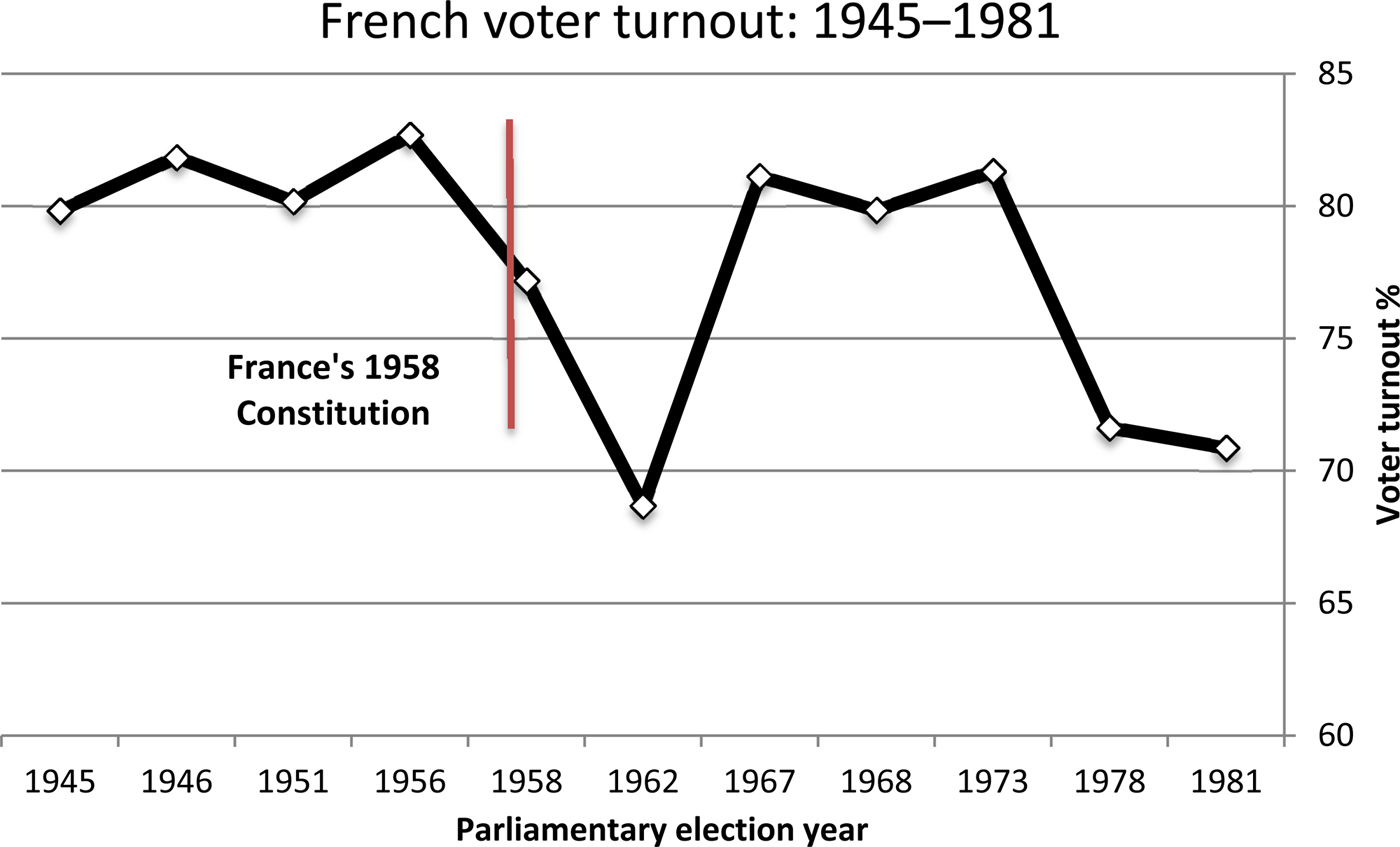
A prominent example of how a new constitution could potentially affect voting is France's 1958 constitution. Figure 1 below displays French voter turnout from 1945 to 1981, with the vertical line marking the implementation of the constitution.
French voter turnout from 1945–1981Footnote 105
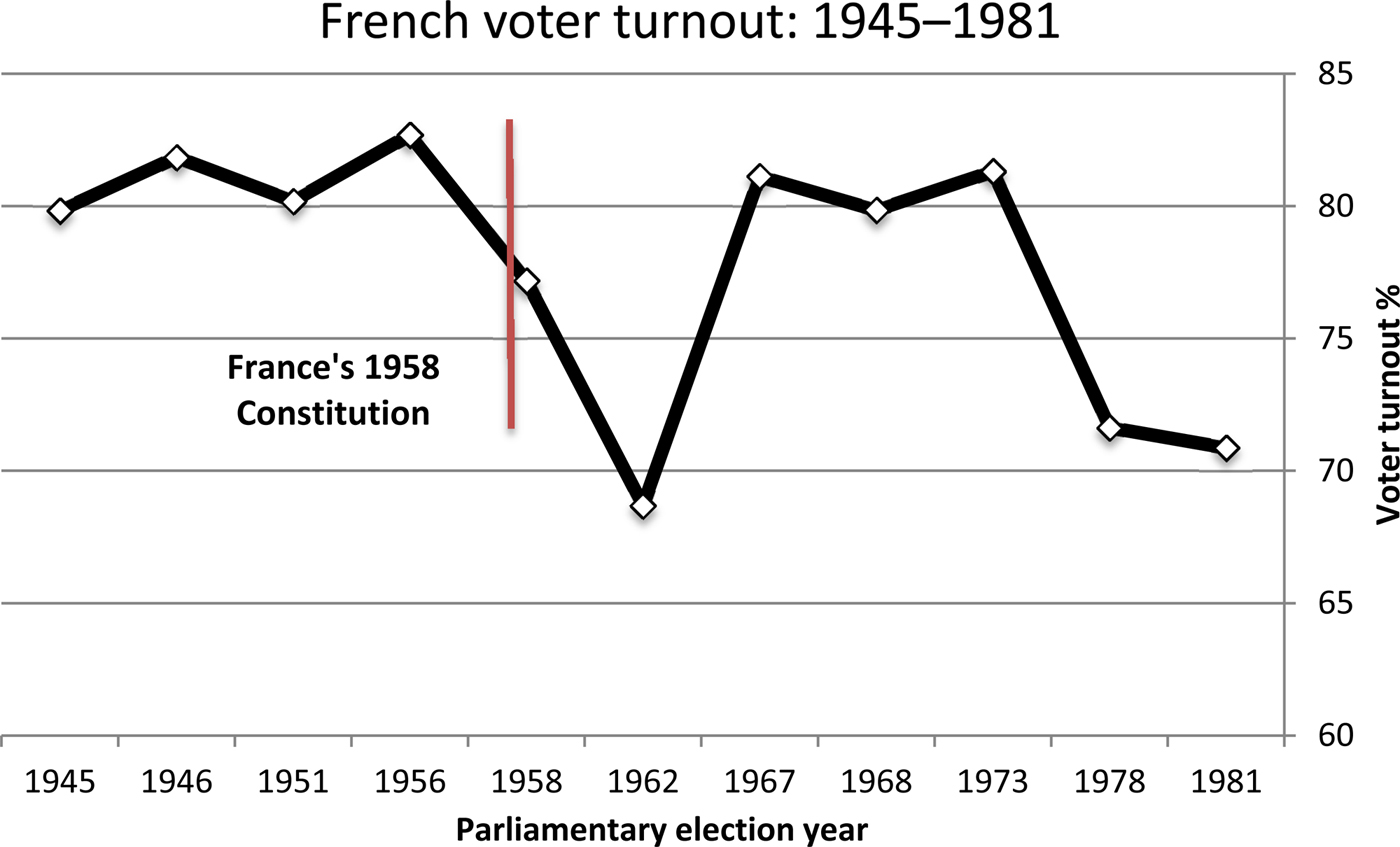
The timeline for France's 1958 Constitution was ideal for this study. The 1958 general elections were held on 23 and 30 November 1958, just six weeks after the adoption of the 1958 Constitution on 4 October 1958. Thus the elections were at least an indirect referendum on the 1958 Constitution. Given these circumstances, the results prima facie demonstrate that the populace was not on the whole more willing to participate in their democracy than they were in 1956, just two years before the Fifth Republic came into existence.
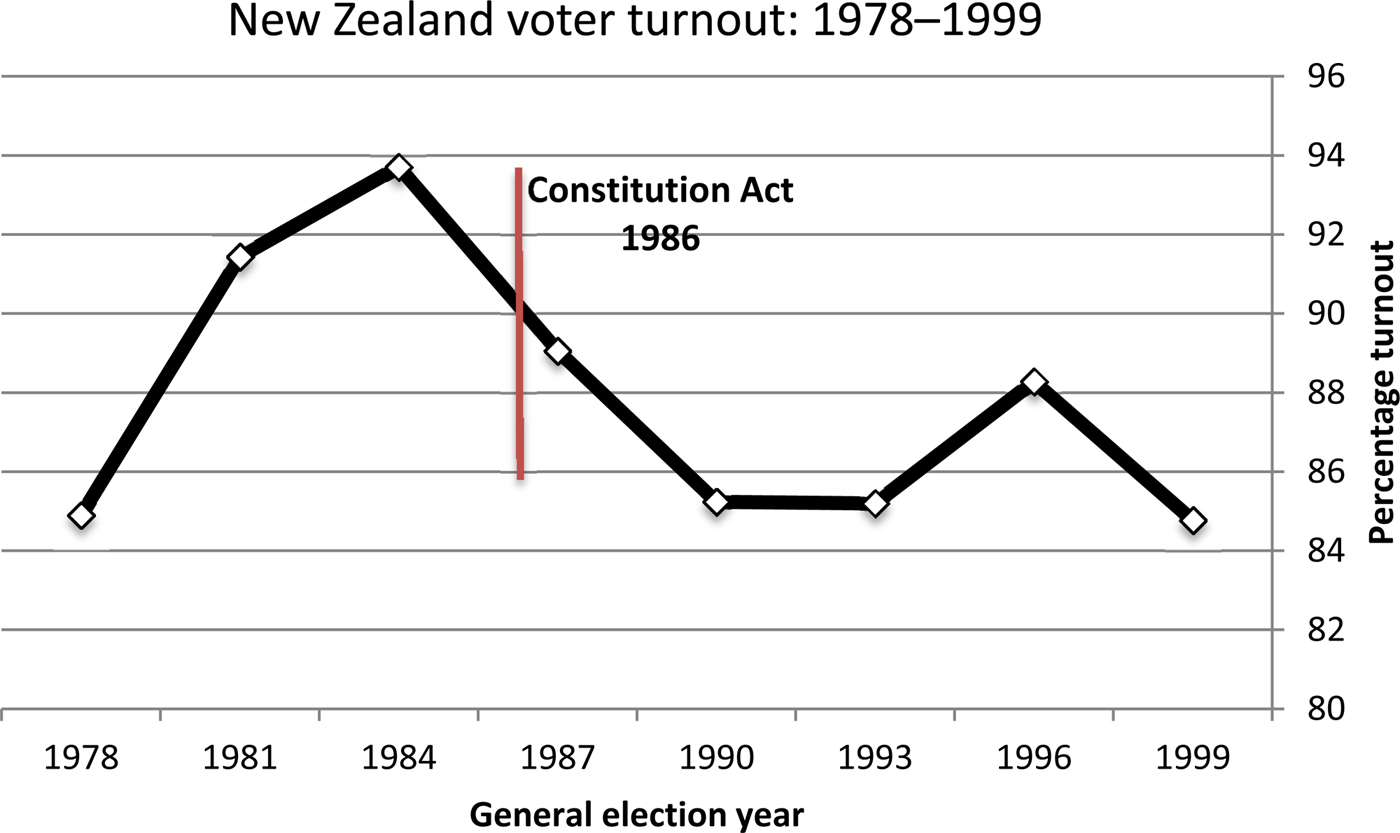
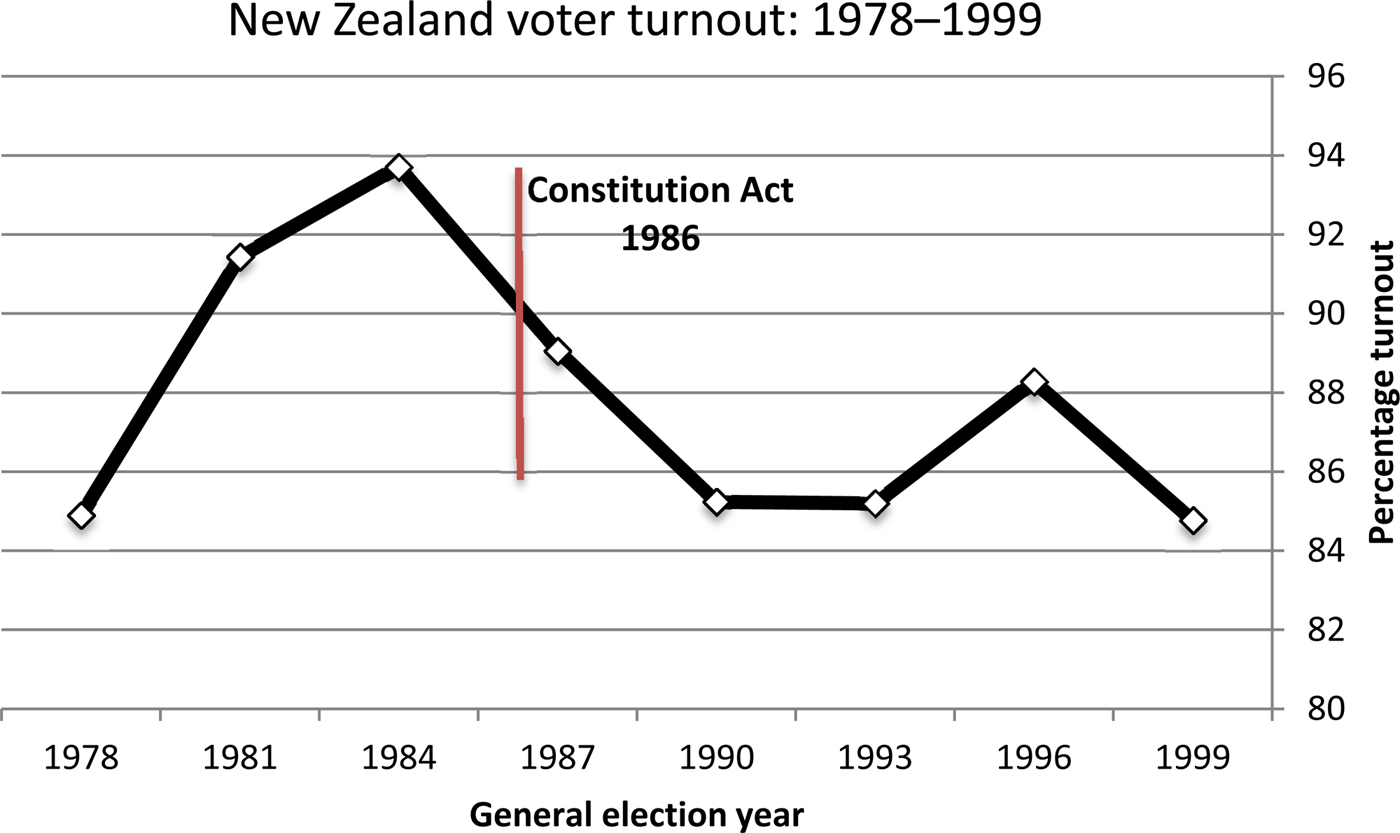
Analysing statutory constitutional documents can also prove fruitful, as the UK government has considered not necessarily enacting a constitution per se, but a constitutional statute.Footnote 107 New Zealand represents an interesting test case as regards both a constitutional statute and, as we will see below, a statutory bill of rights. New Zealand's Constitution Act 1986Footnote 108 is similar to what some have proposed for the UK: a small ‘c’ statutory constitutional statuteFootnote 109 that can be amended by another statute. But the Act, which came into force in 1987, did not appear to invigorate citizens or at least persuade them to go to the polls later that year, as voter turnout declined from 93.71% in 1984 to 89.06% in 1987. Although this is not a terribly significant decrease in voter turnout, it is nevertheless a decrease (see Figure 2).
New Zealand voter turnout 1978–1999Footnote 106
Of course, the above are merely two examples. Other states that have introduced new constitutions have had similar, and at times dramatic, experiences as regards voting turnout. Colombia held parliamentary elections in 1990 that garnered a 55.33% turnout.Footnote 110 A year later a new Colombian Constitution came into existence on 4 July 1991. Merely three months later, on 27 October 1991, parliamentary elections were held. Although it is acknowledged that citizens had just voted a year earlier and may have been ‘turned off’ politics, the 1991 turnout garnered Colombia's lowest recorded voter turnout ever: 33%.Footnote 111 This was a dramatic 22 percentage point drop from the previous year. A similar event occurred in Spain. After Francisco Franco died in 1975, Spain held a general election in 1977 that garnered a turnout of 76.96%.Footnote 112 In 1978 a draft Constitution was written, a constitutional referendum was held on 6 December 1978, and the formal Spanish Constitution was adopted on 27 December 1978 by King Juan Carlos I. However just over two months after constitutional ratification, a general election was held on 1 March 1979, which produced a 68.13% turnout. This was an almost nine percentage point decrease from the 1977 election, and has remained the lowest voter turnout since Spain's post-Franco transition to democracy (the closest percentage to this came in the 2000 general election, which produced a 68.71% turnout).Footnote 113 These two prominent examples demonstrate provisional evidence that the implementation of new constitutions and their impact on voting must be further explored. In a thorough search of states that enacted new constitutions post-World War II, it was found that voting decreased after constitutional implementation in 44 countries.Footnote 114 Voter turnout was found to decline after implementation of constitutions in Albania (1998), Belize (1981), Croatia (1991), Hungary (2011), Malta (1964) and Poland (1997), among others. Further, the lowest post-WWII recorded vote phenomenon after constitutional implementation was found in 12 of those 44 countries, including: after Denmark's 1953 Constitution (80.8%);Footnote 115 Tunisia's 2014 Constitution (60.35%),Footnote 116 and the Central African Republic's 2016 Constitution (44.28%).Footnote 117 These examples provide tentative evidence that Hypothesis No 1 can be refuted.
Of course, this pattern does not always hold for newly-implemented constitutions, and there are many instances in which voter turnout increased. In the same search noted above, post-World War II new constitutions were found to produce an increase in voter turnout in 28 countries, including in Barbados (1966), Jamaica (1962), Honduras (1982), Morocco (2011), Nigeria (1999), Paraguay (1992), Sweden (1974) and Switzerland (1999), among others. Findings regarding the opposite of the ‘lowest recorded vote’ phenomenon noted above – the ‘highest recorded vote phenomenon’ – occurred in 10 of the 28 states. Senegal is a prominent example of such an effect, as its voter turnout jumped from 39.28% to 67.26% after passage of its 2001 Constitution.Footnote 118 However, my argument is not that voter turnout always falls, and it is not within this study's scope to analyse cases of voter increase; my job here is merely to demonstrate that constitutions do not always invigorate democracies.
5. Bills of rights and democratic participation
This section will analyse Hypothesis No 2, that newly-enacted bills of rights are likely to increase voter turnout. Although bills of rights are common in newly-enacted constitutions, enactments on their own do not occur as frequently. Thus, there were fewer data to analyse as regards these documents. The section begins with a case study on the HRA 1998, and then moves to other examples.
Case study: the Human Rights Act 1998
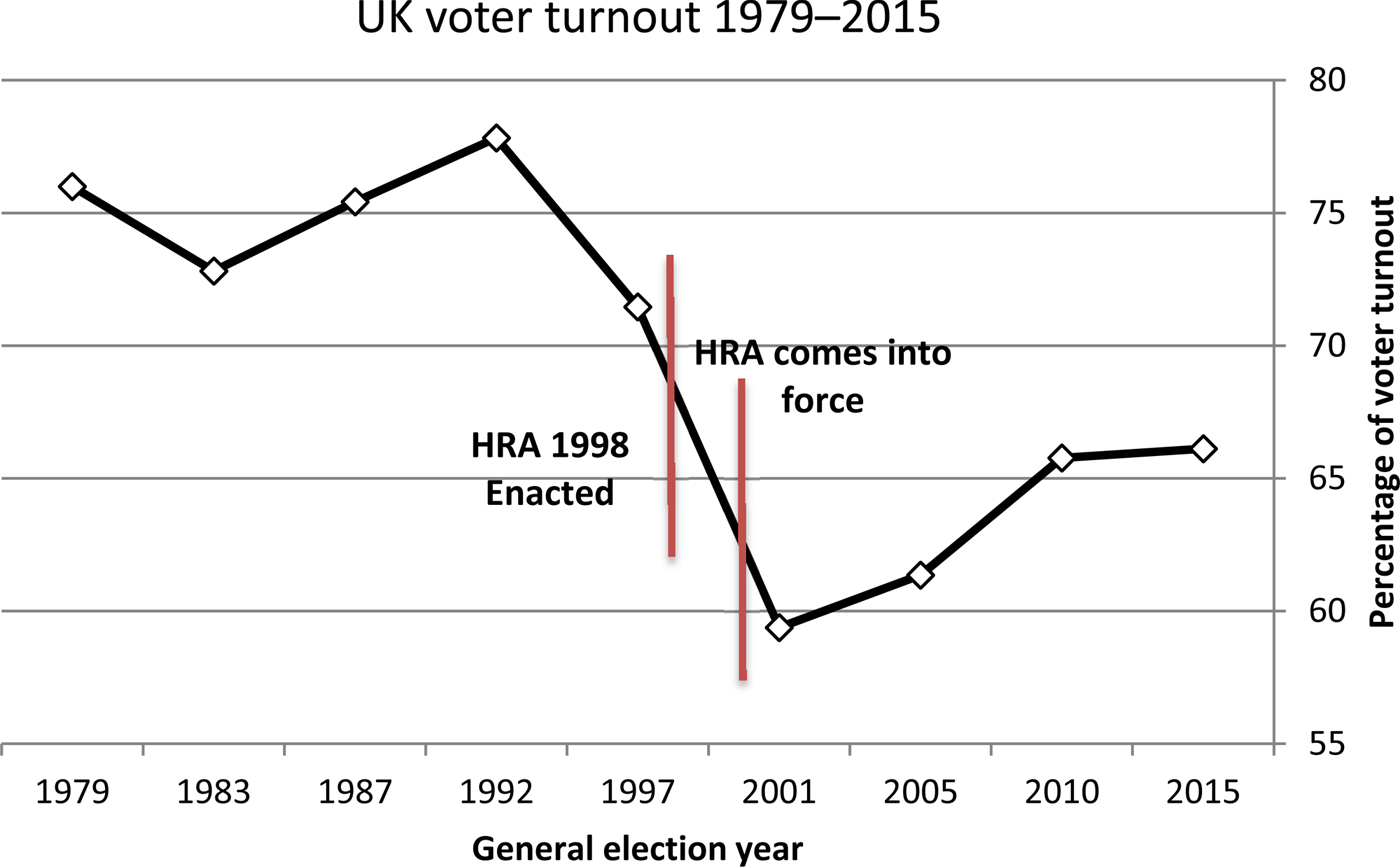
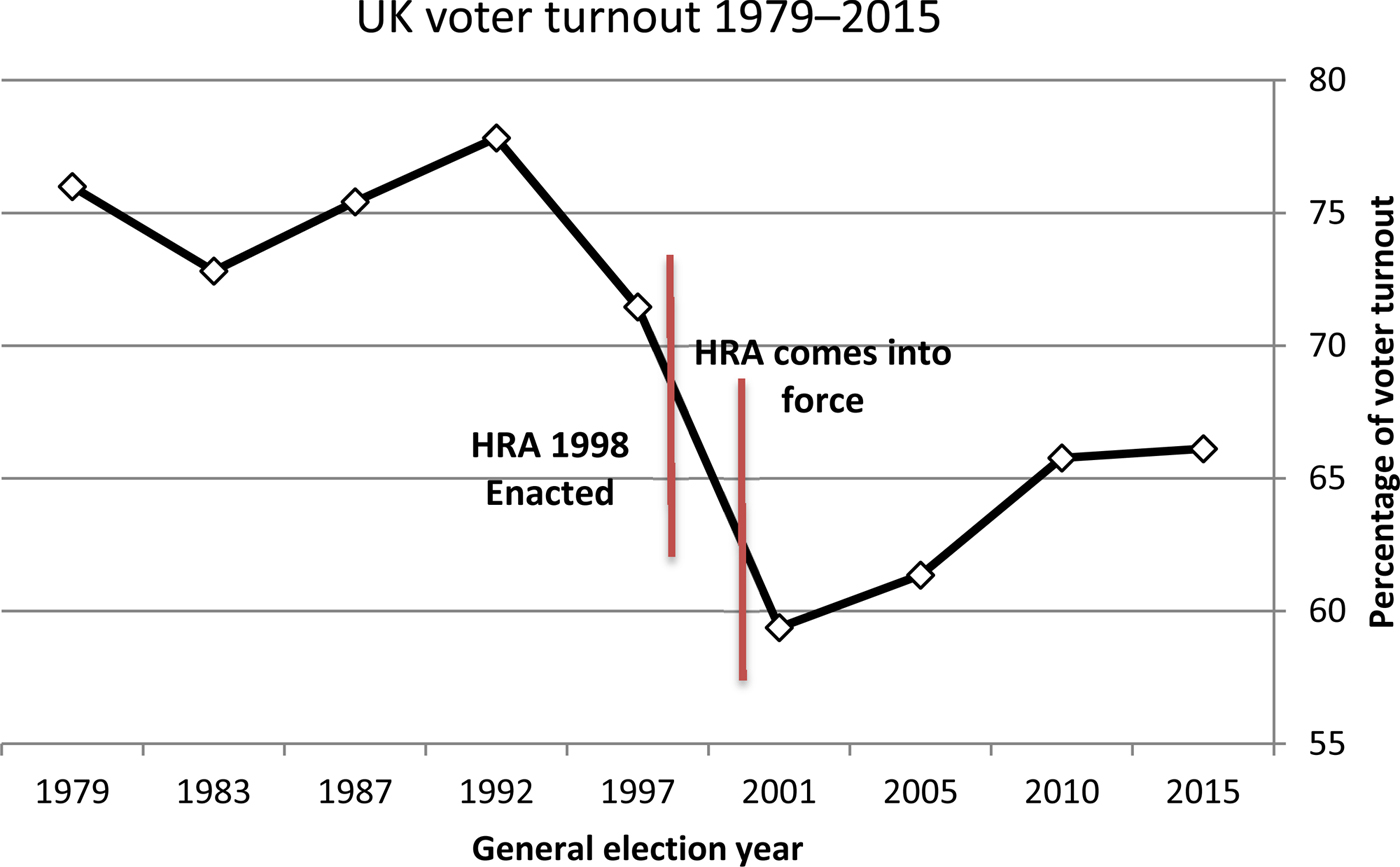
Both when it was proposedFootnote 120 and after its enactment, the HRA 1998 has predominantly been viewed as a ‘bill of rights’ for the UK, and to a large extent – both by the legal and political establishment – it has been treated as such.Footnote 121 Although passed in 1998, the measure did not fully come into force until 2000. Given that there was a general election in 1997 and another in 2001, this supplies ideal evidence in terms of examining the potential effects on UK voter turnout both before the HRA and after its implementation.
But such an analysis must be put into context. The general election in 1997 was a sweeping victory that brought into power Tony Blair and New Labour. The election was characterised as a case of low voter turnout, given that up to that point turnout was the lowest in the post-war period, at 71.46%.Footnote 122 However, given the 1983 general election turnout (72.81%), it could not have been too shocking. Even though no structural changes to the voting mechanisms in Britain had taken place (as there was in 1970, when the voting age was changed from 21 to 18),Footnote 123 Labour was ‘widely anticipated’ to win the election.Footnote 124 Thus the 1997 voting turnout figures, after almost two decades of Conservative leadership, were hardly surprising.
The results of the 2001 election, just after the HRA 1998 fully came into force, were stunning: voter turnout dropped over 12 percentage points, from 71.46% to 59.38% (see Figure 3). The 2001 election was also marked by what was described as ‘voter apathy’ across the board (one academic termed it an ‘apathetic landslide’).Footnote 125 But the election also made history: the turnout ‘was the lowest in a general election since universal adult franchise was established in Britain in the 1920s’.Footnote 126 Indeed, the result remains the lowest turnout in UK post-war history. Purely socio-economic or demographic changes cannot explain the difference in turnout, as the 2001 vote was only four years after the previous one; and indeed, no significant voting mechanisms had changed. Thus, other factors must have influenced the figures. A significant finding from the British Election Study (BES) data was that the campaign failed to motivate potential voters and that many citizens were bored throughout.Footnote 127 The 2001 Labour victory was not a foregone conclusion, however. Usually after major landslide elections, such as occurred in 1997, normality (ie, more competition) returns to the political sphere; in fact this had happened with every major Labour peak going back to 1929 (including those in 1945 and 1966).Footnote 128 Yet the 2001 general election broke the trend back to competition, thus maintaining Labour's distinct advantage over the Conservatives. Again, even though causal inferences cannot be directly connected to the HRA lowering voter turnout, the results still call into question what effect, if any, the constitutional statute had on citizens’ motivation to vote.
UK voter turnout from 1979–2015Footnote 119
Other recent bills of rights
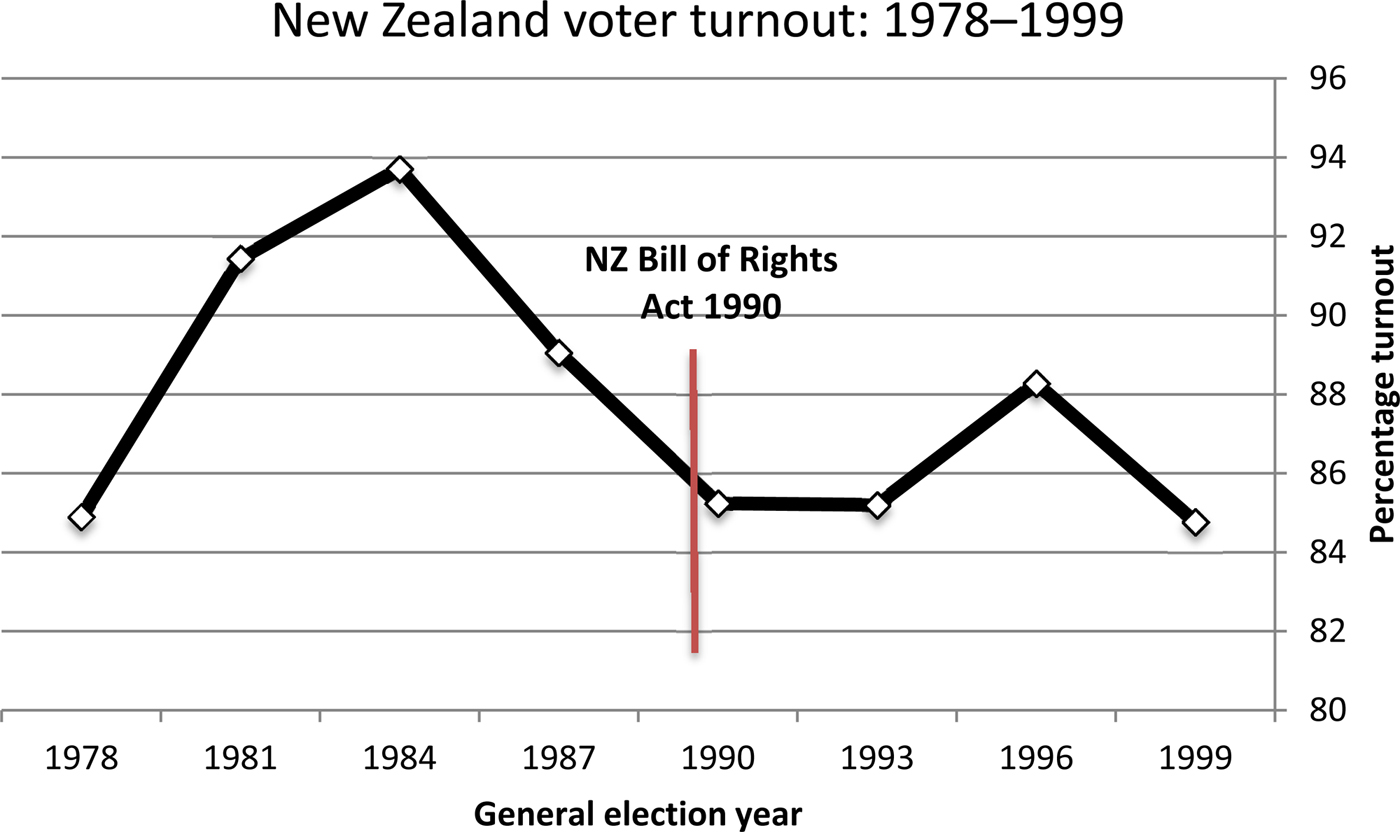
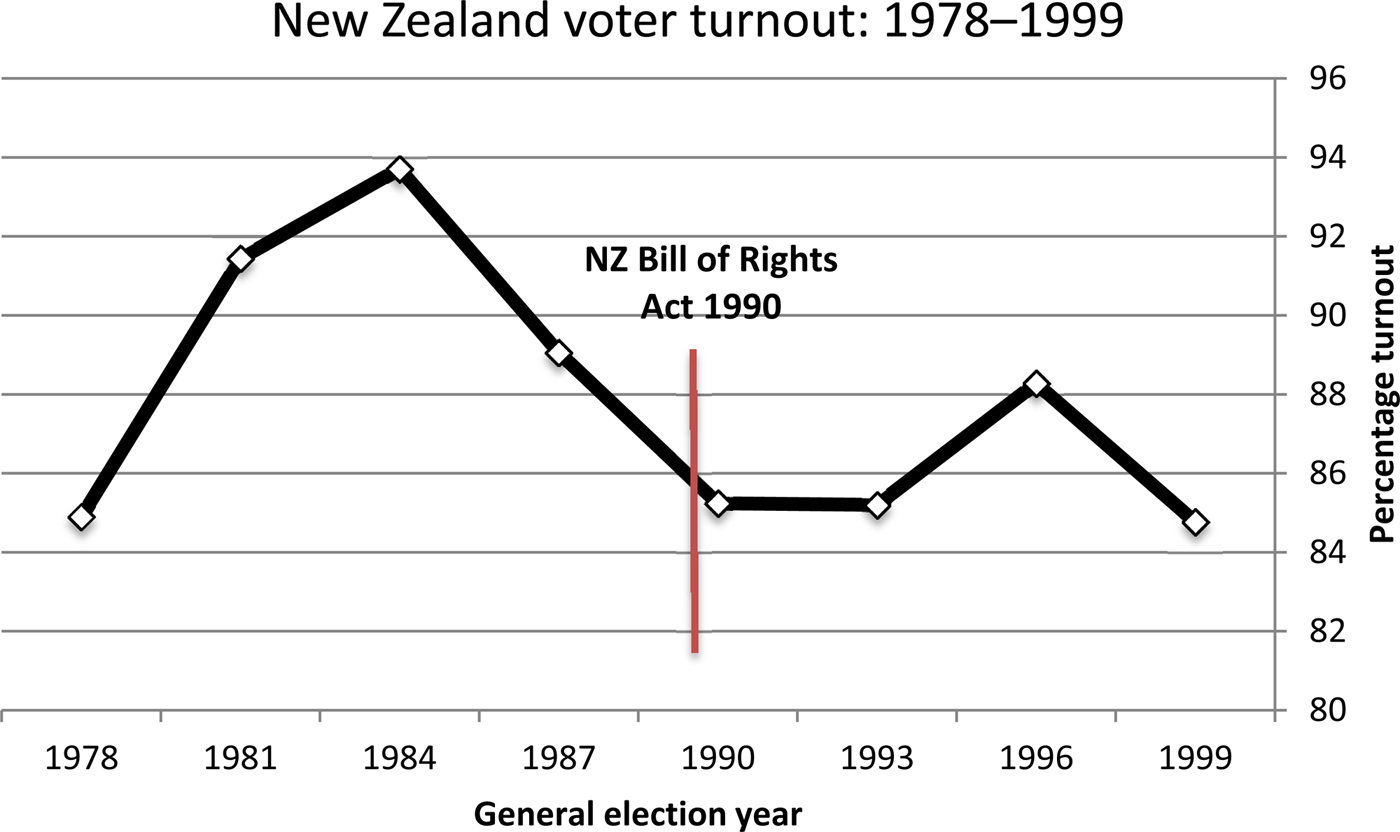
To provide an example from a Westminster-style government who also enacted a statutory bill of rights relatively recently, we return to New Zealand, where shortly after their 1986 constitutional statute, the New Zealand Bill of Rights Act 1990 was enacted.Footnote 129 Recall that after the 1986 Act was passed, turnout dropped over four percentage points. The 1990 Act was passed in August and came into force that September. The general election of 1990 was held on the 27 October 1990, and again there was a 4% decrease in the voter turnout (from 89.06% in 1987 to 85.24% in 1990: see Figure 4). The intriguing element regarding both the 1987 vote (after the Constitution Act) and the 1990 vote is that the general elections were held relatively soon after each major constitutional statute was passed; yet after the passing of each super-statute, voting turnout dropped – again, not significantly, but a drop nevertheless. Thus, over a span of six years and two very significant constitutional statutes, New Zealand voter turnout dropped from the low-90s to the mid-80s, as can be seen in the figure below.
New Zealand voter turnout 1978–1999
Outside of Westminster-style democracies, another recent example of a bill of rights coming into effect is the Charter of Fundamental Rights and Basic FreedomsFootnote 130 that was enacted in 1991 by what was known at the time as the Czech and Slovak Federal Republic, preceded by Czechoslovakia, and which has subsequently become the Czech Republic and Slovak Republic, respectively. The document continued to remain in force in both countries after their split in 1992. The 1991 bill of rights was modelled after the US Bill of Rights, but was a bit more expansive in some respects. The data demonstrates that there was a significant drop in voter turnout after the Charter was implemented, from 96.33% in 1990 to 84.68% in 1992.Footnote 131 And while the 1990 figure was extremely high, and could be the result of the excitement regarding a newfound democracy, the 1992 figure of 84.68% – just two years later – represents almost a 12 percentage point decrease in voter turnout; another tentative sign that bills of rights may not invigorate polities. Altogether, the case studies above provide provisional evidence that Hypothesis No 2 can be refuted.
6. Major constitutional amendments
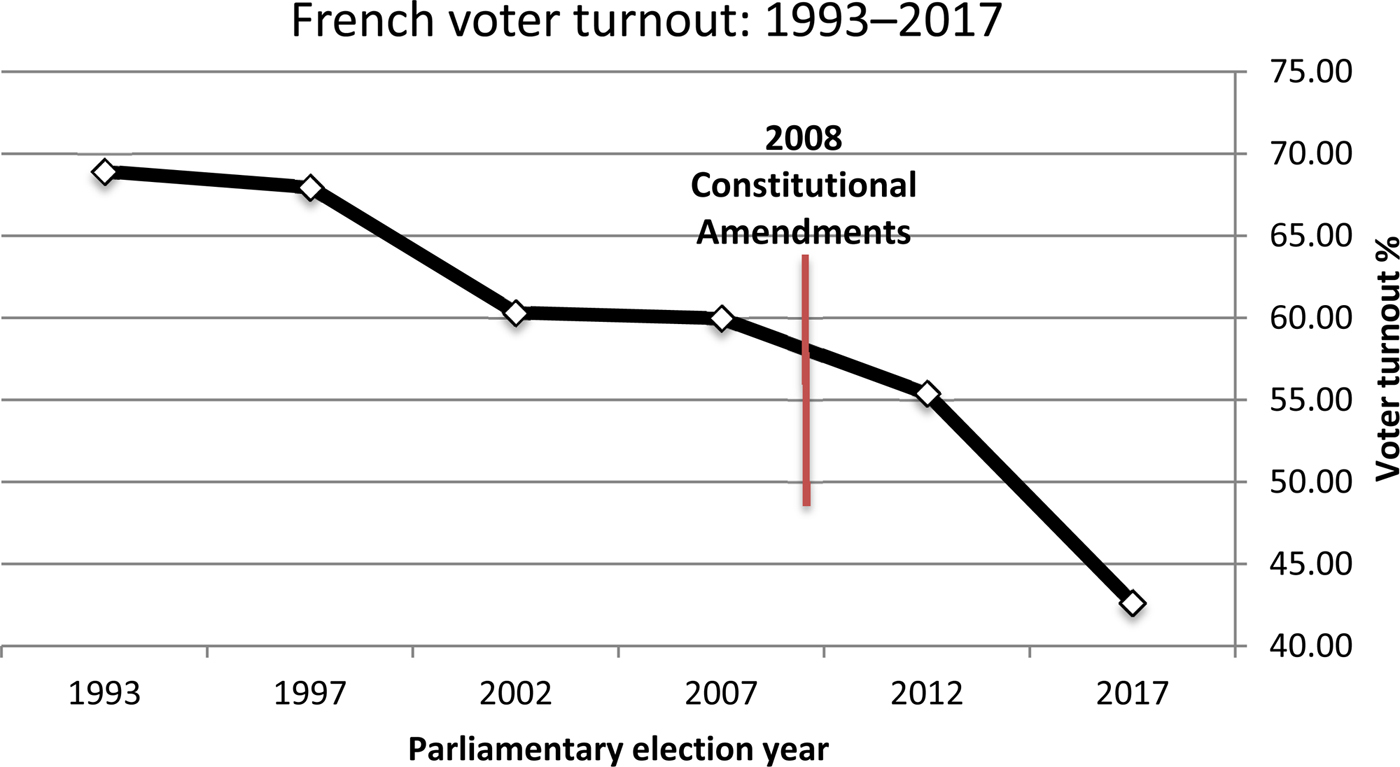
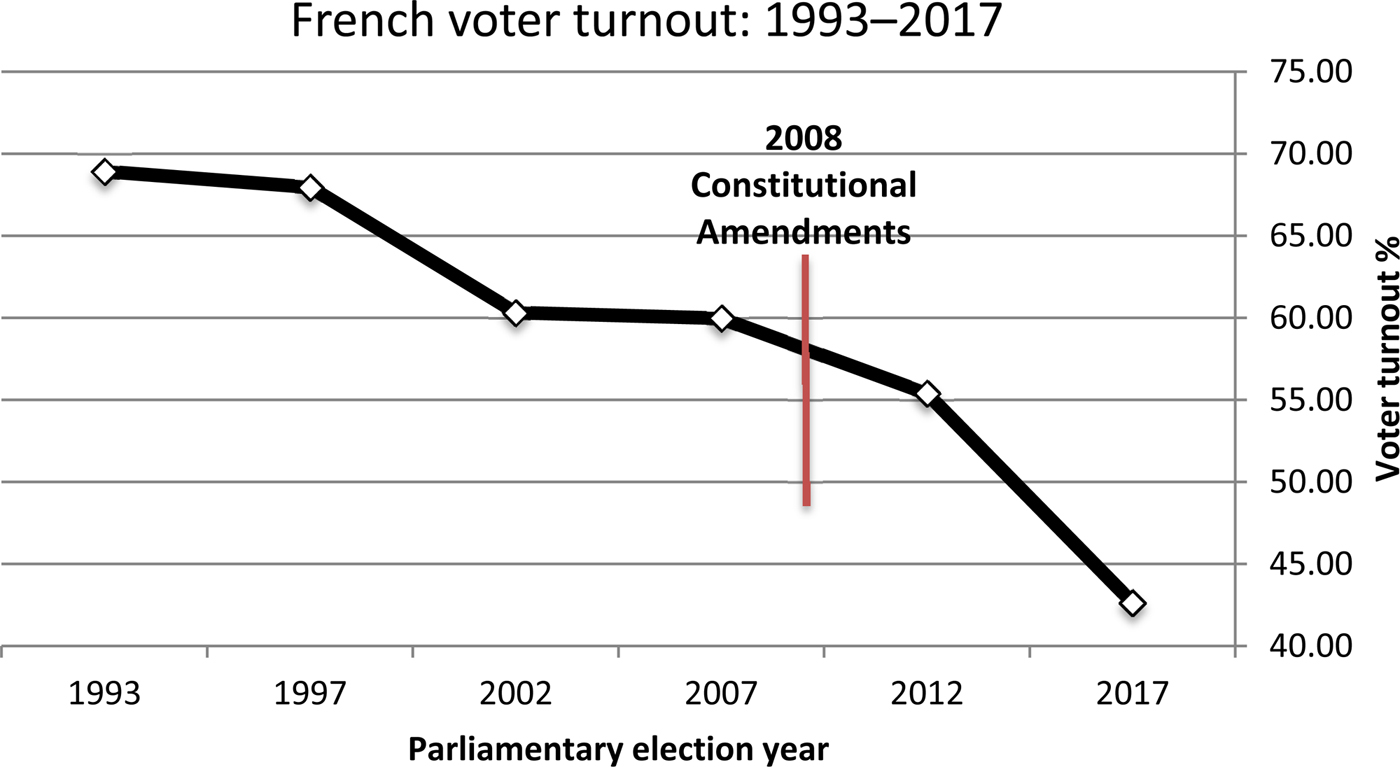
France's 1958 Constitution mentioned above was subject to its most significant amendments in 2008, which some scholars say saved or continued the existence of the Fifth Republic.Footnote 133 Details of the constitutional amendments included various changes regarding major French institutions. Boyron notes that the 2008 reforms achieved three major aims: increasing the powers of Parliament, strengthening judicial independence and bolstering the rights and status of citizens.Footnote 134 Although these appear to be positive democratic changes, voters did not reply with enthusiasm after they were made. Voter turnout slipped over four percentage points, from 59.98% to 55.40% (see Figure 5), which at the time was France's lowest voter turnout in the post-war era; it has since dipped even further, to 42.64% in the 2017 parliamentary election.
French voter turnout 1993–2017Footnote 132
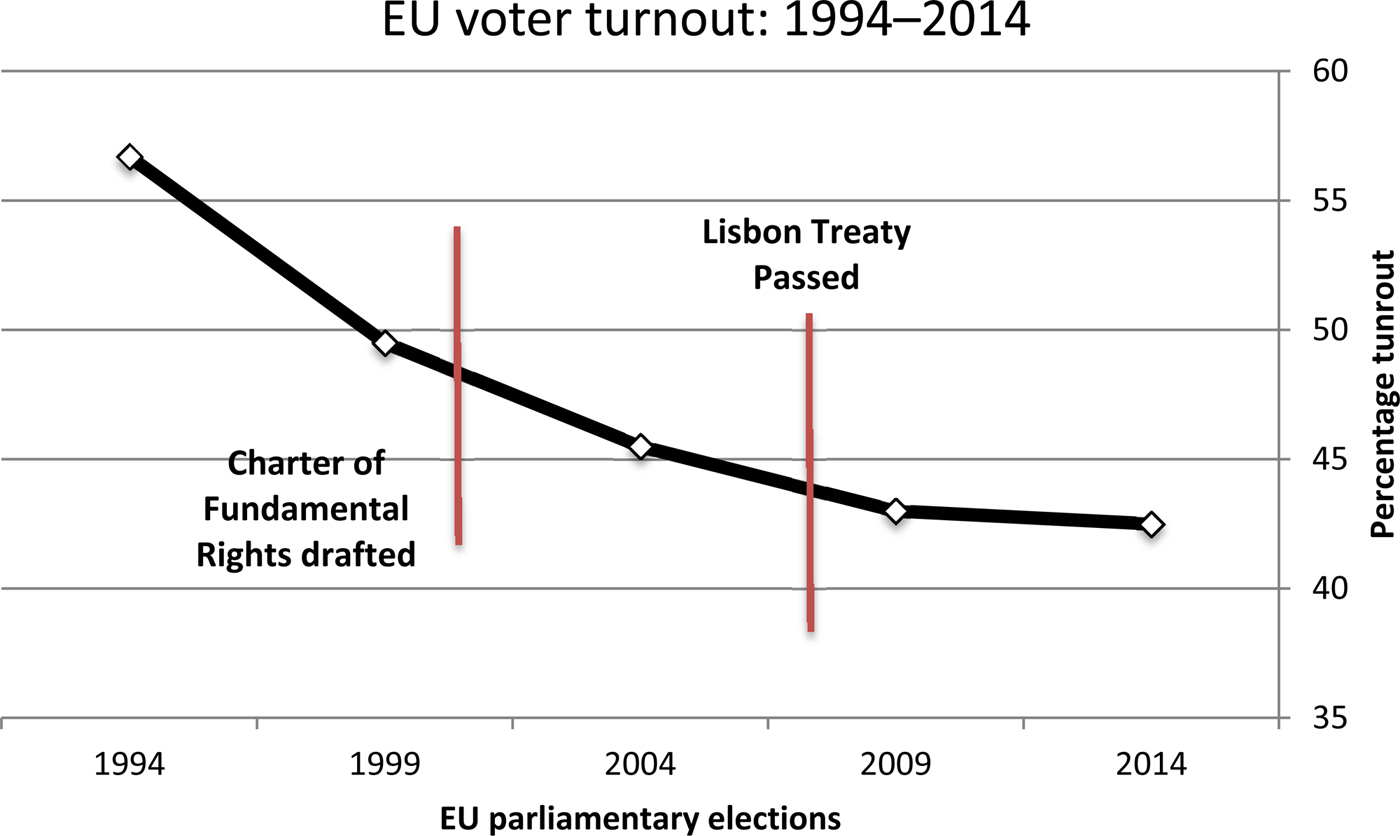
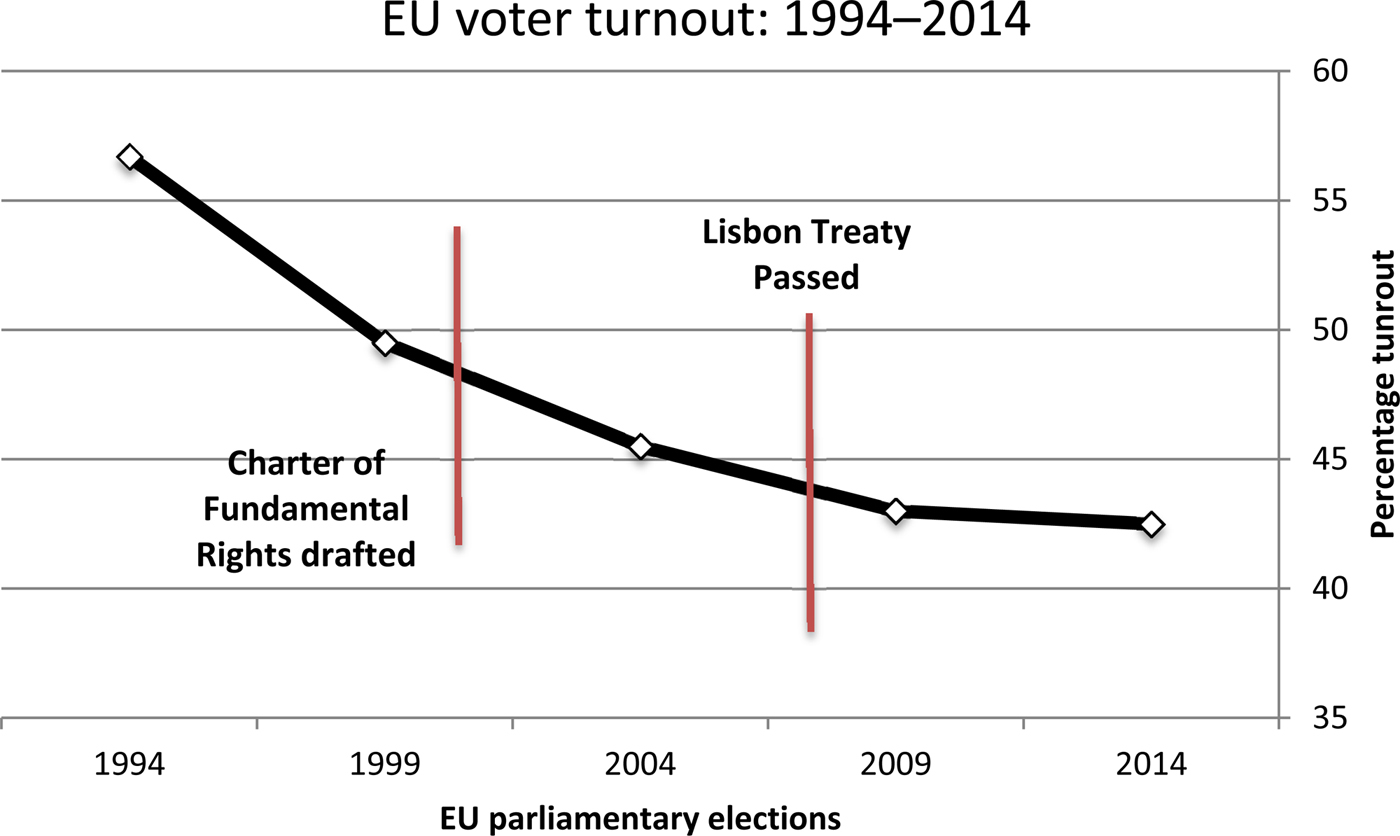
Breaking away from country-based analysis, a significant example of major constitutional amendments can be provided by examining a supra-national entity: the EU. Although some may object to a body such as the EU being included in this analysis, there is little doubt that it incentivises a form of European citizenship, and in some ways, such as through its rights operations and political structure, resembles a nation-state. Indeed, a wide variety of scholars have critically analysed the EU as nation-state – even before the Lisbon Treaty came into effect.Footnote 136 Here there are two major aspects to examine in terms of ‘constitutional’ amendments: the Charter of Fundamental Rights of the European Union and the Treaty of Lisbon. The former – in essence a bill of rights for the EU – preceded the Lisbon Treaty, being created in October 2000 and ratified in December of that same year by the European Parliament, the Council of Ministers and the European Commission. The Lisbon Treaty – in essence a ‘constitution’ for the EU – was introduced after the failure of the Treaty Establishing a Constitution for Europe.
EU parliamentary elections are held every five years. When the EU held parliamentary elections in 1999, before ratification of the Charter, voting turnout was 49.5%.Footnote 137 The next elections took place in 2004, and the result was lower voter turnout: 45.5% (see Figure 6). However, at the time the Charter's legal status was in question, as it had not yet been ratified by the EU Member States. The time for ratification came in 2007, as the Charter was included as a significant part of the Treaty of Lisbon (ratified 13 December 2007, but did not come into force until 1 December 2009). With the Treaty already passed and due to come into force, European parliamentary elections were held in June 2009. It was no secret that the Treaty was a significant issue throughout Europe. And yet, voting turnout dropped again in 2009 to 43%, from 45.5% in 2004. Some may dispute the inferences to be drawn from using the 2009 elections to measure the significance of the Lisbon Treaty, as technically it had not yet come into force. If so, we can use the 2014 elections to measure potential success. Again electoral numbers dropped here, but only marginally, to 42.5%, a 0.5% decrease from 2009. Altogether, it appears that the Charter, and more widely, the Lisbon Treaty, did not invigorate citizens and thus improve voter participation. These case studies provide tentative evidence that Hypothesis No 3 can be refuted.
Total EU voter turnout (1994–2014)Footnote 135
A positive impact on voter turnout?
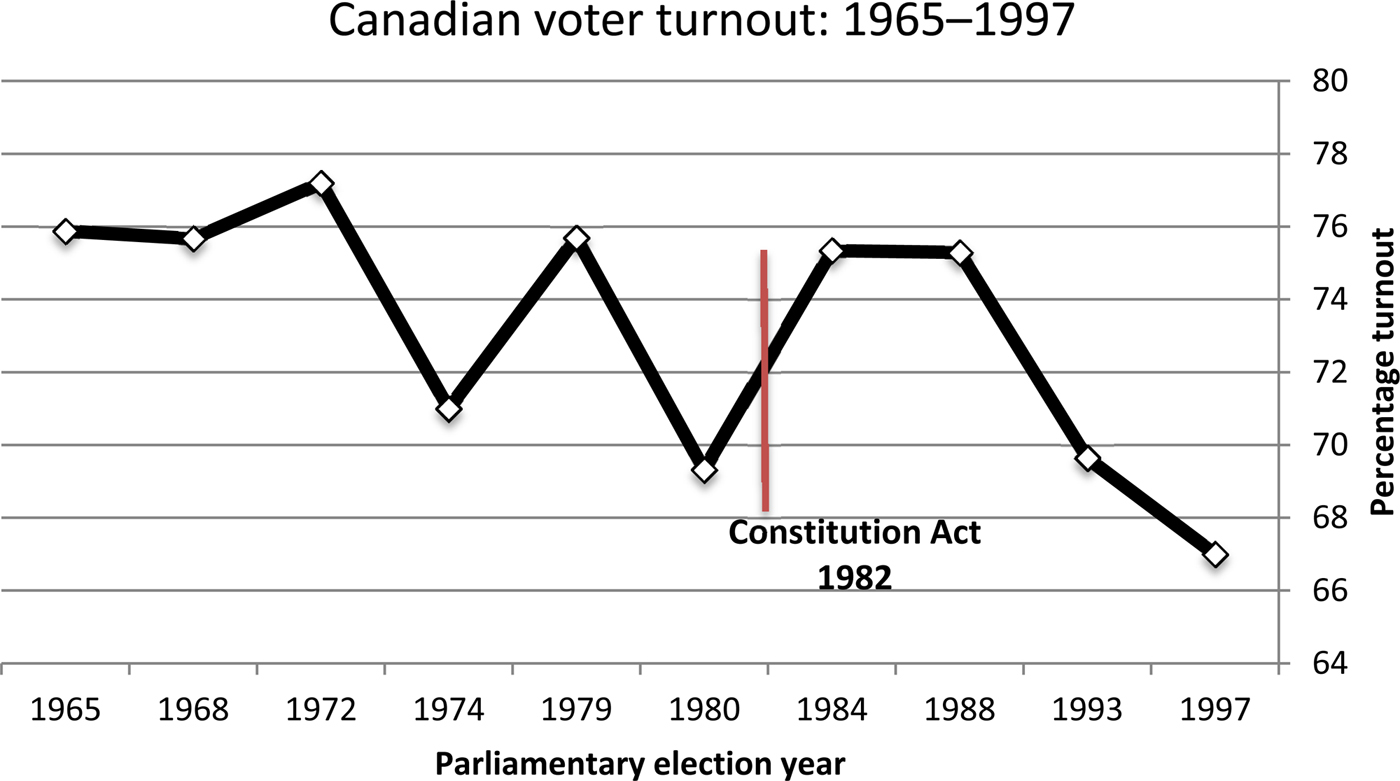
But of course all constitutional amendments do not result in lower voter turnout. An example of a significant constitutional amendment – which included a bill of rights – that prima facie significantly aided voter turnout is from Canada: the Constitution Act 1982. This is classified as a constitutional amendment because Canada's constitution is a mix of written (31 statutes and orders) and unwritten principles, and there is no one controlling fundamental statute on which the Canadian constitution operates.Footnote 139 Nevertheless the 1982 Act, which included the Canadian Charter of Rights and Freedoms,Footnote 140 may have played a role in energising voters for at least a couple of election cycles. In particular, the 1980 vote, which occurred before the Charter was put in place, had a voter turnout of 69.32%. Yet, as Figure 7 points out below, in the 1984 and 1988 elections, turnout increased to 75.34% and 75.29%, respectively.
Canadian voter turnout 1965–1997Footnote 138
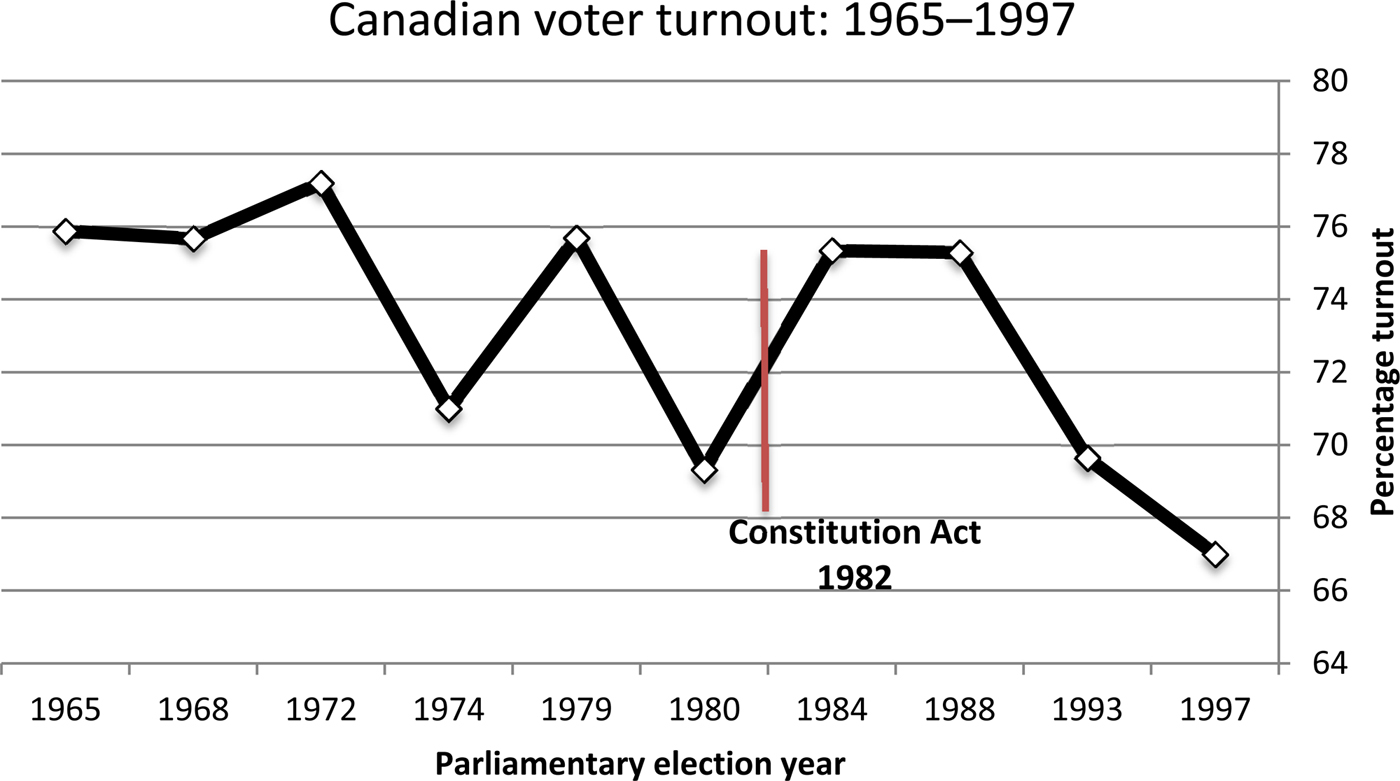
The Canadian numbers require more explanation, however, as the situation is not as straightforward as the passage of a constitutional statute and bill of rights. The 1979 election, which brought the Progressive Conservatives back into power with a minority government, was held less than nine months before the 1980 election. After the minority government was defeated in the Commons, a snap election was held in 1980, with the Liberal Party ascending to power. In 1982 the Canadian government received a form of ‘patriation’ from Britain through the Canada Act 1982,Footnote 141 which was part of a half-century long process of negotiations between the two nations.Footnote 142 Although Canada already had autonomous political independence from Britain, the 1982 Act thus completed the patriation of independence to Canadian citizens. The Act also entrenched civil rights within Canada's supreme law, and gave the judiciary the power to strike down laws inconsistent with the Charter.Footnote 143 The passage of two significant constitutional statutes, which provided full patriation and the entrenchment of newly-established rights, could have propelled Canadian citizens to turnout in higher numbers. In reality, however, the spike in voter turnout could be a distortion, as the low 1980 voter turnout was probably due to the previous election being held just nine months before. Scholars have also noted that higher rates of women were running for election to parliament during the 1984 election,Footnote 144 and that there was an ‘unprecedented’ change to media coverage of opinion polls that year,Footnote 145 two factors that may have positively influenced voter turnout. However, regardless of whether we consider these factors, it is difficult to claim that the Charter ‘invigorated’ Canada's democracy, as the 1984 election merely brought election turnout close to where it was for the 1979 election.
7. Placating, not invigorating, democracy
The ‘traditional’ or ‘intuitive’ argument that constitutions and bills of rights invigorate democracy through enhanced political participation has been challenged. Raw empirical voting data from a number of prominent case studies, in addition to a thorough search of post-World War II constitutional implementation, has provided provisional evidence that the Commons Report's overly simplistic understanding of the (perceived) effects of such devices does not hold, as in many cases voter participation decreased after implementation; thus, perhaps, placating – rather than invigorating – democracies. Therefore tendentious positive claims that constitutions and bills of rights can be inspiring, hold sacred value for citizens, and especially that they can ‘increase participation in the political process’ may need to be significantly re-evaluated and balanced with the recognition that such devices are not as powerful as previously thought.
The reason that some jurisdictions have seen a drop in electoral turnout after implementation is unclear, and it would be irresponsible to attribute the decreases solely to the implementation of constitutions, bills of rights, or constitutional amendments. Voting turnout is a multifaceted phenomenon impacted by a number of complicated factors (eg, interest in politics, perceived value of voting, political disenchantment). Nevertheless, the decreases found in many of the cases above cannot be ignored. Perhaps one explanation of such drops could be a reflection of what Pitkin and others have identified: that constitution-making is a highly political process that involves intense power struggles.Footnote 146 Such high-level political tussles could ultimately discourage democratic participation, rather than enhancing it. Additionally, a decrease in participation in some instances may be due to citizen placation or complacency: after the implementation of a constitution or bill of rights citizens may feel as if their states are in good working order, and thus feel less need to go to the polls. This could potentially explain the instances noted above – perhaps even after the HRA 1998 – in which constitutional or bill of rights implementation produced the lowest post-World War II voter turnout levels.
The issue of citizen sovereignty also needs to be addressed here. New constitutions and bills of rights are widely framed as ‘we the people’ documents that will increase citizen sovereignty. Given that the UK currently operates on a form of parliamentary sovereignty, the ‘we the people’ argument has been a common refrain in Britain for a codified constitution. But in reality the passage of contemporary constitutions and bills of rights often represent a significant curtailment of citizen power, as many of these newly-established documents provide the judiciary – not the citizenry, or even representatives elected by the citizenry – with ultimate powers to determine what is constitutional or unconstitutional within a state. Thus, are the decreases in political participation noted in the empirical section above an acknowledgement – and acceptance – by citizens that their power has been significantly curtailed? This could be another possible explanation for the decreases in democratic participation: citizens may recognise – or at least perceive – that their values and rights are now more entrenched, and being actively ‘protected’ by the judiciary. But given the prominent ‘we the people’ framing of such documents that countries have repeatedly engaged in, this explanation seems unlikely. As Larry Alexander has noted, ‘the real question is whether the people are actually aware of what is going on’ in terms of how judicial review can amend a constitution.Footnote 147 If citizens do realise how easily ‘we the people’ constitutions are amended by the judiciary, then ‘a constitutional crisis awaits’.Footnote 148
So, where are we in terms of constitutions being invigorating or placating democratic mechanisms? Above I have argued that if performative democratic constitutions, bills of rights and notions of ‘we the people’ popular sovereignty hold such high value within democracies, then voting turnout is a realistic and justified measurement of constitutional contentment. And yet, in some cases after the enactment of new constitutions, bills of rights or major constitutional amendments – for whatever reason – states experienced a decline in voter turnout; such was the case in the UK after implementation of the HRA 1998, and the UK still has not climbed back to its pre-HRA voter turnout levels.Footnote 149 This finding leads to the conclusion that while constitutions and bills of rights may serve larger goals as regards organising the state and entrenching fundamental rights, they could also contain democracy-hindering downsides – or, at the very least, may not be as politically powerful or inspiring as once thought. Whatever the implications of the above empirical data, there remains little doubt that more research is necessary into the connection between constitutions and democratic performance, such as voting.
The consequences of such constitutional placation are important for democracy. The more that citizens feel a sense of placation or complacency about their constitutional settlements, two significant results may occur: (1) citizens will be less likely to be the watchful eye or critical voice that democratic states require; and (2) when citizens are less engaged with their democratic functions (ie through voting), unelected actors within a state – such as the judiciary – become much more powerful,Footnote 150 thus diminishing citizen control. As citizens we must concede both the positives and negatives that constitutions and bills of rights offer. In many situations democracy may be placated, not invigorated, through the enactment of such texts.