Introduction
Chronic fatigue syndrome (CFS) is defined by a severe and unexplained fatigue of at least 6 months duration, resulting in a substantial reduction in occupational or leisure activities (Fukuda et al. Reference Fukuda, Straus, Hickie, Sharpe, Dobbins and Komaroff1994; US Centre for Disease Control). Secondary symptoms include self-reported memory and concentration problems, tender lymph nodes, muscle pain, multi-joint pain, sore throat, headaches, unrefreshing sleep and post-exertional malaise; four or more of which must be present for a diagnosis of CFS. Interestingly, cognitive problems are one of the most frequent and disabling symptoms associated with this disorder (Abbey & Garfinkel, Reference Abbey and Garfinkel1991), with 89% of people with CFS reportedly experiencing memory and concentration problems (Jason et al. Reference Jason, Richman, Rademaker, Jordan, Plioplys, Taylor, McCready, Huang and Plioplys1999). This raises the question of whether these problems translate to measurable deficits on objective cognitive tests.
Research conducted over the past 20 years has provided some evidence of cognitive deficits in people with CFS (e.g. Grafman et al. Reference Grafman, Schwartz, Dale, Scheffers, Houser and Straus1993; Smith et al. Reference Smith, Pollock, Thomas, Llewelyn and Borysiewicz1996; DeLuca et al. Reference DeLuca, Christodoulou, Diamond, Rosenstein, Kramer and Natelson2004a), although the results are inconsistent (e.g. Krupp et al. Reference Krupp, Sliwinski, Masur, Friedberg and Coyle1994; Short et al. Reference Short, McCabe and Tooley2002). For example, while some studies have reported deficits in complex information-processing speed (e.g. DeLuca et al. Reference DeLuca, Johnson, Beldowicz and Natelson1995; Johnson et al. Reference Johnson, Lange, DeLuca, Korn and Natelson1997; Marshall et al. Reference Marshall, Forstot, Callies, Peterson and Schenck1997), other studies have not (e.g. Kane et al. Reference Kane, Gantz and DiPino1997; Short et al. Reference Short, McCabe and Tooley2002). Contradictory findings have also been noted for tests of verbal memory, with some (e.g. Michiels et al. Reference Michiels, Cluydts and Fischler1998; Tiersky et al. Reference Tiersky, Cicerone, Natelson and DeLuca1998; Vercoulen et al. Reference Vercoulen, Bazelmans, Swanink, Galama, Fennis, van der Meer and Bleijenberg1998), but not all (e.g. Fiedler et al. Reference Fiedler, Kipen, DeLuca, Kelly-McNeil and Natelson1996; Lawrie et al. Reference Lawrie, MacHale, Cavanagh, O'Carroll and Goodwin2000) studies finding that CFS is associated with poorer performance. Similar inconsistencies are apparent for other cognitive domains.
Methodological limitations are likely to contribute to some of the variation in findings, along with the suggestion that any deficits are likely to be relatively subtle (Moss-Morris et al. Reference Moss-Morris, Petrie, Large and Kydd1996; Tiersky et al. Reference Tiersky, Johnson, Lange, Natelson and DeLuca1997). One limitation of some early studies is that they failed to use control groups (e.g. Altay et al. Reference Altay, Toner, Brooker, Abbey, Salit and Garfinkel1990; McDonald et al. Reference McDonald, Cope and David1993; Schmaling et al. Reference Schmaling, DiClementi, Cullum and Jones1994) and, instead, used normative data that were not well-matched for age, education or IQ (see Tiersky et al. Reference Tiersky, Johnson, Lange, Natelson and DeLuca1997). Other studies did not use published CFS criteria, which may impact on sample selection (e.g. Prasher et al. Reference Prasher, Smith and Findley1990; Smith et al. Reference Smith, Behan, Bell, Millar and Bakheit1993; Krupp et al. Reference Krupp, Sliwinski, Masur, Friedberg and Coyle1994), or used small samples (n<15, e.g. Scheffers et al. Reference Scheffers, Johnson, Grafman, Dale and Straus1992; Sargent et al. Reference Sargent, Anderson and Budek1997). None of this research reported effect sizes to assess the magnitude of group differences independently of sample size and statistical significance, making it difficult to determine whether non-significant findings were due to poor statistical power. In addition, a wide variety of tests have been used to measure cognitive performance, which, in the absence of effect sizes to standardize test scores, cannot be directly compared. The present study therefore undertook a meta-analysis of research examining the cognitive performance of people with CFS, when compared with healthy controls, in order to determine whether CFS is associated with measurable deficits in cognitive functioning and the nature and magnitude of these deficits.
Method
Identification of studies
The PubMed and PsycINFO databases were searched for ‘chronic fatigue syndrome’ and alternate terms (chronic fatigue and immune dysfunction syndrome, chronic fatigue disorder, chronic fatigue-fibromyalgia syndrome, chronic infectious mononucleosis-like syndrome, myalgic encephalomyelitis, post viral fatigue syndrome and royal free disease) from January 1988 (when the first operational definition of CFS was published; Holmes et al. Reference Holmes, Kaplan, Gantz, Komaroff, Schonberger, Straus, Jones, Dubois, Cunningham-Rundles, Pahwa, Tosato, Zegans, Purtilo, Brown, Schooley and Brus1988) to November 2008.
All studies had to meet the following inclusion criteria: (a) CFS was diagnosed using Center for Disease Control (CDC) criteria (Fukuda et al. Reference Fukuda, Straus, Hickie, Sharpe, Dobbins and Komaroff1994) or earlier variants (Holmes et al. Reference Holmes, Kaplan, Gantz, Komaroff, Schonberger, Straus, Jones, Dubois, Cunningham-Rundles, Pahwa, Tosato, Zegans, Purtilo, Brown, Schooley and Brus1988; Sharpe et al. Reference Sharpe, Archard, Banatvala, Borysiewicz, Clare, David, Edwards, Hawton, Lambert, Lane, McDonald, Mowbray, Pearson, Peto, Preedy, Smith, Smith, Taylor, Tyrrell, Wessely and White1991; Schluederberg et al. Reference Schluederberg, Straus, Peterson, Blumenthal, Komaroff, Spring, Landay and Buchwald1992); (b) a healthy control group was assessed; (c) participants were adults (>16); (d) objective cognitive tests were administered (self-report measures were excluded); (e) if treatment was provided, cognition must have been assessed prior to treatment; (f) the provision of statistics that could be converted into a Cohen's d effect size (means and standard deviations; univariate F scores; t scores); (g) the study had been published in a journal; (h) it was written in English.
This search identified 4086 articles. The titles and abstracts of these articles were examined against the inclusion criteria. Full-text versions of 158 articles were obtained to establish study eligibility, with the reference lists of these papers yielding a further six articles. Of the 164 full-text articles, 27 were literature reviews or editorials and 137 were research studies; 56 of which met all of the inclusion criteria. Of the 81 research studies that were excluded, the primary reasons for this were that three did not assess a CFS group, 11 did not use the specified diagnostic criteria for CFS, 31 did not include a healthy control group, 22 did not administer cognitive tests, three only evaluated cognitive functioning after treatment, four used the cognitive test as an independent rather than dependent variable and seven did not provide statistics that would enable the calculation of effect sizes. The latter seven studies reported both significant and non-significant findings (three significant, two non-significant and two both significant and non-significant results), reducing the likelihood of any systematic bias resulting from the exclusion of studies with non-significant findings.
Data from different studies must be independent to ensure that any given sample of participants is not over-represented in the calculation of an effect size (Matt & Cook, Reference Matt, Cook, Cooper and Hedges1994). Seven studies with the same or overlapping participants were identified (and confirmed by the authors: Johnson et al. Reference Johnson, DeLuca, Diamond and Natelson1996, Reference Johnson, Lange, DeLuca, Korn and Natelson1997, Reference Johnson, DeLuca, Diamond and Natelson1998; DeLuca et al. Reference DeLuca, Johnson, Ellis and Natelson1997a, Reference DeLuca, Johnson, Ellis and Natelsonb; and DeLuca et al. Reference DeLuca, Christodoulou, Diamond, Rosenstein, Kramer and Natelson2004a, Reference DeLuca, Christodoulou, Diamond, Rosenstein, Kramer, Ricker and Natelsonb). These seven studies were therefore treated as three separate studies, reducing to 52 the number of independent studies that were eligible for analysis.
Data preparation
Each test was categorized into one of eight cognitive domains, based on information provided in test compendiums (Lezak et al. Reference Lezak, Howieson and Loring2004; Strauss et al. Reference Strauss, Sherman and Spreen2006) and descriptions provided by the test developer and/or the study authors. The cognitive domains were attention (working memory, attention span), memory, reaction time (RT), motor functioning, visuospatial ability, verbal abilities and language, cognitive reasoning and flexibility and global functioning.
Some of the 52 eligible studies did not report the data necessary to calculate effect sizes for all of the tests that they administered (N studies=19). For example, 13 studies did not provide standard deviations or exact p values for some of the tests, five did not provide data for non-significant findings and one failed to provide data for a single test. All authors were contacted in order to request the missing data, with only four authors providing the necessary data (Smith et al. Reference Smith, Pollock, Thomas, Llewelyn and Borysiewicz1996; Claypoole et al. Reference Claypoole, Mahurin, Fischer, Goldberg, Schmaling, Schoene, Ashton and Buchwald2001; Moss-Morris & Petrie, Reference Moss-Morris and Petrie2003; Schmaling et al. Reference Schmaling, Lewis, Fiedelak, Mahurin and Buchwald2003).
Composite test scores were sometimes calculated to provide comparable scores across studies (e.g. total score for the Paced Auditory Serial Addition Test). A small number of studies provided data for specific CFS subgroups: with and without coexisting psychiatric disorders (DeLuca et al. Reference DeLuca, Johnson, Ellis and Natelson1997a, Reference DeLuca, Christodoulou, Diamond, Rosenstein, Kramer and Natelson2004a, Reference DeLuca, Christodoulou, Diamond, Rosenstein, Kramer, Ricker and Natelsonb; Tiersky et al. Reference Tiersky, Matheis, DeLuca, Lange and Natelson2003); pre-morbid and no pre-morbid psychiatric history (Gaudino et al. Reference Gaudino, Coyle and Krupp1997; Tiersky et al. Reference Tiersky, Matheis, DeLuca, Lange and Natelson2003); depressed and non-depressed (Wearden & Appleby, Reference Wearden and Appleby1997); gradual versus sudden onset of CFS (DeLuca et al. Reference DeLuca, Johnson, Ellis and Natelson1997b); medicated versus medication free (Sargent et al. Reference Sargent, Anderson and Budek1997; Michiels et al. Reference Michiels, Cluydts and Fischler1998) and morning versus afternoon test administration (Lawrie et al. Reference Lawrie, MacHale, Cavanagh, O'Carroll and Goodwin2000). Unfortunately, there were too few studies to examine the data for these subgroups. The means for these subgroups were therefore averaged (weighting by sample size) and the standard deviations combined (Higgins & Deeks, Reference Higgins, Deeks, Higgins and Green2008) to provide a single score for the CFS group.
Effect size calculations and analyses
Cohen's d effect sizes were used in this study to determine whether persons with CFS demonstrated cognitive deficits relative to their healthy peers. This statistic measures the difference between the mean scores of two groups, divided by a pooled standard deviation (Cohen, Reference Cohen1988). If means and standard deviations were not available, standard errors were converted into standard deviations and t values and one-way F statistics were converted to d using the formulas provided by Zakzanis (Reference Zakzanis2001). Effect sizes were calculated in several stages. First, effect sizes were calculated for each test score that was used by an individual study. Next, if a study had more than one score for a test variable (e.g. per minute scores for a RT task), the effect sizes for these scores were averaged so that the study contributed only one effect size for each test variable. Effect sizes were then combined across studies. As small samples are associated with greater variability, which affects the reliability of the effect size (Lipsey & Wilson, Reference Lipsey and Wilson2001), it is recommended that an effect size be weighted by the inverse of its variance (i.e. the inverse of the squared standard error; Hedges, Reference Hedges1982). Thus, a mean weighted effect size d w was calculated for each test variable by summing the effect size for each study (weighted by its inverse variance) and dividing by the sum of the weights (Lipsey & Wilson, Reference Lipsey and Wilson2001). Additionally, effect sizes were calculated for each cognitive domain (i.e. attention, memory) by averaging the weighted effect sizes (weighted by sample size) of each study for that domain. If a single study provided multiple measures for a domain, a mean weighted effect size for that study was calculated before combining it with the effect sizes from other studies. According to Cohen (Reference Cohen1988), a small effect is defined as d=0.2, a moderate effect as d=0.5 and a large effect as d=0.8. A medium effect size of 0.5 indicates that the mean test performance of the two groups differs by half a standard deviation. All effect sizes were calculated in such a way that a positive effect size represented poorer performance by CFS participants.
For the weighted effect sizes 95% confidence intervals (Cls) were additionally calculated (Lipsey & Wilson, Reference Lipsey and Wilson2001), which if they do not span zero indicates a significant difference between the performance of the CFS and healthy control groups. As there is a tendency for journals to publish studies with significant findings (Easterbrook et al. Reference Easterbrook, Berlin, Gopalan and Matthews1991), fail-safe N (N fs) statistics were also calculated (Cooper, Reference Cooper1979). This statistic provides a measure of the number of unpublished studies with small effects (d=0.2) that would need to be in existence in order to reduce the mean weighted effect size d w to a small effect (Wolf, Reference Wolf1986). The larger the N fs, the more confidence can be placed in that finding.
Only those effect sizes for tests that were used by two or more studies are reported here because effect sizes that are based on a single study do not provide a reliable measure of group differences (Rosenthal, Reference Rosenthal1995). This removed the findings of two studies, resulting in a total of 50 studies that underwent analysis.
Data interpretation
Researchers and clinicians would be more confident that CFS has impacted on cognitive functioning if there were moderate to large group differences in the performance of people with CFS compared with healthy controls (d w⩾0.5), the performance of the two groups differed significantly (i.e. 95% CIs do not span zero) and that it was unlikely that unpublished findings would draw the current findings into question (i.e. the number of unpublished studies with non-significant findings is greater than the number of studies already published: N fs>N studies). For the purposes of the current meta-analysis, an effect size had to meet all three criteria in order to conclude that cognitive performance is compromised by CFS.
Results
Study and participant characteristics
The 50 studies included in the meta-analysis provided data for 1544 CFS participants and 1487 healthy controls (see Table 1). The majority of participants were female and approaching middle age, with participants ranging from 17 to 79 years of age. There were small and non-significant differences between the CFS and control groups in terms of their age [t(93)=−0.70, p=0.49; d=−0.17] and educational level [t(64)=1.72, p=0.09; d=0.42].
Descriptive statistics for the study participants

CFS, Chronic fatigue syndrome; HADS, Hospital Anxiety and Depression Scale.
The average duration of CFS was almost 6 years; however, participants in some studies had experienced CFS for up to 48 years. People with CFS experienced significantly greater levels of depression than healthy controls on the Beck Depression Inventory (BDI) [t(20)=−9.95, p<0.01, d=4.32] and the depression subscale of the Hospital Anxiety and Depression Scale (HADS) [t(14)=−9.83, p<0.01, d=6.05]. While the average BDI scores indicate clinical levels of depression, the use of this measure with CFS patients has been questioned (Farmer et al. Reference Farmer, Chubb, Jones, Hillier, Smith and Borysiewicz1996). In contrast, the mean HADS depression score, which has been validated for use with CFS patients (Morriss & Wearden, Reference Morriss and Wearden1998; Henderson & Tannock, Reference Henderson and Tannock2005), was within the normal to borderline range. For the eight studies that reported HADS anxiety scores, the average for the CFS group was also in the normal to borderline range, with moderate and significant differences to that of the healthy controls [t(14)=−2.43, p=0.03, d=0.51]. Psychiatric examinations were only undertaken by half of the studies (N studies=29), with 10 studies using them to exclude participants with a co-existing psychiatric disorder. Of the remaining studies that reported their results (N studies=10), approximately one third of their CFS sample had a co-existing psychiatric condition (35%, range 16–50%), which was primarily major depressive disorder or dysthymia (80%) and, to a lesser extent, panic disorder (18%), phobias (14%), anxiety (12%), post-traumatic stress disorder (1%) and obsessive compulsive disorder (1%).
The current CDC diagnostic criteria (Fukuda et al. Reference Fukuda, Straus, Hickie, Sharpe, Dobbins and Komaroff1994) was most frequently used to diagnose CFS (N studies=27), followed by the first published criteria (Holmes et al. Reference Holmes, Kaplan, Gantz, Komaroff, Schonberger, Straus, Jones, Dubois, Cunningham-Rundles, Pahwa, Tosato, Zegans, Purtilo, Brown, Schooley and Brus1988, N studies=15) and its various revisions (Sharpe et al. Reference Sharpe, Archard, Banatvala, Borysiewicz, Clare, David, Edwards, Hawton, Lambert, Lane, McDonald, Mowbray, Pearson, Peto, Preedy, Smith, Smith, Taylor, Tyrrell, Wessely and White1991, N studies=13; Schluederberg et al. Reference Schluederberg, Straus, Peterson, Blumenthal, Komaroff, Spring, Landay and Buchwald1992, N studies=8). A total of 11 studies used more than one set of diagnostic criteria. Of those studies that reported the methods used to diagnose CFS (N studies=33), only five used the comprehensive approach that is advocated by the CDC, which requires a full patient history, physical examination, laboratory tests to exclude other conditions and a psychiatric examination. Other methods of diagnosis included self-ratings and diagnosis by the participant's doctor.
Medication usage was not commonly reported (N studies=14) and, while CFS participants were not on any medication in six studies, the other eight studies reported that between 10% and 71% of the CFS participants were on some form of medication. Low doses of antidepressants were the most commonly used medication, followed by benzodiazepines, endocrine replacements, hypnotics/anxiolytics, anti-inflammatories and gamma-globulin for the immune system.
Cognitive domains
When effect sizes were calculated for each of the eight cognitive domains (see Fig. 1), it was found that RT and attention were the only two domains to show moderate and significant group differences (d⩾0.5, 95% CI≠0). However, the effect sizes contributing to these, and two other domains, were not homogeneous; hence, these scores should be interpreted with caution: RT [Q(20)=58.86, p<0.05], attention [Q(44)=84.15, p<0.05], motor functioning [Q(12)=29.50, p<0.05] and visuospatial ability [Q(11)=26.53, p<0.05]. For the visuospatial domain, the removal of one outlier created a homogeneous grouping [Q(10)=7.71, p=0.66]. This was not the case for the other three domains. Moreover, an examination of some of the variables that may have influenced these scores found that there were no significant correlations between age and RT (r=0.12, n=19, p=0.63), attention (r=0.10, n=45, p=0.52) or motor functioning (r=−0.43, n=12, p=0.17), or between education and RT (r=0.15, n=11, p=0.65), attention (r=−0.13, n=32, p=0.49) or motor functioning (r=−0.27, n=7, p=0.56). There were insufficient data to examine any other relationships.
Cognitive domains: weighted Cohen's d effect sizes with 95% confidence intervals, in descending order from left to right. * Significant test of heterogeneity (Q statistic), p<0.05.

Cognitive tests
The 50 studies examined here used a total of 80 cognitive tests, which yielded 79 different scores.
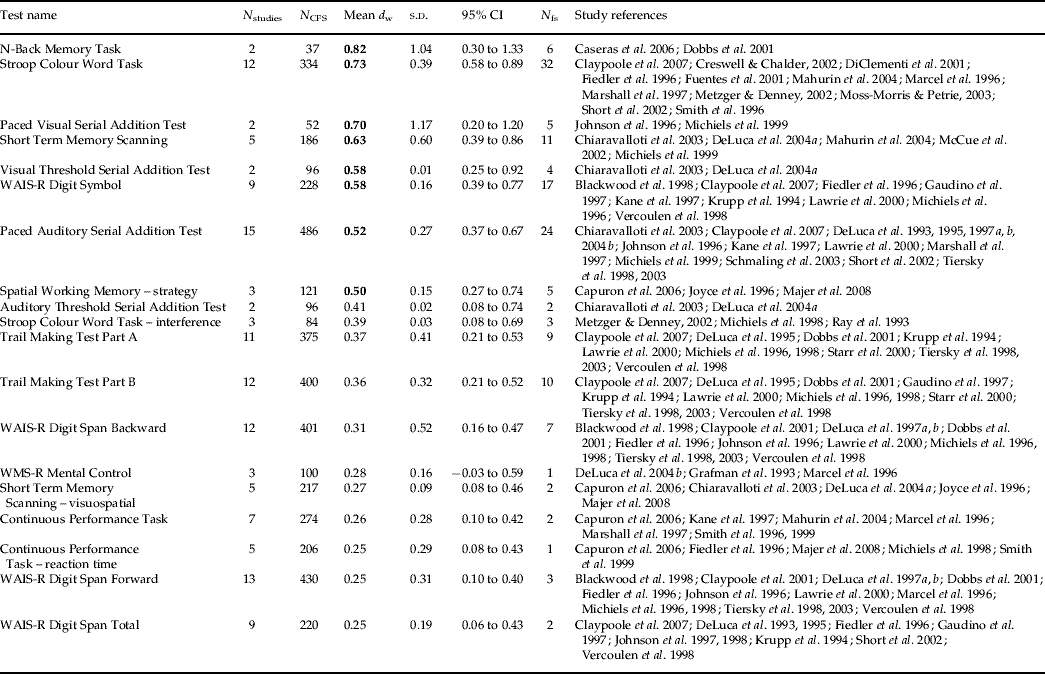
Attention, which encompasses attention span and working memory, was one of the most commonly assessed cognitive domains (N studies=45, N tests=19). There were positive mean effect sizes for all tests, indicating that the CFS group showed deficits to varying degrees in this cognitive domain (see Table 2). Moderate to large and significant effect sizes with acceptable N fs were evident for eight tests: the N-Back Memory Task, Stroop Colour Word Task, Paced Auditory Serial Addition Test (plus visual and threshold versions), Short Term Memory Scanning Task, Wechsler Adult Intelligence Scale – Revised (WAIS-R) Digit Symbol subtest and Spatial Working Memory test. Although very commonly used (N studies=9–13), the Trail Making Test and WAIS – Revised (WAIS-R) Digit Span only showed small, albeit significant, deficits.
Attention: weighted Cohen's d effect sizes for each test, in descending order

CI, Confidence interval; WAIS-R, Weschsler Adult Intelligence Scale – Revised.
Tests with bold effect sizes met the study criteria.
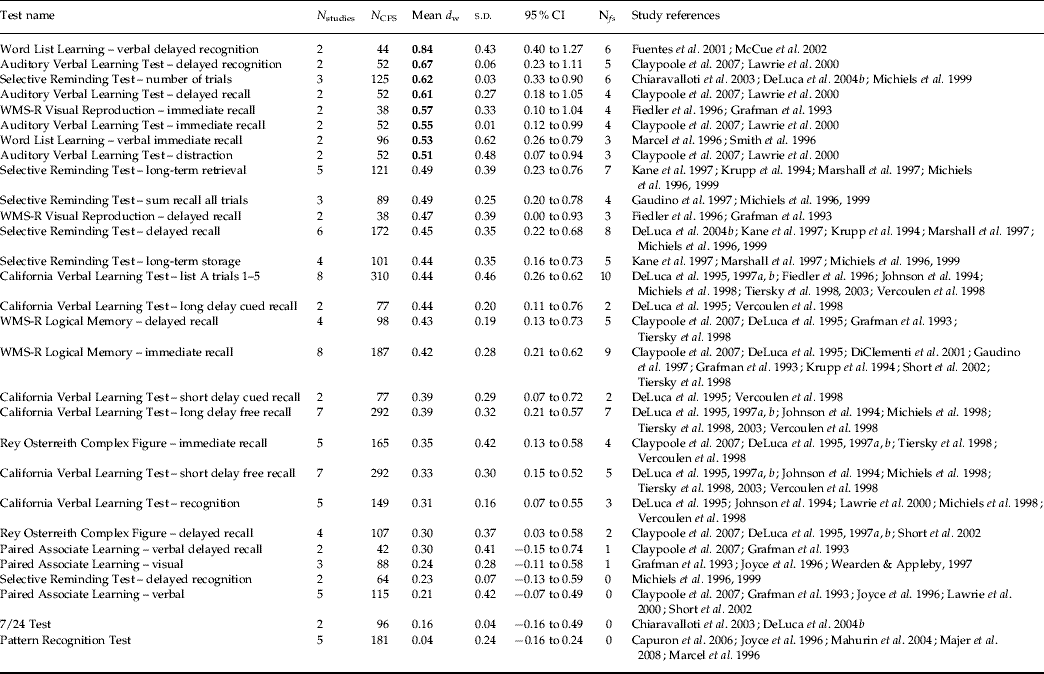
Memory was assessed by the majority of studies (N studies=32) using a large number of verbal and visual memory tests (N tests=29, see Table 3), the majority of which assessed memory for word lists (N tests=20). While the effect sizes for most tests of word list learning and recall were statistically significant, only seven were moderate to large in size, suggesting that some tests are more sensitive to memory deficits in CFS than others. The tests that met the study criteria were single presentation word list learning tasks (immediate recall, delayed recognition), the Auditory Verbal Learning Test (immediate recall, distraction list recall, delayed recall, recognition) and the Selective Reminding Test (number of trials). Whereas one of the least commonly used tests of memory for figures [Wechsler Memory Scale Revised (WMS-R) Visual Reproduction – immediate recall, N studies=2] had a significant medium effect size with acceptable N fs, a more commonly used test of memory for figures was only associated with small but significant group differences (Rey–Osterreith Complex Figure – immediate recall, N studies=5).
Memory: weighted Cohen's d effect sizes for each test, in descending order

CI, Confidence interval; WAIS-R, Weschsler Adult Intelligence Scale – Revised; WMS-R, Weschsler Memory Scale – Revised.
Tests with bold effect sizes met the study criteria.
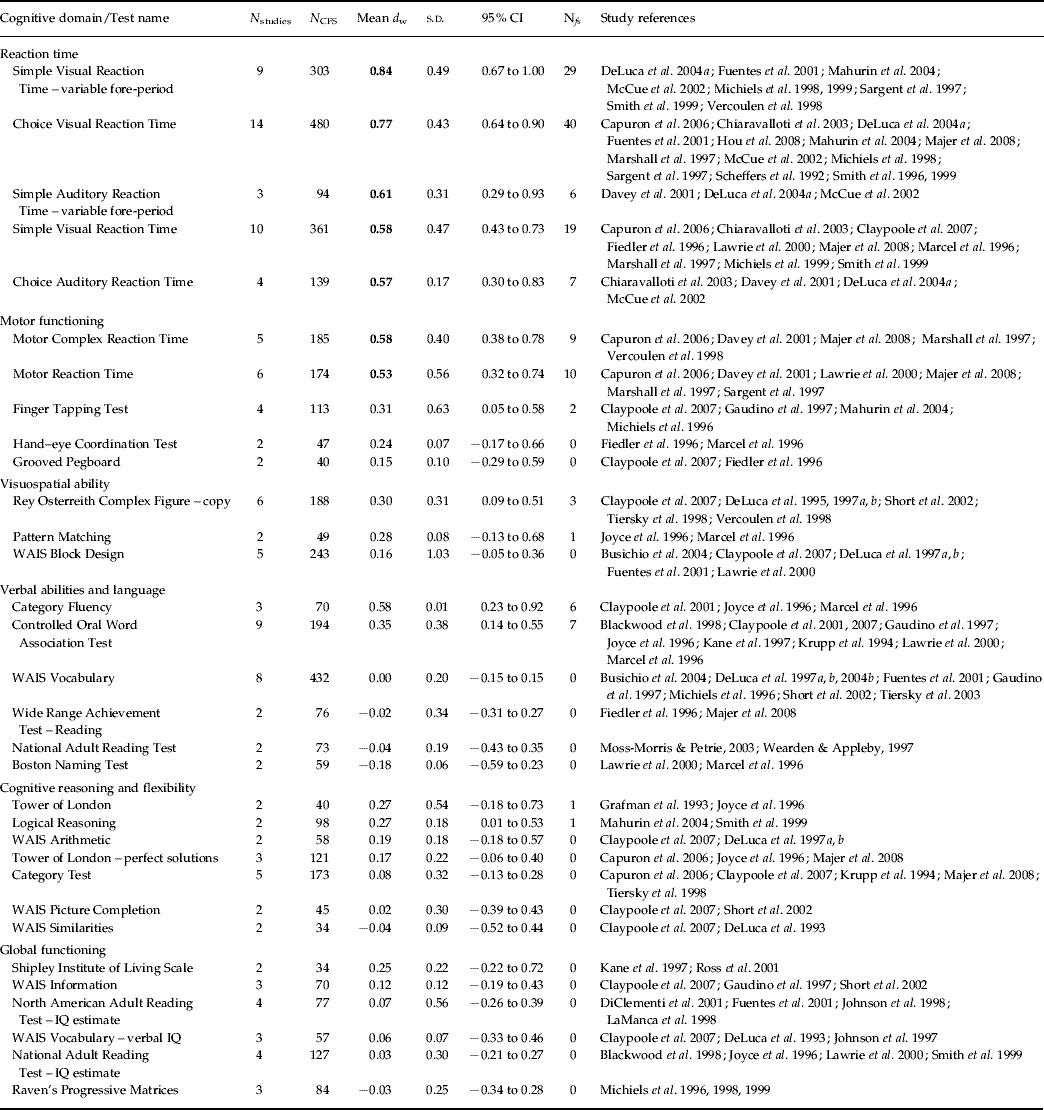
RT was significantly impaired for responses to both simple and complex (choice) stimuli in people with CFS, with all five tests showing medium to large and significant group differences and large N fs (see Table 4). The visual domain was assessed more frequently than the auditory domain.
Weighted Cohen's d effect sizes in descending order for reaction time tasks, tests of motor functioning, visuospatial ability, verbal abilities and language, cognitive reasoning and flexibility, and global functioning

CI, Confidence interval; IQ, intelligence quotient; WAIS, Weschsler Adult Intelligence Scale (all editions).
Tests with bold effect sizes met the study criteria.
Motor functioning in CFS was assessed using three tests of manual dexterity (Finger Tapping Test, Grooved Pegboard, Hand–Eye Coordination Test) and the movement time of simple and complex RT tasks (see Table 4). Only the movement times revealed significant moderate group differences with good N fs statistics, with the CFS group taking longer to perform the motor component of RT tasks.
Three tests of visuospatial ability were used to assess figure copying, pattern matching and block construction (N studies=12). However, these tests only revealed small effects (see Table 4), indicating minimal impairment in this domain.
Of the tests assessing verbal abilities and language, only the Category Fluency Test revealed moderate and significant group differences and good N fs (refer to Table 4). The most frequently used test was the Controlled Oral Word Association Test, which only showed small but significant group differences.
There was little overlap in the tests used to assess cognitive reasoning and flexibility, with most tests only evaluated by two studies (see Table 4). None of the results for these tests met the study criteria, yielding only small effect sizes. Additionally, all but one of the confidence intervals spanned zero, further indicating that this domain is not impaired in people with CFS.
Finally, measures of global functioning were used by 17 studies, with all tests producing small and non-significant effect sizes (see Table 4), indicating that people with CFS performed comparably with healthy controls on these measures.
Discussion
Overall, the data from 52 studies (N CFS=1595; N controls=1533) were analysed in order to determine whether CFS is associated with deficits in cognitive functioning. The groups appeared well matched for gender, age and education, making it unlikely that differences in these variables were contributing to the findings. Persons with CFS were significantly more depressed than the controls, but it was not possible to directly analyse the contribution of depression to cognitive functioning because very few studies provided the necessary data. However, the majority of studies that examined the impact of self-reported depression in CFS on cognitive functioning failed to find a relationship (e.g. DeLuca et al. Reference DeLuca, Johnson, Beldowicz and Natelson1995; Johnson et al. Reference Johnson, Lange, DeLuca, Korn and Natelson1997; Vercoulen et al. Reference Vercoulen, Bazelmans, Swanink, Galama, Fennis, van der Meer and Bleijenberg1998; Short et al. Reference Short, McCabe and Tooley2002; Busichio et al. Reference Busichio, Tiersky, DeLuca and Natelson2004), although some studies did find an association (e.g. Krupp et al. Reference Krupp, Sliwinski, Masur, Friedberg and Coyle1994; Marshall et al. Reference Marshall, Forstot, Callies, Peterson and Schenck1997). Additionally, using clinical interviews, those studies that categorized CFS participants on the basis of psychiatric diagnosis (most commonly major depressive disorder or dysthymia) found that cognitive impairment was greater for people without a co-existing psychiatric disorder than for those with a co-morbid diagnosis (e.g. DeLuca et al. Reference DeLuca, Johnson, Ellis and Natelson1997a; Tiersky et al. Reference Tiersky, Matheis, DeLuca, Lange and Natelson2003). Hence, while the increased levels of depression in people with CFS may explain some of the cognitive problems found in this study, the results from a number of studies suggest that it is unlikely to account for all of the observed problems.
A large number of tests have been used to assess cognitive functioning in CFS and there is considerable variability in the extent to which performance on these measures is affected by this condition. This is likely to have hindered the integration of research findings to date. A total of 24 of the 80 test scores met the study criteria for impairment (d⩾0.5, 95% CI≠0, N fs>N studies), including tests of attention, memory, RT, motor functioning and verbal abilities. In contrast, none of the tests of visuospatial ability, cognitive reasoning and flexibility and global functioning met the study criteria.
Measures of both simple (RT tasks) and complex (Paced Auditory Serial Addition Test) information-processing speed showed moderate to large and significant impairments in persons with CFS, confirming the findings of two previous literature reviews (Tiersky et al. Reference Tiersky, Johnson, Lange, Natelson and DeLuca1997; Michiels & Cluydts, Reference Michiels and Cluydts2001). It is also likely that information-processing deficits contributed to the deficits noted in the movement time of RT tasks, which are reportedly not pure measures of motor speed (Smith & Carew, Reference Smith and Carew1987; Vercoulen et al. Reference Vercoulen, Bazelmans, Swanink, Galama, Fennis, van der Meer and Bleijenberg1998). Moreover, fine motor speed was not impaired in persons with CFS, making it unlikely that motor functioning is predominately responsible for slower RTs.
In addition to deficits in information-processing speed, persons with CFS were impaired on tests that assess working memory over a sustained period of time (i.e. N-Back Memory Task, Short Term Memory Scanning Task, Spatial Working Memory). Moderate and significant impairments were also found for the WAIS-R Digit Symbol Test and the Stroop Task, which showed only minimal impairment when the speed of reading patches and words was taken into account. Michiels & Cluydts (Reference Michiels and Cluydts2001) have suggested that this pattern of performance on the Stroop Task may be due to an ‘overall slowness’ in persons with CFS. While this is consistent with the delays in simple information processing, it is not clear why other simple tests of attention were not also impaired (e.g. Trail Making Test, WMS-R Mental Control).
Previous reviews of the literature have not been able to resolve the conflicting findings regarding verbal and non-verbal memory deficits in persons with CFS (Tiersky et al. Reference Tiersky, Johnson, Lange, Natelson and DeLuca1997; Michiels & Cluydts, Reference Michiels and Cluydts2001). With regard to verbal memory, moderate to large and significant deficits were found on several tests of word list learning (e.g. Auditory Verbal Learning Test and other word list learning tasks). Immediate recall was impaired, as was delayed recall and recognition. DeLuca et al. (Reference DeLuca, Christodoulou, Diamond, Rosenstein, Kramer, Ricker and Natelson2004b) suggest that these memory problems may be due to poor initial learning. The deficits in information-processing speed and working memory identified by this study may contribute to these problems with initial learning. In support of this, persons with CFS took more trials to learn on a task that controlled for initial learning (Selective Reminding Test) but had only minimally impaired immediate and delayed recall.
Non-verbal memory for complex figures and spatial location were not impaired, with only one test of memory for figures showing moderate and significant deficits (WMS-R Visual Reproduction – immediate recall). Thus, memory deficits associated with CFS may be predominately verbal, despite the absence of modality-specific impairments in RT and attention.
Verbal abilities and language were also largely preserved, except for category fluency, which may be reliant on working memory for successful completion (Lezak et al. Reference Lezak, Howieson and Loring2004). Finally, higher order cognitive functions appear to be intact, consistent with the findings of previous reviews (Tiersky et al. Reference Tiersky, Johnson, Lange, Natelson and DeLuca1997; Michiels & Cluydts, Reference Michiels and Cluydts2001).
The magnitude of the deficits in persons with CFS is rarely reported. This study found that there were deficits of 0.5–1.0 s.d. below that of their healthy peers. The practical impact this has on people with CFS appears to have only been explored by one study, which found that people with a greater number of deficits reported more days of inactivity (Christodoulou et al. Reference Christodoulou, DeLuca, Lange, Johnson, Sisto, Korn and Natelson1998).
Overall, the impairments identified by objective cognitive tests are congruent with the memory and concentration problems reported by persons with CFS. While most studies have not found a relationship between self-reported cognitive problems in persons with CFS and their test performance (e.g. Wearden & Appleby, Reference Wearden and Appleby1997; Vercoulen et al. Reference Vercoulen, Bazelmans, Swanink, Galama, Fennis, van der Meer and Bleijenberg1998), their self-rating of performance on specific tests is reliable (Wearden & Appleby, Reference Wearden and Appleby1997).
The cause of these cognitive deficits is uncertain. Depression may be a contributing factor but, as previously discussed, greater deficits have been found in people with CFS without co-morbid depression. Other research has investigated the role of a sudden versus gradual onset of the condition, with those who report a sudden onset being more impaired, possibly representing a subgroup with a viral cause for their condition (e.g. DeLuca et al. Reference DeLuca, Johnson, Ellis and Natelson1997b; Claypoole et al. Reference Claypoole, Noonan, Mahurin, Goldberg, Erickson and Buchwald2007). Other factors that may contribute to the cognitive deficits, while not a cause, are the fluctuations that occur in CFS symptoms (Fuentes et al. Reference Fuentes, Hunter, Strauss and Hultsch2001), such as fatigue, which may result in inconsistent levels of effort being applied during cognitive testing. Although the cause of cognitive deficits in CFS is still not known, treatments with cognitive behaviour therapy and graded exercise have resulted in some improvements (e.g. Thomas et al. Reference Thomas, Sadlier and Smith2006; de Lange et al. Reference de Lange, Koers, Kalkman, Bleijenberg, Hagoort, van der Meer and Toni2008).
Limitations
There are several limitations that may have influenced the study findings. First, a large number of effect sizes were calculated due to the large number of tests that were used by researchers, which may result in some effect sizes being significant by chance alone (i.e. type 1 error). The requirement for an effect size of interest to meet multiple criteria (d⩾0.5, 95% CIs≠0, N fs>N studies) should improve the robustness of our findings; however, we cannot exclude the possibility that type 1 errors have occurred.
Second, while publication bias may have influenced the findings of this study, we attempted to evaluate the potential robustness of our findings by calculating an N fs statistic and ensuring that the number of studies contributing to a finding exceeded this value. Furthermore, nearly half of the studies reported small effect sizes for most tests, indicating that non-significant results are being reported in the literature, thereby reducing the likelihood of publication bias.
Third, many studies did not report data on variables that may have influenced cognitive functioning, such as psychiatric status, depression and the nature of the onset of the condition (sudden versus gradual), thereby precluding an analysis of their impact on cognition. There was also considerable variability in the methods used to diagnosis CFS. Hence, there may be important differences between the CFS participants that may have contributed to the findings. Reeves et al. (Reference Reeves, Lloyd, Vernon, Klimas, Jason, Bleijenberg, Evengard, White, Nisenbaum and Unger2003) have provided guidelines to resolve some of the ambiguities in the CDC CFS criteria (Fukuda et al. Reference Fukuda, Straus, Hickie, Sharpe, Dobbins and Komaroff1994), which may help to standardize the procedures used in future research. However, the cognitive tests that they proposed may need to be reconsidered based on the findings of this meta-analysis.
Finally, the impact of medication usage on cognitive functioning could not be explored in this study. However, individual studies suggest that its impact may be minimal, with one study finding no difference between the performance of medicated and unmedicated persons with CFS (Michiels et al. Reference Michiels, Cluydts and Fischler1998) and another finding significant performance decrements in unmedicated (but not medicated) CFS participants compared with controls (Sargent et al. Reference Sargent, Anderson and Budek1997).
Conclusions
In conclusion, this study provides objective evidence of cognitive deficits in persons with CFS, primarily in the domains of attention, memory and RT. In general, these deficits are consistent with those that are reported by patients. Both simple and complex information processing speed are impaired, along with working memory. The data also suggest that memory deficits may be due to the poor initial acquisition of information but more studies are needed to investigate this. The deficits in performance are around 0.5–1.0 s.d. below that of their healthy peers, which is likely to have an impact on day-to-day activities. In contrast, CFS does not appear to have an impact on perceptual abilities or fine motor speed; nor does it appear to affect higher order cognitive abilities, such as language, reasoning or intelligence.
Declaration of Interest
None.