1. Introduction
The Variscan orogen is the most important orogenic system in Central and Western Europe (Matte, Reference Matte2001). Resulting from Devonian–Carboniferous collision and amalgamation of Gondwana in the south with Baltica and Laurentia in the north (Matte, Reference Matte1986; Ziegler, Reference Ziegler2012; von Raumer et al. Reference von Raumer, Stampfli, Arenas and Martínez2015), it was accompanied by extensive magmatism and high-grade metamorphic events. Variscan magmatism is mainly the result of crustal melting due to high heat flow and thermal relaxation during syn- or post-collisional processes which occurred in continental crust (e.g. Faure et al. Reference Faure, Bé Mézème, Cocherie, Rossi, Chemenda and Boutelier2008, Reference Faure, Cocherie, Mezeme, Charles and Rossi2010). The Devonian–Carboniferous Variscan orogenic belt developed in large continental masses including Gondwana, Baltica and Laurussia as well as Gondwana-derived microcontinents (e.g. Faure et al. Reference Faure, Cocherie, Mezeme, Charles and Rossi2010).
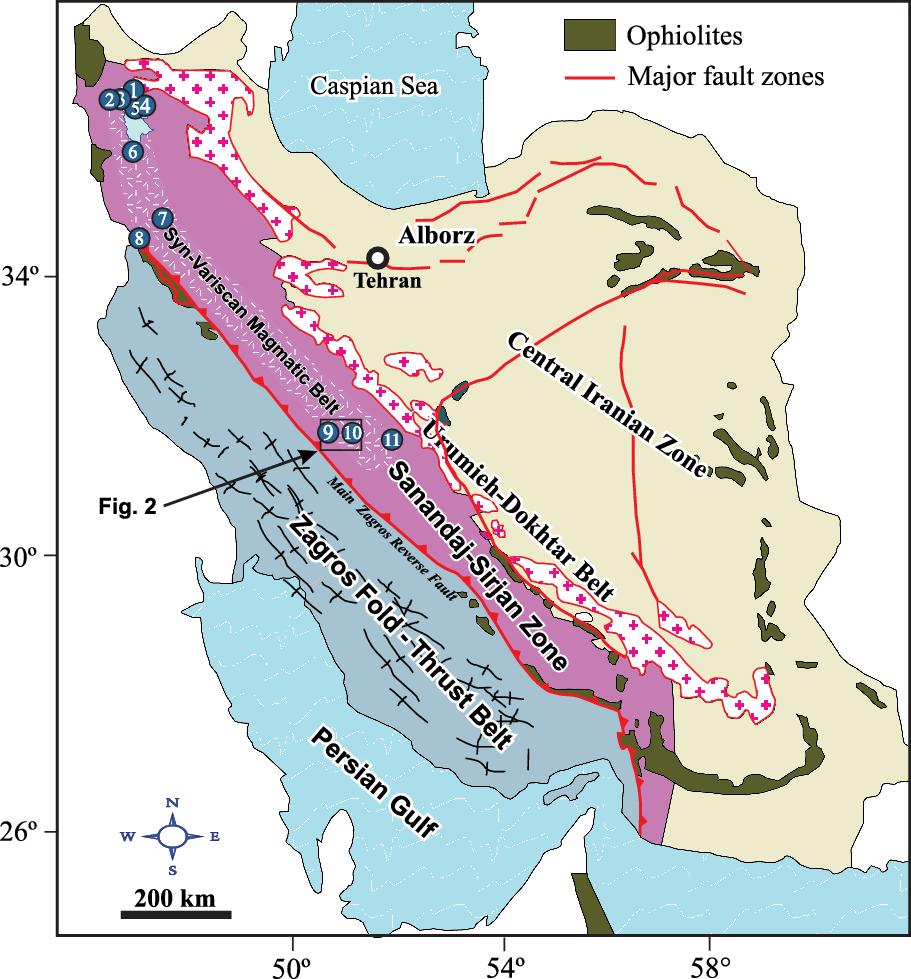
In comparison with other collisional orogenic belts, Variscan metamorphic and magmatic events have not been thoroughly investigated in most parts of Iran (with the exception of the NE part of the country, e.g. Berberian & Berberian, Reference Berberian, Berberian, Gupta and Delany1981) where continental blocks have been interpreted as Gondwana-derived microcontinents. Over the past two decades, magmatic activity related to Middle to Late Palaeozoic orogenic cycles has been reported in the northern part of the Sanandaj–Sirjan Zone (SaSZ) associated with the Zagros Orogenic Belt (e.g. Advay & Ghalamghash, Reference Advay and Ghalamghash2011; Bea et al. Reference Bea, Mazhari, Montero, Amini and Ghalamghash2011; Alirezaei & Hassanzadeh, Reference Alirezaei and Hassanzadeh2012; Moghadam et al. Reference Moghadam, Li, Ling, Stern, Santos, Meinhold, Ghorbani and Shahabi2015; Azizi et al. Reference Azizi, Kazemi and Asahara2017; Fig. 1). The recent U–Pb zircon dating results from several magmatic plutons clearly show that relatively significant magmatic activity occurred at the same time as the Variscan orogeny (the magmatism is therefore termed syn-Variscan in this paper) in the SaSZ (references as above), in contrast to what has been assumed previously. Nevertheless, little is known about the tectonic context of this event in the Iran plateau (e.g. Bea et al. Reference Bea, Mazhari, Montero, Amini and Ghalamghash2011), whereas the event has been well documented in surrounding countries such as Turkey and the Caucasus regions (e.g. Okay & Topuz, Reference Okay and Topuz2017). Moreover, geodynamic reconstructions of the evolution of the Variscan Belt in the SaSZ are still poorly constrained. Syn-Variscan magmatism in the northern SaSZ is mainly bimodal (e.g. Saccani et al. Reference Saccani, Allahyari, Beccaluva and Bianchini2013; Moghadam et al. Reference Moghadam, Li, Ling, Stern, Santos, Meinhold, Ghorbani and Shahabi2015; Azizi et al. Reference Azizi, Kazemi and Asahara2017). Mafic rocks show tholeiitic and alkaline compositions whereas felsic rocks are represented by both A1- and A2–type granitoids (Alirezaei & Hassanzadeh, Reference Alirezaei and Hassanzadeh2012; Moghadam et al. Reference Moghadam, Li, Ling, Stern, Santos, Meinhold, Ghorbani and Shahabi2015; Azizi et al. Reference Azizi, Kazemi and Asahara2017).
Simplified structural map of Iran (Stöcklin, Reference Stöcklin1968) showing the position of the Sanandaj–Sirjan Zone. Location of the study area is indicated on the map as ‘Fig. 2’. Numbers display the locations of zircon U–Pb ages listed in Table 1.

In this study, we conducted U–Pb zircon and K-feldspar 40Ar/39Ar geochronology, electron-microprobe analysis (EMPA) on minerals, and whole-rock element and isotopic geochemistry of the Ghaleh-Dezh mylonitic granites in the Azna region, in order to constrain its crystallization age as well as metamorphism and deformation histories, its geochemical composition, and the petrogenesis and nature of the magma source. Together with previous geochronological and geochemical data from other Late Palaeozoic granites, our new data enhance our understanding of the tectonomagmatic evolution of the SaSZ of the Zagros Orogenic Belt during the Late Palaeozoic.
2. Geological setting
The Sanandaj–Sirjan Zone (SaSZ) is a magmatic and metamorphic belt within the Zagros Orogenic Belt (Agard et al. Reference Agard, Omrani, Jolivet and Mouthereau2005; Mohajjel & Fergusson, Reference Mohajjel and Fergusson2014; Azizi et al. Reference Azizi, Zanjefili-Beiranvand and Asahara2015b; Moghadam et al. Reference Moghadam, Li, Ling, Stern, Santos, Meinhold, Ghorbani and Shahabi2015; Shakerardakani et al. Reference Shakerardakani, Neubauer, Masoudi, Mehrabi, Liu, Dong, Mohajjel, Monfaredi and Friedl2015) which extends from northern Oman through NW Iran and NE Iraq to SE Turkey (Alavi, Reference Alavi1994). The zone is bound by the Urumieh–Dokhtar magmatic belt to the northeast and the Zagros fold–thrust belt to the southwest (Fig. 1; Alavi, Reference Alavi2004; Arvin et al. Reference Arvin, Pan, Dargahi, Malekizadeh and Babaei2007). The SaSZ is 1500 km long and 150–200 km wide, extending parallel to the NW–SE trend of the Main Zagros Reverse Fault. This fault is considered to be a suture between the Iranian microcontinent (Eurasia) and the Arabian plate (Alavi, Reference Alavi1994), formed by the northward subduction of the Neotethys Ocean (since the Early Jurassic) and subsequent collision between the two plates during the Late Cretaceous to Oligocene–Miocene (Berberian & King, Reference Berberian and King1981; Chiu et al. Reference Chiu, Chung, Zarrinkoub, Mohammadi, Khatib and Iizuka2013; Moghadam et al. Reference Moghadam, Li, Ling, Stern, Santos, Meinhold, Ghorbani and Shahabi2015; Davoudian et al. Reference Davoudian, Genser, Neubauer and Shabanian2016).
For many years, the tectonothermal evolution of the SaSZ during the Late Neoproterozoic to Palaeozoic has been a matter of debate (e.g. Berberian & King, Reference Berberian and King1981). In the Late Neoproterozoic, the basement of the SaSZ has more recently been associated with the northern margin of Gondwana (Badr et al. Reference Badr, Davoudian, Shabanian, Azizi, Asahara, Neubauer, Dong and Yamamoto2018). During the Pan-African orogeny (850–510 Ma), numerous granitoid plutons with different tectonic settings intruded into the Iranian basement, especially in the SaSZ. Based on U–Pb zircon ages from granitoids from the SaSZ, some remnants of the Iranian Pan-African basement have been revealed in the Jan complex (Nutman et al. Reference Nutman, Mohajjel, Bennett and Fergusson2014; Shakerardakani et al. Reference Shakerardakani, Neubauer, Masoudi, Mehrabi, Liu, Dong, Mohajjel, Monfaredi and Friedl2015), Ghaleh-Dezh Orthogneiss (Nutman et al. Reference Nutman, Mohajjel, Bennett and Fergusson2014; Shakerardakani et al. Reference Shakerardakani, Neubauer, Masoudi, Mehrabi, Liu, Dong, Mohajjel, Monfaredi and Friedl2015), Zanjan–Takab region (Saki et al. Reference Saki2010; Moghadam et al. Reference Moghadam, Li, Stern, Ghorbani and Bakhshizad2016), Golpayegan (Hassanzadeh et al. Reference Hassanzadeh, Stockli, Horton, Axen, Stockli, Grove, Schmitt and Walker2008), North Shahrekord region (Badr et al. Reference Badr, Davoudian, Shabanian, Azizi, Asahara, Neubauer, Dong and Yamamoto2018) and Azna-Dorud region (Shabanian et al. Reference Shabanian, Davoudian, Dong and Liu2018).
However, there is still no evidence of Ordovician–Silurian (‘Caledonian’) magmatic activity (490–390 Ma) within Iranian continental crust of the SaSZ, although Late Palaeozoic magmatic activity, such as granitoids and gabbros, has recently been revealed in the SaSZ (e.g. Advay & Ghalamghash, Reference Advay and Ghalamghash2011; Bea et al. Reference Bea, Mazhari, Montero, Amini and Ghalamghash2011; Alirezaei & Hassanzadeh, Reference Alirezaei and Hassanzadeh2012; Moghadam et al. Reference Moghadam, Li, Ling, Stern, Santos, Meinhold, Ghorbani and Shahabi2015; Abdulzahra et al. Reference Abdulzahra, Hadi, Azizi, Asahara and Yamamoto2017; Azizi et al. Reference Azizi, Kazemi and Asahara2017; Table 1; Fig. 1).
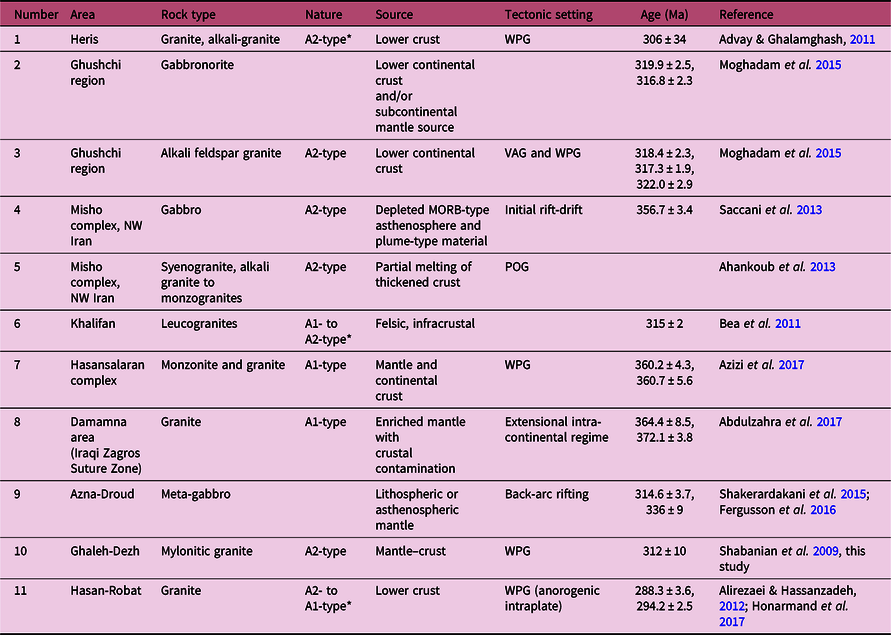
Summary of the petrogenetic characteristics (source and nature) and zircon U–Pb ages of Carboniferous rocks of Iran and Iraq

* Determined in this study.
WPG: within-plate granitoid; VAG: volcanic-arc granite; POG: post-orogenic granite.
Syn-Variscan magmatic activity in the SaSZ often displays bimodal composition (Azizi et al. Reference Azizi, Kazemi and Asahara2017). Syn-Variscan mafic bodies have been reported in the Misho complex, NW Iran (gabbro, 356.7 ± 3.4 Ma (Saccani et al. Reference Saccani, Allahyari, Beccaluva and Bianchini2013), No. 4 in Fig. 1), June complex, NW Iran (Dare-Hedavand metagabbro, 314.6 ± 3.7 (Shakerardakani et al. Reference Shakerardakani, Neubauer, Masoudi, Mehrabi, Liu, Dong, Mohajjel, Monfaredi and Friedl2015, Reference Shakerardakani, Neubauer, Bernroider, Von Quadt, Peytcheva, Liu, Genser, Monfaredi and Masoudi2017); Darijune gabbro, 336 ± 9 Ma (Fergusson et al. Reference Fergusson, Nutman, Mohajjel and Bennett2016), No. 9 in Fig. 1) and Ghushchi complex, NW Iran (gabbronorite, 319.9 ± 2.5 Ma and 316.8 ± 2.3 Ma (Moghadam et al. Reference Moghadam, Li, Ling, Stern, Santos, Meinhold, Ghorbani and Shahabi2015), Nos. 2 and 3 in Fig. 1). The mafic bodies generally consist of deformed dolerite dykes and gabbros. They have N- and P-MORB (normal and plume mid-ocean ridge basalt; Saccani et al. Reference Saccani, Allahyari, Beccaluva and Bianchini2013) or E-MORB (enriched MORB) to alkaline affinities (Moghadam et al. Reference Moghadam, Li, Ling, Stern, Santos, Meinhold, Ghorbani and Shahabi2015; Shakerardakani et al. Reference Shakerardakani, Neubauer, Bernroider, Von Quadt, Peytcheva, Liu, Genser, Monfaredi and Masoudi2017). Magmatic breccia (agmatite) occasionally occurs as a result of granite intrusions into mafic rocks (Saccani et al. Reference Saccani, Allahyari, Beccaluva and Bianchini2013), suggesting syn-plutonic magmatism.
Most Late Palaeozoic granites in the SaSZ form discrete, homogeneous bodies (except the Misho granitoid body; Ahankoub et al. Reference Ahankoub, Jahangiri, Asahara and Moayyed2013), and no enclaves occur within the rocks (e.g. Advay & Ghalamghash, Reference Advay and Ghalamghash2011; Bea et al. Reference Bea, Mazhari, Montero, Amini and Ghalamghash2011; Alirezaei & Hassanzadeh, Reference Alirezaei and Hassanzadeh2012; Ahankoub et al. Reference Ahankoub, Jahangiri, Asahara and Moayyed2013; Moghadam et al. Reference Moghadam, Li, Ling, Stern, Santos, Meinhold, Ghorbani and Shahabi2015; Abdulzahra et al. Reference Abdulzahra, Hadi, Azizi, Asahara and Yamamoto2017; Azizi et al. Reference Azizi, Kazemi and Asahara2017). They are grey-green to often pink in colour and coarse- to fine-grained. The ‘syn-Variscan’ granitic bodies do not appear to be intruded by dykes, except for the Misho granitoid body (Ahankoub et al. Reference Ahankoub, Jahangiri, Asahara and Moayyed2013), and mainly stretch parallel to the Zagros main thrust (NW–SE) formed during the post-Variscan metamorphism and deformation events. Most bodies have undergone different grades of deformation, revealing a mylonitic fabric with preferred orientation of minerals; the Heris granite, which shows only a cataclastic overprint (Advay & Ghalamghash, Reference Advay and Ghalamghash2011), is the only exception. In general, the rocks in the zone were deformed and metamorphosed during Jurassic and Cretaceous times, attaining from amphibolite- to greenschist-facies and rarely eclogite facies (Davoudian et al. Reference Davoudian, Genser, Neubauer and Shabanian2016), and then exhumed mostly in the Late Cretaceous. The events were related to the Zagros orogeny (Agard et al. Reference Agard, Omrani, Jolivet and Mouthereau2005; Mohajjel & Fergusson, Reference Mohajjel and Fergusson2014; Davoudian et al. Reference Davoudian, Genser, Neubauer and Shabanian2016).
Mesozoic magmatic activity is observed from intrusive (e.g. Azizi et al. Reference Azizi, Lucci, Stern, Hasannejad and Asahara2018b; Azizi & Stern, Reference Azizi and Stern2019; Tavakoli et al. Reference Tavakoli, Davoudian, Shabanian, Azizi, Neubauer, Asahara and Bernroider2019) and extrusive (e.g. Kangareh and Taghiabad) (Azizi et al. Reference Azizi, Najari, Asahara, Catlos, Shimizu and Yamamoto2015a) rocks in the zone that intruded into the metamorphic rocks (Azizi et al. Reference Azizi, Najari, Asahara, Catlos, Shimizu and Yamamoto2015a). Previously, it was thought that the Jurassic magmatic rocks reflected a tectonic arc setting related to the subduction of Neotethys beneath Iran (e.g. Ahadnejad et al. Reference Ahadnejad, Valizadeh, Deevsalar and Rasouli2011; Esna-Ashari et al. Reference Esna-Ashari, Tiepolo, Valizadeh, Hassanzadeh and Sepahi2012; Deevsalar et al. Reference Deevsalar, Shinjo, Ghaderi, Murata, Hoskin, Oshiro, Wang, Lee and Neill2017), but new studies have revealed that some of the magmatic rocks formed in a continental rifting environment (Azizi & Stern, Reference Azizi and Stern2019; Tavakoli et al. Reference Tavakoli, Davoudian, Shabanian, Azizi, Neubauer, Asahara and Bernroider2019). Cenozoic granitoid bodies are juxtaposed in different regions of the SaSZ (e.g. Baneh pluton (Azizi et al. Reference Azizi, Hadad, Stern and Asahara2018a)), resulting from the subsequent continental collision of the Arabia and Eurasian plates (Azizi et al. Reference Azizi, Hadad, Stern and Asahara2018a).
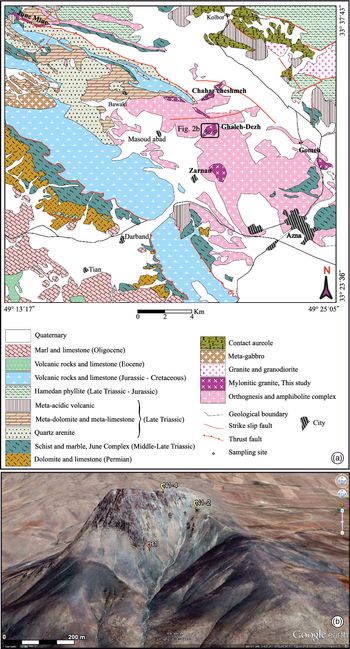
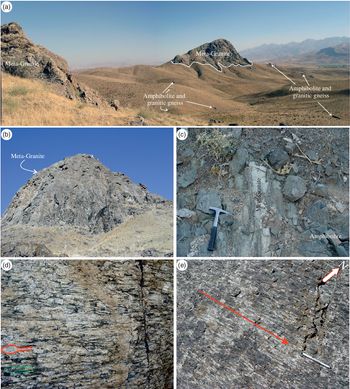
The Azna-Dorud region is a large-scale ductile shear zone with a WNW–ESE trend (Mohajjel et al. Reference Mohajjel, Fergusson and Sahandi2003). The high- to low-grade metamorphic rocks display varying degrees of deformation. The Ghaleh-Dezh metagranite pluton is associated with other deformed and metamorphic assemblages that crop out in the region (Figs 2, Fig. 3a, b), and the metagranites have a sigmoidal structure trending NW–SE (Mohajjel & Fergusson, Reference Mohajjel and Fergusson2000; Fig. 2), nearly parallel to the Main Zagros Reverse fault. The Ghaleh-Dezh granite was emplaced prior to metamorphism associated with the shear zone within the host rocks of granitic gneiss and amphibolite with Late Neoproterozoic age (Figs 2, 3a). No evidence of contact metamorphism is found in the host rocks, although very rarely some host amphibolites are observed to have a lighter colour. The amphibolites are generally dark green with an E-MORB affinity, suggesting that they were derived from a back-arc basin tectonic setting (Koolivand et al. Reference Koolivand, Shabanian and Davoudian2018). The Late Neoproterozoic host granitic gneisses are similar to the Ghaleh-Dezh metagranite at both the mesoscopic and microscopic scales, from the field observations. Mohajjel & Fergusson (Reference Mohajjel and Fergusson2000, Reference Mohajjel and Fergusson2014) have proposed that the granitic gneisses and the metagranites are the same rocks belonging to a single magmatic phase which experienced metamorphism and ductile deformation related to syn-deformational magmatism in a regime of dextral transpression in Late Cretaceous continental collision, while according to our new findings in this work, the two groups of granitic gneiss and mylonitic granite have different ages. U–Pb zircon dating of the host granitic gneisses yielded Late Neoproterozoic crystallization ages of 588 ± 41 Ma (Shakerardakani et al. Reference Shakerardakani, Neubauer, Masoudi, Mehrabi, Liu, Dong, Mohajjel, Monfaredi and Friedl2015) and 568 ± 11 Ma (Nutman et al. Reference Nutman, Mohajjel, Bennett and Fergusson2014), suggesting that the granitic gneisses are associated with other metamorphic rocks in the study area from the lower part of the metagranitic pluton (Fig. 2b). The amphibolites and granitic gneisses display mylonitic foliation (Shabanian et al. Reference Shabanian, Khalili, Davoudian and Mohajjel2009) identical to the foliation in the mylonitic granites (Fig. 3c). Mylonitic fabrics form the main fabric in the pluton and include porphyroclast structures (Fig. 3d), mylonitic foliation and stretching lineation (Fig. 3e). From a geomorphological point of view, the studied metagranitic rocks form features of high relief, in contrast to granitic gneisses and other metamorphic rocks (Fig. 2b).
(a) Simplified geological map of the Azna area (compiled from Sahandi et al. Reference Sahandi, Radfar, Hoseinidoust and Mohajjel2006; Shabanian et al. Reference Shabanian, Khalili, Davoudian and Mohajjel2009; satellite image of the study area). Circle locates the samples studied in this paper. (b) Google Earth satellite image showing location of the U–Pb zircon samples: N1-2 (33° 31′ 42.87″ N, 49° 23′ 22.20″ E), N1-4 (33° 31′ 43.98″ N, 49° 23′ 17.52″ E) and B1 (Nutman et al. Reference Nutman, Mohajjel, Bennett and Fergusson2014).

(a) The metagranite has intruded in the Late Neoproterozoic amphibolite and granitic gneiss. (b) Close-up view of Ghaleh-Dezh metagranite. (c) The metagranite has intruded in the Late Neoproterozoic amphibolite. (d) Coarse-grained Ghaleh-Dezh granite is mylonitized showing ductile structures with prominent feldspar augen and a strong shear fabric. (e) Note strong stretching lineation in the metagranites.

The Ghaleh-Dezh pluton is ∼0.5 km in length and ∼0.3 km in width, although other leucocratic granitic gneisses can be traced over several kilometres. Of the 85 samples collected from the pluton, the two samples used for age dating are from the slope and summit of Ghaleh-Dezh hill and are shown in Figure 2b.
3. Petrography
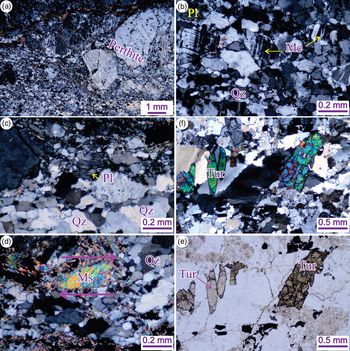
The mylonitic granites consist of quartz, alkali feldspar – mostly as perthite (Fig. 4a) or microcline – plagioclase, biotite and white mica (muscovite and phengitic muscovite; Shabanian et al. Reference Shabanian, Khalili, Davoudian and Mohajjel2009), with minor allanite, epidote, apatite, zircon, tourmaline and opaque minerals. The minerals display cataclastic and/or ductile fabrics resulting from dynamic deformation. The microstructures observed in quartz include elongated, preferably oriented and newly recrystallized quartz aggregates, ribbons, subgrains (Fig. 4b, c) and neograins, undulatory extinction and deformation bands and lamellae. The feldspars show dynamic deformation features such as bends (Fig. 4c) and deformed twins, undulatory extinction, narrow needle-shaped twins terminating inside the grains, kink bands, mantled porphyroclasts, pull-apart structures and lattice twins (microcline (Fig. 4b) and pericline). The micas (biotite and white mica) display a preferred orientation parallel to the main foliation. They sometimes occur as mica fish (Fig. 4d) and show undulatory extinction, bending and kinking. The small euhedral epidote grains are commonly located near the biotites. The allanite and tourmaline (dravite–schorl; Moradi et al. Reference Moradi, Shabanian Boroujeni and Davodian Dehkordi2015; Fig. 4e, f) are fractured through dynamic deformation (Shabanian et al. Reference Shabanian, Khalili, Davoudian and Mohajjel2009). Titanites are present as both individual wedge-shaped, euhedral to subhedral grains (magmatic titanites) and also as fine-grained aggregates resulting from the breakdown of biotite to chlorite (secondary titanites). The magmatic titanites are small and light brown in colour, occurring adjacent to epidote and mafic layers, whereas the secondary titanites are located adjacent to cleavage planes of chlorite after biotite.
Microphotographs of Ghaleh-Dezh metagranitic rocks. (a) Large feldspar porphyroclasts show flame perthite, XPL (crossed polarized light), width of view 9.5 mm. (b) Microcline perthite, XPL, width of view 1.2 mm. (c) Plagioclase porphyroclast with bending in twinning, XPL, width of view 1.2 mm. (d) Muscovite fish suggest a dextral sense of shear, XPL, width of view 1.2 mm. (e) Diamond titanites and tourmaline in the rock matrix, PPL (plane polarized light), width of view 3 mm. (f) Same photomicrograph in XPL, width of view 3 mm. Abbreviations for minerals are from Whitney & Evans (Reference Whitney and Evans2010).

4. Analytical methods
4.a. U–Pb zircon geochronology
Zircon grains were separated from two fresh samples (N12 and N1-4) of the Ghaleh-Dezh metagranite using conventional crushing, sieving, magnetic and heavy-liquid techniques. The concentrates were then purified by hand-picking under a binocular microscope in the Mineral Separation Laboratory of Shahrekord University, Iran.
The zircon grains were analysed by laser ablation inductively coupled plasma mass spectrometry (LA-ICP-MS), Agilent 7700x ICP-MS at Nagoya University, Japan (Kouchi et al. Reference Kouchi, Orihashi, Obara, Fujimoto, Haruta and Yamamoto2015). For calibration, standard glass (NIST SRM 610) and the 91,500-zircon standard (Goolaerts et al. Reference Goolaerts, Mattielli, de Jong, Weis and Scoates2004) were used. Blanks, the zircon standard, and the standard glass were measured at the start and end of each cycle during the measurement of nine points. Approximately 25 μm diameter craters were excavated in the zircon grains by laser with an energy of 11.7 J cm−2, a repetition rate of 10 Hz, 8 s of pre-ablation time and 10 s of integration time (Kouchi et al. Reference Kouchi, Orihashi, Obara, Fujimoto, Haruta and Yamamoto2015).
The ISOPLOT V4.15 program (Ludwig, Reference Ludwig2011) was used to calculate the concordia, intercept ages and statistics. Correction for common Pb was performed using 204Pb intensity (Stacey & Kramers, Reference Stacey and Kramers1975). To construct concordia diagrams, points with high common Pb and discordant ages (more than 10 % discordancy) were excluded before the best-fit line was drawn.
Back-scattered electron (BSE) and cathodoluminescence (CL) images of zircon grains were provided by a scanning electron microscope (JEOL JSM-6510LV) with a CL detector (GATAN MiniCL) at Nagoya University.
4.b. 40Ar/39Ar analysis
The 40Ar/39Ar analytical techniques follow those described by Handler et al. (Reference Handler, Neubauer, Velichkova and Ivanov2004) and Rieser et al. (Reference Rieser, Liu, Genser, Neubauer, Handler, Friedl and Ge2006). To obtain 40Ar/39Ar analyses, a sample of mylonitic granite (sample N1-2) was crushed, sieved, washed with deionized water and oven-dried. K-feldspar grains from crushed size fractions of 250–355 μm and 355–500 μm were separated by hand-picking under a binocular microscope to avoid the presence of altered and inclusion-bearing grains. Mineral concentrates were packed in aluminium foil and placed in quartz vials. The sealed quartz vials were irradiated in the MTA KFKI reactor (Budapest, Hungary) for 16 hours.
The 40Ar/39Ar analyses were carried out using an ultra-high vacuum (UHV) Ar-extraction line equipped with a combined MERCHANTEK™ ultraviolet/ infrared (UV/IR) laser system, and a VG-ISO-TECHTM NG3600 mass spectrometer at the ARGONAUT Laboratory of the Geology Division at the University of Salzburg, Austria. For measurements and after irradiation, 10–20 carefully selected grains with similar properties (e.g. colour and grain size) were finally used. Variation in the flux of neutrons was monitored with the DRA1 sanidine standard for which a 40Ar/39Ar plateau age of 25.03 ± 0.05 Ma was originally reported (Wijbrans et al. Reference Wijbrans, Pringle, Koppers and Scheveers1995). Here we use the revised value of 25.26 ± 0.05 Ma (Van Hinsbergen et al. Reference van Hinsbergen, Straathof, Kuiper, Cunningham and Wijbrans2008). For calculation of the J-values, flux monitors were placed between every four or five unknown samples, resulting in a distance of c. 5 mm between adjacent flux-monitors. Correction factors for interfering isotopes were calculated from ten analyses of two Ca-glass samples and 22 analyses of two pure K-glass samples and are: 36Ar/Ar(Ca) = 0.00022500, 39Ar/37Ar(Ca) = 0.000614 and 40Ar/39Ar(K) = 0.0266.
4.c. Electron-microprobe analysis (EMPA)
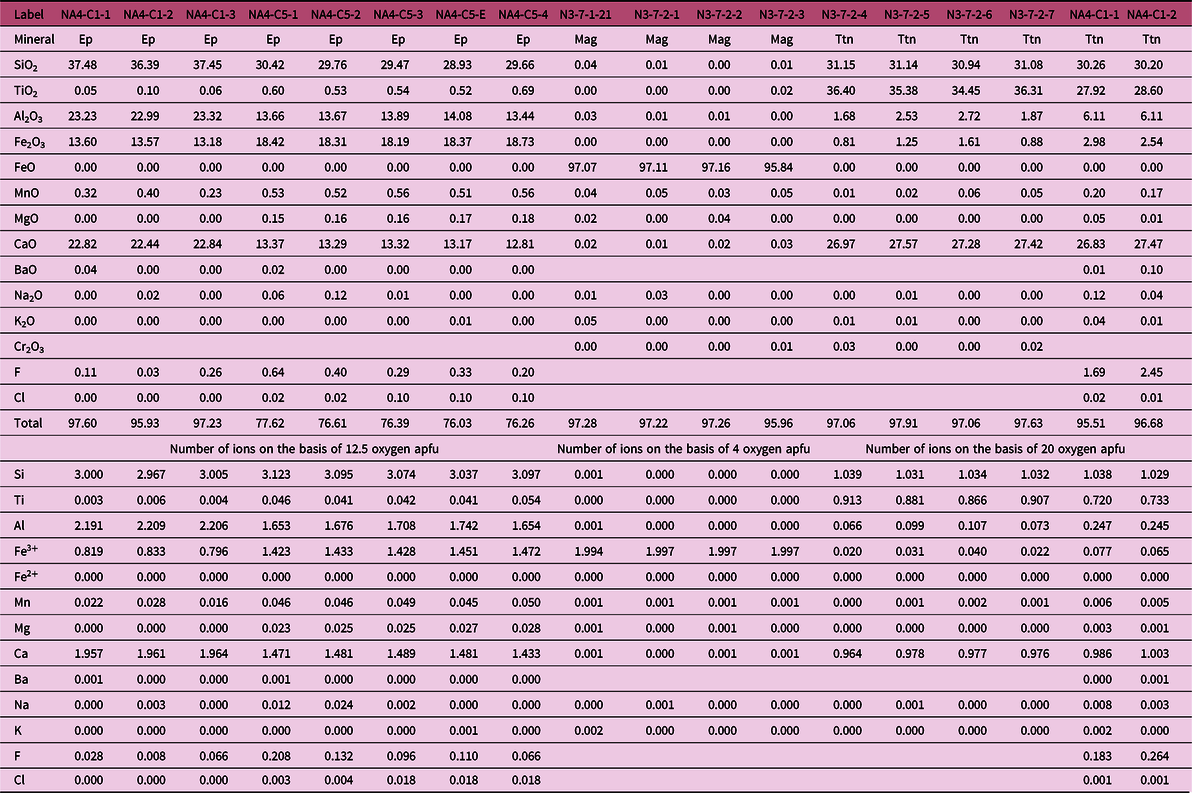
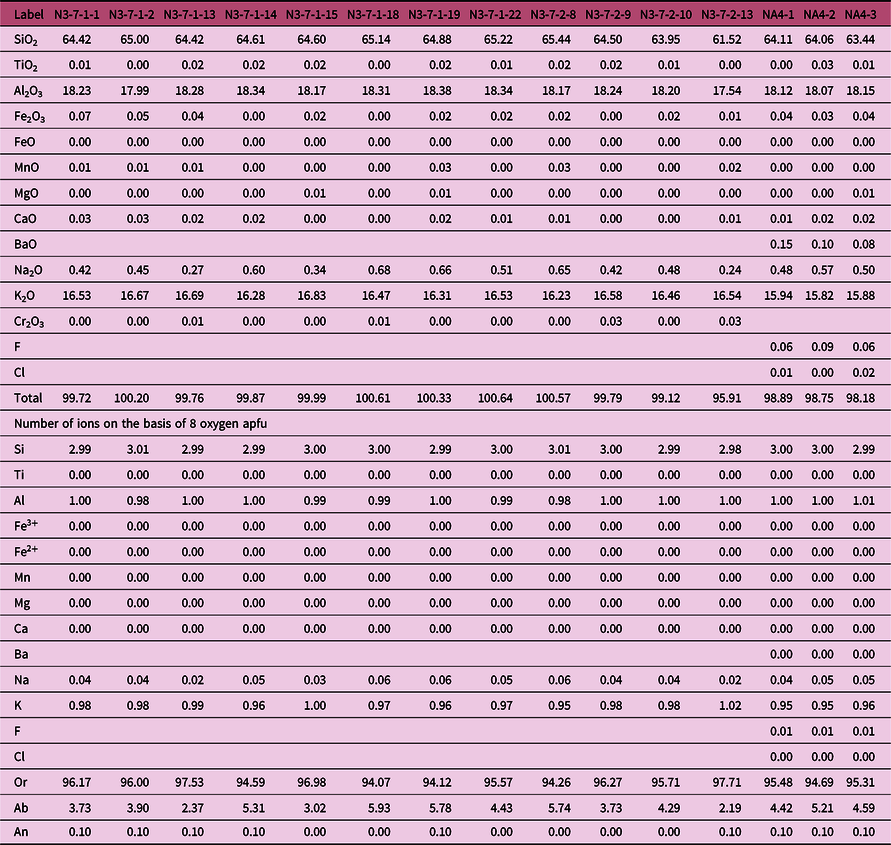
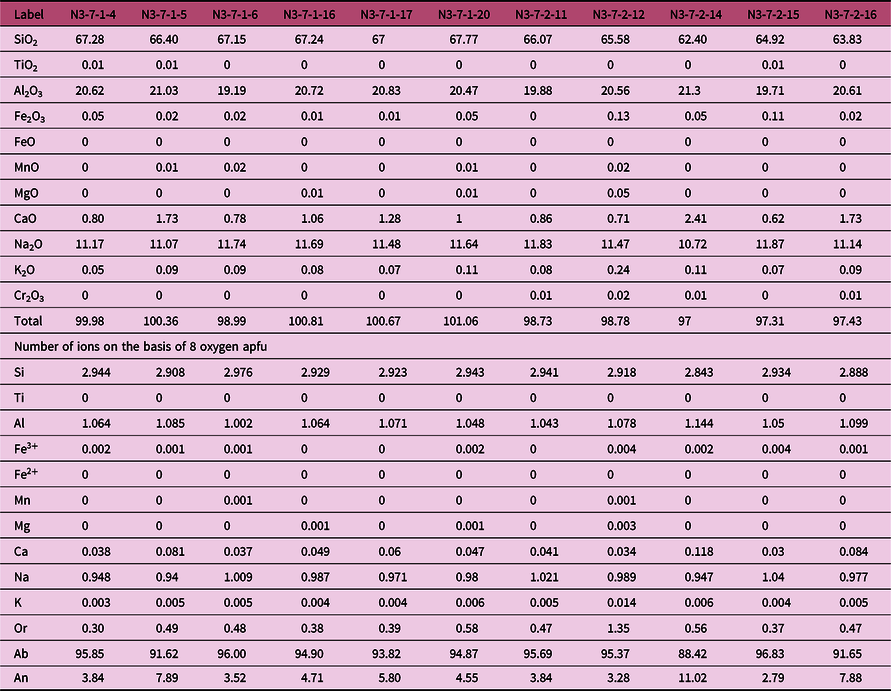
Electron-microprobe analyses were performed at the Department of Geography and Geology, University of Salzburg, using a wavelength-dispersive JEOL Super probe JXA-8600 system (four spectrometers, LiF, PET, TAP crystals) under operating conditions of 15 kV and 40 nA beam current, with a beam diameter of 5 µm. Depending on analysed elements, counting times were typically 10 and 20 s for peaks and 5 and 10 s for upper and lower backgrounds, respectively. Natural quartz, albite, jadeite, adularia, wollastonite, pyrolusite, rutile and chromite, as well as synthetic Al2O3, MgO, FeO, KCl, NaCl and Ba-glass, were used as standards. Control of measurements and calculation of chemical compositions (ZAF corrections) were performed with the Probe for Windows software by Advanced Microbeam. The mineral analyses were processed with the program PET (Dachs, Reference Dachs2004). Mineral abbreviations are after Whitney & Evans (Reference Whitney and Evans2010). Representative chemical analyses and calculated mineral formulae are listed in Table 1.
4.d. Sr and Nd isotope ratios
Three samples of the Ghaleh-Dezh metagranite were analysed for Sr isotope ratios at Nagoya University, and five other samples were analysed at the State Key Laboratory of Continental Dynamics, Northwest University, Xi’an, China, for Sr–Nd isotopic ratios.
To perform Sr isotopic analysis at Nagoya University, 100–200 mg of the powdered samples was dissolved in a covered Teflon beaker using 3 ml of HF (38 %) and 0.5–1 ml of HClO4 (70 %) at 120–140 °C on a hot plate in a clean room. The dissolved samples were then dried by infrared lamps on the hot plate at 140 °C. The dried samples were re-dissolved in 10 ml of 2 M HCl, and the residue was decomposed in a steel-jacketed bomb at 180 °C for 2–5 days for complete decomposition. Strontium isotope ratios were measured with a thermal ionization mass spectrometer (TIMS; VG Sector 54-30 of Nagoya University). The mass fractionation during the Sr isotope measurements was corrected based on the following ratio: 86Sr/88Sr = 0.1194. In this study, NIST-SRM987 (Tanaka et al. Reference Tanaka, Togashi, Kamioka, Amakawa, Kagami, Hamamoto, Yuhara, Orihashi, Yoneda, Shimisu, Kunimaru, Takahashi, Yanagi, Nakano, Fujimaki, Shinjo, Asahara, Tanimizu and Dragusanu2000) was used as the natural Sr isotope ratio standard. Averages and 2σ errors for the repeated analysis of standards during this study were as follows: NIST-SRM 987: 87Sr/86Sr = 0.710238 ± 28 (n = 13). Detailed descriptions of the isotopic analyses are provided by Azizi & Asahara (Reference Azizi and Asahara2013).
In addition, a multi-collector ICP-MS (Nu Plasma) was used to determine Sr and Nd ratios at the State Key Laboratory of Continental Dynamics, Northwest University, Xi’an, China. Isotope ratio measurements have analytical precisions of ±2σ. Separation of Rb, Sr, Sm and Nd was done using a two-column ion-change technique. Sr and Nd isotopic ratios were corrected for mass fractionation relative to 86Sr/88Sr = 0.1194 and 146Nd/144Nd = 0.7219. The BCR-2 standard yielded an 87Sr/86Sr ratio of 0.704959 ± 36 and a 143Nd/144Nd ratio of 0.512613 ± 19, compared with its reported 87Sr/86Sr ratio of 0.704958 and 143Nd/144Nd ratio of 0.512633 (Raczek et al. Reference Raczek, Jochum and Hofmann2003). Using a 147Sm decay constant of 6.54 × 10⁻¹² a−1, depleted mantle model ages TDM Nd (Lugmair and Marti, Reference Lugmair and Marti1978) and depleted mantle values 147Sm/144Nd = 0.2137 and 143/144Nd = 0.51315 (Chen & Jahn, Reference Chen and Jahn1998) were calculated. Also, CHUR (chondritic uniform reservoir) values of 147Sm/144Nd = 0.1966 and 143Nd/144Nd = 0.512646 (Wasserburg et al. Reference Wasserburg, Jacobsen, DePaolo, McCulloch and Wen1981) were used to calculate the εNd value.
5. Results
5.a. Mineral chemistry
5.a.1. Feldspar
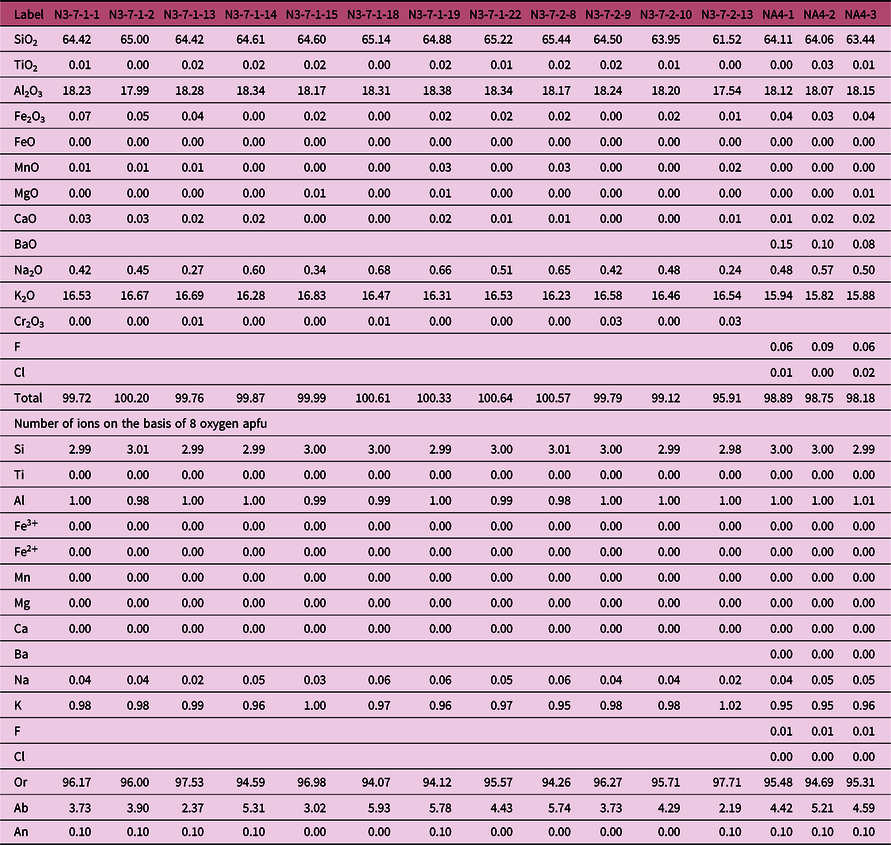
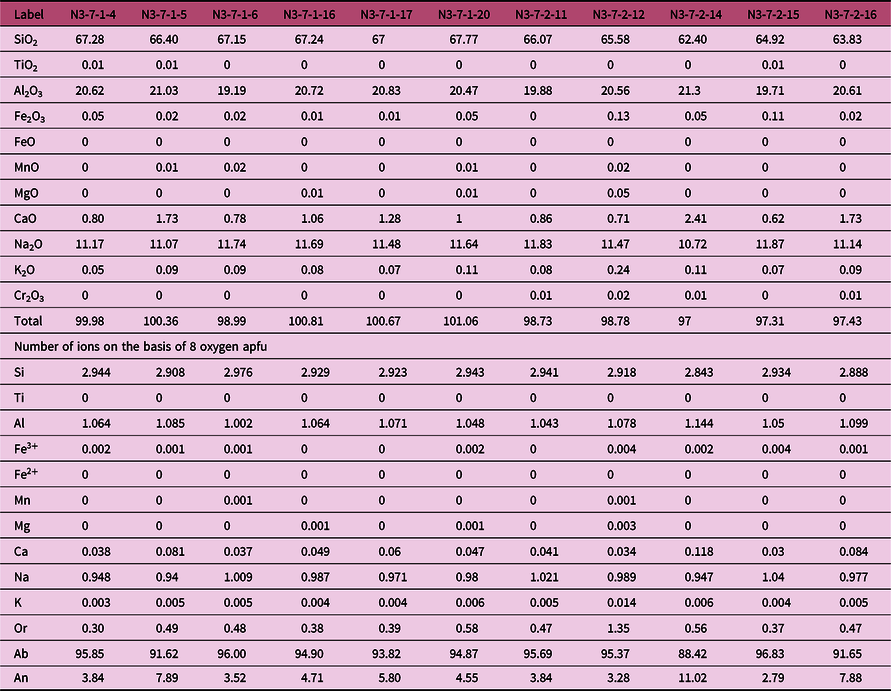
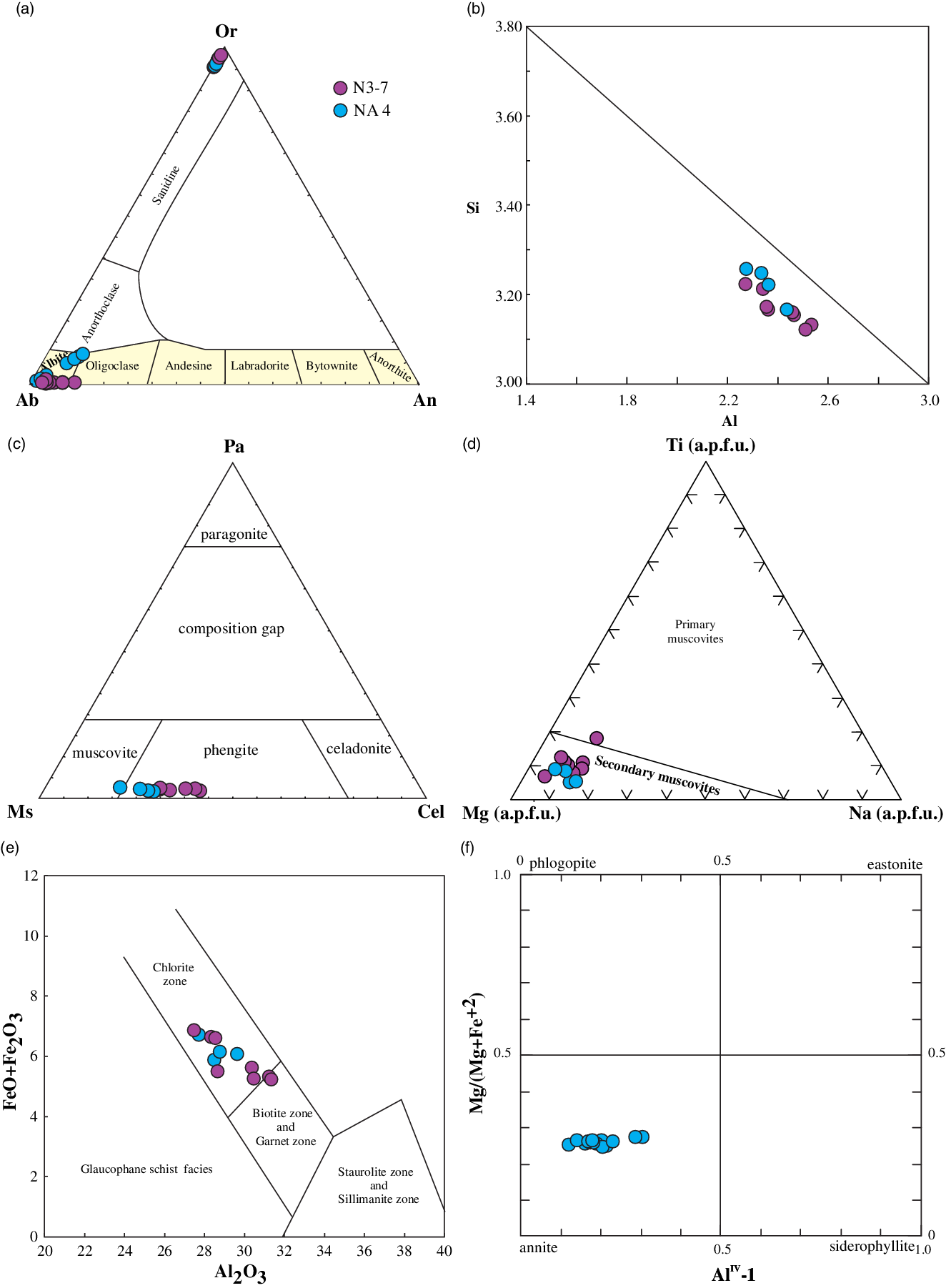
The compositional range of feldspars in the mylonitic granite is presented in Tables 2 and 3. The alkali feldspar composition is relatively uniform, with high Or (94.07–97.71 %) and low Ab (2.20–5.93 %) and An (0.00–0.10 %) contents. Porphyroclasts of alkali feldspars are similar in composition to the perthite. The plagioclase grains have low An contents (2.79–11.02 %), suggesting an Ab-rich composition in the rocks (Fig. 5a).
Electron microprobe analyses of K-feldspar from the Ghaleh-Dezh metagranite
Electron microprobe analyses of plagioclase from the Ghaleh-Dezh metagranite
Compositions of alkali feldspars and plagioclases from the Ghaleh-Dezh metagranite plotted on the Ab–Or–An ternary diagram. (b) Composition of muscovite–phengite in Si vs Al diagram (the line of the ideal Tschermak substitution is shown). (c) Distribution of the white micas on a Ms (muscovite) – Pa (paragonite) – Cel (celadonite) composition diagram. (d) Composition of white micas in the Mg–Ti–Na triangular diagram from Miller et al. (Reference Miller, Stoddard, Bradfish and Dollase1981) (a.p.f.u.: atoms per formula units). (e) The phengitic muscovite mostly shows chlorite grade of metamorphism in Al2O3 vs FeO + Fe2O3 diagram (Butler, Reference Butler1967). (f) Variation diagrams to illustrate biotite compositions in AlIV-1 vs Mg/(Mg + Fe2+) diagram.

5.a.2. Muscovite
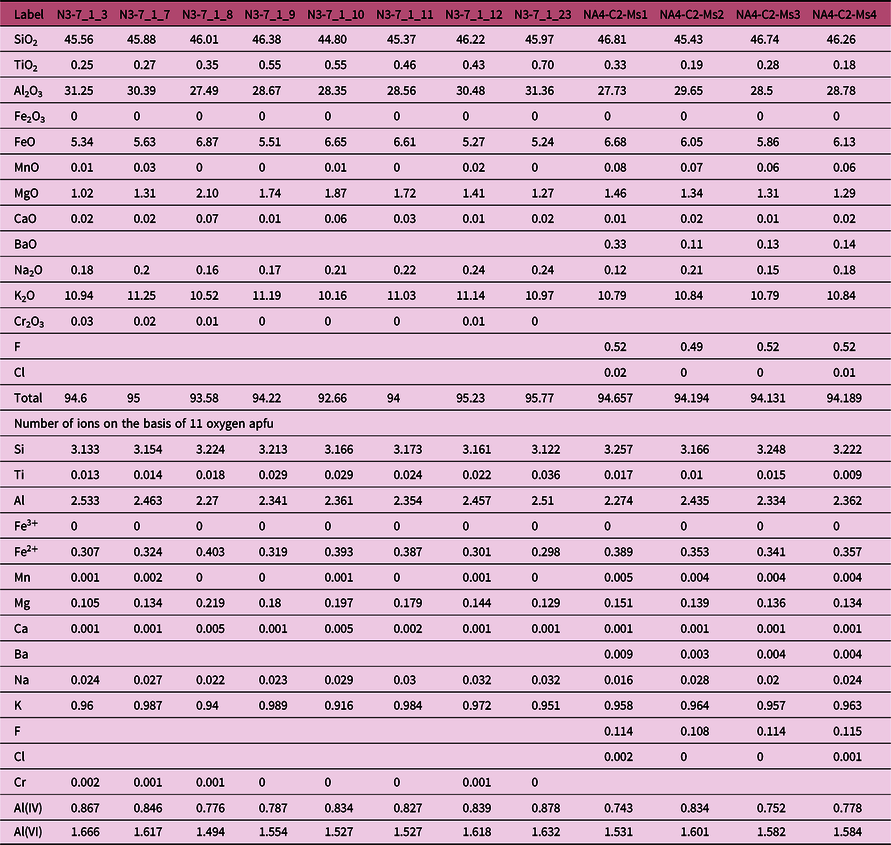
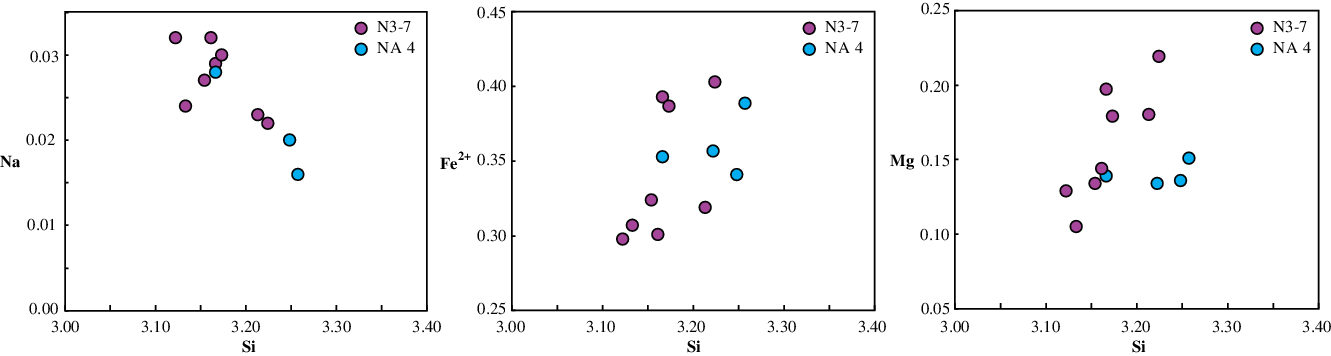
Electron microprobe analyses of white mica are listed in Table 4. Silicon content varies from 3.12 to 3.22 apfu (atoms per formula units), indicating they are phengites. The white micas are rich in muscovite (Table 4; XMu = 0.57–0.72), with low values of Ti (0.01–0.04 apfu), Na (0.02–0.03 apfu) and Al (2.27–2.53 apfu), as shown in the Si–Al binary diagram (Fig. 5b) and the muscovite–paragonite–celadonite ternary diagram (Fig. 5c). In Figure 5b, white-mica compositions are plotted below the ideal Tschermak-substitution line, showing the partial substitution of Al by Fe3+ and some di/trioctahedral substitution (Willner, Reference Willner2005). Mg# values vary from 0.25 to 0.36, whereas the MgO values in muscovite from the mylonitic granite are unusually high (1.02–2.10 wt %). The low total of divalent cations (Fe + Mg + Mn < 1 apfu; in this study = 0.41–0.69 apfu) implies rather high AlVI contents (1.49–1.67 apfu). Negative correlations are visible between Si with Al and Na (Fig. 5b) and between Mg and Fe with Si (Fig. 6). Because crystal growth of the phengitic white mica has occurred at low temperature (Blanco-Quintero et al. Reference Blanco-Quintero, García-Casco, Rojas-Agramonte, Rodríguez-Vega, Lázaro and Iturralde-Vinent2010), the Mg–Ti–Na diagram (Fig. 5d) suggests that the samples were formed in the chlorite to biotite schist zone, which is supported by the Al2O3 vs Fe2O3 + FeO diagram (Fig. 5e).
Electron microprobe analyses of white mica from the Ghaleh-Dezh metagranite

Variation diagrams for Na, Fe2+ and Mg with Si in the phengitic muscovite of the mylonitic granite.

5.a.3. Biotite
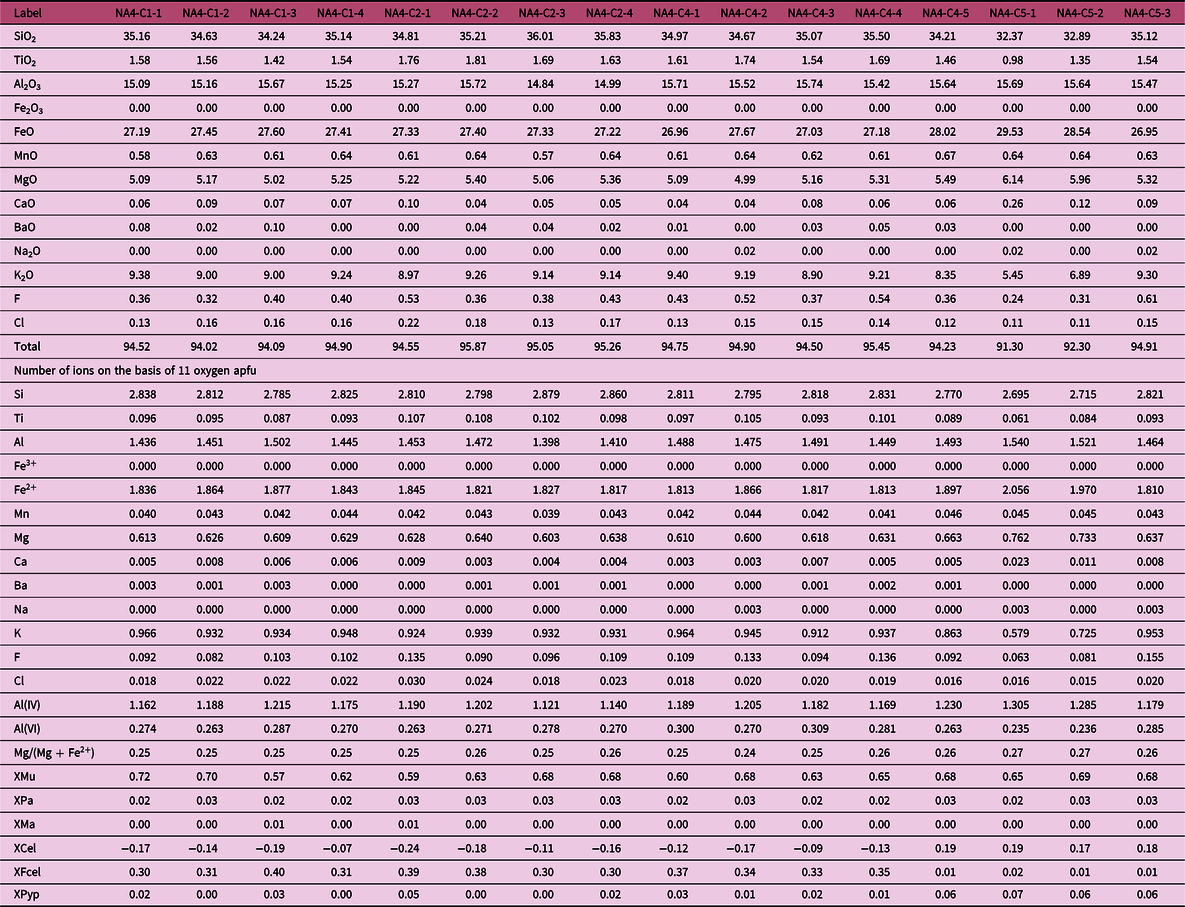
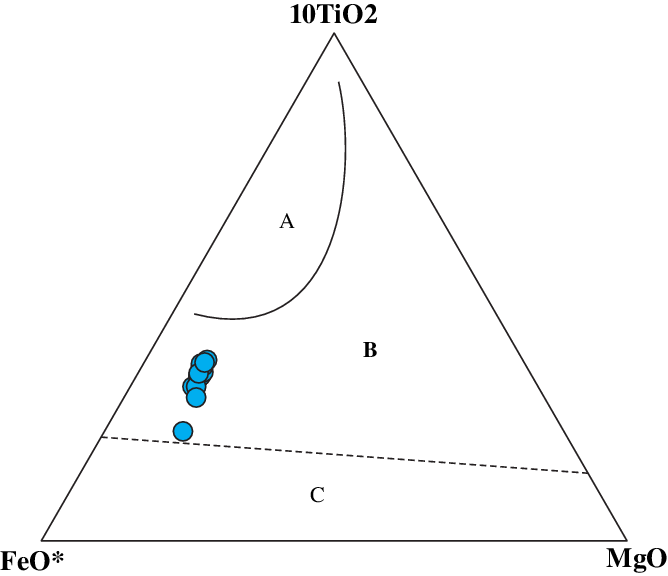
The 16 analyses of biotites from mylonitic granite at Ghaleh-Dezh are listed in Table 5. All of them indicate trioctahedral true micas (2.85 < M site < 3.16 apfu; M = Mg + Fe+2 + Mn + Ti + AlIV), showing affinity of annite in the AlIV vs Mg/(Mg + Fe2+) diagram (Fig. 5f). The biotites exhibit low BaO (Ba = 0.000–0.003 apfu, O = 11) and variable concentrations of K2O (K = 0.579–0.966 apfu, O = 11) (normally larger than 0.9 apfu, O = 11; Tetsopgang et al. Reference Tetsopgang, Suzuki and Njonfang2008), suggesting subsequent overprinting. As shown in Figure 7, the biotites plot in the re-equilibrated biotite domain (Nachit et al. Reference Nachit, Ibhi, Abia and Ohoud2005). AlVI amounts vary between 0.24 and 0.30; as these values are <1, this suggests a magmatic provenance (Nachit et al. Reference Nachit, Ibhi, Abia and Ohoud2005).
Electron microprobe analyses of biotite from the Ghaleh-Dezh metagranite

Composition of biotites from the Ghaleh-Dezh metagranite plot in re-equilibrated biotites domain in the FeO*–10TiO2–MgO diagram (Nachit et al. Reference Nachit, Ibhi, Abia and Ohoud2005). A: domain of the primary magmatic biotites; B: domain of the re-equilibrated biotites; C: domain of the neoformed biotites.

5.a.4. Titanite
The euhedral to subhedral titanites (magmatic titanites) are chemically variable (Table 6): Si = 1.031–1.039 apfu, Ti = 0.866 – 0.913 apfu, Al = 0.066–0.107 apfu, Fe3+ = 0.020–0.040 apfu, Ca2+ = 0.964–0.978 apfu, (Al + Fe3+) = 0.086–0.147 apfu and XFe 3+ = 0.232–0.272. Al and Fe values fall within the range of magmatic titanite (Al = 0.05–0.09 apfu; Fe = 0.03–0.05 apfu; Morad et al. Reference Morad, El-Ghali, Caja, Al-Ramadan and Mansurbeg2009). The titanites that have Fe/Al ratios from 0.27 to 0.37 are mainly of hydrothermal origin, implying re-equilibration of the mineral (Kowallis et al. Reference Kowallis, Christiansen and Griffen1997).
Electron microprobe analyses of titanite (Ttn), magnetite (Mag) and epidote (Ep) from the Ghaleh-Dezh metagranite

5.a.5. Epidote
Epidote analyses are listed in Table 6. The Ps amounts (Ps = Fe3+/Fe3+ + Al) in the mineral are 0.27, which, together with petrographic evidence, suggests a magmatic provenance.
5.a.6. Magnetite
The magnetite is almost pure Fe3O4, and its Al2O3 and TiO2 concentrations are low (<0.03 wt %). Low Ti contents thus suggest a low temperature of formation. Very low contents of Si, Al and Ti further indicate that the magnetites were re-equilibrated during cooling (Yin et al. Reference Yin, Ma and Robinson2017).
5.b. Zircon U–Pb age
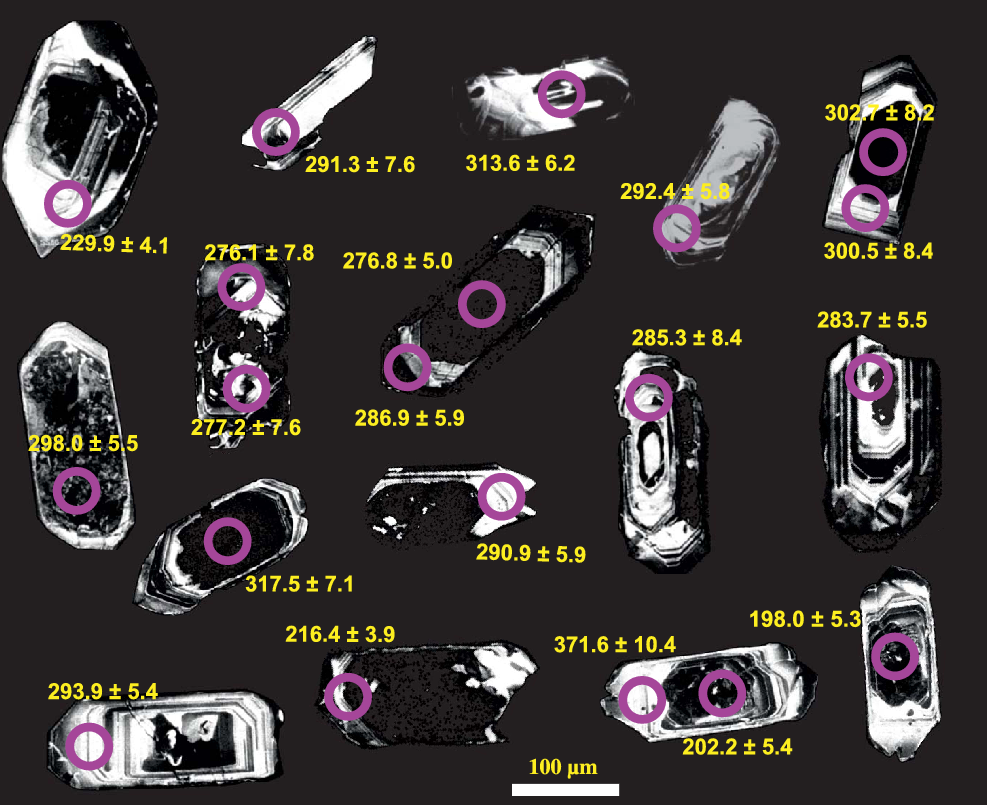
Zircon grains from the Ghaleh-Dezh metagranites are dark-green and brownish red in colour, or colourless prismatic crystals, sometimes with apatite and melt inclusions. CL images of the dated zircon grains from sample N1-4 (Fig. 8) show oscillatory zoning, indicating their magmatic origin.
Cathodoluminescence images of representative zircon grains. Ages (±σ) are indicated. Scale is the same for all zircon images from sample of N1-4, Ghaleh-Dezh metagranite.

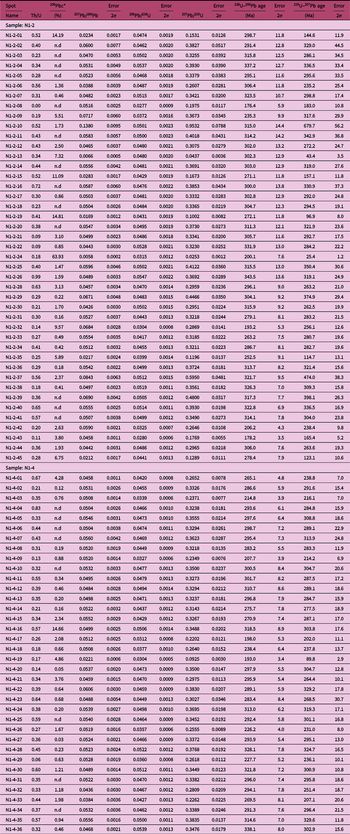
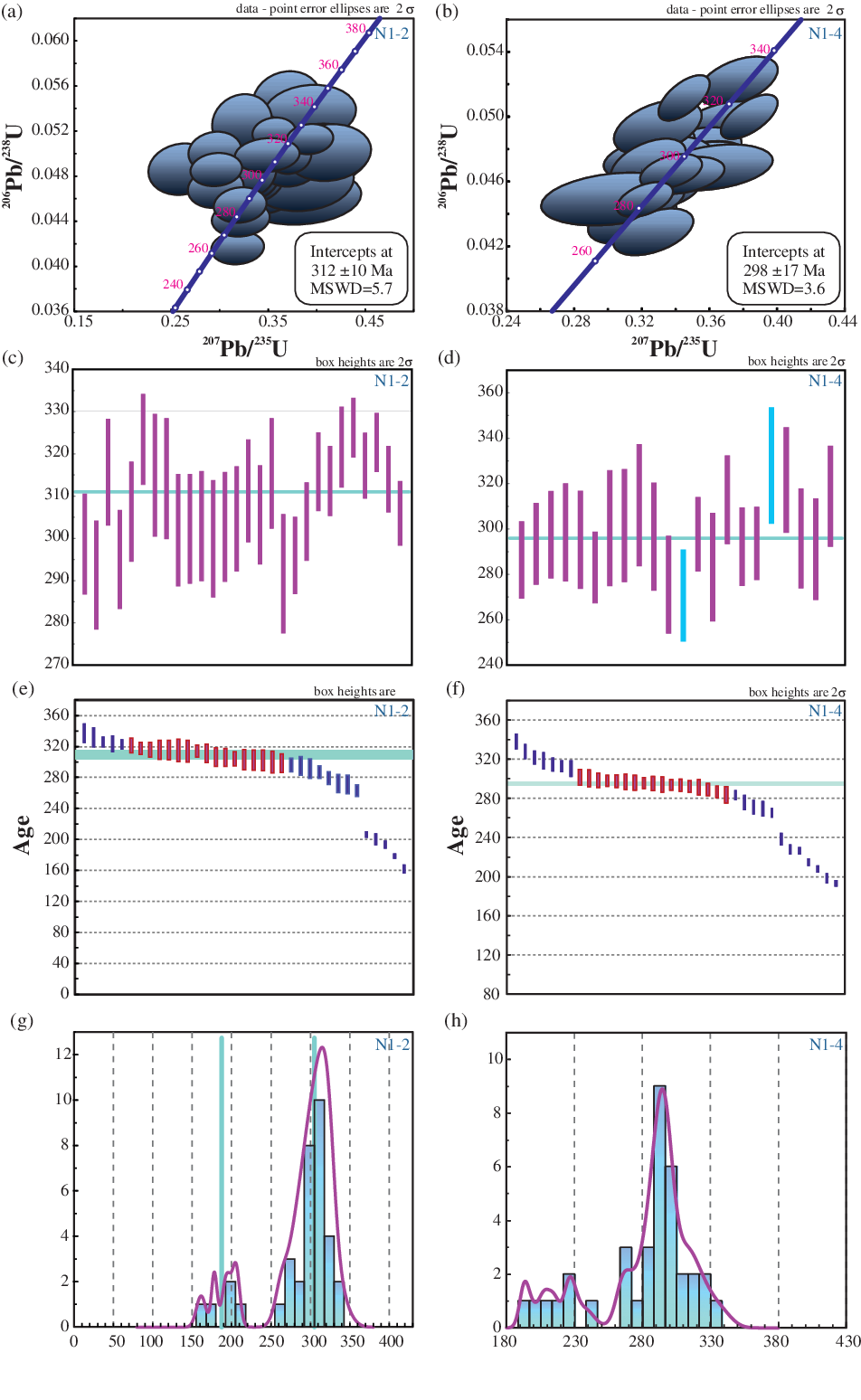
The measured U–Pb isotope ratios of zircon grains from Ghaleh-Dezh metagranites are listed in Table 7. For calculation of ages, concordant grains (less than 10 % discordancy) as well as analyses with common lead less than 2.0 % were used. There is no recognizable correlation between the internal structure of zircon grains and U–Pb ages since there are similar ages in both rim and core (Fig. 8). Most Th/U ratios from analysed spots are higher than 0.2, further supporting their magmatic origin. The data yield concordia intercept ages of 312 ± 10 Ma and 298 ± 17 Ma for two samples N1-2 and N1-4, respectively (Fig. 9). Moreover, a number of zircon grains show younger ages (between 207.7 and 176.4 Ma), and their Th/U ratios vary from 0.00 to 0.18. In general, a weighted mean concordia age of 305 Ma (Late Carboniferous) constrains the crystallization time of the granite pluton.
LA-ICP-MS U–Pb analyses of zircon grains for the Ghaleh-Dezh metagranites

* Percentage of 206Pb contributed by common Pb on the basis of 204Pb. Value of common Pb was assumed by Stacey & Kramers (Reference Stacey and Kramers1975) model; n.d.: no detection of 204Pb.
(a, b) U–Pb concordia ages of zircon grains from the two samples (N1-2 and N1-4) of the Ghaleh-Dezh metagranite. Data-point error ellipses are 2σ. (c, d) Weighted mean U–Pb diagrams for the two samples (N1-2 and N1-4) of the Ghaleh-Dezh metagranite. (e, f) TuffZric diagrams for the two samples (N1-2 and N1-4) of the Ghaleh-Dezh metagranite. (g, h) Histograms of zircon grains from the two samples (N1-2 and N1-4) of the Ghaleh-Dezh metagranite.

5.c. K-feldspar 40Ar/39Ar age
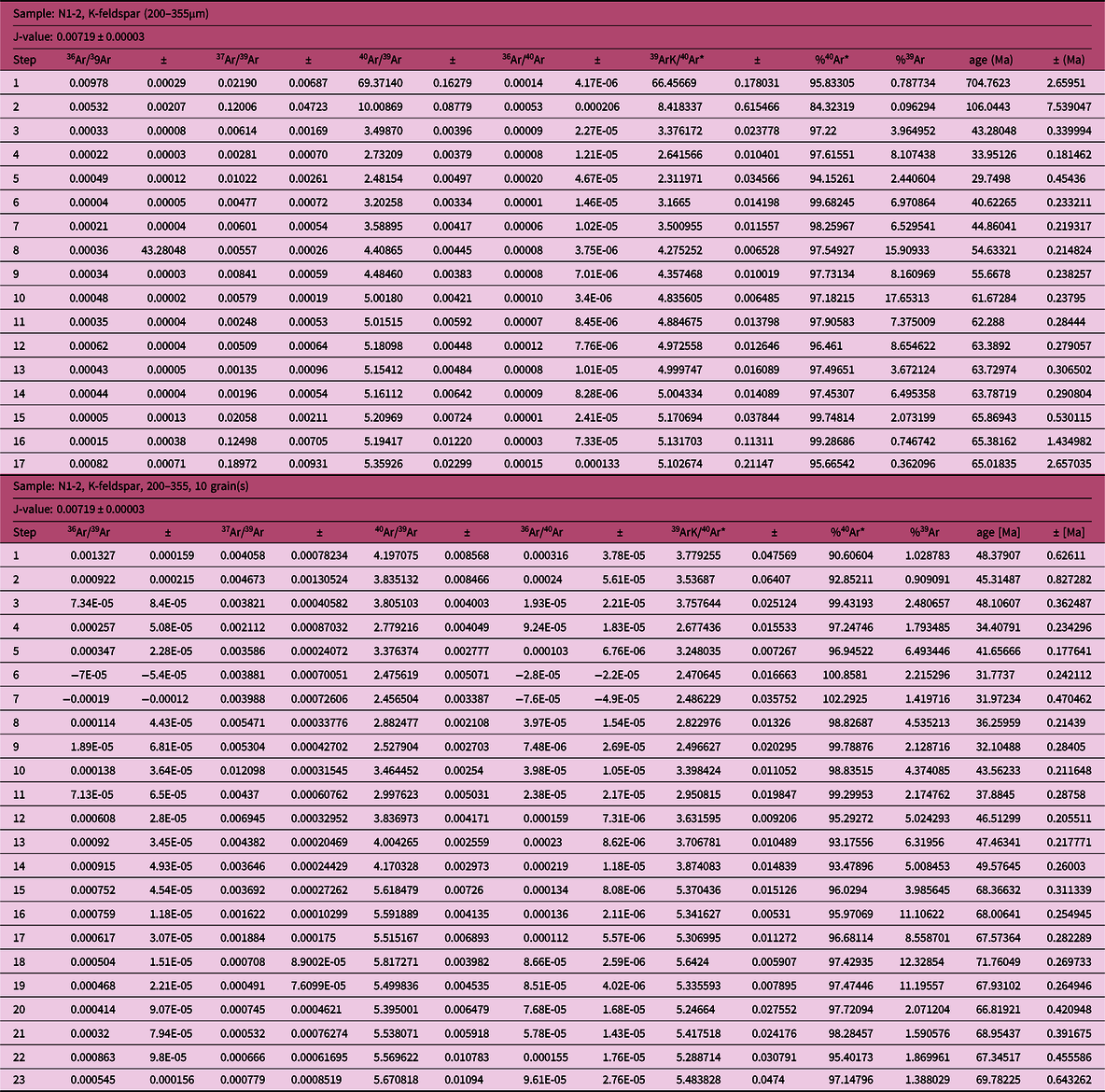
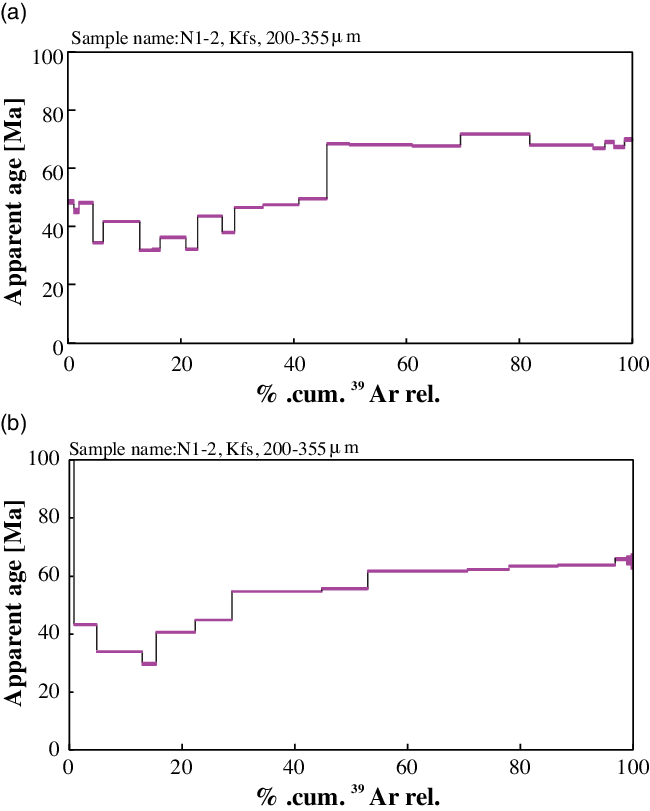
The 40Ar/39Ar geochronological results of analysed steps on two K-feldspar concentrates of grain size 200–350 µm, separated from the N1-2 sample, are listed in Table 8. The K-feldspar is a solid solution close to the Or end-member (94.07–97.71; K = 0.945–1.024 %). Based on the K-feldspar grain size (300 µm diameter) and assuming a slow cooling rate (5 °C Ma−1), Ar closure temperatures of c. 280 °C were calculated using the Ar diffusion parameters of Foland (Reference Foland1974). The 40Ar/39Ar age spectra for K-feldspar concentrates are presented in Figure 10. All isotopic dates are shown at the 1σ level. The Ar release pattern of the N1-2 concentrates reveals discordant age spectra with very complex degassing patterns.
Summary of 40Ar/39Ar age and isochron calculation results on K-feldspar concentrates from the mylonitic granitic samples

Step heating 40Ar/39Ar results for the two K-feldspar samples of the Ghaleh-Dezh metagranite.

40Ar/39Ar dates erratically decrease over the first 15–20 % of gas release and then increase almost monotonically to a plateau-like segment after ∼50 % of the gas has been released. The discordant age spectrum is probably the result of partial outgassing during the Upper Cretaceous to Early Palaeocene. In the first steps, sample N1-2B displays Ar loss, while sample N1-2A shows excess argon. The younger ages obtained during early stages suggest that the mylonitic granite experienced a thermal event between 30 and 45 Ma. The plateau-like segments with ages around 60 Ma may be related to collisional events in the region during the closure of Neotethys.
5.d. Sr–Nd isotope ratios
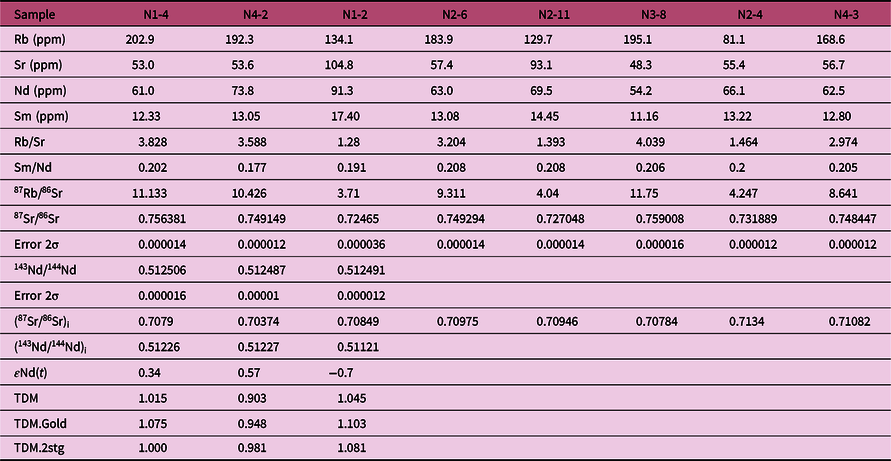
Results of isotope analyses of eight Rb–Sr and three Sm–Nd samples of the mylonitic granite are presented in Table 9. The rocks display relatively high Rb values from 81.1 to 203.3 ppm, low Sr values of 48.3–104.8 ppm and a limited range of Sm and Nd contents of 11.2 to 17.4 and 54.2 to 91.3 ppm, respectively. The initial Sr and Nd isotope ratios are calculated based on the weighted average of the U–Pb zircon age at 305 Ma. The samples have variable (87Sr/86Sr)305 contents from 0.7037 to 0.7130. The (147Nd/144Nd)305 ratios are ∼0.5123. The εNd(t) of these rocks varies from −0.70 to 0.34.
Sr–Nd isotopic composition for the mylonitic granite from the Ghaleh-Dezh body (calculated age of 305 Ma)

Ratios of 87Rb/86Sr and 147Sm/144Nd are calculated from Rb, Sr, Sm and Nd contents measured by ICP-MS (Shabanian et al. Reference Shabanian, Khalili, Davoudian and Mohajjel2009). εNd(t) contents are calculated based on present-day (147Sm/144Nd)CHUR = 0.1967 and (143Nd/144Nd)CHUR = 0.512638. TDM values are calculated based on present-day (147Sm/144Nd)DM = 0.2137 and (143Nd/144Nd)DM = 0.51315.
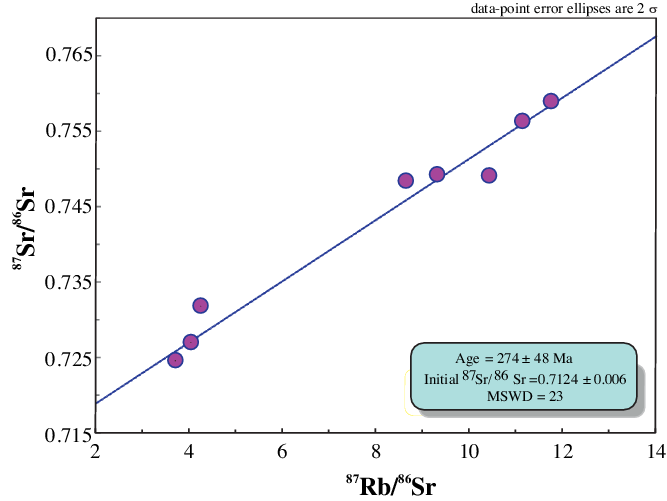
The eight whole-rock samples yield a Rb–Sr errorchron with an age of 274 ± 48 Ma and an initial 87Sr/86Sr isotopic ratio of 0.7124 ± 0.0058 for the mylonitic granite of the Ghaleh-Dezh body (Fig. 11).
Whole-rock Rb–Sr isochron plots for Ghaleh-Dezh metagranite. The mylonitic granite isochron gives an age of 284 Ma with relatively high correlation. The initial 87Sr/87Sr ratio of the isochron is 0.7124.

5.e. Whole-rock geochemistry
Whole-rock geochemical data of the Ghaleh-Dezh pluton were initially presented by Shabanian et al. (Reference Shabanian, Khalili, Davoudian and Mohajjel2009). To better evaluate the relationship between orogenic phases and granitic magmatism, the geochemistry of the mylonitic granites is compared with the geochemistry of other granites in the northern part of the SaSZ with similar ages (e.g. Hasansalaran complex (Azizi et al. Reference Azizi, Kazemi and Asahara2017); east of Misho (Ahankoub et al. Reference Ahankoub, Jahangiri, Asahara and Moayyed2013); Khalifan Pluton (Bea et al. Reference Bea, Mazhari, Montero, Amini and Ghalamghash2011)) that are listed in Table 1.
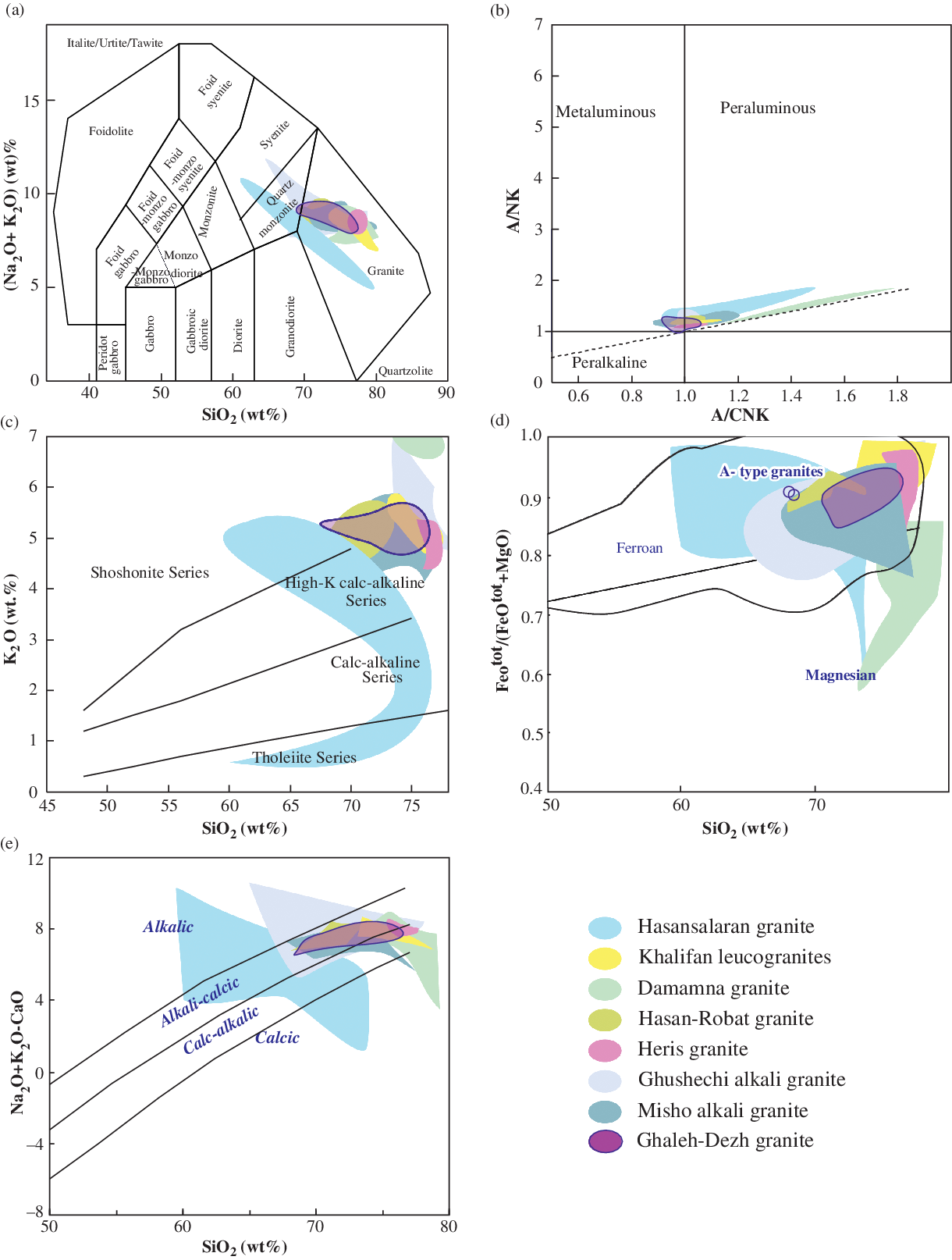
All the granitic samples of the northern part of the SaSZ exhibit relatively high SiO2 (except a few granitic samples from the Hasansalaran complex (Azizi et al. Reference Azizi, Kazemi and Asahara2017)), Na2O (excluding Damamna granitic samples (Abdulzahra et al. Reference Abdulzahra, Hadi, Azizi, Asahara and Yamamoto2017)) and K2O, and low CaO, TiO2, P2O5 and MgO (excluding a few samples from the Hasansalaran complex (Azizi et al. Reference Azizi, Kazemi and Asahara2017)). In the TAS (total alkali vs silica) diagram (after Middlemost, 1994), all samples fall in the granite field (except some from Hasansalaran and Ghushchi that plot in the granite, quartz monzonite and syenite fields; Fig. 12a). A/CNK ratios of the rocks plot in the metaluminous to slightly peraluminous fields of Maniar & Piccoli (Reference Maniar and Piccoli1989) (Fig. 12b), but the samples from the Hasansalaran complex and Damamna area are extremely peraluminous. In the K2O vs SiO2 diagram (Fig. 12c), the syn-Variscan granitoids plot in the high-potassic calk-alkaline field, whereas the granitoid samples of Hasansalaran are scattered throughout.
Geochemistry diagrams. (a) In the TAS diagram (after Middlemost (1994), the felsic igneous rocks mostly plot in the granite field (excluding Ghushchi (Moghadam et al. Reference Moghadam, Li, Ling, Stern, Santos, Meinhold, Ghorbani and Shahabi2015) and Hasansalaran granitoids (Azizi et al. Reference Azizi, Kazemi and Asahara2017)). (b) A/NK–A/CNK diagram (Shand, Reference Shand1947; Maniar & Piccoli, Reference Maniar and Piccoli1989) for the Variscan granitic rocks of the SaSZ. Most of the rocks are metaluminous to slightly peraluminous, except the Hasansalaran (Azizi et al. Reference Azizi, Kazemi and Asahara2017) and Damamna granites (Abdulzahra et al. Reference Abdulzahra, Hadi, Azizi, Asahara and Yamamoto2017). (c) In K2O–SiO2 diagram (Peccerillo & Taylor, Reference Peccerillo and Taylor1976), the ‘Variscan’ granitoids plot in high-K calc-alkaline series (except the Hasansalaran granitoid (Azizi et al. Reference Azizi, Kazemi and Asahara2017)). (d) In the SiO2 vs (FeOt/FeOt + MgO) discrimination diagram (Frost et al. Reference Frost, Barnes, Collins, Arculus, Ellis and Frost2001), the Variscan felsic rocks show a ferroan affinity (excluding Damamna granites (Abdulzahra et al. Reference Abdulzahra, Hadi, Azizi, Asahara and Yamamoto2017)). (e) MALI (Na2O + K2O − CaO) vs SiO2 discrimination diagram of Frost et al. (Reference Frost, Barnes, Collins, Arculus, Ellis and Frost2001); the rocks plot in different fields. The Ghaleh-Dezh granite mostly plots in the alkali-calcic field. The intrusions are introduced in Table 1.

Most of the syn-Variscan granitic samples from the northern part of the SaSZ have high K2O + Na2O contents (>6.25 wt %), excluding three samples of the granitoids of the Hasansalaran complex (Azizi et al. Reference Azizi, Kazemi and Asahara2017). In the geochemical diagrams from Frost et al. (Reference Frost, Barnes, Collins, Arculus, Ellis and Frost2001), most samples plot in the ferroan field, except the Damamna granites (Fig. 12d). Using MALI (the modified alkali–lime index), they range from calcic to alkalic (Fig. 12e). The 10000Ga/Al ratios of the samples are 3.03–10.21 (in Ghaleh-Dezh samples they are 3.18–3.85). All of these data are consistent with A-type granites.
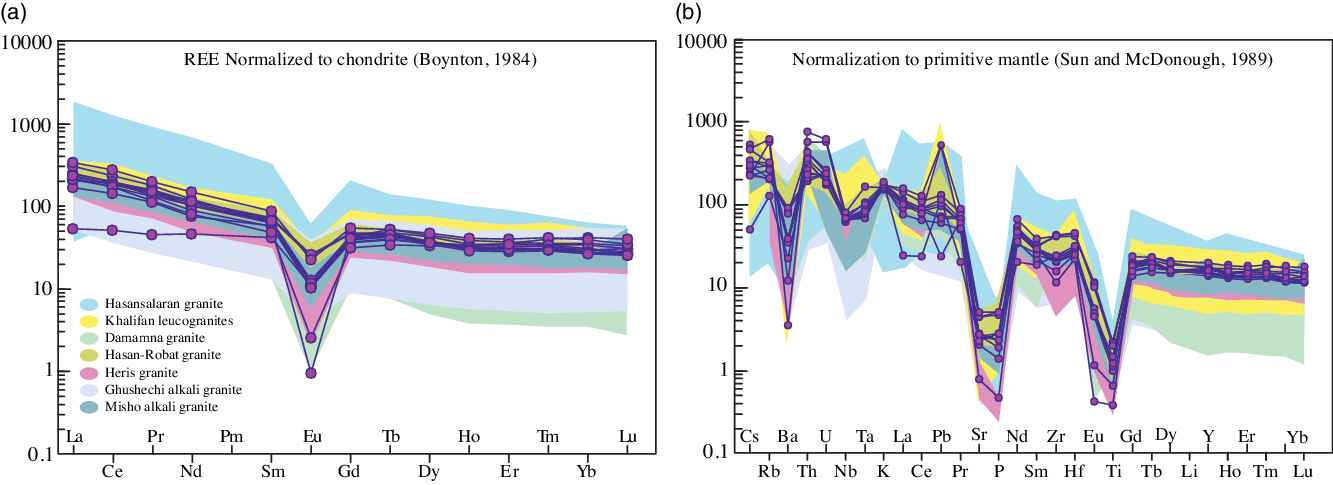
On chondrite-normalized rare-earth element (REE) diagrams (Fig. 13; Boynton, Reference Boynton1984), the syn-Variscan granitic samples from the belt clearly display an enrichment of light REE (LREE) (LaN/YbN = 1.82–10.62, LaN/SmN = 1.27–4.68 for Ghaleh-Dezh and other granitic rocks: LaN/YbN = 1.39–39.70, LaN/SmN = 0.61–10.17 for other granitic rocks), and flat heavy REE (HREE) patterns (GdN/YbN = 0.75–1.73 and 0.75–4.03 for Ghaleh-Dezh and other granitoid samples, respectively) with significant negative Eu anomalies, excluding three samples from Ghushchi (Eu/Eu* for all of the samples from north of the SaSZ = 0.02–3.62; Eu/Eu* for Ghaleh-Dezh = 0.02–0.44). On primitive mantle-normalized incompatible element diagrams (Sun & McDonough, Reference Sun, McDonough, Saunders and Norry1989; Fig. 13b), most of the syn-Variscan granitic samples from the northern part of the SaSZ reveal enrichment of large-ion lithophile elements (LILE) and LREE relative to high-field-strength elements (HFSE) and HREE. They show depletion of Ti, Sr and Ba. Ta, Nb and Pb show different behaviours in the granitic samples of the belt. Hasansalaran granite (Azizi et al. Reference Azizi, Kazemi and Asahara2017), Damamna granite (Abdulzahra et al. Reference Abdulzahra, Hadi, Azizi, Asahara and Yamamoto2017) and Khalifan granite (Bea et al. Reference Bea, Mazhari, Montero, Amini and Ghalamghash2011) display positive anomalies of Nb and Ta, but other samples of the belt exhibit negative anomalies (Fig. 13b). Positive Pb anomalies have been reported in some of the granitic samples, except for Hasansalaran granite (Azizi et al. Reference Azizi, Kazemi and Asahara2017) and three samples from Ghaleh-Dezh.
Comparison of the Ghaleh-Dezh mylonitic granitic rocks with other Variscan granite in the SaSZ in (a) the chondrite-normalized diagram (normalization values after Boynton, Reference Boynton1984), and (b) the trace element spider diagram normalized to primitive mantle (values after Sun and McDonough, Reference Sun, McDonough, Saunders and Norry1989). The intrusions are introduced in Table 1.

Also, the Nb/Ta ratio varies from 5.29 to 11.4 in the granitic samples in the Heris area (Advay & Ghalamghash, Reference Advay and Ghalamghash2011), 11.1 to 16.9 in the Ghaleh-Dezh samples (this study), 13.31 to 19.33 in the rocks of Hasansalaran (Azizi et al. Reference Azizi, Kazemi and Asahara2017), 11.55–20.91 in the rocks of Damamna (Abdulzahra et al. Reference Abdulzahra, Hadi, Azizi, Asahara and Yamamoto2017) and 11.39–20.75 in Ghushchi granite (Moghadam et al. Reference Moghadam, Li, Ling, Stern, Santos, Meinhold, Ghorbani and Shahabi2015). Nb/Ta ratios of >17.6 in the granites display mostly positive correlation with Pb.
6. Discussion
6.a. Relation between crystallization and exhumation ages
Zircon grains from the mylonitic granite from Ghaleh-Dezh yield an average Th/U > 0.38 and an age of 305 Ma (312 ± 10 Ma and 298 ± 17 Ma), with a few grains yielding an age of 200 Ma. The samples (N1-2 and N1-4) which are in close proximity to each other (Fig. 2b) are considered to be related to the same magmatic phase, as their ages are identical to within analytical uncertainties. Therefore, these ages are interpreted as crystallization ages of the zircon grains and are coeval with the tectonothermal evolution of Iranian basement at the time of the Variscan orogeny (Carboniferous/Permian boundary).
In the northern part of the SaSZ, the beginning of the orogeny is revealed by intrusion of A1-type granites and mafic igneous rocks in the Early Carboniferous (e.g. Chiu et al. Reference Chiu, Chung, Zarrinkoub, Mohammadi, Khatib and Iizuka2013; Saccani et al. Reference Saccani, Allahyari, Beccaluva and Bianchini2013; Abdulzahra et al. Reference Abdulzahra, Hadi, Azizi, Asahara and Yamamoto2017; Azizi et al. Reference Azizi, Kazemi and Asahara2017) and continued until the Early Permian with the intrusion of A2-type granites (e.g. Alirezaei & Hassanzadeh, Reference Alirezaei and Hassanzadeh2012). The magmatic rocks are found in a curved belt, which extends northeast of Urumieh (Heris) through north Azna-Dorud (Ghaleh-Dezh) to east Golpayegan (Hasan-Robat); this is here termed the syn-Variscan magmatic belt of the northern part of the SaSZ (Fig. 1).
Occasionally, the igneous rocks of the Ghaleh-Dezh have younger U–Pb zircon ages (Fig. 9). The Th/U ratios of those younger zircon crystals from the mylonitic granite (with less than 10 % discordancy) vary from 0.00 to 0.18, and the ages are between 207.7 and 176.4 Ma, so they have probably been affected by subsequent events such as subduction-related magmatism (e.g. Shakerardakani et al. Reference Shakerardakani, Neubauer, Masoudi, Mehrabi, Liu, Dong, Mohajjel, Monfaredi and Friedl2015), and/or metamorphism and deformation (e.g. Davoudian et al. Reference Davoudian, Genser, Neubauer and Shabanian2016). Mylonitization processes or leaching of metamict grains by fluids under low-temperature conditions result in partial or near-complete Pb loss in these zircon grains (e.g. Wayne & Sinha, Reference Wayne and Sinha1988; Bomparola et al. Reference Bomparola, Ghezzo, Belousova, Griffin and O’Reilly2006).
Most of the granitic rocks in the belt have Rb–Sr whole-rock isochron ages between 232 Ma (for Misho granitoid plutons: Ahankoub et al. Reference Ahankoub, Jahangiri, Asahara and Moayyed2013) and 277 ± 5 Ma (for the Khalifan granite; Bea et al. Reference Bea, Mazhari, Montero, Amini and Ghalamghash2011), likely reflecting an open system during mylonitization and other events. Based on Figure 11, the Rb–Sr errorchron of 274 ± 48 Ma and an initial 87Sr/86Sr isotopic ratio of 0.7124 ± 0.0058 for the mylonitic granite from the Ghaleh-Dezh pluton are consistent with the Rb–Sr age of the Khalifan granite. Based on the distribution of Rb and Sr in K-feldspar and plagioclase, respectively (Giletti, Reference Giletti1991; Cherniak & Watson, Reference Cherniak and Watson1994; Giletti & Casserly, Reference Giletti and Casserly1994), Bea et al. (Reference Bea, Mazhari, Montero, Amini and Ghalamghash2011) interpreted this to reflect Sr isotope resetting as a result of evolution of mesoperthites during an unknown regional event. Moreover, the event has also been reflected in 40Ar/39Ar biotite ages from Gushchi granite (Shahabi et al. Reference Shahabi, Shafaii and Ghorbani2018). Thus, the event may be contemporaneous with reheating of the SaSZ associated with tectonic subsidence and continental drift in the Late Permian through Triassic time related to the opening of the Neo-Tethys ocean (Hassanzadeh & Wernicke, Reference Hassanzadeh and Wernicke2016).
The 40Ar/39Ar K-feldspar age spectra yield crude plateau-like segments with ages of c. 60–70 Ma that appear to be geologically significant and are likely related to the collisional event in the region (Agard et al. Reference Agard, Omrani, Jolivet, Whitechurch, Vrielynck, Spakman, Monié, Meyer and Wortel2011; Mahmoudi et al. Reference Mahmoudi, Corfu, Masoudi, Mehrabi and Mohajjel2011). This collisional event is evident in the magmatic, metamorphic and deformation characteristics of the SaSZ. Moreover, the absence of older 40Ar/39Ar K-feldspar ages shows that K-feldspar ages have been completely reset by the event, implying a minimum temperature of this tectonothermal event of 280 °C. Also, the younger 40Ar/39Ar apparent ages (30 to 45 Ma) in the initial steps of the age spectra are synchronous with U–Pb zircon ages obtained from granitoid rocks in the SaSZ (e.g. Baneh: 39–52 Ma (Azizi et al. Reference Azizi, Hadad, Stern and Asahara2018a)) and the Urumieh–Dokhtar magmatic arc (e.g. Chiu et al. Reference Chiu, Chung, Zarrinkoub, Mohammadi, Khatib and Iizuka2013). This suggests that these ages are geologically meaningful and may indicate that the mylonitic granite experienced a thermal event coinciding with Middle-to-Late Eocene to Oligocene magmatism due to final collision of the Arabian and Eurasian plates (e.g. Azizi et al. Reference Azizi, Hadad, Stern and Asahara2018a).
The above-mentioned geologic history has also influenced the composition of minerals of the rocks. Element exchange in feldspars has likely generated almost pure albite or orthoclase in their evolution. Petrographic observations suggest that phengitic muscovites were created during lower greenschist facies-grade regional metamorphism. The occurrence of pericline twins in plagioclases as well as the formation of microcline with lattice twins implies solid-state ductile deformation (Fig. 4-b) that has taken place during lower greenschist-facies metamorphism, especially in the Jurassic (e.g. Davoudian et al. Reference Davoudian, Genser, Neubauer and Shabanian2016). The results are consistent with young zircon ages (mostly Jurassic) between 207.7 and 176.4 Ma, likely resulting from Pb loss by the later greenschist-facies overprint.
According to the petrographical, geochronological and isotopic data as well as field observations, we propose that mylonitization has been one of the other main factors for the partial resetting of isotope systems in the study area, as the rocks presumably underwent mylonitization and then exhumation due to the operation of the Azna-Dorud shear zone during Jurassic time, as reported from other regions of the SaSZ (e.g. North Shahrekord: Davoudian et al. Reference Davoudian, Genser, Neubauer and Shabanian2016).
In general, the zircon chronology of the rocks from the belt reveals the absence of inherited zircon grains, excluding those from Heris (Advay & Ghalamghash, Reference Advay and Ghalamghash2011). Moreover, average calculated zircon saturation temperatures (T Zr.sat.; Watson & Harrison, Reference Watson and Harrison1983) for the granitoids of the belt are higher than 800 °C (average T Zr.sat. of the Ghaleh-Dezh granite: 827 °C (767–879 °C); Hasansalaran granite: 903 °C (825–1095 °C); Khalifan granite: 856 °C (819–898 °C); Damamna granite: 890 °C (869–920 °C); Hasan-Robat granite: 856 °C (833–875 °C); Ghushchi granite: 817 °C (724–882 °C); Misho granite: 836 °C (660–883 °C)), except the Heris Granite (average T Zr.sat. = 763 °C (695–818 °C)). Furthermore, there is a positive correlation between age and average T Zr.sat. for the granitic rocks of the Variscan magmatism belt of the SaSZ, excluding Hasan-Robat granite (Fig. 14). Based on the classification of Miller et al. (Reference Miller, McDowell and Mapes2003), the Heris granite is a cold granite with a high proportion of inherited crystals (T Zr.sat. < 800 °C), whereas other intrusive bodies are hot granites with a low proportion of inheritance (T Zr.sat. > 800 °C). As shown in Figure 14, the rock affinity varies from A1 toward A2 with decreasing T Zr.sat..
Variation diagram of T Zr.sat. vs age (Ma) for the Variscan felsic rocks.

6.b. Tectonic setting and determination of source
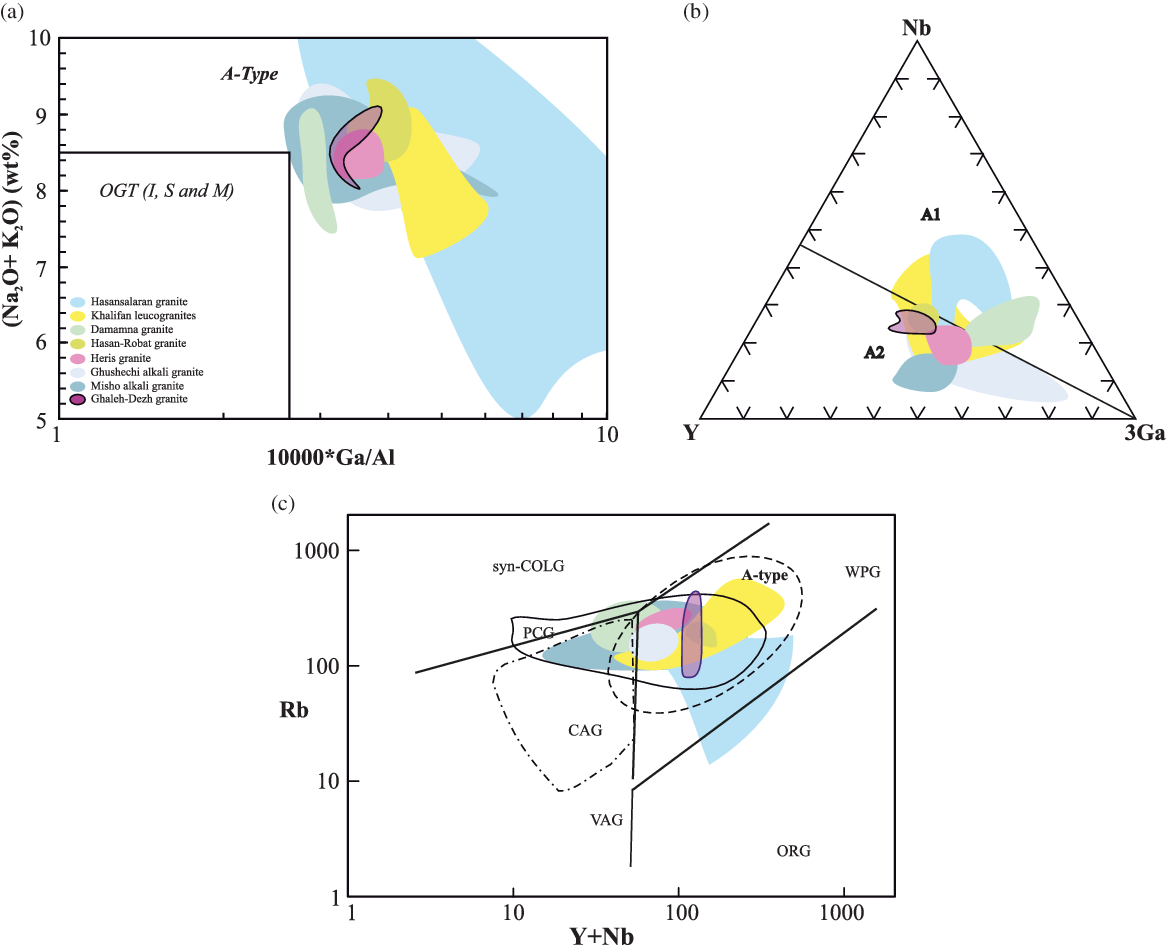
Based on published data from the syn-Variscan intrusions of the SaSZ listed in Table 1 and the negative anomalies of Sr and flat patterns of HREEs on the primitive-mantle-normalized diagrams (Fig. 13b), the felsic igneous rocks are not adakitic. They exhibit A-type affinities according to classification diagrams of Whalen et al. (Reference Whalen, Currie and Chappell1987) and Eby (Reference Eby1992). Also, the enrichment of LREE relative to HREE with significant depletions of Eu in chondrite-normalized diagrams (Fig. 13a) is consistent with an A-type nature for the felsic samples in the belt. They plot in either the A1-type granite field (granitoids from Hasansalaran complex (Azizi et al. Reference Azizi, Kazemi and Asahara2017) and Damamna granite (Abdulzahra et al. Reference Abdulzahra, Hadi, Azizi, Asahara and Yamamoto2017)), the A1 to A2 transition (Hasan-Robat granite and Khalifan granite) or the A2-type field (Misho granitoids (Ahankoub et al. Reference Ahankoub, Jahangiri, Asahara and Moayyed2013); Ghushchi granite (Moghadam et al. Reference Moghadam, Li, Ling, Stern, Santos, Meinhold, Ghorbani and Shahabi2015); Heris granite (Advay & Ghalamghash (Reference Advay and Ghalamghash2011); Ghaleh-Dezh granite (Shabanian et al. Reference Shabanian, Khalili, Davoudian and Mohajjel2009; Fig. 15a, b)). The positive anomalies of Rb, Th, U, K and Pb (excluding samples from Hasansalaran granite (Azizi et al. Reference Azizi, Kazemi and Asahara2017) and three samples from Ghaleh-Dezh (this study)) and negative anomalies of Nb, Ta (excluding samples from Hasansalaran complex (Azizi et al. Reference Azizi, Kazemi and Asahara2017)), Ti, Y, Sr and P (Fig. 13b) on the primitive mantle-normalized diagrams reflect subduction-related processes in active continental margins (Sun & McDonough, Reference Sun, McDonough, Saunders and Norry1989). The high LILE/HFSE ratios of the ‘syn-Variscan’ felsic rocks indicate subduction-related magmatism and over-thickened crust, which are probably related to the tectonic evolution of active continental margins. Thus, most rocks also plot within the WPG field in the tectonic setting discrimination diagram (Rb vs Y + Nb diagram) of Pearce et al. (Reference Pearce, Harris and Tindle1984) (Fig. 15c), except the Damamna granite (Abdulzahra et al. Reference Abdulzahra, Hadi, Azizi, Asahara and Yamamoto2017) and the Ghushchi granitic rocks (Moghadam et al. Reference Moghadam, Li, Ling, Stern, Santos, Meinhold, Ghorbani and Shahabi2015), which plot in the syn-COLG, VAG and WPG fields (Fig. 15c).
10000Ga/Al vs (Na2O + K2O) diagram (Whalen et al. Reference Whalen, Currie and Chappell1987). (b) Nb–Y–3Ga diagram (Eby, Reference Eby1992) for classification of the Variscan felsic rocks of the north of the SaSZ. (c) Discrimination diagrams for granite tectonic setting (Pearce et al. Reference Pearce, Harris and Tindle1984) for the Variscan felsic rocks of the north of the SaSZ. Syn-COLG: syn-collisional granite; WPG: within-plate granite; VAG: volcanic-arc granite; CAG: continental arc granite; PCG: post-collisional granite; and ORG: ocean-ridge granite. The intrusions are introduced in Table 1.

In general, A-type granites are produced by fractional crystallization of mantle-derived mafic magmas (Turner et al. Reference Turner, Foden and Morrison1992; Litvinovsky et al. Reference Litvinovsky, Jahn, Zanvilevich, Saunders, Poulain, Kuzmin, Reichow and Titov2002; Mushkin et al. Reference Mushkin, Navon, Halicz, Hartmann and Stein2003), the partial melting of a crustal source (e.g. Collins et al. Reference Collins, Beams, White and Chappell1982; Whalen et al. Reference Whalen, Currie and Chappell1987; Creaser et al. Reference Creaser, Price and Wormald1991) or the mixing of the two end-members (e.g. Kerr & Fryer, Reference Kerr and Fryer1993; Wickham et al. Reference Wickham, Alberts, Zanvilevich, Litvinovsky, Bindeman and Schauble1996; Mingram et al. Reference Mingram, Trumbull, Littman and Gerstenberger2000; Yang et al. Reference Yang, Wu, Chung, Wilde and Chu2006; Dall’Agnol et al. Reference Dall’Agnol, Frost and Rämö2012). High contents of SiO2 (>60 wt %) may indicate the involvement of felsic crustal materials or strong fractionation of mafic melts during their formation (Lan et al. Reference Lan, Fan, Yang, Cai, Wen and Zhang2015; Shabanian et al. Reference Shabanian, Davoudian, Dong and Liu2018). In the absence of large mafic bodies of the same age as the syn-Variscan granitoids, and given the lack of a complete sequence of basic to intermediate igneous rocks (except for the Hasansalaran area with SiO2 = 59.5–73.9 wt %), this strongly suggests that the fractionation of mafic magma did not play an important role in the production of the felsic rocks (Lan et al. Reference Lan, Fan, Yang, Cai, Wen and Zhang2015; Papoutsa et al. Reference Papoutsa, Pe-Piper and Piper2016). A-type granitic magmas can be produced by partial melting of metasediments, anhydrous lower crustal granulitic residue and calc-alkaline granitoids (tonalite or granodiorite) in the shallow crust (Collins et al. Reference Collins, Beams, White and Chappell1982; Whalen et al. Reference Whalen, Currie and Chappell1987; Creaser et al. Reference Creaser, Price and Wormald1991; Landenberger & Collins, Reference Landenberger and Collins1996; King et al. Reference King, White, Chappell and Allen1997; Patiño Douce, Reference Patiño Douce1997; Wu et al. Reference Wu, Sun, Li, Jahn and Wilde2002; Frost & Frost, Reference Frost and Frost2011; Huang et al. Reference Huang, Li, Li and Li2011; Zhou et al. Reference Zhou, Zhai, Zhao, Lan and Sun2014; Deng et al. Reference Deng, Zhao and Peng2016). High alkali values and mostly low Al2O3 in the felsic rocks are not consistent with a metasedimentary source for the felsic rocks (Deng et al. Reference Deng, Zhao and Peng2016). Granulites in the lower crust would be expected to have calcium plagioclase, pyroxene and amphibole. Therefore, melting of a residual granulite is not consistent with a felsic magma with low MgO, CaO, Al2O3 and Sr, and high Na2O, K2O and SiO2 (Deng et al. Reference Deng, Zhao and Peng2016) (excluding the Hasansalaran granitoid; Azizi et al. Reference Azizi, Kazemi and Asahara2017). Moreover, high (Na2O + K2O)/Al2O3 (>0.6; average of 0.66 in the Ghaleh-Dezh samples) and TiO2/MgO ratios (>1.0 for most samples, with an average 1.08 in the Ghaleh-Dezh samples) also do not support a residual granulite origin. Low amounts of CaO, Mg#, Ni, Cr and V in the felsic rocks also show insignificant contributions of mantle-derived material in their formation (Deng et al. Reference Deng, Zhao and Peng2016), as confirmed by Nb/Ta ratios (<11 in crustal source and >17.6 in mantle source; Green, Reference Green1995). The Nb/Ta ratio is less than 11 in granites of the Heris area (Advay & Ghalamghash, Reference Advay and Ghalamghash2011), varies from 11.1 to 16.9 in the Ghaleh-Dezh samples and more than 17.6 in a few of the rocks of the Hasansalaran (Nb/Ta = 13.31–19.33; Azizi et al. Reference Azizi, Kazemi and Asahara2017), Damamna (Nb/Ta=11.55–20.91; Abdulzahra et al. Reference Abdulzahra, Hadi, Azizi, Asahara and Yamamoto2017) and Ghushchi areas (Nb/Ta = 11.39–20.75; Moghadam et al. Reference Moghadam, Li, Ling, Stern, Santos, Meinhold, Ghorbani and Shahabi2015). Nb/Ta ratios higher than 17.6 in the granites display mostly positive correlation with Pb that may suggest contribution of crustal sources (Moreno et al. Reference Moreno, Molina, Bea, Anbar and Montero2016) as well as mantle.
However, the (87Sr/86Sr)i ratios display wide variations in the felsic rocks (Hasansalaran granitoids: 0.649–0.711 (Azizi et al. Reference Azizi, Kazemi and Asahara2017); Damamna granite: <0.699 (Abdulzahra et al. Reference Abdulzahra, Hadi, Azizi, Asahara and Yamamoto2017); Ghushchi granite: 0.715–0.921 (Moghadam et al. Reference Moghadam, Li, Ling, Stern, Santos, Meinhold, Ghorbani and Shahabi2015); Misho granites: 0.683–0.888, Khalifan granite: 0.738–0.834 (Bea et al. Reference Bea, Mazhari, Montero, Amini and Ghalamghash2011); and Ghaleh-Dezh granite: 0.703–0.713 (this study)). Azizi et al. (Reference Azizi, Kazemi and Asahara2017) and Abdulzahra et al. (Reference Abdulzahra, Hadi, Azizi, Asahara and Yamamoto2017) stated that the (87Sr/86Sr)i values lower than those of original chondrite (0.699) for Hasansalaran granitoids and the Damamna granites are related to the source magmas which were derived mainly from the depleted mantle; but it is more likely that the wide variation in the initial Sr isotope ratios could be due to disturbance of the isotope system during subsequent metamorphism and deformation. In the Misho granites, the dominant process appears to be assimilation–fractionation (Ahankoub et al. Reference Ahankoub, Jahangiri, Asahara and Moayyed2013), while the negative slope in the SiO2 vs (87Sr/86Sr)i diagram of the Ghushchi samples is probably due to alteration. Also, the variation range of εNd(t) values in the felsic rocks is: Hasansalaran granitoids: 0.07–6.02 (Azizi et al. Reference Azizi, Kazemi and Asahara2017); Damamna granite: 1.6–4.2 (Abdulzahra et al. Reference Abdulzahra, Hadi, Azizi, Asahara and Yamamoto2017); Ghushchi granite: 1.3–2.4 (Moghadam et al. Reference Moghadam, Li, Ling, Stern, Santos, Meinhold, Ghorbani and Shahabi2015); Misho granites: −7.4–3.17, Khalifan granite: −0.70–0.01 (Bea et al. Reference Bea, Mazhari, Montero, Amini and Ghalamghash2011); and Ghaleh-Dezh granite: −0.64–0.39 (this study). The εNd(t) variation implies a mantle source (Abdulzahra et al. Reference Abdulzahra, Hadi, Azizi, Asahara and Yamamoto2017; Azizi et al. Reference Azizi, Kazemi and Asahara2017) combined with an intermediate (Moghadam et al. Reference Moghadam, Li, Ling, Stern, Santos, Meinhold, Ghorbani and Shahabi2015) to crustal source (Bea et al. Reference Bea, Mazhari, Montero, Amini and Ghalamghash2011). The variation of the two parameters may reflect variable contributions of crustal and mantle materials. Consequently, the Hasansalaran and Damamna A1-type granitoids appear to have a mantle and crustal source (Abdulzahra et al. Reference Abdulzahra, Hadi, Azizi, Asahara and Yamamoto2017; Azizi et al. Reference Azizi, Kazemi and Asahara2017), whereas the Heris granite likely has a crustal source (Advay & Ghalamghash, Reference Advay and Ghalamghash2011).
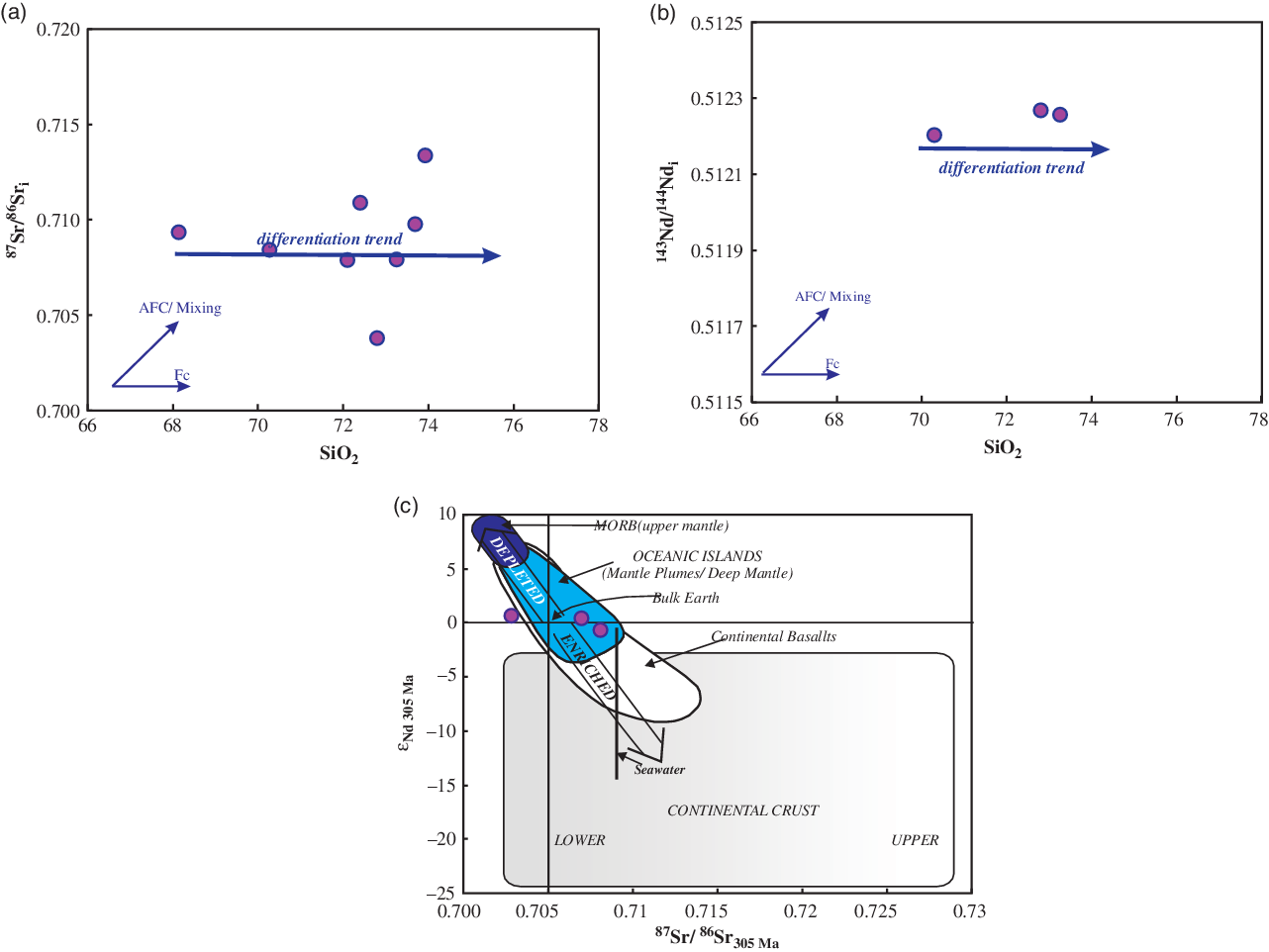
Here, we focus on the source of the A2-type granite from the Ghaleh-Dezh area. The Ghaleh-Dezh metagranite lie on horizontal lines in both an SiO2 vs (87Sr/86Sr)i diagram and an SiO2 vs (143Nd/144Nd)i diagram. This suggests that differentiation processes played an important role in the evolution of the rocks (Fig. 16a, b). The (87Sr/86Sr)i contents vary from 0.7037 to 0.7130 in Ghaleh-Dezh, suggesting ocean island basalt (OIB) (87Sr/86Sri: 0.702–0.706) and continental crust (87Sr/86Sri: 0.706–0.718; Zhou et al. Reference Zhou, Mao and Lyckberg2012) signatures. (Y/Nb)N values for the Ghaleh-Dezh metagranite are <1 (0.21–0.28), confirming an OIB-like source; however, negative Nb anomalies and flat to positive Pb anomalies in Ghaleh-Dezh samples can display a crustal component (Moreno et al. Reference Moreno, Molina, Montero, Anbar, Scarrow, Cambeses and Bea2014). Also, the εNd(t) values vary around zero (horizontal line in the Ghaleh-Dezh in the 87Sr/86Sri vs εNd(t) diagram; Fig. 16c). Nb/Ta, Ce/Pb and Th/Nb values in the Ghaleh-Dezh rocks vary in the ranges 12.83–16.89, 5.07–89.00 and 0.06–0.08, respectively. Therefore, they most likely have a dual mantle–crustal source. In this regard, high K2O/Na2O ratios for most samples, Sr/Ba, low CaO and P2O5 concentrations and depletion in Eu and Sr are consistent with partial melting of tonalite and granodiorite containing biotite and alkali-feldspar with a plagioclase-rich residual at high temperature and shallow depth (e.g. Anderson, Reference Anderson1983; Creaser et al. Reference Creaser, Price and Wormald1991; King et al. Reference King, White, Chappell and Allen1997, Reference King, Chappell, Allen and White2001; Patiño Douce, Reference Patiño Douce1997; Dall’Agnol et al. Reference Dall’Agnol, Scaillet and Pichavant1999; Du et al. Reference Du, Yang, Wyman, Nutman, Lu, Song, Xie, Wan, Zhao and Geng2016). The tonalite and granodiorite have likely inherited mantle characters.
(a, b) The diagrams 87Sr/86Sri and 143Nd/144Ndi vs SiO2 show a differentiation trend for the Ghaleh-Dezh metagranite. (c) The variation of 87Sr/86Sri vs εNd(t) for the Ghaleh-Dezh metagranite.

6.c. Tectonic scenario
After closure of the Proto-Tethys Ocean during the Ediacaran (Late Neoproterozoic), the Gondwana plate underwent repetitive extension and compression contemporaneous with the worldwide orogenic phases (e.g. Badr et al. Reference Badr, Davoudian, Shabanian, Azizi, Asahara, Neubauer, Dong and Yamamoto2018). Each orogenic phase started as a result of extensional forces associated with the Wilson cycle. The events of the ‘syn-Variscan’ phase are difficult to recognize in the SaSZ as a part of the northern margin of Gondwana because in contrast to other regions such as Europe and Turkey (e.g. the Afyon zone (Candan et al. Reference Candan, Akal, Koralay, Okay, Oberhänsli, Prelević and Mertz-Kraus2016)), there is no clear evidence of arc-related magmatism during this time in the SaSZ. The syn-Variscan magmatism in the zone began with development of bimodal magmatism including A1-type granitoids and mafic rocks (e.g. 360 Ma, Hasansalaran area; Azizi et al. Reference Azizi, Kazemi and Asahara2017) and probably ended with the intrusion of A2-type granites (e.g. 305 Ma, Ghaleh-Dezh area; this study).
As mentioned above, due to the absence of I-type granitoids and extensive mafic rocks related to the orogeny, the position of magmatic arc is still a matter of debate. In this regard, it has been suggested that the syn-Variscan orogenic event has been related to back-arc rifting and or inversion and uplift (Sharland et al. Reference Sharland, Archer, Casey, Davies, Hall, Heward, Horbury and Simmons2001; Abdulzahra et al. Reference Abdulzahra, Hadi, Azizi, Asahara and Yamamoto2017). Moreover, Abbo et al. (Reference Abbo, Avigad and Gerdes2018) suggested that the Variscan orogeny gave rise to mantle-induced thermal disturbances in the passive margin of Gondwana (such as Iran and North Africa), contrary to Kohn et al. (Reference Kohn, Eyal and Feinstein1992), who stated that the magmatic events were not related to the ‘Variscan’ orogeny. According to the literature (e.g. Abdulzahra et al. Reference Abdulzahra, Hadi, Azizi, Asahara and Yamamoto2017; Azizi et al. Reference Azizi, Kazemi and Asahara2017), extension created an immature opening of a basin that soon stopped and then closed, eventually opening again to generate the Neo-Tethys.
Azizi et al. (Reference Azizi, Kazemi and Asahara2017) state that the Proto-Tethys oceanic-crust southward subduction beneath northern Gondwana created an arc and back-arc basin. Then roll-back of the oceanic crust (Azizi et al. Reference Azizi, Kazemi and Asahara2017) or mantle-induced thermal disturbances in the passive margin of Gondwana (Abbo et al. Reference Abbo, Avigad and Gerdes2018) may have caused upwelling of hot asthenospheric mantle. The upwelling of the hot mantle plume and surface erosion would increase the geothermal gradient, creating normal faults and lithospheric thinning. The mantle-derived magma would be injected into the lower continental crust, as evidenced from mafic bodies in the Ghushchi (Moghadam et al. Reference Moghadam, Li, Ling, Stern, Santos, Meinhold, Ghorbani and Shahabi2015), the Misho (Saccani et al. Reference Saccani, Allahyari, Beccaluva and Bianchini2013) regions and June complex (Dare-Hedavand metagabbro (Shakerardakani et al. Reference Shakerardakani, Neubauer, Masoudi, Mehrabi, Liu, Dong, Mohajjel, Monfaredi and Friedl2015, Reference Shakerardakani, Neubauer, Bernroider, Von Quadt, Peytcheva, Liu, Genser, Monfaredi and Masoudi2017); Darijune gabbro, 336 ± 9 Ma (Fergusson et al. Reference Fergusson, Nutman, Mohajjel and Bennett2016)). Fractionation of mafic rocks and/or partial melting of basic rocks (Chappell et al. Reference Chappell, Bryant and Wyborn2012) in the lower continental crust could then have led to the production of peraluminous A1-type granitoids in the Hasansalaran area and Damamna regions. Partial melting of tonalite and granodiorite generated A1- to A2- type granites (Khalifan area) and A2-type granites (Gushchi, Ghaleh-Dezh, Heris and Misho regions). The formation of the Khalifan granite with A1- to A2- type features occurred during the extension-to-compression transition, in which compression led to thrusting and crustal thickening. The additional contribution of crustal material would have increased magma production and yielded magma with an A2-type signature. In the later stages, Upper Palaeozoic major extension occurred in Iran which led to the break-up of Gondwana and the opening of the Neotethys Ocean between Sanandaj–Sirjan and Zagros in Permian times. The Hasan-Robat granite (Alirezaei and Hassanzadeh, Reference Alirezaei and Hassanzadeh2012) would also have been produced in the transitional stage of compression to extension.
Among the granitoids, only the Heris granite (average of T Zr.sat. = 763 °C; Fig. 14) was emplaced in a crustal-thickening environment (Miller et al. Reference Miller, McDowell and Mapes2003). Therefore, the generation of the Heris granite as a cold granite is likely to require both the influx of heat and fluids. We note that the heat influx from mafic magma is also needed for generating other syn-Variscan felsic magmas which produced hot granites (T Zr.sat. > 800 °C) that intruded in extensional regions (Miller et al. Reference Miller, McDowell and Mapes2003). These felsic igneous rocks and especially the Ghaleh-Dezh metagranite experienced subsequent thermal events at 274 Ma and 65 Ma, coinciding with opening and closing of the Neotethys Ocean.
7. Conclusion
Comprehensive geochronological, mineralogical, geochemical and isotopic investigations of the Ghaleh-Dezh granite and other granitic rocks with similar ages from the Sanandaj-Sirjan Zone (SaSZ) lead to the following conclusions:
-
1) The ‘syn-Variscan’ orogeny created both extension and compression in the SaSZ as a part of Gondwana, coinciding with intrusion of A1-type granitoids and gabbroic rocks followed by the intrusion of A2-type granite (such as Ghaleh-Dezh metagranite). The tectonothermal events were short-lived. Most of these Variscan felsic igneous rocks are hot granites in which inherited zircon grains are absent.
-
2) The mylonitic granitic rocks of Ghaleh-Dezh serve as evidence of ‘syn-Variscan’ magmatism, and yield crystallization ages of 312 to 298 Ma. Our new zircon U–Pb ages for these mylonitic granites are younger than previously published ages, indicating that granitic magmatism in this area can be divided into two stages: Late Neoproterozoic and Late Carboniferous to Early Permian. The magma sources for the Late Carboniferous Ghaleh-Dezh metagranites are mantle and crust.
-
3) Subsequent events (e.g. opening and closing of Neotethys) have led to significant variations in the chemical compositions of minerals in the Ghaleh-Dezh metagranite, inhibiting the determination of further tectonothermal information from the crystallization of this unit.
Acknowledgements
The research was financially supported by Shahrekord University, Iran (No. 94GRD1M1214) and Nagoya University, Japan (JSPS KAKENHI grants no. 17H01671). We are grateful to the editor, Kathryn Goodenough, and two anonymous reviewers for their constructive and insightful comments and suggestions that helped to improve this paper.