INTRODUCTION
The change from vegetative to reproductive growth in perennial ryegrass (Lolium perenne L.) tillers has a major impact on the seasonal pattern of sward production and quality. During the mid-season inflorescent period (May–August) the sward is predominately comprised of low digestible reproductive tillers (Gilliland et al. Reference Gilliland, Barrett, Mann, Agnew and Fearon2002). Laredo & Minson (Reference Laredo and Minson1975) established that the leaves of perennial ryegrass had a 0·20 higher voluntary dry matter intake than the stem fraction even though the dry matter digestibilities were only slightly higher (670 v. 640 g/kg DM, respectively). Other authors such as Terry & Tilley (Reference Terry and Tilley1964) found that with increasing perennial ryegrass maturity, the stem digestibility declines at a much faster rate than that of the leaf, which is associated with a reduction of plant water-soluble carbohydrate and protein constituents coupled with a reduction in fibre digestibility. Significant differences in green leaf proportion exist between cultivars (Gilliland et al. Reference Gilliland, Barrett, Mann, Agnew and Fearon2002; Smit et al. Reference Smit, Tas, Taweel and Elgersma2005) with leaf proportions as low as 0·63 in mid-season. Late heading cultivars tend to have a greater leaf content than early or intermediate heading cultivars at ear emergence (EE) (Gilliland et al. Reference Gilliland, Barrett, Mann, Agnew and Fearon2002; Gowen et al. Reference Gowen, O'Donovan, Casey, Rath, Delaby and Stakelum2003). Early spring defoliation patterns can condition the sward for mid-season growth by promoting leafier herbage with fewer reproductive tillers. Studies examining the effect of high spring grazing pressure (Korte Reference Korte1981; Holmes & Hoogendoorn Reference Holmes and Hoogendoorn1983) and mechanical pasture topping have revealed lower stem and dead material proportions in the sward mid-season.
While these previous studies have contributed to moderating the problem of mid-season steminess, they have failed to resolve it fully. To achieve further inhibition of mid-season steminess, a more empirical investigation of the control and dynamics of reproductive initiation and seed head development is required. While it is well known that reproductive initiation is day length-dependent and EE is largely energy-dependent, studying the interaction between growing conditions, genotype and location could provide a better understanding of the relative importance of each factor. This could indicate potential strategies for controlling seed head development.
The first morphological sign of the transition to reproductive growth occurs at the shoot apex, where bud primordia develop in the axils of the lower meristem to give the shoot apex a ‘double-ridge’ appearance (Jones & Lazenby Reference Jones and Lazenby1988). Initiation requirements of the reproductive apex vary with grass species and cultivars. Perennial ryegrass normally requires a period of low temperature and short days, known as induction or vernalization before it is competent to respond to the environmental factors which bring about initiation (Cooper Reference Cooper1960; Aamlid et al. Reference Aamlid, Heide and Boelt2000). Wycherley (Reference Wycherley1952) reported that low temperatures alone were essential for floral induction and (Cooper & Calder Reference Cooper and Calder1964; Aamlid et al. Reference Aamlid, Heide and Boelt2000) confirmed that low temperature vernalization is the most important factor governing the transition from vegetative to reproductive development in perennial ryegrass. Cooper (Reference Cooper1960) and Aamlid et al. (Reference Aamlid, Heide and Boelt2000) found that short day length and low temperature, independently, have an inductive effect.
The objective of the present study was to examine the relationship between the timing of reproductive initiation and EE in eight different perennial ryegrass cultivars and to determine the effect of location (latitude) and meteorological conditions on the timing of both these growth stages. As one of the sites used in this study (Crossnacreevy) also tests the EU Common Catalogue of varieties, a further objective of the study was to develop a robust equation to predict the critical initiation date of any cultivar based on its heading date from this site.
MATERIALS AND METHODS
Experimental design and management
The experiment was undertaken at two different latitudes in Ireland over 2 consecutive years: AFBI Plant Testing Station, Crossnacreevy, Belfast (54°32′N, 5°52′W) during 2005 and Moorepark Dairy Production Research Centre, Fermoy, Co. Cork (52°09′N, 08°16′W) during 2006. The soil type at Crossnacreevy is a medium loam soil maintained at approximately pH 6·5, while at Moorepark the soil type is free-draining, brown earth soil with a sandy loam-to-loam texture (Gardiner & Radford Reference Gardiner and Radford1980) at pH 6·5. Fertilizer management was similar at both sites.
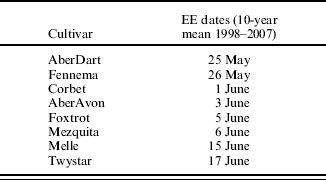
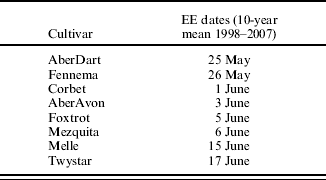
In August 2004, 40 plants of each cultivar (Table 1) were established at 0·75 m spacing on an outdoor site at Crossnacreevy. Cultivars were initially selected in pairs with similar heading dates yet with contrasting digestibility levels as part of an associated study (Hurley Reference Hurley2007). Plants were allowed to vernalize naturally over winter and examinations began in spring 2005. In the following autumn 2005, clones of each plant were created by excising tillers and transplanting them into multipot trays. These tiller clones were transplanted at 0·75 m spacing to an outdoor site in Moorepark and again allowed to vernalize naturally over winter. Examination of these plants began during the following spring of 2006. Examination of plants of the same genetic material at different latitudes during consecutive years tested the accuracy of the means by which the critical day length results were obtained in the present study.
Ear emergence (EE) dates of perennial ryegrass cultivars from United Kingdom National Testing Authority 2007
Plant measurements
Previous reproductive initiation and seed head emergence data for three obsolete perennial ryegrass cultivars (Gremie, Talbot and Perma) collected by Camlin (Reference Camlin1978), were used to generate an ‘ear initiation’ (EI) v. EE regression coefficient. This was used as a guide to the likely EI date for each cultivar in the present study. Based on this predictive guide, EI sampling began in mid-March prior to the expected EI date of the earliest cultivar. On alternate days one tiller was removed from each plant and examined under the microscope for reproductive budding as described by Sweet et al. (Reference Sweet, Wiltshire and Baker1991). All mature and developing leaves were removed, until the apex was visible. Under close examination, the presence of a double ridge on the apex was taken as the earliest possible evidence that the tiller had initiated or turned reproductive. Examinations continued until all plants had initiated. The mean EI date of each cultivar was then determined.
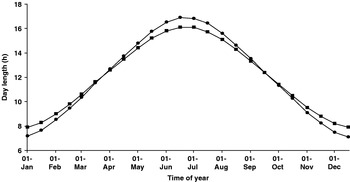
Critical day length, which is defined as the minimum length of daylight required to trigger the growth of the reproductive apex (Evans Reference Evans and Barnard1964), was subsequently calculated for each plant. Daylight length is calculated according to Meeus (Reference Meeus1991). The day length (in hours) for each EI was obtained by interpolation of photoperiodic data corresponding to the latitude of each of the two sites (Fig. 1). This calibration curve was derived from a table compiled by Lam (Reference Lam2006) who calculated the year-round hours of daylight at 5° latitude intervals based on a formula published by Meeus (Reference Meeus1991). The date of plant EE was recorded, according to Cooper (Reference Cooper1952), as the date when three seed heads had visibly emerged on a spaced plant. Day length at the time of EE for each cultivar was also calculated.
Day length hours at Crossnacreevy (54°N) • and Moorepark (52°N) ■. Source: Lam (Reference Lam2006).

Plant energy requirements were calculated in terms of temperature and photosynthetically active radiation (PAR). As there was no specific starting point to growth, energy requirements up to EI was presented as mean daily temperature and mean daily PAR from 1 January but from EI to EE it was possible to measure the accumulated daily temperature and PAR for this specific period. PAR is the amount of useable light energy received by a plant and is dependent on light intensity and day length. It is a direct measurement of radiation in the wave band 400–700 nm measured in MJ/m2/day. It was calculated in terms of degree day accumulation (°C) from EI to EE. Data were collected from meteorological monitoring stations at both sites.
Statistical analysis
All statistical analyses were carried out using the statistical package SAS (SAS 2005). All measurements were subjected to analysis of variance using the following model:

where μ=mean; S i=site effect (i=1–2); C j=cultivar effect (j=1–8); S i×C j=interaction of site and cultivar; e ij=residual error term.
Linear regression was used to relate EI critical day length and 10-year mean heading dates for the eight perennial ryegrass cultivars tested, this was possible as Crossnacreevy is the site used for the EU Common Catalogue.
Relationship between EE and EI
Perennial ryegrass cultivars are classified according to their mean date of ear emergence (MDEE), which is also the ‘Heading Date’, quoted in recommended cultivar lists. In the UK, this heading date is the mean of a rolling 10-year data matrix, comprising the average MDEE of 60 different plants recorded each year in the trial fields at Crossnacreevy, Northern Ireland. These heading date results for the eight test cultivars are presented in Table 1 and were used to produce the correlation between the EI and EE dates in the present study.
RESULTS
Climatic conditions
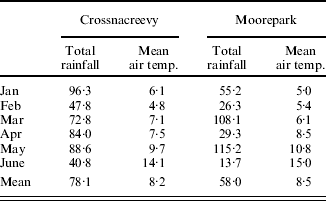
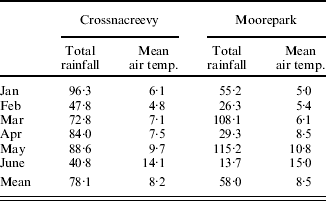
Table 2 shows the total monthly rainfall (mm) and average mean daily temperature (°C) for both sites during the January to June period of each experiment. Plants at Crossnacreevy received a greater rainfall than Moorepark in January (+41 mm), February (+22 mm), April (+55 mm) and June (+27 mm), with rainfall at Moorepark only greater in March (+35 mm) and May (+27 mm). Mean air temperature peaked during June at 15°C at Moorepark and 14°C at Crossnacreevy. Plants at Moorepark experienced greater mean air temperatures than those at Crossnacreevy in February (+0·6°C), April (+1·0°C), and May (+1·1°C), with Crossnacreevy only greater in January (+1·1°C) and March (+2·3°C). Overall, from January to June, the driest and warmest growing conditions were at Moorepark and the wettest and the coolest conditions were at Crossnacreevy.
Total monthly rainfall (mm) and mean monthly air temperatures (°C) at trial sites during experimental period
Differences in latitude between the two experimental sites provided an additional factor in this investigation. Figure 1 shows the magnitude of difference in day length between the two trial sites caused by their difference in latitude. The southern site (Moorepark) has longer day lengths in the winter period than the northern site (Crossnacreevy), but this is reversed in the summer period. Difference in day length hours was greatest between sites on 16 June where Crossnacreevy had a 60 min longer day length than Moorepark; the inverse was true on 16 December where Moorepark had 60 min longer day length duration than Crossnacreevy. The date of equal day length at both sites was approximately 24 March. Production of this day length correction graph for these two sites allowed the influences of differences in accumulated climatic conditions to be separated from the influences of day length differences, thereby facilitating an assessment of how each parameter (EI and EE) responded.
EI
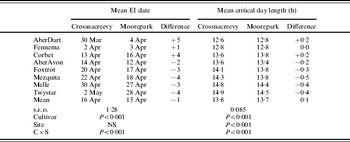
Table 3 shows the EI date and critical day length (corrected for latitude) of each cultivar at both sites. Prior to experiment commencement, the cultivars were selected in pairs with similar heading dates and these pairs were again evident in the recorded EI dates, indicating a relationship between the timing of EI and EE.
Ear initiation (EI) date and critical day length (h) of eight perennial ryegrass cultivars grown at two sites
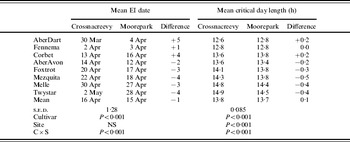
C=cultivar; S=site; s.e.d.=standard error of difference; NS=non significant; Difference accounts for numerical differences between sites. s.e.d. relates to the interaction between Site×Cultivar.
There was a significant interaction (P<0·001) between cultivar and site for both EI date and critical day length, such that the earlier cultivars initiated at Crossnacreevy before Moorepark but the later cultivars initiated first at Moorepark. Furthermore, there was a significant difference between sites in the critical day lengths (P<0·001), but not in the associated EI dates. EI dates at Crossnacreevy ranged from 30 March to 2 May which equated to a range in critical day length of 12·6–14·9 h. Similarly at Moorepark, the EI dates ranged from 3 April to 28 April, which was on average 1 day earlier than at Crossnacreevy. When the critical day lengths were calculated, with adjustments for latitude, the range was 12·8–14·5 h and the average across all the cultivars was only 6 min earlier than at Crossnacreevy. In all these data sets there were significant differences (P<0·001) between the four pairs of cultivars at each site.
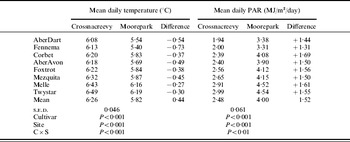
There was a significant interaction between cultivar and site for all plant EI energy received between 1 January and EI (Table 4). At both sites, there was a continuous increase in mean temperature and PAR received with later initiation, but as the order of initiation in the cultivars differed between the sites, this also changed the ranking of the cultivars for these meteorological parameters, resulting in the observed interaction between cultivar and site. Temperature differences between sites contracted with the later cultivars. Yet again there were significant differences between the cultivar pairs (P<0·001) for both meteorological parameters, within the overall trend of later initiating cultivars receiving a higher mean daily temperature and PAR than the earlier cultivars at EI. Energy received was also significantly different (P<0·001) between sites. Mean daily temperature (°C) was significantly greater for all cultivars at Crossnacreevy than Moorepark. Contrasting results were observed for mean daily PAR as significantly greater (P<0·001) values between 1 January and EI were found at Moorepark than Crossnacreevy for all cultivars.
Mean daily temperature and light received from 1 January until EI by eight perennial ryegrass cultivars at two sites

PAR=photosynthetically active radiation; C=cultivar; S=site; s.e.d.=standard error of difference. Difference accounts for numerical differences between sites. s.e.d. relates to the interaction between Site×Cultivar.
EE
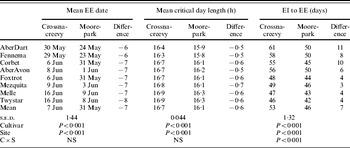
Table 5 shows the EE dates and equivalent day lengths for the cultivars at Moorepark and Crossnacreevy. Converting dates to day length by correcting for latitude, reduced the magnitude of the differences between the sites, but the same level of significant differences (P<0·001) were observed in both data sets. In contrast to the EI results, no site by cultivar interaction was detected in the EE data.
EE date and critical day length (h) of eight perennial ryegrass cultivars at two sites

C=cultivar; S=site; s.e.d.=standard error of difference; NS=non significant. Difference accounts for numerical differences between sites. s.e.d. relates to the interaction between Site×Cultivar.
The cultivars generally headed in the pairs in which they were initially selected, but on average, cultivar emergence dates were 3 days later at Crossnacreevy than the long-term emergence dates for these cultivars recorded by the United Kingdom National Testing Authority (Table 1). The mean EE date at Moorepark was significantly (P<0·001) earlier (7 days) than at Crossnacreevy, which was equivalent to a 36 min shorter day length. EE date was significantly (P<0·001) different between cultivars at both sites, ranging from 29 May (Fennema) to 16 June (Melle/Twystar) at Crossnacreevy and from 23 May (Fennema) to 9 June (Melle) at Moorepark. The difference in EE dates between sites for each cultivar ranged from 6 to 8 days, but when corrected for latitude, resulted in a range in day length of 30–42 min. At Moorepark, day length when the earliest cultivar headed (Fennema) was 15·8 h and when the last cultivar (Twystar) headed was 16·3 h. This was the same day length at which the second earliest cultivar (Fennema) headed at Crossnacreevy. The last cultivars to head at Crossnacreevy were at a day length of 16·9 h (Melle/Twystar). EE was not concurrent at the two sites and when compared in terms of day length, the last cultivar to complete EE at Moorepark coincided with the first cultivar's EE at Crossnacreevy.
The number of days to develop from EI to EE differed significantly between cultivars (P<0·001), ranging from 46 to 61 days at Crossnacreevy and from 42 to 50 days at Moorepark (Table 5). There was also a clear trend associated with cultivar maturity, as the earliest maturing cultivars had significantly longer growth periods to EE than the later maturing cultivars (P<0·001). At Crossnacreevy, therefore, AberDart had the longest interval (61 days) while Twystar had the shortest interval (46 days). At Moorepark, AberDart/Fennema and AberAvon had the longest interval (50 days) while Twystar again had the shortest interval (42 days). In day length terms, the cultivars' development from EI to EE spanned a day length change of between 2·0–3·8 h at Crossnacreevy and 1·8–3·1 h at Moorepark. Overall these responses produced a significant site effect (P<0·001), as cultivars at Crossnacreevy had on average a 7 day longer period between EI and EE than at Moorepark.
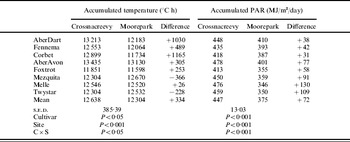
Analysis of the accumulated PAR and temperature (degree hours) received by cultivars between EI and EE, revealed significant interactions between site and cultivar, such that the relative timing between cultivars differed at each site (Table 6). These interactions were randomly distributed across the cultivars and it did not reveal any trends in which more PAR and temperature (°C h) were experienced by either the earlier or later heading cultivars at one site compared to the other. Significant differences (P<0·001) also existed between cultivars at each site but again the distribution of accumulated PAR and temperature (°C h) was randomly distributed across all cultivars at both sites. Comparing the sites during this EI to EE development period, showed that the cultivars also experienced a significantly greater PAR accumulation (+72 MJ/m2/day) and temperature accumulation (+334°C days) at Crossnacreevy than at Moorepark. This is associated with a longer period between EI and EE at Crossnacreevy than Moorepark for the accumulation of energy.
Accumulated temperature and light received between EI and EE by eight perennial ryegrass cultivars at two sites

PAR=photosynthetically active radiation; C=cultivar; S=site; s.e.d.=standard error of difference. Difference accounts for numerical differences between sites. s.e.d. relates to the interaction between Site×Cultivar.
EI–EE relationship
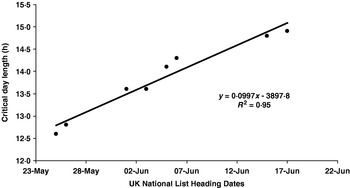
A regression analysis was performed between the EI critical day length data and the EE dates at each site and it was found that these were highly correlated (Moorepark r=0·92, Crossnacreevy r=0·95). Regression analysis was performed between the EE dates at Crossnacreevy and the published 10-year data set used in the statutory National List and various recommended list schemes in the UK (Table 1). These data are also generated only at Crossnacreevy and hence the correlation was again extremely high (r=0·94). It was also found that when regression analysis was performed using the critical day length data from the current study against these 10-year mean heading dates (Fig. 2), the relationship was again very robust (R 2=0·95).
Relationship between ear initiation (EI) critical day lengths and UK National List published heading dates for the eight perennial ryegrass cultivars tested.

DISCUSSION
Comparison of the eight different cultivar genotypes, under different conditions and latitudes provided evidence of the factors that control EI and subsequent emergence and quantified the relationship between these two key events in the plants' life cycle.
EI
The appearance of double ridged primordia in the meristematic apex was taken as the earliest evidence that a plant had turned reproductive. Prior to this, the necessary short day-low temperature induction of the plants had no immediate effect on the morphology of the apex. This is because perennial ryegrass is an obligate long-day plant (Evans Reference Evans and Barnard1964) and so morphological development of embryonic flowering structures can only occur after the photoperiod exceeds a critical day length (Cooper Reference Cooper1952, Reference Cooper1960). Theoretically, the cultivars in the present study should have turned reproductive at the same photoperiod at both latitudes. This was not what was observed, as a significant difference in cultivar photoperiod occurred between the two sites. This does not contradict the accepted physiology of this species, as the photoperiod response was not measured directly but the subsequent morphological response to hormonal changes in the plant was detected instead. A period of growth was, therefore, necessary to produce the double ridged primordia and so prevailing conditions influenced how rapidly this was achieved. The meteorological data showed that cultivars at Moorepark had received significantly more sunlight (PAR) than those at Crossnacreevy. This was of a similar magnitude to that reported by Hennessy (Reference Hennessy2005) between Moorepark and a more northerly site (Grange, 53°31′N). Since Moorepark had longer day lengths than Crossnacreevy during this period (Fig. 1) and rainfall at Moorepark was also considerably less (–82 mm) than Crossnacreevy during January–April (Table 2), this is consistent with greater cloud cover making the observed difference in PAR understandable. Although temperatures were higher at Crossnacreevy, the Moorepark temperatures should not have been limiting to growth as Gaastra (Reference Gaastra1958) showed that growth rates in the field can be satisfactorily derived from the amount of radiation intercepted. Furthermore, grass growth is generally agreed to be strongly dependent on light when nutrients and water are adequate (Donald & Black Reference Donald and Black1958; Cooper & Tainton Reference Cooper and Tainton1968). Consequently, the very small though highly significant (P<0·001) average critical day length difference of 6 min between sites was in fact a measure of the difference in speed of the morphological response, detected by this highly sensitive 40 replicate experimental design. The similarly significant (P<0·001) interaction between cultivar and site was again a consequence of differences in speed of morphological response. As climatic conditions at both sites were not constant throughout the entire period when initiation was occurring, this would explain why the earlier cultivars expressed the morphological change at a shorter day length at Crossnacreevy than at Moorepark whereas the later cultivars displayed the converse response to site. Camlin (Reference Camlin1975) reported similar differential cultivar responses in the timing of reproductive development in perennial ryegrass, though at the later EE stage. In the current study, the 12 min shorter photoperiod requirement at Crossnacreevy than at Moorepark for AberDart and Corbet and the converse 30 min shorter photoperiod for Mesquita at Moorepark, contributed to the cultivar by site interaction. This was, however, a consequence of different speeds of growth at these sites, at different times during the short period subsequent to each apex initiating and not to cultivar by site differences in critical day length requirements. The recorded difference in critical day length induced by significant differences in climate was numerically very small and so the effect of climatic variation, at least within the range experienced in the present study, was minor when converted to critical calendar dates.
Gangi et al. (Reference Gangi, Chilcote and Frakes1983) showed that different cultivars of perennial ryegrass have different requirements for vegetative and reproductive growth and development and previous studies by McCown & Peterson (Reference McCown and Peterson1964) and Canode et al. (Reference Canode, Maun and Teare1972) support this conclusion. In the current study, the critical day length required for reproductive initiation was significantly different between the perennial ryegrasses, ranging from 12·6 to14·9 h for intermediate and late heading cultivars. Keatinge et al. (Reference Keatinge, Camlin and Stewart1979) found similar results over a range of perennial ryegrass maturities, reporting a critical day length range from 11·7 to 15·3 h. The critical day lengths reported for the cultivars in the current study are, therefore, consistent with the findings of previous investigations. Given the accuracy of this experiment, as evident in the detection of even small climatic induced variations, the initiation dates can be accepted as accurate estimates of the cultivars' initiation requirements.
EE
Once floral initiation is attained the subsequent rate of elongation of the fertile shoot and inflorescence development is growth rate controlled and so unlike initiation is not photoperiod dependent. Day length would not be an effective parameter for controlling EE as during this period it only increased marginally at an approximate rate of 2·0 and 1·76 min/day at Crossnacreevy and Moorepark respectively. This was due to the approach of the summer solstice (21 July; Fig. 1) and was much less and within a shorter range across the cultivars than the day length changes at EI (4·18 and 4·08 min/day at Crossnacreevy and Moorepark, respectively). The results clearly demonstrated the absence of any photoperiod involvement in the timing of EE, as the latest maturing cultivar (Twystar) emerged at Moorepark with a day length of 16·3 h, at which stage only the second earliest maturing cultivar (Fennema) had emerged at Crossnacreevy.
In contrast, the useable light intensity and temperature accumulated between initiation and emergence was of a similar order across all cultivars and there was overlap between the sites across the eight cultivars. Comparing these two meteorological parameters, it was notable that accumulated temperature between EI to EE varied by only 0·14 across sites and cultivars, whereas accumulated PAR was twice as variable 0·28. This compares with the findings by Cooper (Reference Cooper1952) who showed that the rate of ear development is most strongly influenced by temperature once the photoperiod threshold is reached. While Johnson & Thornley (Reference Johnson and Thornley1983) showed that an increase in incident light flux density causes increased photosynthesis and so growth, Hennessy (Reference Hennessy2005) and Schapendonk et al. (Reference Schapendonk, Stol, Van-Kraalingen and Bouman1998) reported a significant link between higher mean daily temperatures and increased tissue growth that was more obvious at southerly latitudes. Based on these and similar observations, it is evident that under optimum temperature and irradiation each cultivar should have a minimum time from EI to EE. As the EI to EE period was up to 11 days longer at Crossnacreevy than at Moorepark, the southern site's results were, therefore, closer to this theoretical minimum time for each cultivar.
The order of heading of the cultivars was largely unaffected by season or latitude as they were grouped in pairs consistent with their UK registered heading dates. Although EE was significantly later for all cultivars at Crossnacreevy than Moorepark (8 days), the relative difference between them at each site was very similar and provided a very consistent range from earliest to latest (18 days for Crossnacreevy; 29 May–16 June and 17 days for Moorepark; 23 May–9 June). This was an unexpected consistency given the significant difference in incident PAR and temperature between the sites and the observations of Camlin (Reference Camlin1975). This worker reported a wide variation in relative timing of EE for a standard set of perennial ryegrass cultivars when reassessed annually at a single site. He demonstrated that the observed telescoping effect was due to variations in incident growing conditions which advanced some cultivars and retarded others at various times during the reproductive period, so giving significant cultivar by year interactions. The consistency in the current study and absence of any cultivar by site interactions was due to the pattern of growing conditions being similar at the two sites, but not the magnitudes. This does not, however, indicate that the cultivar responses to climate were atypical in this study as several parameters closely matched previous studies. For example, Keatinge et al. (Reference Keatinge, Camlin and Stewart1979) reported an accumulated temperature requirement for four perennial ryegrasses of 11–12 000°C h during the development changes from initiation to ear emergence. Across the eight cultivars the temperature requirement for the same period was of a similar order of 11 598–13 435°C h. There was no trend associated with cultivar maturity as temperature and light energy requirements appeared to be largely cultivar specific, though their ranking was not identical at the two sites. There was, however a large difference between cultivars in terms of the number of days between EI and EE. The later maturing cultivars had a shorter time interval between EI and EE than earlier maturing cultivars at both Crossnacreevy (−15 days) and Moorepark (−8 days). This was not simply a function of plant genotype but an implication of seasonal conditions, as it took more days in the earlier part of the season to accumulate the necessary energy (°C h) than later in the season. This is again consistent with previous work, as Keatinge et al. (Reference Keatinge, Camlin and Stewart1979) also reported that later heading cultivars had a shorter period between EI and EE. Furthermore, he found that the number of days between EI and EE of several perennial ryegrass cultivars was between 50 and 70 days. Given that this study examined a wider range of maturities than in the current experiment, the observed 42–61-day range across the eight cultivars at two sites is in close agreement with this previous work.
Relationship between EI and EE
The statutory UK Plant Breeders Rights (PBR) scheme involves a single centre test conducted on spaced plants every year at Crossnacreevy. These tests generate the ‘heading dates’ that are used in the three recommended cultivar list publications across the UK (Northern Ireland, Gilliland (Reference Gilliland2007) ; England and Wales, NIAB (2007) ; Scotland, Weddell et al. Reference Weddell, Baker, Carr and Drysdale2007)) and are extensively quoted in commercial and academic publications. Although Camlin (Reference Camlin1975) reported a wide annual variation in timing of EE in these trials, the official heading dates for registered cultivars come from a rolling 10-year data matrix and so the published dates vary by less than one day from year to year. Crossnacreevy annually provides these heading dates for all the cultivars that are registered on the EU Common Catalogue (Anon 2007). These official heading dates are, therefore, a fixed reference for the relative maturity of all perennial ryegrass cultivars in commerce in the EU.
In the current study, EE was recorded by the standard methodology used in the statutory UK PBR trials, and the dates for the eight cultivars were highly correlated (r=0·94) with the published official dates. Furthermore, EI and EE dates were found to be highly correlated at both sites (r=0·92 and 0·95). As expected, substituting the official heading dates for the EE dates from this experiment, retained the very close relationship between initiation and emergence (R 2=0·95). This correlation (Fig. 2) can, therefore, be used to estimate the initiation date of any cultivar on a UK recommended list or even from the EU Common Catalogue, but only based on the published heading dates from Crossnacreevy. The resulting critical day length can then be converted to a date for the appropriate latitude, based on the conversion table compiled by Lam (Reference Lam2006) and the formula published by Meeus (Reference Meeus1991).
It is also theoretically possible to apply these estimates of initiation date to latitudes beyond those studied. The accuracy of these estimates is dependent on both the accuracy of the correlation plus the new latitude to which it is applied. This is because the lower the latitude the greater the photoperiod difference between days at the early spring period of the year, as was evident for Crossnacreevy and Moorepark in Fig. 1. As the relationship between critical day length and the heading dates is a straight line, it is also possible to extrapolate the correlation to earlier and later heading cultivars than those studied. Nonetheless, as with all calibrations, the results should be treated with a degree of reserve appropriate to the extent of the extrapolation.
CONCLUSION
Recording initiation at two latitudes, with associated different conditions, confirmed that while perennial ryegrass cultivars respond to a specific photoperiod, detection through apical development incurs a small growing conditions dependent time lag. Under the conditions experienced, this time lag was of minimal importance in practical terms when converted from photoperiod to initiation date. The timing of EE was dependent on growing conditions but independent of photoperiod and so specific to the climatic conditions experienced during the experimentation. Nonetheless, the rank order of the cultivars was largely retained such that there was a very strong correlation with the published official heading dates for these cultivars. Moreover, there was an equally strong correlation between EI and EE in the experimental data and also with the official heading dates. It was concluded that this correlation was sufficiently robust to estimate the critical initiation date for any perennial ryegrass cultivar on a UK recommended list or on the EU Common Catalogue by using heading dates only from the UK PBR trials at Crossnacreevy. As these heading dates are widely published, it is expected that this calibration will be a valuable tool in grassland research. This estimator of when perennial ryegrass cultivars turn from vegetative to reproductive growth can help the interpretation of their response to varying conditions. In particular, it may assist in future studies of the relative importance of growing conditions, genotype, location and management in controlling primary seed head development in grazing swards.
The authors wish to thank Mr M. Feeney, F. Flynn and J. Nash for their skilled technical assistance.