It was a dark and stormy night in mid October in Boone, North Carolina. I was late for a gumbo dinner that my co-editor was hosting at his house in honor of a visit to the area by Barbara Walthall, the managing editor for PS. Wind gusts exceeding 50 mph were forecast, and rain was coming down in sheets. I wasn’t quite sure the mountainside wouldn’t wash down on me before I got to Phillip’s house. “Too bad for Barbara,” I thought, “she missed the fall colors by just one day.”
A radio program on the Ebola crisis in western Africa distracted my attention. The reporter was profiling a health-care worker who wanted to volunteer for service in the area, but her application had been delayed for weeks while she was shuttled back and forth between government and nongovernmental organizations, her application was processed and reprocessed, and even after she was approved, she was told that she could not be deployed for at least a month. The thrust of the story was clear: the listener was supposed to be outraged that bureaucratic incompetence and delay would only exacerbate what had already become the most severe international public health crisis in memory.
Instead, my editorial antenna kicked in, and it struck me that political scientists might react very differently to this health-care worker’s tale of woe. Recruiting, training, and deploying personnel to a rapidly changing crisis zone with severe infrastructure challenges and located thousands of miles away is a highly sophisticated dance. Yet completing this task in only four weeks struck me as quite impressive. I wondered if my colleagues would agree with me.
That evening, I pitched the idea of a “Spotlight” on Ebola to Phillip, Barbara, and Celina, our editorial assistant. We agreed on a possible timeline, and I agreed to try to identify some potential contributors.
The effort began the next day, and one of the names that I kept encountering was Ruxandra Paul, a recent PhD and a college fellow at Harvard University who works on issues of markets and international migration. Ruxandra graciously agreed to pen an essay quickly.
Fast forward a few days after the effort had begun. A missive from Ken Sherrill, emeritus professor at Hunter College was sent to Steven Rathgeb Smith, the executive director of APSA, with the requisite long list of additional receipient addresses. Citing his own coauthored article on political science and AIDS written 22 years ago with Robert Bailey and Carolyn Somerville (1992) (we are academics after all!), Professor Sherrill asked:
Twenty-two years later shouldn't our profession be in a better position to say meaningful things about a terrible disease that affects marginalized populations, arouses emotions of terror, fear and disgust that is readily used to isolate and worsen the condition of the powerless, etc. How and what, if anything, have we learned from AIDS about caring for people and communities in need, about strategies for prevention and cure, etc? The fate of civil liberties in times of crisis? New forms of community organizations?
Steve sent the e-mail to me, and I saw a golden opportunity. In the famous words of Captain Renault, this was the beginning of a beautiful friendship.
I quickly paired the emeritus professor with the postdoctoral fellow, and Ken and Ruxandra agreed to solicit essays, write their own contributions, and provide editorial leadership for this special spotlight, “The Politics and Policy of Ebola.”
Along with my co-editor and the PS editorial team, our thanks go out to both of them for their tireless efforts. They have worked with each author, providing input under very tight deadlines, and have been instrumental in bringing this important set of essays to print. We owe them our gratitude.
This result is the kind of rapid and timely coverage that only PS can provide. We hope that other groups of scholars may consider indentifying and contributing to topical Spotlight sections in the future.
REFERENCE
Sherrill, Kenneth S., Carolyn M. Somerville, and Robert W. Bailey. 1992. “What Political Science Is Missing by Not Studying AIDS.” PS: Political Science and Politics 25 (4); 688–93.
INTRODUCTION
Ruxandra Paul, Harvard University, guest editor
Kenneth Sherrill, Hunter College, CUNY, guest editor
Ebola is characteristic of an epidemic that can swiftly escalate into a global health crisis. International cooperation, institutional adaptations, and policy harmonization are required to contain the cross-border spread of any contagious and lethal disease. This involves not only intergovernmental coordination and the intervention of international organizations, but also synchronization of state efforts with subnational response frameworks at the regional and local level. It engages non-state actors, including civil society [nongovernmental organizations (NGOs)] and market actors, such as pharmaceutical companies and commercial airlines.
Communication is essential: decision makers need to exchange information on a constant basis, while, at the same time, educating and informing the general public about the disease. State-citizen communication ensures that the public correctly understands the risks associated with the outbreak and knows how the disease is transmitted. Information campaigns can reduce public anxiety while keeping the population educated about what to do if the disease spreads. More than ever before, these efforts to coordinate action and calibrate policy responses happen under the scrutiny of the public eye: mass media and social media, in particular, report on (and spread rumors about) the epidemic. The 24/7 news cycle encourages sensationalism and focuses on those cases that hit closest to home for its viewers. As a result, elected officials, ambitious candidates, and other organizations can politicize epidemic outbreaks like Ebola, transforming rational concerns into irrational fears. The Wild West of rumor and hysteria mixed with solid information in the blogosphere and the Twitterverse may raise the chances for a panic. Never ones to let a crisis go to waste, flamboyant demagogues (Key 1949) are always ready to feed the public a steady diet of bunkum in the hope that the bunkum will be echoed on the polls (Key 1966).
Political science cannot only shed light, but we would argue is obligated as a discipline to shed light on these diverse facets of the Ebola outbreak. Political science can bring clarity and provide context by situating the current crisis in a comparative perspective. This PS spotlight starts this conversation in the discipline.
The contributions to this spotlight address the current global health crisis from a wide range of academic points of view. They examine the domestic, international, and transnational politics of Ebola. The authors discuss Ebola and politics in Africa, Western Europe, and the United States. They show how the outbreak can be decoded through diverse lenses, such as international organizations, public opinion, public health, international law, human rights, security, political behavior, migration, ethnic politics, intersectional analysis, identity, and the politics of care. The authors were encouraged to write in a manner that makes their arguments accessible to broad audiences that include academics, policy makers, and the general public.
Kenneth Sherrill and Carolyn Somerville open the spotlight with a discussion of the politics of Ebola, paying particular attention to West Africa and the United States. They also compare the politics of Ebola to the politics of AIDS. Meredith Weiss then considers the possibility of wider political mobilization around Ebola. Kim Yi Dionne and Laura Seay examine perceptions about Ebola in the United States, looking at the effects on the American public as well as on public policy of othering and of ignorance about Africa. Logan S. Casey turns attention to the impact of political emotions such as disgust and fear on responses to Ebola. Bethany Albertson and Shana Gadarian continue this theme with a discussion of anxiety and public support for protective policies regarding Ebola. Julie Novkov writes about threats to constitutional rights. Angelia Wilson explains American responses to Ebola in the broader context of Protestant individualism, social welfare insecurity, and stakeholder values to analyze the political economy of care.
The second part of the spotlight includes contributions focusing primarily on international organizations, global health governance, and the international politics of Ebola. Jeremy Youde examines the woefully inadequate response of the World Health Organization to Ebola, emphasizing the role of institutional and funding constraints. Joshua Busby and Karen Grépin continue this thread and explain WHO’s failure on Ebola by referencing tensions in the global public health space, organizational pathologies, and reputational costs. Maryam Deloffre argues that the United Nations Security Council’s decision to define the Ebola outbreak as a threat to international peace and security can potentially lead to prioritizing human security, common values, and international law over national interest. Olena Hankivsky shows how intersectionality provides an especially revealing lens to help us understand the politics of Ebola. Finally, Ruxandra Paul explores the tensions between state sovereignty and international human rights law and argues that understanding the complex nature of contemporary international migrations is a sine qua non condition for effective multilateral cooperation in the struggle to control Ebola.
We would like to thank PS: Political Science and Politics for giving us the exceptional opportunity to put together this spotlight on the Ebola outbreak and for providing crucial logistical support that made this possible despite a very short timeline. We want to thank the contributors to this spotlight for putting other work aside and taking on the responsibilities of writing first-rate essays on short notice. Finally, we want to thank the editors and staff of PS for their support and encouragement. We didn’t make it easy for them, but they certainly made it easy for us.
We hope that these contributions constitute a starting point for a broader conversation in the profession. The responsibility for the next step in this conversation lies with you, the readers, scholars, and teachers of political science.
REFERENCE
Key, V. O., Jr. 1949. Southern Politics in State and Nation . New York: Alfred A. Knopf,.
____. 1966. The Responsible Electorate. Cambridge, MA: Harvard University Press.
AIDS, EBOLA, AND POLITICS
Kenneth Sherrill, Hunter College, CUNY
Carolyn M. Somerville, Hunter College, CUNY
In 1992, we and the late Bob Bailey published “What Political Science Is Missing by Not Studying AIDS” (Sherrill, Somerville, and Bailey 1992) in PS: Political Science and Politics. Now, as PS dedicates a spotlight to the issues surrounding Ebola, we return to our old piece to consider the politics of Ebola. In 1992, we decried the absence of research in political science on AIDS-related subjects, and we proposed a research agenda. PS’s current spotlight demonstrates how much research is being conducted today by political scientists on Ebola-related subjects. We focus on the factors contributing to the outbreak and to responses internationally and in the United States.
Unlike the spread of AIDS, which affected every country, Ebola emerged in 1976 as a localized disease primarily affecting poor African countries. Until December 2013, few people contracted Ebola and the outbreaks were quickly contained. However, the current outbreak, in which more than 13,000 people have contracted the disease, is different. Nearly all Ebola patients reside in Guinea, Sierra Leone, and Liberia. Why have these countries become the epicenter of the Ebola outbreak?
Might this current outbreak of Ebola be linked to the civil wars that ravaged Sierra Leone and Liberia in the late 1980s?
Bruntland (2003) presciently speculated about what would happen if an Ebola outbreak occurred in a devastated African country where “the security situation was so bad that international experts could not be sent to contain the outbreak and infected people fled into cities, neighboring countries, and out of the region.”
Bruntland’s thoughts may explain why the Ebola epidemic, which began in Guinea, quickly spread to the neighboring countries of Sierra Leone and Liberia. Previous research highlighted the link between conflict and the spread of AIDS (Iqbal and Zorn 2010). Might this current outbreak of Ebola be linked to the civil wars that ravaged Sierra Leone and Liberia in the late 1980s? The civil wars resulted from corruption and authoritarian rule as well as the loss of Western foreign aid after the end of the Cold War and the imposition of International Monetary Fund structural adjustment policies. Unable to sustain their domestic patronage networks, African leaders faced warlords and rebel groups who violently challenged them. A decade after the end of the civil wars, these countries were unprepared to confront the Ebola epidemic. In a globalized world, the United States now confronts its own Ebola cases.
Have Western countries’ responses to Ebola differed from their responses to AIDS? At least in the United States, individuals who are most at risk of contracting Ebola are not members of low-status, marginalized populations. When AIDS arrived in the United States, at-risk populations were described as “the four Hs”: homosexuals, heroin users, Haitians, and hemophiliacs. Now, Americans most at risk for Ebola are doctors and nurses who endanger their lives to care for others—a group much more difficult to demonize or to describe as irresponsible spreaders of disease. Unlike their condemnations of sinful behavior among Americans who developed HIV, religious institutions embrace the medical personnel they sent to Africa and who contracted Ebola. These factors may limit the politics of panic in the mass public.
The first known poll about AIDS in the United States was in 1983, almost two years after the New York Times reported the appearance of a mysterious disease among homosexuals (Singer, Rogers, and Glassman 1991). Thus, we cannot make direct comparisons between Americans’ responses to the two outbreaks. Between October 8 and 28, 2014, the percentage of Americans “very concerned” about an outbreak of Ebola in the United States decreased from 40% to 32%. Only 14% think it is very or somewhat likely that someone in their family will contract Ebola—but 27% think foreign visitors from West Africa should not be allowed to enter the United States, and another 56% think they should be quarantined on arrival (Dutton, De Pinto, Salvanto, and Backus 2014). Six years into AIDS, 74% of Americans would not eat in a restaurant where they knew a kitchen worker had AIDS (Stipp and Kerr 1989).
The world has moved faster to confront the Ebola virus crisis (Dionne 2014; Garrett 2014). The epidemic raises some of the same issues we discussed in 1992. Perhaps there have been more continuities than changes.
ACKNOWLEDGMENTS
We thank two anonymous reviewers for PS and Andrew R. Flores for their comments and contributions.
REFERENCES
Bruntland, Gro Harlem. 2003. “Global Health and International Security.” Global Governance 9 (4): 417–23.
Dionne, Kim Yi. 2014. “Obama’s Ebola Failure.” Foreign Affairs. Available at http://www.foreignaffairs.com/articles/141986/kim-yi-dionne/obamas-ebola-failure (accessed November 7, 2014).
Dutton, Sarah, Jennifer De Pinto, Anthony Salvanto, and Fred Backus. 2014. “Do Americans Believe There Should Be a Quarantine to Deal with Ebola?” CBS News. October 29. Available at http://www.cbsnews.com/news/do-americans-believe-there-should-be-a-quarantine-to-deal-with-ebola (accessed November 7, 2014).
Garrett, Laurie. 2014. “Hollow Words and an Exponential Horror.” Foreign Policy. Available at http://www.foreignpolicy.com/articles/2014/09/29/hollow_words (accessed November 7, 2014).
Iqbal, Zaryab, and Christopher Zorn. 2010. “Violent Conflict and the Spread of HIV/AIDS in Africa.” Journal of Politics 72 (1): 149–62.
Sherrill, Kenneth, Carolyn M. Somerville, and Robert W. Bailey. 1992. “What Political Science Is Missing by Not Studying AIDS.” PS: Political Science and Politics 25 (4): 688–93.
Singer, Eleanor, Theresa F. Rogers, and Marc B. Glassman. 1991. “Public Opinion about AIDS before and after the 1988 U.S. Government Public Information Campaign.” Public Opinion Quarterly 55 (2): 161–79.
Stipp, Horst, and Dennis Kerr. 1989. “Determinants of Public Opinion about AIDS.” Public Opinion Quarterly 53 (1): 98–106.
MOBILIZING AROUND A(NOTHER) PLAGUE
Meredith L. Weiss, University at Albany, SUNY
However distinct they are epidemiologically, Ebola and AIDS occupy similar policy terrain. Like AIDS, Ebola is steeped in stigma and fear: the popular understanding of transmission mechanisms is murky (hence, e.g., the leap to quarantine in both cases; Gonsalves and Staley 2014); those most affected are sociopolitically marginalized (if more by dint of geography than identity this time); and the virus in question is exceptionally sadistic and deadly. Nevertheless, whereas President Reagan addressed AIDS only after more than 20,000 had died, President Obama has taken immediate, even preemptive, action around Ebola. The path to those responses has been and will remain fundamentally different.
Grassroots mobilization finally thrust AIDS onto policy agendas, overrunning official intransigence. Seronegative gay men and lesbians mobilized on behalf of their community, joined by people with HIV/AIDS (PWHAs) who were well enough to take action. The AIDS Coalition to Unleash Power (ACT-UP) decried the deadly consequences of silence; Visual AIDS battled stigma with art; and lesbian, gay, bisexual, and transgender (LGBT) community groups scraped together support services and information that families, government, and the medical establishment failed to offer. Similar mobilization to help shape the scope and direction of government action is neither so likely around Ebola, nor is the relevant community that might mobilize so clear.
Unlike for AIDS, the response to Ebola thus far has been substantially top-down—that is, organized by the medical and public health communities rather than a mass movement led by those most at risk for infection. That direction likely relates to the nature of the affected communities. The minimal requirements for purposive social mobilization include an identifiable, ideally directly affected, and cohesive “we” that takes collective action; a claim or demand and a target; and available resources, space for engagement, and access to policy makers’ help. Framing Ebola-as-cause poses daunting challenges.
At the outset, AIDS was thought of as a “gay plague”: PWHAs were presumed to be (and generally were) men who had sex with men. It was that identity that especially stigmatized AIDS. Yet, the queer community offered a collective identity and associational base from which to press claims for research and treatment—particularly as movement participation heightened community consciousness, solidarity, and organizational capacity. Given its transmission via any bodily fluid or contaminated objects, Ebola is less discerning: health-care practitioners, family members of those infected, and others are equally susceptible.
The diffuseness of the at-risk category, coupled with the stigma that discourages tying Ebola discursively to oneself and the impossibility—given rapid morbidity and contagiousness—of patients’ taking action on their own behalf, complicates the formation of a clear “we.” Although concerned Americans or others may mobilize, their priorities could challenge—not echo—those of movement adherents in Africa. If Americans had been prone to engage substantially on behalf of medical crises in the Global South, malaria undoubtedly would be far less the scourge that it still is. Marginally more enthusiastic mobilization around “African AIDS” arguably exoticizes and disowns responsibility for seriously addressing a disease that remains far too prevalent at home. Americans are inclined to low-stakes, “feel-good” action around disease, but only when it is coded as nonthreatening and optimistic (e.g., breast cancer’s cheerfully vague pink ribbon) or at least securely distant (Strach and Weiss 2014). Ebola lacks such branding.
Neither is the target of mobilization clear. The greatest need now is manifestly in West Africa, where there have been more than 5,000 deaths. Yet, overwrought calls for action focus on the United States, which has had only four confirmed cases as of this writing (CDC 2014). If activists target the governments of Guinea, Liberia, and Sierra Leone, what specifically might they demand that those (resource-constrained, low-capacity) states do? If activists elsewhere target their home state, is it to spur investment in research and treatment in West Africa or prevention at home? Extant patterns indicate the latter—mobilization by and for those whose panicky logic frames themselves as potential beneficiaries rather than by conscience constituents who lend support without expectation of personal payoff (McCarthy and Zald 1977, 1221–2). Given the limited prospects for mobilization among those stricken or vulnerable in West Africa; the unlikelihood of significant external mobilization targeting African or transnational public health authorities; and the real difficulties of surmounting stigma, fear, and illness to mobilize in the United States if the number of cases increases, substantial grassroots action against the current pandemic seems unlikely.
REFERENCES
Centers for Disease Control and Prevention (CDC). 2014. “2014 Ebola Outbreak in West Africa: Case Counts.” Available at http://www.cdc.gov/vhf/ebola/outbreaks/2014-west-africa/case-counts.html (accessed October 31, 2014).
Gonsalves, Gregg, and Peter Staley. 2014. “Panic, Paranoia, and Public Health—The AIDS Epidemic’s Lessons for Ebola.” New England Journal of Medicine, November 5. Available at http://www.nejm.org/doi/full/10.1056/NEJMp1413425 (accessed November 8, 2014).
McCarthy, John D., and Mayer N. Zald. 1977. “Resource Mobilization and Social Movements: A Partial Theory.” American Journal of Sociology 82 (6): 1212–41.
Strach, Patricia, and Meredith Weiss. 2014. “Market Activism and the Creation of Consensual Politics.” Paper read at the APSA Annual Meeting, Washington, DC.
Framing Ebola as a disease that affects “others” has a negative impact on attitudes toward immigrants as well as public health responses.
PERCEPTIONS ABOUT EBOLA IN AMERICA: OTHERING AND THE ROLE OF KNOWLEDGE ABOUT AFRICA
Kim Yi Dionne, Smith College
Laura Seay, Colby College
Unlike previous recorded Ebola outbreaks, the 2014 epidemic has crossed borders, evolving into a multicountry outbreak. More than 99% of the recorded Ebola cases were reported in Guinea, Liberia, and Sierra Leone.1 However, a few travel-associated cases in Nigeria, Senegal, Mali, and the United States have spotlighted the potential for contagion via travelers from Africa, and they have dominated American media portrayals of Ebola.
The Ebola outbreak highlights ethnocentric and xenophobic understandings of Africa. Current American reactions continue a long history of viewing Africans and the African continent as a diseased, monolithic place. Framing Ebola as a disease that affects “others” has a negative impact on attitudes toward immigrants as well as public health responses.
Late-nineteenth-century Victorians incorrectly hypothesized that Europeans were more intelligent than Africans because an African’s head was deemed to be more “apelike” in shape, which was seen as a sign of inferior intelligence (Brantlinger 1985). These beliefs justified the colonial “civilizing mission” and became the basis for popular-culture portrayals of Africans as “savages” (Steinbock-Pratt 2009). This “othering” of Africans continues; it was most recently manifested in a 2014 Newsweek cover that featured an image of a chimpanzee with the words: “A Back Door for Ebola: Smuggled Bushmeat Could Spark a U.S. Epidemic.” 2
Newsweek’s fear-mongering story about an African disease is a classic case of othering (Weis 1995). It suggests that African immigrants are to be feared, and apes—as well as African immigrants who eat them—could be the dangerous link to an American Ebola outbreak.
These xenophobic fears are compounded by many Americans’ poor geographical knowledge of Africa. Misunderstandings perpetuated by old maps (especially the Mercator projection)3 occur alongside media norms of referring to “Africa” as one entity rather than 54 distinct countries occupying an 11.7-million-square-mile landmass.
Recent events suggest that Americans miscalculate the actual threat of Ebola because their perception of Africa is one country. For example,4 two children who relocated from Rwanda (which is 3,000 miles from the outbreak area) to New Jersey in October were prevented from attending school for a 21-day waiting period.5
From the Immigration Act of 1891 to the detaining of HIV-positive Haitian refugees (Annas 1993) to reactions to the 2003 SARS epidemic (Eichelberger 2007), people immigrating to America often are singled out as disease threats. The first diagnosis in America in September 2014 increased the perception of Americans’ vulnerability to Ebola. As predicted by psychology research (Faulkner et al. 2004), this increased vulnerability amplified negative reactions to those heuristically associated with Ebola (i.e., Africans).
Negative reactions to increased disease vulnerability yield more xenophobic attitudes. This prejudice can engender support for more restrictive immigration attitudes (Hainmueller and Hopkins 2014). Such xenophobia is evident in ongoing calls for travel bans from the Ebola zone, despite the fact that there are no direct flights to America from the area and there is no evidence that travel bans would be effective.
The history of Americans associating immigrants and disease and the implications for attitudes toward them should sensitize us to the impact of othering African immigrants during the current Ebola outbreak. Othering in an epidemic is particularly harmful because it may compel people to reject public health instructions (Eichelberger 2007). We could argue that stereotyping may be a good thing;6 however, lessons from the AIDS epidemic raise caution about the framing of disease using racial or ethnic boundaries (Lieberman 2009).
REFERENCES
Annas, George. 1993. “Detention of HIV-Positive Haitians at Guantanamo—Human Rights and Medical Care.” New England Journal of Medicine 329:589–92.
Brantlinger, Patrick. 1985. “Victorians and Africans: The Genealogy of the Myth of the Dark Continent.” Critical Inquiry 12 (Autumn): 166–203.
Eichelberger, Laura. 2007. “SARS and New York's Chinatown: The Politics of Risk and Blame during an Epidemic of Fear.” Social Science & Medicine 65 (6): 1284–95.
Faulkner, Jason, Mark Schaller, Justin H. Park, and Lesley A. Duncan. 2004. “Evolved Disease-Avoidance Mechanisms and Contemporary Xenophobic Attitudes.” Group Processes & Intergroup Relations 7 (4): 333–53.
Hainmueller, Jens, and Daniel J. Hopkins. 2014. “Public Attitudes toward Immigration.” Annual Review of Political Science 17:225–49.
Lieberman, Evan. 2009. Boundaries of Contagion. Princeton, NJ: Princeton University Press.
Steinbock-Pratt, Sarah. 2009. “The Lions in the Jungles: Representations of Africa and Africans in American Cinema.” In Africans and the Politics of Popular Culture, ed. Toyin Falola and Augustine Agwuele, 214–36. Rochester, NY: University of Rochester Press.
Weis, Lois. 1995. “Identity Formation and the Processes of ‘Othering’: Unraveling Sexual Threads.” Educational Foundations 9 (1): 17–33.
World Health Organization. 2014. Ebola Response Roadmap Situation Report Update. October 25, 2014. Available at http://apps.who.int/iris/bitstream/10665/137185/1/roadmapupdate25Oct14_eng.pdf?ua=1 (accessed October 26, 2014).
NOTES
1. This calculation is from the World Health Organization (2014).
2. Similar stories ran in other US publications (e.g., Bloomberg, Businessweek, and Time) and in British and Swedish newspapers.
3. The Mercator projection—still the most popular—makes Africa appear equal in land area to Greenland, which actually is approximately 1/14th the size of Africa.
4. Many other examples of xenophobic responses in the wake of Ebola are available at http://www.africandefense.org/blog (accessed November 1, 2014).
5. Scientists estimate the incubation period for Ebola—that is, the time from infection to presenting symptoms—to be from 2 to 21 days.
6. For example, if Texas Presbyterian Hospital staff initially suspected Ebola when Liberian Thomas Eric Duncan first sought care there, he might have received earlier treatment for Ebola.
EMOTIONS AND THE POLITICS OF EBOLA
Logan S. Casey,University of Michigan
Although the risk of contracting Ebola in America remains virtually zero, emotions such as fear, anxiety, and disgust contribute to gaps in knowledge about the disease, support for restrictive policies, and increased prejudice. These relationships are reciprocal: emotions influence politics and politics, in turn, influences emotions. Therefore, understanding the influence of emotions provides insight into the politics of Ebola and guidance for officials and policy makers.
Emotions influence people's attention. More than 90% of the public knows that Ebola is transmitted through direct contact with bodily fluids, but barely 50% know that an individual must be sick to be contagious (Hamel, Firth, and Brodie 2014). Explaining how Ebola is transmitted involves talking about disgusting things: blood, vomit, feces, urine, or other fluids must enter through an open wound or mucous membrane (e.g., the mouth). This conjures images like orally ingesting another person’s vomit or diarrhea. Disgust focuses attention on and enhances the memory of a repulsive object or event (van Hooff et al. 2013): because the images are disgusting, people are more likely to remember them—at the expense of other relevant knowledge about transmission.
Disgust also produces avoidance (Rozin, Haidt, and McCauley 2010). Whereas this may keep people from contact with bodily fluids, it also may keep them from listening to further information and instead encourage cognitive distance from this disgust-eliciting topic. Thus, officials who want to increase public knowledge may be more successful if they first discuss showing symptoms before bodily fluids. Although disgust still may draw attention to the latter, this simple intervention could improve medical and political communication.
Emotions also influence policy preferences and prejudice. Anxiety, for example, increases support for restrictive policies such as quarantines (Gadarian and Albertson 2014). Whites, Republicans, and Hispanics all reported double-digit increases in concern about Ebola, as well as increased support of quarantining or refusing US entry to people traveling from affected African countries (Pew 2014; YouGov 2014a; b). These responses to disease often shape responses to associated people or groups; for example, Herek (2002) connected the fear of HIV/AIDS to anti-gay prejudice. Similarly, disgust increases prejudice toward outgroups (Faulkner et al. 2004), and anger triggers negative racial attitudes in whites (Banks and Valentino 2012). These studies suggest a heightened prejudice toward those associated with Ebola and/or affected African nations. Restrictive policies are not necessarily prejudicial; however, they are, by definition, exclusionary. They reinforce boundaries between certain bodies (i.e., “infected” from or in Africa) and others (i.e., “clean” from or in America), which reflects a history of feared contamination from black bodies (e.g., see Novkov 2008).1
Understanding the influence of emotions provides insight into the politics of Ebola and guidance for officials and policy makers.
This group-centric emphasis is evident in immigration’s general salience: during the American “outbreak,” those who identified immigration as the most important national issue increased from 6% to 9% (YouGov 2014a; b). Republicans exhibited the largest increases both in concern about Ebola (i.e., 16 points) and naming immigration the top issue (i.e., 7 points, nearly double) (Pew 2014; YouGov 2014a; b). Because the risk of contamination remains negligible, these preference shifts are more likely to be responses to emotions—and the media coverage designed to provoke them—than actual danger.
Political science offers unique insights about the influence of emotions. Policy makers, scientists, and the media can use these insights to inform their actions and communication to increase public knowledge, implement policies, and resist prejudice.
ACKNOWLEDGMENTS
For helpful comments, I thank Ken Sherrill, Angela Carter, Kristyn Karl, Skip Lupia, Sara McClelland, Raechel Tiffe, and anonymous reviewers.
NOTE
1.Whites also are subject to these policies, but the logic holds: a person is quarantined only if potentially contaminated.
REFERENCES
Banks, Antoine, and Nicholas Valentino. 2012. “Emotional Substrates of White Racial Attitudes.” American Journal of Political Science 56 (2): 286–97.
Faulkner, Jason, Mark Schaller, Justin Park, and Lesley Duncan. 2004. “Evolved Disease-Avoidance Mechanisms and Contemporary Xenophobic Attitudes.” Group Processes & Intergroup Relations 7 (4): 333–53.
Gadarian, Shana, and Bethany Albertson. 2014. “Ebola Will Make Americans More Likely to Give up Civil Liberties.” Washington Post, October 24. Available at http://wapo.st/1z4JodE (accessed October 25, 2014.).
Hamel, Liz, Jamie Firth, and Mollyann Brodie. 2014. “Kaiser Health Policy News Index: Special Focus on Ebola.” Kaiser Health News, October 16. Available at http://kaiserf.am/1wcyfEO (accessed October 24, 2014).
Herek, Gregory. 2002. “Thinking about AIDS and Stigma.” Journal of Law, Medicine & Ethics 30 (4): 594–607.
Novkov, Julie. 2008. Racial Union: Law, Intimacy, and the White State in Alabama: 1865–1954. Ann Arbor: University of Michigan Press.
Pew. 2014. “Ebola Worries Rise.” October 21. Available at http://pewrsr.ch/1vIBdkm (accessed October 22, 2014).
Rozin, Paul, Jonathan Haidt, and Clark McCauley. 2010. “Disgust.” In Handbook of Emotions, ed. Michael Lewis and Jeannette M. Haviland-Jones, 757–76. New York: Guilford Press.
van Hooff, Johanna, Christel Devue, Paula Vieweg, and Jan Theeuwes. 2013. “Disgust- and Not Fear-Evoking Images Hold our Attention.” Acta Psychologica 143 (1): 1–6.
YouGov. 2014a. “Economist Tables October 13, 2014.” Available at http://today.yougov.com/documents/11093 (accessed October 22, 2014).
———. 2014b. “Economist Tables October 27, 2014.” Available at http://today.yougov.com/documents/11187 (accessed October 28, 2014).
EBOLA, ANXIETY, AND PUBLIC SUPPORT FOR PROTECTIVE POLICIES
Bethany Albertson, University of Texas, Austin
Shana Gadarian, Syracuse University
Recent polling of Americans shows that public concern about Ebola has grown since the first cases arrived in the United States—with 4 in 10 Americans saying that they are worried about family members contracting Ebola (Frankovic 2014; Hamel, Firth, and Brodie 2014). The symptoms associated with Ebola are frightening, and the death rate in this current outbreak is very high, reaching 70% in certain places (Centers for Disease Control and Prevention 2014). Ebola anxiety, while potentially misplaced and harmful, has an effect on public policy (Carey 2014; NPR 2014).
Based on work that we have done on other public health anxieties, such as smallpox and the H1N1 flu, we expect that Ebola anxiety leads people to seek protection from diseases that may cause harm to them or their families. In 2011, we worked with YouGov to run an experiment with a representative sample of 600 Americans. These participants were randomly assigned, with some reading a news article about a (fictional) smallpox outbreak that occurred 25 years ago in Cleveland (the “past smallpox” condition) and with others reading an ongoing (fictional) smallpox outbreak in Cleveland (the “present smallpox” condition). News about a current smallpox threat significantly increased respondents’ feelings of anxiety compared to reading about a past outbreak.
To combat a smallpox outbreak, both the World Health Organization and the CDC recommend vaccination, isolation of patients diagnosed with the disease, and decontamination of clothing, bedding, and other personal property. All recommendations are similar to the procedures for fighting Ebola (with the exception of a potential Ebola vaccine, which is still in development). These policies are designed to offer protection yet also entail limitations on free movement, participation in public life, and the potential loss of property. In times of health fears, support for these types of restrictive policies increases.
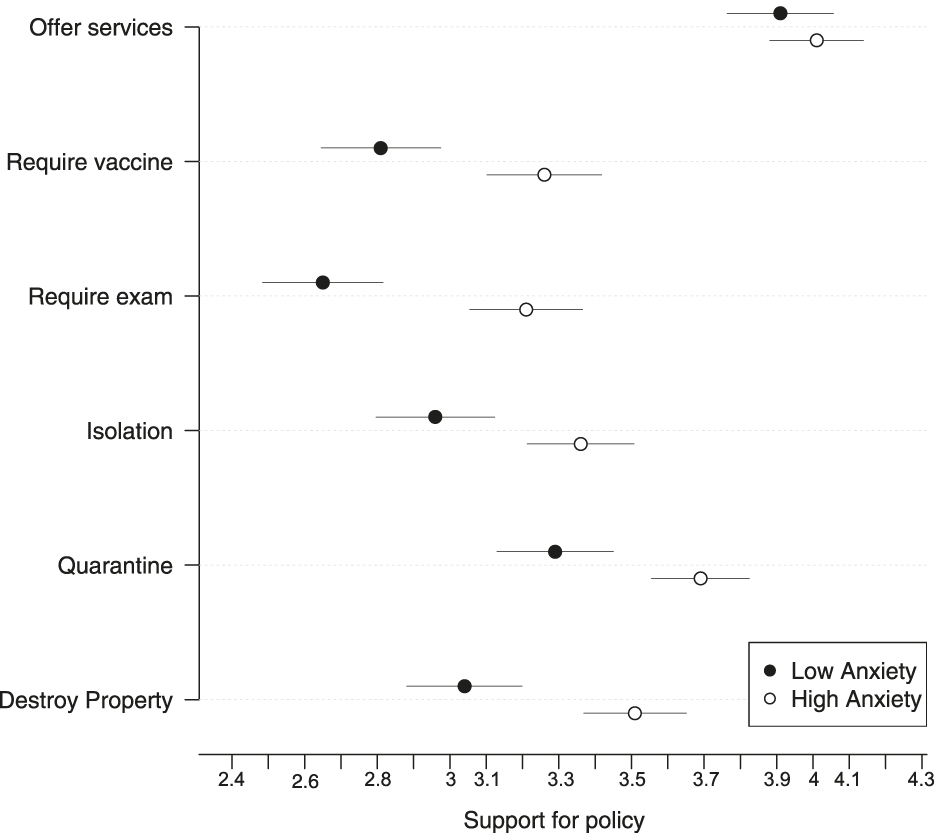
After reading the article, we asked respondents in the 2011 study how much they supported a number of emergency powers that have been proposed by state officials to be used in the event of a smallpox outbreak based on a five-point scale from “strongly oppose” to “strongly support.” We found that respondents who had read a story about a present outbreak of smallpox were the most supportive of emergency powers.
Figure 1 shows how anxiety over a smallpox outbreak made respondents significantly more likely to trade privacy, free movement, and even property for safety. The figure shows the average level of support for the smallpox policies among both high-anxiety respondents and low-anxiety respondents. Anxiety makes respondents 16% more willing to require others to be vaccinated, 20% more willing to undergo a medical examination, 12% more likely to quarantine suspected smallpox patients, 13% more likely to isolate those with smallpox, and 15% more likely to destroy property contaminated by smallpox.
Anxiety Increases Support for Civil Liberties Restrictions Source: Public Health Smallpox YG/P 2011

In our study, respondents read newspaper stories that offered dry, factual accounts. In contrast, some in the US media have amped up the level of fear associated with the Ebola outbreak through sensationalist coverage of highly improbable events, such as airborne transmission of Ebola and its use as a bioweapon by the Islamic State. Finally, in our smallpox study, no politicians used health issues for electoral gain. Senator Rand Paul (R-KY) recently criticized the Obama administration’s handling of Ebola during an interview with a New Hampshire radio station in which he falsely declared that the virus “appears to be very easy to catch” (Kaczynski 2014).
Despite these differences, we think our study and the current Ebola outbreak both emphasize that people will increase their support for policies that fight the contagion, even if these limit civil liberties. Let us hope that concern about Ebola in the United States does not generate support for indiscriminate use of quarantines and other policies experts deem unhelpful.
ACKNOWLEDGMENTS
This piece is based on a longer article on anxiety and Ebola that appeared in The Monkey Cage (Gadarian and Albertson 2014). Both draw their insights from the authors’ forthcoming book Anxious Politics: Democratic Citizenship in a Threatening World (Albertson and Gadarian forthcoming).
REFERENCES
Albertson, Bethany, and Shana Gadarian. forthcoming. Anxious Politics: Democratic Citizenship in a Threatening World. Cambridge: Cambridge University Press.
Carey, Benedict. 2014. “Experts Offer Steps for Avoiding Public Hysteria, a Different Contagious Threat.” New York Times, October 15. Available at http://www.nytimes.com/2014/10/16/health/ebolas-other-contagious-threat-hysteria.html (accessed November 2, 2014).
Centers for Disease Control and Prevention. 2014. “Ebola: Signs and Symptoms.” October 18. Available at http://www.cdc.gov/vhf/ebola/symptoms/index.html?s_cid=cs_3923 (accessed November 2, 2014).
Frankovic, Kathy. 2014. “Are Americans Scared of Ebola?” YouGov: What the World Thinks. October 15. Available at https://today.yougov.com/news/2014/10/15/are-americans-scared-ebola/ (accessed November 2, 2014).
Gadarian, Shana, and Bethany Albertson. 2014. “Ebola Will Make Americans More Likely to Give up Civil Liberties.” Washington Post, October 24. Available at http://www.washingtonpost.com/blogs/monkey-cage/wp/2014/10/24/ebola-will-make-americans-more-likely-to-give-up-civil-liberties/ (accessedNovember 2, 2014).
Hamel, Liz, Jamie Firth, and Mollyann Brodie. 2014. “Kaiser Health Policy News Index: Special Focus on Ebola.” Henry J. Kaiser Family Foundation. October 16. Available at http://kff.org/global-health-policy/poll-finding/kaiser-health-policy-news-index-special-focus-on-ebola/ (accessed November 2, 2014).
Kaczynski, Andrew. 2014. “Rand Paul: Ebola ‘Appears To Be Very Easy To Catch.’” BuzzFeed. October 21. Available at http://www.buzzfeed.com/andrewkaczynski/rand-paul-ebola-appears-to-be-very-easy-to-catch (accessed November 2, 2014).
NPR. 2014. “Doctor: We Should Worry about the Flu, Not Ebola.” NPR.org. October 20. Available at http://www.npr.org/2014/10/20/357628402/doctor-we-should-worry-about-the-flu-not-ebola (accessed November 2, 2014).
INFECTING THE CONSTITUTION
Julie Novkov, University at Albany, SUNY
While Supreme Court cases upholding involuntary sterilizations and the internment of Japanese Americans exist under a moral cloud, the principle behind them—that the state can extinguish the rights of a few to protect the interests of the many—remains “like a loaded weapon,” ready for “any authority…[who] can bring forward a plausible claim of an urgent need” (Korematsu v. United States 1944, 246). This principle, introduced in a case that allowed mandatory vaccinations for smallpox, grounds the law’s encounter with Ebola in America (Jacobson v. Massachusetts 1905). This encounter threatens both rights and vulnerable populations.
Civil-liberties jurisprudence presumes that fundamental rights should not be limited without rigorous review. Nevertheless, judges agree that some crises are sufficiently threatening to warrant a significant limitation of even fundamental rights. The question is how to balance the limitation against the threat.
Balancing is an inexact science. Widespread public fear weights the scale, encouraging the suspension of the broadly shared investment in due process and justice (Lipsitz and Colfax 1965, 327). Policy makers’ perceptions of threat can justify deprivations of rights, and these deprivations are easier to press politically if the public is demanding safety at the expense of rights.
Moreover, even as the weight lifts on one side, the counterweight may be distributed unevenly. Historically, marginalized citizens and immigrants have been targeted more harshly by public health restrictions (Colgrove and Bayer 2005). Jacobson’s doctrine of protecting the public by mandating vaccinations flowed into Buck v. Bell’s 1927 endorsement of mandatory sterilization for the mentally unfit.
American jurisprudence relies on equal protection to ensure that state regulations—especially those that affect vulnerable populations—do not differentiate illegitimately. However, if a vulnerable population is the source of perceived danger, that danger may be turned around to justify unequal treatment.
In the American imagination, Ebola presents an alien racialized threat.
In the American imagination, Ebola presents an alien racialized threat. To defend against this threat, public figures have proposed varied restrictions. Americans returning from Africa have been quarantined. State actors, including university officials, have limited visits from individuals hailing from affected African nations, and they have refused to allow their affiliates to travel to nations that are experiencing outbreaks.
The crisis framing Ebola’s arrival on American soil initiates an important constitutional conversation. Recalibrating the balance between rights and safety in times of perceived danger has long-term risks, including a threat to the Constitution’s role as a constituting document. When the courts engage in balancing, they legitimize the idea that the Constitution may justifiably shrink in times of crisis. This contraction tables the possibility that measures taken in extreme circumstances may be wrong even if they are necessary. The debate shifts from the grounds of what kind of wrong has occurred to the grounds of whether this deprivation even constitutes a wrong.
These struggles also threaten the rights of the most vulnerable, which have been devalued historically in ways unthinkable for other populations. Suspected sex workers were quarantined in response to the fear of syphilis, gays and Haitians were restricted due to the fear of AIDS, Japanese Americans were interned in World War II, and poor women and women of color were disproportionately sterilized during the heyday of the eugenics movement. With Ebola, fear surrounds people who have any connection—real or perceived—to Africa, even if the connection is fragile or imaginary.
How should the law grapple with Ebola? I suggest changing the core questions. Rather than balancing an abstract conception of rights against a generalized perception of threat, we must ask: Who is being restricted? How vulnerable or stigmatized is the restricted population already, and how much will restriction increase vulnerability or stigmatization? We can borrow from equal protection, asking about the narrow tailoring of restrictions that affect some groups more than others. However, can we also “narrowly tailor” and extend protections or benefits to acknowledge and address their vulnerability? Rather than asking whether this is an emergency and allowing the answer to determine the framework for a balancing analysis, we should ask: How far can rights limitations go before they distort the ordinary frame of constitutional decision making? In defending America against Ebola, we also must defend core constitutional commitments to equity, liberty, and justice against panic. Our Constitution also must remain healthy and robust for generations to come.
ACKNOWLEDGMENT
Thanks to Patty Strach and the anonymous reviewers.
REFERENCES
Cases
Jacobson v. Massachusetts, 197 U.S. 11 (1905)
Buck v. Bell, 274 U.S. 200 (1927)
Korematsu v. United States, 323 U.S. 214 (1944)
Secondary Sources
Colgrove, James, and Ronald Bayer. 2005. “Manifold Restraints: Liberty, Public Health, and the Legacy of Jacobson v. Massachusetts.” American Journal of Public Health 95:571–6.
Lipsitz, Lewis, and J. David Colfax. 1965. “The Fate of Due Process in a Time of Crisis.” In The Kennedy Assassination and the American Public: Social Communication in Crisis, ed. Bradley Greenberg, 328–35. Redwood City, CA: Stanford University Press.
HELP OR HATE?
Angelia R. Wilson,University of Manchester
Who deserves help and who should provide help? In the developed West, where Protestant individualism sets the social normative frame, being in “need” is perceived as a personal failure and the answer as self-help and/or purchasing care from the market (Manow 2004). Where that is impossible, the next port of call is one’s family or (religious) community. As a final resort, the residual welfare state intervenes—usually with significant conditions or “price” to be paid. Stakeholders in this political economy of care—the individual, family, market, community, and state—negotiate the values deployed in answering these two central questions (Wilson 2013). Using this political economy of care as a framework, we can trace the care discourse around Ebola.
Historically, the undeserving are constructed as feckless, immoral, unwilling to help themselves, (biblically) unclean, and an infectious threat. This construction justified the marginalization and maltreatment of the poor and sick during the bubonic plague, typhoid, tuberculosis, the AIDS crisis, and now Ebola (Alcabes 2014; Tomes 1998). Psychological research supports similar findings connecting fear, insecurity, and overwhelming complexity with the need for metanarratives; when individuals experience unstable access to health care or other necessities, this insecurity increases religiosity (Norris and Inglehart 2004). Religiosity and fear inform a value-laden care discourse where the answer to who deserves help is those “like us” who are clean—physically and morally. In the United States, citizens perceive health care as scarce and respond negatively to those deemed undeserving who make demands on this resource (Applebaum 2001). For example, Ann Coulter described Dr. Kent Brantly, who contracted Ebola while treating patients, as “idiotic” and “marinating himself in medieval diseases of the Third World” (2014). This belief that care workers only have themselves to blame feeds the recent quarantine policies adopted in New York and New Jersey. “They” will put “us” at risk.
Who should be providing care for Ebola patients? Coulter argues that it is not the job of US Christian charities to help those in Africa, nor is it the responsibility of the state to pay for the treatment of those returning to the United States. Voices on the Right blame the CDC for lack of regulation, information, or lying about the science (Huckabee 2014). This discourse certainly keeps the private (but often religiously affiliated) hospitals out of the line of fire by suggesting that it is not a lack in the health care system, but rather the government, that is the problem.
Ebola discourse emerged as an opportunity for those on the Right to articulate distrust of the federal government, particularly the CDC. According to Jerry Boykin, of the Family Research Council (FRC), by sending troops to help with the crisis, the government is deliberately putting the military at risk (Corsi 2014). For Tony Perkins (FRC), Ebola is just more evidence of “the end times,” the coming of “martial law” (Tashman 2014). Others, such as Mike Huckabee, argue that states should be “overprotecting rather than underprotecting” its citizens and should be responsible for, in Chris Christie’s words, the “safety and health of our citizens.” Such distrust of the federal government, especially the CDC, echoes a familiar right-wing Southern trope of states’ rights while distrust of President Obama’s decisions reflects the right-wing lexicon of the past six years (Worland 2014).
As care demand grows and supply diminishes, states play a crucial role in “mediating the dilemmas” (Daly and Lewis 2000). Mediation is difficult when one side is shouting, science is dismissed, and fear overcomes rationality and compassion. For those watching American politics from the United Kingdom, the most symbolic, Princess-Diana-memory-inducing moment of sanity was President Obama hugging nurse Nina Pham. In America, answering who deserves help and who should provide it appears to have evolved from an ideological, or even theological, debate to one in which the winning stakeholders are those peddling fatalism and fear.
REFERENCES
Appelbaum, L. D. 2001. “The Influence of Perceived Deservingness on Policy Decisions Regarding Aid to the Poor.” Political Psychology 22 (3): 419–42.
Alcabes, Philip. 2014. “Race and Panic.” Chronicle of Higher Education. http://chronicle.com/article/RacePanic/149599/.
Corsi, Jerome. 2014. “General: Sending Military to Fight.” WND. http://www.wnd.com/2014/09/boykin-sending-military-to-fight-Ebola-misuse-of-soldiers/.
Coulter, Ann. 2014. “Ebola Doc’s Condition Downgraded to ‘Idiotic’.” http://www.anncoulter.com/columns/2014-08-06.html.
Daly, Mary, and Jane Lewis. 2000. “The Concept of Social Care and the Analysis of Contemporary Welfare States.” British Journal of Sociology 51(2): 281–98.
Huckabee, Mike. 2014. “DC Babble Outbreak.” http://www.mikehuckabee.com/2014/10/dc-babble-outbreak?CommentPage=2.
Tashman, Brian. 2014. “Tony Perkins Understands.” Right Wing Watch. http://www.rightwingwatch.org/content/tony-perkins-understands-why-people-think-obama-spreading-Ebola-impose-martial-law.
Tomes, Nancy. 1998. Gospel of Germs. Cambridge, MA: Harvard University Press.
Manow, Philip. 2004. “The Good, the Bad, and the Ugly.” MPIfG Working Paper 04/3. Köln: Max-Planck-Institut für Gesellschaftsforschung.
Norris, Pippa and Robert Inglehart. 2004. Sacred and Secular. Cambridge: Cambridge University Press.
Wilson, Angelia. 2013. Why Europe Is Lesbian and Gay Friendly. Albany: State University of New York Press.
Worland, Justin. 2014. “Christie and Cuomo Announce Ebola Quarantine.” Time. http://time.com/3537755/Ebola-new-york-new-jersey/.
THE WORLD HEALTH ORGANIZATION AND RESPONSES TO GLOBAL HEALTH EMERGENCIES
Jeremy Youde, University of Minnesota, Duluth
According to its constitution, the World Health Organization (WHO) is “the directing and co-ordinating authority on international health work” (World Health Organization 1948, 2). Under International Health Regulations, WHO is empowered to take action as soon as human cases of Ebola emerge (Youde 2012). The current Ebola outbreak centered in Guinea, Liberia, and Sierra Leone, however, highlights the difficulties that face WHO as it attempts to carry out those functions. WHO certainly has made missteps in responding to Ebola, but the organization also faces serious structural constraints that undermine its ability to uphold its mission.
WHO’s response to the Ebola outbreak in West Africa has been woefully inadequate. A leaked internal report laments, “Nearly everyone involved in the outbreak planning failed to see some fairly plain writing on the wall” (Sanchez 2014). Among the problems cited are the following:
• When Doctors Without Borders/Medecins Sans Frontieres, which had been providing medical care in West Africa, declared in April that Ebola was spreading out of control, WHO disputed the claim.
• WHO’s Regional Office for Africa initially rebuffed collaboration with the United States Centers for Disease Control and Prevention.
• Margaret Chan, WHO’s Director-General, stated that she “was not fully informed of the evolution of the outbreak” (Sun et al. 2014).
Although this report likely will lead to soul-searching after the Ebola outbreak has ended, WHO’s problematic reactions to it reveal how the structure of this international organization constrains its ability to respond to a rapidly moving epidemic. The international community may have designated WHO as the lead agency, but the organization is structured in a way that undermines that efficacy.
The international community may have designated WHO as the lead agency, but the organization is structured in a way that undermines that efficacy.
Two structural issues directly contributed to the WHO failures. First, the relationship between the central office in Geneva and the six regional organizations undermine WHO’s ability to act in a coordinated manner. WHO is so decentralized that it is essentially seven different organizations awkwardly held together. WHO has no control over or input in how the regional organizations operate or who their leaders are. This fragmentation undermines WHO’s ability to act as a unitary actor and faithful agent for its mandate (Graham 2013). The WHO Regional Office for Africa has been intensely criticized for hampering the response and failing to facilitate the entry of Ebola experts into Guinea (Cheng 2014). Although decentralization may provide a greater opportunity to address local issues and incorporate local voices, the lack of policy coherence among these seven organizations prevents the creation and implementation of effective strategies to deal with cross-border health issues.
Second, WHO is grossly underfunded and has little control over its own budget. Since 2012, the biennial budget has decreased 12% to less than $4 billion, and the organization has eliminated more than 300 jobs. Recent budget cuts particularly targeted the organization’s outbreak- and crisis-response programs. Of the overall budget, however, nearly 80% of funds are provided by member-states for specific projects designated by the donor; WHO cannot direct where those funds are spent (WHO 2013). WHO can direct only a small portion of the budget, providing little control over its operational agenda. Member-states could update their dues payments to increase the amount of money that WHO could control directly, but there have been no changes since the early 1980s (Lee 2008). The organization’s small budget and lack of control over spending render it unprepared to provide necessary resources when an emergency occurs. Instead, WHO must ask for donations from member-states, further slowing response times.
WHO’s response to Ebola has been underwhelming and uninspiring. Analyses of how and why WHO has failed must consider the pathologies that undermine the organization’s ability to carry out its mandate.
REFERENCES
Cheng, Maria. 2014. “UN: We Botched Response to the Ebola Outbreak.” Associated Press, October 17. Available at http://news.yahoo.com/un-botched-response-ebola-outbreak-134221982.html (accessed November 7, 2014).
Graham, Erin R. 2013. “International Organizations as Collective Agents: Fragmentation and the Limits of Principal Control at the World Health Organization.” European Journal of International Relations 20 (2): 366–90.
Lee, Kelley. 2008. The World Health Organization. London: Routledge.
Sanchez, Ray. 2014. “WHO to Review Ebola Response amid Criticism of its Efforts.” CNN, October 19. Available at http://www.cnn.com/2014/10/18/world/who-ebola-response (accessed November 7, 2014).
Sun, Lena H., Brady Dennis, Lenny Bernstein, and Joel Achenbach. 2014. “Out of Control: How the World’s Health Organizations Failed to Stop the Ebola Disaster.” Washington Post, October 4. Available at http://www.washingtonpost.com/sf/national/2014/10/04/how-ebola-sped-out-of-control (accessed November 7, 2014).
World Health Organization. 1948. Constitution of the World Health Organization. Geneva: World Health Organization.
World Health Organization. 2013. Proposed Programme Budget 2014–2015. Sixty-Sixth World Health Assembly, Provisional Agenda Item 12.3. Available at http://www.who.int/about/resources_planning/A66_7-en.pdf?ua=1 (accessed November 7, 2014).
Youde, Jeremy. 2012. Global Health Governance. Cambridge: Polity Press.
WHAT ACCOUNTS FOR THE WORLD HEALTH ORGANIZATION’S FAILURE ON EBOLA?
Joshua Busby, LBJ School of Public Affairs, University of Texas at Austin
Karen A. Grépin,New York University
In October 2014, more than seven months after initial reports surfaced, the World Health Organization (WHO) admitted that it had mishandled the Ebola virus outbreak in West Africa (Cheng 2014). What explains the WHO’s failure to respond more rapidly and forcefully?
The WHO is no longer the organization it once was. As other organizations (e.g., UNAIDS; the Gates Foundation; and the Global Fund to Fight AIDS, TB, and Malaria) have come to play an increasingly prominent role—particularly in mobilizing finance and setting agendas (Fidler 2010; Youde 2012)—the WHO has evolved into a “technical agency” capable of developing guidelines but with little ability to mobilize infrastructure or human resources (Fink 2014b).
After the 2008 financial crisis, the WHO experienced a significant decline in resources, including a $500 million budget shortfall and a 20% staff reduction (Garrett 2012).1 At the 2012 World Health Assembly, the WHO’s crisis and epidemic funding was cut by 50% to $114 million, reducing that staff by almost two thirds (Fink 2014a; Garrett 2014; Park 2014). With 75% of funding from voluntary contributions and 91% earmarked for specific activities in 2010–2011, the WHO has been susceptible to donor whims in financing and unable to flexibly reallocate its budget. From this perspective, the WHO’s failures are largely attributable to donor interests (Van de Pas and van Schaik 2014).
Principal–agent theory also may explain the WHO’s failure (Hawkins et al. 2006). The WHO Regional Office for Africa is quasi-independent of the Geneva secretariat with limited accountability to the center. Historically, leaders were elected by regional governments, selected by political “horse-trading” rather than on the basis of expertise (Cheng 2014). This suggests a wider defect in the WHO’s structure, which has six semi-autonomous regional offices—some of which, such as the Pan American Health Organization, predate the WHO (Clift 2014a; 2014b; Glassman 2014).
Specific organizational pathologies also may explain the WHO’s poor response to Ebola (Barnett and Finnemore 1999). WHO Director-General Margaret Chan suggested that her office was informed of the deficient regional response in late June 2014, two months after Doctors Without Borders warned that it was overwhelmed (Gale and Lauerman 2014). Only in August did the WHO declare Ebola a “public health emergency of international concern” (WHO 2014).
One reason for this delay may be that the WHO was criticized for over-reacting when it declared a global health emergency during the 2009 swine flu episode.2 When that outbreak proved to be less serious than feared, critics accused the WHO of being “too cozy” with vaccine makers (Cheng 2011). These claims ultimately were deemed without merit (McNeil Jr. 2011), but the blow to its reputation may have rendered the WHO reluctant to declare a health emergency prematurely and more likely to entrust the Ebola fight to its regional office (Seidner 2014).
The updated International Health Regulations (IHRs) of 2005 affirmed the WHO’s central role in both warning about and responding to public health events. However, evidence suggests that the WHO no longer is capable of responding adequately to global emergencies, which perhaps necessitates fundamental reform or new structures (Bloom 2011; Gostin 2014; Lee and Pang 2014).
REFERENCES
Barnett, Michael N., and Martha Finnemore. 1999. “The Politics, Power, and Pathologies of International Organizations.” International Organization 53 (4): 699–732.
Bloom, Barry R. 2011. “WHO Needs Change.” Nature 473 (7346): 143–5. DOI: 10.1038/473143a.
Cheng, Maria. 2011. “WHO’s Response to Swine Flu Pandemic Flawed.” The Washington Post, March 10, Health. Available at http://www.washingtonpost.com/wp-dyn/content/article/2011/03/10/AR2011031002021.html.
———. 2014. “U.N.: We Botched Response to the Ebola Outbreak.” AP, October 17. Available at http://time.com/3516777/u-n-we-botched-response-to-the-ebola-outbreak.
Clift, Charles. 2014a. “What’s the World Health Organization For? Final Report from the Centre on Global Health Security Working Group on Health Governance.” Chatham House. May 21. Available at http://www.chathamhouse.org//node/14466. [AU: Access date? Please add for all subsequent entries as well]
———. 2014b. “Ebola and WHO Reform: Who Cares?” Global Health Check. October 14. Available at http://www.globalhealthcheck.org/?p=1678.
Fidler, David. 2010. “The Challenges of Global Health Governance.” Available at http://www.cfr.org/publication/22202/challenges_of_global_health_governance.html.
Fink, Sheri. 2014a. “Cuts at W.H.O. Hurt Response to Ebola Crisis.” New York Times, September 3. Available at http://www.nytimes.com/2014/09/04/world/africa/cuts-at-who-hurt-response-to-ebola-crisis.html.
———. 2014b. “W.H.O. Leader Describes the Agency’s Ebola Operations.” New York Times, September 4. Available at http://www.nytimes.com/2014/09/04/world/africa/who-leader-describes-the-agencys-ebola-operations.html.
Gale, Jason, and John Lauerman. 2014. “How the World’s Top Health Body Allowed Ebola to Spiral Out of Control.” Bloomberg. October 17. Available at http://www.bloomberg.com/news/2014-10-16/who-response-to-ebola-outbreak-foundered-on-bureaucracy.html.
Garrett, Laurie. 2012. “Money or Die.” Foreign Affairs, March 6. Available at http://www.foreignaffairs.com/articles/137312/laurie-garrett/money-or-die.
———. 2014. “We Could Have Stopped This.” Foreign Policy, September 5. Available at http://www.foreignpolicy.com/articles/2014/09/05/we_could_have_stopped_this_ebola_virus_world_health_organization.
Glassman, Amanda. 2014. “Hiring Reform at WHO.” Center for Global Development. October 15. Available at http://www.cgdev.org/blog/hiring-reform-who.
Gostin, Lawrence O. 2014. “Ebola: Towards an International Health Systems Fund.” The Lancet 384 (9951): e49–51. DOI: 10.1016/S0140-6736(14)61345-3.
Hawkins, Darren G., David A. Lake, Daniel L. Nielson, and Michael J. Tierney. 2006. Delegation and Agency in International Organizations. Cambridge: Cambridge University Press.
Lee, K., and T. Pang. 2014. “WHO: Retirement or Reinvention?” Public Health 128 (2): 119–24. DOI: 10.1016/j.puhe.2013.08.002.
McNeil Jr., Donald G. 2011. “Report Criticizes W.H.O.’s Response to Swine Flu.” New York Times, March 10, Health/Money & Policy. Available at http://www.nytimes.com/2011/03/11/health/policy/11flu.html.
Nebehay, Stephanie, and Barbara Lewis. 2011. “WHO Slashes Budget, Jobs in New Era of Austerity.” Reuters, May 19. Available at http://www.reuters.com/article/2011/05/19/us-who-idUSTRE74I5I320110519.
Park, Alex. 2014. “Why the World Health Organization Doesn’t Have Enough Funds to Fight Ebola.” Mother Jones. September 8. Available at http://www.motherjones.com/politics/2014/09/ebola-world-health-organization-budget.
Seidner, Mark. 2014. “The Global Response to the Ebola Fever Epidemic: What Took So Long?” PLoS Medicine. August 22. Available at http://blogs.plos.org/speakingofmedicine/2014/08/22/global-response-ebola-fever-epidemic-took-long.
Van de Pas, R., and L. G. van Schaik. 2014. “Democratizing the World Health Organization.” Public Health 128 (2): 195–201. DOI: 10.1016/j.puhe.2013.08.023.
WHO. 2003. “WHO Extends Its SARS-Related Travel Advice to Beijing and Shanxi Province in China and to Toronto, Canada.” WHO. April 23. Available at http://www.who.int/mediacentre/news/notes/2003/np7/en.
———. 2013. Proposed Programme Budget 2014–2015. Available at http://www.who.int/about/resources_planning/PB14-15_en.pdf?ua=1.
———. 2014. “WHO Statement on the Meeting of the International Health Regulations Emergency Committee Regarding the 2014 Ebola Outbreak in West Africa.” WHO. August 8. Available at http://www.who.int/mediacentre/news/statements/2014/ebola-20140808/en.
Youde, Jeremy. 2012. Global Health Governance. 1st edition. Cambridge, UK, and Malden, MA: Polity Press.
NOTES
1. The WHO’s $2 billion annual budget compares to about $6 billion for the United States Centers for Disease Control and Prevention. It often is reported that nearly $1 billion was cut from the WHO’s biennial budget in 2012–2013; however, the previous biennial budget was about $4.5 billion, and the nearly $1 billion reduction reflects cuts to the WHO’s proposed 2012–2013 budget of $4.8 billion (Nebehay and Lewis 2011). The budget actually was reduced from $4.5 billion in 2010–2011 to $3.99 billion in 2012–2013 (WHO 2013).
2. In the midst of the 2003 severe acute respiratory syndrome (SARS) episode, WHO used ambiguities in its authority to issue an unprecedented travel advisory to discourage people from traveling to parts of China and Toronto, Canada (WHO 2003). After that episode, the IHRs were updated in 2005 to require states to report on a wider set of health outcomes that might be of international concern.
HUMAN SECURITY, HUMANITARIAN RESPONSE, AND EBOLA
Maryam Zarnegar Deloffre, Arcadia University
The current Ebola outbreak underscores recurrent problems in international responses to humanitarian crises. Reluctantly led by the World Health Organization (WHO), the international response has been slow, bureaucratic, underresourced, and uncoordinated. States failed to acknowledge the magnitude of the outbreak and were stingy in committing adequate resources to curb its spread. A notable difference is that the international community mobilized around a public health crisis—a human security threat—not in response to human rights violations resulting from conflict. Thus, the Ebola outbreak provides an empirical example of a human security crisis. As states and the UN increasingly use the language of human security, they create the obligation to act and provide a new logic for humanitarian intervention. This has implications for enhancing the interoperability of nongovernmental organizations (NGOs) and militaries and improving global accountability for future crises.
Typically we think of security threats as a threat to a country’s national interests. Human security broadens this conventional understanding to include a focus on the individual and considers poverty, health pandemics, and climate-related disasters as security threats. Human security is people-centered, emphasizing common values—human rights, international humanitarian law, and equitable development—rather than national interest (Suhrke 1999). In September, the UN Security Council (UNSC) adopted Resolution 2177 calling the Ebola outbreak a threat to international peace and security. Likewise, President Obama evoked the language of human security when he urged the international community to act. Subsequently, the UN established the UN Mission for Ebola Emergency Response, and Obama deployed 3,000 US Africa Command troops to help contain Ebola and preserve stability in West Africa.
As states and the UN increasingly use the language of human security, they create the obligation to act and provide a new logic for humanitarian intervention.
Although military assistance in humanitarian crises is not new, what is notable in the Ebola crisis is that NGOs such as Doctors Without Borders/Médecins Sans Frontières (MSF) called on states to commit troops for logistical support. Most NGOs, including MSF, typically refuse to partner with national militaries because past collaborations—Kosovo, Afghanistan, Iraq—compromised their core humanitarian principles of neutrality (not taking sides in a conflict), impartiality (not discriminating in aid provision), and independence (working without government interference). Despite their differing mandates, NGOs and militaries have complementary comparative advantages. NGOs are flexible, have rapid response capacity, and sustained commitment in local communities while militaries have hierarchical command structures, regular funding, a pool of skilled labor, and abundant logistics capabilities. Focusing on the common values embedded in human security might improve the interoperability of humanitarian actors in a way that recognizes their key comparative advantages without blurring lines between their distinctive roles and responsibilities.
MSF’s dire call for help provides an opportunity to consider how to improve the coordination of global humanitarian actors to increase capacity and produce effective outcomes. The values undergirding human security supply a common mandate to frame ethical standard operating procedures (SOPs) for improving coordination of NGOs, international organizations, states, and the private sector. Technical SOPs lead to stodgy, delayed action (as in the case of the WHO delaying to declare Ebola a public health crisis) and myopia (as in diverting resources from other health priorities to prepare for the mild influenza pandemic in 2009) (Abraham 2011).
One way to generate ethical SOPs is to link the values of human security to the “people” in people-centered security by focusing on enhancing social accountability to aid beneficiaries. Social accountability requires that global actors identify the broader social expectations, rules, norms, and values that govern their social relationships and create their social obligations (Fry 1995). Humanitarian NGOs have made important strides in institutionalizing social accountability by developing consensus-based self-regulatory mechanisms to govern and coordinate their collective responsibility to provide humanitarian aid. Using a rights-based approach, NGOs—along with states, international organizations, local partners, and aid recipients—generated ethical SOPs and practices that define operational objectives in line with maintaining the rights to life and dignity of individuals (Deloffre 2010; 2014).
While human security began as a project of middle power states, the United States’ Global Health Security Agenda and the UNSC declaration show that it now figures in the foreign policy of great powers. Embracing the human security agenda might generate global solutions to public health crises by leveraging existing capacities and creating a long-standing commitment and obligation to improving global public health.
REFERENCES
Abraham, Thomas. 2011. “The Chronicle of a Disease Foretold: Pandemic H1N1 and the Construction of a Global Security Threat.” Political Studies 59:797–812.
Deloffre, Maryam Z. 2014. “Transnational Ethical Communities in International Politics.” Paper presented at International Studies Association. Toronto, Canada.
——— 2010. “NGO Accountability Clubs in the Humanitarian Sector: Social Dimensions of Club Emergence and Design.” In Voluntary Regulation of NGOs and Nonprofits: An Accountability Club Framework, eds. M.K. Gugerty and A. Prakash, 169–200. Cambridge: Cambridge University Press.
Fry, Ronald E. 1995. “Accountability in Organizational Life: Problem or Opportunity for Nonprofits?” Nonprofit Management and Leadership 6(2): 181–95.
Suhrke, Astri. 1999. “Human Security and the Interests of States.” Security Dialogue 30(3): 265–76.
INTERSECTIONALITY AND EBOLA
Olena Hankivsky, Simon Fraser University
Reactions to the Ebola outbreak have focused on finding solutions to contain the virus, explaining the morphing of this outbreak into a public health emergency, and learning from this epidemic for the future. Comparatively less attention has been paid to interrogating the complex interplay of factors underpinning the crisis. Because intersectionality as a framework for policy analysis prioritizes intersecting axes of privilege and oppression (Collins 1990; Crenshaw 1997; Hankivsky 2012), it reveals important, albeit often overlooked, interactions of social locations and structures of power. These are essential not only for understanding the disparate effects of and responses to Ebola but for advancing a deep structural analysis, essential to more fully understanding the epidemic.
To date, the crisis has been framed in a myriad of ways. Geography has been offered as a reason for the slow international response, including that of the WHO, and the inadequate medical care. This is most starkly evidenced by the fact that the development of drugs and vaccines is not prioritized for diseases that affect poor and remote countries. No doubt, the reaction of the pharmaceutical industry would have been very different if the outbreak had occurred in some large Western nation. Experimental drugs such as ZMapp seem to be more readily available to patients from the West. This was evidenced by the death of a leading Ebola doctor in Sierra Leone who did not receive ZMapp, while two re-patriated American aid workers did and survived.
Others have raised the issue of race. In the United States, critics have argued that Thomas Eric Duncan died in Dallas because the “white man” withheld medical treatment to him (Kim and Jackson 2014). Similarly, the Giorgis (2014) article, “The problem with the west’s Ebola response is still fear of a black patient,” suggested that Ebola was being framed as a “black” disease, in a way that perpetuates racism. Others yet have argued that gender plays a key role. It is estimated that as many as 75% of Ebola deaths in Liberia are female, no doubt largely due to the division of informal and formal care work, including care of sick patients (UN Women 2014). And finally religion/spirituality, with promises of traditional healings, has been targeted for undermining proper treatment and care of the virus.
From an intersectionality perspective, the dynamics of the epidemic cannot be reduced to single foci or explanatory factors. Geography (including urban/rural location), race, gender, and socioeconomic status operate together in a synergistic fashion to shape the experiences of those affected by the crisis. To illustrate, a “female Ebola patient” is not only defined by gender but also by her geographic location, race, socioeconomic status, and religion. And, it is the interaction of these that shapes the disease experience and outcome for each patient.
And yet, as Rita Dhamoon (2011) reminds us, an intersectionality-type analysis is not just focused on actual intersections but instead interrogates what they reveal about power: specifically, multilevel, interacting systems and structures, in which individual experiences are embedded. Some experts, like Paul Farmer, have argued that the extent of the Ebola outbreak is more a symptom of a weak healthcare system than anything else. And, while true if one considers the impoverished state of nations within West Africa (Farmer refers to this as “the terrorism of poverty”) (Washington Post 2014), this explanation fails to fully interrogate the broader forces of power that create the contexts in which inadequate health care systems (and indeed poverty) exist. Intersectionality prioritizes such structural analyses by directing attention to mutually reinforcing systems of colonialism, racism, neoliberalism, globalism, imperialism, xenophobia, and sexism to analyze how these shape political and economic priorities, policies, and public perceptions at both international and national levels. This interlocking “matrix of power” creates and perpetuates inequities between and within nations, their systems, and their populations and ensures fertile ground for an outbreak such as Ebola to spread.
At a minimum, solutions to future pandemics may lie in strengthening weak health-care systems and creating markets for developing drugs and vaccines for rare diseases. These may also include effective implementation of the International Health Regulations (WHO 2005), a legally binding agreement that is intended to improve the capacity of 196 countries to respond to global public health threats, advancing the US-led global security agenda (which seeks to accelerate progress towards reducing health security risks), and improving implementation of the World Health Assembly’s international policy frameworks.
But these measures in and of themselves will not sufficiently buffer against future health crises. As intersectionality reveals, the change that is required necessitates challenging broader structures of power including neoliberalism, capitalism, and racism at all levels of politics and policy—something that is largely lacking from the mainstream discourses around the Ebola crisis. Only a fundamental transformation of power can mitigate inequities that come to the fore when an epidemic strikes one part of the world but threatens the entire international community.
REFERENCES
Collins, Patricia H. 1990. Black Feminist Thought: Knowledge, Consciousness, and the Politics of Empowerment. Boston: Unwin Hyman.
Crenshaw, Kimberle. 1997. “Intersectionality and Identity Politics: Learning from Violence against Women of Colour.” In Reconstructing Political Theory: Feminist Perspectives. eds. Mary Lyndon Shanley and Uma Narayan. University Park: Pennsylvania State University Press, 178–94.
Dhamoon, Rita Kaur. 2011. “Considerations on Mainstreaming Intersectionality.” Political Research Quarterly 64(1): 230–43.
Giorgis, Hannah. 2014. “The Problem with the West's Ebola Response Is Still Fear of a Black Patient.” The Guardian, October 16. Available at http://www.theguardian.com/commentisfree/2014/oct/16/west-ebola-response-black-patient (accessed November 12, 2014).
Hankivsky, Olena (ed.). 2012. An Intersectionality-Based Policy Analysis Framework. Vancouver, BC: Institute for Intersectionality Research and Policy, Simon Fraser University.
Kim, Grace Ji-Sun, and Jesse Jackson. “Ebola Outbreak and Outcry: Saving Thomas Eric Duncan.” Huffington Post. http://www.huffingtonpost.com/grace-jisun-kim/ebola-outbreak-and-outcry_b_5943216.html
UN Women. 2014. “Ebola Outbreak Takes Its Toll on Women.” Available at http://www.unwomen.org/en/news/stories/2014/9/ebola-outbreak-takes-its-toll-on-women (accessed November 12, 2014).
Washington Post. “Paul Farmer on Ebola: This Isn’t a Natural Disaster, This Is the Terrorism of Poverty. “ Achenblog: Available at http://www.washingtonpost.com/blogs/achenblog/wp/2014/10/06/paul-farmer-on-ebola-this-isnt-a-natural-disaster-this-is-the-terrorism-of-poverty (accessed November 12, 2014.)
World Health Organization (WHO) 2005. International Health Regulations, 2nd ed. Available at http://www.who.int/ihr/publications/9789241596664/en/ (accessed November 12, 2014).
ENDING EBOLA: A MOVING TARGET
Ruxandra Paul, Harvard University
Reactions to the Ebola outbreak show that the international community has yet to reach agreement on what constitutes an adequate policy response to transnational public health crises. Historically, governments have used isolation and quarantine to protect against contagious diseases. Leaders perceive epidemics as nonconventional security threats (Totten Reference Totten2012). Thus, immigration policy becomes a tool to protect citizens from external threat. The “liberal paradox” manifests itself acutely in global health crises, as states have to balance international openness (migration, trade) with domestic forces pushing for closure (Hollifield Reference Hollifield2004). In a postnational setting, migrants might claim rights on the basis of universal “personhood” (Soysal Reference Soysal1994). This has not happened for West African migrants. European and American returnees, while presumably more aware of human rights discourses (Bloemraad Reference Bloemraad2004), rely on citizenship in their claims-making when challenging quarantines (Sandburn Reference Sandburn2014). As a result, the Ebola outbreak has generated little international-level dialogue on balancing state sovereignty, public health protection, and human rights.
Oversimplifying migration, governments act as though all migrants travel legally, on itineraries without detours or stays in transit countries. These assumptions are unrealistic. Migration often escapes state control (Castles, de Haas, and Miller Reference Castles, Haas and Miller2014). Routes can span several countries. Reaching the destination may take weeks or months, especially for refugees or the undocumented who experience smuggling or trafficking (Gushulak and MacPherson Reference Gushulak and MacPherson2004).
Misrepresenting migratory flows undermines the effectiveness of policy responses, as governments underestimate the need for cooperation. It leads to counterproductive measures that fail to prevent the spread of Ebola and jeopardize the human rights of already vulnerable groups like displaced migrants and asylum seekers. Cross-border bilateral arrangements do not suffice for tackling highly contagious, untreatable diseases that kill more than 90% of those infected and are “difficult… to contain under the best of circumstances” (Youde Reference Youde2014). Global health emergencies are most effectively addressed through cooperation and policy harmonization.
Cross-border bilateral arrangements do not suffice for tackling highly contagious, untreatable diseases that kill more than 90 % of those infected and are “difficult… to contain under the best of circumstances”
In a world of increasing global mobility, persistent disparities in infectious disease prevalence render unilateral strategies of disease control ineffective (Gushulak and MacPherson Reference Gushulak and MacPherson2004). Marine General John F. Kelly, chief of United States Southern Command, warned that an outbreak in Central America or the Caribbean could trigger mass migration to the United States, as those countries had “almost no ability to deal with” Ebola (LaGrone Reference LaGrone2014), and their citizens would “run away from Ebola” or seek treatment in the United States (Thompson Reference Thompson2014).
Still, governments try to fight Ebola through border controls. Many African countries (Cameroon, Gambia, Ivory Coast, Kenya, Nigeria, Senegal) halted or limited air travel from Ebola-hit states. Some airlines suspended flights to and from West Africa. South Africa refused entry to noncitizens and permanent residents traveling from Ebola-affected countries (Chishti, Hipsman, and Pierce Reference Chishti, Hipsman and Pierce2014). Australia temporarily suspended its immigration and humanitarian programs for people from West Africa (Siegel Reference Siegel2014). Costa Rican authorities were on high alert, due to high numbers of undocumented West African migrants entering the country en route to the United States. All police officers were instructed not to handle or move corpses under any circumstances, including traffic accidents or crime scenes devoid of Ebola suspicions. Such duties were left to health officials who intervened in HAZMAT suits (InsideCostaRica.com 2014). Romanian authorities brought to shore a boat that crossed the Black Sea from Turkey carrying 88 Afghan, Iraqi, and Syrian migrants. Doctors in HAZMAT suits, border police, and gendarmes were mobilized for fear of Ebola (Stiri.TVR.ro 2014). Albania detained and quarantined illegal Eritrean migrants on Ebola suspicions. They had arrived through Greece and intended to cross the Adriatic into Italy by ferry, following a popular migrant route (Sharkov Reference Sharkov2014).
Managing infectious diseases requires understanding migration and mobility: who moves, their motivations, their itineraries, and so forth (Deane, Parkhurst, and Johnston Reference Deane, Parkhurst and Johnston2010). For instance, irregular migrants may not report to a hospital if they fear deportation (Gushulak and MacPherson Reference Gushulak and MacPherson2004). For global health crises like Ebola, containment and management are processes of global rather than local or national epidemiology. They require “specific migration-focused surveillance, detection and interpretation systems” (idem). Since the nineteenth century, international law has helped harmonize inconsistent quarantine regulations, facilitate the exchange of epidemiological information, establish international health organizations, and standardize screening (Aginam Reference Aginam2002). It should continue to do so within structures revised in light of contemporary migratory dynamics.
Adapting multilateral health governance to migratory systems is a win-win strategy. First, it helps governments protect their citizens more effectively. Managing migration requires a multilateral or regional regime (Hollifield Reference Hollifield2004) that enables countries of origin, destination, and transit to assess risks, share responsibilities, and create flexible response frameworks. Second, it helps migrants by reducing the risk that human rights will be jeopardized, particularly those of vulnerable migrants like asylum seekers and the undocumented.
SPOTLIGHT CONTRIBUTORS
Bethany Albertsonis an assistant professor in the government department at the University of Texas at Austin. Her research focuses on political psychology with an emphasis on emotion and religion and politics in the United States. She can be reached at balberts@austin.utexas.edu.
Joshua Busbyis an associate professor of public affairs at the University of Texas at Austin. His first book Moral Movements and Foreign Policy was published by Cambridge University Press in July 2010. His second book (with Ethan Kapstein) AIDS Drugs for All: Social Movements and Market Transformations was also published by Cambridge in September 2013. He can be reached at busbyj@utexas.edu.
Logan S. Caseyis a doctoral candidate in the University of Michigan's department of political science. His research focuses on the role of prejudice in the political sphere, particularly in the LGBT context. He strives to develop creative approaches to the empirical study of political identities. He can be reached at lscasey@umich.edu.
Maryam Zarnegar Deloffreis an assistant professor in the department of historical and political studies at Arcadia University. She is currently working on a book manuscript that examines the emergence and development of transnational, self-regulatory NGO accountability institutions such as the Sphere Project, Humanitarian Accountability Partnership-International, and COMPAS Qualité. She can be reached at deloffrem@arcadia.edu.
Kim Yi Dionneis a Five College Assistant Professor of Government at Smith College. She studies the opinions of ordinary Africans and interventions aimed at improving their condition. She is completing a book on the misaligned policy priorities that doomed the global AIDS intervention in Africa. She can be reached at kdionne@smith.edu.
Shana Gadarianis an assistant professor of political science at the Maxwell School of Citizenship and Public Affairs, Syracuse University and senior research associate at the Campbell Public Affairs Institute. She can be reached at sgadaria@syr.edu.
Karen A. Grépinis an assistant professor of global health policy at New York University’s Robert F. Wagner’s Graduate School of Public Service. She is the author of a well-read global health blog ( http://www.karengrepin.com ), which focuses on issues related to global health and global health policy. She can be reached at karen.grepin@nyu.edu.
Olena Hankivskyis a professor in the School of Public Policy and director of the Institute for Intersectionality Research and Policy at Simon Fraser University. Currently she is Visiting Professor at the London School of Hygiene and Tropical Medicine. She is the editor of Health Inequities in Canada: Intersectional Frameworks and Practices as well as author of Social Policy and Ethics of Care. She can be reached at oah@sfu.ca.
Julie Novkovis chair of the department of political science and a professor of political science and women’s studies at the University at Albany, SUNY. Her research focuses on political science and women’s, gender, and sexuality studies. Her book, Racial Union, was co-recipient of the APSA 2009 Ralph Bunche Award for best scholarly work in political science regarding the phenomenon of ethnic and cultural pluralism. She can be reached at jnovkov@albany.edu.
Ruxandra Paul(PhD, Harvard 2014) is a Postdoctoral Harvard College Fellow in the government department at Harvard University and a member of the Transnational Studies Initiative at the Weatherhead Center for International Affairs. She studies international migrations, cyberpolitics, citizenship, democratization, and European integration. Her book manuscript Citizens of the Market examines the political effects of high-mobility migration in migrant-sending countries. She can be reached at rpaul@fas.harvard.edu.
Laura Seayis an assistant professor of government at Colby College. She is completing a book, Substituting for the State, about the role non-state actors play in governing the eastern Democratic Republic of the Congo in response to the Congolese state’s weakness in North Kivu, South Kivu, and Ituri. She can be reached at leseay@colby.edu.
Kenneth Sherrillis a professor emeritus of political science at Hunter College, CUNY, specializing in public opinion, political participation, voting and elections, and LGBT politics. He can be reached at ken@kensherrill.com.
Carolyn M. Somervilleis an associate professor in and chair of the political science department of Hunter College. Her research includes extensive expertise in African studies. She has published works on integration in West African countries, the impact of the IFIs on African countries, and politics in southern Africa. She can be reached at csomervi@hunter.cuny.edu.
Meredith L. Weissis associate professor and director of international programs at the Rockefeller College of Public Affairs and Policy, University at Albany, SUNY. Weiss's research focuses on Southeast Asia, and her current research focuses on political networks, party and coalition structures, collective identities, and the roles and strategies of political leaders. She can be reached at mweiss@albany.edu.
Angelia R. Wilsonis professor of politics at the University of Manchester. A prolific author, Wilson’s new book, Why Europe Is Lesbian and Gay Friendly (and Why America Never Will Be) (SUNY 2013), compares the European and American differences which lead to divergent policies regarding lesbian and gay citizens. She can be reached at a.r.wilson@manchester.ac.uk.
Jeremy Youdeis associate professor of political science and head of the department of political science at the University of Minnesota, Duluth. His previous research on global health politics has appeared in Global Society and Social Science and Medicine, and his most recent book is Global Health Governance (Polity 2012). He can be reached at jyoude@d.umn.edu.