


Several nutrients have been associated with the risk of CVD in epidemiological studies. These include various fatty acids, many antioxidative nutrients, sodium and dietary fibre (Srinath Reddy & Katan, Reference Srinath Reddy and Katan2004). Extensive evidence from observational studies exists on the impact of nutrients on CVD risk, but the results of controlled trials focusing on individual nutrients have often been inconclusive (Jacques & Tucker, Reference Jacques and Tucker2001; Kris-Etherton et al. Reference Kris-Etherton, Lichtenstein, Howard, Steinberg and Witztum2004; Törnwall et al. Reference Törnwall, Virtamo, Korhonen, Virtanen, Taylor, Albanes and Huttunen2004). Trials based on comprehensive diet-based approaches, such as the Dietary Approaches to Stop Hypertension (DASH), with modified dietary patterns (Craddick et al. Reference Craddick, Elmer, Obarzanek, Vollmer, Svetkey and Swain2003) and randomised intervention studies on traditional Mediterranean-type diets (Kris-Etherton et al. Reference Kris-Etherton, Eckel, Howard, St Jeor and Bazzarre2001; Esposito et al. Reference Esposito, Marfella, Ciotola, Di Palo, Giugliano, Giugliano, D'Armiento, D'Andrea and Giugliano2004) have been more successful in showing effects of dietary factors on the risk of CVD. When examining the associations between diet and chronic diseases in purely observational settings, the use of dietary patterns has been found to be helpful (Kant, Reference Kant2004; Srinath Reddy & Katan, Reference Srinath Reddy and Katan2004). Nutrients or single foods are not consumed in isolation, but in numerous different combinations, which can lead to complex synergistic effects. Dietary patterns reflect the types and amounts of foods that are consumed in reality and may therefore produce more easily interpretable results (van Dam et al. Reference van Dam, Rimm, Willett, Stampfer and Hu2002) or even new hypotheses.
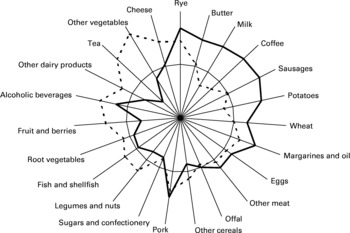
In a previous study, we identified two major dietary patterns found in the Cardiovascular Risk in Young Finns cohort (Mikkilä et al. Reference Mikkilä, Räsänen, Raitakari, Pietinen and Viikari2005). The Cardiovascular Risk in Young Finns is a longitudinal study on CVD risk factors and their determinants among children and young adults in Finland. The first cross-sectional study was carried out in 1980, when the subjects were children aged 3–18 years. The same subjects have been followed since, the latest follow-up being in 2001, when all subjects had reached adulthood. Similar patterns were identified at the three study points (baseline in 1980, 6-year follow-up in 1986, and 21-year follow-up in 2001). Dietary patterns in 2001 are shown in Fig. 1. The first pattern was strongly correlated with traditional foods in Finland, such as potatoes, sausages, milk, coffee, rye and butter, and was therefore labelled as the ‘traditional pattern’. The second pattern was characterised by greater consumption of vegetables, fruit, root vegetables, fish, cheese and tea, most of which are foods that are, albeit not exclusively healthy, considered to reflect the subject's tendency to make health-promoting food choices. This pattern was termed the ‘health-conscious pattern’. We also showed substantial tracking of these patterns reflecting food choices of subjects throughout the study period from 1980 to 2001, especially among those subjects who were more than 15 years old at baseline (Mikkilä et al. Reference Mikkilä, Räsänen, Raitakari, Pietinen and Viikari2005). The aim of this study was to examine the associations of these dietary patterns with cardiovascular risk factors in this Finnish population cohort using repeated measurements from childhood to adulthood.
Dietary patterns identified among subjects in 2001. Each arm of the star illustrates the correlation between the pattern and the food group, with an inverse correlation (r = − 1) at the midpoint and a positive correlation (r = +1) at the outer edge of the constellation. A correlation of zero is indicated by the circle. The solid line shows the traditional dietary pattern and the dotted line indicates the health-conscious dietary pattern.
Subjects and methods
The Young Finns Study is a large, longitudinal multicentre study on CVD risk factors and their determinants among children, adolescents and young adults in Finland. Determinations have included ascertaining serum cholesterol and other lipid levels, blood pressure examinations, anthropometric measurements and dietary interviews. Data have been collected with questionnaires on diet, smoking, alcohol use, physical activity and other lifestyle factors, and on subjects' own and their family's sociodemographic situation and history. The ethics committees of the participating centres have approved the study protocol. Details of the methods have been described previously (Åkerblom et al. Reference Åkerblom, Viikari, Raitakari and Uhari1999; Juonala et al. Reference Juonala, Viikari, Hutri-Kähonen, Pietikäinen, Jokinen, Taittonen, Marniemi, Rönnemaa and Raitakari2004).
Subjects
The first cross-sectional study was carried out in 1980, when the randomly selected participants were 3–18 years of age (n 3596, 83 % of those invited), and the same subjects have been followed since. All of those participating in 1980 were re-invited in 1986 and in 2001 to the follow-up studies, and approximately 70 and 66 % of them participated, respectively.
In 1980, a 50 % random sample of the subjects was chosen to participate in the 48-hour dietary recall interview. These subjects were then repeatedly interviewed with the same method in the subsequent follow-up studies. Dietary information and blood samples were obtained from 1768 subjects (then children and adolescents, 3–18 years) in 1980, from 1200 subjects (then children, adolescents and young adults, 9–24 years) in 1986, and from 1037 subjects (now all young adults, 24–39 years) in 2001.
Dietary assessment
In the 48-hour recall, dietary interviewers, all trained dietitians, collected information on foods and beverages consumed by subjects during the 2 d prior to the interview. In 1980 and 1986, 3- to 12-year-old children were interviewed together with their mother or father or another accompanying person. As detailed information as possible on the type and amount of foods and drinks reported was documented on forms by the interviewer. The study protocols have been described in detail elsewhere (Räsänen et al. Reference Räsänen, Ahola, Kara and Uhari1985, Reference Räsänen, Laitinen, Stirkkinen, Kimppa, Viikari, Uhari, Pesonen, Salo and Åkerblom1991; Mikkilä et al. Reference Mikkilä, Räsänen, Raitakari, Pietinen and Viikari2004). Details of the pattern analysis have been reported previously (Mikkilä et al. Reference Mikkilä, Räsänen, Raitakari, Pietinen and Viikari2005). Briefly, food groupings of the food consumption databases used in different years were unified to obtain 24 standardised food groups (Fig. 1). Food items were grouped according to their habitual culinary use or nutrient composition. Some items (e.g. coffee and tea) were kept as a separate group because they were considered to represent distinctive food choices. A principal component analysis was performed separately for each study year to assess the major dietary patterns existing in the study group. The factors were rotated by an orthogonal transformation, and the number of factors was considered on the basis of the eigenvalues and a scree plot analysis, both resulting in three patterns of which the one with the lowest eigenvalue at all study points was not interpretable and therefore not included in further analyses. Thus, for each study year, we eventually chose and identified two consistent dietary patterns. The patterns were extracted separately for men and women but, as the obtained factors were very similar (data not shown), the final pattern analyses were made with both genders combined.
Assessment of outcome variables
Details of the biochemical methods in 1980 and 1986 have been published earlier (Porkka et al. Reference Porkka, Raitakari and Leino1997). Lipid analyses in 2001 and the correction factor equations of the methods in 1980, 1986 and 2001 have been described in detail by Juonala et al. (Reference Juonala, Viikari, Hutri-Kähonen, Pietikäinen, Jokinen, Taittonen, Marniemi, Rönnemaa and Raitakari2004). Briefly, in 2001, venous blood samples were drawn after an overnight fast. Serum total cholesterol and triacylglycerol concentrations were determined enzymatically (Olympus Diagnostica GmbH, Hamburg, Germany). HDL cholesterol was determined after precipitation of LDL and VLDL by dextran sulphate 500 000, and LDL cholesterol concentrations were calculated using the Friedewald formula (Friedewald et al. Reference Friedewald, Levy and Fredrickson1972). Serum apolipoproteins A-I and B were analysed immunoturbidimetrically (Orion Diagnostica, Espoo, Finland). Serum insulin (all study years) and homocysteine (only in 2001) were determined by using fluorescence polarisation immunoassays (Abbott Laboratories, Abbott Park, IL, USA), and C-reactive protein (CRP) (only in 1980 and 2001) by a sensitive latex turbidimetric immunoassay (Wako Chemicals GmbH, Neuss, Germany).
Blood pressure was measured with a standard mercury sphygmomanometer in 1980 and with a random-zero sphygmomanometer in 1986 and 2001. The average of three measurements was used in statistical analysis. BMI was calculated as the participant's weight in kilograms divided by the square of the height in metres.
Assessment of other variables
Factors considered possible confounders in the relationship between dietary patterns and outcome variables, i.e. physical activity and smoking, were assessed with self-administered questionnaires at each study point. The variable representing physical activity was categorised using information on the frequency of rigorous exercise of at least 30 min duration into three categories: daily, 1–6 times weekly and less than weekly. Smoking status was classified as never, formerly/infrequently or currently.
Statistical analyses
Associations between dietary patterns and cardiovascular risk factors were studied using factor scores for two dietary patterns at all three study years. To describe basic characteristics related to dietary patterns and to obtain univariate associations between dietary patterns and CVD risk factors in a cross-sectional setting (all study years separately), we divided the subjects into quintiles according to standardised dietary pattern scores, for both genders, both patterns and all three study points. Before the division, the pattern scores were energy adjusted to eliminate confounding due to variation in the amount of food consumed (i.e. in body size and energy expenditure) as well as to control possible under- or over-reporting of food consumption. The adjustment for total energy intake was performed using the residual method (Willett, Reference Willett1998). Selected study characteristics as well as the mean values of the outcome variables were then calculated in the lowest quintile, three middle quintiles and the highest quintile separately.
We also conducted a multivariate analysis to examine the independent longitudinal associations between dietary pattern scores and CVD risk factors as repeated measurements using a mixed linear regression model and with time-variant covariates taken into account. The SAS® procedure PROC MIXED enables efficient analysis of repeated measures data by allowing the user to model the covariance structure (Littell et al. Reference Littell, Henry and Ammerman1998). We chose to use unstructured covariance on the basis of a REML log likelihood test. Another advantage of PROC MIXED is that it can handle data with missing measurements. Therefore, even measurements on subjects lost in the follow-up were included in the longitudinal models, thus the final number of subjects included was 1200. Using this method, we were able to construct models where repeated measurements of the pattern scores were inserted in the model to predict repeated measurements of the outcome variables (risk factors); therefore, all models were genuinely longitudinal.
All outcome variables were standardised into age- and sex-specific z-scores with a mean of 0 and a standard deviation of 1. This was done because of the age dependence of the CVD risk factors at issue. First, we conducted two separate models for each outcome, where scores for either the traditional or the health-conscious pattern were fitted as continuous independent variables, adjusted for age (years) and total dietary energy (kJ/d). Thus, the models were based on the following simplified principle: standardised risk factor level1980,1986,2001 = intercept+β1 (dietary pattern score1980,1986,2001)+β2 (age1980,1986,2001)+β3 (total energy1980,1986,2001)+β4 (years from baseline)+error, where coefficient β1 represents the predicted change in the standardised risk factor level when the dietary pattern score increases by one unit. Secondly, we produced similar multivariate models with additional adjustments for smoking status and physical activity. In addition to being an outcome variable indicating the risk of CVD, BMI could also be considered a confounder when linking dietary exposures to other CVD risk factors. Therefore, we carried out additional analyses for other outcomes controlling for BMI, i.e. including it in the model as an explanatory variable. All models were performed separately for female and male subjects.
Results
In 2001, male subjects had significantly higher scores for the traditional dietary pattern, whereas girls and women had more health-conscious diets (Table 1). Physical activity and smoking were also associated with dietary patterns. Subjects with a more traditional diet were physically less active and more likely to be current smokers than those with a health-conscious diet. For brevity, only results from 2001 are presented in Table 1. However, as previously mentioned, the dietary patterns were very similar at all three study time points. See Mikkilä et al. (Reference Mikkilä, Räsänen, Raitakari, Pietinen and Viikari2005) for complete dietary patterns and tracking of dietary patterns in this cohort over time.
Characteristics of subjects (n 1037) according to quintiles (Q) of energy-adjusted dietary pattern scores in 2001
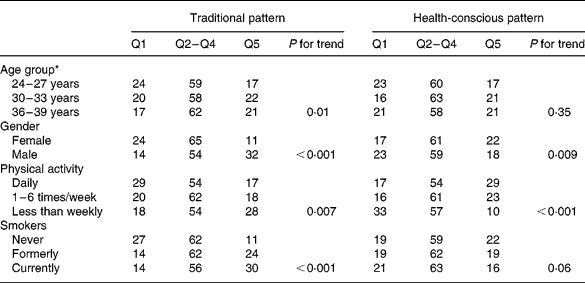
Values are proportions (%) of the characteristic in the quintile.
* Representing the three age cohorts of the study.
Table 2 shows the age-adjusted mean values of the studied risk factors by quintiles of the energy-adjusted dietary pattern scores in 1980 (childhood) and 2001 (adulthood). Female subjects with high traditional pattern scores had on average higher total and LDL cholesterol concentrations in both 1980 and 2001. Among males, this trend of higher total and LDL cholesterol concentrations with increaseing traditional dietary pattern scores was apparent only in childhood (1980). Among both genders, subjects with higher traditional pattern scores had significantly higher values of apolipoprotein B than those with lower traditional pattern scores in both 1980 and 2001.
Mean values* of risk factors in childhood (1980) and adulthood (2001) according to quintiles (Q) of energy-adjusted traditional dietary pattern scores in the corresponding study year (n 1037)

* Adjusted for age.
In 2001, we observed a significant trend in the levels of numerous risk factors according to the traditional pattern scores among women, but this was less pronounced among men. When divided into quintiles according to the health-conscious pattern, the differences in risk factors were smaller and less consistent, especially among men (Table 3).
Mean values* of risk factors in childhood (1980) and adulthood (2001) according to quintiles (Q) of energy-adjusted health-conscious dietary pattern scores in the corresponding study year (n 1037)

* Adjusted for age.
The results of multivariate analyses are shown in Table 4. In models adjusted for age, gender, smoking, physical activity, total energy intake and study year, significant associations of the traditional pattern scores were observed with total and LDL cholesterol concentrations, apolipoprotein B and CRP levels among both genders, and also with insulin levels and systolic blood pressure among women and homocysteine levels among men (Table 4). When an additional adjustment for BMI was made in the models for other outcomes, the correlation with apolipoprotein B disappeared in women and the correlation with plasma insulin concentrations in women weakened (data not shown). The health-conscious pattern was associated with lowered risk factor levels, but mainly only among women. Total and LDL cholesterol concentrations, apolipoprotein B and CRP values had a significant negative relationship with health-conscious pattern scores in women, all unaffected by the insertion of BMI into the model. In addition, health-conscious pattern scores were found to have an independent significant inverse association with homocysteine concentrations in both genders.
Multivariate analyses of the longitudinal associations of the repeated measurements of traditional dietary pattern scores and standardised cardiovascular risk factors (n 1200)

Coefficient b indicates the change in the predicted z-score for the outcome variable for a unit increase in the pattern score, keeping other variables in the model fixed.
* Adjusted for age (years), total energy (kJ/d), smoking (never, formerly, currently), physical activity (daily, 1–6 times/week, less than weekly) and years from baseline (0, 6 or 21).
† z-scores.
Discussion
In an earlier study, we identified similar dietary patterns across the 21-year study period (Mikkilä et al. Reference Mikkilä, Räsänen, Raitakari, Pietinen and Viikari2004). The consistency of the patterns enabled investigation of their usability as a measure of risk of CVD from childhood to adulthood. During recent years, dietary patterns have become widely used in nutritional epidemiology. They have several advantages over focusing on individual nutrients (Fung et al. Reference Fung, Willett, Stampfer, Manson and Hu2001). Nutrient-based approaches fail to take into account the many known (and unknown) interactions between nutrients and other still unidentified dietary components. Also, in epidemiological studies, it is difficult to separate the specific effects of individual nutrients because of the highly inter-related nature of dietary exposures (Jacques & Tucker, Reference Jacques and Tucker2001). The nutrient contents of foods often have inter-relationships that lead to highly correlated intakes. Thus, although diets with multiple components cannot be expected to have correlations with physiological or pathological outcomes that are as strong as correlations with single compounds, dietary patterns offer a new approach in nutritional epidemiology, with results that can more easily be translated into practical advice for the public (Fung et al. Reference Fung, Willett, Stampfer, Manson and Hu2001).
We observed significant associations suggesting a disadvantageous effect of traditional food choices on the risk of CVD. Moreover, we observed somewhat inconsistent associations between risk factors and the health-conscious pattern in the multivariate analysis. In a previous study among American adults, the ‘Western pattern’, rich in meat and meat products, eggs and high-fat dairy products, was found to be associated with an elevation in some risk markers of CVD, whereas the ‘American-healthy pattern’ had no such associations (Kerver et al. Reference Kerver, Yang, Bianchi and Song2003). In other studies, dietary patterns reflecting healthy food choices have often been found to have stronger associations with more favourable levels of CVD risk factors or diagnosed CVD (Huijbregts et al. Reference Huijbregts, Feskens and Kromhout1995; Fung et al. Reference Fung, Willett, Stampfer, Manson and Hu2001; Millen et al. Reference Millen, Quatromoni, Nam, O'Horo, Polak and D'Agostino2002) than that shown here. Millen et al. (Reference Millen, Quatromoni, Nam, O'Horo, Polak and D'Agostino2002) observed a significant increase in the risk for carotid atherosclerosis among female subjects following an ‘empty calorie’ diet compared with those following a ‘heart healthy’ diet. In a follow-up study of male health professionals, a ‘prudent’ diet was inversely associated with coronary heart disease (Hu et al. Reference Hu, Rimm, Stampfer, Ascherio, Spiegelman and Willett2000).
Although the health-conscious pattern identified in our study is characterised by foods rich in components that have the potential capacity to lower the risk of CVD, similar to the American ‘prudent’ and ‘heart healthy’ patterns (Slattery et al. Reference Slattery, Boucher, Caan, Potter and Ma1998; Hu et al. Reference Hu, Rimm, Smith-Warner, Feskanich, Stampfer, Ascherio, Sampson and Willett1999), we labelled the pattern as ‘health-conscious’ rather than ‘healthy’. While the pattern represents conscious efforts to make healthy food choices, it cannot be considered exclusively health promoting. For instance, its effect on the intakes of different fatty acids is not as strong as the effect of the traditional pattern (Mikkilä et al. Reference Mikkilä, Räsänen, Raitakari, Pietinen and Viikari2005). Thus, our results suggest that the health-conscious dietary pattern is an indicator of an overall health-promoting lifestyle rather than an independent preventive factor for CVD. For similar reasons, Kerver et al. (Reference Kerver, Yang, Bianchi and Song2003) termed a pattern rich in vegetables, tomatoes, fruit and tea as ‘American-healthy’ and not ‘healthy’.
The dietary patterns constructed with factor analysis have no generally approved terms of reference, and therefore the results may be affected by subjective analytic decisions by the authors (Jacques & Tucker, Reference Jacques and Tucker2001; Srinath Reddy & Katan, Reference Srinath Reddy and Katan2004). In addition, dietary patterns are sample specific, and any generalisations need to be made with caution. Although dietary patterns are not completely comparable, there are some common features that may explain at least part of the similar findings. For example, in American studies using the dietary pattern approach, researchers have consistently identified a Western type of diet (Fung et al. Reference Fung, Willett, Stampfer, Manson and Hu2001; van Dam et al. Reference van Dam, Rimm, Willett, Stampfer and Hu2002; Kerver et al. Reference Kerver, Yang, Bianchi and Song2003). This diet consists of foods very different from our traditional pattern, with the former containing such items as potato chips and other deep-fried foods, hamburgers, pizza and soft drinks, but the two diets do have similar nutrient contents. They are both characterised by an elevated intake of high-fat and high-sodium foods that are often low in antioxidative nutrients such as vitamin C, folate and carotenes. American ‘Western’ food is often considered, even in Finland, to represent the most disadvantageous and unhealthy food choices with regard to the risk of CVD. Diet–health relationships should, however, always be interpreted by taking into account culture-specific features. As an example, most of the potatoes reported by our subjects were consumed as plain cooked or mashed potatoes and only 9 % as chips or crisps. Our results suggest that traditional diets in Finland, which include large proportions of sausages, potatoes, milk, coffee and butter, may pose a greater threat to cardiovascular health than ‘Western’ food, which was not consumed enough among the participants of this study to be manifested as a dietary pattern.
Even after appropriate adjusting, there is a possibility of residual confounding in the analyses. Also, when testing several models, there is an increasing possibility of a significant result by chance only. Nevertheless, the associations identified in this study are mainly consistent, logical and both biologically and behaviourally meaningful. Many of the observed associations can at least partly be explained by the known effects of nutrients in the pattern diets. Elevated total and LDL cholesterol and apolipoprotein B concentrations among subjects with the traditional diet may be explained by a high intake of saturated fatty acids and dietary cholesterol and a low intake of unsaturated fatty acids and dietary fibre. The impact on apolipoprotein B concentrations, however, is complex due to its genetic variation in response to diet (Rantala et al. Reference Rantala, Rantala, Savolainen, Friedlander and Kesäniemi2000). Higher serum insulin concentrations independently associated with traditional pattern scores among women may be a result of effects of several macronutrient factors, especially of the amount and type of fatty acids and carbohydrates in the diet (Riccardi & Rivellese, Reference Riccardi and Rivellese2000).
A high content of sodium in traditional foods is likely to play an important role in the higher systolic blood pressure observed among female subjects with high traditional pattern scores. Moreover, the traditional diet was found to have a positive association with BMI in both women and men, but significant only in adulthood. This is probably due to the accumulating effects of food behaviour during life. The health-conscious pattern was characterised by a high consumption of vegetables, which inevitably leads to high intakes of folate. Thus, not surprisingly, subjects with health-conscious food choices had significantly lower concentrations of homocysteine, an indicator of folate intake and a possible risk factor of CVD, with both atherogenic and thrombogenic effects (McKinley, Reference McKinley2000).
The dietary patterns were constructed on the basis of food consumption information obtained by the 48-hour recall method. As with all food consumption methods, the 48-hour recall has its limitations. While being suitable for estimating average food consumption and nutrient intakes of a group, it fails to take into account the intra-individual variability of the diet (Willett, Reference Willett1998). However, short-term recall methods provide accurate information on the types and amounts of foods consumed. Moreover, foods or food groups distinguishing the different dietary patterns were mostly foods that are usually consumed daily or several times a week, such as coffee, tea, potatoes, butter, bread, vegetables and fruit. We used the results of an FFQ filled out by the same participants to evaluate the validity of the dietary patterns (Mikkilä et al. Reference Mikkilä, Räsänen, Raitakari, Pietinen and Viikari2005) and showed high correlations between the food consumption results obtained with these two methods. We therefore believe that these patterns reflect the true food behaviour styles existing among the study sample. Togo et al. (Reference Togo, Heitmann, Sorensen and Osler2003) and McNaughton et al. (Reference McNaughton, Mishra, Bramwell, Paul and Wadsworth2005) also observed a high consistency between dietary patterns assessed through different methods. However, any bias caused by the short-term measurement is likely to have diluted rather than strengthened the observed associations.
Although the assessed dietary patterns have differences in their average nutrient composition, the patterns are based on food groupings, not nutrient intakes. Therefore, large variation may be present in the nutrient intakes of subjects with similar pattern scores. In the univariate analyses, many associations between risk factor levels and dietary pattern scores among males are only apparent during childhood. This could be explained by the drastically increased selection of foods, also of those typical in the traditional diet, with more variation in their nutrient contents. It is possible that having a high traditional pattern score in 1980 inevitably meant certain foods and certain nutrient intakes along with them. In 2001 it was possible to have a high score with different food choices leading to a different nutrient profile of the diet. Similarly, the choice within a food group is the likely explanation for the gender differences in the associations between health-conscious pattern scores and risk factors. In a previous study, we computed the nutrient intakes of the same study population and showed significant gender differences (Mikkilä et al. Reference Mikkilä, Räsänen, Raitakari, Pietinen and Viikari2004). These results suggest that gender differences exist in food choices within the same food group, e.g. women choose low-fat dairy products more often than do men.
Supporting previous studies, we conclude dietary patterns to be significant determinants of CVD risk factor levels. In a recent study among the subjects of The Cardiovascular Risk in Young Finns Study, i.e. the same subjects as in this study, many of these risk factors were linked to vascular markers of pre-clinical atherosclerosis (Raitakari et al. Reference Raitakari, Juonala and Kähönen2003). Therefore, dietary patterns may well have a role in the development of CVD. Our findings offer practical, food-based information on the associations between diet and risk factors for CVD in Finns and encourage further use of dietary patterns in epidemiological research.
Acknowledgements
This study was financially supported by the Academy of Finland (grant nos 77 841 and 210283) and the Juho Vainio Foundation.



