During the last quarter of the nineteenth century, factory workers in several states lobbied for, and ultimately secured passage of, legislation requiring that firms provide workers with weekly wage payments, which in the past had typically been made on a monthly basis. When the courts subsequently upheld the constitutionality of these laws, they were among the first legislative victories for laborers in the period immediately preceding the Progressive Era.Footnote 1 Considerable anecdotal evidence indicates that the switch from monthly to weekly payments, by itself, would have benefited workers by reducing their reliance on credit extended by opportunistic merchants, landlords, and lenders. Indeed, this was undoubtedly widely recognized by workers and their legislative supporters at the time.Footnote 2 However, the higher transactions costs of making up payrolls and distributing wages to their employees on a weekly, rather than monthly, basis would presumably have been shifted backward to workers in the form of lower wages.Footnote 3 Additionally, under nineteenth-century common law, workers were at risk of forfeiting the wages due them if they failed to give adequate notice before quitting their jobs or if their employer determined that the workers had shirked, disobeyed shop rules, or committed other acts of malfeasance on the job. By paying workers infrequently and threatening them with wage forfeiture in the interim, employers gained an added measure of control over turnover, agency, and other transactions costs.Footnote 4 Insofar as weekly pay periods raised these types of costs, workers’ wages would likely have been lower to compensate for the extra cost.
Thus, wage payment reform presented workers with a tradeoff. More frequent wage payments might benefit employees by reducing their reliance on creditors or exposure to the risk of wage forfeiture. However, firms would demand, and at least some workers would accept, a wage reduction to compensate for the higher operating costs. This countervailing effect, being more subtle, was doubtless an unforeseen consequence of the legislative reform for workers and some of their advocates.
If workers would have benefited from the combination of shorter pay periods and lower wages, on balance, then weekly payments should have emerged from a competitive labor market. Indeed, some firms in Massachusetts did pay workers on a weekly basis prior to the legislative mandate, suggesting that their workers were net beneficiaries of more frequent pay. In practice, however, the threat of wage forfeiture may have sufficiently limited labor mobility that legislation was required to secure weekly payment of wages in the face of opposition by those employers who were reluctant to lose the control over turnover and agency costs that monthly wage payment afforded them.
We first analyze the theoretical effects of wage payment reform using a two-period model of deferred compensation. When the wage elasticity of labor supply is positive, the reform increases both the effective wage rate, which includes the cost of deferred payment, and a representative worker's utility if the effect of the payment reform on labor supplied is positive. These effects are reversed when the wage elasticity of labor supply is negative.
We then examine the issue empirically. Data from the manuscript census and vital records of the Commonwealth of Massachusetts are matched with administrative records from January 1885 through March 1886 for the Lawrence Manufacturing Company, a Lowell, Massachusetts textile mill. This period encompasses the passage of a state law requiring that firms pay their workers weekly. Our empirical estimates imply a positive wage elasticity of labor supply for both men and women and a small but statistically significant increase in average hours worked per week that we attribute to the increase in the frequency of wage payment. In light of the predictions of the theoretical model, our empirical results imply that the switch from monthly to weekly payments increased the effective wage rate and well-being of the average worker. These findings are consistent with the fact that the overwhelming majority of mill workers in our sample opted for weekly rather than monthly payments when offered a choice prior to the effective date of the legislation. We also provide evidence that the reform lowered the average wage, as would be expected if more frequent wage payments increased both employees’ utility and firms’ transactions costs that were borne by the workers.
HISTORICAL BACKGROUND
Industrialization profoundly altered not only the nature of work but also the legal relationship between workers and firms. Employment relationships in the early years of the Industrial Era were governed by so-called master-servant statues which restricted the mobility of workers and severely sanctioned shirking on the job. As factories replaced home-based production, however, there was increased concern among firms about the duration of the employer-employee relationship and worker malfeasance. In this new environment for employment relations, firms sought ways to reduce employee turnover and monitoring costs. The infrequent payment of wages, combined with the practice of wage forfeiture, provided employers with a relatively low-cost way of pursuing these goals.Footnote 5
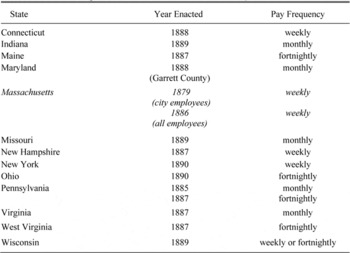
FREQUENCY OF PAYMENT LEGISLATION, 1879–1890

Source:
U.S. House of Representatives, “Labor Legislation.”
In response to these practices, a number of states enacted laws regulating the timing of wage payments. In 1892 Carroll Wright, U.S. Commissioner of Labor, enumerated all of the then-extant legislation considered beneficial to labor.Footnote 6 There are many types of labor legislation in Wright's list, including worker safety laws, regulations for mines, factories, and other places of work, rudimentary work hours laws, prohibitions of (or restrictions on) work by minors, women, and foreign nationals, and criminal and civil statutes related to labor organizations. Our interest, however, is in legislation related explicitly to the payment frequency of wages.
Table 1, derived from Wright's report, shows that thirteen states had adopted frequency of pay laws by 1890.Footnote 7 Massachusetts was the first state to pass such a law when legislation enacted in 1879 mandated weekly payment for city workers. The Massachusetts law mandating weekly payment for all workers in the Commonwealth went into effect in July 1886, having been passed in March of that year after a prolonged discussion in newspapers and pamphlets throughout the state.Footnote 8 Many factory workers in this period struggled to coordinate their day-to-day expenditures with monthly wage payments, and often resorted to buying groceries and other supplies on store accounts at prices that were considerably higher than they would have been had they paid cash.Footnote 9 Moreover, workers could be “trusteed” in Massachusetts, meaning that a lien could be placed on their wages if they fell behind in paying off these debts. The discharge of an accumulated debt often involved a lawyer's fee, set in 1883 at $3.85, or between 15 percent and 20 percent of a typical worker's monthly earnings. Thus, short-term borrowing was a very costly way of smoothing consumption between infrequent paydays. In testimony before the United States Senate, one speaker pointed explicitly to these short-term costs: “I will say in regard to my own city that for a long time we have been trying to get weekly payment of wages enforced by legislation. I think that change has been a benefit to the working men. It certainly has been a benefit to thrifty people, but I don't know that it has done any good to the thriftless. But the man that has a lot of little children, trying to bring them up, and to educate them and provide for them in every respect, it has enabled that man to get his pay weekly and in that way to purchase his necessaries a little cheaper, because he can get as much for a dollar cash as he could get for $1.20 or $1.25 on credit.”Footnote 10
These considerations suggest that a change from monthly to weekly wage payments would have improved the economic well-being of most workers. Indeed, many (but not all) of the mill workers and administrators whom the Massachusetts Bureau of Statistics of Labor, with Carroll Wright as chief, surveyed about this issue believed that more frequent payment of wages would, on balance, benefit workers. In particular, most of the survey respondents viewed the demise of the trustee system as the greatest benefit from implementing weekly pay. Wright reported that “[A] treasurer said that ‘it was better for the people, because it permitted them to pay cash for their goods, as well as save, for they bought more freely when they had a book and got trusted [sic] for rum quicker than for groceries.’”Footnote 11 Again, as reported by Wright: “The president of another corporation said, ‘Our mill was the first to start the system of weekly pay; our operatives were then getting about $600 a year each, and the change at that time was virtually an increase of 10 percent, for they could get lower prices, and consequently save much more money. They would have some of it in their pockets while as it was before the storekeeper had it all in his.’”Footnote 12
However, the theory of compensating wage differentials implies that a profit-maximizing firm would have been driven by competitive forces to pay lower wage rates in exchange for bearing the additional transactions costs of providing more frequent paydays. These additional costs are captured in the quotation reported by Wright in the following passage: “A gentleman, who from the nature of his business comes into contact with the mill operatives, said … ‘If the larger mills should pay once a week it would entail considerable more expense. The Pacific Company employs between five and six thousand hands, and it would be extremely difficult for the paymaster to visit all these people once a week, carrying his trunk up and down stairs, and taking receipts from each one. He has to go to the help so as not to stop the work. I believe once a fortnight is the better way to pay them, and it will eventually come to that.’”Footnote 13
Some administrators also expressed concern about possible agency (or moral hazard) costs associated with weekly payments. A treasurer from one of the nearby Fall River manufacturers, which had been paying weekly for two years, was quoted by Wright as follows: “Some of the help always remain out a day after they are paid, whether weekly or monthly, and I presume they always will.”Footnote 14 Moral hazard concerns were also expressed by the treasurer at another mill, who, Wright reported, “… was about to begin the weekly payment system because the operatives preferred it [and] thought that by so doing they would gain a better class of help, though he said it would undoubtedly increase intemperance among the improvident …”.Footnote 15 Although increased absenteeism or drunkenness and its attendant lower average worker productivity was a widely feared consequence of more frequent paydays, the anecdotal evidence recorded by Wright is mixed: “A superintendent of one of the mills said, ‘When we began [paying weekly], it was said that the operatives would get intoxicated more frequently and cause us more trouble; but our treasurer determined to give it a fair trial and the result exceeded our anticipations, for we found that instead of increasing drunkenness, it has had a contrary effect, so far as we could ascertain by the working days of our operatives’.”Footnote 16
There is anecdotal evidence that mill workers were willing to accept lower compensation to receive their pay on a weekly basis, rather than fortnightly or monthly. According to Wright, “[A]n operative in the Arlington Mills, where they are paying weekly … left another mill where he was receiving a little better pay, in order to secure the advantages of the weekly system.”Footnote 17 Wright also claimed that “… there is not an operative in Lawrence [where weekly wage payments were the norm] who would not leave $2 a day in any other mill to get $1.50 here, simply because of this weekly pay.”Footnote 18 Below, we report empirical evidence supporting the prediction of the theory of compensating differentials that the average hourly wage of the mill workers in our sample decreased after implementation of the wage payment reform.
In summary, the overall effect on workers’ well-being of the wage-payment reform is a priori indeterminate because of the opposing effects of the combined wage reduction and increased payment frequency. In the next section, we show that whether an individual worker would be better or worse off depends on the direction of the response of the worker's labor supply to both the wage change and the implementation of the reform.
THEORETICAL FRAMEWORK
To analyze the response of an individual's labor supply and welfare when the payment of wages changes from a monthly to a weekly basis, we use the following two-period model of deferred compensation.Footnote 19 A worker chooses labor supply h in the first period and consumption of a composite, numéraire good in the first and second periods, c 1 and, c 2 to maximize utility u(h, c 1, c 2) subject to the present-value budget constraint. The individual's decision problem is to maximize utility given a budget constraint; therefore,

where r is the one-period interest rate, m represents endowed (or nonlabor) income, and
![\[
\begin{array}{c}
omega = \left[{\pi plus \frac{{1 minus \pi }}{{1 + r}}} \right]w = \left[{\frac{{1 + r\pi }}{{1 + r}}} \right]w
\end{array}
\](https://static.cambridge.org/binary/version/id/urn:cambridge.org:id:binary:20160308070918556-0826:S0022050712000691_eqn2.gif?pub-status=live)
is the effective wage rate, which depends on the hourly wage rate w, and the proportion 1 − π of wage earnings that is deferred.Footnote 20 Initially, π equals zero and all wage earnings are deferred.
We treat nonlabor income m as a constant determined by decisions made prior to the anticipation of the wage-payment reform, and assume that the interest rate r is not affected by the reform. Thus, the labor supply and indirect utility functions associated with the worker's problem expressed in equation 1 can be written as h(ω) and V(ω), respectively, and all positive and normative effects of the wage payment reform are captured by changes in labor supply and utility that result from a change in the effective wage rate ω.
Equation 2 defining the effective wage rate ω implies that reform of the wage payment system results in a positive direct effect, through the increase in the fraction π of wage earnings that are not deferred. A negative indirect effect arises to the extent that the move to weekly wages raises costs to the employer that lead to a compensating reduction in the wage rate w. Thus, with Δπ = 1 as a result of the change to weekly payment, the sign of the change in the effective wage rate, given by

is theoretically indeterminate. Although we do not have data that would allow us to estimate empirically the change in the effective wage rate resulting from the payment reform, we can obtain empirical estimates of both the wage elasticity of labor supply and the effect of the reform on labor supply. With this information, we can infer the sign of Δω by exploiting the fact that there exists an intermediate value for the effective wage rate, which we denote by ω†, such that the change in labor supply given by equation 3 can be expressed as the product of Δω and the slope of the labor supply function at ω†; that is,

If Δh and ∂h(ω†)/∂ω have the same sign, then we can infer that the wage payment reform increased the effective wage rate (Δω > 0) and therefore increased utility. If the two terms have opposite signs, then we infer that both the effective wage rate and utility declined in response to the reform.
To obtain empirical evidence on the signs of Δh and ∂h(ω†)/∂ω, we estimate a labor supply equation and then calculate the elasticities of labor supply with respect to the wage and to the reform, using the estimated coefficients from the labor-supply equation and the sample means of the variables. We use the signs of these two estimated labor supply elasticities, along with the condition expressed in equation 4, to determine the effect of the wage payment reform on workers’ well-being.
DATA
In 1885 the Lawrence Manufacturing Company (hereafter, “the company”) in Lowell, Massachusetts employed approximately 2,500 individuals in tasks ranging from opening and cleaning raw cotton to the bleaching, dyeing, folding, and packing of finished products (rough sheeting, union suits, and hosiery). Data were taken from weekly payroll records on the earnings and work hours of every employee of the company for whom administrative records existed for the entire 65-week period from January 1885 through March 1886.Footnote 21 Only those employees who had worked at least two consecutive pay periods and who were still on the payroll at the end of the study period were included in our analysis. Additional information about each worker, including age, literacy, native (first) language, savings, date of marriage, and number of children, was obtained by matching the payroll records to the manuscript census and vital records of the Commonwealth of Massachusetts from 1870 to 1920. After eliminating child workers (under the age of 14) and employees with no definitive match in the census and vital records data, we were left with complete observations on 210 company workers for the full sample period. Data were also obtained from company records on the total number of bales of raw cotton in inventory, the total number of spinning machines and weaving looms in use, and the total number of pounds of finished cloth goods produced for each week during the sample period. These weekly company variables were normalized by the number of employees prior to estimation. Thus, the data comprise a balanced panel with 210 people times 65 weeks and a total of 13,650 observations.
Prior to December 1885, the company made up payrolls monthly, handing out pay envelopes on the Saturday of the first week of the new month. December 1885 was a transitional month, with some employees opting to receive their wages at month's end but most choosing to be paid weekly. After December 1885, but well in advance of the effective date of the legislative mandate, all company employees received a paycheck every Saturday covering the work performed in the previous week.
A daily tally of hours worked and output produced was kept for each individual paid by piece rates, but only hours worked were recorded for individuals paid on time rates. The hourly wage rate variable was constructed for both piece-rate and time-rate workers by dividing their weekly earnings by weekly hours worked. At the end of the pay period, totals were compiled and the bookkeeper made note of workers who were fined for damaged goods, charged for “living on the corporation” and thus had their room, board, and energy costs deducted directly from their pay, or had been trusteed.
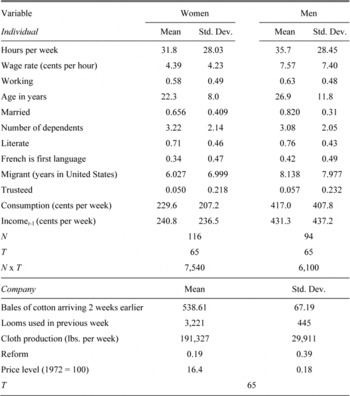
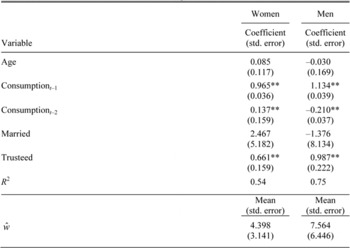
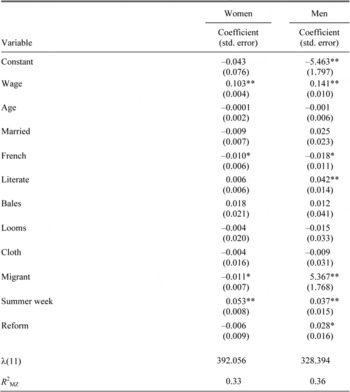
The sample means and standard deviations of the individual and company variables are reported in Table 2. The wage variable, measured in the log of cents per hour in week t for employee i, was obtained for men and women separately as the predicted value from estimated wage equations that are reported in Appendix Table 1. This wage proxy was used because zero hours of work are recorded for approximately 40 percent of the possible employee weeks over the sample and, hence, no hourly wage is observed. Age is defined as the difference, measured in years, between the most recent pay date (alternatively, the date of the end of the current week) and the worker's birth date.
Consumption and labor supply decisions at any point in time may have been affected not only by contemporaneous marital status but also by the prospects for future marriage among those who were currently unmarried. For example, an unmarried woman may have worked additional hours in the present to save for a trousseau or dowry in anticipation of marriage in the future. On the other hand, the expectation of future marriage may have reduced her current labor supply if she believed that factory work would not be her primary occupation in the future. Because we know the date of marriage (if any) for everyone in our sample, we are able to create a continuous, forward-looking marriage variable (Married) that changes over time for those workers who were unmarried during the sample period but who would eventually marry at some future date. For such workers, the marriage variable is the fraction of future time observed between the year of the observations and 1920 that such a person is married. Persons who were married by the year containing the observation week are assigned a fixed value of one for this variable, and those who are never observed to be married through 1920 receive a fixed value of zero.Footnote 22 Thus, for workers who were unmarried in the year of observation, our marriage variable can be interpreted as capturing unobservable characteristics that influence the future propensity to marry and that might affect current labor supply.Footnote 23
DESCRIPTIVE STATISTICS

Sources:
See the text.
In addition, we control for workers whose first language was French and the number of years immigrants had been in the United States since migrating.Footnote 24 The migrant variable is defined to be zero for native-born workers. We added a dummy variable, Trusteed, equal to one if there was a lien or garnishment placed on the employee's earnings in a given week to discharge unpaid debt. Incomet–1 is defined as labor earnings (w × h) lagged one period, and consumption (c) is proxied by the predicted values from an estimated consumption expenditures equation reported in Appendix Table 2.
The company variables include a set of three measures (Bales, Looms, and Cloth defined in Table 2) that are assumed to have affected the demand for labor. The lag lengths on the first two variables reflect the flow or cycle time in the textile manufacturing process.Footnote 25 Because the plan to switch to weekly wage payments was announced well in advance of the legal mandate, individuals would have been able to make small adjustments each period in their labor supply as implementation of the payment reform drew closer in time. Therefore, following Laura LaHaye, we specify the Reform variable as a distributed lag of the form {1 / [1 + exp (52 − t)]}.Footnote 26 The price-level variable, denoted p, is the quarterly GNP Deflator (1972 = 100) reported by Nathan Balke and Robert Gordon.Footnote 27 Endowment, or nonlabor, income (m) is not observed but is approximated by consumption minus wage payments for hours worked (m = c − (w × h)).
EMPIRICAL MODEL AND RESULTS
We specify and estimate a model of labor supply which allows us to incorporate both demand-side and supply-side determinants of the observed weekly variations in hours of work.Footnote 28 The functional form generalizes the Linear Expenditure System to allow for non-separable (direct) utility, while imposing homotheticity. Preferences for goods and leisure are represented by the indirect utility function
![\[
\begin{array}{c}
V(w, p, m; d) = [m + a(w, p, d)] / [b(w, p, d)]
\end{array}
\](https://static.cambridge.org/binary/version/id/urn:cambridge.org:id:binary:20160308070918556-0826:S0022050712000691_eqn5.gif?pub-status=live)
where w is the wage rate, p is the price level, m is non-labor income, and d is a vector of demographic (taste-shift) variables.Footnote 29 The functional forms for a(w, p, d) and b(w, p, d), respectively, are specified as

![\[
\begin{array}{c}
ln_b(w, p, d) = betaf(d)ln_w + [1 plus beta f(d)]ln_p
\end{array}
\](https://static.cambridge.org/binary/version/id/urn:cambridge.org:id:binary:20160308070918556-0826:S0022050712000691_eqn7.gif?pub-status=live)
Applying Roy's Identity to equation 5, the labor supply equation is
![\[
\begin{array}{c}
h(w, p, m; d) = aff(d) plus afc(d)p1/2/w1/2 plus beta_f(d)[m + a(w, p; d)] / w
\end{array}
\](https://static.cambridge.org/binary/version/id/urn:cambridge.org:id:binary:20160308070918556-0826:S0022050712000691_eqn8.gif?pub-status=live)
Substituting from equations 6 and 7 into equation 8 and introducing the reform variable (Reform) in a way that influences labor supply both additively and (through the wage rate) multiplicatively, the labor supply equation can be written
![\[
\begin{array}{c}
h = (alpha_ff plus beta_0 alpha_ff) plus beta0 (m/w) plus beta_1 [(m/w) times Reform] plus (alpha_ff beta1) Reform plus 2 (afc beta_0) [(p/w)1/2] plus 2 (alphafc beta_1) {[(p/w)1/2] times Reform} + (alpha cc beta_0) [(p/w)] plus (acc beta_1) [(p/w) times Reform] \end{array}
\](https://static.cambridge.org/binary/version/id/urn:cambridge.org:id:binary-alt:20160712070615-33289-mediumThumb-S0022050712000691_eqn9.jpg?pub-status=live)
Estimating the labor supply equation required dealing with several important issues. First, an observation of zero hours worked in a given week may represent either a voluntary choice on the part of the worker or a demand-side decision by the company not to schedule work for the employee that week. Although we cannot observe the supply of hours out of equilibrium, we do observe whether or not an employee was working in a given week. Therefore, the labor supply model in equation 9 was augmented by an inverse-Mills-ratio term, representing the probability that the employee worked that week (h > 0) as a function of the wage rate, a set of demographic characteristics affecting individual labor supply, and the set of time-varying variables affecting the company's labor demand.Footnote 30 We assume that employees chose their hours of work, conditional on being employed in a given week.Footnote 31
Second, the labor supply equation was specified as a censored-regression (Tobit) model to account for the fact that we include observations on those employees for whom hours worked (and, thus, labor market earnings) in a given week were zero. Third, the wage variable appearing in the selection and labor supply equations is a proxy obtained from the predicted values of an estimated wage equation. Finally, a random effects, rather than a fixed effects, estimator, was used to estimate jointly the selection and labor supply equations because of the inclusion in the selection equation of two time-invariant explanatory variables (French and Literate) describing individual worker characteristics. To facilitate calculation of the focal elasticities, the labor supply equation was estimated in double-logarithmic form. Separate equations were estimated for male and female workers.
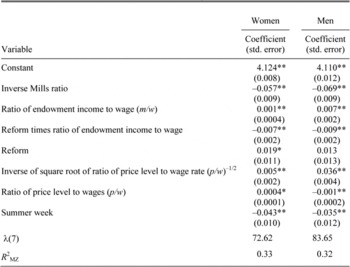
Table 3 reports the selectivity-corrected Tobit estimates of the labor supply equations.Footnote 32 Because of the potential for multicollinearity, the interactions of the Reform variable with the inverse-real-wage variable p/w and its square root (p/w)1/2 in equation 9 were dropped from the estimated equations that are reported. A seasonal dummy variable, Summer week (equal to one if the week observed occurred in June, July, or August and equal to zero otherwise), was added to control for the possibility that labor supply was affected by the summer vacations of school-aged children.
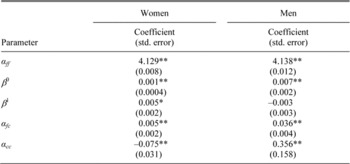
The empirical results reveal that the coefficients on the inverse Mills ratio are negative and statistically significant, thereby justifying the use of a selectivity-correction procedure. Labor supply was lower in the summer weeks, as expected. The estimated coefficients on the variables that include the wage rate w and Reform terms are difficult to interpret directly, owing to the nonlinearity of the functional form. However, estimates of the preference parameters, reported in Appendix Table 4, imply that leisure is a normal good since ∂h/∂m = − β 0/w − β Footnote 1[(1/w) x Reform] > 0, when evaluating w and Reform at their sample mean values.
Crucial to our assessment of the welfare effect of the wage payment reform are the signs of the estimated wage and reform elasticities of labor supply. The estimated wage elasticity of labor supply can be calculated by substituting the estimated preference parameters into the expression
![\[
\begin{array}{c}
all ln_h/all ln_w = beta 0 (m/w2) + beta 1 [(m/w2) × Reform] plus (afc beta 0) [(p/w)1/2]x (1/w) plus (alpha cc beta 0) [(p/w2)]
\end{array}
\](https://static.cambridge.org/binary/version/id/urn:cambridge.org:id:binary:20160308070918556-0826:S0022050712000691_eqn10.gif?pub-status=live)
LABOR SUPPLY EQUATION

Notes:
Coefficients and standard errors are maximum-likelihood (ML) Tobit estimates. Individual fixed effects were included to control for unobserved, person-specific characteristics.
and evaluating it at the sample means of the explanatory variables. Similarly, our estimate of the elasticity of labor supply with respect to the wage payment reform can be obtained by substituting the relevant parameter estimates into

and, again, evaluating the expression at the sample means of the variables. The wage and reform elasticities for women and men are computed to be as follows:

The estimated wage and reform elasticities of labor supply are positive and statistically different from zero for men and women. Although the wage elasticities appear to be small, they are conditional upon the employee working during a given week and so are best thought of as “intensive-margin” responses to changes in the wage. Most importantly, however, the signs of the wage and reform elasticities, combined with the implications of our theoretical model, imply that the change from monthly to weekly payment of wages increased the average worker's effective wage rate and economic well-being.
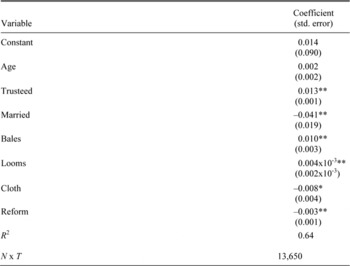
Our theoretical analysis of the relationship between wage payment reform and workers’ welfare highlights two opposing effects: (1) workers are better off with more frequent wage payments because such payments allowed closer synchronization between the receipt of wage income and consumption outlays over the (shorter) pay period; and (2) the increased cost of payroll administration is passed back to the workers in the form of lower wages, making workers worse off. The anecdotal evidence is consistent with both of these theoretical effects. It is possible, however, to use our data to obtain more direct evidence on the second of the two effects of the payment reform on wages. To accomplish this, we specified and estimated a reduced-form wage regression as a function of the introduction of the reform, age, anticipated marital status, trusteed status, the company demand variables, and individual fixed effects.
Table 4 presents the empirical results using the pooled sample of men and women. Among the individual-specific variables, the Age coefficient is positive, as expected, and statistically significant at the 7 percent level. Workers who were trusteed in a given week received higher wages, and an increase in the likelihood of being married in the future is associated with a lower current wage. An increase in company labor demand (proxied by the appropriately lagged values of Bales and Looms) increased wages, as expected. However, an increase in current output, as measured by the Cloth variable, decreased contemporaneous worker demand and wages, suggesting a form of production smoothing. Evidence that the wage payment reform reduced the wage rate, as predicted by the theory of compensating differentials, is given by the estimated coefficient on the Reform variable, which is negative and statistically significant. This result is consistent with the hypothesis that the cost to the company of more frequent payment of wages was passed back to its workers in the form of a lower average wage which, in turn, reflected the additional value placed by the workers on being paid each week.
WAGE-REFORM RELATIONSHIP

Notes:
Coefficients are OLS estimates. Individual fixed effects were included to control for unobserved, person-specific characteristics. The null hypothesis of “no fixed effects” is rejected, with F = 94.53 (p < 0.001).
CONCLUDING REMARKS
In the late nineteenth century, workers lobbied various state legislatures (primarily in the Northeast) to enact laws mandating that employers allow their employees to receive wage payments on a weekly basis, rather than biweekly or monthly as had been common practice. In response to these efforts, several states, beginning with Massachusetts in 1886, passed such legislation as part of the vanguard of labor legislation in the late nineteenth and early twentieth century. The increase in the frequency of wage payments presumably benefited workers by reducing their dependence on costly credit provided by employers, merchants, landlords, and other lenders. On the other hand, the more frequent disbursement of wages increased the costs to firms of payroll administration, and reduced their ability to control labor mobility through the wage forfeiture process. These additional costs would presumably have been passed back to workers in the form of lower wages. Thus, it is not clear a priori that legislative reform of the timing of pay was beneficial for workers.
We specified and analyzed a two-period model of deferred compensation to explore the theoretical effects of wage payment reform on workers’ labor supply, effective wage rate, and welfare. We showed that if the wage elasticity of labor supply is positive and the effect of the implementation of the wage payment reform increases labor supplied, then the reform also increases the effective wage rate and the representative worker's well-being.
Using data on male and female mill workers at the Lawrence Manufacturing Company in Lowell, Massachusetts for the 65-week period from January 1885 to March 1886, we first estimated a selectivity-corrected labor supply model for both men and women to ascertain the effects of the payment reform and changes in the hourly wage rate on labor supply. Our estimates of this model imply that the wage elasticity of labor supply was positive and that the implementation of the reform increased average hours worked per week. In addition, we provided reduced-form evidence that the payment reform lowered the average wage rate, as the theory of compensating differentials predicts if the reform were both costly to the firm and beneficial for the workers. Together, these findings lead us to conclude that the switch from monthly to weekly disbursement of pay increased the effective wage rate and well-being of workers at the textile mill. This conclusion is consistent with the observation that 90 percent of the mill workers in our sample chose to be paid weekly rather than monthly when given the choice in advance of the legislative mandate.
Appendix
WAGE EQUATION

Notes:
Coefficients are OLS estimates. Individual and week fixed effects were included in the wage equation to control for unobserved person-specific characteristics and time trends.
CONSUMPTION EQUATION

Notes:
Coefficients are Tobit ML estimates. Individual and week fixed effects were included in the wage equation to control for unobserved person-specific characteristics and time trends.
EMPLOYMENT PROBABILITY EQUATION

Notes:
Coefficients and standard errors are Probit ML estimates.
LABOR SUPPLY PARAMETERS

Notes:
Coefficients and standard errors are Wald estimates obtained from equation 9 and Table 3.