Introduction
Early childhood is a critical period in which the foundations of cognitive, language, physical, emotional, and social development are created (UNICEF, 2013). That the quality of development in this period can have a significant influence on the quality of a country's human resources has been advanced by several longitudinal studies (Heckman, Reference Heckman2000, Reference Heckman, Watt, Ayoub, Bradley, Puma and LeBoeuf2006; Kagitcibasi, Sunar, Bekman, Baydar, & Cemalcilar, Reference Kagitcibasi, Sunar, Bekman, Baydar and Cemalcilar2009). Heckman, Pinto, and Savalyev (Reference Heckman, Pinto and Savelyev2013) stated that the factors effective in early childhood have an important role in the development of skills and abilities in adulthood. Specifically, language development, which involves several components, including both receptive and expressive language, emerges in early years and is influenced by different contextual variables which would have longitudinal effects. Of interest in the current study, the development of receptive language, or what the child understands, is crucial because it usually provides a base for expressive language and other developmental domains (Slack Hines, Reference Slack Hines2001).
Theoretical frameworks that emphasize the universal importance of parent–child relationships in early development are consistent with research findings in early language development. For instance, social interactionists trace the origins of language development to the earliest attempts to communicate meaning, whereby early infant–mother interaction becomes a template for subsequent communication, including language and social communications (Bruner, Reference Bruner and Forgas1985). Vygotsky (Reference Vygotsky, Gauvain and Cole1978) further emphasizes the importance of connections between people. However, important variation occurs due to the socio-cultural context, a point underscored by other social interactionists (Bronfenbrenner & Morris, Reference Bronfenbrenner, Morris, Damon and Lerner1998; Hoff, Reference Hoff2006). Early social interactions underpin early development universally; communication of meaning leads to language and social development, engagement relates to stimulation and motor exploration. However, as could be suggested by social interactionists emphasizing the role of the cultural context, the relations of these components to one another may differ.
Based on the above-mentioned theories, receptive language development is a part of well-coordinated development and learning process affected by both biological and socio-cultural factors, starting from birth and early interactions. On this basis, general mechanisms underlying language development have been examined in different research studies, while the cross-cultural effects are less focused upon. The current research aimed to identify the associations between receptive language development and other developmental domains in low-income children across different cultures. The following section explains the effect of socioeconomic status on language development as a contextual variable, and the need for a cross-cultural perspective on language development. Additionally, the relations between language and other developmental domains will be explained based on the current research.
Socioeconomic status
Variety in the vocabulary that the child hears is associated with the socioeconomic conditions of the parents. Parents with higher education and higher income use more varied words in communication with their children, compared to less socioeconomically advantaged parents (Hoff, Reference Hoff2003; Hoff-Ginsberg, Reference Hoff-Ginsberg1998). Children from favorable socioeconomic conditions use their language skills more effectively (Lawrence, Reference Lawrence1997). Heath (Reference Heath1982) reported that opportunities for language usage among children from less favorable socioeconomic conditions were inadequate, which caused a delay in their acquisition of these skills, thereby hindering the development of their academic skills.
In a study conducted by Hancock, Kaiser, and Delaney (Reference Hancock, Kaiser and Delaney2002), researchers provided a language and behavior program to families with low socioeconomic levels and analyzed the interaction of mothers with their children, and the development of the children. These researchers found that families from lower socioeconomic levels provided less support to their children in the acquisition of language skills and positive social behavior, communicated with their children less, and demonstrated less role modeling in language usage. The preschool period provides an important window of opportunity to foster learning, including interpersonal competencies and behavioral regulation, and may be especially influential when intervention efforts seek to strengthen environments that influence the daily experiences of young children (Sheridan, Knoche, Edwards, Bovaird, & Kupzyk, Reference Sheridan, Knoche, Edwards, Bovaird and Kupzyk2010).
In research conducted by Hart and Risley (Reference Hart and Risley1995), quality and quantity differences in the language of parents with differing social statuses were examined. Researchers found that the children of families with higher socioeconomic levels heard more new words and were provided with more positive feedback from their families compared to those from lower socioeconomic levels. Other research emphasizes that children from low socioeconomic levels received less verbal stimuli from their environments and had a more limited vocabulary than more advantaged peers (Baydar et al., Reference Baydar, Kuntay, Yagmurlu, Aydemir, Cankaya, Goksen and Cemalcilar2014; Hoff, Reference Hoff2003; Rowe, Reference Rowe2008). Studies conducted with children who had language and speech problems suggested that these children could not build competent social relationships and had limited social behavior repertoires, attributed to communication difficulties (Redmond & Rice, Reference Redmond and Rice2002; Windsor, 1995, as cited in McCabe & Meller, Reference McCabe and Meller2004). Worldwide, researchers and policy-makers are seeking to close achievement gaps in language and other areas of development that exist between low-income children and their more advantaged peers. The purpose of the current study was to investigate relations between receptive language and other areas of development among low-income children in two cultural contexts, the United States and Turkey.
Cross-cultural perspectives
Cultural variations in children's thinking, learning, play, communications, and mutual interactions have been documented in various research. Studies in which North American and European samples were used showed that the rate of inequality in language was caused by the differences in, and variety of, environmental support provided to children (Zhang, Jin, Shen, Zhang, & Hoff, Reference Zhang, Jin, Shen, Zhang and Hoff2008). Culture affects the language development of children, perhaps due to the beliefs held by adults about their roles in language development in children, and variation in talking with children before language acquisition (Zhang et al., Reference Zhang, Jin, Shen, Zhang and Hoff2008).
In some cultures, children frequently observe the interactions of adults; in others, children have less opportunity to observe interactions between adults. While North American mothers start talking to their children before birth or right after birth, in contrast, Mayans with Mexican heritage, Australian Walpiris, and some American groups with African heritage do not address young children as talking partners. While educated North American mothers use more object-oriented and tangible words at a high rate when talking to their children, Asian mothers were observed to use fewer object-oriented words and more verbs and abstract words (Hoff, Reference Hoff2006). Thus, culture can create variation in the communication opportunities and language models provided to children. However, in most cultures, the social environment provides a natural environment for the child's language development (Hoff, Reference Hoff2006), and there tends to be a positive relation between language development and children's social competence (Bornstein, Haynes, & Painter, Reference Bornstein, Haynes and Painter1998; Longoria, Page, Hubbs-Tait, & Kennison, Reference Longoria, Page, Hubbs-Tait and Kennison2009; Nærland, Reference Nærland2011).
Moreover, we know from previous research and theoretical perspectives (Baydar, Akcinar, & Imer, Reference Baydar, Akcinar, Imer, Sayıl and Yagmurlu2012; Kagitcibasi, Reference Kagitcibasi2007) that children's socialization within the family context varies depending on the cultural norms and priorities of parents. For example, Kagitcibasi and Ataca (Reference Kagitcibasi and Ataca2005) in their longitudinal study found that Turkish parents, especially from low socioeconomic backgrounds (as in the current study) emphasized the importance of the interdependence of children with their parents in part because collectivistic cultural values are prioritized. Kagitcibasi (Reference Kagitcibasi1970) also reported that Turkish parents emphasize obedience and the compliance of children more than parents in the United States do. In the United States, an individualistic society, children are taught early on to be independent, whereas in Turkey, a collectivistic culture, interdependence is highly valued. Moreover, Turkish caregivers are more authoritarian than American caregivers, and they place more importance on the obedience of children (Kagitcibasi, Reference Kagitcibasi1970, Reference Kagitcibasi2012), whereas American parents tend to emphasize autonomy and self-expression (Coll & Magnuson, Reference Coll, Magnusson and Masten1999), which may limit or contribute to language development, respectively.
Language development and other developmental domains
Children need vocabulary (both receptive and expressive), as well as verbal reasoning abilities, in order to read and comprehend spoken words (McCardle & Chhabra, Reference McCardle and Chhabra2004). In turn, these language skills help facilitate children's social competence, such as positive peer interactions (Hebert-Myers, Guttentag, Swank, Smith, & Landry, Reference Hebert-Myers, Guttentag, Swank, Smith and Landry2006) and successful behavior regulation following their parents’ standards (Kochanska, Coy, & Murray, Reference Kochanska, Coy and Murray2001). More specifically, children with more advanced language development levels communicate better with peers and adults, perhaps because they use their understanding and listening skills more effectively. These skills enable children's socialization to improve more readily (Nwora & Gee, Reference Nwora and Gee2009; Tomatis, Reference Tomatis1991). Highly competent young children select appropriate and effective behavioral strategies, are well accepted in their peer group, and have reciprocated friendships as early as three to four years of age (Odom, McConnell, & Brown, Reference Odom, McConnell, Brown, Brown, Odom and McConnell2008). Language skills have also been found to contribute to children's success in problem-solving (Landry, Smith, & Swank, Reference Landry, Smith, Swank, Lewis and Carpendale2009). A study with Finnish preschool children also found that language skills predicted children's efficiency in solving word problems (e.g., responding to oral mathematical problems) (Kyttälä, Aunio, Lepola, & Hautamäki, Reference Kyttälä, Aunio, Lepola and Hautamäki2014).
Language is also related to fine and gross motor development. Iverson (Reference Iverson2010) reported that language develops in the context of the developing body in which the language system is embedded, demonstrating how language influences motor development, and vice versa. This relation is supported by studies illustrating that children using fine motor skills more effectively, including gestures and mimicry, were more successful in expressing emotions and thoughts efficiently (Iverson & Braddock, Reference Iverson and Braddock2011; Magill-Evans & Harrison, Reference Magill-Evans and Harrison2001). A longitudinal study in Norway also showed that, at the age of three years, children's language skills predicted fine motor skills, and at the age of five years, they predicted gross motor skills (Wang, Lekhal, Aaro, Holte, & Schjolberg, Reference Wang, Lekhal, Aaro, Holte and Schjolberg2014). While the associations between language skills and other developmental areas have been found to be of importance for children, particularly children from disadvantaged backgrounds, these studies have been primarily conducted in the Western world. Therefore, there is a need to investigate whether these associations emerge in a non-Western context as well. The present study aimed to address this gap in the literature by examining these associations in the United States and Turkey.
The present study
Given what we know about language development, as outlined above, the present study is guided by two main theoretical frameworks: (1) the social interactionist approach, and (2) the bioecological approach to language acquisition. The social interactionist approach states that language acquisition consists of interactions between children and adults, and that language comes to exist for communication (KENPRO, 2010; Schieffelin & Ochs, Reference Schieffelin and Ochs1986). Thus, we investigated the relations between language skills, particularly the receptive language of preschool children, with other developmental domains (i.e., large motor, fine motor, problem solving, communication, and personal–social abilities). The bioecological approach emphasizes that each child is embedded in multiple contextual systems and that various factors within these systems influence children's development (Bronfenbrenner & Morris, Reference Bronfenbrenner, Morris, Damon and Lerner1998). As such, the aforementioned constructs were analyzed from a cross-cultural perspective, in the United States and Turkey. Further, we controlled for several demographic variables (e.g., maternal education, child gender) to account for the potential influences of these proximal factors on language skills and other developmental domains. The research questions were as follows:
1. Is there a relation between receptive the language skills and developmental domains of Turkish preschool children from low-income families?
2. Is there a relation between the receptive language skills and developmental domains of US preschool-aged children from low-income families?
3. How are patterns of relations between receptive language and developmental domains the same and different in the Turkish and US contexts?
Given the centrality of language, we hypothesized that better receptive language skills will be more associated with positive development in other domains. However, because Turkey-based research in these areas is very limited, hypotheses regarding specific differences between the two countries are exploratory.
Method
This research, which was performed with Turkish and American samples, is a cross-cultural study using quantitative research methods to gather information about children's receptive language and developmental competencies in multiple domains.
Participants
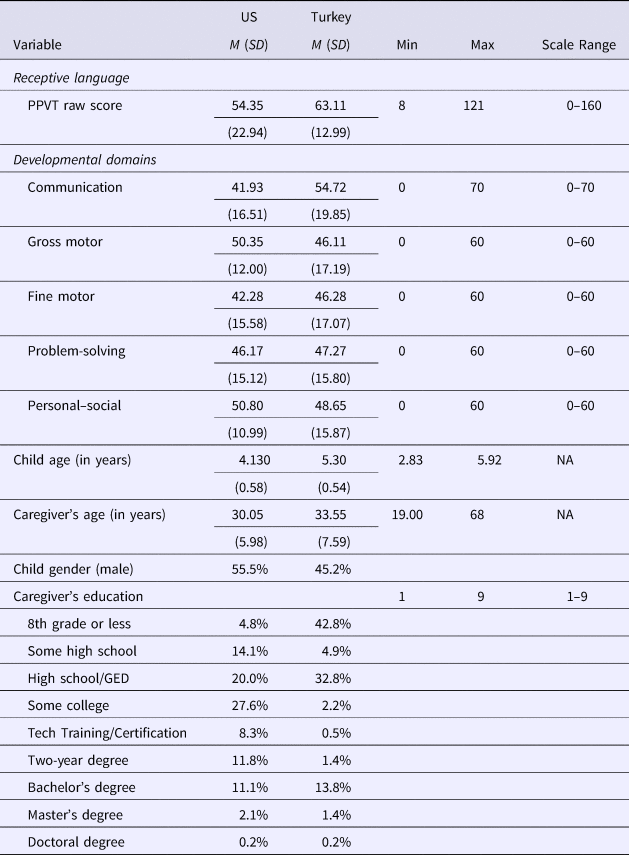
Data in the Turkish component of the study were collected during the spring term of the 2014–2015 academic year from children attending preschools and nursery classes operated by the Ministry of National Education in central Turkey, and their families. The preschools located in this region had students from the lowest socioeconomic level, according to reports from the Turkish Statistical Institute (TUIK, 2013) and the Ankara Development Agency (ADA, 2014). Ages and Stages Questionnaire (ASQ) data were available for 471 children, and these data were collected during February and March, 2015. Data on receptive language were collected from 334 children in June, 2015. All children in the Turkish sample were typically developing. Children with disabilities were not included in the data collection process. Therefore, each child was able to complete the required tasks in the current study. Table 1 presents a summary of the participants’ demographic information and the descriptive statistics. In the Turkish sample, 45.2% of the children were males, and the mean age was 5.30 years (range from 2.83 to 5.92 years).
Descriptive statistics of the variables in the study

In the US sample, all children aged three to five years in three Head Start programs participated in the study. All families were low-income and from different backgrounds. The EDUCARE program is open to serve children from all backgrounds as it employs a comprehensive educational approach. Although 10% of children in Educare have disabilities, these disabilities were not identified. Furthermore, during data collection, all children were eligible to participate as long as they were able to complete the required tasks. Thus, identifying if children have disabilities was not necessary for the purposes of data collection. Families whose household income was at, or below, the 2014 federal poverty threshold (annual income of $23,850 for a family of four before tax) are eligible to enroll in those programs. Data were collected during the 2014–2015 academic school year and were collected in the fall and spring. Fall data were used for the Peabody Picture Vocabulary Test (PPVT-4) and family demographics; spring, or most recent data, were used for ASQ. PPVT-4 was administered to 273 children, whereas ASQ scores were collected from 287 participants. A total of 56% of the children were males, and mean age was 4.13 (range from 2.97 to 6.05).
Data collection tools
Family information form
A form was constructed by researchers in order to obtain demographic information from the families, including the child's and caregiver's age and gender, and the caregiver's educational background.
The Ages and Stages Questionnaire – ASQ
The Ages and Stages Questionnaire is a screening tool that aims to measure the communication, fine motor, gross motor, problem-solving, and personal–social development of children aged 0;3.0 to 6;0.0. It is based on evaluations of parents. The first version of the ASQ was designed by Squires, Bricker, and Potter (Reference Squires, Bricker and Potter1997). The questionnaire was translated into Turkish by Kapci, Kucuker, and Uslu (Reference Kapci, Kucuker and Uslu2010) and this form of the questionnaire (ASQ-TR) was used for the Turkish sample in the current study. For the US sample, a newer version of the ASQ, the ASQ-3 (Squires & Bricker, Reference Squires and Bricker2009) was administered. This version is administered and scored in the same way as the ASQ but has one less item for the Communication subscale. For both countries, the ASQ is completed by the parent or the caregiver of the child. Responses to the items are “yes”, “sometimes”, or “not yet”, and are scored as 10, 5, or 0, respectively, in all five subscales. The sum of the scores is the total score for each subscale, and it allows researchers to determine children's development at risk, when any of the subscales are below the cut-off scores (Squires et al., Reference Squires, Bricker and Potter1997). The reliability of the original form of ASQ was studied by examining the internal consistency, test–retest reliability, and inter-observer reliability of the questionnaires. Test–retest reliability of the ASQ was examined by comparing two questionnaires completed by the same parent with a two-week time interval. The percent agreement for 145 parents was 92%. Intra-class correlations ranged from .75 to .82, suggesting that the ASQ has strong test–retest reliability. Intra-class correlations by area ranged from .43 to .69, suggesting robust agreement between parents and trainer examiners when completing the ASQ on a group of 107 children. Moreover, internal consistency was acceptable, with alphas ranging from .51 to .87. Sensitivity and specificity scores in the original form were 86.1% and 85.6%, respectively.
The Turkish version of the ASQ (ASQ-TR) has items equivalent to the US version, with a few exceptions. As Kapci et al. (Reference Kapci, Kucuker and Uslu2010) reported, after conferring with a group of five Turkish professionals, eight mothers, and six preschool teachers about the cultural appropriateness of the translated / back translated ASQ-TR, an item was added to the communication subscale and several alterations were made in the terms and expressions for cultural appropriateness. Validity and reliability studies for the Turkish form of the Ages and Stages Questionnaire were conducted among 978 children (three to seventy-two months of age) and their parents/caregivers. A total of 564 children were in the ‘not at risk’ group, while 375 of them were ‘at risk’ with regard to severe developmental delays. Concurrent validity was tested with 19 separate age forms of ASQ-TR, whereas validity for known groups was tested for 39 children diagnosed as disabled beforehand. Reliability measures were directed in the same way as the original form. Eventually, ASQ-TR showed an acceptable inter-rater correlation from .76 to .93. The ASQ-TR have the following alpha values for each subscale: .911 (Communication), .876 (Gross Motor), .895 (Fine Motor), .841 (Problem Solving), and .895 (Personal–Social). Sensitivity and specificity scores of ASQ-TR were 94% and 85.5%, respectively.
The Peabody Picture Vocabulary Test – PPVT
The Peabody Picture Vocabulary Test, which measures the vocabulary development of children from the age of two, and is a performance test, was used in this study in order to assess the receptive language skills of children. The Peabody Picture Vocabulary Test was developed by Dunn in 1959 and adapted to Turkish culture by Katz, Onen, Demir, Uzunkaya, and Uludag in 1974 (Oner, Reference Oner2008). The reliability of the test varies between .71 and .81, and test–retest reliability of the test has values between .52 and .90 (Ozguven, 1998, as cited in Ipek & Bilgin, Reference Ipek and Bilgin2007). In the test, which includes 100 cards, the child is asked to identify and show, from among four pictures on each card, the picture that complies with the description provided to her or him. Each correct answer receives one point. The receptive language level of the child is determined by moderating the raw score obtained based on the receptive language age.
The fourth edition of the PPVT (PPVT-4) was administered to the US sample. Psychometric properties of the PPVT-4 include an internal consistency reliability of .94 on each form. Alternate form reliability ranges from .87 to .93, with a mean of .89. The average test–retest reliability is .93, with a range of .92 to .96.
The data collection process
Research data were collected within the context of a research project executed comparatively by a university in central Turkey and at a Midwestern university in the United States. In Turkey, research data were collected by 14 researchers who were trained in the usage of data collection tools. In order to measure the developmental levels of the children, ASQ forms were distributed to families, and the completed forms were collected later in the same week by the researchers. In order to measure the receptive language skills of children, the PPVT was administered to each child individually by a researcher.
In the United States, parents, with assistance from program family support workers, completed the ASQ and entered the data into program records. Scale scores were extracted from program records by two research assistants for the current study. For the PPVT-4, data collectors submitted a video that was evaluated by research leads, who certified data collectors according to protocol procedures. PPVT-4 data were collected by individually administering the test to children who were invited to a testing room. Each examination took about 15 minutes.
Ethics
Ethical approvals regarding the applicability of the research were obtained from the (authors’) University Ethics Committee and the Turkish Ministry of National Education. During the study, data were obtained only from children and their families who wanted to participate in the study. Especially during applications done one-to-one with children, the convenience and comfort of children were considered. In the United States, university Institutional Review Board approval was obtained, first for data collection, and then again for sharing the de-identified data across programs and with the Turkish university.
Results
Data were prepared for analyses. Because the Turkish and US versions of PPVT were different from each other, we analyzed each country's data separately and draw comparative conclusions in the ‘Discussion’ section. Correspondingly, PPVT scores for each country were checked for univariate/multivariate normality. Following established indices for acceptable sampling distributions (Field, Reference Field2000, Reference Field2009; Gravetter & Wallnau, Reference Gravetter and Wallnau2014; Trochim & Donnelly, Reference Trochim and Donnelly2006), normality tests showed that, for the Turkish sample, PPVT scores were normally distributed with a skewness of –0.743 (SE = 0.096) and kurtosis of –1.452 (SE = –1.452). As the same ASQ version was used for both the US and Turkey data collection, combined ASQ scores from both countries were also tested for normality. All developmental domains were all in the range of acceptable and normal distribution: communication: skewness = –1.102 (SE = 0.084), kurtosis = 0.289 (SE = 0.169); gross motor: skewness = –1.564 (SE = 0.084), kurtosis = 1.590 (SE = 0.169); fine motor: skewness = –1.189 (SE = 0.084), kurtosis = 0.439 (SE = 0.169); problem solving: skewness = –1.581 (SE = 0.084), kurtosis = 1.667 (SE = 0.169); and personal–social: skewness = –1.931 (SE = 0.084), kurtosis = 3.098 (SE = 0.169).
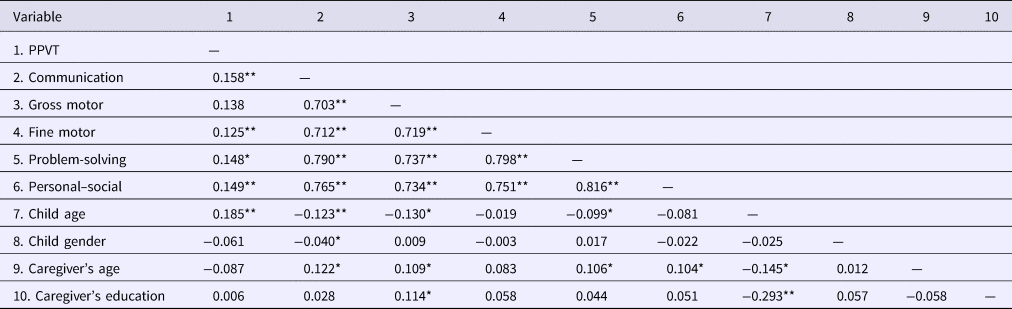
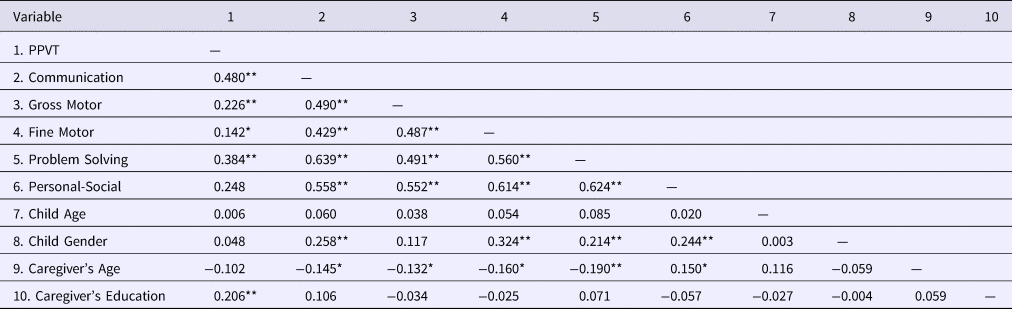
Research questions 1 and 2, examining whether there is a relation between the receptive language skills and developmental domain levels of Turkish preschool children from low-income families, and US preschool children from low-income families, were addressed first by examining correlations. For the Turkish sample (Table 2), PPVT scores are significantly and positively correlated to communication (r = .158, p < .01), fine motor (r = .125, p < .01), problem-solving (r = .148, p < .05), and child's age (r = .185, p < .01). For the US sample (Table 3), PPVT scores are significantly and positively correlated to communication (r = .480, p < .01), gross motor (r = .226, p < .01), fine motor (r = .142, p < .05), problem-solving (r = .384, p < .01), and caregiver's education (r = .206, p < .01).
Correlations among study variables for the Turkish sample

Notes. Child gender was dummy-coded (1 = male; 2 = female); * p < .05; ** p < .01.
Correlations among study variables for the US sample

Notes. Child gender was dummy-coded (1 = male; 2 = female); * p < .05; ** p < .01.
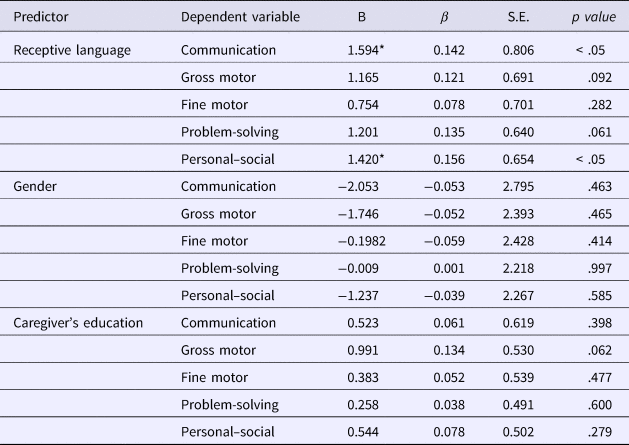
We then conducted a series of simple regression analyses for each country using the maximum likelihood estimator in MPlus version 7.11 (Muthen & Muthen, Reference Muthen and Muthen2012) to examine the relations among the variables. We regressed all the ASQ subscales on PPVT scores and also included child gender and caregiver's educational level as covariates. For the Turkey group (Table 4), receptive language significantly and positively predicted communication (B = 1.594, β = .142, p < .05) and personal–social scales (B = 1.420, β = .156, p < .05), but not gross motor, fine motor, and problem-solving scales. Gender and caregiver's education did not predict any of the developmental domains.
Regression Coefficients, Standard Error Estimates, and p-values for the Regression Coefficients for the Turkish sample

Note: * indicates significance.
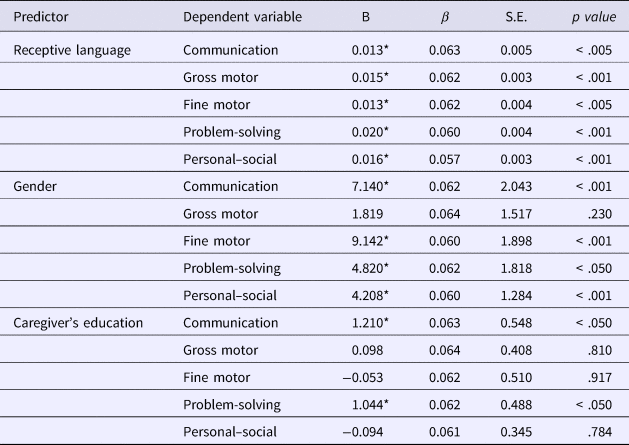
In the US sample (Table 5), receptive language significantly and positively predicted every subscale score: communication (B = 0.013, β = .185, p < .001), gross motor (B = 0.015, β = .286, p < .001), fine motor (B = 0.013, β = .188, p < .005), problem-solving (B = 0.020, β = .305, p < .001), and personal–social (B = 0.353, β = .353, p < .001). Gender also predicted higher communication (B = 7.140, β = .222, p < .001), fine motor (B = 9.142, β = .301, p < .001), problem-solving (B = 4.820, β = .165, p < .05), and personal–social (B = 4.208, β = .199, p < .001) scores in the US sample. Mother's education, on the other hand, only predicted communication scores (B = 1.210, β = .140, p < .005) and problem-solving (B = 1.044, β = .062, p < .05), in that higher education of the mothers is more related to children's higher communication scores.
Regression Coefficients, Standard Error Estimates, and p-values for the Regression Coefficients for the US sample

Note: * indicates significance.
Discussion
The findings of this study reveal that the receptive language skills of children living in low-income households have positive relations with communication and personal–social skills in Turkey. In the United States, receptive language was associated with every domain of development measured – communication, problem-solving, fine motor, personal–social, and gross motor development. In the US sample, gender was also a strong predictor of most developmental domains, while maternal education predicted communication and problem-solving, controlling for receptive language. The discussion that follows synthesizes our research questions 1 (about Turkey) and 2 (about the United States) with research question 3 (cross-cultural), by first discussing the domains where receptive language was predictive in both cultures, and then the domains that were different in their relations to receptive language in the two cultural contexts. Next, we discuss the different roles found for maternal education and gender in predicting domains in the two contexts. Finally, we conclude with a general synthesis of cross-cultural similarities and differences.
Receptive language in association with developmental domains: similarities and differences in two cultural contexts
Similarities: communication skills and personal–social skills
Our findings showed that the receptive language of children was associated with their communication skills in both cultural contexts. This is commensurate with previous research (Gifford-Smith & Brownell, Reference Gifford-Smith and Brownell2003; McCabe, Reference McCabe2005) showing that a child's ability to initiate and maintain conversations using language skills as a tool for expression was associated with their positive interactions. Overall, it appears that children's ability to use language according to its rules in early periods enables them to develop skills of effective listening and speaking as part of their communication skills (Beckman & Edwards, Reference Beckman and Edwards2000; Pae & Greenberg, Reference Pae and Greenberg2014). This is also consistent with previous findings in Turkey showing that children with high levels of language skills have a wider vocabulary, use more complex words, and more easily express themselves (Ege, Acarlar, & Guleryuz, Reference Ege, Acarlar and Guleryuz1998; Ergin, Reference Ergin2012; Guler & Donmez, Reference Guler and Donmez2007; Yildiz Cicekler & Sen, Reference Yildiz Cicekler and Sen2010).
Our finding that receptive language predicted personal–social skills is consistent with existing Western-based literature (Nwora & Gee, Reference Nwora and Gee2009; Tomatis Reference Tomatis1991). Indeed, when children have a better command and understanding of the language, they are more able to use it as a tool to socialize and interact with other people. This finding could be explained by the notion that children's use of language and cognitive skills go hand in hand; therefore, children with better language skills may initiate and maintain positive social interactions within their environment (Mashburn et al., Reference Mashburn, Pianta, Hamre, Downer, Barbarin, Bryant, Burchinal, Early and Howes2008). Parallel to this notion, Turkish children who are better at utilizing their language skills and/or exposed to complex language use in the early years may transfer this utilization into their socialization context (Sarilar, Matthews, & Kuntay, Reference Sarilar, Matthews and Kuntay2015; Uzundag & Kuntay, Reference Uzundag and Kuntay2018).
Differences: gross motor development, fine motor development, and problem-solving skills
The receptive language of children predicted gross motor and fine motor development and problem-solving skills in the US sample but not in the Turkish sample. First, the fact that more domains were associated with receptive language in the US context suggests that receptive language may be more of a prominent factor in child development within the US context than the Turkish context. The dominant US culture encourages back-and-forth verbal communication between child and caregiver, and Educare programs emphasize parent–child and teacher–child dyadic verbal interactions. Although our data do not show a significant difference in receptive language scores between the United States and Turkey, it is possible that children in the United States are reared such that their everyday experiences are centered on facilitating their language development, and their progress, in turn, may reflect improvement in other areas of development. Moreover, many children in the US sample had been in Educare since early infancy and would have benefitted from Educare's strong early language programmatic centrality (Yazejian, Bryant, Freel, Burchinal, & the Educare Learning Network Investigative Team, Reference Yazejian, Bryant, Freel and Burchinal2015).
Receptive language was also found to be related to gross and fine motor development and problem-solving skills for the US sample. Our results corroborate the previously found link between language and motor skills in Western contexts (Hill, Reference Hill2000; Iverson & Thelen, Reference Iverson and Thelen1999) and Western-based studies showing children with language skills at more advanced levels to be more successful at using effective problem-solving strategies (Bridges, Reference Bridges1979; Landry, Miller-Loncar, Smith, & Swank, Reference Landry, Miller-Loncar, Smith and Swank2002). We attribute these findings to the numerous opportunities available to the US sample to advance in their motor development and problem-solving skills in play. For example, the preschool where the US sample was drawn from has spacious indoor and outdoor play areas, which could have helped develop children's motor skills, as well as a variety of play materials that encourage problem-solving.
The Turkish sample, on the other hand, did not have a similar physical context (Olgan & Kahriman-Ozturk, Reference Olgan and Kahriman-Ozturk2011; Sevimli-Celik, Kirazci, & Ince, Reference Sevimli-Celik, Kirazci and Ince2011) in that Turkish programs do not emphasize large motor development as much as other areas of development. Although the national curriculum states that the program should support children's whole development, and that educational plans should be prepared with equal importance being accorded to all developmental domains, this may be difficult to implement in practice. When it comes to indoor/outdoor activities, teachers may have concerns about planning outdoor activities (Yilmaz, Reference Yilmaz2016), and might not be aware of how to plan outdoor activities by using the materials in their surroundings. In another study (Alat, Akgumus, & Cavali, Reference Alat, Akgumus and Cavali2012), teachers emphasized discouraging factors, including unfavorable physical conditions, safety problems in school gardens, the number of children in their classes, parental permission for outdoor activities, and weather conditions. These factors could have restricted the potential associations with motor development for Turkish children. As Walle and Campos (Reference Walle and Campos2014) and Iverson (Reference Iverson2010) stated, ongoing motor development provides new opportunities for children to practice and refine new skills which are critical for language and communication systems. In particular, Iverson (Reference Iverson2010) claims two crucial points about the relation between motor and language development. The first one was the fact that the acquisition of motor skills provides infants with new opportunities to practice skills relevant to language acquisition. The second one was that new motor skills change children's experiences with the others. On this basis, when teachers do not create safe spaces for children's motor actions it is concluded that it might restrict their verbal acts as well. On the other hand, teacher-directed table activities (such as cutting, drawing, and writing) are very common in Turkish preschools and that might limit the verbal interaction between children and teachers in the preschool context.
The role of child gender and caregiver's education in association with developmental domains: similarities and differences in two cultural contexts
Interesting findings emerged with regard to the role of gender in the two contexts. That gender is more associated with the different developmental domains in the US context than in Turkey suggests that gender differences are more pronounced in the United States. Girls were found to score higher in most of the ASQ domains, and this is similar to existing literature in the US context (Administration for Children and Families, 2002; Love, Chazan-Cohen, Raikes, & Brooks-Gunn, Reference Love, Chazan-Cohen, Raikes and Brooks-Gunn2013). Previous research with Turkish children has shown mixed findings on the significant associations between gender and social outcomes. For example, Metin Orta, Corapci, Yagmurlu, and Aksan (Reference Metin Orta, Corapci, Yagmurlu and Aksan2013), in their study with intact families, found that girls scored higher on social competence than boys. However, some other studies conducted in the same district of Ankara as the current study (Acar, Reference Acar2016; Oneren-Sendil & Tantekin-Erden, Reference Oneren-Sendil and Tantekin-Erden2014) did not find significant association between gender and the social competence of children from low socioeconomic status families. Further, in the original validation study of the ASQ (Kapci et al., Reference Kapci, Kucuker and Uslu2010), the researchers found that only personal–social and communication domains differed across genders, favoring girls, but other domains did not differ across genders. These findings and the current findings suggest that the method of measurement or socioeconomic status of children may undermine the lack of association between gender and social outcomes.
For the US sample, but not the Turkish sample, caregiver's education predicted the child's score in communication and problem-solving. Research emphasizes that mothers with higher educational levels act more deliberately in childrearing and, therefore, children achieve more developmental gains (Benjamin Reference Benjamin1993; Sticht & McDonald, Reference Sticht and McDonald1990). Taner and Basal (Reference Taner and Basal2005) found that, even though two mothers from lower and higher socioeconomic levels spend the same amount of time with their children, the stimuli they provide for children during their interaction is qualitatively different. Mothers with higher educational levels use more words compared to mothers with lower educational levels, provide more details to the child during conversation, and allow the child to ask questions (Hart & Risley, Reference Hart and Risley1995). In addition, educated mothers are observed to be more helpful than less educated mothers in areas such as reading books before going to bed and offering explanations about books whenever the child asks. A stimuli-rich environment may provide more opportunities for the child to gain new experiences and talk about these new experiences (Taner & Basal, Reference Taner and Basal2005). Moreover, mother's education level was found to be directly related to parent behaviors, which support the child's development by presenting various stimuli.
A common finding of studies conducted in Turkey and Western cultures concludes that the low level of a mother's educational attainment also decreases the time she spares for her child and behaviors that support the child's development (Demirel, Uner, & Kirimi, Reference Demirel, Uner and Kirimi2001; Klebanov, Brooks-Gunn, Chase-Landsdate, & Gordon, Reference Klebanov, Brooks-Gunn, Chase-Lansdale, Gordon, Brooks-Gunn, Duncan and Aber1997; Yagmurlu, Citlak, Dost, & Leyendecker, Reference Yagmurlu, Citlak, Dost and Leyendecker2009). Studies have shown these associations are assumed to exist in the Turkish context as well (Bekman, Aksu-Koc, & Erguvanli-Taylan, Reference Bekman, Aksu-Koc and Erguvanli-Taylan2012), however, in the present study, different patterns in the two cultures regarding the education level of mothers show inconsistency with the literature. At this point, it can be concluded that the effect of the Educare program for the US sample is highly notable. When supportive intervention studies in the Turkish context are assessed, it is seen that the parent education programs have been effective to reduce the negative consequences of lower maternal education on certain child outcomes. For instance, Bekman et al. (Reference Bekman, Aksu-Koc and Erguvanli-Taylan2012) and Muslugume (Reference Muslugume2016) found that parent education programs promoting language development for children living in disadvantaged areas had positive effects on children's language development and indirect effects on other developmental domains.
Contributions and limitations of the current study
This study contributes to the literature in at least two ways. First, the cross-cultural comparison adds to our limited knowledge of child development in non-Western contexts. The results also incite our understanding of how cultural factors or varying social contexts influence how children develop. One of the most important elements in culture and human interaction is language, and it may also influence other areas of development via social interactions (Bayraktar, Reference Bayraktar2009). Previous studies have found that cultural differences related to language influence mother–child interaction, cognitive development, and language development (Gopnik, Choi, & Baumberger, Reference Gopnik, Choi and Baumberger1996). Our study contributes to the literature by not only illustrating the importance of language for two domains in both cultural contexts, but also identifying the more pervasive influence of receptive language in the Western vs. Turkish context, as evidenced by the significant prediction of language for gross and fine motor and problem-solving development in the former but not the latter context. The study further contributes by illustrating the more pervasive role of gender in predicting development in the United States, and to a lesser extent for maternal education. While maternal education and gender have been found to be predictive in other Turkish developmental contexts, the differences found in the current study raise questions about the early development of low-income children and suggest further study, given the prominence of augmenting early development for low-income preschool age children around the world (United Nations General Assembly, 2015).
However, this research is not without limitations. Our study employed a correlational design, and thus our findings do not determine causation. The variation in the developmental domains may not be solely attributed to receptive language skills, as potential confounding may have influenced the relation between the variables (e.g., cognitive stimulation at home and in school). In addition, the use of two different versions of the PPVT limited us from making direct comparisons of the receptive language scores and their respective effects between the two countries. Finally, because we did not randomize our sample, sampling bias may have occurred, and this restricts the generalizability of our findings for both Turkey and the United States. These limitations indicate that the results should be interpreted with caution.
Acknowledgement
The findings reported here are based on research conducted as part of the Hacettepe University–University of Nebraska Self-Regulation Study. Public kindergartens and elementary schools in Ankara, Turkey, Educare of Lincoln and Omaha, Nebraska, USA, and contributions of Altindag District National Education Directorate, Lisa St. Clair and Megan Sheppard, Munroe Meyer Institute, University of Nebraska Medical Center, are acknowledged. The Turkey part of this work was supported by the Hacettepe University Scientific Research Unit in Ankara, under research Grant Number SDS-2015-5455, and received generous support from the Hacettepe University Early Childhood Policies Research and Application Center.