Introduction
Superior semicircular canal dehiscence syndrome, first described by Lloyd Minor of Johns Hopkins University Hospital in 1998, is a rare otological condition associated with a combination of signs and symptoms. The most common of these are conductive hearing loss, vertigo induced by pressure changes and loud noise (Tullio phenomenon), and conductive hyperacusis. The syndrome occurs due to the dehiscence of the bone overlying the apex of the superior canal.Reference Rosowski, Songer, Nakajima, Brinsko and Merchant1–Reference Beiden, Weg, Minor and Zinreich4
Failure of postnatal bone development is thought to be the mechanism for superior semicircular canal dehiscence. Cadaver studies show that this type of abnormality is present in 0.4–0.5 per cent of the population.Reference Watson, Halmagyi and Coltebach5–Reference Carey, Minor and Nager6
The majority of patients who suffer from superior semicircular canal dehiscence syndrome are able to control their symptoms simply by avoiding the sound and pressure stimuli that cause the problems. For more refractory cases, surgical treatment is an option. This can involve either plugging or resurfacing the superior semicircular canal.Reference Banerjee, Whyte and Atlas7
Pathophysiology: ‘third window’ hypothesis
The dehiscence of the superior circular canal produces a ‘third mobile window’ into the inner ear. It is postulated that the auditory and the vestibular symptoms of superior semicircular canal dehiscence syndrome can be explained by the existence of this third window.
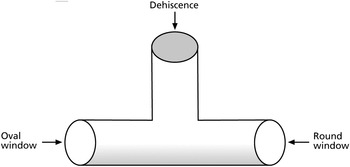
The presence of the third window increases the pressure differential between the two normal windows, which causes conductive hyperacusis. The traditional blocking or resurfacing techniques aim to resolve this issue by omitting the third window, thereby reducing the pressure difference between the oval and the round window (Figure 1).
Diagrammatical representation of traditional semicircular canal dehiscence surgical treatment, which entails resurfacing or blocking of the round window.

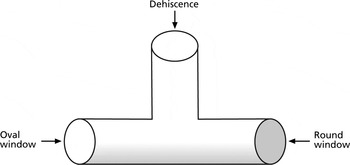
We propose that occlusion of the round window can also help to reduce the conductive hyperacusis symptoms of superior semicircular canal dehiscence syndrome, resulting in a greatly reduced pressure difference between the two remaining windows (i.e. the oval window and the window created by the dehiscence of the superior semicircular canal) (Figure 2).
Diagrammatical representation of the alternative semicircular canal dehiscence surgical procedure to treat conductive hyperacusis symptoms, which entails permeatal blocking of the round window.

Blocking of the round window in superior semicircular canal dehiscence can increase the dissipation of transmitted sound pressure into the dehisced semicircular canal. This will result in greater vestibular stimulation, which may lead to or exacerbate the Tullio phenomenon. This procedure can therefore only be performed on patients with no signs of the Tullio phenomenon. In addition, patients who undergo the proposed procedure should be monitored for signs of Tullio post-operatively, and the blocking of the round window should be reversed if necessary.
It should be pointed out that blocking of the round window is expected to exacerbate the conductive hearing loss in patients with superior semicircular canal dehiscence syndrome. This is because blocking of the round window would further reduce the diminished fluid displacement in the cochlea.
This paper describes a technique of permeatal blocking of the round window. This procedure can be used for the subgroup of superior semicircular canal dehiscence patients who present with conductive hyperacusis symptoms as their main complaint. The procedure was carried out on two patients at James Cook University Hospital, Middlesbrough, UK between 2007 and 2008.
Materials and methods
The tympanomeatal flap is initially elevated through a permeatal approach. The round window niche is then identified and the mucosal fold around it is cleared. The round window membrane is subsequently identified and occluded with bone wax, muscle and fascia, in three separate layers. Finally, the tympanomeatal flap is reflected, and an ear wick is inserted. The ear wick is removed one week after the procedure.
Case studies
Patient 1
A 59-year-old lady with no significant past medical history was referred by her general practitioner to the otolaryngology team with several months history of right-sided hearing loss and ‘fullness’. Findings of the ENT examination (conducted by the otolaryngology team) were normal. Her audiogram revealed a mild right-sided hearing loss, with a normal tympanogram. After nearly two years of missed diagnosis (differential diagnoses during this time included sensorineural hearing loss due to hydrops, eustachian tube dysfunction and acoustic neuroma), the possibility of superior semicircular canal dehiscence syndrome was considered. This followed her first reported complaint of ‘hearing her eyelid close on the right hand side’.
The patient was subsequently referred to the senior author (AB). A computed tomography (CT) scan confirmed superior semicircular canal dehiscence. Pre-operative vestibular-evoked myogenic potential assessment revealed greater sound sensitivity of the right saccule. Further examination revealed a continuous, spontaneous, right-beating nystagmus, which was recorded without fixation. No additional nystagmus or abnormal eye movements were recorded or observed.
After a full explanation of the procedure had been provided (including the possible risks and benefits), the patient agreed to undergo permeatal blocking of the round window. The post-operative vestibular-evoked myogenic potential assessment revealed normal thresholds in the right saccule, which had decreased by 15 dB nHL compared with the pre-operative findings.
Two years after the procedure, the patient's symptoms had continued to improve, with no significant problems.
Patient 2
A 42-year-old gentleman with no significant past medical history was referred to the superior semicircular canal dehiscence syndrome specialist by another otolaryngology colleague with the complaint of being able to hear neck movements following a road traffic accident. A CT scan confirmed the diagnosis of the syndrome.
A pre-operative audiogram revealed a mild conductive hearing loss on the left side, with a normal tympanogram. Pre-operative vestibular-evoked myogenic potential assessment revealed greater sound sensitivity of the left saccule. After full explanation of the procedure had been provided (including the risks and benefits involved), the patient agreed to undergo the procedure. His post-operative vestibular-evoked myogenic potential assessment again indicated a normalisation of sound sensitivity of the left saccule. The patient reported a significant reduction in symptoms post-operatively.
Results
The two patients who underwent this procedure were followed up one week after the operation. Both reported great post-operative improvement in their symptoms. There were no complications in either case, and no occurrence of the Tullio phenomenon was reported following the procedure. As predicted, mild exacerbation of conductive hearing loss was observed in both patients.
Discussion
Blocking of the round window through a permeatal approach can successfully control symptoms of conductive hyperacusis in patients with superior semicircular canal dehiscence syndrome. This technique can be an effective alternative to plugging or resurfacing of the semicircular canal dehiscence. The procedure is simple to perform and can be carried out as day-case surgery.
It is important to note that this procedure has so far only been carried out on two patients. A greater number of patients are needed for a better evaluation of this new surgical technique.