Implications and Contribution
This study provides unique insights into the conditional associations between deviant peer affiliation and substance use in adolescence. Novel findings improve understanding of substance use onset by identifying sympathetic nervous system reactivity as a conditional vulnerability factor.
Onset of substance use: Deviant peer, sex, and sympathetic nervous system predictors
Substance use is a leading cause of health problems during adolescence and beyond (Johnston et al., Reference Johnston, Miech, O'Malley, Bachman, Schulenberg and Patrick2019). According to the 2018 Monitoring the Future national survey results, 9.2% of eighth graders and 42.9% of twelfth graders have been drunk, 9.1% of eighth graders and 23.8% of twelfth graders have smoked cigarettes, and 13.9% of eighth graders and 43.6% of twelfth graders have used marijuana (Johnston et al., Reference Johnston, Miech, O'Malley, Bachman, Schulenberg and Patrick2019). Use of these common substances rises dramatically over the high school years, and thus identifying risk and protective factors during adolescence is vitally important.
Deviant peer affiliation is a reliable and strong predictor of adolescent substance use (Barnes, Hoffman, Welte, Farrell, & Dintcheff, Reference Barnes, Hoffman, Welte, Farrell and Dintcheff2006; Dishion & Owen, Reference Dishion and Owen2002; Kiesner, Poulin, & Dishion, Reference Kiesner, Poulin and Dishion2010; Scaramella, Conger, Spoth, & Simons, Reference Scaramella, Conger, Spoth and Simons2002; Windle, Reference Windle2000; for a meta-analytic review see Allen, Donohue, Griffin, Ryan, & Turner, Reference Allen, Donohue, Griffin, Ryan and Turner2003). Adolescents spend increasing amounts of time with peers without adult supervision (Parker, Rubin, Erath, Wojslawowicz, & Buskirk, Reference Parker, Rubin, Erath, Wojslawowicz, Buskirk, Cicchetti and Cohen2006). In addition, peers exert a powerful influence on behavior during this developmental period (Brechwald & Prinstein, Reference Brechwald and Prinstein2011; Parker et al., Reference Parker, Rubin, Erath, Wojslawowicz, Buskirk, Cicchetti and Cohen2006), and deviant peers may provide access to illicit substances and reinforce substance use (Brechwald & Prinstein, Reference Brechwald and Prinstein2011; Dishion, Piehler, & Myers, Reference Dishion, Piehler, Myers, Prinstein and Dodge2008).
While the multiple “main effect” risk and protective factors associated with adolescent substance use are outside the scope of this report, studies have highlighted the heterogeneity of the deviant peer affiliation–substance use link with an eye toward identifying contextual factors that moderate the strength of this relationship (Farrell & White, Reference Farrell and White1998; Frauenglass, Routh, Pantin, & Mason, Reference Frauenglass, Routh, Pantin and Mason1997; Mayberry, Espelage, & Koenig, Reference Mayberry, Espelage and Koenig2009). Researchers also have encouraged greater integration of biological measures at multiple levels to better understand heterogeneity in such environment–behavior relationships (Cicchetti & Gunnar, Reference Cicchetti and Gunnar2008). This novel study is focused on biological, person-level moderators of the link between deviant peer affiliation and onset of substance use. Specifically, this is the first study to investigate sex and individual differences in sympathetic nervous system (SNS) activity as measured by preejection period (PEP) as moderators of the association between deviant peer affiliation and onset of substance use.
PEP, the time it takes the left ventricle of the heart to fill and for the aortic valve to open, is regulated by SNS input (Goedhart, Willemsen, Houtveen, Boomsma, & De Geus, Reference Goedhart, Willemsen, Houtveen, Boomsma and De Geus2008; Newlin & Levenson, Reference Newlin and Levenson1979). PEP reactivity, the lengthening or shortening of PEP in response to stimuli, has been linked to delinquent and risky behaviors in childhood and adolescence. For example, blunted PEP reactivity (i.e., lengthened PEP in response to a challenge relative to a resting state) has been tied to delinquent behavior (Beauchaine, Gatzke-Kopp, & Mead, Reference Beauchaine, Gatzke-Kopp and Mead2007), alcohol (Brenner & Beauchaine, Reference Brenner and Beauchaine2011; Derefinko et al., Reference Derefinko, Eisenlohr-Moul, Peters, Roberts, Walsh, Milich and Lynam2016), marijuana, and tobacco use (Derefinko et al., Reference Derefinko, Eisenlohr-Moul, Peters, Roberts, Walsh, Milich and Lynam2016). Supporting these findings, a cross-sectional study reported that the association between deviant peer affiliation and externalizing behavior was stronger for adolescents with blunted PEP reactivity (Hinnant, Erath, Tu, & El-Sheikh, Reference Hinnant, Erath, Tu and El-Sheikh2016). Another cross-sectional study in young adult students found that approach behavior to rewards in a computerized game was positively associated with substance use, but only for individuals with blunted PEP reactivity (Beauchaine et al., Reference Beauchaine, Gatzke-Kopp and Mead2007; Brenner & Beauchaine, Reference Brenner and Beauchaine2011; Hinnant, Erath, et al., Reference Hinnant, Erath, Tu and El-Sheikh2016; Hinnant, Forman-Alberti, Freedman, Byrnes, & Degnan, Reference Hinnant, Forman-Alberti, Freedman, Byrnes and Degnan2016). Thus, blunted PEP reactivity seems to be a risk factor for externalizing and some substance use behaviors, and may additionally moderate associations between social or behavioral risk factors and maladaptive outcomes.
Sex differences in substance use show that, compared to adolescent girls, adolescent boys are more likely to engage in binge drinking, marijuana, and tobacco use by twelfth grade (Miech et al., Reference Miech, Johnston, O'Malley, Bachman, Schulenberg and Patrick2018) and are more likely to affiliate with deviant peers (Svensson, Reference Svensson2003). However, evidence for sex as a moderator of deviant peer–outcome associations is mixed (Crosnoe, Erickson, & Dornbusch, Reference Crosnoe, Erickson and Dornbusch2002; Svensson, Reference Svensson2003; van Lier, Vitaro, Wanner, Vuijk, & Crijnen, Reference van Lier, Vitaro, Wanner, Vuijk and Crijnen2005; Westling, Andrews, Hampson, & Peterson, Reference Westling, Andrews, Hampson and Peterson2008). While no studies have found that sex moderates associations between PEP reactivity and substance use or related risk-taking behaviors, sex has been found to moderate links between other indices of autonomic nervous system function and outcomes (e.g., Beauchaine, Hong, & Marsh, Reference Beauchaine, Hong and Marsh2008). Thus, the role of sex in our analyses is considered to be exploratory.
In summary, a great deal of research suggests that deviant peer affiliation is a key predictor of adolescent substance use (and many other maladaptive and health-risk behaviors). However, there is variability in this association that can be elucidated by considering person-level moderators. We focus on the conditional roles of sex and SNS reactivity, specifically PEP reactivity, which has predictive validity in accounting for individual differences in problem behavior and substance use. We consider onset of alcohol, marijuana, tobacco, or any substance use to test whether the hypothesized associations are specific to one type of substance use or consistent across substance use generally and, because of data collection limitations, binge drinking of alcohol in the past 30 days and sexual activity involving substance use from age 16 onward as outcomes.
We hypothesized that deviant peer affiliation would be positively associated with increasing probability of substance use and sexual activity involving substance use over time. We also hypothesized that blunted PEP reactivity would exacerbate the association between deviant peer affiliation and substance use or sexual activity involving substance use over time. Finally, we explored whether relations between deviant peer affiliation and substance use or sexual activity involving substance use over time would be strongest among boys with blunted PEP reactivity. We did not have specific hypotheses about whether interactions among sex and PEP reactivity would differentiate risk for types of substance use, and thus testing the hypotheses with multiple types of substance use is considered exploratory. Because of the novelty of this investigation, differentiation (or lack of differentiation) among substance use outcomes as a function of the predictors would be useful information, as it would suggest risk for specific types of substance use or risk for substance use broadly.
Method
Participants
Data were used from three waves of a longitudinal examination of biopsychosocial influences on youth development. Researchers recruited participants from nearby public schools by sending letters home with children; 37% of those who met criteria participated. Exclusion criteria included a diagnosis of a chronic illness, developmental delay, or attention-deficit/hyperactivity disorder (ADHD), or living with a single parent. The sample at Wave 1 comprised 251 adolescents (53% female) who were representative of the recruitment area in race/ethnicity (34% Black, 66% White) and were diverse in socioeconomic status (SES; 43% of adolescents’ families lived at or near the poverty line, 22% were lower middle class, and 35% middle class and above). Participants’ mean ages across study waves were 15.78 (SD = 9.58 months), 16.78 years (SD = 9.32 months), and 17.70 years (SD = 8.99 months); study waves are referred to as ages 16, 17, and 18, respectively. Retention rates were high: of the age-16 sample, 92% returned at age 17, and 87% participated at age 18; 95% were retained from ages 17 to 18.
Procedure
All study procedures were reviewed and approved by the university's Institutional Review Board; relevant procedures are described here. Adolescents provided assent and parents (predominantly mothers) gave their consent at each wave of data collection. At age 16, youth visited a campus laboratory where they participated in a physiological assessment of pre-ejection period during a 3-min baseline resting period and a 3-min mirror star-tracer stress task (Lafayette Instrument, Lafayette, IN) that has been shown to invoke stress responses from the SNS (Hinnant, Erath, et al., Reference Hinnant, Erath, Tu and El-Sheikh2016). Participants were seated throughout the physiological assessment and instructed to remain as still as possible. After collection of physiological data, adolescents completed questionnaires using a computer in a private setting. Youth returned to the lab to complete questionnaires at subsequent annual follow-up visits at ages 17 and 18.
Measures
Deviant peer affiliation
At age 16, adolescents completed the Community Action for Successful Youth scale of Association with Deviant Peers (Metzler, Biglan, Ary, & Li, Reference Metzler, Biglan, Ary and Li1998). Four items surveyed the frequency with which adolescents spent time over the previous week with friends who engage in delinquent behavior, such as getting in trouble, fighting, or stealing (α = .84). Responses, ranging from 1 (never) to 7 (more than 7 times), were summed for analyses, resulting in an observed range from 4 (low deviant peer affiliation) to 28 (high).
Pre-ejection period
PEP was derived from cardiac and thoracic impedance data collected using disposable Ag-AgCl electrodes (1″ foam, 7% chloride gel; MindWare Technologies, Inc., Gahanna, OH). Cardiac data were obtained through a modified lead-II configuration (Berntson et al., Reference Berntson, Bigger, Eckberg, Grossman, Kaufmann, Malik and van der Molen1997) of electrodes placed on the right clavicle and the base of the left and right ribs. For thoracic impedance data, electrodes were placed in a four-spot impedance configuration (Berntson & Cacioppo, Reference Berntson, Cacioppo, Malik and Camm2004) at the apex and base of the thorax and on the back at 1.5 inches above and below the thorax locations. Data were sampled at 1,000 Hz and amplified with a gain of 5,000, and were analyzed using MindWare IMP software. PEP was scored in 1-min segments, and an average across minutes was used to compute resting and stress-response (star-tracing) scores. PEP reactivity was calculated as a difference score by subtracting star-tracing task level from resting level. Positive scores indicate lengthened PEP relative to resting state, termed blunted PEP reactivity, and a decrease in SNS activity in response to the star-tracing stress task. Negative scores indicate shortened PEP relative to resting state, termed heightened PEP reactivity, and an increase in SNS activity.
Substance use
At ages 16, 17, and 18, youth reported on substance use via the Centers for Disease Control's Youth Risk Behavior Survey (Centers for Disease Control and Prevention, 2012). Alcohol use onset was surveyed through the question, “How old were you when you had your first drink of alcohol other than a few sips?” Marijuana use onset was asked as, “How old were you when you tried marijuana for the first time?” Tobacco use onset was indicated through the item, “How old were you when you smoked a whole cigarette for the first time?” For the onset of alcohol, marijuana, and tobacco use, participants selected from five age categories: 9–10, 11–12, 13–14, 15–16, and 17 or older. Dummy variables were created for each age response and for each substance (0 = onset not in age range, 1 = onset in age range). Additional variables indexing use of any substance (alcohol, marijuana, or tobacco) for each age category were also created to measure general substance use risk. Binge drinking was surveyed by the question, “During the past 30 days, on how many days did you have 5 or more drinks of alcohol in a row, that is, within a couple of hours?” For each data-collection time point, binge drinking was dichotomized (0 = no binge drinking in past 30 days, 1 = binge drinking in past 30 days). Sexual activity involving substance use was measured by asking, “Did you drink alcohol or use drugs before you had sexual intercourse the last time?” (0 = no, 1 = yes).
Covariates
Toward rigorous testing of the hypotheses, variables known to be associated with adolescent substance use were controlled in analyses. Adolescents’ race (0 = White, 1 = Black), sex (0 = girl, 1 = boy), and SES (derived from the computation of income-to-needs ratio; U.S. Department of Commerce, 2012) were considered as covariates. Notably, sex also was considered as a moderator of relationships per our hypotheses. Because resting levels of SNS tend to covary with SNS reactivity in response to challenge (Wilder, Reference Wilder2014), resting PEP was also included as a covariate.
Results
Analysis plan
All substance use measures exhibited moderate-to-severe positive skew and so were transformed into dichotomous yes or no variables at each time point and used in discrete time survival analyses to predict probability of substance use and sexual activity involving substance use over time. Some characteristics unique to survival analysis are worth mentioning in regard to interpretation. First, when participants report an event (e.g., binge drinking) they move into that category and remain in that category for all subsequent time points. Thus, focus on event onset is a characteristic of survival analysis. Second, to derive correct estimates, all participants’ data are included, whether they experience an event or not (Zwiener, Blettner, & Hommel, Reference Zwiener, Blettner and Hommel2011). This is called censored data (i.e., some participants may experience the event before onset of data collection while other may never experience the event of interest during data collection). Third, independent variables predict a latent (i.e., unobserved) categorical variable where regression coefficients are interpreted as log odds (as in cross-sectional logistic regression), which can be converted to odds ratios, probabilities, or hazards. In graphically depicting our results, we chose to use probability curves to describe change over time. A corollary of the third point is that the probabilities at various time points are derived from the repeated measures of observed variable intercepts (i.e., baseline probabilities from the sample), which are modified by individuals’ values on the predictor variables (Muthén & Muthén, Reference Muthén and Muthén2017).
We evaluated alcohol, marijuana, tobacco, or any substance use from age 9 to 10 onward, as well as binge drinking of alcohol in the past 30 days and sexual activity involving substance use from age 16 onward in separate models. All independent variables were mean centered before analysis to minimize colinearity between interaction terms and constituent variables. All predictor variables were entered into a given model simultaneously, controlling for the covariates of race, family SES, and resting state measure of PEP. Missing data were handled with maximum likelihood estimation. Robust standard errors were derived for model parameters. Significant interactions were plotted at one standard deviation above and below the mean of PEP reactivity or, in the case of sex, at values for girls and boys. Unconditional probabilities (i.e., the sample's average probability) are also depicted in figures for comparison purposes.
Preliminary analyses
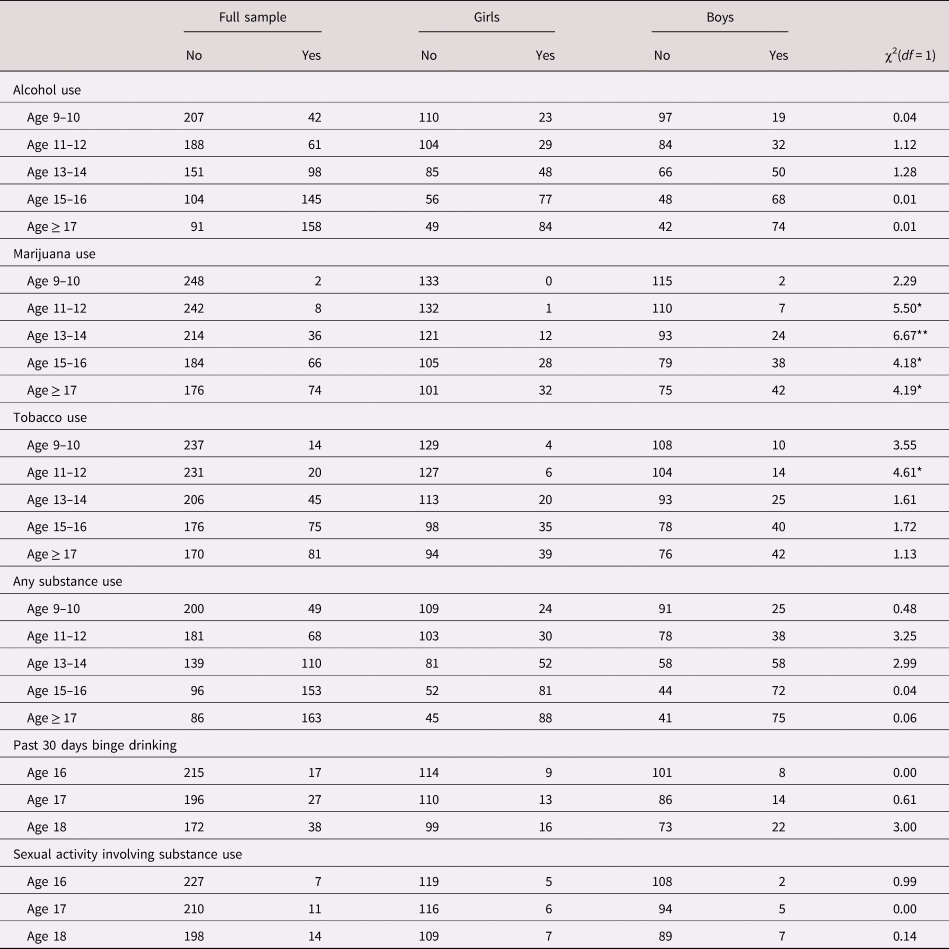
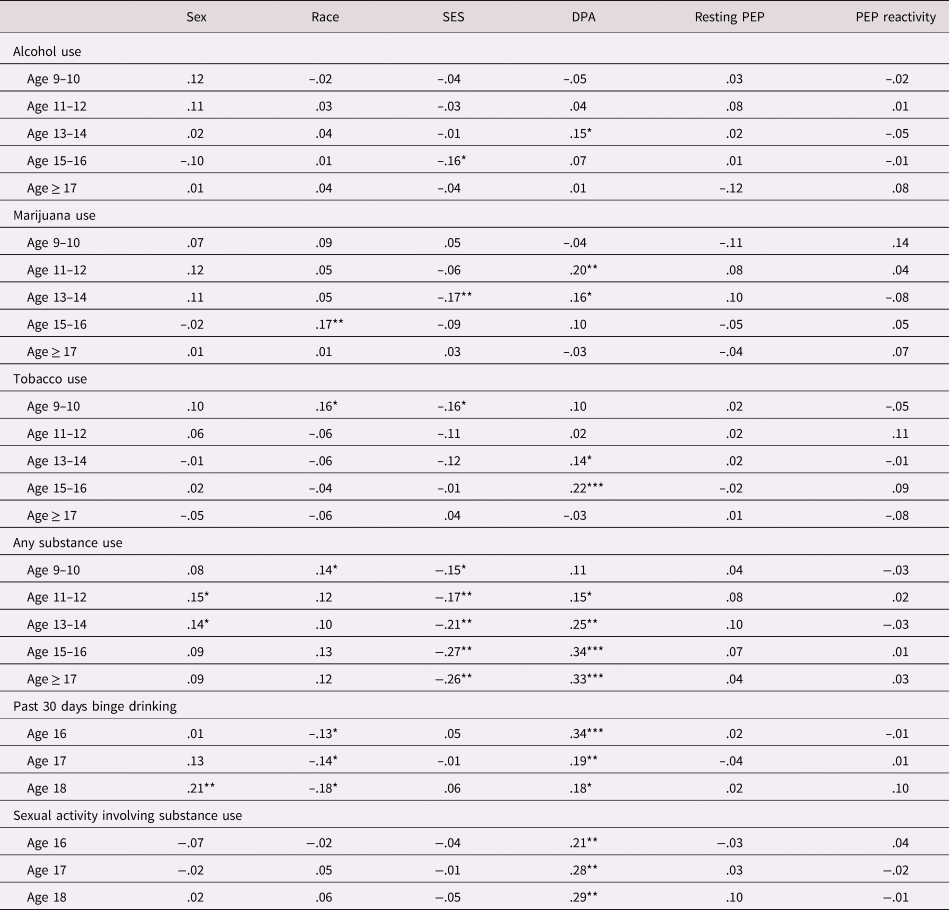
Descriptive statistics and correlations are provided in Tables 1–3. Repeated measures of dichotomous substance use outcomes were missing for between 0 and 18% of adolescents, missing rates that are acceptable for accurately estimating model parameters (Dong & Peng, Reference Dong and Peng2013). Chi-square tests showed that use of one substance was associated with use of other substances, regardless of time point of measurement. Missing data analysis revealed some evidence for patterns of missingness (i.e., data missing at random) related to family SES, and its inclusion as a covariate in predictive models helps to account for this systematic missingness.
Descriptive statistics and sex differences in continuous covariate, main predictor, and moderating variables

Note. All variables were collected or measured at age 16. Socioeconomic status is represented by income-to-needs ratio.PEP = preejection period.
* p < .05. **p ≤ .01.
Frequencies and sex differences in outcomes

Note. *p < .05. **p ≤ .01.
Correlations of covariates, main predictor, and moderating variables with outcome variables

Note. All variables collected or measured at age 16. Sex: 0 = girl, 1 = boy. Race: 0 = White, 1 = Black. SES = socioeconomic status, represented as income-to-needs ratio. DPA = deviant peer affiliation. PEP = pre-ejection period. SCL = skin conductance level.
* p < .05. **p < .01. ***p < .001.
Alcohol use onset
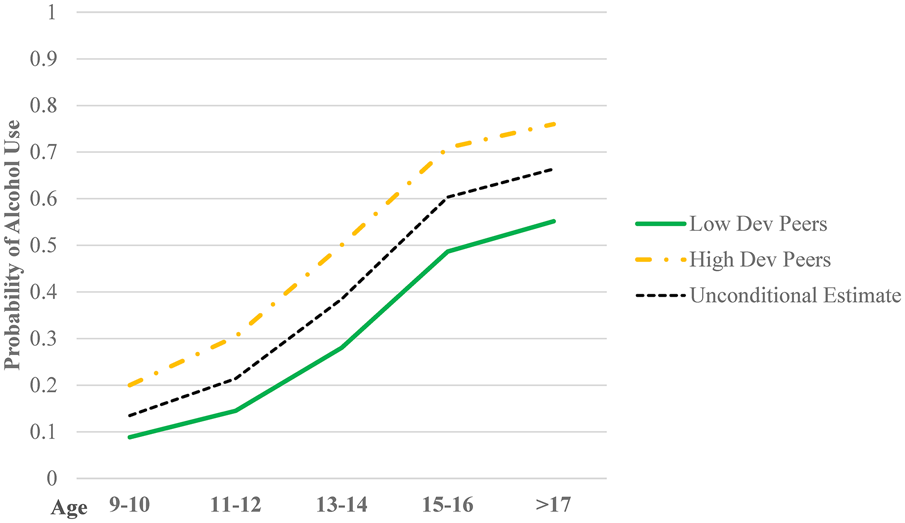
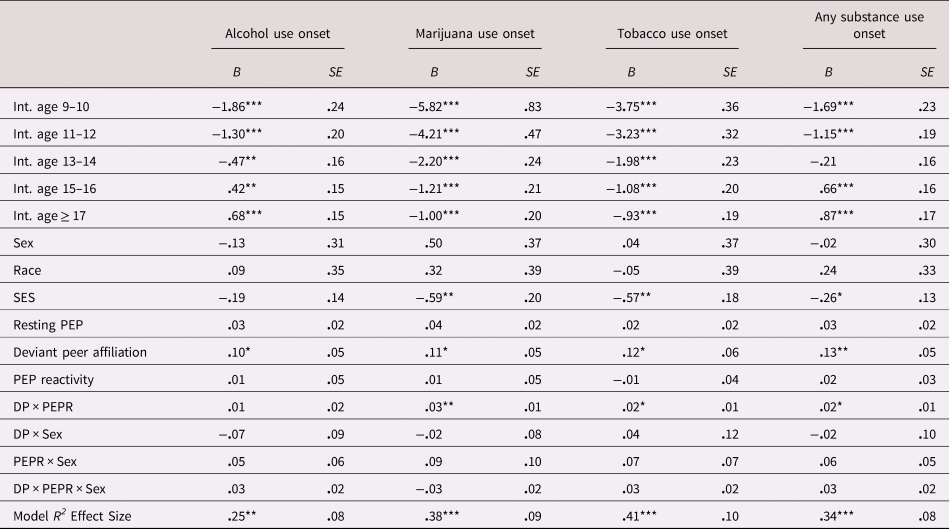
Deviant peer affiliation was positively related to risk for alcohol use (Table 4). Contrary to hypotheses, PEP reactivity and sex did not moderate this association. Figure 1 shows that deviant peer affiliation is positively related to probability of alcohol use over time.
Probability curves for alcohol use conditional on deviant peer affiliation.

Survival analysis of onset of alcohol use, marijuana use, tobacco use, and any substance use: preejection period (PEP) reactivity and sex as moderators

Note. Int. = Intercept, log odds of use. B = unstandardized estimate. SE = standard error. SES =socioeconomic status. Sex: 0 = girl, 1 = boy. Race: 0 = White,1 = Black. SES represented as income-to-needs ratio. DP = deviant peer affiliation. PEPR = PEP reactivity.
* p < .05. **p < .01. ***p < .001.
Marijuana use onset
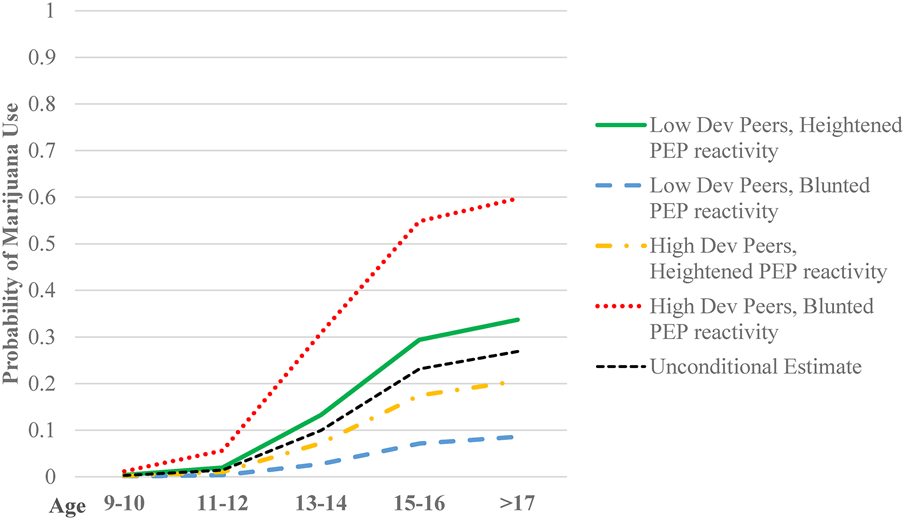
Marijuana use results are found in Table 4. Race and sex were unrelated to marijuana use, but family SES was negatively related to probability of marijuana use. Deviant peer affiliation was positively related to probability of marijuana use. PEP reactivity was unrelated to marijuana use. The deviant peer–marijuana use association was moderated by PEP reactivity, depicted in Figure 2. Adolescents with high levels of deviant peer affiliation and blunted PEP reactivity evidenced the highest probability of marijuana use over time.
Probability curves for marijuana use conditional on deviant peer affiliation and preejection period (PEP) reactivity.

Tobacco use onset
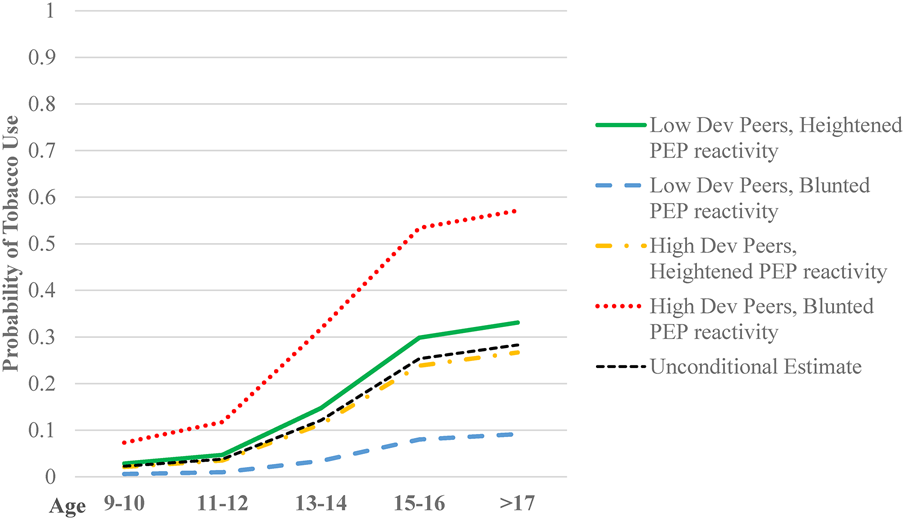
Results from this model are shown in Table 4. As with marijuana use, SES was negatively related to tobacco use and race was unrelated to tobacco use. Sex was unrelated to tobacco use but deviant peer affiliation was positively related to use of tobacco. PEP reactivity was not directly associated with tobacco use. Similar to models with binge drinking and marijuana use as outcomes, PEP reactivity moderated the relationship between deviant peer affiliation and tobacco use (Figure 3). Adolescents with high deviant peer affiliation and blunted PEP reactivity had the highest probability of tobacco use.
Probability curves for tobacco use conditional on deviant peer affiliation and preejection period (PEP) reactivity.

Any substance use onset
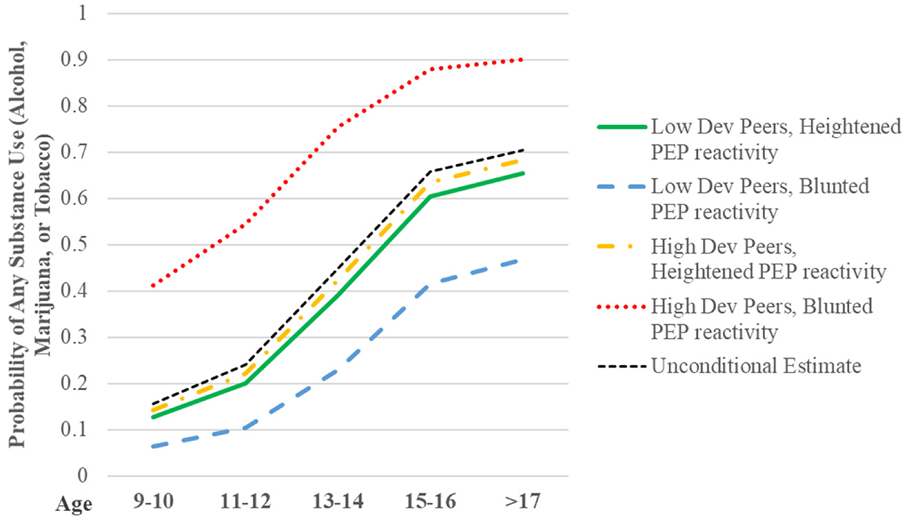
Any substance use (i.e., use of alcohol, marijuana, or tobacco) was negatively associated with SES and positively associated with deviant peer affiliation. As with the prior models, the interaction between deviant peer affiliation and PEP reactivity predicted any substance use (Table 4), with the highest probability of any substance use over time found for adolescents with high deviant peer affiliation and blunted PEP reactivity (Figure 4).
Probability curves for any substance use conditional on deviant peer affiliation and preejection period (PEP) reactivity.

Past 30 days binge drinking
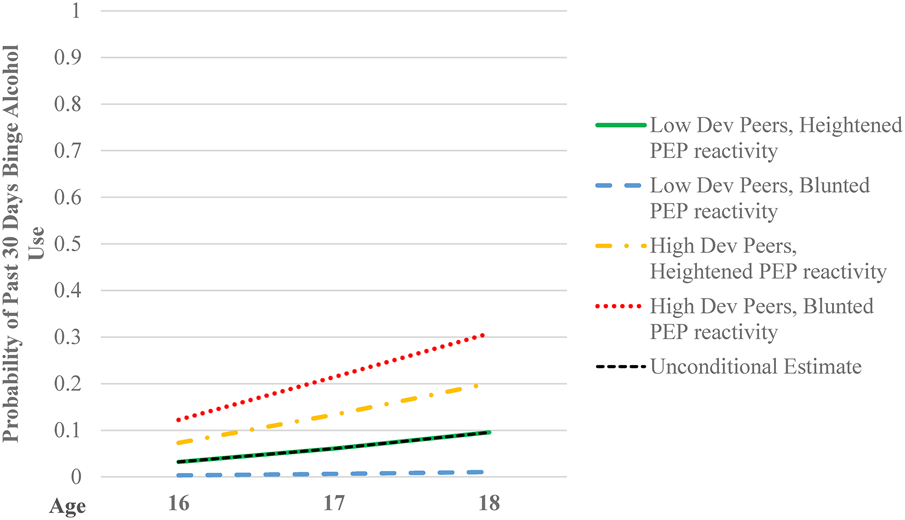
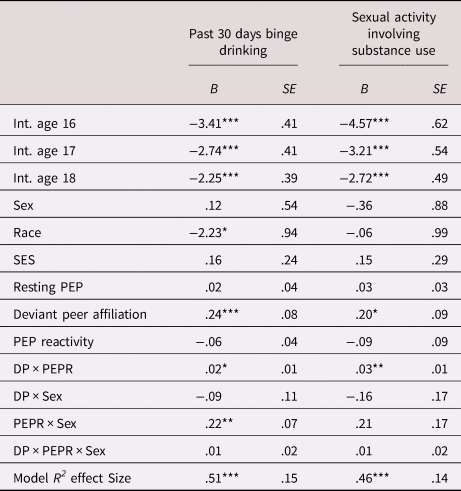
Results from the model predicting binge drinking in the past 30 days are presented in Table 5. White adolescents were more likely to engage in binge drinking than were Black adolescents, while sex and family SES were unrelated to binge drinking. Deviant peer affiliation was positively and robustly associated with binge drinking. PEP reactivity was not directly related to binge drinking. However, PEP reactivity was found to moderate the association between deviant peer affiliation and binge drinking. Figure 5 depicts this conditional association where probability of binge drinking increased over time the most for adolescents with high deviant peer affiliation and blunted PEP reactivity. A second interaction indicated that the relationship between sex and binge drinking was moderated by PEP reactivity. Probability of binge drinking increased more for girls with heightened PEP reactivity and for boys with blunted PEP reactivity. This interaction was not replicated for any other outcome and so was not included as a figure.
Probability curves for past 30 days binge drinking conditional on deviant peer affiliation and preejection period (PEP) reactivity.

Survival analysis of past 30 days binge drinking and sexual activity involving substance use: PEP reactivity and sex as moderators

Note. Int. = Intercept, log odds of use. B = unstandardized estimate. SE = standard error. SES =socioeconomic status. Sex: 0 = girl, 1 = boy. Race: 0 = White, 1 = Black. SES represented as income-to-needs ratio. PEP = preejection period. DP = deviant peer affiliation. PEPR = PEP reactivity.
* p < .05. **p < .01. ***p < .001.
Sexual activity involving substance use
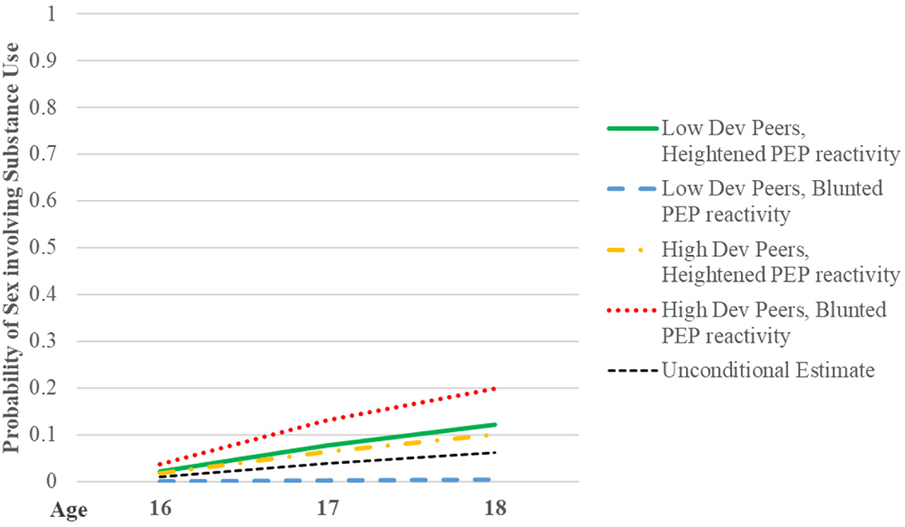
As shown in Table 5, deviant peer affiliation was positively associated with sexual activity involving substance use, but this relationship was moderated by PEP reactivity. Depicted in Figure 6, adolescents with high deviant peer affiliation and blunted PEP reactivity were increasingly likely to have engaged in sexual activity involving substance use, relative to adolescents with other combinations of these variables.
Probability curves for sexual activity involving substance use conditional on deviant peer affiliation and preejection period (PEP) reactivity.

Summary
A largely consistent patterns of results emerged from the analyses. With the exception of alcohol use onset, the deviant peer affiliation–substance use association was moderated by PEP reactivity, but not sex, and indicated increasing probabilities of most types of substance use, binge drinking, and sexual activity involving substance use for adolescents with high deviant peer affiliation and blunted PEP reactivity.
Discussion
While deviant peer affiliation is a robust predictor of adolescent substance use, and this association was replicated in the current study, there is significant heterogeneity in this relationship. In other words, the strength of the deviant peer–substance use association varies between individuals and may depend upon inter- and intra-individual influences. Our main goal was to elucidate the roles of sex and SNS reactivity as moderators of the link between deviant peer affiliation and adolescent substance use. Our primary hypothesis was that sex and sympathetic nervous reactivity as measured by PEP reactivity would moderate the association between deviant peer affiliation and substance use or sexual activity involving substance use. Specifically, based on prior literature, we posited that the strongest links between these variables would be found for boys with blunted PEP reactivity.
We used deviant peer affiliation, PEP reactivity, sex, and their interactions to predict dichotomous repeated measures of substance use with discrete time survival analyses. Significant associations were translated from logistic regression coefficients to plot probability curves of substance use over time. A main takeaway point from the results is that, with the exception of alcohol use, probabilities of engaging in substance use, binge drinking, and sexual activity involving substance use over time evidenced a consistent pattern as a function of the predictors. In other words, the statistical effects of deviant peer affiliation, PEP reactivity, sex, and the interactions among them did not distinguish among types of substance use. Rather, the pattern of results indicates a stronger positive association between deviant peer affiliation and substance use that could be interpreted as conditional risk for substance use broadly.
The overall pattern of results indicated that blunted PEP reactivity strengthened the association between deviant peer affiliation and all substance use outcome variables with the exception of alcohol use. However, the role of PEP reactivity as a moderator in the deviant peer affiliation–substance use relationship did not vary by sex, and thus this exploratory hypothesis was not supported. The “bird's eye view” of these results suggests that PEP reactivity is useful in explaining heterogeneity in the link between deviant peer affiliation and onset of substance use. The finding that blunted PEP reactivity strengthens associations between deviant peer affiliation and substance use resonates with related findings from other studies (Beauchaine et al., Reference Beauchaine, Gatzke-Kopp and Mead2007; Brenner & Beauchaine, Reference Brenner and Beauchaine2011; Hinnant, Erath, et al., Reference Hinnant, Erath, Tu and El-Sheikh2016; Hinnant, Forman-Alberti, et al., Reference Hinnant, Forman-Alberti, Freedman, Byrnes and Degnan2016). Overall, these findings highlight the importance of the intersection of context with biology.
Limitations
We speculate that deviant peer affiliation invites substance use and related risky behaviors among adolescents who exhibit psychophysiological characteristics tied to stronger approach motivation as reflected by blunted PEP reactivity. It has been proposed that blunted PEP reactivity is indicative of biological under-arousal to reward, which results in a compensatory increase in approach toward and tolerance for risk in contexts that involve rewards (e.g., sensation seeking behaviors; Beauchaine, Reference Beauchaine2001; Zisner & Beauchaine, Reference Zisner, Beauchaine and Cicchetti2016). However, an important limitation to this study is the disconnect between its theory and measurement. Reinforcement sensitivity theory (Gray, Reference Gray1982; McNaughton & Gray, Reference McNaughton and Gray2000; Pickering & Corr, Reference Pickering, Corr, Boyle, Matthews and Saklofske2008) posits that individuals are differentially sensitive to reward (or punishment) and their respective cues, and these individual differences are manifested at multiple levels of analysis (e.g., central and autonomic nervous system activity, behavior, personality). For example, indices of approach behavior have been related to substance use in adolescence (Colder et al., Reference Colder, Hawk, Lengua, Wiezcorek, Eiden and Read2013; Creemers et al., Reference Creemers, Dijkstra, Vollebergh, Ormel, Verhulst and Huizink2010; Genovese & Wallace, Reference Genovese and Wallace2007; Willem, Bijttebier, & Claes, Reference Willem, Bijttebier and Claes2010). PEP reactivity has been proposed as a biomarker of approach motivation (see Beauchaine, Reference Beauchaine2001) and has been functionally related to reward sensitivity and approach behavior (Brenner, Beauchaine, & Sylvers, Reference Brenner, Beauchaine and Sylvers2005; Richter & Gendolla, Reference Richter and Gendolla2009). However, the construct validity of PEP reactivity as a marker of the behavioral approach system is more tenuous when the measurement context does not map onto the theoretical construct (Zisner & Beauchaine, Reference Zisner, Beauchaine and Cicchetti2016). In this study, PEP reactivity was measured during a star-tracing challenge, a stress task that is widely used and reliably elicits SNS reactivity. Although the task may indirectly elicit approach motivation (e.g., desire to succeed), measurement of PEP reactivity during tasks that specifically involve incentives motivating approach behavior would strengthen claims that this physiological measure reflects function of the behavioral approach system. SNS-derived outputs such as PEP can be altered in response to a variety of conditions that do not necessarily activate the behavioral approach system, and it is important to consider the possibility that SNS reactivity elicited by our measure is unrelated or only peripherally related to the construct of approach motivation. In other words, while our results are consistent across outcomes and show fairly large effect sizes, we must consider the theoretical interpretation of the results cautiously and somewhat speculatively.
Second, our sample is representative of the community and region from which it was drawn, and thus may not generalize to more at-risk or clinical samples. Consistent with this, although use of alcohol, marijuana, and tobacco were variable enough in the sample for analysis, these data were highly skewed (and subsequently dichotomized), and there were too few adolescents reporting use of other drugs for analysis. Third, this study is longitudinal but correlational, and we are thus unable to make conclusions about cause–effect relationships. Thus, it is important to make the clear distinction between statistical associations and causal effects; while our results provide the former, the study design does not allow us to make any statements about the latter. This limitation is illustrated by the analytic design wherein the key predictor variables are drawn from age 16 data but are used to predict later as well as earlier substance use (a clear violation of the principle of temporal precedence needed to establish a cause–effect relationship). Related to this limitation, binge drinking and sexual activity involving substance use, which we viewed as important health risk variables to include, were only measured prospectively for three time points. On a similar note, while we had repeated measures data for all variables, our aim was not to contrast socialization (i.e., deviant peers promoting substance use) versus selection effects (substance using adolescents seeking out deviant peers), but rather to more specifically address conditional putative socialization effects from deviant peer affiliation. It is entirely possible that there are bi-directional influences of both socialization and selection. Finally, a drawback to measurement of binge drinking in the past 30 days is that it is likely underrepresenting adolescents’ true binge drinking behavior, which tends to be more variable than that of adults (Tucker, Orlando, & Ellickson, Reference Tucker, Orlando and Ellickson2003).
Future directions
For at least a decade, researchers have been making the argument for greater integration of biological measures at multiple levels into clinical and prevention science in psychology and related disciplines (Cicchetti & Gunnar, Reference Cicchetti and Gunnar2008). The current study adds to this literature by suggesting that the link between deviant peer affiliation and adolescent substance use is to some degree conditional on PEP reactivity. Other future work in this area could improve upon the face, predictive, and concurrent validity of tasks used when measuring autonomic reactivity; the task ideally would be reflective of the outcomes of interest (Zisner & Beauchaine, Reference Zisner, Beauchaine and Cicchetti2016). In addition, the transactional nature of environment–person–outcome associations are still relatively poorly understood in most cases. Research on how deviant peer affiliation and substance use experiences predict change in these biomarkers would be illuminating. Limitations notwithstanding, this study provides unique insights into the conditional associations between deviant peer affiliation and onset of substance use and will hopefully spur additional research on this topic.
Acknowledgments
The content is solely the responsibility of the authors and does not necessarily represent the official views of the National Institutes of Health. We wish to thank the staff of our Research Laboratory, most notably Bridget Wingo, for data collection and preparation, and the school personnel, children, and parents who participated.
Funding Statement
This research was supported by Grant R01-HD046795 from the Eunice Kennedy Shriver National Institute of Child Health and Human Development awarded to Mona El-Sheikh.
Conflicts of Interest
None