Introduction
In the 1960s, the demand for illegal drugs both in Puerto Rico and in the USA – to where most of these drugs arriving on the island were ultimately exported – increased significantly.Footnote 1 As a result of this increase in demand, the illegal drug trade became a much more lucrative enterprise and began to expand rapidly. As in other countries, the expansion and gradual consolidation of the drug trade in Puerto Rico involved the formation of various drug-trafficking organizations.Footnote 2 These criminal organizations have operated in particular from within Puerto Rico’s poor barrios and housing projects. The residents of these marginalized communities have not benefited much from the national economy, and this is certainly an important part of the reason why drug-trafficking organizations have been able to establish a strong presence there.Footnote 3 There is no doubt that the drug trade has served as a means for some residents of these neighbourhoods to improve their financial conditions, sometimes exponentially. Nevertheless, the trade-off for such economic progress has been disastrous overall for these communities. As a result of the drug trade, gun violence, drug addiction and incarceration rates among the residents of Puerto Rico’s poor barrios and housing projects have increased drastically;Footnote 4 for example, in 1997 it was estimated that around 70% of all homicides in Puerto Rico were drug-related.Footnote 5 Most of these victims were young male adults from Puerto Rico’s most disadvantaged communities, a situation that remains the same today. Several scholars have already studied these issues. What has not received sufficient attention, however, is the particular type of narcoculture that began to take shape within the poor barrios and housing projects concerned. This culture of drug trafficking manifests itself in numerous ways, and is by no means limited to these communities, as we shall see. In this study, I focus on the expressions of Puerto Rican narcoculture that can be discerned in reggaeton music.
Reggaeton is a popular-music genre that began to develop in Puerto Rico’s poor urban barrios and housing projects in the early 1990s.Footnote 6 During its formative stages, reggaeton was particularly influenced by Jamaican dance hall, Panamanian reggae en español and US hip hop. Throughout the 1990s, reggaeton artists gradually increased their fan base in Puerto Rico, as well as across Latin America and within the Latino population in the USA. The genre’s big commercial breakthrough occurred, however, in the early 2000s, when three recordings in particular played a pivotal role. First, Tego Calderón’s El Abayarde (2003) helped to bring reggaeton music into the mainstream in Puerto Rico,Footnote 7 while concomitantly making the genre more popular abroad. One year later, the New York rapper N.O.R.E. released the song ‘Oye mi canto’ (2004), in which he collaborated with – among others – the Puerto Rican reggaeton artist Daddy Yankee.Footnote 8 This song became a huge success in the USA, reaching the thirteenth position in the Billboard Hot 100 chart in November 2004.Footnote 9 The fact that ‘Oye mi canto’ contains both Spanish and English lyrics certainly contributed to its popularity among non-Spanish-speaking audiences. Around the same time that this song was popularizing reggaeton among a broader non-Spanish-speaking audience, Daddy Yankee released the album Barrio fino (2004). The remarkable commercial success of this album, which included the highly successful song ‘Gasolina’, helped to solidify reggaeton’s position as an important player within the international music market.
Ever since this breakthrough in the early 2000s, reggaeton artists have continued to enjoy high levels of success, particularly in Spanish-speaking countries. More recently, however, interest in the genre beyond its core Spanish-speaking fan base has been propelled by the tremendous success of the song ‘Despacito’, originally recorded by Luis Fonsi and Daddy Yankee, and featuring Justin Bieber in the remix (2017). Like ‘Oye mi canto’ and ‘Gasolina’ in the early 2000s, but to an even greater extent, ‘Despacito’ became a worldwide sensation. The song even reached the Number 1 position in the Billboard Hot 100 chart, a feat not achieved by a song sung in Spanish since 1996,Footnote 10 and ended up breaking seven Guinness records, among them that for the first YouTube video to reach five billion views.Footnote 11
Around the time that ‘Despacito’ became a worldwide sensation, new talents mainly from Puerto Rico began to gain more recognition in the music industry. Among them were Anuel AA, Jhay Cortez, Myke Towers, Ozuna and Bad Bunny. This new generation of reggaetoneros or traperos – in tandem with already well-established artists such as Farruko and the Colombian J Balvin – has also contributed significantly to the recent popularity of the genre beyond its core Spanish-speaking fan base. Particularly important in this regard has been Bad Bunny, whose album YHLQMDLG (Yo hago lo que me da la gana) reached the Number 2 position in the Billboard 200 album chart in March 2020. With this album, ‘Bad Bunny achieve[d] the highest-charting all-Spanish-language album ever on the all-genre chart.’Footnote 12 On the basis of this recent development, one can say that reggaeton music currently finds itself at an important historical juncture.
The links between reggaeton music and Puerto Rican narcoculture have been a topic of debate throughout the genre’s history, even though the term ‘narcoculture’ has not commonly been used explicitly. For instance, in the early 1990s, when reggaeton music was still called ‘underground’,Footnote 13 the genre was heavily criticized for – among other things – its violent and drug-related content.Footnote 14 The outcry against ‘underground’ music encouraged the Puerto Rican government in 1995 to prohibit it.Footnote 15 That, of course, proved to be unconstitutional. Nevertheless, the debate over reggaeton’s narco-messages and narco-representations has persisted until the present.
For the most part, arguments in this debate have tended to oscillate between two extreme poles. On the one hand, the critics argue that reggaeton’s explicit content represents a danger to society and morality. They contend that the messages disseminated through the genre promote – among other things – drug use, as well as criminal and violent behaviour. Reggaeton’s defenders, on the other hand, tend to dismiss the assumption that a musical expression like reggaeton could have any actual effect on an individual’s behaviour. Poverty, unemployment, disenfranchisement and other kinds of socio-economic problems are, in their view, the catalysts for drug abuse as well as criminal and violent behaviour. Reggaeton artists – so they say – are simply ‘telling it like it is’. That is, they are portraying the hard realities of life in Puerto Rican poor barrios and housing projects. The same types of argument can be found among reggaeton scholars: in particular, the notion that reggaeton is simply illustrating the hardships of life in Puerto Rico’s marginalized communities is commonly accepted, as we shall see; similarly, the potential negative effects of reggaeton’s narco-messages and narco-representations have been for the most part dismissed or heavily downplayed.
The discussion concerning reggaeton’s narco-messages and narco-representations – both in academia and in public discourse – has not relied for the most part on empirical evidence on either side. More than anything, positions have been established on the basis of political ideologies and alliances, and this has had the unfortunate effect of overly politicizing the issue. One of the main objectives of this article is to attempt to go beyond this politically biased debate and to explore the topic in a more impartial and critical manner. Specifically, I evaluate whether and to what extent reggaeton’s narco-messages and narco-representations – when they converge with other variables – could potentially influence an individual’s modes of thinking and behaviour. This study does not aim to provide a definitive answer to this issue; more than anything, it strives to analyse, on the basis of the available research, the extent to which the claim that such influence may occur has scientific merit. This is an important question, as the topic has been for the most part ignored by reggaeton scholars and remains understudied. The analysis will rely particularly on research in social psychology concerning violent media content and in the areas of persuasion studies and prejudice studies. However, I shall also consider literature from other fields, including criminology.
Narcoculture and reggaeton music
The study of narcoculture has been gaining impetus since the early twenty-first century. Some scholars, however, had already begun to analyse the phenomenon as early as the 1990s.Footnote 16 Central and South American researchers have conducted many of these investigations, so a significant part of the available literature has been published in Spanish. Studies of narcoculture have concentrated particularly on its manifestations in Colombia and Mexico, reflecting the strong presence of powerful drug-trafficking organizations in these two countries over the last 50 years. Nonetheless, narcoculture has also been investigated in countries such as Brazil and Chile.Footnote 17
Concerning Puerto Rico, the literature available is very limited. Among the few publications on the subject are the articles by Iván Chaar López published in the online magazine 80 grados. Footnote 18 More recently, Luis Javier Cintrón-Gutiérrez published an essay on this topic in the book Caribbean without Borders (see above, note 3), and Rafael Ponce-Cordero published a study concerning the relationship between reggaeton and narcoculture in the journal Mitologías hoy in which he analyses the manifestation of narcoculture and social banditry in the Puerto Rican film Talento de barrio. Footnote 19 The film tells the story of a Puerto Rican drug dealer who decides to abandon his illicit business and to concentrate fully on his career as a reggaeton artist. Daddy Yankee – co-producer of the film – stars, and several other reggaeton artists also have minor roles in the film. Besides Ponce-Cordero’s article, there are a few studies which discuss certain topics related to the presence of narcoculture in reggaeton music without, however, using the term ‘narcoculture’ explicitly.Footnote 20 This has so far prevented an adequate analysis of certain aspects pertaining to the presence of Puerto Rican narcoculture in reggaeton music – a lacuna which this article aims to fill.
I define narcoculture here as a type of (sub)culture developed primarily in areas with a strong and extended presence of drug-trafficking organizations.Footnote 21 Its symbols, values, beliefs, modes of thinking and behaviour, as well as its artistic expressions and aesthetics, tend to regulate and legitimize the lifestyle of people involved in the drug trade.Footnote 22 It should be noted that, despite some shared characteristics, each country (and sometimes each region) displays its own particular kind of narcoculture, reflecting the fact that the development of narcoculture is always informed by broader cultural values and practices already present in the location concerned. And one does not need to be directly involved in drug trafficking in order to display modes of thinking and behaviour linked to narcoculture.Footnote 23 For instance, a mural honouring the memory of a drug lord already constitutes a manifestation of narcoculture,Footnote 24 for such artistic expressions tend to legitimize the illegal activities committed by these individuals by projecting them as venerable personalities. The same can be said when residents of a community recognize narcotraffickers as community leaders and authority figures.Footnote 25
Certainly, these types of behaviour and modes of thinking are ultimately threatening to social stability, but it would be too simplistic to criticize them without taking into consideration the multiple and complex reasons that allow narcotraffickers to become leaders within the communities in which they operate, which in many cases result from the incapacity of the state to provide a stable and safe environment in these communities.Footnote 26 We must thus be careful not to stigmatize the people that have been influenced by, or rather socialized through, narcoculture because of their close proximity to the world of drug-trafficking organizations,Footnote 27 since it is they who suffer more directly the consequences of the high levels of violence that tend to accompany the drug trade. Many of the behaviours and modes of thinking adopted by residents of marginalized communities constitute survival and defence mechanisms which permit them to confront the difficult environment in which they live.Footnote 28 Concomitantly, it is to a significant extent the frustration at the lack of social and economic mobility that has driven many individuals to criminality.Footnote 29 In this sense, even though criminal activities such as drug trafficking ultimately need to be rejected owing to their potential threats to social stability, the socio-economic strains that promote such types of behaviour in the first place must also be considered before an understanding of such complex phenomena as the drug trade and the culture that has evolved around it can be reached.
These considerations should not lead us, however, to the mistaken view shared by some scholars who believe that by labelling certain types of behaviour and modes of thinking as narcoculture we are stigmatizing the residents of marginalized communities. This line of thinking seems to imply that the phenomenon of narcoculture should not be investigated at all, which in fact amounts to a sort of scholarly censorship. If we accept that argument as valid, we could similarly claim that feminist scholars stigmatize some men by categorizing certain types of behaviour and modes of thinking as sexist. Or we could claim that scholars investigating the phenomenon of racism stigmatize some individuals by labelling certain practices as racists. Should this kind of research be stopped, in order to avoid upsetting anyone that may misconstrue its intentions? How can conditions in our society – particularly within the most disadvantaged sectors – be improved if we are not capable of engaging with such an important topic as narcoculture in a critical manner? Surely censorship is not the way to solve this issue. Care is definitely needed when the topic of narcoculture is addressed in order to avoid promoting discriminatory attitudes against disadvantaged communities. But the same academic rigour should be applied to this topic as to any other scholarly endeavour.
As already mentioned, the links between reggaeton and Puerto Rican narcoculture have not yet been thoroughly explored. For the most part, scholars have considered the genre to be an artistic expression that simply tends to reflect the hardships of life in Puerto Rican marginalized communities.Footnote 30 Zaire Zenit Dinzey-Flores states, for example: ‘The social and economic inequalities experienced by reggaetoneros are rearticulated in lyrics that highlight the plight of people who are poor, stigmatized, and vulnerable to violence.’Footnote 31 Similarly, Marisol Lebrón writes that rap and reggaeton music provide a glimpse of the ‘realities and aspirations of low-income Puerto Rican youths, who are largely shut out of mainstream public discourse’.Footnote 32 There are certainly several reggaeton songs, such as Eddie Dee’s ‘Señor official’ (1997) and Wisin’s ‘Riendo para no llorar’ (2004), that fit this description of reggaeton music. Nonetheless, proportionally speaking, this kind of song constitutes a minority within the genre, as can easily be demonstrated by the subgenre within reggaeton known as maleanteo. Maleanteo songs tend for the most part to idealize gun violence and the world of drug trafficking, and are thus strongly linked to Puerto Rican narcoculture. Songs like ‘Señor official’ and ‘Riendo para no llorar’, however, engage more critically with the socio-economic problems affecting marginalized communities.
One of the main problems with current scholarly analysis is that it tends not to differentiate sufficiently between the plurality of messages and representations disseminated through reggaeton music. The reality is that reggaeton’s representations of the socio-economic problems affecting marginalized communities tend to oscillate between two poles. On the one hand, there are songs such as ‘Señor official’ and ‘Riendo para no llorar’ that engage critically with the subject;Footnote 33 on the other, maleanteo songs such as ‘Jala gatillo’ (Las Guanábanas Podrías, 1992), ‘Bienvenidos a mi mundo’ (Nova y Jory, Cosculluela and Syko, 2009) and ‘Armao 100pre andamos’ (Anuel AA, 2016) for the most part simply glorify the world of drug-trafficking organizations and their underlying values. Other songs – including the case study I discuss below – could be placed at some point between these two extreme poles, depending on how pronounced their links to narcoculture (if indeed there are any) are. In this article, I study mainly those songs and music videos that lean towards the narcoculture pole: that is, I examine reggaeton songs and music videos that tend – to differing degrees – to legitimize gun violence and the illegal drug trade. Such types of song include, but are certainly not limited to, maleanteo songs.
In the following section I analyse the music video of the remix of ‘Somos de calle’.Footnote 34 My aim is to illustrate how Puerto Rican narcoculture manifests itself in this music video. The reasons for choosing the ‘Somos de calle’ remix as the case study are twofold. First, I selected it because several highly influential reggaeton singers (including Daddy Yankee, Arcángel and Cosculluela) are featured in the video. This is significant, for it illustrates that the influence of narcoculture in the genre is no secondary phenomenon, but constitutes rather an integral part of the mainstream of reggaeton. Secondly, I had the opportunity several years ago to interview the director of the music video, Carlos Martín. The additional information gathered from this interview has allowed me to conduct a more thorough analysis of the video.
Even though the ‘Somos de calle’ remix was released in 2008, it can still serve as a representative of more contemporary reggaeton songs. As mentioned above, the presence of narcoculture in reggaeton music has been a constant feature throughout the genre’s history, from early ‘underground’ hits such as ‘Jala gatillo’ to more recent releases such as ‘Por si roncan’ (Almighty and Ñengo Flow, 2015), ‘Armao 100pre andamos’ and ‘Subimos de rango’ (Bad Bunny, Omy de Oro and Shootter Ledo, 2019). Throughout the genre’s history, the same basic elements have been employed to invoke narcoculture, most of which is discussed in the analysis below.Footnote 35
Analysis of the music video of the ‘Somos de calle’ remix
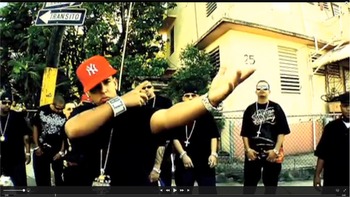
One of the most important elements pertaining to narcoculture featured in the music video of the ‘Somos de calle’ remix is the presence of weapons. Guns are explicitly displayed only in the scene in which Julio Voltio, portrayed in the role of a contract killer or gatillero, chases down a man with what appears to be an AR-15 rifle (2' 22"– 2' 53"), and this scene will be discussed in more detail below. In other scenes (0' 35"–0' 37"; 0' 48"–0' 50"; 1' 10"–1' 12") some of the singers simulate having a gun in their hands and pulling the trigger (see Figure 1). There are also several aural references to guns in the music. For instance, when Chino Nyno sings, ‘We won’t stand being conned [listerías], if you’re a snitch [you get shot] in your mouth, if you eat like a pig [comelón] in your belly’,Footnote 36 we hear a gunshot within the music which clearly makes reference to the sung lyrics. Many other reggaeton songs linked to narcoculture, such as ‘Bienvenidos a mi mundo’, display the sound of gunshots as well as the loading of guns within the music, establishing in this way a sonic connection with the lyrics and visuals of their respective music videos.
Daddy Yankee simulating holding a gun in his hand. Note also the ostentatious jewellery or ‘bling bling’. Still from ‘Somos de calle’ (remix), <https://www.youtube.com/watch?v=oIyZg1ty9Og>, at 0' 49".

All these references to weapons are significant, for in narcoculture guns ‘are regarded as symbols of power, the person who carries a gun has the power to impose his or her will upon others’.Footnote 37 In general, narcoculture fosters values and ‘modes of behaviour characterized by an extreme “lust for power”’.Footnote 38 Guns are part of narcoculture’s symbolic world and thus help to objectify this exaggerated desire for power. Other important symbols are ostentatious jewelleryFootnote 39 and beautiful women.Footnote 40 The use of jewellery (or ‘bling bling’) constitutes a symbol of power, as it strives to demonstrate the monetary riches the narcotrafficker has achieved through the drug trade. Luxurious items therefore constitute objects with the help of which the narcotrafficker aims to acquire social distinction and legitimation in society. David Moreno Candil, César Jesús Burgos Dávila and Jairo Eli Valdez Batiz write with regard to this:
In relation to drug trafficking, clothing and the possession of luxurious items are elements of desirability, power and social distinction; also a form of legitimation. For Ovalle, ‘To have a watch of the best and most expensive brand, to be with the most attractive woman, to go to the most exclusive places, to own the most striking house, the most luxurious cars; these are all manifestations of the search for acceptance of these individuals.’ Consumption constitutes a symbolic battle in which the goal is to ‘give an impression’, to ‘win over’ and to ‘inspire respect or trust’. Hence, the dress code and the consumption are social practices through which the economic power of the world of drug trafficking reveals itself.Footnote 41
Women (or rather, an objectified version of them) form part of this symbolic world, as indicated above. Essentially, women are valued in narcoculture primarily as precious objects whose worth is intrinsically linked to their physical appearance. Consequently, the ‘possession’ of one or many beautiful women is tantamount to the possession of ostentatious jewellery.Footnote 42 Both function as symbols whose purpose is to highlight the wealth and power attained through drug trafficking.
In reggaeton music all these symbols of power have been adopted. Most of them are discernible in the music video of the ‘Somos de calle’ remix, with the exception of representations of beautiful women as precious objects. (Such representations of women, however, constitute a common feature of many other reggaeton music videos, as other studies have shown.Footnote 43 ) The adoption of narcoculture’s symbols of power in reggaeton music is not surprising. Most reggaeton singers tend to emulate the figure of the bichote or drug lord in their media image or public persona, and many artists have adopted pseudonyms such as the Big Boss (Daddy Yankee), Don Omar, Héctor El Father and Kendo Kaponi, all of which make reference to the figure of the drug lord.Footnote 44 Of course, when reggaeton artists adopt the image of the drug lord and his symbols of power, they reinterpret them in the process, for their intention is to illustrate monetary gains they have acquired legally by means of their artistic success within the music industry. This reinterpretation, however, does not undermine the legitimizing effect that this appropriation entails, since the connection to the figure of the drug lord is still significantly present.
The reinterpretation of the gun as a symbol of power in reggaeton music follows a dynamic that differs from the resignification of ostentatious jewellery and the ‘possession’ of beautiful women. As we have seen, jewellery and women tend to highlight the riches obtained through the drug trade or, in the case of reggaeton artists, through musical success. In contrast, guns are more directly connected, as we have also seen, to the capacity of imposing one’s will upon others. They thus allude to the mentality of (literally) eliminating anyone who ‘gets in our way’. Such a mindset clearly resembles the types of behaviour accepted within narcoculture’s code of ethics.Footnote 45 In reggaeton music, gun violence is often used figuratively by the singers when they want to assert their superiority over another ‘rival’ artist, who is usually depicted as having inferior singing skills. In other cases, however, the artists portray themselves as actual killers, emulating thereby the figure of the drug lord.
Occasionally, we find both types of use closely intertwined within one text. For example, in the ‘Somos de calle’ remix Arcángel sings: ‘You better take it easy, because if I catch you around my block you’re going to get shot. / You better take it easy, Arcángel, “the Wonder”, the protagonist of your failure.’Footnote 46 If we analyse only the first sentence of this statement, we could argue that it reflects the tendency among many reggaeton artists to portray themselves as ruthless people, following the drug lord archetype. However, if one considers the whole statement, it could be argued that Arcángel is using gun violence figuratively in order to affirm his superiority over an unspecified musical adversary. This is not the case, however, when De la Ghetto sings: ‘I am not an assassin, but I pull the trigger when it’s necessary.’Footnote 47 Here we can observe his clear intention of portraying himself as a person not to be ‘messed with’. Even when gun violence is used figuratively, narcoculture’s code of ethics continues to be clearly present and ultimately legitimized.
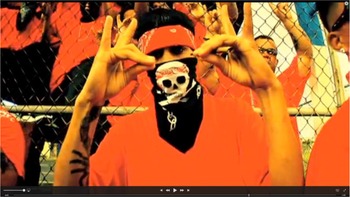
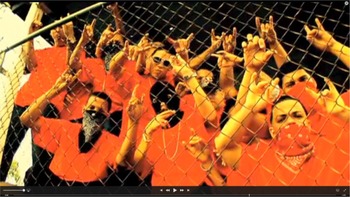
Closely related to the allusions to guns are references to the figure of the gatillero or contract killer, allusion to which is made directly in this music video when Voltio appears dressed in black with his face covered with a ski mask, chasing down a man through the barrio with the intention of murdering him. In other scenes, we discern more subtle references to the figure of the gatillero. Several sections of the video (for example, at 4' 37"–4' 57") portray in the background men covering their faces with handkerchiefs, alluding to the way in which assassins usually cover their faces when committing a murder. When Baby Rasta mentions in the video (at 4' 45"–4' 46") the Puerto Rican street gang Los Lobos,Footnote 48 some of them are depicted ‘throwing up’ the hand signs of that particular gang. Gangs, naturally, are another intrinsic part of narcoculture (see Figures 2–3), and many other reggaeton songs, such as Myke Towers’s ‘Ganga’ (2019), make reference to them.
Young male covering his face with a handkerchief with a skull motif and ‘throwing up’ gang signs. Detail of still from ‘Somos de calle’ (remix), <https://www.youtube.com/watch?v=oIyZg1ty9Og>, at 4' 45".

Young males ‘throwing up’ gang signs. Note also that they are all wearing the same colours, another reference to gang affiliation. Still from ‘Somos de calle’ (remix), <https://www.youtube.com/watch?v=oIyZg1ty9Og>, at 4' 45".

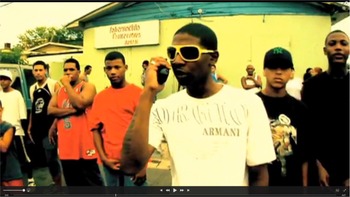
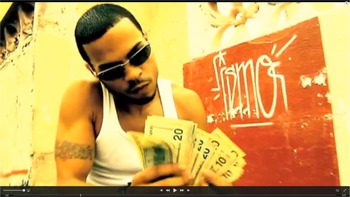
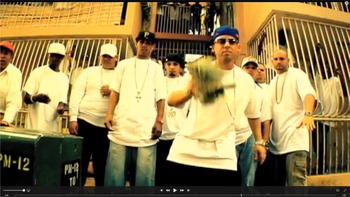
Drug trafficking is also depicted in subtle ways in the ‘Somos de calle’ remix. For example, there is a brief scene in which a man is using a walkie-talkie (2' 00"–2' 04"), a device commonly used by drug-trafficking organizations as a means of alerting to the presence of police or gang rivals on their turf (see Figure 4). Furthermore, in several scenes (1' 20"–1' 21"; 4' 35"–4' 37") we can see men – including some of the singers – holding stacks of dollars in their hands. Given the context in which the money is shown, the allusion is presumably to the money that can be made through drug trafficking (see Figures 5–6). On some occasions, however, it can be argued that the stack of dollars makes reference to the artistic success of the singer. As mentioned before, the media image of reggaeton artists tends to emulate – and hence to blend with – the figure of the drug lord. Reggaeton artists constantly play with this singer/drug lord duality through their media representations and song lyrics, just as they do with the drug lord’s symbols of power.
Man talking into a walkie-talkie, a device commonly used in drug trafficking. Still from ‘Somos de calle’ (remix), <https://www.youtube.com/watch?v=oIyZg1ty9Og>, at 2' 03".

Man counting money in a corner of a barrio. Given the context, the scene seems to allude to the money that can be made through drug trafficking. Still from ‘Somos de calle’ (remix), <https://www.youtube.com/watch?v=oIyZg1ty9Og>, at 1' 20".

Cosculluela throwing a big stack of dollars to the camera. Still from ‘Somos de calle’ (remix), <https://www.youtube.com/watch?v=oIyZg1ty9Og>, at 4' 36".

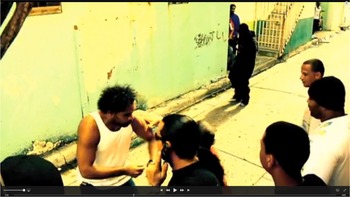
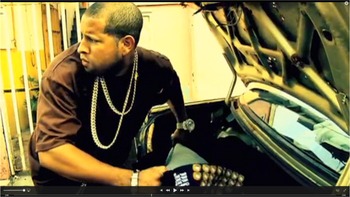
The scenes in which Voltio is depicted as a contract killer also make reference to drug dealing. The man whom he is trying to kill seems to be a drug dealer who at the moment at which he is caught is exchanging money with another man in a corner of the barrio (see Figure 7). Even though these scenes could certainly be interpreted as a warning against the dangers of the drug trade, more than anything they tend to validate the violent behaviour being displayed. We must bear in mind that the focus of attention in the scenes (however brief they are) lies not primarily in the victim being murdered but in the perpetrator (see Figure 8), and so they do not try to evoke disgust towards the violent act; more than anything, these scenes reinforce the typical media image assumed by most reggaeton artists – as tough and notorious individuals. The contract killer, whose character Voltio here depicts, is another important archetype within the world of drug trafficking.
Man being surprised by an assassin or gatillero (Julio Voltio) in a corner of the barrio. Still from ‘Somos de calle’ (remix), <https://www.youtube.com/watch?v=oIyZg1ty9Og>, at 2' 24".

Julio Voltio hiding the clothes he used during the murder scene (subtly) depicted in the music video. Still from ‘Somos de calle’ (remix), <https://www.youtube.com/watch?v=oIyZg1ty9Og>, at 2' 46".

Regardless of the multiple interpretations that can be given to this murder scene, it is noteworthy that many reggaeton songs and music videos depict criminal and utterly violent conduct from the perpetrator’s perspective. This is a common trait of representations linked to narcoculture.Footnote 49 The lyrics by Chino Nyno, Arcángel and De la Ghetto quoted above are clear examples of this. More recent instances can be found in ‘Armao 100pre andamos’ when Anuel AA states: ‘What do you think, should we fill his Tacoma with [bullet] holes? And if this motherfucker [cabrón] don’t die, he’s gonna be in a coma.’Footnote 50 Similarly, Almighty sings in ‘Por si roncan’: ‘I’m the cancer of the streets. The guns passed through, I know the bouncer. A wrong move and we’ll fill your Lancer with [bullet] holes.’Footnote 51
Particularly for this reason, the undifferentiated notion that reggaeton music merely portrays the socio-economic problems affecting poor barrios and housing projects in Puerto Rico remains open to question. This constant representation of crime and violence from the perpetrator’s perspective – who, as we can see, is usually the singer – promotes first and foremost identification with the perpetrator rather than the victim. By this means, such representations help first and foremost to legitimize narcoculture’s underlying values, modes of thinking and behaviour. Empathy with the victim is completely absent in this type of representation.
The potential effects of reggaeton’s narco-messages and narco-representations
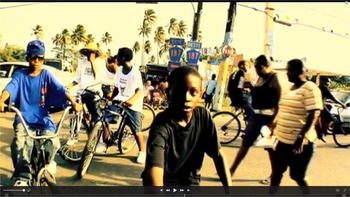
Some of the most salient elements relating to Puerto Rican narcoculture are thus discernible in the music video of the ‘Somos de calle’ remix. As mentioned before, similar types of narco-representations and narco-messages can be found in many other reggaeton songs and music videos. Narcoculture is by no means the only topic visually thematized in the ‘Somos de calle’ remix. The director strove to portray both the positive and the negative aspects of life in Puerto Rican poor barrios and housing projects.Footnote 52 For this reason, as well as those related to narcoculture, less prominent scenes are present in which daily life in these communities is depicted (see Figure 9).Footnote 53 Similar kinds of representations of daily life and Puerto Rican narcoculture can also be found in many other reggaeton music videos,Footnote 54 but overall the topic of narcoculture predominates in the visuals of the ‘Somos de calle’ remix. This is understandable, since the lyrics are also strongly linked to narcoculture, including, for example, verbal references to gun violence and gang affiliation.
Children riding their bicycles in Loíza, Puerto Rico. Still from ‘Somos de calle’ (remix), <https://www.youtube.com/watch?v=oIyZg1ty9Og>, at 3' 27".

In this section of the article, I shall examine the potential detrimental effects that the narco-messages and narco-representations disseminated through some reggaeton songs and music videos could have in society, particularly among reggaeton fans from marginalized communities. There have not been, to my knowledge, any previous empirical studies of this aspect. In the analysis I will therefore rely (mainly) on research in social psychology concerning violent media content, as well as in persuasion studies and prejudice studies. The literature on these subjects has demonstrated that media content is capable of actually influencing – for better or worse – our modes of thinking and behaviour. Hence, this research suggests by analogy that the narco-messages and narco-representations disseminated through genres such as reggaeton could potentially have an effect on the thought patterns and behaviour of at least some of its listeners and (in the case of music videos) viewers under certain conditions. These potential effects, however, would still need to be empirically demonstrated in further studies. Hence the discussion here is about potential, rather than proved, effects.
An important feature that makes reggaeton’s narco-messages and narco-representations potentially more likely to influence an individual’s thought patterns and behaviour is the genre’s codes of authenticity, including for instance the notion of street credibility, which the genre adopted from US hip hop. We should bear in mind that these codes of authenticity, which largely regulate the aesthetic parameters of reggaeton music, tend to foster the idea that reggaeton artists (just like hip-hop artists) are representing ‘the real thing’.Footnote 55 That is to say, there is a latent claim that reggaeton music portrays what life is really like in the poor barrios and housing projects in Puerto Rico, and that its singers are as notorious and dangerous as they tend to portray themselves as being through their media image. The common references to actual places in Puerto Rico in reggaeton lyrics and music videos help to reinforce this authenticity claim.
However, rather than depicting ‘the real thing’, reggaeton songs and music videos linked to narcoculture tend to reproduce the stereotypical notions concerning marginalized communities which are normally disseminated through other mass media outlets.Footnote 56 By this I mean that these songs and music videos tend to overemphasize and exaggerate the violence and criminal activity affecting Puerto Rican poor barrios and housing projects. In this way, they essentially reduce life in these communities to these particularities, as if violence and crime were the only distinguishing factors characterizing them. But these representations of life in such Puerto Rican communities help to reinforce negative attitudes already present within Puerto Rican society.
The underlying suggestion that these songs and music videos represent the ‘real thing’ could lead some reggaeton fans to perceive the genre’s dramatic (narco-)depictions of life in Puerto Rican poor barrios and housing projects, portraying the negative stereotypes associated with these communities, to be reliable representations of reality there. This is noteworthy, for studies have shown that, as L. Rowell Huesmann put it, ‘Those viewers who perceive the violence as telling about life more like it really is and who identify more with the perpetrator of the violence are also stimulated more toward violent behaviour in the long run.’Footnote 57 Accordingly, the real-life aura surrounding reggaeton’s narco-messages and narco-representations could potentially promote the idea that some reggaeton fans adopt – to different extents – the values and modes of thinking promoted through the music. In other words, reggaeton’s narco-messages and narco-representations may contribute to the gradual development of specific cognitive scripts strongly linked to narcoculture. Cognitive scripts are ‘blueprints for behaviour and guidelines for deciding’ how to act in a given situation,Footnote 58 and are shaped both by our own experiences in daily life and by media experiences.Footnote 59
As explained in Huesmann’s statement quoted above, the development of these cognitive scripts may be supported by the fact that in reggaeton songs and music videos the artists are usually portrayed as being responsible for committing the violent and/or criminal act. Artists are individuals with whom the listener or viewer is likely to identify. In other words, they tend to serve as role models for some of their fans, particularly younger ones. Anthony Pratkanis and Elliot Aronson write in this regard: ‘People learn from the behaviour of those they see and admire on television.’Footnote 60 Identification with the singer on the part of some reggaeton fans could therefore potentially make the narco-messages and narco-representations disseminated through the music more appealing, and hence more likely to influence thought patterns and behaviour.Footnote 61
The normative acceptance of violent and criminal behaviour constitutes another potential effect – closely related to that discussed above – that reggaeton’s narco-messages and narco-representations could have on some of its listeners or viewers. Studies have shown that, ‘The more people see aggression presented as a way of resolving conflicts of interests and expressing anger, the more they come to think of it as common and acceptable.’Footnote 62 By the same token, the more people are exposed to criminal and violent behaviour such as drug trafficking and gun violence, the more likely it is that they will come to accept (or at least tolerate) it as a legitimate form of conduct. In this sense, the systematic representation of utterly violent and criminal behaviour in reggaeton songs and music videos could potentially help to normalize (to differing degrees, depending on other variables) such conduct among some of its listeners/viewers. This means not only that some reggaeton fans could come to regard criminal and/or violent behaviour as a justifiable course of action for themselves, but also that they would be more prone to accept it when it is undertaken by others.Footnote 63 Moreno Candil, Burgos Dávila and Valdez Batiz argue similarly when they state that exposure to narcoculture ‘generates psychosocial proximity to the world of drug trafficking; that is, levels of sympathy, understanding, interaction, appropriation, and valorization of the phenomenon’.Footnote 64
The argument is not that the narco-messages and narco-representations disseminated through genres like reggaeton, narcocorridos or hip hop could by themselves alter an individual’s modes of thinking and/or behaviour.Footnote 65 As Huesmann states with regard to the effects of violent media content:
Violent or aggressive actions seldom result from a single cause; rather multiple factors converging over time contribute to such behaviour. Accordingly the influence of the violent mass media is best viewed as one of the many potential factors that influence the risk for violence and aggression. No reputable researcher is suggesting that media violence is the sole cause of violent behavior.Footnote 66
Accordingly, it would be unreasonable (and utterly simplistic) to suggest that merely listening to reggaeton – or any kind of music – could by itself lead somebody to tolerate, much less to commit a criminal and/or violent act. However, it seems to me misguided to take the other extreme and affirm that reggaeton’s narco-messages and narco-representations, with their systematic idealization of gun violence and the drug trade, have no effect on the individual, particularly on those highly exposed to them. The empirical evidence accumulated from studies on the effects of violent media content as well as from persuasion studies and prejudice studies suggests, by analogy, that reggaeton’s narco-messages and narco-representations could in fact influence an individual’s modes of thinking and behaviour to differing degrees when they converge with other developmental, dispositional and social factors.Footnote 67
The consideration of the potential effects of reggaeton’s narco-messages and narco-representations in tandem with other variables seems to me fundamental. We must bear in mind that we do not listen to music in a social vacuum; rather, we consume musical products within a particular social context. Moreover, when we listen to and make sense of music and other artistic expressions, we bring to the process our own life experiences as well as particular biological and psychological dispositions. All of these variables inform in different ways how we interpret and valorize (from an aesthetic as well as an ethical point of view) the music to which we are listening, and research on this topic should reflect this complexity.
In my view, the potential effects of reggaeton’s narco-messages and narco-representations should not be understood (nor investigated) in terms of how they directly influence behaviour. Rather they should be analysed as one of many variables that could potentially influence an individual’s attitudes towards criminal and violent behaviour.Footnote 68 We must bear in mind that all manifestations of narcoculture offer an alternative code of ethics which proposes specific ways of making sense of the world and oneself.Footnote 69 At the same time, this code of ethics regulates particular sets of behaviour common in – though not necessarily exclusive to – the drug trade. For example, gun violence is regarded as acceptable and even praiseworthy conduct under narcoculture’s code of ethics. Hence, questions that further research needs to address are whether, how, to what extent and under which conditions reggaeton’s narco-messages and narco-representations could contribute on a cognitive-affective level to the (re)signification and valorization of criminal and violent behaviour. These are important questions. For as we have seen, the extent to which individuals regard criminal and violent conduct such as drug trafficking and gun violence as legitimate (normalized) influences the extent to which they are willing to tolerate it and even to regard it as a valid course of action for themselves. In fact, criminologists have shown that people who ‘hold beliefs favourable to crime’ are more likely to engage in criminal activities.Footnote 70
Young reggaeton fans from marginalized communities in Puerto Rico – and elsewhere – are arguably at particularly great risk of being strongly influenced by reggaeton’s narco-messages and narco-representations. We must bear in mind that these fans tend to have fewer opportunities to improve their quality of living than do youths from other social milieus. This may potentially make them more susceptible to the idealized version of the drug-trafficking world fomented through some reggaeton songs and music videos. We also need to consider that reggaeton fans from poor barrios and housing projects are generally more directly exposed in their daily lives to Puerto Rican narcoculture. This by itself puts this group at greater risk of being to some extent influenced by the values, modes of thinking and behaviour underlying Puerto Rican narcoculture. Reggaeton’s narco-messages and narco-representations could serve within this context as a harmful reinforcement of certain types of behaviour and modes of thinking already present in their most immediate social environment. Patti Valkenburg and Jessica Taylor Piotrowski write in this regard: ‘Researchers have found that when children or adolescents see things in the media that resemble their everyday lives, they are especially susceptible to media effects (often referred to as a resonance effect).’Footnote 71
This discussion raises a valid question: could poverty and the rest of the immediate social environment not have such a strong impact among individuals growing up in marginalized communities as to render the media messages discussed here altogether irrelevant? It is certainly true that the immediate social environment has a strong influence in shaping the values, modes of thinking and behaviour of an individual.Footnote 72 However, this does not mean that research on media content should be neglected. As we must bear in mind:
Individual behavior is generated by [an] evolved computer [i.e. the human brain], in response to information that it extracts from the internal and external environment […] To understand an individual’s behavior, therefore, you need to know both the information that the person registered and the structure of the programs that generated his or her behavior.Footnote 73
This statement illustrates the significance of taking into consideration as many input variables as possible when studying human behaviour. Only in this way can we understand how different variables may potentially interact with each other under specific conditions.
The mass media constitutes an ever-present element in our modern social environment and moulds in different ways our perceptions of reality as well as our attitudes, values, modes of thinking and behaviour, even if we are not necessarily fully conscious of this process.Footnote 74 Studies concerning violent media content, persuasion studies and prejudice studies, among others, have illustrated this. Edward Schiappa, Peter Gregg and Dean Hewes state:
Because the human brain processes media experiences similarly to how it processes ‘direct experience’, people typically react to televised characters as they would real people. The idea that ‘mediated life’ is equivalent to ‘real life’, at least as far as people’s cognitive and behavioural responses are concerned, is the central claim of what Reeves and Nass call the ‘media equation’. In a media-rich environment, people may come to ‘know’ more people parasocially than directly through interpersonal contact. Few people have direct contact with the President of the United States, but virtually everyone in the world has strong opinions about the person holding that office. Most media users form attitudes and beliefs about many politicians, athletes, journalists, and entertainers with whom their contact has been exclusively through the mass media. In addition to parasocial contact with ‘real’ individuals, people also have parasocial contact with fictional characters. Obviously human beings are capable of making a distinction between a fictional character on a television program and people we know in the real world; however, most of the time while watching television or a movie we do not make the effort to do so.Footnote 75
The ‘media equation effect’ has also been corroborated by studies from the field of cognitive neuroscience,Footnote 76 and is consistent with research from evolutionary psychology.Footnote 77
For our purposes, it is worth pointing out that just as we form attitudes and beliefs about people whom we know only parasocially, we also develop specific attitudes and beliefs about social phenomena (such as war, the drug trade, gun violence) with the help of their representations in the mass media. This includes, naturally, the messages and representations disseminated through popular-music genres such as reggaeton, narcocorridos, hip hop and trap music. To be sure, the extent to which media content linked to narcoculture – as it converges with other variables – could influence an individual’s attitudes towards criminal and violent behaviour is yet to be determined. But given the significance of the mass media in our society and the increasingly common presence of narcoculture within it, research on this topic seems to me not only justifiable, but also necessary.
Lastly, we must consider that media content linked to narcoculture could also make more difficult the envisioning of alternatives to improve socio-economic conditions in marginalized communities. Moreno Candil, Burgos Dávila and Valdez Batiz argue similarly when they state: ‘Prolonged exposure to violent events contributes to their normalization, and even worse, it hinders the conceptualization of alternatives, as this violence becomes a quotidian element of life.’Footnote 78 Accordingly, media content linked to narcoculture hinders – at least to some degree – the contemplation of alternative significations and valorizations of the drug trade which, instead of idealizing it, could potentially engage in a more critical manner with its negative effects.
Reggaeton, narcoculture and academia
As already mentioned, the potential effects of reggaeton’s narco-messages and narco-representations have not yet been studied in detail. For the most part, reggaeton scholars have either ignored this topic or have tended to reduce the issue to a mere manifestation of moral panic.Footnote 79 The reaction to reggaeton’s narco-messages and narco-representations in Puerto Rico – and elsewhereFootnote 80 – has at some points certainly showed evidence of such moral panic. Nevertheless, just because there has been an exaggerated, counterproductive and highly politicized response to this issue does not necessarily mean that the concerns underlying such misguided courses of action were not without merit. In order to assess this, the potential effects of reggaeton’s narco-messages and narco-representations – as well as the overall links of reggaeton to narcoculture – need to be thoroughly investigated.
As we have seen, the prevalent (undifferentiated) scholarly view has been that reggaeton artists are merely ‘telling it like it is’ or, as Raquel Z. Rivera puts it, ‘speaking the voice of marginality’.Footnote 81 As a result of this view, the main focus has been understanding what reggaeton’s representations can tell us about the socio-economic conditions affecting marginalized communities. This is certainly an important subject and should not be neglected. Nevertheless, this does not tell us anything about the potential effects that such narco-messages and narco-representations may have on some reggaeton fans once they are disseminated through the mass media. The reason for this is that these are ultimately two different research topics. The first concerns itself with analysing the relation between the socio-economic conditions in marginalized communities and the messages and representations produced by reggaeton artists. This line of enquiry is related to what Stuart Hall refers to as the encoding level of analysis.Footnote 82 By contrast, the second research topic concerns itself with the possible effects that such messages and representations may have when received by an individual under specific conditions, and this line of enquiry is related rather to the decoding level of analysis.
The prevalent interpretation among reggaeton scholars evidences several deficiencies from an analytical point of view. As we saw, it does not differentiate adequately between the different types of messages and representations disseminated through reggaeton music. Moreover, it essentially takes at face value the latent claim prevalent in the genre that it is supposedly representing ‘the real thing’. As discussed above, this is more than anything a myth intrinsically related to reggaeton’s codes of authenticity.
At a certain level of abstraction we could argue that reggaeton’s narco-messages and narco-representations reflect the socio-economic problems affecting marginalized communities in Puerto Rico. To some extent we could even regard such messages and representations as a critique (and a defiance) of the socio-economic and political inequalities predominant in Puerto Rican society.Footnote 83 Nevertheless, the question remains: how and to what extent can we reconcile the explicit disregard for the rights of other people – starting with the right to live – inherent in these narco-messages and narco-representations with the argument that these same messages and representations constitute a revindication of the rights of a specific group for recognition in society?Footnote 84 This fundamental question has not been thoroughly and critically addressed by reggaeton scholars. And the failure to engage with such an important issue severely undermines the subaltern resistance narrative that has become the norm in reggaeton scholarship.
At the most immediate level, reggaeton’s narco-messages and narco-representations tend more than anything to reproduce the same stereotypes regarding marginalized communities prevailing in Puerto Rican society. The only difference is that in reggaeton music such stereotypical representations are reinterpreted in a ‘positive’ way, at least according to the values underlying Puerto Rican narcoculture.Footnote 85 The reason for this is that these messages and representations are heavily informed by narcoculture’s code of ethics. As such, they tend at the most immediate level to validate narcoculture’s underlying values, modes of thinking and behaviour, regardless of any other possible interpretation that can be given to them.
There seem to be among some scholars certain implicit biases affecting the critical assessment of reggaeton’s narco-messages and narco-representations. Reggaeton’s representations of women have been much more openly criticized.Footnote 86 This raises the question: if the potential effects of reggaeton’s narco-messages and narco-representations should not be of any real concern, why should it matter how women are represented in the genre? After all, that would not have any effect on real life either. But are not these scholars being justifiably critical of reggaeton’s representations of women because they ultimately believe that such representations reinforce negative attitudes and behaviour towards women in society? Why are reggaeton’s links to narcoculture not analysed with the same rigour?
It is worth stressing that the way in which women are usually represented in reggaeton music is intrinsically related to the values underlying Puerto Rican narcoculture. Of course, misogynistic attitudes and behaviour have their own independent history and precede the emergence of Puerto Rican narcoculture. My point is simply that such attitudes and behaviour have important points of intersection with Puerto Rican narcoculture which, for the most part, have been overlooked by feminist reggaeton scholars. This is unfortunate, as feminist theories could be helpful in formulating a better critique of the potential effects of reggaeton’s narco-messages and narco-representations.
I believe that the discrepancies in the way in which reggaeton’s narco-messages and narco-representations have been analysed in relation to the representation of women are at least partially owing to the fact that the former topic has been associated too closely with conservative politics – and concomitantly framed in an utterly simplistic manner. Since these political views are understandably not consistent with these scholars’ views, they tend to disregard the topic altogether. The evidence presented in this article has illustrated that, regardless of the politically biased manner in which this topic has been addressed in public discourses, it should not be disregarded, for there are legitimate reasons to believe that the links between narcoculture and certain popular-music genres such as reggaeton could potentially have detrimental effects in society that we still do not fully comprehend. Only by conducting detailed and interdisciplinary research shall we be able fully to corroborate (or refute) this claim.
Conclusion
In a recent interview with Ángel M. Vera (‘El Guru’), the Puerto Rican reggaeton artist Jory Boy talked about why he did not write maleanteo songs any more. He commented:
You know, I believe in karma, brother, and […] it once happened to me that somebody called me: ‘Yo, Jory, check out this video.’ And I see that in the video they kill someone with my song ‘Bienvenidos a mi mundo’ playing [in the background]. And for me, that told me like […] ‘I am helping these people kill each other.’ I saw it that way. Some people don’t care, but I saw it like that. I said: ‘This is going to bring me bad karma’ […] So I said […]: ‘Fuck it. I am not doing any more […] maleanteo songs. Let’s concentrate on the girls.’Footnote 87
Several important points relating to our topic are raised in Jory Boy’s statement. For instance, the media image portrayed in his song ‘Bienvenidos a mi mundo’ differs from the artist’s true character: he sings that he plays with his life every day owing to his dangerous lifestyle,Footnote 88 but in fact the actual person behind the image shows a genuine concern for the high levels of violence affecting Puerto Rico, and an unwillingness to contribute in any way to that violence. This illustrates the importance in general of establishing a clear differentiation between an artist and their media image.Footnote 89
In this respect it should be noted that many other reggaeton artists (including Daddy Yankee, Don Omar and Ozuna), who at least at some point in their careers have all recorded songs with strong links to narcoculture, have also, in one way or another, helped Puerto Ricans in need.Footnote 90 Similarly, the Puerto Rican singer Nicky Jam, who struggled with drug addiction and alcoholism, and had several run-ins with the law at a younger age, is now promoting a healthy, drug-free lifestyle, as can be seen in his autobiographical series Nicky Jam: El Ganador. Footnote 91 To associate reggaeton artists solely with the links to narcoculture that some of their songs and their media image display would hence be misguided. However, more research needs to be conducted in order to understand better the reasons that motivate so many reggaeton artists to write songs linked to narcoculture and to project a media image that tends to emulate the figure of the drug lord.
With regard to Jory Boy’s statement above, the song ‘Bienvenidos a mi mundo’ seems to have served this unknown killer (or killers) as a musical validation of their violent lifestyle. This is essentially the main function of narcoculture. It legitimizes the world of drug-trafficking organizations by configuring an alternative code of ethics that validates the criminal and violent behaviour of people involved in the drug trade. In this process, it eliminates – or at least drastically reduces – any type of cognitive dissonance (that is, remorse) that these individuals may experience owing to their actions. The unknown murderer here would presumably have killed the other person even if maleanteo songs did not exist. But that is not the point. Rather, the question is: if these messages and representations had a validating and hence encouraging effect under these (extreme) conditions, as this anecdote seemingly suggests, could they not also influence reggaeton fans’ attitudes towards criminal and violent behaviour in other ways as well?
The evidence presented in this article suggests that this may possibly be the case. As we have seen, the extent of that influence seems to depend, however, on its convergence with other developmental, dispositional and social factors in particular ways which are not yet fully understood.Footnote 92 Young reggaeton fans living in marginalized communities with a strong presence of drug-trafficking organizations seem to be at particular risk of being highly influenced by these messages and representations.
The increasing presence of narcoculture in popular-music genres such as reggaeton, narcocorridos, hip hop and trap music needs to be investigated more thoroughly, and interdisciplinary research seems fundamental to understanding this phenomenon in all its complexities. Moreover, it is important to detach this research from the politically biased debate that has surrounded this topic in public discourse and that has seemingly affected its critical assessment in academia.