INTRODUCTION
Decapod crustaceans, especially brachyuran crabs and shrimps, are commonly cited among the main marine introduced species. Some of these species present a clear invasive character, competing (e.g. for habitat, food) with native species when reaching very abundant populations. Two brachyurans, the Chinese mitten crab Eriocheir sinensis H. Milne Edwards, 1853 and the European green crab Carcinus maenas (Linnaeus, 1758) are listed among the ‘100 of the world's worst alien invasive species’ by Lowe et al., Reference Lowe, Bowne, Boudjelas and De Poorter2000). There are currently ten alien decapod species reported in the marine and estuarine waters of the Iberian Peninsula, although only five of them present well-established populations: the above-mentioned E. sinensis (García de Lomas et al., Reference García de Lomas, Dana, López-Santiago, González, Ceballos and Ortega2010), the Harrisi's mud crab Rhithropanopeus harrisii (Gould, 1841) (Cuesta et al., Reference Cuesta, García Raso and González Gordillo1991), the Say's mud crab Dyspanopeus sayi (Smith, 1869) (Schubart et al., Reference Schubart, Guerao and Abelló2012, Marco-Herrero et al., Reference Marco-Herrero, Guerao and Cuesta2013), Hemigrapsus takanoi Asakura & Watanabe, 2005 (Noël et al., Reference Noël, Tardy and d'Udekemd'Acoz1997as Hemigrapsus penicillatus) and the oriental shrimp Palaemon macrodactylus Rathbun, 1902 (Cuesta et al., Reference Cuesta, González-Ortegón, Drake and Rodríguez2004). Another two recently reported species with remarkable populations are Percnon gibbesi (H. Milne-Edwards, 1853) and Afropinnotheres monodi Manning, 1993 (Félix-Hackradt et al., Reference Félix-Hackradt, Hackradt, Treviño-Otón and García-Charton2010; Subida et al., Reference Subida, Arias, Drake, Garcia Raso, Rodríguez and Cuesta2011), but their consideration as an introduced species is questionable, because in both cases the native distributions (western and North Atlantic coast of Africa) are close to the Iberian Peninsula. However, even if they have arrived in a natural northward expansion process, they are showing an invasive behaviour. Regards the rest of the Iberian introduced species, there are the occasional records but no conclusive data on stable populations. One of this occasionally cited species is the blue crab, Callinectes sapidus Rathbun, 1896, which has been reported in the Tagus estuary (Gaudêncio & Guerra, Reference Gaudêncio and Guerra1979), the Port of El Musel, Gijón, the Guadalquivir River (Cabal et al., Reference Cabal, Millán and Arrontes2006), the Ebro Delta (Castejón & Guerao, Reference Castejón and Guerao2013) and, more recently, in the Sado estuary (Ribeiro & Veríssimo, Reference Ribeiro and Veríssimo2014).
The genus Callinectes Stimpson, 1860 comprises 15 species (Ng et al., Reference Ng, Guinot and Davie2008), mainly distributed in the Pacific and Atlantic coasts of the American continent. The only two cases of species of Callinectes located outside of their original distributions are some well-established populations of Callinectes sapidus (native to the western Atlantic Ocean), reported in the Mediterranean Sea (Galil, Reference Galil2000) and in the eastern Atlantic Ocean (Ribeiro & Veríssimo, Reference Ribeiro and Veríssimo2014), and a solitary record of Callinectes danae in the north Adriatic (Mizzan, Reference Mizzan1993). The present paper presents the first report of Callinectes exasperatus (Gerstaecker, 1856) for European waters, being the first time that this species is found outside of its native distribution (western Atlantic Ocean).
MATERIALS AND METHODS
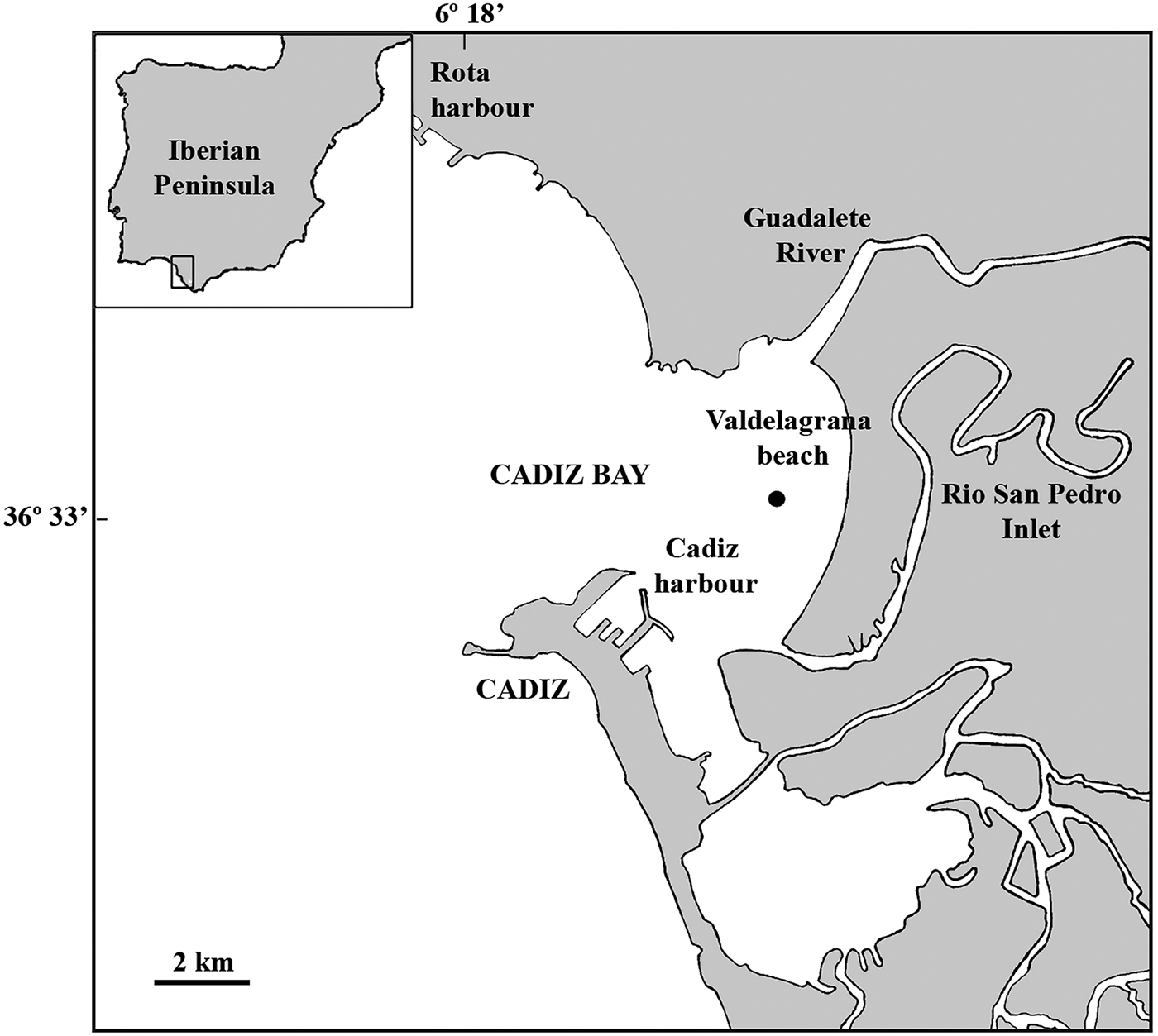
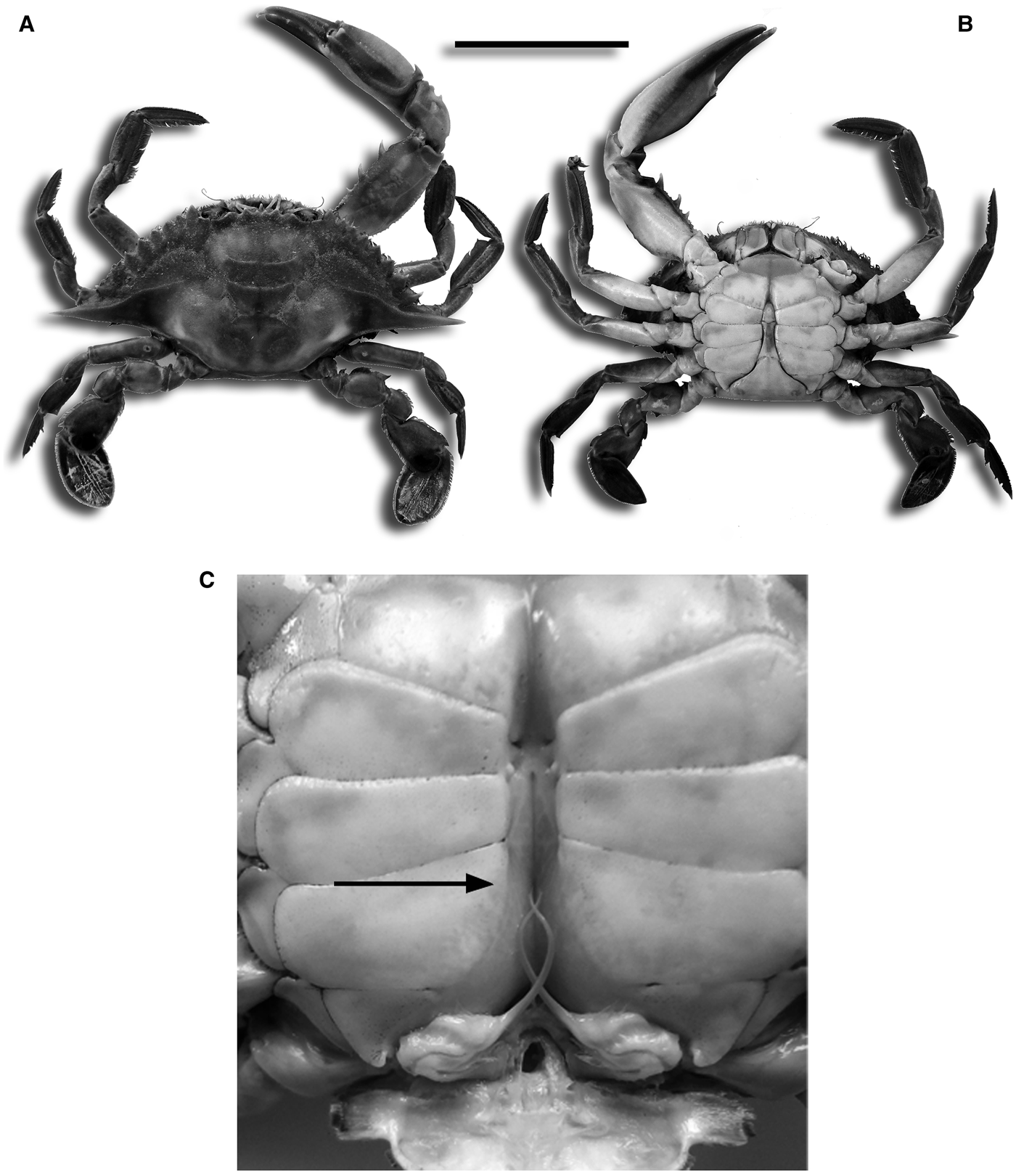
A male crab individual was collected by trammel net on 24 October 2013 by fishermen in Cadiz Bay at a depth of 4.5 m, on the sandy bottom of the Valdelagrana beach, El Puerto de Santa María (36°32′58″N 6°14′36″W) (Figure 1). The specimen was transported alive to the Instituto de Ciencias Marinas de Andalucía (CSIC). The individual was killed by freezing at −20°C and then preserved and stored in ethanol (80%). The specimen was an adult male, with 43.88 mm carapace length and 106.97 mm carapace width (from tip-to-tip of long lateral spines), and it had lost its left queliped when it was removed from the net. The specimen was identified as Callinectes exasperatus (Figure 2) based on its morphological features, such as the denticulation of the frontal margin between the eyes and the gonopod length (Figure 2C). Due to the fact that it had never before been reported as an introduced species, in European seas or elsewhere, a confirmation based on DNA barcode was carried out.
Map showing the sampling location (black dot) of Callinectes exasperatus at Valdelagrana beach, Cadiz Bay.

Callinectes exasperatus (ICMAN2013-110) male specimen collected at Valdelagrana beach. (A) dorsal view; (B) ventral view; (C) detail of gonopods (arrow points out the tip of gonopods). Scale bar = 4 cm.
A similar specimen was collected some days previous by the same fishermen and in the same area, but it was lost while it was being removed from the trammel net and, therefore, it was not available to us for identification purposes.
DNA extraction, amplification and sequencing
The DNA barcode identification of the crab was based on a partial sequence of the 16S rDNA gene. Total genomic DNA was extracted from muscle tissue from the second-right pereiopod, following a modified Chelex 10% protocol (Estoup et al., Reference Estoup, Largiadèr, Perrot and Chourrout1996).
Target mitochondrial DNA from the 16S rDNA gene was amplified with the polymerase chain reaction (PCR) using the following cycling conditions: 2 min at 95°C, 40 cycles of 20 s at 95°C, 20 s at 45°C, 45 s at 72°C and 5 min at 72°C. Primers 1472 (5′-AGA TAG AAA CCA ACC TGG-3′) (Crandall & Fitzpatrick, Reference Crandall and Fitzpatrick1996) and 16L2 (5′-TGC CTG TTT ATC AAA AAC AT-3′) (Schubart et al., Reference Schubart, Cuesta and Felder2002) were used to amplify 551 bp. The PCR product was sent to CISA-INIA's laboratories to be purified and then bidirectionally sequenced.
Sequences were edited using the software Chromas version 2.0., and then a BLAST search was executed at the NCBI webpage to get the sequence that best matched, resulting in a 99% match with the only 16S sequence of Callinectes exasperatus deposited at Genbank. The 544 bp sequence (accession number: DQ407682) belongs to a specimen from Isla Margarita, Venezuela (DNA voucher ULLZ-4366) and was obtained in the context of a molecular phylogeny of the American Callinectes by Robles et al. (Reference Robles, Schubart, Conde, Carmona-Suárez, Alvarez, Villalobos and Felder2007). These data fully confirm a correct initial identification of our specimen based on its morphological characters. The individual DNA voucher is deposited at the ICMAN crustacean collection under the accession number ICMAN2013-110.
DISCUSSION
Introduced species are one of the major threats to biodiversity and, due to the difficulties in preventing, controlling and eradicating aquatic organisms in open systems, the worst kinds of effects of these introductions often occur in marine and estuarine habitats. Studies have shown that only 16% of marine ecoregions have no reported marine invasions, and even that figure may be inflated due to under-reporting (Molnar et al., Reference Molnar, Gamboa, Revenga and Spalding2008). A significant number of reports of exotic species are only occasional arrivals. Although these cites do not imply an establishment of the species, they are an advisory on the potential vulnerability of these ecosystems, since the situation could change with the modification of the environmental conditions or the increase of propagule pressure. However, as Callinectes species' life cycles are linked to estuarine habitats, the scarcity of these habitats in the Mediterranean could be limiting to their potential for expansion. In contrast, the Atlantic coast of the Iberian Peninsula presents an important number of suitable estuaries for these species, but is probably lacking the rest of their environmental requirements.
International shipping, followed by aquaculture, represents the major vector of marine and estuarine introductions (Molnar et al., Reference Molnar, Gamboa, Revenga and Spalding2008). In the case of Callinectes exasperatus, its presence in Cadiz Bay could be mediated by accidental transport in the ship's ballast water. Close to this area there are several harbours with international shipping traffic, such as Cadiz harbour, located within the tourist cruise routes and with fishing and container ports, and the Rota US Naval Station, which most likely ensures maritime traffic connexions with other US Naval Stations situated on the American east coast. Moreover, in this area there are suitable habitats for these species, such as the Guadalete and Guadalquivir estuaries, that have already been invaded by other introduced species, such as Rhithropanopeus harrisii, Palaemon macrodactylus and Eriocheir sinensis (Cuesta et al., Reference Cuesta, García Raso and González Gordillo1991, Reference Cuesta, González-Ortegón, Drake and Rodríguez2004; García de Lomas et al., Reference García de Lomas, Dana, López-Santiago, González, Ceballos and Ortega2010), and where Callinectes sapidus have been occasionally recorded (Cabal et al., Reference Cabal, Millán and Arrontes2006) – most recently sighted in the Guadalquivir estuary in autumn 2013 (Lobato, personal communication).
Callinectes exasperatus has never before been reported outside of its native distribution range – from the southern tip of Florida to Brazil, and from the western Gulf of Mexico to Bermuda. There is the exception of 22 specimens collected in central South Carolina by SERTC (Knott et al., Reference Knott, Wenner and DeVictor2003), but this fact could be considered as a natural northward expansion. Similar reports have been made for other Callinectes species, such as Callinectes bocourti A. Milne-Edwards, 1879 (see Perry, Reference Perry1972) and Callinectes marginatus (A. Milne-Edwards, 1861) (see Knott et al., Reference Knott, Wenner and DeVictor2003 as Callinectes larvatus), but these could also be examples of natural expansions since they do not imply large variations in distance. Besides that of Callinectes sapidus, the only exception is that of Callinectes danae Smith, 1869; one male of this species was caught in September of 1981 at the Lagoon of Venezia (Mizzan, Reference Mizzan1993), but since then, no more specimens have been found.
ACKNOWLEDGEMENTS
We thank the fisherman Antonio Mariscal Villalpando for providing us with the live specimen of Callinectes exasperatus, captured by himself, as well as for the collection data and comments about the other lost specimen. The molecular analysis was carried out under funding from the project MEGALOPADN (CGL2009-11225), funded by the ‘Ministerio de Economía y Competitividad (MINECO)’ Spanish Plan R+D+I and FEDER.