Evolution
Evolution means changes in flow configuration (shape, form, rhythm) that occur in a discernible direction in time. It is a universal tendency in nature, a distinct phenomenon of physics (Figure 1). Changes in design occur in a goal-oriented direction, as if with function, or objective. The concept is as old as western civilization. The word evolution comes from the Latin verb evolvo - evolvěre, which means to come forth, to unroll. The word evolution brings up the same mental image of birth as the word nature (from the Latin natura, she who gives birth to everything).
The evolution and spreading of thermodynamics during the past two centuries,Reference Bejan 1 after a drawing made in 1982.Reference Bejan 3 Caloric theory mated with mechanics to give birth to thermodynamics; more recently, evolutionary design (function, goal-oriented change) mated with thermodynamics, and enhanced the usefulness and permanence of both (cf. Figure 6).

Evolutionary changes are visible throughout nature, the animate and the inanimate together. Evolution is covered by physics across the board, from biology to geophysics, technology and social organization.Reference Bejan 1 The changes occur such that flow is facilitated, access to flow space is enhanced, and flow longevity is increased. Changes that facilitate the flow are retained. This is the physics meaning of evolution, in its broadest sense, and it is covered by the constructal law of physics.Reference Basak 2 – Reference Bejan and Zane 6 Advances in the physics of life and evolution constitute a most active domain of scientific research, and are reviewed regularly.Reference Reis 7 – Reference Baluška and Witzany 17
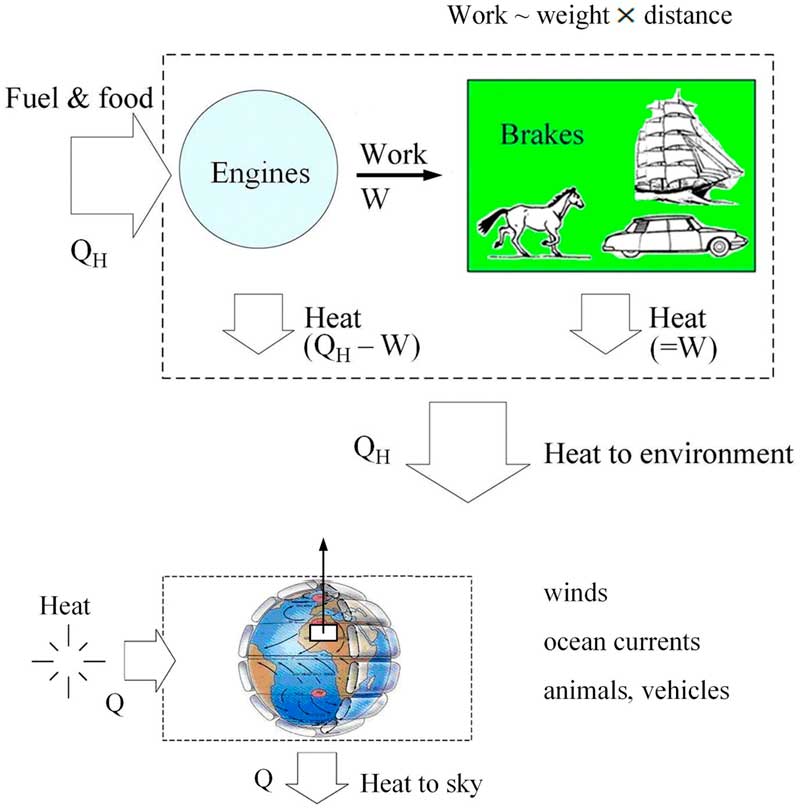
Nothing flows and moves unless it is driven by power, which is called ‘energy’ in popular coverage, yet its proper name in physics is useful energy (exergy, work), which spent per unit of time is ‘power’, dissipated power. The power comes from engines, inanimate, animate, and human-made. The power is destroyed (dissipated) instantly by the flow and movement, because of the interaction between the mover and its environment (Figure 2).
The live systems of civilization dissipate the work produced by animals and engines from food and fuel, and reject it as heat to the ambient. The produced work is destroyed in proportion with the force that resists the movement times the distance travelled (L). The force is proportional to the weight (Mg) of the mass (M) that is moved. In sum, fuel consumption is movement (ML). Every live system can be viewed as an engine that delivers its power to a dissipater of power (e.g. a brake). All the heating received from the fire is rejected as heat to the ambient. The earth is a heat engine that dissipates all its power in the movement of its atmospheric and oceanic circuits, turbulent whirls, animal migration cycles, and humanity (transportation, construction, manufacturing, agriculture, science, education, information, etc.).

The Human & Machine Species
The pace of technology allows us to witness our own evolution in our lifetimes in the following sense: we are attached to and empowered by our contrivances, including historical artefacts, new machines, and our social organizations and the rule of law. We are what I call the human & machine species, and we are evolving with each improvement to aircraft and other machines. In the biological realm, evolution occurs on a timescale immensely longer than our lifetimes. We, the observers, are latecomers to the movie of animal evolution, and we are challenged to imagine the plot.
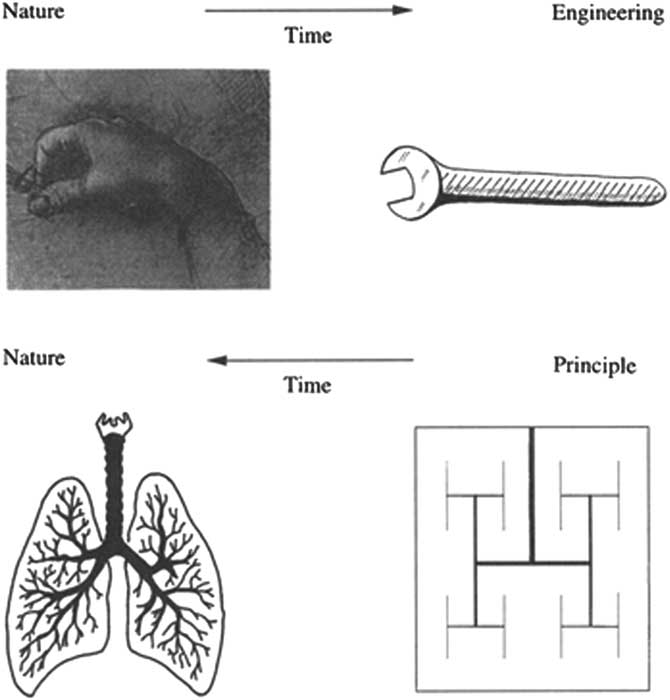
The word ‘machine’ in the human & machine species requires some explaining. It is not about automobiles, power plants, refrigerators, and manufacturing. ‘Machine’ in this instance is used in accord with its oldest meaning, which is ‘contrivance’ (mihaní in old Greek), a sophisticated tool that allows for more effective use of human effort (Figure 3).
The contrivance (machine) is an attachment (an artefact) that enhances the impact of human action on the environment. The occurrence and proliferation of artefacts is a constructal-law tendency. This drawing from 2000Reference Bejan 4 shows the contrast between empiricism (top) and theory (bottom).

Every artefact that we attach to ourselves is a contrivance, the shirt, the harvested food, and the power drawn from an animal or an electrical outlet. Over the centuries new contrivances have made us much more powerful, bigger, and longer living.
Every new model of aircraft makes us an improved human & machine species for moving our bodies, groups, and belongings over the entire globe. This design is changing, and what evolves with it is the movement of humans. This spreading flow gets better, faster, more efficient, and farther reaching. This is just like the evolution of animal fliers. The bigger fly faster. The slow evolution of animal fliers has brought numerous forms of animal movement to converge on the same design features as the fast evolution of human fliers.
An accidental encounter at a thermodynamics conference in March 2000 gave me the idea that we are a ‘human & machine species’, not the naked body pictured along with other naked animals in the biology books (Ref. 4, p. 310). After this click, I knew I understood better who we are, after all our name homo sapiens has been hinting at more than just the naked body.
At that conference in 2000, the invited speaker pointed out a key difference between a naturally designed system (e.g. animal) and a human-made system (e.g. heat exchanger). According to him, the design changes (the optimization) make the natural system better and bigger in time, while the human-made device is just that, a lifeless construct frozen in time. The reality is quite different. The heat exchanger exists only as an extension of the humans who made it – an extension of the minds, hands and human bodies and groups that acquired this device.
Man (homo) today is a construct immensely larger and more complex than a human body examined in isolation. One individual today is a live and evolving flow construct that covers the globe. Each of us is becoming a bigger, better and denser vascular construct that enhances human movement, staying power, and sustainability. The heat exchangers, which help us along this evolutionary route, become better (more efficient, denser, lighter, cheaper). They are accessories, parts of the human & machine specimen. They should be likened to the toenails of the animal, not the animal.
The list of new and future contrivances is endless, because such is evolution – goal-oriented change without end design (destiny). Science itself is an artefact that evolves constantly to become more useful to man: the list of the unexplained becomes shorter thanks to the big tent offered by a new and successful law and its filial theories. Only with progressively better science (compact, hierarchical) can our multiplying observations keep on flowing into our finite-size brains. Only by evolving (compact, hierarchical) can our brains maintain the function (knowledge, action, guidance). We know more not because our heads are getting bigger. We know more because both parts of the human & machine species are evolving. Advice to those who fear artificial intelligence: the homo part cannot have enough of the sapiens part.
Energy technology ‘happens’. This urge is in everyone. Humans of all eras want more of it, unwittingly, because it is essential for sustaining and perpetuating human life (Figures 1–3). All the needs of humanity can be reduced to one flow: fuel is consumed, heat flows through the human space from high temperature to ambient temperature, and the effect is beneficial for human life: heating, transportation, cooling and fresh water.
The adoption of controlled fire was the first ‘energy technology’ of mankind. Fire is good for movement (i.e. life) and because it is good it was adopted. Controlled fire is a human contrivance for more and better food, instant and portable shelter, longer day, and many other design changes that are good for the continuity of movement. With fire, the early humans did not depend on caves for warmth, dryness and safety.
This step occurred in one unmistakable direction, from no fire to fire. It was a design change (a transition) of the same nature as the emergence of organs for vision in animal design, the emergence of terrestrial animal locomotion from swimming, and the emergence of flying later on. Each step in one direction, to facilitate movement and mixing (rearranging) on earth, is in accord with the constructal law of design and evolution in nature.
Fire is more than a metaphor for human energy technology. It is an icon. Another old technology, more recent than fire, is wind power, which was adopted by early humans to push their boats against the current and the wind, to distances immensely greater than their lands of origin. The winds, like the rivers and the ocean currents, are driven by the earth heat engine pictured in Figure 2. Domesticated animals, water wheels, and fire-driven engines followed, in an unending sequence of new contrivances added to the old (see Table 1). They all meant one design change: ‘energy’ (useful energy, exergy, work, power) that the naked man did not have.
The evolution of energy technology: the timeline of the major design adoptions.

To fossil fuels and ‘renewables’ (wind, waterfalls), many other contrivances were added to save energy and to make the use of energy more effective. At the top of this much newer list are the wheel, writing, and science (e.g. mechanics and thermodynamics). These design changes in human presence (movement, life, sustainability) happen in one clear direction, from the illiterate pedestrian to the pedestrian with vehicle and science, not the other way around.
Technology Evolution
Think of air travel as a global flow system. Mass is carried over the Earth within airplanes; air rushes around the airplanes and currents flow through them in the form of electricity to drive motors that move flight control surfaces. Fuel and air combine to produce combustion gases that turn turbines or drive pistons. A river is a flow system, too, consisting of water and sediments that can, over time, produce a delta whose branches deliver water, nutrients and life to the sea. Our lungs are a flow system of chemical energy exchange between air and blood. The visible design similarities among flow systems are not a product of chance. They arise from distinct mechanisms, including genetic mutations, geophysical interactions and technological changes adopted by humans. But the solutions exhibit a design oneness toward improving the flow of currents within these systems.
In aircraft technology we see evolution in real time.Reference Bejan, Charles and Lorente 18 There is a unity with the animal and geophysical worlds:
∙ Speeds should be proportional to body mass raised to the fractional exponent 1/6, and this is just like the speeds of all animals (fliers, runners, swimmers).
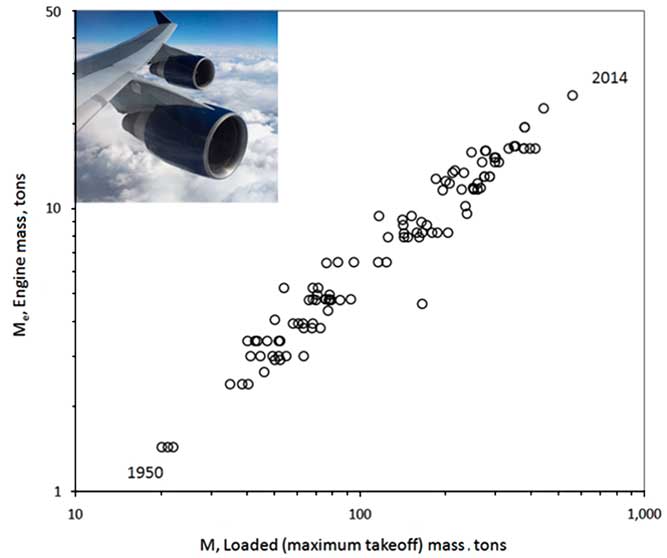
∙ Engine mass should be proportional to body mass, just like the proportionality between muscle mass and body mass in all animals, and between motor mass and body mass in road vehicles (Figure 4).
∙ Fuel load should be proportional to body mass and engine mass, just like the proportionality between food intake and animal body mass.
∙ Distance travelled (the range) should be proportional to body mass, just as with animals, rivers, atmospheric currents and rolling stones. The bigger travel farther and live or last longer.Reference Bejan 19
∙ The fuselage length and the wing span should be almost equal, which is also exhibited by flying animals.
∙ There should be a geometric similarity between the fuselage profile and the wing profile. Both profiles should fit in slender rectangles with the aspect ratio 10:1.
During the evolution of airplanes the engine sizes have increased almost proportionally with the airplane sizes. The data refer only to jet engine airplanes.Reference Bejan 1

Key is the question of why an organ (engine, fuel or wing, for example) should have a characteristic size. The answer, it turns out, is at the heart of why humans are attracted to technology, and why they have the instinct to change it, to improve it, which means to evolve it.
Think of an aircraft or ground vehicle that consumes fuel and moves across the world map, and ask how large one of the organs of this vehicle should be, for example, the engine, or a duct with fluid flowing through it, or the heat exchanger surface of the environmental control system. Because the size of the organ is finite, the vehicle is penalized in fuel terms by the component in two ways. First, the organ is alive with currents that flow by overcoming resistances, of many kinds. In thermodynamics, this universal phenomenon is called irreversibility, entropy generation or destruction of useful energy (exergy). This fuel penalty is smaller when the organ is larger, because larger means wider ducts and larger heat transfer surfaces.Reference Bejan, Lorente, Yilbas and Sahin 20 In this limit, larger is better.
Second, the vehicle must burn fuel and destroy more exergy in order to transport the organ. The fuel penalty for carrying the organ is proportional to the weight of the organ. This second penalty suggests that the smaller is better, and it comes in conflict with the first penalty. From this conflict emerges the purely theoretical discovery that the organ should have a characteristic size that is finite, not too large, not too small, but just right for that particular vehicle. The organ size recommended by this trade-off is such that large organs (engines, fuel loads) belong on proportionally large vehicles and small organs belong on small vehicles.
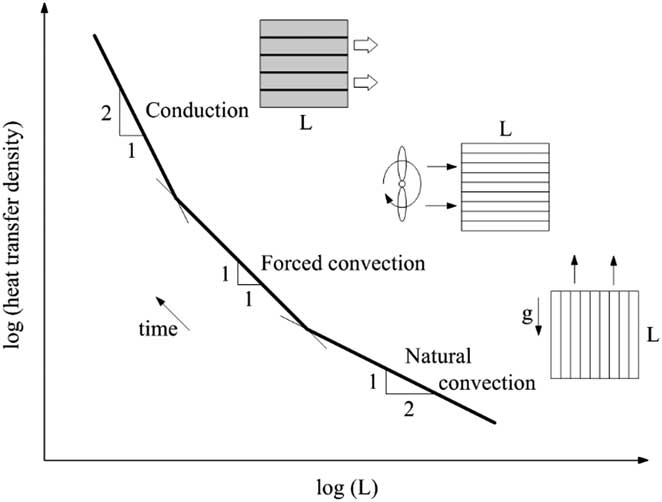
Finally, even greater savings in fuel consumption are registered when the organ size identified above becomes even smaller (miniaturized) thanks to changes in the flow mechanism, which leads to greater density of function. This is illustrated in Figure 5 with the evolution of cooling technology from natural convection to forced convection and finally conduction.
The evolution of heat transfer density toward higher values, showing two phenomena: evolution toward smaller sizes (miniaturization), and stepwise changes in cooling technology.

The Arrow of Time
New technologies emerge so that they offer greater access to what flows – greater access to the available space, areas and volumes, and persistence in time. As a special class of evolving designs, humanity today is kept moving sustainably by the power and movement produced in our contrivances: engines and vehicles. The designs morph with us.
Evolving designs keep spreading across the landscape in the form of better science, cognition, knowledge, security, technology, health care and much more. Knowledge means two features that are present at the time: idea and action (implementation), i.e. a flow-design change that is useful, and the ability to make the change happen.
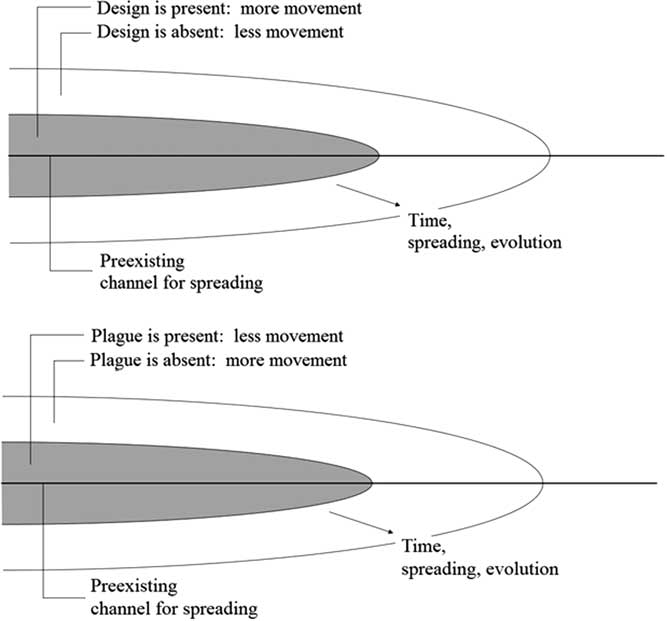
Knowledge spreads over a territory naturally. The boundary between those who know more and those who know less is shifting in the direction of more knowledge and greater territory. Knowledge (the ability to make useful design change) is penetrating the areas with less knowledge, because knowledgeable people are more mobile than the rest (Figure 6).Reference Bejan 1
Knowledge is the contagious spreading of design changes that lead to greater, easier and more lasting movement on the covered territory. Plague and enslavement are the opposite kind of spreading.Reference Bejan 1

The ‘origin of life and evolution’ is in the freedom with which natural flow systems morph their configurations and rhythms so that, over time, they find greater and easier access for their movement. As the physics law of life and evolution, the constructal law expands the reach of these concepts to cover all evolution phenomena, from biology to geophysics, technology, society, medicine, education and culture.
Flow architectures are evolving right now, throughout nature and in our technologies. The value of the constructal law lies in its power to predict. To use the law is not an empirical data-mining experiment. With the law we expect the data to line up.
Acknowledgements
I thank the National Science Foundation for supporting my research throughout my career, including the period reviewed in this article and Reference 1. I also thank Professor Ineke Sluiter for the wonderful and continuing discussion on the origin and meaning of words.
Adrian Bejan is the J.A. Jones Distinguished Professor at Duke University, and is a member of Academia Europaea. He is a graduate of the Massachusetts Institute of Technology (BS 1971, MS 1972, PhD 1975) and an Honorary Member of the American Society of Mechanical Engineers. He has received 18 honorary doctorates from universities in 11 countries. He has published widely on thermodynamics, evolutionary design, and the constructal law of organization in nature, as physics.