In the antebellum period, the American national state played a much smaller role in citizens' lives than it does currently. The national state did possess a range of critical powers, including a substantive capacity to tax and raise a military.Footnote 1 However, even in policy areas where the national state possessed authority, such as interior management or the postal service, its capacity to pursue independently developed polices was often limited.Footnote 2 The limited character of national power also extended to seemingly logical uses of federal authority, such as infrastructure activities. National debates over the constitutionality of using federal resources to fund local projects, a lack of congressional mechanisms (such as standing committees) for cooperation on large bills, and southern concerns that a federally built infrastructure was the first step in the national abolition of slavery all stalled progress on a federal internal improvements system.Footnote 3 But this lack of national administrative strength prior to the Civil War should not suggest that the antebellum United States was entirely stateless or without strong governance.
Instead, local political institutions, from state legislatures to city councils, stepped into the gap left by national inactivity to provide and administer public goods.Footnote 4 Through federalism, state governments in particular possessed considerable power to raise revenues, police citizens, and engage in ambitious public works projects.Footnote 5 As a consequence, antebellum American state building was decentralized, with local actors providing necessary goods and services. In federal systems, this decentralized approach to state building stands as an alternative to relying on the national state to achieve political development. At the same time, however, such a localized approach to governance raises the specter of free-riders and shirkers. In other words, with a reliance on subnational governments and without a central administration, there is a persistent risk that not all state legislatures will engage in state development, undermining decentralized state building.
While state-level action was important in numerous policy areas in the antebellum United States, no localized policy arena was of more critical importance to national capacity building than subnational internal improvement programs. State-sponsored internal improvement programs greatly enhanced travel and shipping across the nineteenth-century United States, which was still very much a frontier nation. Additionally, these early American infrastructure projects produced myriad overflow benefits beyond their basic function of improving citizens' and goods' mobility. The construction of antebellum infrastructure systems increased land values, enhanced agricultural opportunities, developed manufacturing cites, and improved defense.Footnote 6 Thus, state governments were deeply interested in road, canal, and rail projects in the antebellum era. Of these early internal improvement projects, state legislatures' involvement in rail promotion was especially vital to national capacity building.Footnote 7 Though the railroad's dominance was never guaranteed, railroads ultimately offered new possibilities in transportation with which other transport systems, including canals, could not complete. Specifically, railroads offered the advantage of swift and regularized transportation to the nation. Through doing so, railroads reduced the impact of geography on travel.Footnote 8 At their core, railroads were an undeniably modern and industrial mode of transportation. The impact of railroads was felt in numerous ways, as railroading produced larger corporations, a more homogenous nation, and an increasingly public life where Americans traveled with and interacted more.
often with strangers than ever before.Footnote 9 While many railroads were built by private capitalists, political institutions also exerted a considerable influence over rail planning.Footnote 10 In particular, the lack of immediate federal action on railroads allowed state governments a great deal of latitude in how they approached rail promotion, planning, and regulation within their own borders.
Realizing the need for subnational state action to promote local rail development, many state legislatures stepped forward to stimulate rail construction within their own borders. Some states were especially aggressive in their rail promotion, building railroads directly with state funds, while other states were more measured in their efforts. However, not all states were active rail promoters, raising the critical question of what led to this variation in local rail promotion policies. Local policy development often occurs due to the spreading of new policies from innovator states outward to proximate states. This diffusion of new policies is often attributed to social learning, where state legislatures observe the actions of nearby states and borrow novel policies for implementation within their own borders. However, parallel thinking, where states converge on similar policies due to shared circumstances, also plays a major role in policy diffusion. In parallel thinking cases, diffusion results from similar local circumstances, rather than direct learning occurring over state lines. While social learning placed internal improvements on neighboring states' political agendas during the antebellum era, shared local conditions, rather than active social learning, was most critical in determining whether or not a state legislature enacted its own state rail promotion program.
Significantly, state rail promotion sheds light on the role of local political actors in American capacity building. While the degree of subnational rail promotion varied greatly, state policies were nonetheless an important facet of American rail development, laying the foundation for a national transportation network.Footnote 11 However, what remains unclear is whether enough states engaged in local action on railroads to provide national capacity, particularly national capacity that would rival federal action. In fact, the lack of policy diffusion on rail promotion schemes suggests that local action was not reliable enough to compensate for centralized action in state building. Additionally, beyond offering insight into American political development and local political processes, my analysis here stresses the importance of geography to state building activities. In order to develop the argument that the spread of local rail policies resulted from parallel thinking instead of social learning, I outline the relationship between the state and American federalism, enumerate the advantages of state action on railroads, and then provide an overview of the diffusion literature. Then, I present a theory of policy diffusion via parallel thinking, discuss my methods, and offer the results of my statistical analyses. Finally, I conclude by considering the implications of both political geography and parallel thinking on American political development theories, notably by stressing how the shortcomings of local state building contributed to American political centralization.
THE PROBLEM OF THE STATE AND AMERICAN FEDERALISM
The first step toward investigating how local governments contributed to national state building is to outline what is meant by the term “the state.” It is particularly important to consider the relationship between both the state and federalism, as well as the connection between the state and the built environment. In many ways, the argument that local governments provided services or legal frameworks for national-level state building seems to challenge basic notions of what the state is. The state, as a construct, is generally recognized through autonomy. A governing body becomes a “state” when that agency gains its own interests, beyond those demanded by its constituents. These interests generally originate from a state's competition in a field against other states. For instance, a state can develop a particular interest in public health, far beyond what voters or citizens are demanding. The state's interest in public health does not reflect a maternalistic desire to provide the best possible life for its citizens. Rather, this interest in nutrition and cleanliness originates from the state's need to have healthy laborers and soldiers. This development of discrete interests, as well as a capacity to effect change in society and economy, is the traditional hallmark of the modern state.Footnote 12
The United States, particularly in the years from the founding through at least the Civil War, was without many of the features that define the modern state. In the late eighteenth and early nineteenth centuries, the American state lacked the obvious central bureaucracies, large budgets, or sizable personnel that defined its European contemporaries. The early American state is often portrayed as weak, lacking the centralized administration that would allow it to pursue its own interests or significantly redirect social processes in the manner that is required to be defined as a state.Footnote 13 It is only with later crises, including industrialization and the Civil War, that the American state—in the traditional European model of the state—begins to appear, complete with larger budgets, more bureaucrats, and agencies to enforce rules.Footnote 14 In the American context, the study of state development emphasizes the “durable shift in governing authority”.Footnote 15 Picking up on the notion that studying the state involves studying an autonomous and influential institution, American political development considers how the American state transformed from being underdeveloped to finally becoming a modern state in its own right.
However, as noted above, the claim that the early American state was wholly absent is increasingly coming under critique. More and more, American political development theorists are stressing that the American state has always been present, just perhaps not in ways that are instantly recognizable. First, it is critical to underscore that the Constitution itself creates a strong central state, as indicated by the manner in which the constituent aspects of the Union (the states) are locked out of direct political representation in the national body. Specifically, state governments lack representation in the national government: while state legislatures selected early senators, legislatures nonetheless lacked the power to direct how senators voted or to recall those senators for votes the legislature disliked. From its earliest days, the American central state possessed its own power and legitimacy, wholly distinct from the constituent states.Footnote 16
Additionally, numerous scholars stress how active the national state was during the early decades of the Republic. Richard John highlights the federal government's vital role in building post roads and delivering mail, a critical function of nation building in the country's first years.Footnote 17 Echoing this sentiment, Brian Balogh argues the early American state was quite active, as evidenced by the federal government's role in collecting tariffs, conducting land surveys, investing in lighthouses, managing large tracts of public land, and using the court system to build and define economic rules. Often, this early, active national state is overlooked because it was intentionally kept out of sight, so as to not disconcert nineteenth-century Americans who were wary of a strong central state.Footnote 18 Yet, despite its invisibility, the national state was present and behaving as a state: gently guiding the economy and society, as well as pursuing its own, unique interests. Similarly, the early American national state was also involved in American public health by providing health care to merchant marines.Footnote 19 Finally, the antebellum national state possessed the traditional state powers of being able to maintain a peacetime army and exert broad taxation.Footnote 20 While this range of powers was not fully deployed in the early days of the Republic, they nonetheless speak to a strong, capable national administration.
Another critique of the “early stateless” thesis of American history highlights federalism and the role of local governments. Federalism and local policies were critical in shaping the young nation's burgeoning economy.Footnote 21 While the national state was not obviously proactive during the nineteenth century, the same cannot be said for state and local governments. State governments had a great deal of power, and were regularly involved in public health, internal improvements, and economic regulation.Footnote 22 The American nineteenth-century state was decentralized, with American state power distributed across many actors, including local governments and private agencies.Footnote 23 In this displaced model of the state, local actors perceive the need for particular policies or state agencies. Then, one by one, the state governments enact the necessary policies. Instead of a centralized body developing its own interests and acting toward fulfilling those ends, the development and pursuit of “state interests” is dispersed. In this federalized state building, local actors resemble ants in a colony: each ant/state works on its own, not fully aware of its participation in the whole, but nonetheless contributing to an overarching function. Furthermore, state capacity, understood as the state's ability to accomplish ends, is still enhanced through these decentralized activities. For instance, in the case of the military, local militias could be called into action and forts could be constructed. At later times, those same troops would be released, the forts pulled down, and military strength reconstituted elsewhere.Footnote 24 As a consequence of federalism, the early American state was not at all absent. To the contrary, the nineteenth-century American state as enshrined in local actors was flexible, quick, and perhaps easily missed, but nonetheless still very much present.Footnote 25
This dispersed American state was especially skilled at the development of infrastructural power.Footnote 26 Infrastructural strength itself refers to the “power to coordinate civil society”.Footnote 27 Infrastructural power allows for the spread of ideas and resources; it empowers coordination. Without a strong system of infrastructure, a state cannot function or govern effectively. Infrastructure covers a range of resources, including communication networks, agricultural production, education, and military organization. Also critical is transportation infrastructure, the material networks along which ideas, people, and goods travel. Without an ability to overcome physical distance, governance is slowed to the point of ineffectiveness. When space is a barrier, laws cannot be enforced, defense is difficult, economic growth slows, and information trickles along too slowly for maximum benefit. Thus, space matters as a medium to connect institutions with one another. However, at the same time, space is also political and an institution itself. Space is permeable, and there are few fixed or natural barriers that cannot be altered or overcome in some manner. Decisions about how to change space, which are fundamentally decisions about which actors to connect and which to separate, are always subject to choice and conflict. Further, much like any institution, the spatial relationships built by infrastructure exert a long-term impact on social relations.Footnote 28 Thus, spatial development is critical to state building, as decisions about infrastructure will determine which areas are defended, economically successful, culturally relevant, and politically influential.
The role of space, and the development of transportation infrastructure, was especially critical in the postrevolutionary days of the United States. In the early nineteenth century, much of the nation was still a frontier, leaving it isolated and difficult to traverse. Travel was often slow and difficult, relying on unpredictable waterways and rutted, poorly maintained roads.Footnote 29 Despite repeated groundswells for national action on turnpikes and canals throughout the late eighteenth and early nineteenth centuries, American transportation infrastructure remained very much a provenience of local governments in the decades before the Civil War. In this period, federal support was limited to post roads, engineering assistance in planning canals and railroads, as well as the clearing of harbors and rivers.Footnote 30 Though important projects, these minimal federal actions were simply insufficient to meet the transportation demands of the growing frontier nation. As a result, the majority of major internal improvement projects, such as the Erie Canal and Ohio's dense network of canals, were undertaken by state governments.Footnote 31 Therefore, local governments' role in building and coordinating local internal improvements projects into a national system were especially salient, both for decentralized American state building as well as the rationalization of American space.
Yet, while the presence of local governance in the absence of national action during the nineteenth century is well established, the processes by which state governments became involved in new policy areas and the impact of local policies remain open questions. This decentralized approach to state building is a unique perspective on the growth of state capacity that challenges the notion of a singular, central state that develops and pursues its own discrete interests. Decentralized state building, where local actors each fulfill policy obligations within their own territories, requires many legislatures and bureaucrats to implement similar polices at approximately the same time in order to be effective. If many states are choosing to not participate, or pursuing wildly different agendas through a range of techniques, then the result is a chaotic jumble of policy environments rather than cohesive state building.Footnote 32 It is this danger of poor local choices that produces the threat of “race to the bottom” welfare policies, a danger that leads critics to argue that local control over some policy areas—such as economic redistribution—actually generates disadvantageous outcomes.Footnote 33 Decentralized state building is a Gestalt process, where many actors must take action without any centralizing body coordinating. The lack of a central coordinator means that states could always opt out of building a piece of infrastructure or supporting a particular regulatory body, leaving a gap in the national patchwork of local services. If many states opt out of a regulation or service, then it is not clear how well local actions actually compensate for national inaction. While local governments possessed the capacity to provide the policies that compensated for a lack of national action, the question remains: Was this approach to state building even feasible, and if so, how did it work?
THE VALUE OF PUBLIC ACTION
Through federalism, there is the possibility that decentralized local actions cohere to build national capacity. However, for that process to function, local policies actually need to offer some benefit. Which raises the question: Did local rail promotion programs in the antebellum United States actually improve local railroads and even offer the possibility of contributing to a greater national whole? Though not all state rail promotion programs were unqualified successes (and some nearly bankrupted their respective state coffers), the overall impact of state action on railroads was positive. Two critical benefits flowed from state action on railroads: 1) rail development within individual states occurred at a considerably faster rate and 2) railroads penetrated isolated, but valuable, sectors of individual states more quickly.
The first, and most anticipated, result of state money being applied to railroads was the more rapid expansion of the indigenous rail network. Maryland's aid to a local rail company in 1828 is a crucial example of state support dramatically improving a local rail system. The Baltimore and Ohio Railroad, chartered by the Maryland state legislature in 1827, was one of the earliest American railroads constructed. Initially, the railroad was supported solely by private capital, along with a grant from the city of Baltimore. However, in 1828, the state of Maryland acquiesced to requests for state aid and provided support by subscribing to $500,000 of the rail company's stock. In doing so, Maryland became one of the first states to directly support local railroad development, behind Pennsylvania's investment in the Main Line.Footnote 34 Eventually, this small contribution would increase and the state would end up becoming one of the company's major stockholders. Less than a decade later, in 1836, the Baltimore and Ohio boasted a complete route to Washington, D.C.; revenues of $260,000 a year; seven locomotives; over a thousand freight cars; and forty-four passenger cars. Freight shipping on the railroad was so successful that the company was actually unable to keep up with demand.Footnote 35 With the benefit of assistance from the state of Maryland, America's first railroad was an overwhelming success.
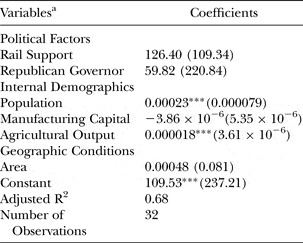
Further, the positive role Maryland's state legislature served by investing state funds in a local rail company was hardly isolated. In order to illustrate more generally how states' rail promotion policies positively impacted local rail growth, Table 1 summarizes an ordinary least squares (OLS) regression demonstrating the relationship between state rail promotion policies and local railroad vitality. The dependent variable is the number of railroad miles in a state in 1860. The independent variables are 1850 economic, political, and geographic factors, all obtained from historical census data.Footnote 36 The data are lagged a decade to allow for prior conditions to impact future events. The particular relationship of interest is rail support in the state and its impact on miles of track. The value for rail support is ordinal, ranging from one to three. At the minimum, states offered no support for local railroads. At the maximum, states offered direct, robust assistance, such as grants to companies. The median value describes states that provided indirect support, such as utilizing state credit to assist private railroad companies in attaining capital.
Ordinary Least Squares Regression of the Impact of State Rail Policies on Miles of Track Within a State, 1860

*denotes significance at 0.10 level.
** denotes significance at 0.05 level.
*** denotes significance at 0.01 level.
a The dependent variable is the number of miles of railroad track within a state in 1860. The independent variable of interest is a state's rail promotion program in 1850. The ten-year lag allows for the policy decision in 1850 to exert an impact. The remaining variables are control variables. Sources: Carville et al., Historical U.S. County Boundary Files; Cline, Alabama Railroads; Goodrich, Government Promotion of American Canals and Railroads; Haines, Historical, Demographic, Economic and Social Data; Hull, Shortline Railroads of Arkansas; MacGill, History of Transportation; Million, State Aid to Railways in Missouri; Pisani, “Promotion and Regulation”; Reed, New Orleans and the Railroads; Rubin, “Canal or Railroad?”; Scheiber, “Federalism and the American Economic Order”; Taylor, Transportation Revolution; Usselman, Regulating Railroad Innovation.
The results in Table 1 underscore that states with more active rail promotion programs did possess more miles of track than their neighbors without such programs. Though the relationship between rail promotion and miles of track is not statistically significant, the finding is not inconsequential: the coefficient for rail support is both positive and sizable. In a bivariate model where rail miles were regressed solely against the variable for rail support, the resulting coefficient is in fact both positive as well as significant. Given the small sample size (N = 32) along with the controls for other economic, political, and geographic conditions, the findings from the more complete model in Table 1 suggest that states with active rail support developed considerably more robust transportation networks than states that chose to forgo railroad promotion. Hence, state action on railroads tended to be successful, and accomplished the goal of enhancing the local rail network.
However, beyond just enlarging the size of the state's rail system, legislative aid to rail companies also pushed railroads more quickly into areas they may not have otherwise reached for many years. For instance, state rail support in Georgia allowed an early rail network to build into the more isolated northwest corner of the state.Footnote 37 The Georgia experience was hardly unique. In the 1830s, western states such as Illinois also engaged in rail promotion efforts to compensate for the slow trickle of private companies building local railroads.Footnote 38 Through state promotion, railroads pressed into less-populated areas, where private capital may not have invested for a long period of time. This success of state rail action begs the question of how rail promotion programs in one state influenced contiguous states' legislatures and why all states did not adopt their own rail promotion programs.Footnote 39
THE CAUSES OF LOCAL POLICY DEVELOPMENT
State rail promotion efforts can produce denser rail systems, suggesting that local actors are capable of contributing to national state building in a meaningful manner. However, a state building process would have worked better if many, or all, states adopted rail promotion efforts. If more states adopted rail promotion programs, national capacity would have slowly improved. Through such a patchwork process, capacity building could have occurred via local, alternative means. But, in the antebellum United States, this is not what occurred. Instead, there was considerable local variation, as some states chose to engage in rail promotions while other states abstained. The antebellum reliance on local state building along with local variation in approaches to rail promotion raises the conundrum of what drives local policy adoption. In the present analysis, I apply contemporary theories of local policy development to the spread of nineteenth-century rail policies to untangle whether early American states' rail development strategies were driven by social learning or parallel thinking.Footnote 40 Through clarifying the cause of local policy development, a clearer picture of how local governments contributed to national state building can be developed.
Local policy development in the nineteenth century was driven by a variety of forces, many of which still shape contemporary legislation. In the nineteenth century, state legislators were motivated by a range of local interests, including constituent demands, rural/urban conflicts, partisanship, and ethnic ties.Footnote 41 Intriguingly, railroads were particularly susceptible to local pressures. Rail companies made choices about technological improvements based heavily on the proximity of materials as well as local usage patterns.Footnote 42 However, both in the nineteenth century as well as the present day, local policy development appears to also be shaped by neighboring states' policies. Policy diffusion, or the spread of a policy innovation from one jurisdiction to another, is a common occurrence in the United States.Footnote 43 Through diffusion, state legislatures seek to improve local administrative strength and thereby their own competitive advantage vis-à-vis contiguous states.
There are two theoretically distinct processes that account for policy diffusion. The first mechanism driving policy diffusion is social learning, which is the predominant mechanism explaining contiguous neighbors' sharing policy proclivities. In social learning theory, states share similar policies because they actively borrow from one another. In more detail, social learning diffusion occurs when state legislatures observe policy experiences in nearby states. From observing neighbors' programs, state legislatures can vicariously experience the successes and pitfalls of a novel policy agenda. After evaluating the overall value of a new policy, based on a bordering state's experience, a state legislature can reach an informed decision on whether or not to adopt a similar policy of their own.Footnote 44 Social learning diffusion predicts that successful policies should be adopted by many states, moving in a wave across the country. If this occurs, state governments supply necessary services and regulatory activities, effectively providing necessary national state functions through decentralized activity.
Increasingly, social learning diffusion is perceived as a complex social process, involving a series of discrete stages. Andrew Karch argues that social learning diffusion is actually a multistep process, encompassing agenda setting, information gathering, customization, and enactment. In agenda setting, a policy proposal receives attention within a state due to activity in another locale and is thereby considered by activists, interest groups, and legislators in a state. During information gathering, nonprofits and think tanks use policy success in other states to push for a policy innovation in a state lacking a program found elsewhere. Customization involves legislators altering diffusing policies to fit local conditions. Finally, enactment is the passage of a law that resembles a neighbor's policy by a state legislature. Karch emphasizes that social learning diffusion is not merely the enactment of a policy that nearby states have adopted. Rather, social learning diffusion has an arc, with contiguous states influencing one another from the initial phase of policy consideration through the final step of a governor singing a bill into law.Footnote 45
Karch's multistep diffusion process allows for a more nuanced discussion of how states influence one another. Notably, Karch's multistep diffusion theory provides for circumstances where an increased number of neighboring states enacting a policy may help set the agenda for a particular state without necessarily leading that state to actually enact that new policy. Further, while agenda setting, information gathering, and customization are important to state building, enactment is the critical action for subnational states' successful participation in American political development. If more neighbors' engaging in novel policies cannot push a state to adopt an innovation, the problem of gaps and policy differences among states limits states' policies' contribution to national capacity.
The social learning diffusion process, as described by Karch, drives the spread of numerous policies among state governments. The most common occurrence of social learning among state governments is the spread of welfare and social safety net policies among contiguous neighbors. For state governments, redistributive policies, which move funds from haves to have-nots, are often perceived as risky propositions by legislators. Redistribution policies tend to lead to higher taxes, and they offer little direct economic benefit to states that engage in them. States with higher taxes find it more difficult to attract new businesses and residents. Essentially, the state places itself at a competitive disadvantage to other states by raising taxes to fund redistribution. Further, state legislatures always fear that by raising welfare benefits, unemployed and impoverished individuals from nearby states will relocate in order to access the higher benefits. The danger of high taxes and the relocation of benefit recipients has led to a “race to the bottom” in welfare spending, where state legislatures are not only hesitant to increase local welfare payments, but will also decrease welfare benefits whenever their neighbors lower their benefits.Footnote 46 Reductions in local welfare spending, based on neighbors' lowering welfare budgets, exemplify local policy development driven through social learning diffusion.
This active social learning among states is not due to the natural intellectual curiosity of state legislators, but is rather driven by the structure of American federalism. More specifically, social learning diffusion is driven by competition among states. This subnational competition is fueled by the porousness of American federalism at the subnational level. State governments have no real control over their own borders, a situation that allows people and capital to flow easily between states.Footnote 47 The result is that as states compete with one another for capital and population, legislatures assume policies similar to their neighbors in order to maintain a competitive advantage and thereby sustain the interest of investors and skilled populations.Footnote 48 Competition, as it occurs between states, is an effort on the part of state legislatures to insulate the local economy from interlopers. Within the broader field of American federalism, state legislatures are attempting to collect more resources than their neighbors, and then prevent those resources that are already contained within the state from leaving for other locales. Thus, competition among states is not necessarily about producing more open internal markets so much as it is about advancing local development and frustrating rivals' economic growth.
This competition among states, termed “rivalistic state mercantilism” by Harry Scheiber, was as common in the nineteenth century as it is today.Footnote 49 In the antebellum period, state governments were granted responsibility over a wide range of policy areas, making them particularly powerful political actors.Footnote 50 Given the power of antebellum state governments, the strength of state rivalries, and internal improvement's centrality to indigenous economic development, we would anticipate that neighbors' policies would have a significant impact on local policy development, particularly in the realm of railroad promotion.Footnote 51
In many ways, an examination of the historical record would seem to bolster the claim that nineteenth-century transportation policies diffused from state to state. For instance, states regularly altered the toll rates on their canals in order to attract traffic from competitors. Even when states received help from Army engineers in the planning of early transportation systems, local leaders pushed infrastructure systems that stressed local density over regional connectivity.Footnote 52 Hence, regional competition among states colored early transportation polices. For instance, the spread of canal plans among the Atlantic seaboard states, and even into interior states such as Ohio, suggests social learning diffusion driven by competition.Footnote 53 In this vein, Julius Rubin stresses that the construction of the Pennsylvania Main Line system of railroads and canals, as well as rail systems in both Maryland and Massachusetts resulted as direct and purposeful responses to New York's Erie Canal.Footnote 54 As a consequence of this historical evidence, local policy convergence on rail promotion programs in the antebellum United States might be anticipated.
However, this same historical record also raises some questions over mechanisms of social learning diffusion, and even questions of whether social learning diffusion actually occurred at all. Rubin notes that the success of the Erie Canal set off a panic among other major Atlantic shipping cities, which feared that New York's dominance of the western market would lead their own economies to permanently lag. In response to the Erie Canal, the other major ports of Philadelphia, Baltimore, and Boston all became entangled in their own internal improvement plans. However, Rubin also notes that each state undertook a very different approach from the other two in their infrastructure development. Notably, Pennsylvania rushed into a canal-railroad hybrid, Maryland also moved quickly on internal improvements but preferred a massive risk on new railroad technology over canals, and Massachusetts bided its time before setting forth on its own railroad investment project.Footnote 55 Thus, states engaged in different types of policies and not necessarily at the pace that intense state rivalries might lead us to expect. When this historical account is brought into conversation with Karch's multistage theory of social learning diffusion, it is evident that states did influence one another. However, that influence appears to have occurred during the agenda setting phase of social learning diffusion, and neighbors seemed to exert less impact on one another during the actual policy enactment phase of diffusion. If this is the case, and neighbors cannot push one another to enactment, the contribution of state governments to overall national capacity building comes into question.
However, if states that are near one another do not lead each other to enact similar policies, how do we explain the spatial clustering of policies, especially across such policy areas that range from welfare benefits to railroad construction? While social learning sustained by local competition informs most diffusion theories, there is an alternative explanation for the clustering of similar policies in contiguous states. In this second theory of diffusion, states adopt policies primarily due to their own circumstances and policy experiences.Footnote 56 In this account, the fact that contiguous states adopt similar policies has little to do with observation and learning. Instead, the clustering of novel policies among states that share a border results from states in the same region facing comparable problems under related circumstances. In other words, clustering is the result of parallel thinking, rather than social learning. From this perspective, state policy evolves from internal political and economic characteristics, rather than a regional zeitgeist. If parallel thinking occurs, state policies reflect regional problems and resources—and fail to be consistent across the nation. Should parallel thinking occur, state governments' policies are less uniform and therefore less effectively contribute to national capacity. When parallel thinking is the cause of local policy development, state governments' ability to compensate for national policy activity is limited.
As a driving force of policy development, parallel thinking has received less attention. Recently, however, there have been numerous efforts to disentangle when social learning is and is not occurring in local policy development. There is increasing evidence that policies do not diffuse at a constant rate, and an early period of adoption may be followed by much longer gaps in-between new appearances of a policy.Footnote 57 This delay suggests that some factors beyond social learning, such as the development of new conditions or opportunities within a state, are driving policy development. In addition, Frederick Boehmke and Richard Witmer have analyzed how the length of time a state possesses a policy impacts neighbors' adoption of that policy. In considering the time a state has been implementing a policy and its impact on neighbors' policies, Boehmke and Witmer argue for the consideration of policy success in evaluating social learning. Through examining duration in this manner, Boehmke and Witmer effectively assess whether social learning, or some other competitive process, is driving policy adoption.Footnote 58 Yet, analyses of parallel thinking in policy diffusion remain the exception rather than the rule in studies of state politics. In part, this lack of focus on the role of a policy's success in diffusion is due to the deficit of strong diffusion measures. In order to fully assess whether social learning or parallel thinking is occurring, the value of a policy must be ascertained, by considering its output or longevity. However, the overall utility of a policy is difficult to accurately measure, and current research tends instead to simply consider the presence of a policy when evaluating the diffusion process. The overall utility of a local policy, and how any local benefits impact the spread of that new policy to nearby jurisdictions, is a question that is still open in diffusion studies.
Finally, it is worth noting that, despite limits on travel and communication in the nineteenth century, policy convergence through social learning was feasible in the antebellum period. For social learning diffusion to occur, legislators must be aware of policies in other states. Thus, there must be some mechanism for legislators to learn about neighboring states' programs, as well as the costs and benefits of those programs.Footnote 59 State legislatures gain their information about other states' policies from numerous sources, but most notably via social networks and interpersonal connections. Specifically, state legislators are connected to each other across state borders through professional associations, partisan ties, or even personal relationships. Through such connections, legislators can share information about local policies and their utility with distant actors in other states.
During the antebellum period, communication about railroads across state lines was common and surprisingly easy. Numerous national merchant journals, such as Debow's Review, provided information on railroad development in other states. Additionally, there were many national and regional railroad conferences, which brought together investors and elected officials to discuss railroading.Footnote 60 With these conditions, there was ample opportunity for railroad policies to spread among political and business leaders. Thus, despite the seeming barriers to communication that could have frustrated social learning in the antebellum period, there were actually sufficient, if not ample, opportunities for state legislators to share their experience with state rail promotion. In the end, both social learning and parallel thinking are plausible explanations accounting for the diffusion of rail promotion programs in the antebellum period. In order to parse between these rival explanations, the impact of both the clustering of rail policies in space as well as the success of contiguous neighbors' rail programs must be evaluated.
LOCAL CONTEXT AND STATE ADOPTION OF RAIL PROMOTION POLICIES
Though the clustering of rail promotion policies in the antebellum United States suggests social learning diffusion, my analysis will argue that rail promotion program enactment actually originated more from parallel thinking than neighbors' influence. Neighboring states' policies may have placed rail promotion on the local agenda of a particular state, but the ultimate decision as to whether or not to enact the policy resulted from the economic and political conditions within a state. The spatial clustering of rail policies resulted not from social learning, but rather from neighboring states sharing similar internal conditions. Internal conditions shaped local policies more than other states' rail programs because it was these indigenous features, and not neighbors' actions, that determined the need and risk of rail investment. State governments that engaged in rail promotion faced the difficulty of managing and funding a major infrastructure program. These immediate, tangible costs and benefits weighed more heavily for state legislatures than the competitive threat a neighbor's own rail program presented.
Though potentially both profitable to the state as well as a boon to the local economy, state-sponsored railroad development was always a gamble. Railroad promotion entailed high costs, long construction times, and uncertain profitability. There was always a risk that rail development could flounder, or even fail. If failure occurred, railroad evelopment programs would backfire: when rail programs failed, they decimated rather than lifted up the state's economy.Footnote 61 Further, rail development was a time-consuming and essentially permanent process, since tracks were not easily rerouted. States were chained to their rail development programs, and could not easily extract themselves from rail investment.Footnote 62 Though states competed with one another for resources, the presence of rail policy in nearby states was simply insufficient to push legislatures to invest in local railroads. Given the risks of long-term commitment rail investment involved for states, the factors pushing state legislatures toward rail promotion hinged primarily on local context. It is these differences in local conditions that determined whether a state engaged in railroad promotion. Local political and economic conditions, such as tax revenue, the presence of policy entrepreneurs, or the size of local obstacles, regularly impact state policy decisions.Footnote 63 The two critical internal factors in shaping local motivation for rail promotion were local economic conditions and a state's extant transportation access. Since I argue that states preferred to avoid bearing infrastructure costs whenever possible, I expect that evidence will show that states were wary of burdening themselves with rail construction costs. The exceptions would be states with stronger economies, which were willing to hazard the risk of rail promotion for the potential benefit to their indigenous rail network. With vibrant economies, strong tax bases, and large amounts of private capital, manufacturing states were especially well-positioned to gamble on rail promotion. Additionally, manufacturing states possessed a vested interest in enhancing the local rail network. Manufacturing states required dense rail networks, since manufacturing required access to both raw materials as well as a means to ship finished products. The inherently diffuse nature of manufacturing means that any state relying on manufacturing as a major sector of its economy requires a strong infrastructure network.
In contrast to manufacturing states' support for rail promotion, I would expect that agricultural states and states with smaller population densities avoided government action to dodge the risk such large capital investments presented. In agricultural states, the economy was often fragile, and the mismanagement of state resources could be a disaster. Historically, many rural states faced bankruptcy due to poorly conceived and managed rail promotion plans.Footnote 64 In addition, rural states often lacked the year-round traffic, either in population or bulk goods, to justify large rail programs. In manufacturing states, both raw materials and finished products were moved year round. With their larger populations, manufacturing states also presented a healthier passenger population with which to nurture nascent railroads. In contrast, rural states contained smaller populations, and only moved large amounts of product in the fall, during harvest. The underutilization of rural railroads is best observed in conflicts over rate charges. Low traffic rural railroads often led to high fees to move goods short distances, an economic situation that angered farmers and would directly contribute to the founding of the Grange in the late nineteenth century.Footnote 65 Given these conditions, rural state legislatures were reluctant to invest in rail promotion schemes.
In addition to local economic conditions, I also anticipate that local infrastructure quality impacted state legislatures' evaluation of whether government action on railroads was necessary. Much as with local economic conditions, local infrastructure quality directly informed how great the need for state railroad promotion actually was. For instance, states with particularly underdeveloped transportation systems were more likely to have greater demand for state action to maintain their competitive advantage over other states. To gauge how infrastructure quality impacted a state's rail promotion decisions, I included measures of both rail miles within a state as well as a state's water access in the model. If states already possessed large rail networks built through private means, state action on rail promotion became less necessary. State legislators would not endorse spending public funds for promotion efforts if private actors were already meeting local rail needs. Along these lines, when states possessed numerous waterways, I argue that local connectivity was already high. In addition, states with greater water access faced considerable costs in maintaining water routes, as well as vested interests that challenged aid for new, competing infrastructure projects. For example, in New York, early attempts to bring the state into railroad promotion were initially defeated by canal interests.Footnote 66 In both situations, when infrastructure within a state was already well developed, state legislators considered it unnecessary to spend resources on additional infrastructure. Therefore, I anticipate that states with poor water access and fewer railroads had greater interest in rail promotion programs, and therefore were more likely to engage in such policies.
Significantly, my argument posits that state legislators' decision to enact a local rail promotion program was not impacted by rail promotion activities in neighboring states. In many theories of local policy development, neighboring states' actions are regularly credited with profoundly influencing local policy choices. For instance, new school funding systems or lottery provisions regularly produce regional competition and inspire the spread of policies from state to state.Footnote 67 However, while the geographic clustering of rail programs occurred, legislators' final choice on public investment in railroads was unrelated to the success of neighboring states' rail programs. Policy success, instead of the mere presence of a policy in a nearby state, is a significant factor for explaining policy diffusion through social learning, yet it is rarely directly evaluated. Neighbors' rail programs did place the rail promotion issue on the local agenda, making railroads a salient political issue. In the end, though, rail promotion programs in contiguous states, successful or not, were insufficient motivation to prod local action on the railroad development issue. Though states compete with one another, state legislatures are not “irrational adopters.” Clusters of nearby states adopting similar policies are observed in many policy arenas. However, this clustering results from states facing similar problems with a comparable set of policy tools in a commensurable political context. In other words, clustering results from similar context rather than through diffusion through social learning.
While my primary emphasis is analyzing policy development through considerations of internal economic features and neighbors' rail policies, I also include a number of theoretically relevant controls in my analysis. In particular, the local political culture could exert a substantial effect on state legislatures' approaches to rail promotion. If the local political climate was not predisposed to state intervention in the economy, then state rail promotion policies would be less likely. Therefore, I include a measure of local political conditions. While demand for infrastructure was bipartisan in the antebellum period, Whigs (and later Republicans) were particularly insistent in advocating an active government, especially on internal improvements such as railroads.Footnote 68 As a result, I would expect that states with Republican and Whig governors were more likely to pass railroad promotion programs than states with Democratic political leaders.Footnote 69
Additionally, I included a measure for a state's slave population in my analyses. The local slave population reflects both a state's economic resources as well as the political values of the state. Given the role of slavery in the antebellum United States, the impact of a state's slave population on rail promotion cannot be overlooked.Footnote 70 Now that I have outlined the basic theoretical framework, I will consider how to measure and evaluate the factors that led some states to adopt rail promotion efforts while other states shied away.
ASCERTAINING STATE RAIL STRATEGIES
To analyze the political conditions that led some state legislatures to adopt rail promotion policies, I utilize statistical models along with geographic analyses. Though historical cases are addressed, I emphasize statistical analysis to gain a broader and more systematic view over the spread of rail promotion policies. I analyze the period 1821–1860. This time frame captures the period just prior to the first state rail promotion legislation, which was in Pennsylvania in 1827, until the outbreak of the Civil War. With the large changes in state building and federal power that occurred as the result of the war, 1860 is an ideal theoretical endpoint.
My analysis is built around an event history model, which estimates the factors that led a state to “fail” and adopt a railroad promotion program. An event history model can be thought of as an epidemiological approach to political study. An event history model attempts to predict what leads a “patient” (in this case an antebellum state government) to “die” or “become infected” (engage in a particular action or policy). In interpreting an event history model, a positive coefficient indicates a factor that led to failure, in this case the adoption of a rail promotion policy. A negative coefficient occurs when an increase in the given variable reduced the probability of a state's adopting rail promotion policies.Footnote 71
For the present analysis, I estimate a Cox-Snell proportional hazards model, with clustering by state. Unlike other event history functions, such as the Weibull or log- logistic models, there is no underlying assumption about the data's hazard rate in Cox-Snell models.Footnote 72 The hazard rate assumption gauges how quickly other patients (states) will fall ill (adopt a rail promotion program) once the first patient exhibits symptoms. In the case of railroad development, there is no clear theoretical guideline to estimate how quickly rail promotion will spread. Thus, the Cox proportional hazard model's flexibility makes it the ideal function for historical estimation. In addition, though states could engage in a range of rail promotion programs, a failure in this model is defined as any rail promotion effort.Footnote 73 Further, I use the Breslow method to account for ties, in order to clarify the relationship between the independent variable and the dependent variables when multiple states adopted rail promotion programs in the same year.
The model estimated is state i's railroad policy in time t, as determined by political and economic conditions at time t -1 as well as geographic conditions at time t. The time frame utilized is year. The dependent variable is a binary measure of whether rail support was supplied in that year, with a value of zero or one. At zero, states offer no rail support, while a value of one signifies a state adopting a rail promotion plan. Utilizing secondary historical sources, each state was coded according to the presence of a rail promotion strategy between the years 1821 and 1860.Footnote 74 Once a state adopted a rail policy, it was removed from the population and could not move between positions of supporting and not supporting railroads.Footnote 75
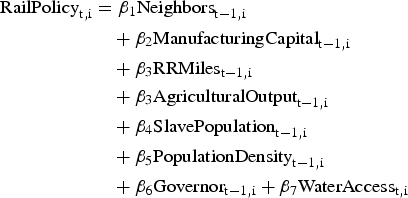
To measure whether railroad policies diffused across states, the influence of other states’ policies on local rail promotion programs is measured. Neighbors are defined as all contiguous states sharing a border with the state. As is commonly done in policy innovation studies, the diffusion measures are lagged by one year, allowing for prior conditions to influence future policy decisions. Neighbors' rail policies are ascertained in two distinct manners. The first approach emphasizes only spatial clustering, and is the standard approach in diffusion studies. For this measure, neighbors' rail policies were measured in three ways, and the model was estimated three times: once for each measure of diffusion. The first two diffusion instruments measure neighboring states' rail policies, and weight all neighbors identically. First, a simple count of the number of bordering states with a rail policy was included. This measure is merely a summation of how many of a state's neighbors have any type of a rail promotion policy. This variable measures whether simply having neighbors who engage in any rail promotion was sufficient to push a state legislature to adopt its own rail promotion program. Second, in order to account for the fact that some states possess longer borders, thus providing them with more neighbors, the average value of a state's neighbors' rail policies was calculated. For the average rail policy measure, neighboring policies were again coded on an ordinal scale of increasing rail support. Then, the number of neighboring states with a rail policy was divided by the total number of a state's neighbors.
In addition to the first two measures, a third measure of neighbors' policies was developed by taking the average of neighbors' rail policies and weighting them by travel time between the states. By weighting the averages in this manner, space and communication are more directly incorporated into the model. The weighted value accounts for the role communication with political actors in other states served in local railroad policy development, thereby measuring how information flows from other localities influenced rail promotion decisions within states. The measure addresses the contention that states that are more closely connected with one another would be more likely to imitate their neighbors' railroad policy, since higher connectivity would enhance both the flow of information between states along with the potential competitive pressure among states.Footnote 76
The averages were weighted by the travel times between states along existing transportation routes in each decade. To determine the weights, a closest facility network analysis was performed in ArcMap. A closest facility network analysis determines the fastest routes between any two points on a shared geographic network. The state shapefiles were derived from the Historical U.S. County Boundary Files, 1790–1999.Footnote 77 To perform the analysis, first the geographic center of each state was determined.Footnote 78 Then, the river, canal, and railroad routes, digitized from paper sources for the period of 1820–1860, were layered over the states.Footnote 79 In the simulation, railroad travel times were set at 25 m.p.h., while river and canal travel times were held at 12 m.p.h..Footnote 80 Finally, straight lines from the geographic centers of each state to the nearest rail, canal, and river vertexes were added.Footnote 81 Those “roads,” which linked state centers to the broader network, were assumed to facilitate travel at 7 m.p.h. With the network analysis, the length of time required to travel between two geographic points was simulated.
Network analyses were performed for each of the decennial years during the period. Since transport networks developed slowly, the same travel time weights were utilized throughout each respective decade. In order to weight the measures, the inverse square of travel time was utilized. The inverse square is a common transformation in geographic analyses, and produces data where closer events exert a greater influence on a state's railroad policies than more distant ones. Finally, the weighted averages were divided by the variable's mean, to produce more sensible coefficients.
However, as discussed previously, a simple measure of neighbors' policies does not adequately differentiate between social learning and parallel thinking. To overcome this limitation, an analysis of how neighbors' rail promotion successes shaped local rail promotion decisions was needed. Hence, a second set of models with measures that accounted for neighbors' actual policy success with railroad promotion was estimated. Policy success, especially with a program like rail development, is difficult to accurately evaluate. Possible measures include pace of track completion, revenue generated by the railroad, or the percent of the state accessible by rail. However, with a historical case such as nineteenth-century rail promotion, policy evaluation data are exceedingly difficult to come by.
As a result, to measure the success of a state's neighbor's rail policies, I measured the miles of track in neighboring states. The miles of track measure is ideal, since it is a direct and transparent measure of how dense a state's infrastructure system actually was at any given point in time. Further, while miles of track are not a perfect measure of success, prima facie, states with more rail miles per square mile were able to build a larger, denser infrastructure system. By simple virtue of offering rail access to more locales, states with more rail miles per square mile can be defined as successful. To account for size variation among states, and its impact on miles of track within a state, I specifically measured the ratio of miles of track to the area of the state in square miles. The only states included in these measures were those states that possessed rail promotion programs. As with the first set of neighbors' measures, I developed three distinct variables. First, I summed all of a state's neighbors' rail miles/area ratios into a single measure. Second, I determined the average of a state's neighbors' rail/area ratio. Finally, I also calculated the weighted average of the rail miles/area ratio using the travel times developed from the network analysis, as discussed previously. By adding this second set of independent variables, my analysis should more accurately evaluate how the success of neighbors' policies, rather the mere presence of the policies, impacted the diffusion process.
Beyond the policy convergence measures, states' internal characteristics, including economic, political, and geographic factors, were built into the model. While states were diverse, a median state interest was assumed for all internal factors. Local economic conditions were measured with historical census data. Measures for a state's manufacturing capital, slave population, agricultural output, and population density (total population divided by area in square miles) were all incorporated in the model.Footnote 82 Values for the years between censuses were interpolated.Footnote 83 When added to the model, each of the variables were also divided by the mean, in order to produce more sensible coefficients. As with the neighbors' rail policy measures, all socioeconomic values were lagged by one year. To address local infrastructure quality, measures of a state's water access and existing rail system were also built into the model. The water access measure is the percent of a state's counties containing some navigable body of water. The railroad measure is the number of rail miles in a state, divided by the variable mean and also lagged by one year.Footnote 84
After economic conditions, the next potential internal factor that could impact state rail polices was local political culture. To incorporate local political conditions' impact on state rail promotion adoption, a measure of state political ideology was included in the model. The proxy for state political ideology was the governor's partisanship. The governor value was binary, with Democratic governors coded as one, while Whig, Republican, and Opposition governors were coded as zero. Since the governor was both a locally elected office and captured the opinions of the entire state, the governor's partisanship was an ideal proxy for state political attitudes. Data on historical governor's partisanship was obtained from the National Governor's Association.Footnote 85 The governor's party measure was also lagged by one year.
Finally, there are persistent concerns in event history models that observations do not possess a flat hazard rate.Footnote 86 If this occurs, biased results are produced. In order to correct for this problem, a temporal dependence control was incorporated into the model. While there are many suggestions for addressing this problem, the solution adopted here was to include a duration dependency covariate as a control.Footnote 87 To develop the control, a locally weighted regression on the probability of a state adopting rail support was performed on the time variable. The results of the regression were then incorporated into the model as an additional covariate.Footnote 88 These statistical analyses, combined with mapping techniques and historical cases, allowed for a thorough examination of how railroad promotion spread from state to state.
RESULTS
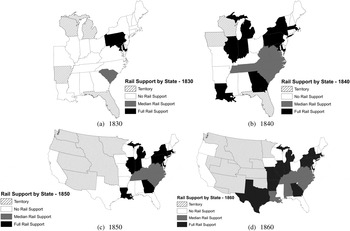
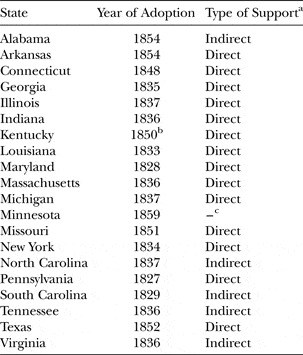
In the antebellum period, twenty states out of the thirty-three in the Union were engaged in some type of rail support by 1860. Table 2 summarizes the states that engaged in railroad promotion, indicating both their year of initial adoption as well as the type of support in which the state engaged. Most states engaged in direct rail support, such as purchasing railroad stock, and the median year of adoption was 1836. Nine of the states that engaged in railroad state were original colonies. Nine states that adopted rail promotion programs would later secede from the Union. Figure 1 is a graphic representation of this data, displaying rail promotion strategies by decade from 1830 to1860. By merely examining Table 2 and Figure 1, no immediate pattern of political culture, geography, or economy is present that explains why some states engaged in railroad promotion and other states abstained.Footnote 89
Presence of State Railroad Promotion Policies in the Antebellum Period, by Decade. Sources: Carville et al., Historical U.S. County Boundary Files; Cline, Alabama Railroads; Goodrich, Government Promotion of American Canals and Railroads; Haines, Historical, Demographic, Economic and Social Data; Hull, Shortline Railroads of Arkansas; MacGill, History of Transportation; Million, State Aid to Railways in Missouri; Pisani, “Promotion and Regulation”; Reed, New Orleans and the Railroads; Rubin, “Canal or Railroad?”; Scheiber, “Federalism and the American Economic Order”; Taylor, Transportation Revolution; Usselman, Regulating Railroad Innovation.

Summary of State Railroad Promotion Projects by Year and Type, 1821–1860

aStates are classified as either adopting direct forms of rail support, such as investing in rail companies, or indirect forms, including offering banking rights to rail companies. The direct/indirect differentiation refers only to the first rail promotion endeavor in which a state engaged. Sources: Carville et al., Historical U.S. County Boundary Files; Cline, Alabama Railroads; Goodrich, Government Promotion of American Canals and Railroads; Haines, Historical, Demographic, Economic and Social Data; Hull, Shortline Railroads of Arkansas; MacGill, History of Transportation; Million, State Aid to Railways in Missouri; Pisani, “Promotion and Regulation”; Reed, New Orleans and the Railroads; Rubin, “Canal or Railroad?”; Scheiber, “Federalism and the American Economic Order”; Taylor, Transportation Revolution; Usselman, Regulating Railroad Innovation.
bThe exact year of Kentucky adoption is unclear. However, by 1850, Kentucky did have an active rail promotion program.
cThe actual form of Minnesota's rail support is unconfirmed.
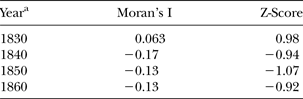
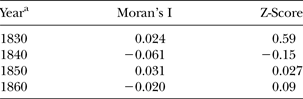
To determine whether state rail promotion was geographically clustered, I executed two Moran's I tests. A Moran's I is a basic test of spatial clustering; it identifies whether phenomenon in space are clumped together, dispersed, or randomly separated from one another in space. Much like other statistical analyses, a Moran's I test produces a coefficient value and a z-score. These values indicate clustering versus dispersion, as well as statistical significance. Table 3 summarizes Moran's I results for each decade from 1830 through 1860, analyzing whether the presence of states with direct, indirect, or no rail promotion policies were clustered. Table 4 presents a similar analysis. However, rather than searching for clustering in the ordinal categories of direct, indirect, and no rail promotion, Table 4 summarizes a Moran's I where states were coded as merely either possessing rail promotion or not. In both cases, the Moran's I located neither spatial clustering nor dispersion. Instead, the lack of statistical significance suggests random dispersal of rail policies across antebellum American space. If rail promotion policies were being spread by social learning, we would expect those policies to be clustered near one another in space. One factor limiting the value of the Moran's I in this case is the lack of spatial homogeneity across the four time periods. The growth in the nation, as more states and territories were added over time, may have distorted the measure of clustering. While the Moran's I is a basic test and therefore not definitive, as a basic overview of the data it suggests that social learning does not explain the adoption of antebellum rail promotion programs by state legislatures.
Moran's I Analysis of Full Range Railroad Promotion Policy Clustering, 1830–1860
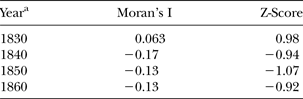
aMoran's I analysis was performed with ArcMap. Rail promotion data are organized by decade when a state began a rail promotion program, and are coded for indirect, direct, and no support. Sources: Carville et al., Historical U.S. County Boundary Files; Cline, Alabama Railroads; Goodrich, Government Promotion of American Canals and Railroads; Haines, Historical, Demographic, Economic and Social Data; Hull, Shortline Railroads of Arkansas; MacGill, History of Transportation; Million, State Aid to Railways in Missouri; Pisani, “Promotion and Regulation”; Reed, New Orleans and the Railroads; Rubin, “Canal or Railroad?”; Scheiber, “Federalism and the American Economic Order”; Taylor, Transportation Revolution; Usselman, Regulating Railroad Innovation.
Moran's I Analysis of Binary Railroad Promotion Policy Clustering, 1830–1860
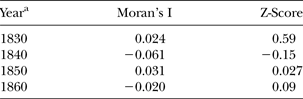
aMoran's I analysis was performed with ArcMap. Rail promotion data are organized by decade when a state began a rail promotion program, and are coded for support or no support. Sources: Carville et al., Historical U.S. County Boundary Files; Cline, Alabama Railroads; Goodrich, Government Promotion of American Canals and Railroads; Haines, Historical, Demographic, Economic and Social Data; Hull, Shortline Railroads of Arkansas; MacGill, History of Transportation; Million, State Aid to Railways in Missouri; Pisani, “Promotion and Regulation”; Reed, New Orleans and the Railroads; Rubin, “Canal or Railroad?”; Scheiber, “Federalism and the American Economic Order”; Taylor, Transportation Revolution; Usselman, Regulating Railroad Innovation.
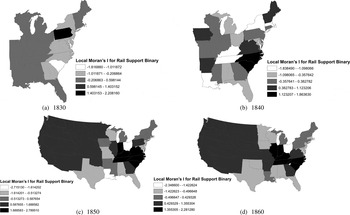
In order to shed more light on the spatial clustering of rail promotion programs, I executed a second test for spatial clustering. Figure 2 summarizes the results for local Moran's I analyses on the binary railroad promotion variable for each decade from 1830 through 1860. A local Moran's I, much like the standard Moran's I, attempts to identify instances of spatial clustering. But, rather than taking a global view, a local Moran's I only measures whether a spatial unit is similar to or different from its immediate neighbors. In Figure 2, the shading grows darker where states are near other states with similar rail programs, and lighter where states are outliers with a different rail program than their neighbors. Significantly, the local Moran's I does not report whether rail programs were clustered or dispersed, it merely highlights whether states were similar to or different than their neighbors. Thus, states that did not have rail programs but were near one another produced a high local Moran's I value, as did neighboring states with rail programs.
Local Moran's I for Binary Railroad Promotion Measures, 1830–1860. Sources: Carville et al., Historical U.S. County Boundary Files; Cline, Alabama Railroads; Goodrich, Government Promotion of American Canals and Railroads; Haines, Historical, Demographic, Economic and Social Data; Hull, Shortline Railroads of Arkansas; MacGill, History of Transportation; Million, State Aid to Railways in Missouri; Pisani, “Promotion and Regulation”; Reed, New Orleans and the Railroads; Rubin, “Canal or Railroad?”; Scheiber, “Federalism and the American Economic Order”; Taylor, Transportation Revolution; Usselman, Regulating Railroad Innovation.

However, when used in conjunction with Figure 1, Figure 2 provides insight into the geographic distribution of rail policies. By 1860, mid-Atlantic, southern Atlantic, and midwestern states were all engaging in rail policies similar to their neighbors'. More specifically, many states in this region possessed some type of rail promotion. In contrast, Ohio stands out as a unique state, much different than its neighbors in its resistance to a rail promotion program. However, Louisiana is also highlighted in 1840 and 1850 as being a pioneer in rail promotion, while many of its neighbors chose to not engage in the internal improvements trend. While the global Moran's I test in Tables 3 and 4 reveals that there was not spatial clustering on a national level, Figure 2 suggests that regional rail promotion clustering did occur. Of course, Figure 2 cannot reveal what drove this regional clustering, and does not offer any particular insight as to whether social learning or parallel thinking pushed the adoption of rail promotion programs.
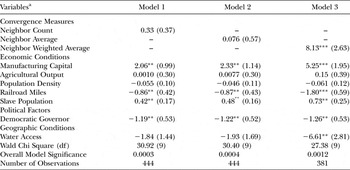
A better perspective on how neighboring states influenced one another's rail promotion programs is gained through the event history models. The findings indicate that while states near one another tended to share rail promotion strategies, these similar policy programs did not result from diffusion due to social learning. Instead, state rail promotion approaches varied due to local context, with state governments engaged in rail support only when it was necessary and the state's budget could successfully support a rail promotion endeavor. The output of the three Cox proportional hazard models to ascertain whether neighboring states' rail policies impacted local rail promotion programs are collected in Table 5. As hypothesized, a state's internal economic factors played a major role in rail promotion decisions. Notably, as indicated by the positive and significant coefficient found in all three models, manufacturing states were more likely to engage in rail promotion programs than other states. However, from both the statistical analyses and patterns in Figure 1, it is not clear that rural states actively avoided rail promotion. Thus, as predicted, state action on railroads occurred when state funds were sufficient to gamble on railroads.Footnote 90
Cox Event History Analysis of Impact of Neighbors' Rail Policies on Local Rail Promotion, 1821–1860

*denotes significance at the 0.10 level.
**denotes significance at 0.05 level.
***denotes significance at 0.01 level.
aThe dependent variable is period when a state developed a rail program, as measured in years. The independent variable of interest is the measure of neighbors' rail policies, including a count of neighbors' rail policies, the average of neighbors' rail policies, and the average neighbors' rail policies weighted by travel time between the centroid of the states. Sources: Carville et al., Historical U.S. County Boundary Files; Cline, Alabama Railroads; Goodrich, Government Promotion of American Canals and Railroads; Haines, Historical, Demographic, Economic and Social Data; Hull, Shortline Railroads of Arkansas; MacGill, History of Transportation; Million, State Aid to Railways in Missouri; Pisani, “Promotion and Regulation”; Reed, New Orleans and the Railroads; Rubin, “Canal or Railroad?”; Scheiber, “Federalism and the American Economic Order”; Taylor, Transportation Revolution; Usselman, Regulating Railroad Innovation.
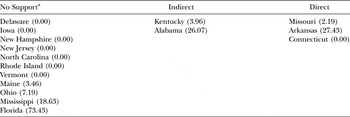
State Per Capita Debt and Railroad Promotion Policies, 1841–1860

aStates are grouped by their degree of railroad support, with states that offered any support to a railroad after 1841 placed in the corresponding category. Underneath each state is a measure of that state's per capita debt in 1841. Source: Rodden, Hamilton's Paradox.
In terms of the theoretical expectations for local infrastructure quality, the findings are mixed. Across all of the models, the factor of having water access is consistently negative. However, water access is only statistically significant in the third model. These mixed results most likely result from the large number of states, from New York to Louisiana, that relied heavily on commerce and shipping for their economy. This reliance on commercial shipping led many states with dense waterways to also support railroads as a means to maintain their major ports and commercial centers. Thus, it appears that states with existing stronger internal improvement systems avoided new rail promotion programs. However, the specific impact of the existence of waterways on a legislature's decision to attempt rail promotion is more complex than an assertion that land-locked states built railroads while states with waterways avoided rail policy innovations.
The conclusion that states with strong extant transportation networks avoided rail promotion is further supported by the negative coefficient on railroad miles within a state. The rail miles indicate that states with dense rail systems avoided rail promotion. To put it another way, those states lacking viable rail networks were the states more predisposed to engage in public rail promotion. As a consequence, I conclude that public rail support was more common in states lacking sufficient infrastructure. Thus, as anticipated, states with both the ability to fund public rail and the need for an enhanced transportation network engaged in rail support programs.
These findings on the connection between local economic conditions and rail promotion strategies are striking since railroad capital was often not solely a local affair. Many railroads were funded by investors from beyond a state's borders, particularly as urban businesses in other states attempted to gain access to new markets.Footnote 91 Yet, despite the availability of capital from other states, local conditions still determined whether or not states utilized government power to encourage rail growth. Of course, private capital available within a state could be a proxy for another facet of the state's resources, such as bureaucratic strength. However, the more likely explanation is that while outside investors were interested in accessing materials within states that lacked rail capital, the cost and subsequent risk of investment in states with poorly developed rail systems was simply too great. As a result, there were too few external private actors willing to fund the initial local railroad developments in infrastructure poor states. Thus, it was up to local governments to jump-start the state's rail system through public support.
In terms of neighboring states, the models in Table 5 reveal that neighboring states, generally, were not an influence on local rail policy decisions. In the first two models, the coefficient measuring neighbors' rail policies does not even approach significance. Thus, neighbors' actions neither discouraged nor encouraged legislators' decisions on internal rail promotion. The one exception is the third model, which measured the impact of the weighted average. The third model indicates that states that were closer to one another engaged in similar rail promotion programs. But, this finding only suggests the spatial clustering of rail promotion policies, and does not necessarily indicate social learning. Given that states that are closer are more likely to also share similar economic and geographic conditions and neighbors' impact was only evident in this one model, this finding could still result from parallel thinking arising from a similar context.Footnote 92
Though the analysis though this point suggests little support for social learning diffusion, social learning remains a plausible explanation for the adoption of state rail promotion programs since rail promotion policies regularly appeared near one another in neighboring states. A brief consideration of the historical record also suggests that social learning could have served some role in local rail policy development. For example, in the antebellum period, Pennsylvania was competing with both New York and Maryland to host the region's major port city, particularly in relation to western trade. At the time, both of Pennsylvania's competitor states benefited from public action on infrastructure: Maryland possessed state-supported turnpikes and railroads and New York funded the Erie Canal. To respond to these efforts, Pennsylvania undertook a major infrastructure plan of its own in 1827. In the first instance of railroads being supported by public funds, Pennsylvania's state legislature set out to build the Pennsylvania Main Line. The Main Line contained both canal and rail sections, and its goal was to cross the mountains in order to provide trade access with the northwestern frontier.Footnote 93 Thus, as in other policy diffusion theories, Pennsylvania's rail promotion efforts seemed to result from social learning diffusion driven by competition with other states.
Similarly, seemingly in response to rail development in other states, New York state eventually reciprocated by also investing in a rail network. Demands for state support for railroads in New York began soon after railroads first appeared earlier in the nineteenth century, primarily driven by cities not originally included on the Erie Canal route. New York's rail proponents argued that better transportation was central to their economic growth.Footnote 94 Initially, the high degree of water access in New York stalled progress on a state-supported rail system. In particular, canal interests in the state actively worked against state support for railroads, as a means to protect their own investments.Footnote 95 However, as other states invested in railroads, New York was ultimately compelled to respond. Specifically, as Boston-based railroads began to reach markets in New York, support for state railroad aid in New York suddenly increased rapidly.Footnote 96
The responsive nature of state rail promotion programs, as driven by state economic rivalries, seems supported by a cursory examination of antebellum rail routes. Figure 3 illustrates national rail construction's progress decade by decade, contrasted against county manufacturing capital.Footnote 97 The maps underscore that in states with rail promotion programs, such as Georgia and New York, railroads generally pressed into counties with less manufacturing capital. Thus, rail promotion was adopted by states seeking to expand their railroads into their own internal frontier. Additionally, many states, including New York, Pennsylvania, Massachusetts, Georgia, and Maryland, were engaged in an effort to reach the western frontier in hopes of capturing greater trade for their local ports. This rapid western expansion, supported by state funding, suggests that competition among states played at least some role in antebellum railroad development.
State Railroad Development in Each Decade, by Manufacturing Activity at the County Level. Sources: Carville et al., Historical U.S. County Boundary Files; Cline, Alabama Railroads; Goodrich, Government Promotion of American Canals and Railroads; Haines, Historical, Demographic, Economic and Social Data; Hull, Shortline Railroads of Arkansas; MacGill, History of Transportation; Million, State Aid to Railways in Missouri; Pisani, “Promotion and Regulation”; Reed, New Orleans and the Railroads; Rubin, “Canal or Railroad?”; Scheiber, “Federalism and the American Economic Order”; Taylor, Transportation Revolution; Usselman, Regulating Railroad Innovation.

As a means to potentially reconcile the historical record with the findings of the event history analysis, I find it useful to return to Karch's more specific analysis of social learning policy diffusion. Specifically, Karch's emphasis on how local policies influence agenda setting in nearby states is especially useful. In light of Karch's social learning diffusion model, it is likely that social learning among states served a role in placing internal improvements programs on the political agenda of a state. Further, based on historical accounts, there is evidence of agenda setting diffusion through social learning among a subset of states that were direct competitors with each other and were home to large commercial centers. But across all states and their neighbors, including those with much different degrees of resources and economic interests, social learning diffusion—of agenda setting or any other variety—seems less evident. Hence, while social learning placed rail promotion on some legislative agendas, the ultimate passage of rail promotion programs by state legislatures had less to do with competition among neighbors and more to do with local concerns over immediate cost and long-term maintenance of infrastructure projects.
Returning to Table 5 and the control variables, the results indicate that Democratic governors were less likely to engage in rail promotion than their Whig and Republican counterparts. In addition, states with larger slave populations were more likely to engage in rail promotion. Most likely, this finding is a function of state wealth, similar to the manufacturing capital measure. States with larger slave populations were also states with overall stronger economies, and therefore these state legislatures were more likely to risk rail promotion projects. However, while Table 5 offers insight into whether rail promotion policies were fostered within neighboring states, it does not fully address the issue of diffusion and social learning. In order to address that question, additional analysis is needed.
To measure social learning's effect on the spatial clustering of rail plans, a second Cox event history model was estimated. In this second set of models, neighboring states' success with their rail promotion programs is directly measured. As indicated by the results, summarized in Table 7, the success of a contiguous state's rail policies exerted no impact on local promotion plans. Much as in the prior models, the coefficients for neighbors' influence were generally nonsignificant. The one exception is, again, the third model. The coefficient in the third model suggests that states actually avoided rail promotion programs when their neighbors engaged in successful railroad promotion. This could indicate that states allowed neighbors with successful rail programs to develop regional systems and bear the cost of supplying the regional transportation system. However, that is a broad conclusion to draw from one model, particularly given that the model incorporates only a single, simplified measure of rail success. Instead, the more reasonable conclusion is simply that neighboring states with rail promotion programs, regardless of the success of those programs, did not directly influence other states' direct enactment of internal improvement supports. While social learning diffusion did introduce the idea of rail promotion to some state legislatures, especially neighboring states with existing rivalries, local conditions played a much larger role than neighbors' actions in determining whether legislatures actually enacted rail assistance legislation.
Cox Event History Analysis of Impact of Neighbors' Successful Rail Policies on Local Rail Promotion, 1821–1860
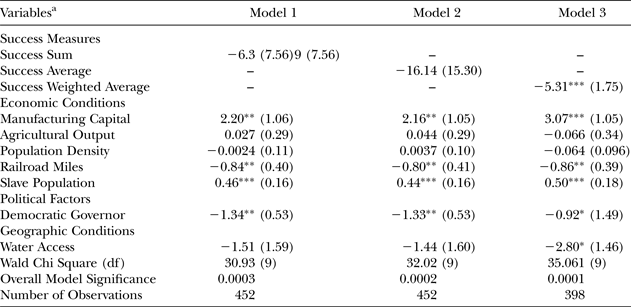
*denotes significance at the 0.10 level.
**denotes significance at 0.05 level.
***denotes significance at 0.01 level.
aThe dependent variable is period when a state developed a rail program, as measured in years. The independent variable of interest is the measure of neighbors' rail policy successes, including a count of neighbors' rail policies, the average of neighbors' rail policies, and the average neighbors' rail policies weighted by travel time between the centroid of the states. Carville et al., Historical U.S. County Boundary Files; Cline, Alabama Railroads; Goodrich, Government Promotion of American Canals and Railroads; Haines, Historical, Demographic, Economic and Social Data; Hull, Shortline Railroads of Arkansas; MacGill, History of Transportation; Million, State Aid to Railways in Missouri; Pisani, “Promotion and Regulation”; Reed, New Orleans and the Railroads; Rubin, “Canal or Railroad?”; Scheiber, “Federalism and the American Economic Order”; Taylor, Transportation Revolution; Usselman, Regulating Railroad Innovation.
Beyond the impact of neighbors' railroad success, the findings for internal economic conditions are consistent with the outcomes in the first set of models. Notably, manufacturing states and states with infrastructure shortcomings, as indicated by rail miles within a state and water access, were again more likely to engage in rail promotion practices. Therefore, while clustering of rail policies did occur, this clustering did not result from a concerted effort on the part of state legislatures to borrow their neighbors' policies. Effectively, the enactment of local rail promotion policies hinged neither on neighbors' policies nor the success of those policies. Instead, clustering occurred due to a combination of diffusion of policy agendas as well as states within a region sharing common circumstances and facing comparable problems, and thereby inadvertently converging on remarkably similar policy solutions. In sum, rail promotion clustering in the antebellum era was the result of rational actors arriving at the same conclusion, and not the consequence of direct social learning.
Up to this point, I have attempted primarily to show how states shaped one another's policy choices on rail promotion during the antebellum period. The findings suggest that while, as suggested by the historical record, social learning diffusion of ideas may have played some role in placing rail promotion on the political agenda, competition across states does not explain policy enactment. Specifically, as more of a state's neighbors engaged in infrastructure projects, a given state was not compelled to copy that policy. Instead, actual policy enactment hinged much more on local political conditions and economic characteristics.
To support these claims, I will now discuss rail development in the Atlantic South, which underscores the role of internal conditions and parallel thinking over social learning in accounting for antebellum rail promotion enactment by state governments. In the antebellum South, active state rail promotion began with South Carolina. In the 1830s, South Carolina found itself in an economically weak position: Charleston's dominance over regional shipping was challenged by upriver cities in both South Carolina and Georgia. In an attempt to revitalize their local economy, Charleston's leading residents quickly turned to transportation infrastructure as a means to advance their own economic position. The result was the Charleston and Hamburg Railroad, which, at 136 miles, was the longest railroad in the world at the time of its completion in 1833.Footnote 98 South Carolina's railroad proved to be a tremendous economic success, restoring Charleston to its former glory.
At first glance, South Carolina's active rail strategy may seem surprising, given the state's more rural character and its abundant rivers and sea ports. However, South Carolina was a wealthy state, as indicated by its large port at Charleston and sizable slave population, with a more rural backcountry. Thus, consistent with the findings in the statistical analysis, South Carolina's internal conditions of a strong economic base and inaccessible hinterland made the state a likely contender for a local rail promotion effort.
If social learning explains the adoption of rail promotion policies by antebellum states, South Carolina's successful actions should have set off a flurry of other states adopting their rail promotion programs. Another glance at Figure 1, or even the dates on Table 2, underscores that nearby states did adopt rail programs in the wake of the South Carolina endeavor. However, a more careful consideration of the Georgia case reveals that parallel thinking, rather than social learning, was the actual cause.
From its earliest days, Georgia's government was active and interventionist. The colony was founded as a philanthropic experiment: the colony's trustees approved all settlers, and actually provided settlers with resources to get them started in their new life. The goal of the colony was to offer a second chance, and provide individuals with needed resources to succeed.
A large part of the colony's, and later the state's, interventionist program included an emphasis on internal improvements. For instance, the colony built its first public roads in 1755. In 1804, the state of Georgia continued to construct public roads, which were explicitly aimed at easing transport, improving the economy, and attracting labor to the state. Throughout the early years of the Republic, Georgia supported roads and canals. Support for internal improvements was so strong that debate rarely revolved around whether the state should engage in infrastructure construction. Instead, debates swirled around the type of infrastructure that should be built, and where the routes should be located.Footnote 99
This active state support in Georgia for internal improvements carried over to a strong interest in railroads. Cities and counties began requesting state aid for rail development as early as 1831, when a state railroad convention was arranged to discuss the possibility of using state funds to spur rail growth. Inspired by these demands, Georgia Governor Wilson Lumpkin (1831–1835) lobbied for the state to engage in railroad promotion. Lumpkin's plan was for the state to build a central trunk line, and then allow private investors and communities to supply the rest of state's rail network. Lumpkin set forth two arguments for state involvement in the railroad. First, Lumpkin posited that Georgia contained insufficient capital to build a railroad without state assistance. But, additionally, Lumpkin argued the railroad was a public good, and state involvement would ensure a railroad that best served the common interests of the state.Footnote 100
Initially, the largest support for the railroad originated from the northern center of the state, where elites in the growing population and manufacturing center of Athens sought improved shipping infrastructure. Support for the rail network was not unanimous, and southern coastal regions already sufficiently served by waterways opposed state railroad construction.Footnote 101 However, when the plan was expanded to include branch lines throughout the central and western parts of the state, support for state action on the rail system was slowly built. But, state support for the Georgia plan did not solely come about due to incremental changes to the railroad's scope. Instead, increased rail activity in neighboring South Carolina did influence Georgia's rail politics. Notably, in 1836, the Knoxville Convention brought together representatives from numerous states, including Georgia and many western states, to deliberate on the possibility of building state-supported railroads from the southern Atlantic coast into the continent's interior.Footnote 102 Though a plan was developed in which South Carolina would collaborate with North Carolina, Tennessee, Kentucky, and Ohio to build a continuous railroad from Charleston to Cincinnati, the program never came to fruition. In large part, the plan floundered due to bickering over local advantage among the partner states. Significantly, business interests from Georgia were present at the railroad conference, and aware of South Carolina's plans.Footnote 103 These elites were inspired to bring this information back to Georgia, and use it to help successfully push for a rail promotion agenda in their home state.
As a result of the Knoxville Convention and amendments to the rail plan, Georgia's state legislature finally passed a bill to begin the construction of its own state supported railroad in 1836. The railroad itself went from northwest Georgia, near the Tennessee border, to the Chattahoochee River in DeKalb County. The initial endpoint of the railroad was simply named Terminus, but would later be changed to Atlanta. The railroad's design followed the basic plan originally set forth by Lumpkin: the state supported a core trunk line, and allowed cities, counties, and private investors to develop the more extended webs of the system. The rail system was a considerable success, and propelled the development of Georgia into a major shipping and manufacturing site in the antebellum South.
The Georgia and South Carolina cases both stress how internal conditions, such as a history of being an active state and having a desire for local growth, played a much more significant role in determining state rail policies than neighbors' actions. Neighbors' actions may have been part of the debate over whether or not a state engaged in railroads, and South Carolina's rail successes certainly made state support for railroads a part of the political conversation in Georgia. However, it seems unlikely that the mere presence of a neighbor with a rail policy was sufficient to push a state into its own rail promotion programs. Georgia's pre-existing plans for rail promotion, along with its economic interventionist history, suggest that while South Carolina's activities drew some attention to the rail issue, the final enactment choice was determined more on local grounds than competitive fervor.
The limited influence of neighbors is evident when considering Alabama. Alabama was a heavily agricultural state, but there was an abiding interest in building railroads in the state, including discussions of state support for railroads. Yet, despite being bordered by rail-supporting Georgia and Tennessee, Alabama was deeply wary of internal improvements. In large part, this wariness stemmed from a combination of the state's failed experiment with a bank and a general unease that any infrastructure would aid economic elites at the cost of the average citizen.Footnote 104
For most of the antebellum period, Alabama avoided rail promotion. The state allowed some railroads, such as the Tuscumbia, Courtland and Decatur Railroad, to actually go out of business, rather than use public funds to support the company. In fact, while Alabama farmers began to diversify their investments prior to the Civil War, finding funds for rail construction often remained difficult in antebellum Alabama.Footnote 105 Despite these capital problems, the state legislature even withheld federal money from railroads. For example, the Two Percent Fund was established by the federal government, and collected revenue generated from the selling of public lands. The fund was intended for internal improvements, but Alabama was often negligent in dispersing these funds.
In fact, the only rail support Alabama provided was a loan to the Mobile and Ohio in 1854. The Mobile and Ohio loan was approved by Governor John Winston, who then proceeded to veto all other rail subsidies. Winston's choice was motivated by the support he received from Mobile interests. These same Mobile interests that backed Winston had also invested heavily in the Mobile and Ohio Railroad. Significantly, the Mobile and Ohio loan in Alabama generated controversy, as planters were displeased with the loan but poorer whites praised the increased access the road would deliver. The antebellum debates over railroads within Alabama underscore that rail promotion programs were often heavily contested among regional interests within a state. In Alabama, this conflict centered heavily around Alabama's own commercial cities thwarting one another's attempts to secure state aid, as part of ongoing rivalries.Footnote 106 Thus, rail promotion adoption was never an automatic process driven by neighbors' actions, and was often subject to intense conflicts between economic actors that had both very different needs as well as long-term visions for local economic vitality.Footnote 107
Alabama's rail promotion efforts underscore how little impact neighbors, such as Georgia, had on local choices for railroads. For years, Alabama resisted rail promotion, and local conditions, especially the lack of capital and an abundance of waterways that already supplied much of the state's transportation needs, stalled progress on state support for railways.Footnote 108 The state's eventual decision to engage in rail subsidy was more related to internal political interests and conflict than regional competition.
Finally, the limited impact of neighbors' rail policies is evident in Louisiana's adoption of rail promotion. While Louisiana was a poor state, it was also a state heavily invested in transportation infrastructure. Much of the state's wealth originated from New Orleans's location at the mouth of the Mississippi River. Because Louisiana was a major transportation hub, the state legislature was keenly interested in canals, roads, and rails. Furthermore, shipping interests in the state actively viewed South Carolina and New York as rivals, vying for control over national shipping traffic. Despite this, Louisiana was resistant to early efforts to engage in rail promotion. Eventually, the state did purchase rail stock, and offered surveying assistance to rail companies as well. However, much of the rail development that occurred in Louisiana was accomplished through private investors and cities investing in rail companies. The state itself was notoriously “stingy,” often only slowly trickling out funds and providing only partial amounts of promised funds.Footnote 109 Much as with New York or Alabama, Louisiana's ultimate action on railroads stemmed more from internal debates over railroads, as local shipping interests pressed for state action and state legislators approached the problem warily. Actions in other states were part of the agenda-setting process in Louisiana, but those neighbors' policies alone were incapable of actually pushing the state into enacting its own rail promotion program. Rather, consistent with other states, as indicated by both the statistical analyses as well as the historical cases, local concerns, and not external forces, ultimately determined how Louisiana approached its own internal improvement problems.
DISCUSSION
In the antebellum period, railroad policy innovations within states were not enacted due to actions in other states, contrary to what is often observed in other policy arenas. Though this was an early period in the history of railroads, the number of investors, rail companies, conferences, and private publications devoted to developing infrastructure all underscore that a systemic field was emerging at this time. Thus, diffusion through social learning on antebellum rail promotion is a reasonable expectation. But, diffusion through social learning was certainly not the norm when it came to state-level rail promotion. While neighboring states' rail policies placed rail promotion on the political agenda, this seems to primarily have been the norm among large commercial states and not across all state governments. In the end, neighbors' actions did not produce actual policy enactment. Instead, state legislatures based their rail promotion decisions on indigenous economic conditions and extant infrastructure quality, engaging in rail promotion only when the economy was strong enough to support such a risk and local infrastructure required dramatic expansion.Footnote 110
The fact that social learning did not contribute to rail promotion indicates a disparity with analyses of other types of local policy development. Yet, railroads are not the only infrastructure technology that has not developed through social learning policy diffusion. In contemporary politics, both new highway technologies and electricity utility regulation display a similar resistance to policy convergence.Footnote 111 More broadly, my findings underscore the necessity of evaluating policy success when studying diffusion, and not merely the presence of a policy. Further, as highlighted by Karch, the analysis of antebellum rail promotion diffusion also stresses the importance of viewing diffusion as a multistage, complex process. Thus, these findings suggest that diffusion, strictly defined in terms of social learning, is less common than normally argued. Instead, policy development is achieved through co-evolution and parallel thinking, with states stumbling onto similar solutions due to a shared set of problems and tools for addressing those policy crises.
Further, the findings on railroad innovation raise questions with regard to infrastructure policies and American political development more broadly. The consistent findings on water access and rail promotion adoption reveal that physical conditions exert a sizable effect on economic and political choices. Put more directly, space is a critical component of state building. Physical connectivity within a state determines the ease with which political actors can interact with one another. In addition, political decisions with regard to space have a semi-permanent aspect, as spatial forms are only altered through a great deal of expense. This makes space an inherently political construct, and yet little attention is turned to the role of space in shaping state form and transformation. More explicitly, a strong central state is impossible if that state cannot reach out to enforce laws, extract resources, or provide services. Significantly, all of these capacities are directly related to the quality of a state's material infrastructure. Railroads, which were erected both at the dawn of the industrial era and the beginnings of American political centralization, were a critical aspect of early American state building. Hence, the process of rail development was fundamental to American state building, as the choices made about where railroads went and who controlled those routes had a profound capacity to shape local and national political power, as well as the relationship between local and national actors. In sum, space and infrastructure were central, though often overlooked, components of American state building.
Finally, beyond the implications for policy diffusion and political geography, an emphasis on state railroad programs also raises the question of whether local policies were able to successfully build the state in the absence of national action. Antebellum railroad development highlights that, at least initially, American state building was almost exclusively a local affair. American political development theories tend to emphasize the growth of the national administrative state, notably the central bureaucracy.Footnote 112 But with its federal structure, American political development involved more than government action at the national level. Increasingly, American political development theories emphasize the role of local governments in driving federal policy or providing necessary national resources, such as military support or health care.Footnote 113 However, the number of states not engaging in rail promotion, as indicated by the lack of spatial clustering detected by the Moran's I, as well as the failure of these rail promotion schemes to diffuse, suggests that local state building resulted in considerable shortcomings. In the case of railroads, private investors filled these necessary gaps. But, in other policy areas where private action was less common or even absent (such as health or economic regulation), state governments' decisions to abstain seriously undermined resource availability and state development. This lack of consistent local action actually enhanced a tendency toward political centralization, as the national state had to step in to provide necessary services that were left unmet at the local level. Ultimately, while state governments possessed the capacity to contribute to overall national development, this analysis underscores that it remains unclear whether antebellum states actually fulfilled that role.