1 Introduction
In their recent article, Béjar & Kahnemuyipour (Reference Béjar and Kahnemuyipour2017) (B&K) add considerably to our understanding of the syntax of copular sentences and the varying possibilities for agreement that they exhibit. They extend the data with new facts from Persian and Eastern Armenian, and they provide an analysis of the types of agreement that these languages allow, in terms of differing ‘phi-sensitivity’ of the probe.
One of the patterns of agreement that they present and discuss is that found in specificational copular clauses. In clauses of this type, they show that in both Persian and Eastern Armenian, the copula agrees in both Person and Number with the second nominal (NP2), rather than with the first (NP1), despite the fact that it is NP1 that occupies the canonical clausal subject position.Footnote [2]

This same pattern was identified in Moro (Reference Moro1997) in Italian, and also appears to be the preferred option in German (even when the effect of Verb Second (V2) is controlled for), and to be possible in a number of other languages (see the discussion in Heycock Reference Heycock2012).Footnote [3] As can be seen from the translations, it is quite different from the English agreement pattern, where the verb appears in third singular and does not agree with the second noun phrase.
A crucial ingredient of B&K’s analysis of this pattern is that in specificational copular sentences, NP1 has no phi-features that can be targeted by an external probe. As a result, it is essentially invisible to the agreement probe on T, which in Persian and Eastern Armenian consequently always finds, and is valued by, the phi-features of NP2, yielding the consistent NP2 agreement pattern observed in (1) and (2).
Why, though, should NP1 in a specificational sentence not have any phi-features that could be targeted by agreement?Footnote [4] B&K argue that this follows because the overt nominal (e.g. qaatel ‘murderer’) in (1a) is actually buried within a CP within a larger covert structure. The structure that they propose is given in (3).Footnote [5]

B&K argue that, in general, phi-features on D enter the derivation unvalued. They can acquire a value in one of two ways: either through agreement with phi-features lower down in the nominal complex or contextually by a deictic assignment function. Both routes, however, are blocked for a specificational DP such as the one in (3): the phi-features on ‘murderer’ are not sufficiently local, being contained within the CP structure, and as the DP receives an intensional interpretation, there is no assignment via deixis. As a result, the ‘defective D’ has ‘just the minimal feature required to be recognized in the syntax as a nominal category’ (B&K:490), a feature they call [n]. As long as a probe is searching for a more highly specified feature bundle than this minimal feature, it will simply bypass NP1 entirely; this is what happens in both Persian and Eastern Armenian, yielding the pattern of NP2 agreement exemplified in (1) and (2).Footnote [6]
B&K do not go into detail concerning how a system like that found in English could be derived, but they mention briefly the possibility that in such a language the probe might simply have the minimal feature specification [n]; this would then match even with the defective DP that occurs as the subject of a specificational sentence. Whatever the specifics, notice that given the analysis of Persian and Armenian, the contrast in agreement between Persian and Armenian, on the one hand, and English, on the other, illustrated by the examples and translations in (1) and (2), cannot be that the verb agrees with NP2 in the former type of languages and with NP1 in the latter. Rather, the contrast would have to be between NP2 agreement and default agreement.Footnote [7] That is, on the assumption (surely desirable, and made explicit in B&K’s article) that the internal syntax of specificational subjects should be essentially the same across languages, this noun phrase cannot value the phi-features of the probe (even if they do agree with respect to the feature [n]), since it is not specified for these features. In consequence, the probe never receives a value. The morphological expression of this is default agreement, which typically corresponds to third singular agreement (see Béjar Reference Béjar2003: 16).Footnote [8]
The account presented in B&K is very compelling (and we should make clear that their data and analysis extend to other types of copular clauses). In this paper, we seek to establish, however, that there is an empirical problem with a crucial premise of the analysis of agreement in specificational clauses, namely the premise that specificational subjects have no ‘targetable’ phi-features. We will argue that evidence from English and from Icelandic, including a special case involving ‘plurale tantum’ nouns (formally plural although semantically singular), shows clearly that NP1 in specificational sentences carries at least Number features that are accessible to an external probe; we believe that the pattern extends at least to other Germanic languages that have not lost all verbal agreement, including Dutch and Faroese. This is demonstrated by the fact that the alternative to agreeing with NP2 is not in fact default agreement, but agreement with NP1. We will further show that our data also speak against a simple modification of B&K’s proposal.
2 Plural subjects of specificational sentences
2.1 Plural subjects in English
Our first observation is a simple one about English. As seen above, English generally does not allow agreement with NP2 (expected given that NP2 is not nominative; see Bobaljik Reference Bobaljik, Harbour, Adger and Béjar2008). However, if we consider specificational sentences with plural subjects, we find that agreement has to be plural; see Heycock (Reference Heycock2009).

This is clearly completely unexpected if NP1 in a specificational sentence has no phi-features that can value the probe on the root T. Of course, given just these examples, one might claim that the verb is agreeing with NP2. However, this is extremely unlikely, given that when NP1 is singular, such agreement is generally quite degraded.Footnote [9]

As B&K note, one possible way of interpreting the subjects of specificational sentences is as concealed questions (Romero Reference Romero2005, Heycock Reference Heycock2012). Moreover, the agreement properties of concealed questions turn out to be the same as those of specificational subjects, in that when pluralised they too must control plural agreement on the verb.

There is a clear contrast with the default singular agreement found with the comparable ‘non-concealed’ questions.Footnote [10]

It is a central part of B&K’s proposal that the structure in (3) for the initial nominal in a specificational sentence has no specification for Number visible at the root. However, if one takes this structure to be at least analagous to an ‘overt’ free relative,Footnote [11] it could be argued that the lack of Number features at the root is in fact not expected (Marcel den Dikken, Hideki Kishimoto, private communication). It is certainly the case that in at least some languages, free relatives can require either singular or plural agreement on an external probe, or may be ambiguous with respect to Number, as illustrated by these examples from Dutch.Footnote [12]

However, it is essential for B&K’s analysis that a singular ‘intensional’ NP – the kind of nominal that appears initially in a specificational sentence – must be radically underspecified for phi-features in a way that distinguishes it from a singular ‘extensional’ NP that appears in other types of sentences (including the kind of predicational copular sentences exemplified in (8)).Footnote [13] This is how, for example, they explain the difference in Persian between, on the one hand, agreement with a plural NP2 in a specificational sentence, as in (2a), repeated here as (9a) (where NP1 is a singular ‘intensional’ NP with the free-relative-like syntax they propose, and by hypothesis invisible to a probe), and, on the other hand, agreement with a singular NP1 in an ‘assumed identity’ copular sentence, as in (9b).

We do not see any evidence from free relatives in extensional contexts, like the ones in (8), that – just in the singular case – there is the kind of radical absence of Number features visible to an external probe that is needed if an analogous structure is to be invoked for the NP1 in (9a). Rather, it seems to us that free relatives such as those in (8) are either singular or plural – or ambiguous between the two – in just the same way as other nominals.Footnote [14]

Thus, amending B&K’s analysis by giving their covert structure for specificational subjects identical properties to those of free relatives would certainly avoid the problem of agreement with plural specificational subjects. However, it does so at the cost of destroying the core of their proposal – the explanation for the ‘invisibility’ of singular specificational subjects for Number agreement in some languages. We therefore do not consider this further, but turn instead to two new sets of data from Icelandic, one of which involves a case that has long been considered not to occur, namely one in which in a specificational sentence NP1 is plural and NP2 singular.
2.2 Plural subjects in Icelandic
Further evidence that specificational subjects have accessible Number features comes from Icelandic, which allows for an additional type of evidence given the greater richness of agreement morphology in this language. In Hartmann & Heycock (Reference Hartmann, Heycock, Thráinsson, Heycock, Petersen and Hansen2017b), we have established that there is considerable inter- and intra-speaker variation concerning agreement in specificational sentences in Icelandic. One part of our study involved an online guided production task where participants – 75 self-reported native speakers of Icelandic – had to fill in a blank corresponding to the position of a copula in a specificational copular clause. In all cases, the clauses had the structure of embedded interrogatives, as this rules out a V2 derivation (see, e.g., Thráinsson Reference Thráinsson2007), guaranteeing that the initial nominal in the copular clause is indeed in the canonical subject position (rather than, say, a topicalised predicate in a V2 structure).
There were five different conditions involving different combinations of Number and Person for NP1 and NP2. For a full account, see Hartmann & Heycock (Reference Hartmann, Heycock, Thráinsson, Heycock, Petersen and Hansen2017b); here, we just pick out the two most relevant conditions for the present discussion. In Condition C, NP1 was third person singular, and NP2 second person singular. In Condition E, NP1 was third person plural and NP2 second person plural. These two conditions are illustrated in (11) for one lexicalisation (there were 15 different lexicalisations, so that each participant saw each condition three times).

In Condition C, 49% of the responses (N = 105/218) were second person singular forms of the copula (agreement with NP2); the remaining 51% were third person singular (N = 113/218). Since NP1 was singular in this condition, it cannot be determined from this condition alone whether this second option was agreement with NP1 or simply default agreement. In Condition E, however, NP1 is plural. In this condition, 44% of the responses were second person plural forms; that is, agreement with NP2 (N = 91/209); crucially, all of the remaining 56% of responses (N = 118/209) were third person plural forms; that is, unambiguous agreement with NP1. This constitutes strong evidence that the variation in Icelandic is between agreement with NP2 and agreement with NP1. Default agreement is not an available option. These production data are further bolstered by judgment data: our evidence to date suggests that where ‘default’ agreement can be distinguished from NP1 agreement (i.e. where NP1 is plural), default agreement is strongly ungrammatical (Hartmann & Heycock Reference Hartmann and Heycock2017a).
2.3 Icelandic pluralia tantum and specificational sentences
A special subset of Icelandic nominals also allow us to circumvent the possible objection that nominals like winner (which can be pluralised and hence have been used in the cases discussed above) are somehow fundamentally different from nouns like problem, cause (which can appear as a singular NP1 with a plural NP2). Icelandic has a number of plurale tantum nouns – nouns that are formally plural but semantically singular – that can occur as NP1 in a specificational sentence. Such nouns include upptök ‘cause’, rök ‘reason’, óeirðir ‘riot’, mistök ‘mistake’, harðindi ‘hardship’ and verðlaun ‘prize’.Footnote [15] In a larger experiment on agreement possibilities in copular sentences in Icelandic, we therefore included a subexperiment testing judgments on examples with such plurale tantum nouns in the position of NP1.
As we have just seen, there is considerable variation within Icelandic concerning the agreement possibilities/preferences in specificational sentences. In order to make testable predictions for the data, we will consider two alternative analyses of this variation, along the following lines.
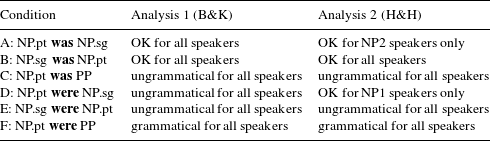
∙ Analysis 1 (based on the proposal in Béjar & Kahnemuyipour Reference Béjar and Kahnemuyipour2017): speakers of Icelandic vary between a system in which the probe is specified for phi-features and so agrees with the closest NP that has such features (as in their analysis of Persian and Eastern Armenian), yielding NP2 agreement, and a system in which the probe is specified only for [n] and so can probe no further than (featurally defective) NP1, yielding default third singular agreement. In a specificational clause, by hypothesis, there is only one NP that has accessible phi-features, so it is always the closest such NP.
∙ Analysis 2: speakers of Icelandic vary between a system in which agreement is with NP2 and a system in which it is with NP1. A proposal for the syntax underlying such a system is discussed in Hartmann & Heycock (Reference Hartmann, Heycock, Thráinsson, Heycock, Petersen and Hansen2017b), but the reader can take Analysis 2 to be any proposal that has the property that agreement might vary between NP1 and NP2, both of which have accessible Number features.
2.3.1 Design, Methodology, Participants
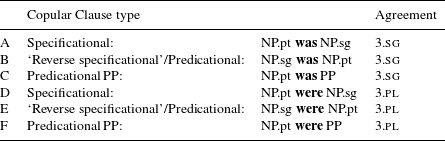
We set up an online judgement task using the ‘Thermometer Judgments’ paradigm (see Featherston Reference Featherston, Maria Riehl and Rothe2008) based on the Magnitude Estimation technique (see Bard, Robertson & Sorace Reference Bard, Robertson and Sorace1996). In the subexperiment concerned with plurale tantum nouns, participants were asked to give their judgments of acceptability when the verb in a copular sentence including a plurale tantum noun showed either third singular or third plural agreement. We set up three different clausal environments, resulting in six different conditions. This is set out schematically in Table 1 and illustrated in (12).

In all cases, the copular clause had the form of an embedded interrogative, in order to ensure that the structure could not be parsed as an instance of predicate topicalization with Verb Second (V2); such a parse was ruled out because V2 is excluded in embedded interrogatives. Further, the sentences all included negation in order to establish beyond doubt that the second NP was in a low position (lower than negation) within the clause.
Conditions testing agreement with plurale tantum (pt) NPs.

The conditions with a PP predicate (C and F) were intended to give us baseline information about judgments on singular/plural agreement with plurale tantum nouns in Icelandic where these nouns head the subject NP in a predicational copular sentence with no other potential target for agreement. To the extent that speakers have a system where agreement is determined by the syntactic number of the nominal (rather than some kind of ‘semantic agreement’ with the notional number), examples in Condition C should be judged ungrammatical and those in Condition F grammatical.
To the extent that Icelandic does have syntactic plural agreement with plurale tantum NPs in predicational sentences, the predictions of the two types of analysis can be summarized as in Table 2. As can be seen from this table, the crucial cases for distinguishing between the two hypotheses are the ratings for Conditions A and D.
Predictions for copular clauses with plurale tantum NP.

2.3.2 Results and discussion
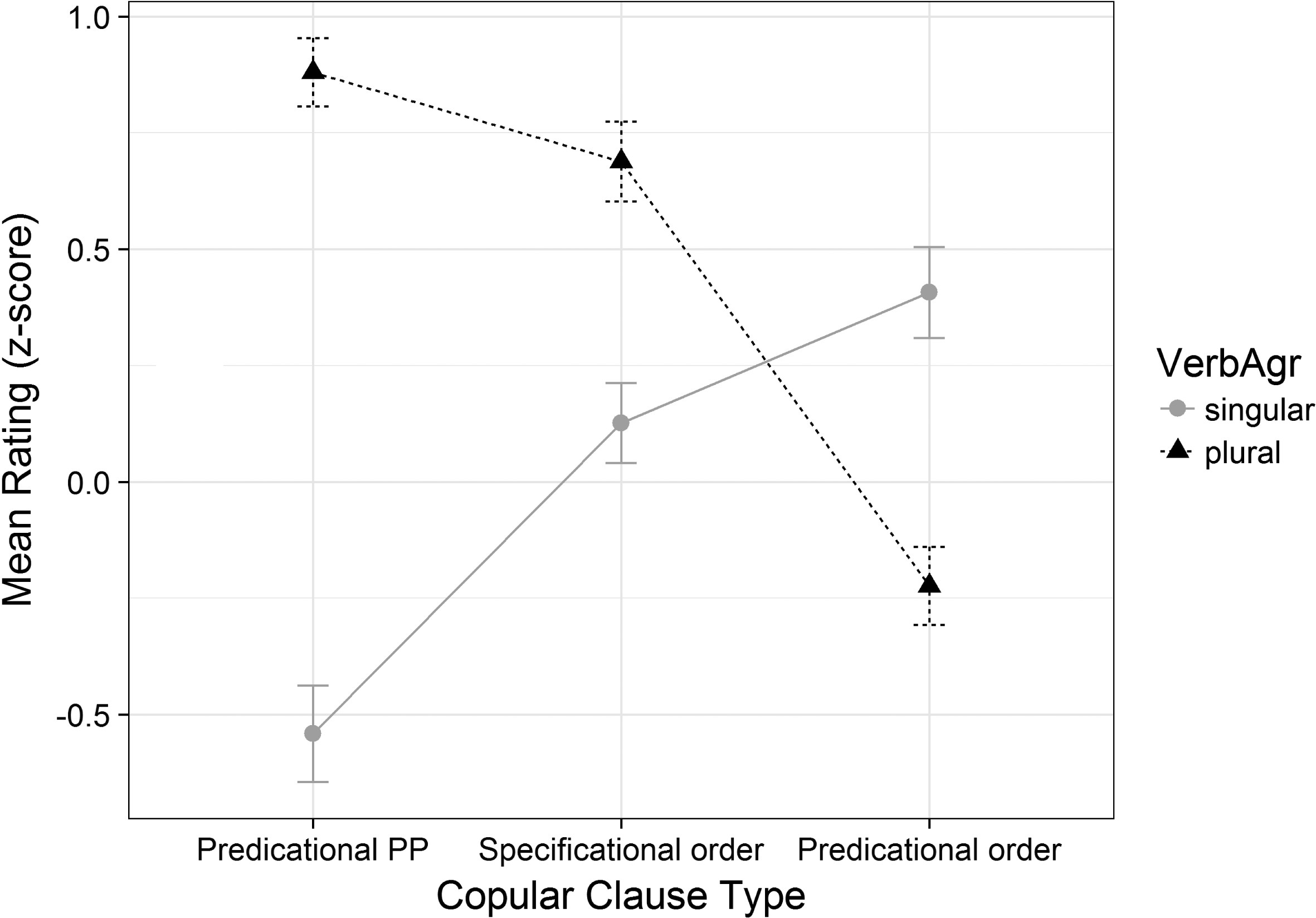
The results of this subexperiment are given in Figure 1.
Overall results: normalized mean ratings.

First, the judgments on the predicational PP conditions (Conditions C and F; leftmost data points in the graph in Figure 1) give us a baseline on agreement with plurale tantum NPs as the subjects of uncontroversial predicational copular sentences. As can be seen from the judgments on the Predicational PP conditions in Figure 1, plural agreement is strongly preferred to singular agreement (t1(1,58) =
 $-$
10,433 p < 0.0001; t2(1,5) =
 $-$
9,769, p< 0.0001), with singular agreement receiving the lowest ratings of all conditions. Therefore, we can safely conclude that syntactic agreement with the plural phi-feature on a plurale tantum subject NP, as illustrated in (12F) above, is clearly strongly preferred over any kind of semantic singular agreement, as in (12C).
Second, the mean ratings for plural agreement with a plurale tantum NP as the subject of a specificational sentence (D) are almost as high as those in the predicational PP case: see the higher of the two data points in the centre of Figure 1. Recall that under Analysis 1 above, based on the proposal in B&K, these sentences are predicted to be ungrammatical as the plural features of the first nominal should be inaccessible to an external probe. Therefore, we have further evidence that specificational subjects do have Number features that are accessible to external probes, contrary to the proposals in den Dikken (Reference den Dikken2014) and B&K. This is in line with the observations made in Section 2 above concerning English and other cases in Icelandic, and provides more evidence against Analysis 1.
Consistently with this, the mean ratings for singular agreement in a specificational sentence (NP2 agreement) are significantly lower than the ratings for plural agreement in this condition (see the lower data point in the centre of Figure 1), while they are significantly higher than the baseline for failure of agreement (as with the PP case). The intermediate status of this configuration is unexpected under Analysis 1. If there is no nominal with plural features that can be targeted by agreement, singular agreement should be the only grammatical option even for speakers who do not allow agreement with NP2.
Instead, we consider that the results here support the prediction of Analysis 2, namely that singular agreement in this configuration is only possible for speakers who have a system that allows agreement with NP2 in specificational sentences. The fact that when the plurale tantum NP is the subject of a specificational sentence with a singular NP2, the ratings for singular agreement are lower than those for plural agreement, suggests that, overall, the speakers participating in this experiment are more likely to have a system with agreement with NP1 than a system with agreement with NP2. The fact that ratings for singular in these specificational clauses are nevertheless well above the ratings for singular in the PP condition (when the plurale tantum NP is the subject of a predicational sentence) suggests, however, that agreement with NP2 in a specificational sentence is also a possible pattern.Footnote [16]
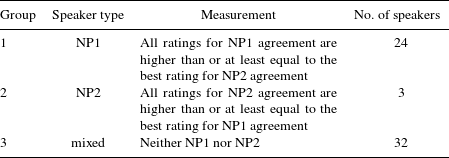
In order to measure whether the intermediate score for singular agreement with specificational subjects is a result of variation between speakers, we can try to establish speakers’ preferences for NP1 versus NP2 agreement independently of the plurale tantum cases by using their ratings for NP1 and NP2 agreement in specificational copular clauses not involving plurale tantum NPs from the same experimental session. Thus, we grouped the participants based on the ratings for sentences like (13) into three different groups: speakers who prefer NP1 agreement, speakers who prefer NP2 agreement and speakers with no clear preference, as in Table 3.Footnote [17]

Groups of speakers, based on agreement preferences.

Based on this classification,Footnote
[18]
there are only three speakers with a preference for NP2 agreement (NP2 speakers) and 24 speakers with a preference for NP1 agreement (NP1 speakers). The largest group of 32 speakers give mixed ratings. NP1 speakers behave in the specificational sentences with plurale tantum subjects as expected: on average, their rating for plural (NP1 agreement) amounts to 0.7836 while their rating for singular (NP2 agreement) is clearly worse, with
 $-$
.0397. This supports Analysis 2. Two of the NP2 speakers also behave as expected, with the opposite preference (that is, for singular agreement) in the plurale tantum case. The third speaker has a preference for the plural (NP1 agreement). Unfortunately, however, of course, the group of NP2 speakers is too small to be able to draw any firm conclusions from their preferences in the plurale tantum case.
Even though there is a considerable amount of intra-speaker variation for agreement in SCCs (see Hartmann & Heycock Reference Hartmann, Heycock, Hammerly and Prickett2016, Reference Hartmann, Heycock, Thráinsson, Heycock, Petersen and Hansen2017b), this overall pattern supports Analysis 2. A dispreference for NP2 agreement is clearly not a preference for default agreement or agreement with the less specified noun phrase; rather, it is a preference for agreement with the initial noun phrase (the English pattern), as the pattern with plurale tantum NPs shows.
2.4 Possible alternative analyses
In the discussion above, we have contrasted the predictions of two proposals concerning the possibility of agreement with NP1 in specificational sentences. The proposal in Béjar & Kahnemuyipour (Reference Béjar and Kahnemuyipour2017) is based on the hypothesis that NP1 in a specificational sentence is part of a covert clausal structure that blocks any external probe from agreeing with the overt NP contained within it. Hence, non-agreement with NP2 can only result in default agreement. The alternative proposal we have referenced briefly – set out in more detail in Hartmann & Heycock (Reference Hartmann, Heycock, Hammerly and Prickett2016, Reference Hartmann, Heycock, Thráinsson, Heycock, Petersen and Hansen2017b) – assumes that NP1 has accessible phi-features, but, in the course of the derivation, may or may not intervene between the agreeing head and NP2. If it intervenes, it captures agreement (NP1 agreement); if it does not, the agreeing head finds NP2 (NP2 agreement).
The results that we have presented here establish, we believe, that the hypothesis that specificational subjects have no accessible number features is simply not tenable. However, one might consider a variant of the account in terms of the phi-sensitivity of the probe that does not rely on the proposal that NP1 has no accessible phi-features. Following the proposal of Preminger (Reference Preminger2011) – which in turn draws heavily on proposals in Béjar (Reference Béjar2003) and Béjar & Rezac (Reference Béjar and Rezac2009) – for a slightly different case, we might suppose that in a variety with NP2 agreement, there are two separate probes for agreement. One is looking not just for Number, but specifically for the plural value of Number. If it fails to find a match, the result will be singular agreement. The other is looking not just for Person, but specifically for ‘participant’ – which covers both first and second person. If it fails to find a match, the result will be third person agreement.Footnote [19] For a language like English, one could instead hypothesize that there is a single probe, specified only to look for phi-features. Such a probe will always match against NP1, the desired result.
Such an account would be claiming that NP2 agreement is possible just because, when NP1 and NP2 in a specificational sentence do not simply match in features, NP2 is typically featurally richer than NP1 (plural rather than singular; specified for Participant rather than unspecified). However, of course, the plurale tantum cases discussed above are an exception to this pattern: when the subject of a specificational sentence is a plurale tantum NP, NP2 can be singular. That is, NP2 may be featurally poorer than NP1 in just this case. What predictions would such an account make for the cases we have considered, and are they met by our data?
Suppose that NP2 agreement arises if speakers have a grammar with a probe that is specified to search for a nominal carrying a plural feature, with singular agreement ensuing if there is no such match. If all speakers had only this system, we would expect A and B (A, the causes be.3sg the drought; B, the drought be.3sg the causes) to be ungrammatical, while D and E (D, the causes be.3pl the drought; E, the drought be.3pl the causes) should be grammatical.
This is not the pattern observed. However, there is a complication, in that we know that there is variation between two systems, both between and within speakers: one system in which NP1 agreement is preferred/possible and one in which NP2 agreement is preferred/possible. Translated into the account we are entertaining here, this would mean that there is variation between a system where the probe simply searches for an NP with phi-features, as in English, and hence agrees with the higher of the two NPs (NP1), and a system where the probe is looking for plural.Footnote [20] If we take this into account, the crucial prediction is that in the specificational clauses with a plurale tantum subject, A (singular agreement) will be fully ungrammatical for all speakers and D (plural agreement) fully grammatical, since in these cases the grammars converge. Speakers who have an English-type system where the copula simply agrees with the higher NP will require plural agreement since that NP is plural; speakers who have a system where the verb looks for a plural NP to agree with will require plural agreement because there is an accessible plural NP. Conditions B and E will get intermediate scores as the two systems will result in opposite ratings for these conditions.
The high acceptability of plural agreement (Condition D) is consistent with such an account. What is problematic, however, is the relatively high ratings for singular agreement (Condition A). Under the account as hypothesized here, there should be no derivation that would result in singular agreement here. Yet, the ratings are well above the baseline for ungrammaticality, and significantly higher than for E (plural agreement where the plurale tantum NP is NP1 and NP2 is singular), a case where the more specified probe would result in a derivation with plural agreement. This shows that quite a few speakers allow for a grammar in which the verb agrees with NP2 independent of the featural specification of NP1. We therefore conclude that this alternative account would not make the right predictions for our data.
3 Conclusion
Recent work on agreement (see, for example, Polinsky & Potsdam Reference Polinsky and Potsdam2001, Baker Reference Baker2008, Bobaljik Reference Bobaljik, Harbour, Adger and Béjar2008, Sigurðsson & Holmberg Reference Sigurðsson, Holmberg, D’Alessandro, Fischer and Hrafnbjargarson2008, Preminger Reference Preminger2011, den Dikken Reference den Dikken2014, Béjar & Kahnemuyipour Reference Béjar and Kahnemuyipour2017, among many others) has demonstrated the richness of the data in this domain, and the insights that can be gained from detailed theoretical analysis of the new patterns that have been described. In this short article, we have considered agreement in one particular configuration, that of copular sentences, and in particular specificational copular sentences, which are now known to show a range of agreement possibilities that go beyond the contrast between Italian-type and English-type systems noted in Moro (Reference Moro1997).
We hope to have shown that any analysis that accounts for ‘downward’ (NP2) agreement in specificational copular clauses on the assumption that the higher NP (NP1) is devoid of accessible phi-features cannot be correct, at least for the Germanic languages that we have considered, as we have provided a range of evidence that this assumption is false. At least in Icelandic and in English (and all the data that we have seen so far for Dutch, Faroese and German lead to the same conclusion), the first NP in a specificational sentence carries Number features that are accessible to external probes, and while there is a range of possible outcomes (and in many cases significant inter- and intra-speaker variation), ‘default’ agreement appears never to be an option.
We have also considered a different possible account in terms of phi-sensitivity, namely that NP2 agreement for Number might be the result of a probe that is specifically looking for plural, with singular agreement the result of a failed search, and concluded, rather more tentatively, that such an account is also inconsistent with our results.
In the course of attempting to differentiate between the predictions made by these different analyses, we have provided a new set of data from Icelandic to further extend the observations against which theories can be tested.