Implications
Lamb survival is affected by the selection of the mother on the basis of temperament and temperament influences the expression of maternal behaviour in sheep under experimental field conditions. This study investigated whether the selection on the basis of temperament had resulted in hormonal differences between the two temperament lines with regard to the hormones that were required for the onset of maternal behaviour. We found that the hormonal differences between the two temperament lines were generally small and thus the results of this study do not suggest that the selection for a calm or nervous temperament has profoundly affected the intrinsic ability of mothers to display adequate maternal behaviour under indoor housing conditions.
Introduction
A lamb’s survival depends, in part, on the quality of maternal care it receives from its dam. Lamb survival is affected by the selection of temperament. Studies with Merino ewes selected for high or low reactivity to humans and isolation (respectively labelled ‘calm’ and ‘nervous’ (Murphy, Reference Murphy1999; Murphy et al., Reference Murphy, Purvis, Lindsay, Le Neindre, Orgeur and Poindron1994)) have found that the mortality rate of lambs born to calm ewes (calm lambs) is half that of the lambs born to nervous ewes (nervous lambs). The results by Murphy (Reference Murphy1999) and Murphy et al. (Reference Murphy, Purvis, Lindsay, Le Neindre, Orgeur and Poindron1994) suggest that this is due to some differences in the expression of maternal behaviour between the two temperament lines during the early post-partum period. Calm ewes were found to have higher levels of maternal behaviour (grooming and bleating) than nervous ewes (Murphy, Reference Murphy1999). However, the behaviour of the ewes was watched by human observers standing 1 m away from the ewe and lamb. The animals were selected on their reactivity to humans and thus the presence of humans during the observations may have affected the behaviour of the ewes. Therefore, whether the differences in the maternal behaviour between the ewes selected for a calm or nervous temperament is independent of the environmental conditions remains to be investigated.
The spontaneous onset of maternal behaviour in the ewe at parturition is largely under hormonal control (Poindron and Levy, Reference Poindron and Levy1990), and the degree and duration of maternal behaviour each animal exhibits at parturition vary between individuals. Earlier studies have found that the amount of maternal behaviour expressed by dams is correlated with the concentration of progesterone, oestradiol and cortisol during the peripartum period (Pryce et al., Reference Pryce, Abbott, Hodges and Martin1988; Dwyer et al., Reference Dwyer, Gilbert and Lawrence2004). Therefore, it is not known whether the differences in maternal behaviour reported by Murphy (Reference Murphy1999) and Murphy et al. (Reference Murphy, Purvis, Lindsay, Le Neindre, Orgeur and Poindron1994) between the two temperament lines could be due to differences in the level of sex steroid and stress hormones required for the onset of maternal behaviour.
In sheep, as in other mammals, oestradiol plays a critical role in the facilitation of maternal behaviour. Oestradiol plays a priming role and is critical for vaginal stimulation to be able to trigger maternal behaviour (Poindron et al., Reference Poindron, Levy and Krehbiel1988; Kendrick and Keverne, Reference Kendrick and Keverne1991; Meurisse et al., Reference Meurisse, Gonzalez, Delsol, Caba, Levy and Poindron2005). In addition, oestradiol is positively correlated with the quality of maternal behaviour displayed by the ewe. Higher levels of maternal care (licking and grooming, udder acceptance) were found in Blackface ewes that also had higher oestradiol concentrations immediately before birth (Dwyer et al., Reference Dwyer, Gilbert and Lawrence2004). Other hormones have also been reported to come into play in the control of maternal behaviour at parturition in mammals. Progesterone may be inhibitory if present at birth, but it can also facilitate the action of oestradiol (Kendrick et al., Reference Kendrick, Da Costa, Broad, Ohkura, Guevara, Levy and Keverne1997). Corticosteroids also have been reported to play a role in the modulation of ongoing maternal behaviour during the post-partum period (Rees et al., Reference Rees, Panesar, Steiner and Fleming2004). However, very high levels due to stress may be detrimental to maternal behaviour (Tu et al., Reference Tu, Lupien and Walker2005; Weinstock, Reference Weinstock2005).
The aims of this study were (i) to verify whether the maternal behaviour of the two temperament lines differed in controlled conditions in which the animals had been intensely habituated to the presence of humans, in particular by daily feeding and (ii) to investigate whether the selection had resulted in hormonal differences between the two lines with regard to the hormones that could be involved in the onset of maternal behaviour.
Material and methods
Experimental design
Twenty-two single-bearing multiparous Merino ewes from a flock of sheep selected for their calm or nervous temperament (10 calm, 12 nervous) were transferred indoors and kept in individual pens 2 weeks before parturition. Blood samples were collected at 6-h intervals from all ewes from 4 days before parturition to 24 h after parturition. Behavioural interactions between ewe and lamb were recorded for 2 h starting at parturition. Oestradiol, progesterone and cortisol concentrations in each blood sample were determined by radioimmunoassay. The use of animals and the procedure were approved by the University of Western Australia Animal Ethics Committee (approval number 05100466).
Animals
The 22 experimental ewes came from the temperament flock maintained at the Allandale Research Farm of the UWA School of Animal Biology, Wundowie, Western Australia. The ewes were multiparous and were aged between 3 and 5 years. The two temperament lines of ewes resulted from within line selection over 17 years on the basis of testing temperament in individual lambs when they were 3 months old, 2 weeks after weaning using a combination of two behavioural tests as described by Beausoleil et al. (Reference Beausoleil, Blache, Stafford, Mellor and Noble2008). In brief, the first behavioural test is a conflict of motivation test between approaching flock members and a human in an arena test; the second test is an isolation test in a closed box. A score based on movements and vocalisation, and combining the behaviour of the subject in the two tests was given to each individual (calm = 27.75 ± 7.3, nervous = 87.08 ± 13.38 for the 22 ewes in this study). All ewes were synchronised in oestrus using progesterone sponges and naturally mated with a sire of the same temperament line. They had previously lambed and were all determined by ultrasound scanning to be carrying a single lamb. Two weeks before parturition, the ewes were transferred indoors to individual deep litter pens measuring 1.2 × 3.2 m and were fed hay and concentrates for maintenance with water available ad libitum. The animals were habituated to the presence of humans by twice daily feeding for 2 weeks.
Blood sampling procedure
Blood samples, approximately 9 ml, were collected from the jugular vein by venipuncture at 6-h intervals from all ewes from 7 days before the expected date of birth until the first signs of parturition. Only samples from the last 4 days of pregnancy were available for all ewes and thus analyses were only performed on samples from 4 days before parturition. No sampling was performed during labour. Immediately after parturition a blood sample was taken and then samples were taken at 1, 2, 8, 16 and 24 h after parturition. Blood samples were centrifuged immediately after sampling and the resultant plasma was separated and stored at −80°C until assayed for oestradiol, progesterone and cortisol. As the action of taking a blood sample for plasma cortisol measurement can evoke a considerable response from the animal, blood samples were taken by experienced and competent staff within 2 min of the start of the sampling procedure as the response to handling is not reflected in the sample if it is taken within this time frame (Broom and Johnson, Reference Broom and Johnson1993).
Lambing procedure
The ewes lambed without assistance as far as possible. However, if the ewe had begun labour but had not delivered the lamb after it had been visible for 1 h then assistance was given (Dwyer et al., Reference Dwyer, Gilbert and Lawrence2004). Lamb weight was recorded within 24 h of birth.
Behavioural observations
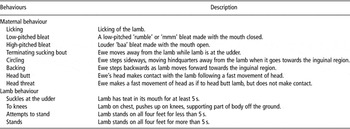
Maternal and lamb behaviour data were collected by continuous live observations for 2 h and recorded on preformatted sheets. Behaviours of the ewe included licking, low-pitched and high-pitched bleating, acceptance and rejection at the udder, backing and circling away. Behaviour of the lamb included latency of attempts to stand and suck as well as latency to actually stand and suck. The definitions of behaviours recorded are given in Table 1. Duration of labour was determined from the first appearance of the lamb to when the lamb dropped onto the ground.
Definitions of maternal and neonatal behaviours

Radioimmunoassay
Oestradiol was measured in a single assay using Estradiol MAIA kit (Adaltis, Casalecchio de Reno, Italy) after extraction with diethyl ether. The limit of detection was 0.7 pg/ml and the intra-assay coefficients of variation were 3.9%, 2.1% and 5.1% at 48.7, 13.1 and 2.56 pg/ml.
Progesterone samples were assayed using Progesterone DSL-3900 radioimmunoassay kit (Diagnostic Systems Laboratories, Webster, Texas, USA). The limit of detection was 0.15 ng/ml and the intra-assay coefficients of variation were 2.6% and 3.0% at 1.01 and 10.21 ng/ml.
Cortisol samples were assayed using GammaCoat Cortisol 125I radioimmunoassay kit (DiaSorin, Stillwater, Minnesota, USA). The limit of detection was 3.5 nmol/l and the intra-assay coefficients of variation were 1.2% and 4.0% at 43.1 and 109.6 nmol/l.
Statistical analyses
Maternal behaviours were compared between temperament lines using a two-factorial (temperament line, time after birth) analysis of variance (ANOVA) with GenStat, 8th edition (VSN International Ltd, Hemel Hempstead, UK). The first and second hour after birth were analysed separately to determine whether the wane in maternal behaviour over time differed between the two temperament lines. Differences between temperament lines on the ratio of the number of times the ewe terminates the sucking bout/time the lamb suckles at the udder were analysed with two sample t-tests. Differences between temperament lines on the proportion of ewes circling and backing away from their lambs were carried out with a Fisher’s exact probability test (GenStat, eighth edition). Differences between temperament lines in the duration of labour and time to shed placenta were analysed with two sample t-tests. Lamb behaviours and weight were compared between temperament lines using a Mann–Whitney U-test.
Hormone concentrations were analysed with repeated measures ANOVA in three separate time periods: (i) 4 days to 1 day before parturition, (ii) immediately after birth, 1 h after, 2 h after and (iii) 8, 16 and 24 h after birth. Post-hoc comparisons were performed with least squares means differences. Comparisons between the end of a time period and the beginning of the next were analysed using t-tests for paired samples.
Results
Parturition shedding of placenta and lamb weight
The duration of labour did not differ between calm (13.5 ± 2.3 min) and nervous (19.4 ± 7.3 min) ewes (P = 0.44). Similarly, the time it took to shed the placenta after giving birth did not differ between calm (197.3 ± 24.3 min) and nervous (208 ± 14.0 min) ewes (P = 0.707). The birth weight of the lambs did not differ between calm (4.8 ± 0.22 kg) and nervous (4.8 ± 0.15 kg) lambs (P = 0.895).
Maternal behaviour
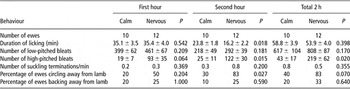
All but one ewe began licking their lamb within the first 10 min of birth. Time spent licking the lamb, number of low-pitched and high-pitched bleats, the ratio of ewes that terminated sucking bouts/time at the udder and the proportion of ewes that circled and backed away from the lamb did not differ between the two temperament lines during the first hour after birth (Table 2).
Maternal behaviour of calm and nervous ewes during the first and second hour post partum

During the second hour after birth, calm ewes spent longer licking their lambs, emitted less high-pitched bleats and a lower proportion circled away from their lamb compared with nervous ewes (Table 2). However, the number of low-pitched bleats, the ratio of ewes that terminated sucking bouts/time at the udder or the proportion of ewes backing away from their lamb did not differ between the two lines (Table 2).
When the observations of the 2 h post partum are pooled, calm and nervous ewes differed in the number of high-pitched bleats and tended to differ in the proportion of ewes that circled away from their lamb. Calm ewes emitted less high-pitched bleats and tended to circle away from their lamb less compared with nervous ewes (Table 2). Otherwise, calm and nervous ewes did not differ in the amount of time they spent licking their lamb, in the number of low-pitched bleats they emitted or in the ratio of ewes that terminated sucking bouts/time at the udder or in the proportion of ewes that back away from the lamb (Table 2).
Lamb behaviour
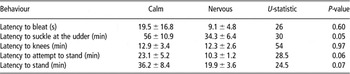
There was no difference between temperament lines on the latency of the lambs to start bleating after birth or in the latency to get upright to their knees (Table 3). Calm and nervous lambs did differ in the latency to suckle at the udder, whereas nervous lambs were quicker to start suckling than calm lambs (Table 3). Nervous lambs also tended to be quicker at attempting to stand (P = 0.063) as well as at standing (P = 0.072) compared with calm lambs (Table 3). However, calm and nervous lambs did not differ in the amount of time they spent suckling at the udder during the first (calm = 3.51 ± 1 min, nervous = 5.6 ± 1.2 min; P = 0.218), second (calm = 4.87 ± 1.2 min, nervous = 5.56 ± 0.6 min; P = 0.497) or whole 2 h (calm = 8.38 ± 1.76 min, nervous = 11.15 ± 1.5 min; P = 0.234) post partum.
Behaviour of calm and nervous lambs immediately after birth

Comparison of hormone concentrations before, during and after parturition between the two temperament lines
In both temperament lines, oestradiol concentrations increased over the 4 days before parturition and up to the sample just after parturition (P < 0.001). Then, these concentrations declined in both lines up to 24 h post partum (P = 0.007). Differences between lines were found only on 1 day before birth where the nervous ewes had significantly higher levels of oestradiol compared with the calm ewes (P = 0.016) and 24 h after birth where oestradiol levels were higher in calm than nervous ewes (P = 0.006; Figure 1).
Plasma concentrations of (a) oestradiol, (b) progesterone and (c) cortisol from 10 calm (open circle) or 12 nervous (closed circle) ewes from 4 days before parturition to 24 h after parturition. Hormone concentrations before parturition were averaged for each day. Standard errors are shown as bars. *P < 0.05, P = 0.1.

Plasma progesterone declined before parturition in both temperament lines (P < 0.001) and remained low after parturition. No significant differences in concentrations were found between temperament lines before parturition. On the other hand, concentrations immediately after birth were higher in the calm ewes than the nervous ewes (P = 0.022; Figure 1).
Cortisol concentrations increased during the 4 days before parturition and then peaked immediately after birth in both temperament lines (P < 0.01). One hour after birth, cortisol levels declined in both temperament lines, however, from 2 h after birth to 8 h after birth, cortisol concentration decreased in the calm (P = 0.04) ewes but not in the nervous ewes (P = 0.5; Figure 1).
Discussion
Mothers of both temperament lines showed adequate maternal behaviour under the controlled conditions of this study. In both lines, all ewes displayed the full complements of maternal behaviour to be expected at parturition: licking of the neonate, acceptance at the udder, emission of maternal bleats, while showing no signs of aggression towards their neonate. Therefore, our results do not suggest that selection for a calm or nervous temperament has profoundly affected the intrinsic ability of mothers to display adequate maternal behaviour. Similarly, the behaviour of the lamb did not seem to be strongly affected by selection, the only difference being that lambs of the nervous line were slightly more active than calm lambs and reached the udder sooner than calm lambs. Finally, the differences in hormone concentrations between lines were generally small; only oestradiol levels differed significantly between the two lines only on the last day pre partum. Plasma concentrations of oestradiol were higher in the nervous line of mothers that tended to display quantitatively less maternal care. These results are surprising as oestradiol facilitates maternal behaviour and that its levels are positively correlated with maternal care (Pryce et al., Reference Pryce, Abbott, Hodges and Martin1988; Dwyer et al., Reference Dwyer, Gilbert and Lawrence2004). Therefore, taken together, these results do not suggest that the selection of sheep on their calm or nervous temperament has resulted in intrinsic differences between the two lines in the quality of maternal behaviour expressed in controlled housing conditions or its immediate hormonal control by oestradiol.
The small differences in maternal behaviour found in this study might illustrate that, when external conditions such as weather, food, contact with humans are controlled, the selection for calm or nervous temperament has little effect on the expression of maternal behaviour. In this study, possible interactions between the display of maternal behaviour in each line and other factors were kept to a minimum: animals gave birth indoors, in individual pens and with sufficient food to meet their requirements. In addition, they had been extensively habituated to human presence, which was associated with the reward of food distribution. These conditions contrast with those of previous studies conducted outdoors (Murphy et al., Reference Murphy, Purvis, Lindsay, Le Neindre, Orgeur and Poindron1994; Murphy, Reference Murphy1999). The sheep then also selected for their calm or nervous temperament were exposed to winter climatic conditions, had to spend a large amount of time grazing to meet their metabolic requirements and had been conditioned to human presence only by habituation without any reward and had the possibility of remaining at a distance from humans at any time. The inadequacy of maternal care displayed then by the ewe/lamb selected for nervousness may not have been the result of a limited capacity to express poor maternal behaviour per se, but because of an inhibition of maternal behaviour by a situation perceived as more stressful (human presence + adverse environmental factors) in nervous female ewes. The tendency of nervous mothers to circle away from their lambs more often than calm ewes reported here may illustrate their high reactivity to stressful situations.
Two other components of maternal behaviour – grooming duration during the second hour post partum and frequency of bleats – differed between calm and nervous ewes in this study. Whether these differences are important for lamb survival in the field is not clear. Calm ewes groomed their lambs more than nervous ewes during the second hour post partum. However, it must be noted that overall licking time did not differ between the two lines, and the difference found during the second hour post partum may well be the result of the difference of behaviour of the lambs in the two lines. Nervous lambs were more active from the start and reached the udder sooner than calm lambs, and therefore the activity of calm lambs was likely to increase during the second hour and stimulate the grooming behaviour of the mother at that time. This is supported by the fact that the suckling activity of calm lambs was only 63% that of nervous lambs in the first hour post partum, whereas it represented 88% of it in the second hour. This may have resulted in reinforcing the grooming behaviour of calm mothers towards their lambs during the second hour post partum. This also agrees with the findings of Dwyer and Lawrence (Reference Dwyer and Lawrence1999) that during the second hour post partum, Suffolk lambs received more grooming attention than Blackface lambs, presumably because Suffolk lambs were less likely to have sucked.
With regard to vocal behaviour, nervous ewes bleated consistently more than calm ewes in this study, mainly because of a higher number of high-pitched bleats. However, the frequency of low-pitched bleats did not differ between the two lines. Low-pitched bleats are used for communication between a ewe and her lamb at a short distance (Shillito, Reference Shillito1972), whereas high-pitched bleats can indicate signs of distress (Kiley, Reference Kiley1972; Dwyer et al., Reference Dwyer, McLean, Deans, Chirnside, Calvert and Lawrence1998). Therefore, the lack of difference in low-pitched bleat frequencies emitted by calm and nervous mothers could indicate that the maternal behaviour did not differ between the two lines. Nevertheless, the higher frequency of high-pitched bleats in nervous mothers may suggest that nervous ewes were more stressed by the lambing process. This also agrees with the fact that a high rate of high-pitched bleats contributes to a higher index in the selection scheme (Murphy et al., Reference Murphy, Purvis, Lindsay, Le Neindre, Orgeur and Poindron1994; Blache and Ferguson, Reference Blache and Ferguson2005) and with the higher vocal activity of sheep of the nervous line in open-field tests (Nowak et al., Reference Nowak, Poindron, Sèbe, Hart, Chadwick and Blache2006; Bickell et al., Reference Bickell, Poindron, Nowak, Chadwick, Ferguson and Blache2009). Alternatively, the selection for temperament may have led to the nervous animals being more vocal in all situations. Therefore, the higher vocal activity of nervous mothers is probably a general reflection of their nervous temperament rather than some specific difference of maternal behaviour with calm ewes. Furthermore, recent studies have shown that even high-pitched bleats are part of the normal repertoire of postparturient ewes and that vocal communication, both through low- and high-pitched bleats, is beneficial for the mother–young bond (Sèbe et al., Reference Sèbe, Nowak, Poindron and Aubin2007 and 2009) and that emission of high-pitched bleats tends to increase after parturition (Dwyer et al., Reference Dwyer, McLean, Deans, Chirnside, Calvert and Lawrence1998). Therefore, the difference in vocal activity encountered here between the two temperament lines of mothers is unlikely to contribute to the poorer lamb survival found in nervous ewes.
The comparison of hormonal profiles in the mothers of the two temperament lines does not suggest that the levels of oestradiol or progesterone have been strongly affected by selection. Interestingly, while concentrations of cortisol continued to decrease in calm mothers from 2 h after birth, they did not do so up to 24 h post partum in nervous mothers. Cortisol is a good indicator of stress in sheep (Hargreaves and Hutson, Reference Hargreaves and Hutson1990; Roussel et al., Reference Roussel, Hemsworth, Leruste, White, Duvaux-Ponter, Nowak and Boissy2006) and this may suggest that the first 24 h after birth was a more disturbing experience for the nervous ewes than the calm ewes. Investigating the existence of any differences in the neurobiological response to stress between the two lines and their consequences would be necessary to confirm this possibility.
The behaviour of the lamb was slightly affected by the selection for temperament. Nervous lambs were more active than calm lambs, a difference observed in a previous study when lambs of the nervous line show increased locomotor and vocal responses in an open-field test compared with lambs of the calm line soon after birth (Bickell et al., Reference Bickell, Poindron, Nowak, Chadwick, Ferguson and Blache2009). In undisturbed conditions, within a contained small environment, this higher reactivity is probably not a disadvantage for nervous lambs, as they appear to suckle earlier than calm lambs. However, a high reactivity may be non-adaptive in the field where a lamb that becomes separated from its dam may have less success in finding and reuniting with its dam as the conditions enable ewes and lambs to become separated at greater distances and for longer periods of time, thus adding to the inadequate response of the dam, as suggested in previous studies conducted in the field (Murphy et al., Reference Murphy, Purvis, Lindsay, Le Neindre, Orgeur and Poindron1994; Murphy, Reference Murphy1999).
In conclusion, hormonal differences between the two temperament lines were generally small and the differences did not seem to affect maternal behaviour as mothers of both temperament lines showed adequate maternal behaviour under the controlled conditions of this study. Further studies on the influence of temperament on maternal behaviour and lamb survival under field conditions might show that the selection for temperament could be advantageous to lamb survival when the mother and the young faced some degree of adversity such as limited access to food, shelter or some disturbance (human contact).
Acknowledgements
This research was supported by funding and a PhD scholarship from Meat and Livestock Australia and The University of Western Australia. We also thank Steve Gray for all his help, advice and expertise and for caring for the animals.