Introduction
Sunscreens consist mainly of various organic and/or inorganic UV filters and are used worldwide because UV radiation is classified as a group 1 carcinogen for humans by the International Agency for Research on Cancer (Armstrong et al. Reference Armstrong, Brenner, Baverstock and Cardis2012). Numerous laboratory, clinical, and case studies have shown that topically applied organic UV filters, such as avobenzone, oxybenzone, octocrylene, octyl methoxycinnamate, and amiloxate increase plasma concentrations, trigger endocrine disruption, and cause allergic reactions (Schlumpf et al. Reference Schlumpf, Cotton, Conscience, Haller, Steinmann and Lichtensteiger2001; Collaris and Frank Reference Collaris and Frank2008; Janjua et al. Reference Janjua, Kongshoj, Andersson and Wulf2008; Burnett and Wang Reference Burnett and Wang2011; Gilbert et al. Reference Gilbert, Pirot, Bertholle, Roussel, Falson and Padois2013; Kim and Choi Reference Kim and Choi2014; Matta et al. Reference Matta, Zusterzeel, Pilli, Patel, Volpe, Florian, Oh, Bashaw, Zineh, Sanabria, Kemp, Godfrey, Adah, Coelho, Wang, Furlong, Ganley, Michele and Strauss2019; Adler and DeLeo Reference Adler and DeLeo2020). While effective inorganic alternatives, such as titanium dioxide (TiO2) and zinc oxide (ZnO), have generally been recognized as safe and effective (GRASE) according to the US Food and Drug Administration (FDA) and as Natural Health Products (NHPs) by the Canadian Food and Drugs Act, their nanoparticle toxicity has yet to be fully characterized (Wang et al. Reference Wang, Zhou, Chen, Yu, Wang, Ma, Jia, Gao, Li, Sun, Li, Jiao, Zhao and Chai2007; Li et al. Reference Li, Zhu, Zhu, Xue, Sun, Yao and Wang2008; Wu et al. Reference Wu, Liu, Xue, Zhou, Lan, Bi, Xu, Yang and Zeng2009; Kim et al. Reference Kim, Chen, Qi, Gelein, Finkelstein, Elder, Bentley, Oberdörster and Pui2010; Liu et al. Reference Liu, Zhang, Pu, Yin, Li, Zhang, Liang, Li and Zhang2010; Xiong et al. Reference Xiong, Fang, Yu, Sima and Zhu2011). What is known, however, is that TiO2 nanotoxicity depends on its particle size; the smaller the particle size, the greater the toxicity due to greater ease of penetration into the epidermis (Limbach et al. Reference Limbach, Li, Grass, Brunner, Hintermann, Muller, Gunther and Stark2005; Rothen-Rutishauser et al. Reference Rothen-Rutishauser, Schürch, Haenni, Kapp and Gehr2006; Fujiwara et al. Reference Fujiwara, Suematsu, Kiyomiya, Aoki, Sato and Moritoki2008; Jeong et al. Reference Jeong, Won, Kang, Lee, Hwang, Hwang, Zhou, Souissi, Lee and Lee2016). For this reason, formulation of TiO2 nanoparticles with other coating materials or combining them with other micro-particles as supports may be desirable to mitigate its toxic effects (Fisichella et al. Reference Fisichella, Berenguer, Steinmetz, Auffan, Rose and Prat2012; Bernauer et al. Reference Bernauer, Bodin, Celleno, Chaudhry, Coenraads, Dusinska, Duus-Johansen, Ezendam, Gaffet, Galli, Granum, Panteri, Rogiers, Rousselle, Stepnik, Vanhaecke and Wijnhoven2016; Therapeutic Goods Administration 2016).
Bentonite consists largely of Mnt, with minor amounts of other minerals such as feldspar, clinoptilolite, and quartz depending on the geological environment (Yalçin and Gumşer Reference Yalçin and Gumşer2000; Boylu et al. Reference Boylu, Çinku, Esenli and Çelik2010). Due to its particular properties such as high cation exchange capacity (Caglar et al. Reference Caglar, Afsin, Tabak and Eren2009) and adsorption ability (Stadler and Schindler Reference Stadler and Schindler1993), purified bentonite has been studied extensively for use in high-value-added industries, such as pharmaceuticals (Park et al. Reference Park, Shin, Kim, Kim, Kang, Lee, Kim, Lee and Kim2016), therapies (Mukherjee Reference Mukherjee and Mukherjee2013), and cosmetics (Carretero and Pozo Reference Carretero and Pozo2010). Bentonite is also categorized as GRASE when administered to the gastrointestinal tract or dermis (Adamis et al. Reference Adamis, Fodor and Williams2005; Maxim et al. Reference Maxim, Niebo and McConnell2016). In cosmetics, this material has been used widely, without reports of adverse effects, in facial creams, hair dyes, moisturizers, cleansers, and colorants (Adamis et al. Reference Adamis, Fodor and Williams2005; Nones et al. Reference Nones, Riella, Trentin and Nones2015). Bentonite has not been studied extensively, however, as a UV filter. In previous studies, UV absorption by Mnt-supported organic compounds, such as N-methyl 8-hydroxy quinolone methyl and ethyl cinnamate, was investigated. The UV protecting ability of the Mnt-drug composites was greater than that of either the pure Mnt or the pure drug (Vicente et al. Reference Vicente, Sánchez-Camazano, Sánchez-Martín, Del Arco, Martín, Rives and Vicente-Hernández1989; Del Hoyo et al. Reference Del Hoyo, Vicente and Rives2001). UV absorbance by various Mnt samples in wool-wax-alcohol creams with glycerol has also been investigated (Hoang-Minh et al. Reference Hoang-Minh, Le, Kasbohm and Gieré2010).
Several studies have demonstrated the diverse preparation methods of Mnt-TiO2 composites for photocatalytic applications. The methods include: air-drying of pillared TiO2 derived from hydrolysis of TiCl4 using cetyltrimethylammonium (CTA+) ion-exchanged Mnt (Bahranowski et al. Reference Bahranowski, Gaweł, Klimek, Michalik-Zym, Napruszewska, Nattich-Rak, Rogowska and Serwicka2017); a hydrothermal method using tetraethyl orthotitanate (TEOT) with CTA+ to Mnt suspension (Hassani et al. Reference Hassani, Khataee and Karaca2015); solvolytic reaction of CTA+-tetrabutyl orthotitanate (TBOT) with CTA+-Mnt (Sun et al. Reference Sun, Peng, Liu and Xian2015); a solid diffusion process (Liang et al. Reference Liang, Wang, Liao, Chen, Li and Feng2017); a sol-gel method involving heterocoagulation of Mnt and Ti(IV) isopropoxide (Kun et al. Reference Kun, Mogyorósi and Dékány2006; Tahir and Amin Reference Tahir and Amin2013), followed by oven drying below 373 K, calcination at higher temperatures, and final grinding. Preparation of Mnt-TiO2 composites using a spray dryer, which is used commonly at the industrial scale to produce materials with round and regular granules, however, has not been demonstrated previously.
The use of uniform and spherical particles is desirable for the prevention of skin irritations in cosmetic applications. The irregular shape and size of bentonite or purified bentonite can be compensated by using a spray dryer with atomizer or spray nozzle to disperse the suspension and slurry into a controlled droplet size (Synder and Lechuga-Ballesteros Reference Synder, Lechuga-Ballesteros, Augsburger and Hoag2008; Schaefer and Lee Reference Schaefer and Lee2015). Spray drying is an advantageous process with short drying time (Gharsallaoui et al. Reference Gharsallaoui, Roudaut, Chambin, Voilley and Saurel2007) and heat sterilization (Teixeira et al. Reference Teixeira, Castro and Kirby1995), resulting in a consistent PSD (Walzel Reference Walzel2011; Bastan et al. Reference Bastan, Erdogan, Moskalewicz and Ustel2017; O’Sullivan et al. Reference O'Sullivan, Norwood, O'Mahony and Kelly2019). With respect to its use as a pharmaceutical ingredient, bentonite has been studied extensively for control of final granule size through use of a spray dryer with a two-fluid nozzle (spraying the suspension and compressed air simultaneously) and an ultrasonic nozzle (spraying the suspension via vibration of ultrasonic frequency at the end of the tip) (Dening et al. Reference Dening, Joyce, Rao, Thomas and Prestidge2016; Hellrup et al. Reference Hellrup, Nordström and Mahlin2017), but research reports into cosmetic applications are not found readily.
The objective of the present study was to determine which spray-drying nozzle type (ultrasonic or two-fluid) was better for achieving spherical uniformity and size of Mnt-TiO2 composite particles so as to improve their application to sunscreen cosmetics.
EXPERIMENTAL
Preparation of Purified Mnt
The raw bentonite (Bento-b) was collected from the Gampo-40 (Bgp40) mining area located in Gyeongju, South Korea (Fig. 1). The purified Mnt was prepared by wet purification from Bento-b. A bentonite suspension (10 wt.%; 500 g of bentonite added to 4500 g of deionized water) was dispersed evenly at 3000 rpm for 10 min using an homogenizer (CAT M. Zipperer GmbH X1740, Ballrechten-Dottingen, Germany) without a dispersing agent. This colloidal suspension was sieved through a #500 mesh to obtain a particle size of <25 μm. The sieved suspension was centrifuged at 6000 rpm (6760×g) for 10 min (Hanil SUPRA 30K, Daejeon, South Korea) and the centrifuged cake was dried in a conventional oven at 353 K for 2 days. The dried sample was ground by hand in a pestle and mortar and was used as a starting material for the synthesis of Mnt-TiO2 composites.
Location of the sampling site within South Korea

Synthesis of Mnt-TiO2 Composites
Mnt suspension (5 wt.%; 10 g of purified Mnt added to 190 g of deionized water) was dispersed at a maximum speed (30,000 rpm, according to the manufacturer’s specification) using an homogenizer (IKA T10 basic, Staufen, Germany) for 5 min without a dispersing agent. To prepare Mnt-TiO2 composites, titanium dioxide (TiO2, rutile, 99.5%, <100 nm, Sigma-Aldrich, St. Louis, Missouri, USA) was added slowly to 5 wt.% Mnt suspension at weight ratios of Mnt:TiO2 of 10:0 (control), 10:1, and 5:1. Mnt (control) and Mnt-TiO2 mixtures were dispersed in an ultrasonic bath (Kodo JAC 3020, Hwasung, South Korea) at room temperature for 10 min. The final colloidal suspension was dried by a spray dryer (Buchi B-290, Flawil, Switzerland) with the following settings: an ultrasonic nozzle operating at a power of 7 W, 35 m3/h aspirator rate, and 453 K inlet temperature, with a feeding rate of 2.1 mL/min, based on previous studies which optimized the dehydration of sprayed droplets using the same equipment (Legako and Dunford Reference Legako and Dunford2010; Kemp et al. Reference Kemp, Wadley, Hartwig, Cocchini, See-Toh, Gorringe, Fordham and Ricard2013, Reference Kemp, Hartwig, Herdman, Hamilton, Bisten and Bermingham2016). A schematic diagram for the purification process of Mnt and the synthesis of Mnt-TiO2 composites by spray drying is shown in Fig. 2.
Schematic illustration of the synthesis of Mnt-TiO2 composites

Analytical Methods
The samples prepared were characterized by powder XRD, energy dispersive X-ray fluorescence spectrometry (ED-XRF), SEM, energy dispersive X-ray spectroscopy (EDS), particle size analysis (PSA), ultraviolet-visible (UV-Vis) spectrophotometry, and colorimetry. Powder XRD patterns were recorded using a Rigaku MiniFlex 600 (Tokyo, Japan) diffractometer with CuKα radiation (λ = 1.5406 Å) at 40 kV and 15 mA. Data for all samples prepared in this study were collected over the range from 2 to 70°2θ with a step size of 0.02°2θ. Indexing of the XRD patterns obtained was carried out using Rigaku PDXL software (PDXL2). The chemical compositions of the samples were determined by ED-XRF (Rigaku NEX CG, Tokyo, Japan) using a Mo X-ray tube at 50 kV. Each sample was prepared by the fusion bead method (Watanabe Reference Watanabe2015) and was analyzed three times to obtain a mean value. To investigate the particle morphology and size of the Mnt-TiO2 composites, each sample was coated with gold in argon for 120 s and then examined using an environmental SEM (ZEISS Model EVO LS25, Oberkochen, Germany), operating at 10 kV. Elemental mapping of Mnt-TiO2 composites was determined by SEM with EDS (Thermo Fisher Scientific NORAN SYSTEM7, Waltham, Massachusetts, USA). The PSD and average particle sizes were measured by PSA (Microtrac Bluewave S3500, Montgomeryville, Pennsylvania, USA) equipped with two analytical methods; wet and dry (Plantz Reference Plantz2009). The wet method was used to measure the purified bentonite suspension, pre-treated in an ultrasonic bath for 60 s, and spray-dried composites were measured using the dry method in a stream of air at 20 psi. The UV absorption property of each sample was recorded at 250 to 600 nm using a UV-Vis-NIR spectrophotometer (Perkin Elmer Lambda 950, Waltham, Massachusetts, USA). The brightness of each sample was measured in triplicate by reflectance colorimetry (Minolta DP-400, Osaka, Japan) to obtain a mean value according to the manufacturer’s instructions.
RESULTS AND DISCUSSION
The powder XRD patterns (Fig. 3a) showed that Bento-b from the Bgp40 mining area consists mostly of Mnt with minor amounts of clinoptilonite (framework type code HEU) as natural zeolite, albite, and quartz. An SEM image of Bento-b showed overlapping, irregularly shaped Mnt fragments (Fig. 4a). After separation and purification, the final purified sample consisted of Mnt with trace amounts of other inorganic compounds. Four intense X-ray peaks at 5.77, 19.78, 35.20, and 61.75°2θ, respectively, from the (001), (100), (105), and (300) reflections of the Mnt structure confirmed the identification (MacEwan Reference MacEwan1944; Sun et al. Reference Sun, Peng, Liu and Xian2015; da Silva Favero et al. Reference da Silva Favero, dos Santos, Weiss-Angeli, Gomes, Veras, Dani, Mexias and Bergmann2019). Furthermore, the basal spacing (d 001) was calculated to be 15.31 Å by the PDXL software, indicating a Ca-type Mnt (MacEwan Reference MacEwan1944; Sun et al. Reference Sun, Peng, Liu and Xian2015; da Silva Favero et al. Reference da Silva Favero, dos Santos, Weiss-Angeli, Gomes, Veras, Dani, Mexias and Bergmann2019).
XRD patterns of a Bento-b and purified Mnt (Mnt: Montmorillonite; C: Clinoptilolite; Q: Quartz; A: Albite) and b TiO2, Mnt-TiO2 (5:1), and Mnt-TiO2 (10:1) composites

SEM images of a Bento-b, b Mnt, c, e, and g Mnt-TiO2 composite (10:1), d, f, and h Mnt-TiO2 composite (5:1), and i, j TiO2

The chemical compositions of both Bento-b and Mnt were determined by ED-XRF analysis (Table 1) and indicated that Si, Al, Mg, Fe, and O are major elements in the Mnt framework. Both Ca2+ and Na+ are exchangeable non-framework cations. Comparison of elemental analyses before and after purification showed that the SiO2 content decreased from 57.18 to 54.75 wt.% due to removal of quartz, but no significant change was observed in Al2O3 contents; Ca2+ increased slightly by ~0.24 wt.% as Na+ decreased. Thus, the Si/Al ratio of the Mnt framework was 3.17(7).
Chemical compositions (wt.%) of Bento-b, Mnt, and Mnt-TiO2 composites

1Loss on ignition
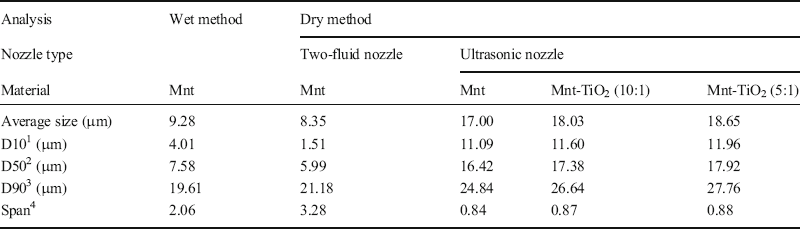
The average particle size of Mnt in aqueous suspension, used as a starting material for the synthesis of Mnt-TiO2, was 9.28 μm, analyzed by the wet method (Table 2). The PSD of Mnt in the suspension showed a unimodal distribution, ranging from 2.313 to 62.23 μm and a ‘span value’ (particle distribution width calculated by distribution parameters (D90-D10)/D50) of 2.06 (Fig. 5a, Table 2). Prior to synthesis of Mnt-TiO2 composites, a two-fluid nozzle and an ultrasonic nozzle were compared in terms of their resulting particle-size uniformity using Mnt. The average particle size of spray-dried Mnt prepared using a two-fluid nozzle was 8.35 μm and that for an ultrasonic nozzle was 17.00 μm, (Table 2). While the PSD curve of particles produced by the former has a wider size distribution (span value = 3.28) with the size ranging from 0.688 to ~74 μm, the PSD curve produced by the latter nozzle had a unimodal, narrower size distribution (span value = 0.84), with particle size ranging from 6.54 to 52.33 μm (Fig. 5b,c). The ultrasonic nozzle was chosen over the two-fluid nozzle, therefore, for the synthesis of Mnt-TiO2 composites, to obtain a more uniform particle size. This was supported by a comparative study using an identical instrument on the effects of ultrasonic, two-fluid, or three-fluid nozzles on the PSD, which showed that the ultrasonic nozzle gave a narrower PSD curve than the other two (Legako and Dunford Reference Legako and Dunford2010; Schaefer and Lee Reference Schaefer and Lee2015). Furthermore, Mnt particles treated by an ultrasonic nozzle exhibited a crumpled spherical morphology with a wrinkled surface (Fig. 4b). This phenomenon was attributed to instant evaporation of the liquid under capillary pressure (Tsapis et al. Reference Tsapis, Dufresne, Sinha, Riera, Hutchinson, Mahadevan and Weitz2005; Bahadur et al. Reference Bahadur, Sen, Mazumder, Paul, Bhatt and Singh2012; Bari et al. Reference Bari, Parviz, Khabaz, Klaassen, Metzler, Hansen, Khare and Green2015).
Particle-size distribution of Mnt and Mnt-TiO2 composites

110th percentile of particle diameter curve. 2 50th percentile of particle diameter curve. 3 90th percentile of particle diameter curve. 4 Measurement of the spread of the distribution obtained as (D90-D10)/D50
Particle-size distribution of a purified Mnt suspension; spray-dried Mnt with a b two-fluid nozzle and c ultrasonic nozzle; and spray-dried d Mnt-TiO2 (10:1) and e Mnt-TiO2 (5:1)

The XRD patterns of two Mnt-TiO2 composites (10:1 and 5:1) revealed that composites had been synthesized successfully (without loss of crystallinity of the Mnt framework (Fig. 3b)) using a spray dryer with an ultrasonic nozzle. Major peaks at 24.40, 36.06, 41.24, and 54.32°2θ corresponding to the (110), (101), (111), and (211) reflections of rutile were observed in XRD patterns of the two composites. The particle shape of the Mnt-TiO2 composites appeared to be nearly spherical (Fig. 4c-f). The SEM images of composite surfaces taken at high magnification show massive, curved plates with TiO2 nanoparticles (Fig. 4g,h). The sizes of the TiO2 nanoparticles used in the present study were between 30 and 50 nm (Fig. 4i,j). In comparison with previous studies on the preparation of Mnt-supported (Dong et al. Reference Dong, Ng, Hu, Shen and Tan2014; Dening et al. Reference Dening, Joyce, Kovalainen, Gustafsson and Prestidge2019) or illite-supported (Stunda-Zujeva et al. Reference Stunda-Zujeva, Stepanova and Bērzi$nLa-Cimdi$nLa2015) composites using a spray dryer, the method used here has produced more uniform and regularly shaped particles.
Chemical analysis (Table 1) showed that the TiO2 content in the final Mnt-TiO2 composites with Mnt:TiO2 ratios of 10:1 and 5:1 were 10.59 and 17.84 wt.%, respectively. Elemental mapping by SEM-EDS revealed a homogeneous distribution of Ti in the composites (Figs 5g,h and 6). More TiO2 in the starting material led to more TiO2 in the composite (the 5:1 starting material had 68% more TiO2 in the final composite than the 10:1 starting material). The average particle size of the Mnt-TiO2 composites increased slightly from 18.03 μm (10:1) to 18.65 μm (5:1). This result was supported by previous reports on the effect of atomizing energy, feeding rate, surface tension, and suspension viscosity on particle size obtained with the spray-drying method (Vicente et al. Reference Vicente, Pinto, Menezes and Gaspar2013). The narrow PSD curves of the two composites prepared with an ultrasonic nozzle were similar to those obtained from purified Mnt (Fig. 5c-e). The span values of the two composites, were 0.87 (10:1) and 0.88 (5:1), which are reasonable compared to results from previous studies (Synder and Lechuga-Ballesteros Reference Synder, Lechuga-Ballesteros, Augsburger and Hoag2008; Wang et al. Reference Wang, Purwanto, Lenggoro, Okuyama, Chang and Jang2008). In a study on spray-dried protein formulation using two different atomizing nozzles (Synder and Lechuga-Ballesteros Reference Synder, Lechuga-Ballesteros, Augsburger and Hoag2008), the distribution width of a dried sample using an ultrasonic nozzle was less than that by a two-fluid nozzle; the former was 1.0 and the latter was 1.9. The span values, results for an ultrasonic nozzle on correlations between particle- and droplet-size distributions, were 1.07-2.66 (Wang et al. Reference Wang, Purwanto, Lenggoro, Okuyama, Chang and Jang2008).
SEM-EDS elemental mapping images of Mnt and Mnt-TiO2 composites. a Mnt, b and d Mnt-TiO2 (10:1), c and e Mnt-TiO2 (5:1)

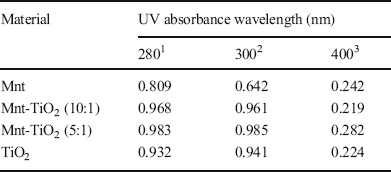
The UV absorption capabilities of TiO2, Mnt, and the two Mnt-TiO2 composites were examined by UV spectrophotometry with wavelengths from 250 to 600 nm (Fig. 7) and the data of their UV absorbance in three selected wavelengths: 280 nm (borderline wavelength of UVC and UVB), 300 nm (most hazardous UV spectra; Young et al. Reference Young, Harrison, Chadwick, Nikaido, Ramsden and Potten1998), and 400 nm. UV results from the Mnt used to prepare the composites in the present study were compared with those obtained from other, purer Mnt samples (Wyoming, STx-1, SAz-1, and SWy-2 from the Source Clays Repository of The Clay Minerals Society) published by Hoang-Minh et al. (Reference Hoang-Minh, Le, Kasbohm and Gieré2010). Bentonite by itself has a UV filtering ability because of electron-charge transfer mechanisms derived from Fe3+, which is a structural octahedral Y-position atom (Chen et al. Reference Chen, Shaked and Banin1979), but the addition of TiO2 increases its UV filtering capability. The UV absorbance of the Mnt-TiO2 (5:1) composite was ~21.5% (280 nm), 53.4% (300 nm), and 16.5% (400 nm) greater than for purified Mnt (Table 3). Results for the Mnt-TiO2 (10:1) composite were slightly less, with the absorbance increasing by ~19.7% (280 nm) and 49.7% (300 nm) over purified Mnt. Similar results were reported for TiO2/bentonite and TiO2/Kunipia-F Mnt (Mishra et al. Reference Mishra, Mehta, Sharma and Basu2017). The UV absorbance of pure TiO2 was similar to that of Mnt-TiO2 (5:1). The UV absorption ability of Mnt-TiO2 (10:1) was as effective as that of the 5:1 composite and of TiO2 in the UVC to UVB range (250–315 nm); UV absorption by the 10:1 composite was weaker in the UVA range (315–400 nm), however. Because UV radiation from 300 to 360 nm, although less hazardous than UV 280–300 nm, can damage skin regardless of the epidermal layer (Young et al. Reference Young, Harrison, Chadwick, Nikaido, Ramsden and Potten1998), a formulation providing more TiO2 than found in Mnt:TiO2 (10:1) is important.
UV absorbance spectra of TiO2, Mnt, Mnt-TiO2 (10:1), and Mnt-TiO2 (5:1) composites

UV absorbance of Mnt, Mnt-TiO2 (10:1), and Mnt-TiO2 (5:1) composites

1End of the UV-B range. 2 The most hazardous wavelength for skin damage. 3 End of the UV-A range.
Finally, brightness is an important property of cosmetics and should increase as the very white TiO2 content increases. Powdered samples prepared in the present study were analyzed by reflectance colorimetry to quantify this effect, and revealed that the brightness of the Mnt-TiO2 composites was enhanced by 1.14% (10:1) and 14.13% (5:1) as the TiO2 contents increased. The brightness of Mnt-TiO2 composites may, thus, be controllable depending on the TiO2 loading. Together with the whiteness effect of TiO2, the purity and/or characteristics (e.g. trace elements of framework and/or non-framework) of Mnt can also influence the brightness of the composites.
A potentially adverse effect of TiO2 loading in cosmetics is an increase in toxicity. Recently, smaller TiO2 nanoparticles have been used for advanced application and cosmesis (Schneider and Lim Reference Schneider and Lim2019). Although TiO2 is generally regarded as safe, some concern has been expressed about its nanotoxicity because TiO2 particles <60 nm in size can penetrate the dermis and accumulate in major organs such as skin, subcutaneous muscle, heart, liver, spleen, lung, kidney, and brain, inducing reactive oxygen species-related responses and in vivo weight loss (Wu et al. Reference Wu, Liu, Xue, Zhou, Lan, Bi, Xu, Yang and Zeng2009). Furthermore, nanoparticle toxicity is known to increase as size decreases (Limbach et al. Reference Limbach, Li, Grass, Brunner, Hintermann, Muller, Gunther and Stark2005; Rothen-Rutishauser et al. Reference Rothen-Rutishauser, Schürch, Haenni, Kapp and Gehr2006; Fujiwara et al. Reference Fujiwara, Suematsu, Kiyomiya, Aoki, Sato and Moritoki2008; Jeong et al. Reference Jeong, Won, Kang, Lee, Hwang, Hwang, Zhou, Souissi, Lee and Lee2016). By combining TiO2 with Mnt in the composites, the particle size is much greater than 60 nm, suggesting that the Mnt-TiO2 composites are a promising active UV filter ingredient with less potential toxicity than TiO2 nanoparticles used alone.
Conclusions
Mnt-TiO2 composites can be used effectively as an inorganic UV filter in sunscreen cosmetics for UV protection. To scale up preparation of Mnt-TiO2 composites, or even Mnt alone, for industrial purposes the use of spray drying with an ultrasonic nozzle (rather than a two-fluid nozzle) is desirable in order to achieve uniform and nearly spherical, micro-sized granules suitable for cosmetic applications. The UV absorption ability of Mnt-TiO2 composites with Mnt:TiO2 weight ratio of <10:1 is as effective as TiO2 alone for dangerous UV wavelengths. Taken together, these results demonstrate a simple and effective method to produce a Mnt-TiO2 composite of uniform size and shape with enhanced UV absorption as an active sunscreen ingredient in cosmetic applications via spray drying.
ACKNOWLEDGMENTS
This research was supported by the Basic Research Project (Grant 20-3213) of the Korea Institute of Geoscience and Mineral Resources (KIGAM) funded by the Ministry of Science, ICT, and Future Planning of Korea.
Funding
Sources are as stated in the Acknowledgments.
Compliance with Ethical Statements
Conflict of Interest
The authors declare that they have no conflict of interest.