INTRODUCTION
In the dry season of the semi-arid tropics, land with a standing water table is able to grow some field crops without irrigation. Such land commonly occurs in the rice-based lowlands in Thailand (Jintrawet et al., Reference Jintrawet, Katawetin and Kerdsuk1983; Polthanee, Reference Polthanee1991), Nigeria (Adigbo et al., Reference Adigbo, Okeleye and Adigbo2007), Bangladesh (Hassan et al., Reference Hassan, Karim, Hamid and Salam2003), India (Kar and Kumar, Reference Kar and Kumar2009), Indonesia and the Philippines (Rahmianna et al., Reference Rahmianna, Adisarwanto, Kirchhof and So2000; So and Ringrose-Voase, Reference So and Ringrose-Voase2000). Success of dry season cropping depends largely on crop establishment and the subsequent availability of soil moisture (Zandstra, Reference Zandstra1982). The amount of water potentially available to dry season crops depends on both the amount of stored soil moisture at sowing plus additions from rainfall or capillary water rising from a shallow water table (Kerdsuk, Reference Kerdsuk1986; Logsdon et al., Reference Logsdon, Hernandez-Ramirez, Hatfield, Sauer, Prueger and Schilling2009).
Previous studies on dry season cropping suggested that peanut seeds should be sown deeply (10–15 cm) in the field when the water table gradually receded downward in the soil profile and topsoil (0–15-cm depth) dried out very quickly to below permanent wilting point (PWP) late in the growing season (Chantron, Reference Chantron1983; Kerdsuk, Reference Kerdsuk1986; Khongmorn, Reference Khongmorn1994; Polthanee, Reference Polthanee2001). Polthanee (Reference Polthanee2001) indicated that peanut after deep seeding (15 cm) in the dry season with a shallow water table gave highest leaf area index (LAI), dry matter and seed yield because of the greater root length density in the deep soil layer. Sowing deeply may enhance establishment because of higher soil moisture content around the seed and lead to better germination and emergence of seedlings (Mahdi et al., Reference Mahdi, Bell and Ryan1998; Schillinger et al., Reference Schillinger, Donaldson, Allen and Jones1998). Since soil moisture generally increases with depth, deeper planting may ensure an adequate plant population (Stucky, Reference Stucky1976). Siddique and Loss (Reference Siddique and Loss1999) reported that sowing large seeded legumes, chickpea (Cicer arietinum L.) and faba bean (Vicia faba L.) at depth may improve crop establishment where moisture from summer and autumn rainfall is stored in the subsoil below 5 cm, by reducing damage from herbicides applied immediately before or after sowing and by improving the survival of Rhizobium inoculated on the seed due to more favourable soil conditions around the deeply placed seed. Increased sowing depth may enhance root penetration to greater soil depth to explore the soil moisture that remains available at depth throughout the crop cycle (Polthanee, Reference Polthanee2001). In addition, greater sowing depth can reduce the chance of damage by birds, mice (Brown et al., Reference Brown, Singleton, Tann and Mock2003) and white mold (Lamb and Johnson, Reference Lamb and Johnson2004).
Notwithstanding the above benefits of deep sowing, this is also reported in other circumstances to hamper or delay emergence of seedlings (Banks and Gilmour, Reference Banks and Gilmour1979; Hadjichristodoulou et al., Reference Hadjichristodoulou, Della and Photiades1977; Paula Júnior et al., Reference Paula Júnior, Rotter and Hau2007; Roundy et al., Reference Roundy, Winkel, Cox, Dobrenz and Tewolde1993) and to decrease subsequent growth and yields of plants (Nambiar and Srinivasa Rao, Reference Nambiar and Srinivasa Rao1987; Ouled Belgacem et al., Reference Ouled Belgacem, Neffati, Papanastasis and Chaieb2006; Paula Júnior et al., Reference Paula Júnior, Rotter and Hau2007; Yagmur and Kaydan, Reference Yagmur and Kaydan2009). Seedling emergence was decreased with depth of sowing due to lack of aeration (Roundy et al., Reference Roundy, Winkel, Cox, Dobrenz and Tewolde1993) and a thick soil layer above seedling shoots (Aikins and Afuakwa, Reference Aikins and Afuakwa2008). The time of emergence of the first leaf is greater from deep sowing than from shallow sowing because the first leaf starts from a deeper point (Hadjichristodoulou et al., Reference Hadjichristodoulou, Della and Photiades1977; Kudair and Adary, Reference Kudair and Adary1982). Shanmuganathan and Benjamin (Reference Shanmuganathan and Benjamin1992) suggested that increased sowing depth delayed seedling emergence and reduced seedling relative growth rate due to low light interception by small cotyledons. In previous studies, damage of the first leaf due to opening of the coleoptile within the substrate was proposed as the main cause of decreased emergence with deep sowings of wheat (Andrews et al., Reference Andrews, Scott and Mckenzie1991; Whan, Reference Whan1976) although no equivalent reports exist for large seeded legumes. However, deep sowing (>10 cm) was reported to reduce growth and yield of crops, such as peanut (Nambiar and Srinivasa Rao, Reference Nambiar and Srinivasa Rao1987; Rao and Reddy, Reference Rao and Reddy1985), even though it placed the seed closer to the stored moisture in the soil profile.
When there is adequate moisture throughout the soil profile in the dry season, there may be a penalty from sowing seeds too deep. It was hypothesized that under field conditions with a shallow standing water table and enough soil moisture for crop growth in the soil profile for the entire growing season it would not be necessary to sow seeds deep. Direct experimental evidence is lacking or inconclusive for our hypothesis. To investigate the hypothesis, three field experiments were conducted on sandy soil profiles with standing water tables at varying depths. The objectives of this study were to determine effects of sowing depth on emergence, growth and yield of four legume crop species in sandy soils without irrigation in fields where there was a shallow standing water table after harvest of rice.
MATERIALS AND METHODS
Experimental design and treatments
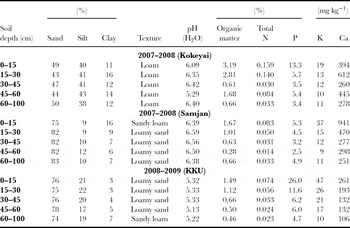
Field experiments were undertaken at three sites in Khon Kaen province, Northeast Thailand. Sites 1 and 2 were conducted in farmers’ fields at Kokeyai village (Baan Fang district; latitude 16°28´ N, longitude 102°39´ E) and Samjan village (Muong district; latitude 16°42´ N, longitude 102°48´ E) from 13 December 2007 to 27 March 2008 (dry season). Site 3 was conducted at the Fruit Crops Research Station (latitude 16°28´ N, longitude 102°48´ E) located in Khon Kaen University (KKU) from 17 December 2008 to 27 March 2009 (dry season). Average temperature in Khon Kaen province during the growing season in 2007–2008 and 2008–2009 ranged from 25 to 27 °C and 22 to 29 °C, respectively. The soil in Kokeyai is a Typic Paleustults (Satuk soil series), in Samjan it was an Arenic Haplustalf (Nam Phong soil series) and in KKU it was a Typic Kandiustult (Chum Phuang soil series). Soils were analysed for texture by the hydrometer method, and soil water holding capacity was analysed by a pressure plate (–10 and –1500 kPa); chemical properties, viz. pH by 1:2.5 H2O, organic matter was determined by the Walkley–Black wet oxidation method, total N was determined by the micro-Kjeldahl method, extractable P by the Bray II method and exchangeable K and Ca were determined by using 1 M ammonium acetate extraction at pH 7 (Simard, Reference Simard and Carter1993). Physical and chemical properties of soils in Kokeyai, Samjan and KKU are presented in Table 1. All locations were selected because the soils experience capillary water rise from a shallow water table in the dry season.
Soil physical and chemical properties in Kokeyai and Samjan (2007–2008), and KKU (2008–2009) at 0–15, 15–30, 30–45, 45–60 and 60–100-cm depth.

A split–split plot design was used with four legume species (peanut, cowpea, mungbean and soybean) in the main plot, two levels of sowing depth (5 and 15 cm from soil surface) as the split plot factor and sampling time as a repeated measure. Experiments were replicated four times.
In the year 2007–2008, peanut (Arachis hypogaea c.v. Tainan 9), cowpea (Vigna unguiculata c.v. KKU 264 R), mungbean (Vigna radiata c.v. U-thong 1) and soybean (Glycine max c.v. NakhonSawan 1) were grown at shallow and deep sowing depths. In the year 2008–2009, cowpea (Vigna unguiculata c.v. KKU 264 R) and mungbean (Vigna radiata c.v. U-thong 1) were grown at shallow and deep sowing depths.
Legume seeds were sown at two depths, approximately 5 cm (called shallow sowing), which was the ordinary seeding depth (Dungan and Ross, Reference Dungan and Ross1957; Martin and Leonard, Reference Martin and Leonard1965), and approximately 15 cm (referred to as deep sowing).
At each sampling date, samples were collected from plots in separate replicate blocks.
Crop management
After rice was harvested from each field in 2007–2008, rice straw was removed and soil was ploughed and harrowed thrice to loosen the topsoil to 15-cm depth. The soil was allowed to dry for two to three days after each round of plowing and harrowing. Before final plowing and harrowing, soil was fertilized with 15–15–15 compound fertilizer (N:P2O5:K2O) at 156 kg ha−1 by broadcasting and limed at 625 kg ha−1 to raise pH to nearly 7. In 2008–2009, after weeding, soil was prepared in a similar manner as done in the previous year. Sub-plot dimensions in Kokeyai, Samjan and KKU were 2.5 × 11, 5 × 8, and 7 × 7 m, respectively.
For shallow sowing, seeds were placed in furrows made by a Planet Jr. (approximately 5 cm from soil surface). For deep sowing, seed sowing was accomplished using a plow drawn by two-wheel tractor to make furrows of approximately 10 to 15-cm depth. The seeds were then dropped in the furrows and covered with the soil when the adjacent furrow was prepared. Peanut seeds were soaked in water for 24 h before planting but seeds of other legume species were soaked for only 4 h and treated with Captan at 5 g kg−1 seed to protect seedlings from crown rot. Only soybean seeds were inoculated with 1 mL of dense Rhizobium japonicum before planting; other legumes nodulate effectively without inoculation in these soils (Hinson and Hartwig, Reference Hinson and Hartwig1982; Khongmorn, Reference Khongmorn1994). In 2007–2008, seeds were sown with two seeds per hill at 0.5-m row-to-row spacing and 0.10-m plant-to-plant spacing. In 2008–2009, seeds were sown with two seeds per hill in the plant spacing of 0.35 × 0.10 m, and seedlings were thinned to one plant per hill at two weeks after seeding. There was no weeding or fertilizer application after planting. Pests and diseases were controlled by weekly applications of carbosulfan (20% w/v, water soluble concentrate) at the rate of 2.5 L ha−1, methomyl (40% soluble powder) at the rate of 1.0 kg ha−1 and carboxin (75% wettable powder) at the rate of 1.68 kg ha−1. The experiment was kept under rainfed conditions, so there was no irrigation in the field.
Soil moisture and water table
Soil moisture was recorded throughout the growing season using the gravimetric method for the depths of 0–15, 15–30, 30–45, 45–60 and 60–100 cm. Soil samples were collected one core per plot. Water table level was observed by the rise of water in perforated polyvinyl chloride (PVC) tubes, installed at 20-, 40- and 100-cm soil depth. Four PVC tubes were installed to measure average water table levels at all locations. Each tube was located near the corner of each experimental field. Water table depth was measured from the soil surface in the PVC tube throughout the experiment by using a calibrated wooden stick.
Seed yield and harvest index (HI)
After physiological maturity, seed yields were determined from 50 hills randomly chosen in each plot. Pods were shelled out and cleaned after air-drying. Mature, intact and healthy seeds were then weighed for yield calculation. Harvest index was calculated as the ratio of total seed yield to total biomass, including good seed weight at final harvest.
Emergence and shoot dry weight
Seedling emergence in each plot was counted from five groups of 20 hills. Plant samples for shoot growth analyses were collected from 16 hills per plot randomly selected at 3, 6 and 9 weeks after sowing (WAS) in 2007–2008 and 3, 6, 9 and 11 WAS in 2008–2009. Plants in each plot were sampled for shoot growth analysis by separating the plant into stem, leaf and pod (when present), and dried at 80 °C for 48 h. Crop growth rate (CGR) was computed as described by Hunt (Reference Hunt1978) in g m−2 day−1:
 \[
{\rm CGR} = {\rm W}_2 - {\rm W}_1 /{\rm t}_2 - {\rm t}_1,\]
Data analysis
Data were analysed for emergence percentage, total shoot dry weight, seed yield and harvest index. A split plot design was applied using STATISTIX-8, except where there were multiple harvests or sampling times when a repeated measures design was applied.
RESULTS
Rainfall and water table depth
In 2007–2008, legumes received rainfall in Kokeyai twice at 7 (8.5 mm) and 13 (24.3 mm) WAS, and Samjan received rainfall at 6 (4.8 mm), 7 (2.7 mm) and 13 (7.8 mm) WAS. In 2008–2009, legumes received rainfall in KKU at 1 (0.5 mm) and 10 (6.2 mm) WAS. Total rainfall at all locations in both years was minimal. Therefore, growth of crops relied largely on capillary water rising from the shallow water table apart from residual soil moisture in the soil profile at sowing.
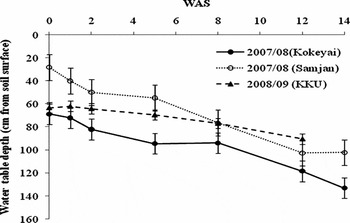
In 2007–2008, measured water table depths ranged from 69 to 133 cm below the soil surface in Kokeyai and 28 to 102 cm below the soil surface in Samjan. In 2008–2009, water table depth ranged from 62 to 90 cm below the soil surface in KKU. The water table depth declined below 100 cm at 9 WAS in Kokeyai and 12 WAS in Samjan, while at KKU it never declined below 100 cm (Figure 1).
Water table depth after sowing (weeks after sowing, WAS) in Kokeyai and Samjan (2007–2008), and Khon Kaen University (KKU) (2008–2009) during the growing season. Vertical bars represent standard error.

Soil water content
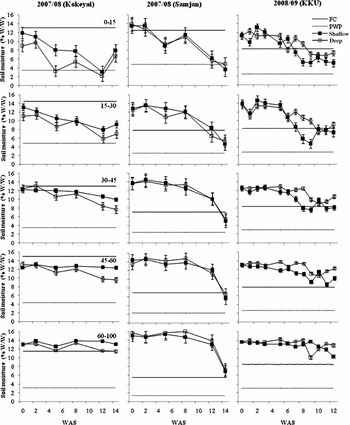
Soil water in the topsoil (0–15 cm from soil surface) of all locations decreased to near PWP at harvest. However, soil water levels increased with depth. Soil water contents in the subsoil (>15 cm from soil surface) remained in the available ranges throughout the growing season (Figure 2). Thus, legumes at all locations seemed to have enough water during the growing season and did not experience water deficit. The depth of sowing did not affect soil moisture content (Figure 2).
Soil water content of shallow- and deep-sown plots (weeks after sowing, WAS) at 0–15, 15–30, 30–45, 45–60 and 60–100 cm in Kokeyai and Samjan (2007–2008), and Khon Kaen University (KKU) (2008–2009) during the growing season. Horizontal lines represent water contents at field capacity (FC) and permanent wilting point (PWP). Vertical bars represent standard error.

Emergence percentage
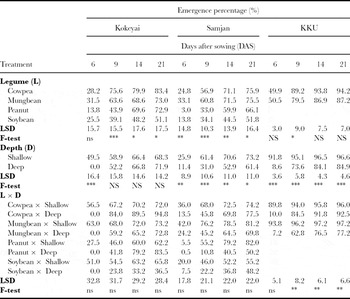
Deep sowing delayed emergence by approximately 3–7 days for all legumes at all locations. Cowpea and mungbean had higher emergence percentage than peanut and mungbean in Kokeyai and Samjan (Table 2). Emergence percentage of legumes after shallow sowing was higher than after deep sowing at all locations by approximately 14–83% (Table 2). There was no interaction between legume species and sowing depth for emergence at Kokeyai and Samjan. In KKU, deep-sown mungbean had the lowest emergence percentage at 9, 14 and 21 days after sowing (Table 2).
Emergence percentage (%) of legumes after shallow and deep sowing in Kokeyai and Samjan (2007–2008), and KKU (2008–2009).

LSD: Least significant difference at the 0.05 probability level.
NS: Non-significant.
Significant at the *0.05, **0.01 and ***0.001 probability levels.
Total shoot dry weight
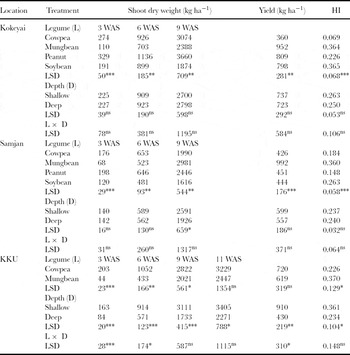
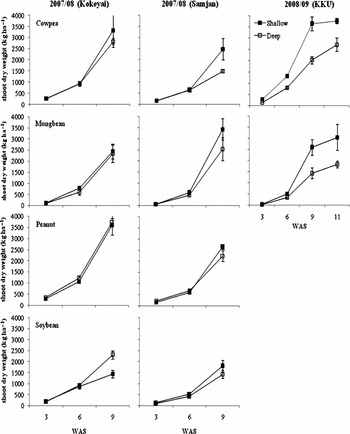
In 2007–2008, shoot dry weights of legumes after shallow and deep sowing were not significantly different at 3, 6 and 9 WAS for all legumes at both locations. Except at 9 WAS, deep sowing of soybean raised shoot dry weight in Kokeyai, but deep sowing of cowpea depressed shoot dry weight in Samjan. (Table 3 and Figure 3)
Shoot dry weight, seed yield and harvest index (HI) of cowpea, mungbean, peanut and soybean after shallow and deep sowing depth in Kokeyai, Samjan and KKU.

WAS: Weeks after sowing.
LSD: Least significant difference at the 0.05 probability level.
NS: Non-significant.
Significant at the *0.05, **0.01 and ***0.001 probability levels.
Total shoot dry weight (kg ha−1) of legumes after shallow and deep sowing in Kokeyai and Samjan (year 2007–2008), and KKU (year 2008–2009) at 3, 6 and 9 weeks after sowing (WAS). Values are means of four replicates. Vertical bars represent standard error. Statistical tests for the data are shown in Table 2.

In 2008–2009, shoot dry weights after shallow sowing were higher than after deep sowing in cowpea and mungbean at every sampling date (Table 3 and Figure 3).
Seed yield and harvest index
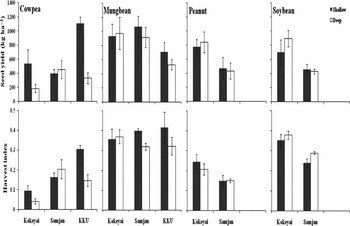
Legumes after shallow and deep sowing had similar seed yield in both years and at all locations except cowpea in KKU, where shallow sowing raised seed yields (Table 3 and Figure 4). Harvest indices of legumes after shallow and deep sowing were not significantly different at every location except cowpea at KKU and mungbean at Samjan, where shallow-sown legumes had higher harvest index than deep-sown legumes (Table 3 and Figure 4).
Seed yield (kg ha−1) and harvest index (HI) of legumes after shallow and deep sowing in Kokeyai and Samjan (year 2007–2008), and KKU (year 2008–2009). Values are means of four replicates. Vertical bars represent standard error. Statistical tests for the data are shown in Table 2.

DISCUSSION
Emergence percentage
Deep sowing delayed emergence rate of all legumes at all locations by 3–7 days. Such delays in emergence could make seedlings more susceptible to emergence constraints such as soil crusting, waterlogging due to unseasonal late rain, diseases, insect damage and weed competition (Banks and Gilmour, Reference Banks and Gilmour1979). Moreover, plant emergence was more variable with deep sowing. Variation in plant age by up to a week could cause inconsistent maturity leading to harvesting difficulties and quality variation (Banks and Gilmour, Reference Banks and Gilmour1979).
Notwithstanding the delay in emergence, final emergence counts of deep-sown legumes were similar to or lower than shallow-sown legumes except increase with cowpea and peanut at Kokeyai, which was the driest location. Legumes emerged well after shallow sowing, perhaps because soil in the seed zone approximately 5 cm underneath the soil surface had adequate water for seedling emergence in these trials. In contrast, deep-sown legumes did not emerge as well because of adverse effect from increased soil strength or higher soil water content on seed germination and/or emergence. Mahdi et al. (Reference Mahdi, Bell and Ryan1998) reported that sowing wheat at 12 cm decreased seed emergence and led to reduced seedling vigour. Increasing sowing depth below 5 cm reduced seedling emergence of Japanese chestnuts (Castanea crenata) (Seiwa et al., Reference Seiwa, Watanabe, Saitoh, Kannu and Akasaka2002) because a greater fraction of seed reserves were exhausted before the emergence of seedling. Similarly, Banks and Gilmour (Reference Banks and Gilmour1979) suggested that 4 to 6 cm was a more reliable sowing depth for germination and emergence than 8 to 12 cm for soybean planted in the dry season when the soil water at that level was adequate. By contrast, Siddique and Loss (Reference Siddique and Loss1999) suggested that sowing at 10-cm depth improved crop establishment in faba bean and chickpea, both large-seeded legumes, but only in fields which had soil water stored below 4 cm. Such differences in results of studies may be related to seed size in relation to planting depth, soil strength and soil water around and below the seed.
Growth and yield
Yield and harvest index of legumes did not differ meaningfully among sowing depths. Growth of deep-sown legumes was mostly similar to or lower than shallow-sown legumes as reflected in total shoot dry weight. The exception was soybean in Kokeyai at 9 WAS where deep-sown legume had higher shoot dry weight than shallow-sown legume. Kokeyai had the lowest soil water content in the topsoil, and soybean is the most sensitive of the grain legumes to water stress (Wright, Reference Wright, Wright and Nageswara Rao1994). Deep sowing might help soybean roots to penetrate into deeper soil profile to access more water. Buakum et al. (Reference Buakum, Limpinuntana, Vorasoot, Pannangpetch and Bell2012) found that deep-sown legume crops (approximately 15 cm) in sands with receding water table depth had deeper and finer root systems than shallow-sown crops (approximately 5 cm).
By contrast with the present results, Chantron (Reference Chantron1983) reported that growth and yield of peanut in the dry season without any irrigation after sowing at 10- and 15-cm depths were significantly higher than at 5-cm depth. Peanut in that study was grown in a field where topsoil water content was lower than PWP between 12 and 15 WAS. Chantron (Reference Chantron1983) argued that deep sowing allowed the root system to utilize soil water at greater depth in the field where there was 1–1.5-m water table depth. Jintrawet et al. (Reference Jintrawet, Katawetin and Kerdsuk1983) also reported that deep sowing (approximately 10–15 cm) facilitated root exploration for water in deep soil layers which in turn promoted growth and yield for peanut cultivation after rice harvesting at locations with soil water content of 0–10 cm, which dropped below PWP late in the growing season. Furthermore, Polthanee (Reference Polthanee2001) found that peanut grown after rice in the dry season of Northeast Thailand after deep sowing (15 cm) gave the highest growth and yield when soil water content at 0–15 cm fell below PWP 10 WAS.
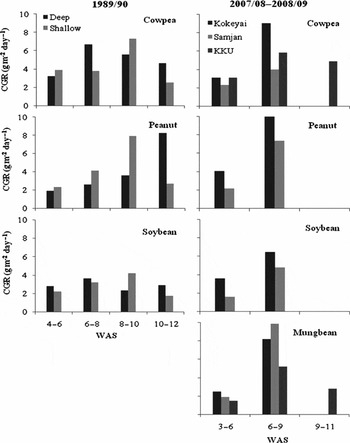
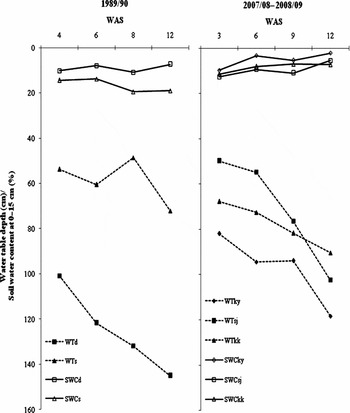
The above-referred studies had lower water table depth and lower soil water content than the three sites in the present study. Collectively, these results suggest that deep sowing leads to better growth and yield of legume crops when topsoil dries out to PWP within 10 weeks of sowing. On the other hand, it was not necessary to sow seeds deep at locations with a shallow and slowly receding water table. For example, Khongmorn (Reference Khongmorn1994) reported that crop growth rates of cowpea, peanut and soybean after deep sowing (approximately 10–15 cm) in Kokeyai were lower in a field with shallow water table depth (54–75-cm underneath soil surface) than with deep water table depth (101–145 cm), especially late in the growing season (at 10–12 WAS) (Figure 5). Water table depths in Kokeyai, Samjan and KKU in the present study were intermediate between the deep water tables and the shallow water tables in Kokeyai in 1989–1990 (Figure 6). Soil texture affects capillary rise from a water table with greater water rise in clay than in sand (Hillel, Reference Hillel and Hillel1998). Clay contents in this study (3–16% clay) and in the study by Khongmorn (Reference Khongmorn1994) (6–10% clay) were similar, so in the studies there was no expected significant difference in capillary rise of water from the water table. The shallow-sown legumes grew well in the present study in the dry season without irrigation because soil water contents throughout the soil profile of all locations were in the available range throughout the growing season.
Crop growth rate (CGR) of cowpea, peanut, soybean and mungbean after deep sowing (~15 cm) on paddy fields with deep (Deep) or shallow (Shallow) water tables in Kokeyai in 1989–1990 (Khongmorn, Reference Khongmorn1994) and in Kokeyai, Samjan and KKU in 2007–2008–2008–2009.

Water table depth (deep – WTd; shallow – WTs) and soil water content (0–15 cm) (deep – SWCd; shallow – SWCs) in paddy fields in Kokeyai in 1989–1990 (Khongmorn, Reference Khongmorn1994) and Kokeyai (WTky), Samjan (WTsj) (both in 2007–2008) and KKU (WTkk) (in 2008–2009). Soil water content (0–15 cm) labels as follows: Kokeyai (SWCky), Samjan (SWCsj) and KKU (SWCkk).

The present results define the water tables and soil water drying conditions that favour deep versus shallow sowing of legumes in sandy paddy fields after rice. These findings have relevance to a wide range of sandy paddy fields in Northeast Thailand, Laos, Cambodia and Vietnam.
CONCLUSIONS
Although deep sowing helps legume roots penetrate deeper in the soil profile to explore water, it also delayed seedling emergence and consequently reduced growth and yield of crops at sites with available water in the topsoil throughout the growing season. Thus, deep sowing was not beneficial for the dry season cropping in field conditions with shallow water table and adequate stored soil water for crop growth.
Sandy rice fields that can support satisfactory yield of legume crops in the dry season without irrigation by shallow sowing should maintain soil water content at 0–15-cm depth greater than PWP throughout the growing season.
Acknowledgements
The authors are grateful for the financial support of the Royal Golden Jubilee PhD Program (Grant No. PHD/0268/2545) under the Thailand Research Fund, and also for support by the Farming System Research Group of Khon Kaen University.