As Marmot and Wilkinson have suggested, because the health of an individual is greatly affected by social and environmental factors, the role of community is important for the health of individuals.Reference Marmot and Wilkinson1 For practical intervention in the health of individuals, the necessity of a population approach has been widely recognized since Rose’s precepts.Reference Rose2 Since the Great East Japan Earthquake (GEJE) on March 11, 2011, we have become even more convinced of the roles of community in saving lives, both during the acute phase of the disaster and during the recovery phase that follows.3, Reference Matsumoto, Yamaoka and Inoue4 In the Hyogo Framework for Action 2005–2015 by The United Nations International Strategy for Disaster Reduction (UNISDR), community-level development and the strengthening of institutions, mechanisms, and capacities, in particular, were emphasized at all levels to systematically enhance resilience against disasters.5, 6
Similar to resilience, disaster vulnerability is constructed socially.Reference Morrow7 The concept of social vulnerability in a disaster management context was introduced in the 1970 s when researchers recognized that vulnerability also involves socioeconomic factors affecting community resilience.Reference Juntunen8, Reference Flanagan, Gregory, Hallisey, Heitgerd and Lewis9 In 2009, the UNISDR defined vulnerability as “the conditions determined by physical, social, economic, and environmental factors or processes, which increase the susceptibility of a community to the impact of hazards.”5 Knowledge about the areas where vulnerable people are located and about the general nature of their circumstances are important for effective emergency management.Reference Morrow7, Reference Wood, Burton and Cutter10 Therefore, the identification of vulnerable communities may be the first step in responding to a disaster and preparing for future disasters. The development of simple measures using existing information is beneficial for identifying vulnerable communities and for building resilient communities. We hypothesized that demographic information from before the time of the disaster, as part of the community diagnosis,Reference Masami11 could help to identify vulnerable communities.
Ishinomaki City, a coastal town located in the Tohoku region of northeast Japan (total population 160,826), is the municipality with the largest number of casualties caused by the GEJE. More than 70% of the total households in Ishinomaki City (42,157 households) were inundated by the huge tsunami that occurred following the earthquake.12 Immediately after the GEJE, most of the victims had to move to temporary shelters. Six months after the GEJE, temporary housing projects were started, and those whose homes had been destroyed by the GEJE moved to these temporary houses. However, persons from approximately 5000 households remained in or returned to their original homes despite serious damage (referred to as the “the stay-at-home victims”Reference Matsumoto, Yamaoka and Inoue4), and the number of such households is expected to increase.Reference Muto13 Many residents were living exclusively on the second floors of their homes, because the tsunami had swept away the first floors completely. We focused on the stay-at-home victims because they were provided less support by governmental agencies and their needs were not reflected by the agencies, compared with individuals in shelters and temporary housing projects. Owing to poor governmental support and weak neighborly ties in the community, these people faced difficulties and required external support for health and living.
To provide various types of support for the stay-at-home victims, a needs-assessment survey (stay-at-home victims survey) was conducted by a nongovernmental organization, the Health and Life Revival Council in Ishinomaki District (RCI). Using the results from the RCI survey, we identified vulnerable communities in Ishinomaki City.
The purpose of this study was to prepare for future disasters by developing a simple measure for use in identifying disaster-vulnerable communities. To obtain this measure, we sought factors related to communities in need by examining the associations between the pre-disaster demographic characteristics of the communities and the post-disaster proportion of vulnerable households in Ishinomaki City.
Methods
Study Design and Communities
This was a descriptive study in which the community was used as the unit of study rather than the individual resident or household. We performed the study in Ishinomaki City, which comprises 77,143 males and 83,683 females, with a population density of 289 people/km2. The main industry is manufacturing and construction. The mean age is 46.7 years (aging rate, 26.9%). More than 45% of households are nuclear families, and the life expectancy is 80.3 years in males and 86.7 years in females.
In the 2010 Census,14 177 town or village sections made up the study area in Ishinomaki City, Miyagi Prefecture. We defined a community as one town or village section according to the 2010 Census. We excluded 86 communities in which the stay-at-home victims survey was not conducted (because of no apparent effect of the tsunami) and 20 communities in which the survey was conducted in fewer than 5 households. Ultimately, 71 communities were selected as the subject of this study.
The population and number of households in the 71 communities were 69,753 and 18,948, respectively, accounting for 43.3% and 32.8% of the total population and households in Ishinomaki City (177 communities), respectively. The gender ratio (male:female) and proportion of elderly individuals (≥65 years of age) in the 71 communities did not differ greatly from those of the whole population of Ishinomaki City (0.924 vs. 0.922 and 26.1% vs. 27.2%, respectively). In these communities, RCI conducted the stay-at-home survey in 3722 households. This study was approved by the ethics committees of Teikyo University.
Variables
Need for Health and Living Support After the GEJE
We identified the households in need of health and living support (ie, the vulnerable households) according to the stay-at-home victims survey conducted in Ishinomaki City. In each community we calculated the proportions of households with the following 4 types of need: medical, elderly, psychological, and dwelling environment. We regarded the proportions as the vulnerable community index.
The survey was conducted in Ishinomaki City between October 2011 and March 2012 (6 to 12 months after the GEJE) by interviewers of the RCI. Ishinomaki City sustained devastating damage due to the GEJE, a 9.0 magnitude earthquake with a tsunami of more than 8.0 meters. Ishinomaki City experienced the largest number of casualties of all municipalities in Japan and thus was selected as the survey site. A face-to-face survey using a semi-structured questionnaire was conducted. The primary objective of the survey was to identify the households in need of health and living support and to provide the appropriate support to stay-at-home victims.Reference Matsumoto, Yamaoka and Inoue4, Reference Muto13
The RCI, which comprised a number of private bodies including a clinic and nonprofit organizations, started its activities in November 2011 and has aimed to provide rapid and appropriate support in response to the needs of stay-at-home victims in Ishinomaki City. In total, 326 interviewers visited each of the households remaining in the area, including those that experienced severe damage, and interviewed the earthquake and tsunami victims. The semi-structured questionnaire was composed of 5 categories of questions: household information (sex, age, occupation, income of family members), relationship with neighbors and society (presence of friends, communication and exchange, community), meals (intake, appetite), living information (transportation, damage to dwelling, troubles), and health of family members (medical history, present illnesses, physical and psychological symptoms, prescription drugs, physical activities). All interviewers were trained by using both an instruction manual and on-the-job training during home visits with experienced interviewers.Reference Muto13
To identify vulnerable households in need of 1 of the 4 kinds of support, team meetings based on the results of the survey were held once per week. To prepare for the meetings, interviewers confirmed the answers to the questions, and the group leader checked the answer sheets. In attendance at the meetings were the leaders of the interview groups and health or living specialists, such as doctors, public health nurses, nurses, social workers, and staff in charge of relief supply, dwellings, transportation, and information. They assessed each case, focusing on the changes that occurred after the GEJE and their ability to solve problems. These processes enhanced interrater reliability and validity. Examples of required support used to define the vulnerable households were as follows: medical support because of cessation of necessary treatment as the result of closure of their original clinic after the GEJE and difficulty finding a place to receive medical care owing to transportation damage; elderly support because of a lack of knowledge regarding the availability of elderly care for impaired physical activity or dementia; psychological support because of untreated psychological symptoms, such as depression, insomnia, or suicide ideation; and dwelling environment support because of difficulty cleaning up the rubble of one’s home or repairing a home that incurred dangerous damage. Thus, the qualitative needs could be analyzed quantitatively. We determined the number of vulnerable households, as decided during the team meeting, according to 4 types of need and calculated the proportions of households from each community to be used as the vulnerable community index.
Demographic Characteristics Before the GEJE
We selected 9 variables as simple as possible to represent the demographic characteristics of the community before the GEJE by use of the 2010 Census.14, 15 To apply the findings of this study to other areas at risk of disaster, not only in Japan but also in global settings, we selected 6 items of fundamental information: age distribution, marital status, family type of household, duration of residency at the current domicile, industry, and type of last school completed. We calculated the proportions of people or households according to the following variables: age distribution (young people, <15 years of age; aged people, ≥65 years of age), marital status (proportion of widowed or divorced), type of family in household (proportion of one-person households, proportion of households of aged persons over the age of 65 only), duration of residency at the current domicile (proportion of people with residency less than 5 years ), industry (proportion of people who engaged in fisheries or agriculture), and level of education completed (proportion of people who completed senior high school or more). These proportions were then used to define the living situation index of residents within a community. By use of the median values of Ishinomaki City as a whole, each proportion was converted into a binary variable.
Damage Caused by the GEJE
We used tsunami inundation depths and mortality rates as the indexes of damage caused by the GEJE. Using data and maps depicting the levels of inundation obtained from the Ministry of Land, Infrastructure and Transport,16 we evaluated tsunami inundation depths for each community. Communities with no inundation were defined as “0 m,” those with inundation depths >8.0 m in at least part of the community were defined as “10.0 m,” and those with inundation depths >8.0 m in the entire community area were defined as “12.0 m.”
We calculated the mortality rates among each community by dividing the number of deaths by the population before the GEJE, as obtained from the Census 2010.14 The Miyagi Prefectural Government formally recognized 3471 GEJE-related deaths in Ishinomaki City between March 11, 2011, and September 30, 2012, of which 3251 were caused directly by the tsunami or building collapse.17 With the consent of the families, the Police Department of Miyagi Prefecture reported 3079 deaths with detailed information (age, gender, and address),18 and we included these deaths in the mortality rate estimation.
Statistical Methods
Logistic regression analyses were used to determine the statistical associations among the outcome variables (proportions of households in need of medical, elderly, psychological, or dwelling environment support), the explanatory variables, including 9 demographic characteristics of the communities, and the inundation depths and mortality rates as indexes of damage caused by the GEJE.
First, we conducted a univariate analysis of each explanatory variable and calculated the odds ratios (ORs) with 95% confidence intervals (CIs) in Model 1. Next, we adjusted by the proportion of aged people in Model 2. In Model 3, we performed multivariate analyses using as the covariates the proportion of aged people and the variables whose 95% CIs did not include 1.0 in Model 1 or 2, with the exception of the variables associated with the proportion of aged people (Spearman’s correlation coefficients were >0.70) with statistical significance. Thus, the excluded variables were the proportions of young people (r=–0.90), widowed or divorced people (r=0.76), aged-persons-only households (r=0.82), people with a residence duration <5 years (r=–0.71), and people who completed senior year of high school or more (r=–0.72).
All analyses were performed by using SAS version 9.3 (SAS Institute, Inc, Cary, NC, USA). All tests were two-sided, and values with 95% CIs that did not include 1.0 or with P values <0.05 were regarded as significant.
Results
The numbers of households in need of the 4 types of support (proportion of all households included in the stay-at-home survey) were as follows: medical support, 67 households (1.8%); elderly support, 877 households (23.6%); psychological support, 68 households (1.8%); and dwelling environment support, 114 households (3.1%).
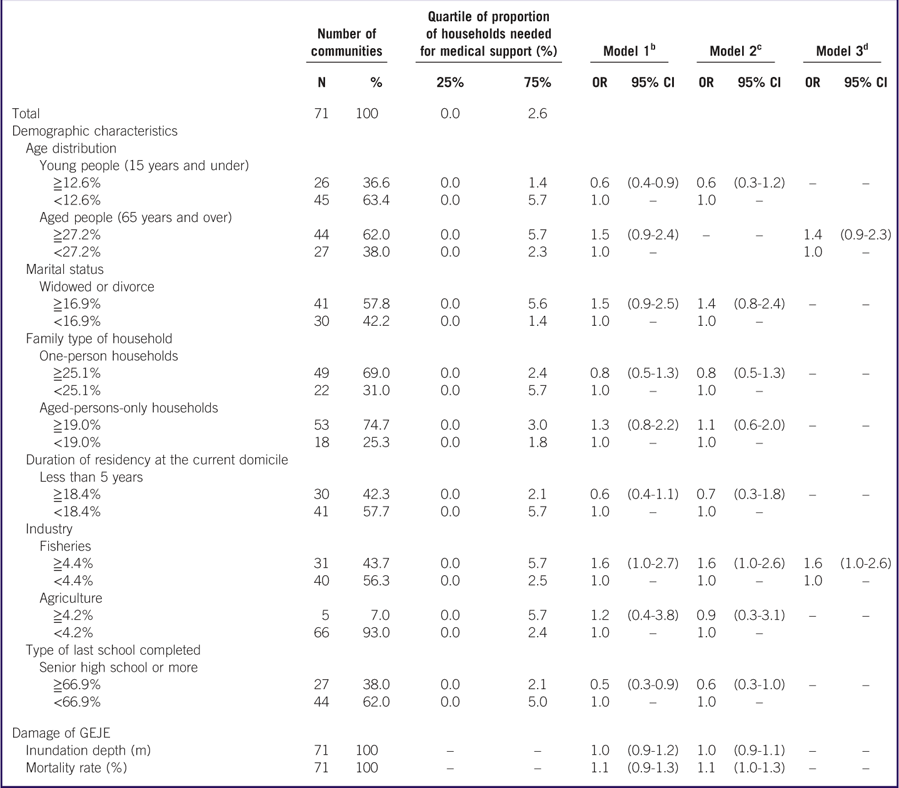
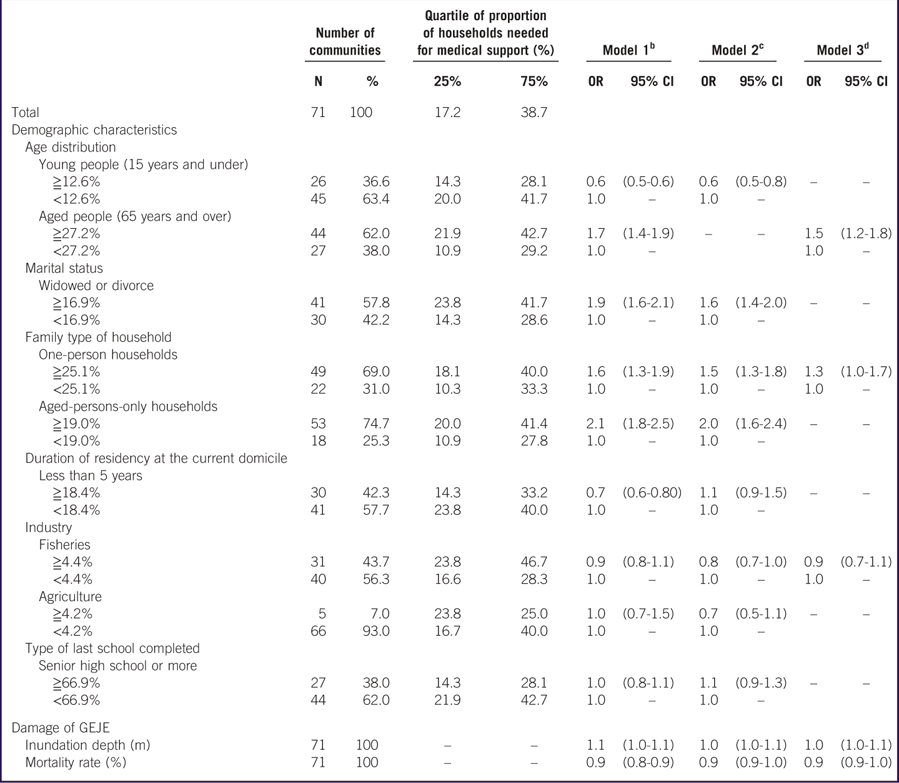
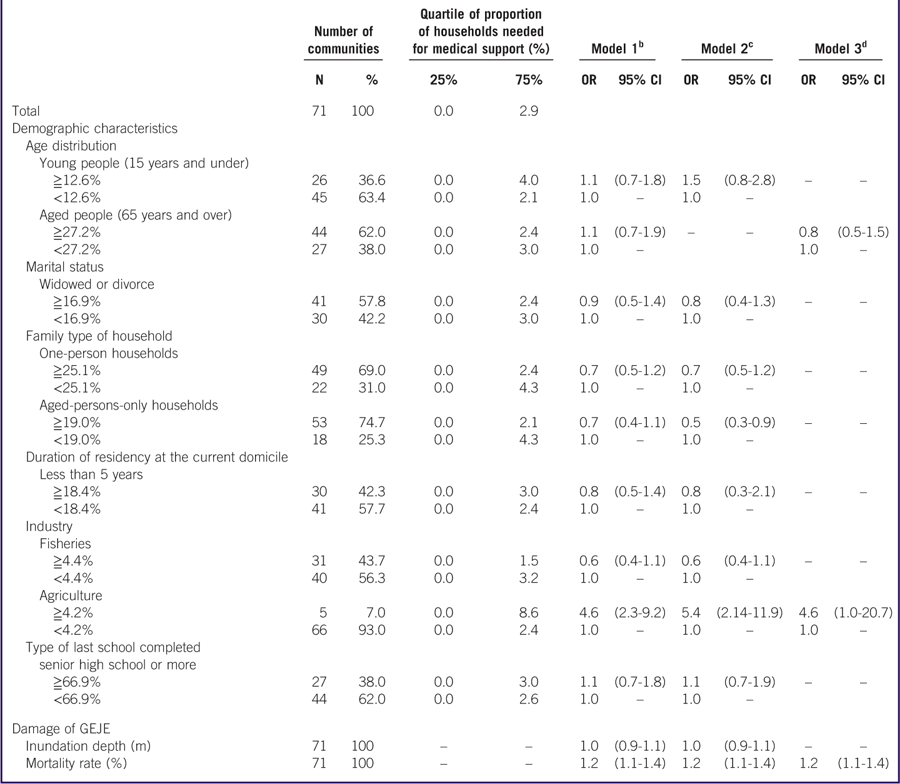
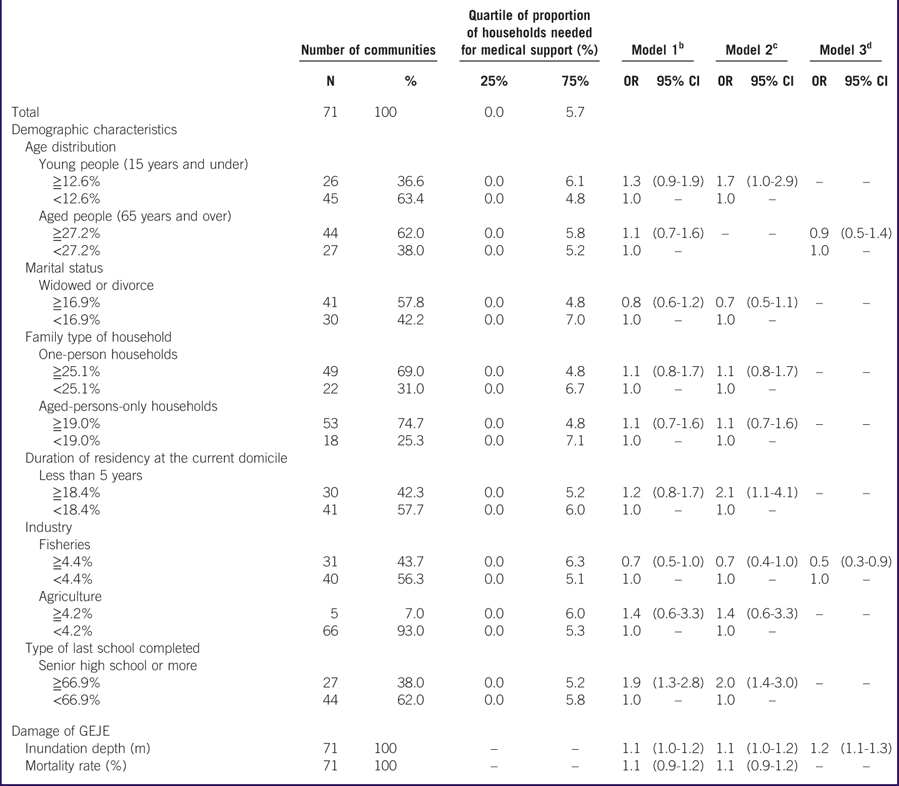
The relationships between the community characteristics and the need for health and living support after the GEJE are shown in Tables 1–4. Here, the community characteristics included 9 demographic characteristics before the GEJE and 2 indexes of damage caused by the GEJE.
Association Between the Need for Medical Support and the Characteristics of the CommunityFootnote a

a Abbreviations: CI, confidence interval; GEJE, Great East Japan Earthquake; OR, odds ratio. The community characteristics include 9 demographic characteristics before the GEJE and 2 indexes of damage caused by the GEJE.
b Model 1: The univariate model.
c Model 2: The model adjusted for the proportion of aged people.
d Model 3: The multivariate model (covariates were the proportion of aged people and people who engaged in fisheries).
Association Between the Need for Elderly Support and the Characteristics of the CommunityFootnote a
a Abbreviations: CI, confidence interval; GEJE, Great East Japan Earthquake; OR, odds ratio. The community characteristics include 9 demographic characteristics before the GEJE and 2 indexes of damage caused by the GEJE.
b Model 1: The univariate model.
c Model 2: The model adjusted for the proportion of aged people.
d Model 3: The multivariate model (covariates were the proportion of aged people, one-person households, people who engaged in fisheries, the inundation depth, and mortality rate).
Association Between the Need for Psychological Support and the Characteristics of the CommunityFootnote a
a Abbreviations: CI, confidence interval; GEJE, Great East Japan Earthquake; OR, odds ratio. The community characteristics include 9 demographic characteristics before the GEJE and 2 indexes of damage caused by the GEJE.
b Model 1: The univariate model.
c Model 2: The model adjusted for the proportion of aged people.
d Model 3: The multivariate model (covariates were the proportion of aged people, people who engaged in agriculture, and mortality rate).
Association Between the need for Dwelling Environment Support and the Characteristics of the CommunityFootnote a
a Abbreviations: CI, confidence interval; GEJE, Great East Japan Earthquake; OR, odds ratio. The community characteristics include 9 demographic characteristics before the GEJE and 2 indexes of damage caused by the GEJE.
b Model 1: The univariate model.
c Model 2: The model adjusted for the proportion of aged people.
d Model 3: The multivariate model (covariates were the proportion of aged people, people who engaged in fisheries, and the inundation depth).
In the univariate model (Model 1), the proportion of those engaged in the fisheries was positively associated with the need for medical support, whereas the proportions of young people and those who had completed their senior year of high school or more were negatively associated with the need for medical support. In the multivariate model (Model 3) inclusive of 2 covariates, the proportion of those engaged in the fisheries (OR=1.6; 95% CI: 1.0–2.6) was associated with the need for medical support with marginal significance (Table 1).
In the univariate model (Model 1), the factors positively associated with the need for elderly support were the proportions of aged people, widowed or divorced people, one-person households, and households containing only aged people, as well as inundation depth. Factors negatively associated with the need for elderly support were the proportions of young people and those who had lived at their current domicile for <5 years, as well as mortality rate. These factors, with the exception of the proportion of people who had lived at their current domicile for <5 years, were also significantly associated with the need for elderly support in Model 2. In the multivariate analysis (Model 3), we included 5 variables, of which the proportions of aged people (OR=1.5; 95% CI: 1.2–1.8), one-person households (OR=1.3; 95% CI: 1.0–1.7), and inundation depth (OR=1.0; 95% CI: 1.0–1.1) were positively associated with the need for elderly support, and mortality rate (OR=0.9; 95% CI: 0.9–1.0) was negatively associated with the need for elderly support (Table 2).
The factors positively associated with the need for psychological support in the univariate model (Model 1) included mortality rate and the proportion of people engaged in agriculture. After adjustment for the proportion of aged people (Model 2), those factors remained associated with the need for psychological support, and the proportion of households containing only aged persons was found to be negatively associated with the need for psychological support. In a multivariate analysis that included 3 variables (Model 3), we found that the proportion of people engaged in agriculture (OR=4.6; 95% CI: 1.0–20.7) and mortality rate (OR=1.2; 95% CI: 1.1–1.4) were positively associated with the need for psychological support (Table 3).
The factors positively associated with dwelling environment support in the univariate model (Model 1) included the proportion of people who had completed their senior year of high school or beyond and the inundation depth. In addition to these, the proportions of young people and those with a residency duration <5 years were also positively associated in Model 2. In the multivariate model inclusive of 3 variables (Model 3), inundation depth (OR=1.2; 95% CI: 1.1–1.3) was positively associated and the proportion of those engaged in the fisheries (OR=0.5; 95% CI: 0.3–0.9) was negatively associated with the need for dwelling environment support (Table 4).
Discussion
Because the effects of a disaster may differ according to the characteristics of a community, and the necessary countermeasures in response to a disaster must be modified according to the community, we focused on the community rather than the individuals in this study. To develop a simple measure to identify vulnerable communities, we sought factors related to communities in need by examining the association between pre-disaster demographic characteristics of communities from the census and the post-disaster proportion of vulnerable households in Ishinomaki City. The factors positively associated with the need for elderly support included the proportions of aged people (OR=1.5; 95% CI: 1.2–1.8) and one-person households (OR=1.3; 95% CI: 1.0–1.7). The factors positively associated with the need for psychological support included the proportion of people engaged in agriculture (OR=4.6; 95% CI: 1.0–20.7). Need for dwelling environment support was negatively associated with the proportion of people engaged in the fisheries (OR=0.5; 95% CI: 0.3–0.9). No factors were found to be associated with the need for medical support.
The world is at risk of natural disasters that can result in serious disruption of the functioning of a society and in widespread human, material, or environmental losses far exceeding the capacity of local containment. To prepare the necessary and appropriate support, it is essential to obtain information regarding the needs of those communities affected by disaster, and needs assessment plays a crucial role in disaster management from a public health viewpoint.Reference Noji19
In general, repeated assessments corresponding to each phase of the post-disaster course are required.Reference Choudhary, Chen and Martin20 First, rapid assessment is required during the impact and emergency phase.Reference Guha-Sapira and Lechata21 In situations with limited time and resources, the process of collecting information and analyzing the impact of a disaster with the aid of prior assessments based on census information may be a practical approach that takes priority into account.Reference Kunii22 From the viewpoint of emergency management and the disaster response, a community vulnerability inventory is required and reflects the location of at-risk groups, such as the following: the elderly, recent residents, and communities with high densities of children, among others.Reference Morrow7 Next, a thorough assessment is needed during the rehabilitation and reconstruction phase to screen for problems and comprehensive health care needs throughout the affected area. Home evacuees should also be included. We considered the stay-at-home victims survey to be part of the thorough assessment conducted during the rehabilitation phase. In this study, via the stay-at-home victims survey, we obtained information on individuals in need of external support from others or from organizations, rather than those simply in need of medical care, elderly care, psychological care, or a dwelling.
In this study, we obtained demographic information about the communities from the 2010 Census. Census information can also be used for assessment as a part of a community diagnosis during the warning and preparation phase for prospective disasters. The Japanese Census is conducted every 5 years and is a count of all individuals and households living in Japan, with information on the household members (eg, gender, year and month of birth, employment status, place of work or schooling) and the households (eg, number of households and kind of housing).23 Census information provides initial insight into the local populations, as the first step in understanding a community,Reference Phillips24 and is considered to be appropriate pre-disaster information.
To consider the effect of community, we investigated the information from each community. Community members consist of the individual residents, who are also affected by the community itself. We were interested in determining which communities were resilient and which were vulnerable. We were able to recognize demographic and fundamental information from the census and to apply the knowledge obtained from this study to all communities in Japan.
No factors were associated with the need for medical support. There seem to be 2 reasons for this. First, the need for medical support depends on individual-level factors, not on community characteristics. Those in need of medical care appeared to have access to medical institutions through their own efforts, such that there was no association between the community’s demographic characteristics before the disaster and the proportion of people needing support. Second, only households with the ability to access medical care could return to or remain in their own homes in broken communities as the stay-at-home victims and thus were among those participating in this survey.
Higher proportions of aged people and one-person households were associated with a greater need for elderly support. If an elderly person in need of care lives alone, he or she will encounter difficulty and require external support. Furthermore, the communities with higher proportions of one-person households might have weak social bonds, because elderly persons living alone require not only care from their families but also monitoring by their neighbors.
The proportion of those engaged in agriculture was positively associated with the need for psychological support. We do not know the explanation for this, but the inland areas of Ishinomaki City where agriculture is common have several unique characteristics. After the earthquake, the tsunami hit the inland areas by traveling upriver,25 and people in the agricultural areas experienced unexpected human damage, with many schoolchildren dying. In addition, the agricultural community does not normally allow intimate mutual support among neighbors, and this may bring about a sense of isolation. We consider that these factors are related to the higher proportion of those in need of psychological support, but we do not have evidence to support this conclusion.
The need for dwelling environment support was negatively associated with the proportion of people engaged in the fisheries. This might be related to the knowledge of fishermen regarding life within or cooperation among the neighborhood during unusual situations, such as the GEJE. On the other hand, in Ishinomaki City, the fisheries are located mainly in the Oshika Peninsula on a steep landscape called “Rias” where the tsunami inundation was high. Residential areas in the Oshika Peninsula experienced damage too extensive (most houses were washed out by the tsunami) for the residents to remain in their community, such that households experiencing less damage were more likely to participate in the survey.
As an additional analysis, we examined the association between the need for support and the damage resulting from the disaster and found that inundation depth was positively associated with the need for elderly care and dwelling environment support. This could be explained by the fact that tsunami inundation causes physical and infrastructural damages, as well as inactivity among the elderly owing to the destroyed community and resulting inconveniences. The mortality rate was positively associated with the need for psychological care, which suggests that the extensive degree of human damage caused prolonged mental suffering. The mortality rate was negatively associated with the need for elderly care, potentially because there was greater mortality among the elderly in need of care because of difficulty escaping the tsunami.
This study had several limitations. First, we dealt with the community rather than individuals because of the aim and nature of the study; consequently, ecological fallacy could have been introduced. However, it is important to study the impact of environmental factors, including societal characteristics, because the recognition that risk is manifested socially as well as physically ensures the best emergency response.Reference Lemyre, Gibson and Zlepnig26 Thus, our focus on communities may be of value so long as the possibility of ecological fallacy is taken into consideration when interpreting the results. Second, the survey participants were not selected randomly nor counted completely; thus, only particular households may have participated in the survey. However, the purpose of the survey was to urgently identify those in need of support among the victims who remained in their homes and who therefore had less chance of receiving public support. Third, census data do not provide complete information for diagnosing a community. In this study, no information was available on human factors (eg, morbidities, disabilities, and pregnant women), social factors (eg, income, neighborhood response networks, and local groups), or physical factors (eg, shelters and community centers).
Despite the limitations mentioned above, census information was used to identify communities vulnerable to disaster in preceding studies, similar to the present study. When Hurricane Andrew hit the United States in 1992, vulnerability maps were designed by using census databases. Certain categories of individuals, such as the elderly, female-headed households, recent residents, and the poor, were reportedly at greater risk throughout the disaster response process.Reference Morrow7 In northern Australia, using the large databases available, including the census and property information databases, community vulnerability was defined and measured despite the limitations of that study.Reference King27
For future disasters, we can think of various types of information other than the current data that can be used to improve planning. Such items include income, an index of resilience (level of social capital or social networks), and an index of vulnerability (morbidity of chronic disease, nursing care rate, medical insurance, and existence of family doctors).
Conclusions
Several pre-disaster factors, such as age distribution and the type of industry and household family, were associated with the needs for health and living support 6 to 12 months after the GEJE in Ishinomaki City. Our findings suggest that consideration of demographic characteristics by use of simple census data is useful for identifying vulnerable communities and for preparing for future disasters.
Acknowledgements
This study was supported financially by the Ministry of Education, Culture, Sports, Science and Technology through Grant-in-Aid for Young Scientists (B) 26870596 “Disaster and Gender: Women’s empowerment in the community for building resilience (PI: Aya Ishiguro)” and the Japan Public Health Society through a Special Grant for Public Health for the Great East Japan Earthquake in 2012. We thank the members of the Health and Life Revival Council in the Ishinomaki District, including Shinsuke Muto, Ai Sonoda, Kohei Shiozawa, Miyuki Osaka, and other staff members and volunteers, for their contributions in conducting the stay-at-home victims survey, as well as members of the Teikyo Ishinomaki Research Group, including Kazue Yamaoka, Kunio Hara, Hideyo Tsutsui, Shoko Matsumoto, and Akie Midorikawa, for their collaboration and feedback in this study.