INTRODUCTION
Hydroidolina (=Leptolina) is a clade of hydrozoans comprising Leptothecata (=Leptomedusae, Thecata), Anthoathecata (=Anthomedusae, Athecata) and Siphonophorae (Collins, Reference Collins2002; Marques & Collins, Reference Marques and Collins2004; Collins et al., Reference Collins, Schuchert, Marques, Jankowski, Medina and Schierwater2006). Amongst the approximately 3220 valid species of Hydroidolina (Bouillon et al., Reference Bouillon, Gravili, Pagès, Gili and Boero2006), there exist vast amounts of diversity in the morphologies of hydroids and medusae as well as in life cycles. Uncovering a robust phylogeny for Hydroidolina would shed insight into the patterns underlying this diversity and provide a framework for generating hypotheses concerning processes responsible for their evolution. In addition, molecular phylogenies of Hydroidolina could help serve as a guide to taxonomic classification, which has been somewhat problematic, in large part due to inconsistencies in classifications of hydroids and medusae (e.g. Bouillon, Reference Bouillon1985, Reference Bouillon and Grassé1994).
Hydrozoan phylogenetics has seen much progress in recent years, particularly in revealing major hydrozoan lineages and questioning others. For example, phylogenetic analyses have shown that Hydrozoa comprises two well-supported, reciprocally monophyletic clades, Trachylina and Hydroidolina (Marques & Collins, 2004; Marques, Reference Marques2001a; Collins, Reference Collins2002; Collins et al., Reference Collins, Schuchert, Marques, Jankowski, Medina and Schierwater2006; Van Iten et al., Reference Van Iten, Leme, Simões, Marques and Collins2006). Siphonophorae is a clade (Collins, Reference Collins2002; Dunn et al., Reference Dunn, Pugh and Haddock2005), but its phylogenetic position within Hydroidolina is uncertain (Collins, Reference Collins2002; Collins et al., Reference Collins, Schuchert, Marques, Jankowski, Medina and Schierwater2006). Similarly, there is strong support for the monophyly of Leptothecata (Collins et al., Reference Collins, Schuchert, Marques, Jankowski, Medina and Schierwater2006; Leclère et al., Reference Leclère, Schuchert and Manuel2007), but no well-supported hypotheses have emerged regarding its relationship with other hydroidolinans. Molecular phylogenetic studies do not support the monophyly of Anthoathecata and instead suggest that it is a paraphyletic assemblage that has given rise to one or more hydroidolinan groups (Marques & Collins, 2000; Marques, Reference Marques2001a; Collins, Reference Collins2002; Collins et al., Reference Collins, Schuchert, Marques, Jankowski, Medina and Schierwater2006; Van Iten et al., Reference Van Iten, Leme, Simões, Marques and Collins2006).
Although these studies illuminated the phyletic status of the three main groups of Hydroidolina, the relationships within and between these groups remain uncertain (Collins et al., Reference Collins, Schuchert, Marques, Jankowski, Medina and Schierwater2006). In addition, with exception to studies on Kirchenpaueriidae (Peña Cantero & Marques, Reference Peña Cantero and Marques1999), Corynidae (Collins et al., Reference Collins, Winkelmann, Hadrys and Schierwater2005), Siphonophorae (Dunn et al., Reference Dunn, Pugh and Haddock2005), Tubulariidae (Marques & Migotto, Reference Marques and Migotto2001), Campanulariidae (Govindarajan et al., Reference Govindarajan, Boero and Halanych2006), Hebellidae–Lafoeidae (Marques et al., 2006) and Plumularioidea (Leclère et al., Reference Leclère, Schuchert and Manuel2006), relationships within component hydroidolinan groups have not been studied within a detailed phylogenetic framework. In an effort to further clarify relationships within Hydroidolina, we greatly augmented the published molecular dataset of hydroidolinan taxa using three molecular markers, the nuclear large (28S) and small (18S) subunit rDNAs and the mitochondrial large subunit rDNA (16S). We present combined phylogenetic analyses of 97 hydroidolinan taxa (plus 13 trachyline taxa as outgroups) under maximum likelihood (ML) and parsimony (MP) criteria. The augmented dataset reveals new evolutionary patterns in morphology, although a more thorough sampling is needed to further clarify these patterns. These data suggest that a molecular phylogenetic approach is promising for guiding future taxonomic classifications but further study is needed to elucidate phylogenetic patterns of the deeper nodes within Hydroidolina.
MATERIALS AND METHODS
Taxa sampled, DNA isolation, amplification and sequencing
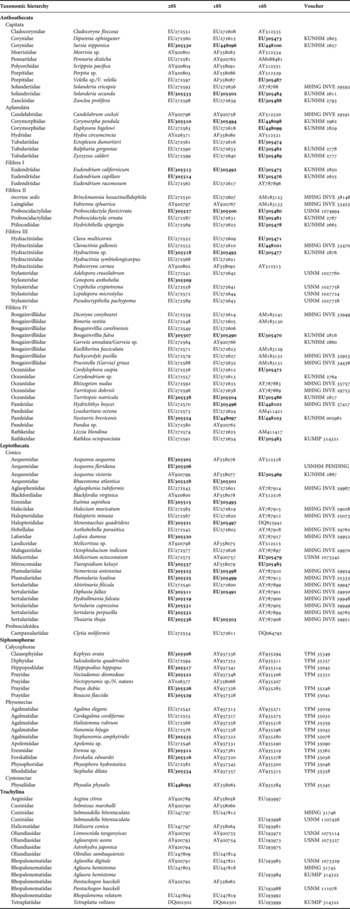
The 110 hydrozoan taxa used in this study are arranged taxonomically in Table 1, including GenBank accession and museum voucher numbers. The sequences in Table 1 comprise both published and new DNA sequences generated for this study. Although most new sequences correspond to museum voucher specimens, some were included that had no associated vouchers, but for which published sequences of other markers were generated from the same DNA pool. For new sequences, genomic DNA was extracted using Qiagen DNeasy kits according to the manufacturer's protocol (QIAGEN Inc., Mississauga, ON) or a standard phenol/chloroform protocol. The latter method involved tissue digestion with proteinase K (20 mg/ml) in a lysis buffer (20 mM Tris–CL pH 8.0, 5 mM EDTA pH 8.0, 400 mM NaCl, 2% SDS), extraction with phenol/chloroform (1:1), precipitation with 2.5 vol. 95% EtOH and elution in TE or H2O.
Taxon and sequence list. A complete list of sequences used in the analyses with GenBank accession numbers and museum voucher numbers. Those in bold represent new sequences generated for this study.

KUMIP, University of Kansas Museum of Invertebrate Paleontology; KUNHM, University of Kansas Natural History Museum; MHNG, Muséum d'Histoire Naturelle de Genève; YPM, Yale–Peabody Museum; USNM, US National Museum of Natural History.
An approximately 600 bp fragment of 16S was amplified using a modified forward primer (F1Mod: TCGACTGTTTA CCAAAAACATA) and reverse primer (R2: ACGGAATGA ACTCAAATCATGTAAG) from Cunningham & Buss (Reference Cunningham and Buss1993). Amplifications of 16S were conducted with the following thermal profile: 5 minutes (min.) at 94°C; 5 cycles of 50 seconds(s) at 94°C, 50 s at 45°C and 1 min. at 72°C; 30 cycles of 5 s at 94°C, 50 s at 50°C and 1 min. at 72°C; 10 min. at 72°C. An approximately 1.8 kb portion of the gene coding for 18S was amplified with universal eukaryotic primers as described by Medlin et al. (Reference Medlin, Elwood, Stickel and Sogin1988). Nearly complete, an approximately 3 kb portion of the gene coding for 28S was amplified and sequenced according to Evans et al. (Reference Evans, Lindner, Raikova, Collins and Cartwright2008).
All gene fragments were purified and sequenced by Cogenics, Inc. (Houston, TX) and assembled and edited using Sequencher v4.5 (Gene Code Co., 2005). Sequences for each marker were aligned using the program MUSCLE (Edgar, Reference Edgar2004). Regions containing alignment ambiguities were removed using Gblocks v0.91b (Castresana, Reference Castresana2000) with default parameters except the minimum length block was set to 5 and half the taxa were allowed to be gaps for any given position (Table 2). The three datasets were concatenated into one combined dataset.
Summary of genetic markers used in this study.

Phylogenetic analysis
Phylogenetic analyses were performed on individual markers and on the combined dataset using both maximum likelihood (ML) and parsimony (MP) criteria. ML searches were performed using GARLI v0.951.OsX-GUI (Zwickl, Reference Zwickl2006) under an assumed GTR + I + G model with rates estimated from the data. The assumed model of nucleotide substitution was selected by using the Akaike information criterion (AIC) as implemented in ModelTest (Posada & Crandall, Reference Posada and Crandall2000). For the combined dataset the ML analysis was repeated 10 times from random starting trees using default termination conditions. Each run gave identical topologies and similar likelihood scores. 100 bootstrap replications were run in GARLI v0.951.0sX-GUI (Zwickl, Reference Zwickl2006) under the same parameters.
MP analyses were performed using PAUP* 4.0.0b10 (Swofford, Reference Swofford1998). Heuristic analyses were run using 500 random addition sequences and TBR branch swapping. 100 bootstrap replications were run using 10 random addition sequences per replicate and TBR branch swapping. Most parsimonious trees were summarized as a strict consensus.
The concatenated, Gblocked DNA alignment and corresponding trees can be found in TreeBASE (http://www.treebase.org/treebase/index.html, accession No. S2066).
RESULTS AND DISCUSSION
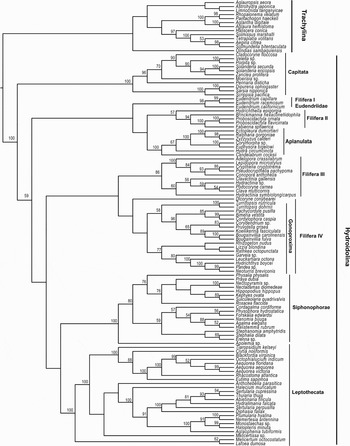
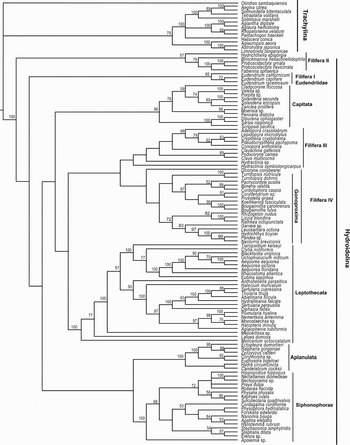
After excluding the ambiguously aligned regions, the combined dataset of nearly complete 28S rDNA, nearly complete 18S rDNA and partial 16S rDNA contained 5046 characters, 1699 of which are parsimony informative. Information about individual markers is shown in Table 2. The markers were analysed separately under a ML optimality criterion and in a combined dataset under ML and MP optimality criteria. There is incongruence in topologies between the individual markers and very little support for most of the nodes in the 16S and 18S datasets (not shown). By contrast, the 28S topology is almost identical to the combined dataset (not shown) but the combined dataset shows a higher frequency of well-supported nodes (bootstrap values >50%), than the 28S topology (not shown). Given that the 28S and combined dataset are congruent but the combined dataset gives better overall support values, we concluded that the combined dataset provides the most robust hypotheses. Thus, all subsequent discussions are confined to the analyses of the combined dataset (Figures 1 & 2).
Phylogenetic hypothesis among 110 hydrozoan taxa, based on a maximum likelihood criterion of a combined dataset of nearly complete 28S, nearly complete 18S and partial 16S rDNA sequences. Bootstrap values greater that 50 are indicated above nodes. The assumed model (GTR+I+G) with six substitutions rates estimated from the data (A-C, 0.8735; A-G, 2.9730; A-T, 1.6586; C-G, 0.8463; C-T, 5.2641; G-T, 1.0000), an assumed proportion of invariant sites (0.5740) and a gamma shaped parameter of (0.6021).

Phylogenetic hypothesis among 110 hydrozoan taxa, based on parsimony criterion of a combined dataset of nearly complete 28S, nearly complete 18S and partial 16S rDNA sequences. Bootstrap values greater that 50 are indicated above nodes. Topology is a strict consensus of the 10 most parsimonious trees (5046 characters). Length: 13246 steps, CI–0.26; RI–0.59.

MP and ML analyses both support the monophyly of Hydroidolina (Figures 1 & 2). Trachyline relationships are treated in detail in this volume (see Collins et al.) and are therefore not discussed here. The hydroidolinan taxa included in these analyses sort out into eight different monophyletic clades (Figures 1 & 2; Table 1). The composition of taxa in these clades is identical in the ML and MP analyses (Figures 1 & 2). Both optimality criteria support the monophyly of Leptothecata and Siphonophorae. In the ML and MP topologies, ‘Anthoathecata’ is a polyphyletic assemblage with leptothecates and siphonophores derived within anthoathecate lineages. Although it should be noted that all of the nodes separating the different anthoathecate lineages are weakly supported, consistent with previous phylogenetic analyses (Collins, Reference Collins2002; Marques & Collins, Reference Marques and Collins2004; Collins et al., Reference Collins, Winkelmann, Hadrys and Schierwater2005, Reference Collins, Schuchert, Marques, Jankowski, Medina and Schierwater2006; Dunn et al., Reference Dunn, Pugh and Haddock2005; Van Iten et al., Reference Van Iten, Leme, Simões, Marques and Collins2006; Leclère et al., Reference Leclère, Schuchert and Manuel2007). The separate anthoathecate clades that emerge from both the ML and MP analyses are Aplanulata (Collins et al., Reference Collins, Winkelmann, Hadrys and Schierwater2005), Capitata sensu stricto and four filiferan clades (Figures 1 & 2; Table 1). The composition and relationships within these major clades are discussed below.
Relationships among these major clades of Hydroidolina are uncertain. There is very little bootstrap support (<50%) in the deeper nodes under both optimality criteria and there is incongruence in the ML and MP topologies between the major clades. Given the inconclusiveness of these results, any discussion of relationships between major hydroidolinan clades would be premature. By contrast, within each of the major clades, the topologies in the ML and MP analyses are largely congruent and most of the nodes within these clades display high bootstrap support (Figures 1 & 2). Thus we focus our discussion below on the composition and relationships within these clades.
Capitata sensu stricto
Capitata is traditionally defined by the presence of capitate tentacles at some stage in its life cycle (Reese, Reference Rees1957; Petersen, Reference Petersen1990). Recent molecular phylogenetic analyses have questioned the monophyly of Capitata and instead suggest that there are two clades, Aplanulata (sensu Collins et al., Reference Collins, Winkelmann, Hadrys and Schierwater2005) and non-Aplanulata capitates (Collins, Reference Collins2002; Collins et al., Reference Collins, Winkelmann, Hadrys and Schierwater2005, Reference Collins, Schuchert, Marques, Jankowski, Medina and Schierwater2006). Our ML and MP analyses provide strong support (bootstrap values = 100 and 96 respectively) for a clade of capitates to the exclusion of aplanulata taxa. We refer to this clade as Capitata sensu stricto herein. Within Capitata sensu stricto the topologies between the ML and MP analyses are nearly identical (Figures 1 & 2). Both optimality criteria indicate support for the suborder Zancleida including Cladocorynidae, Porpitidae and Zancleidae (sensu Peterson, 1990), but also including Solanderiidae. Moerisia and Pennaria together form a sister taxon to the Zancleida clade (MP; Figure 2) or as successive sister taxa (ML; Figure 1). A Corynidae+Polyorchidae clade is strongly supported under both optimality criteria (Figures 1 & 2). These topologies are largely consistent with that of Collins et al. (Reference Collins, Winkelmann, Hadrys and Schierwater2005, Reference Collins, Schuchert, Marques, Jankowski, Medina and Schierwater2006).
Aplanulata
Aplanulata (Collins et al., Reference Collins, Winkelmann, Hadrys and Schierwater2005) is a clade supported by previous molecular phylogenetic analyses (Collins et al., Reference Collins, Schuchert, Marques, Jankowski, Medina and Schierwater2006) and is united by the lack of a ciliated planula stage (Petersen, Reference Petersen1990). Our analyses of Corymorphidae, Hydridae, Candelabridae and Tubulariidae representatives provide strong support for the monophyly of Aplanulata (bootstrap values = 100 for ML and MP) (Figures 1 & 2). Although our sampling is limited, within Aplanulata, there is strong support and nearly complete congruence between ML and MP topologies and these relationships are largely consistent with that recovered from Collins et al. (Reference Collins, Winkelmann, Hadrys and Schierwater2005) that used partial 16S data. Corymorphidae and Tubulariidae are both monophyletic and there is strong support for a Corymorphidae+Tubulariidae clade (bootstrap values = 100 for ML and MP). The Hydra+Candelabrum clade is the sister group to the rest of Aplanulata in the MP analysis (Figure 2) but are successive sister taxa in the ML analysis (Figure 1). As discussed in Collins et al. (Reference Collins, Schuchert, Marques, Jankowski, Medina and Schierwater2006), there are other putative Aplanulata families that await future sampling and analyses.
Filifera I: Eudendriidae
Our MP and ML analyses provide strong support for a Eudendriidae clade (bootstrap values = 98 for ML and 85 for MP), apart from other filiferan clades (Figures 1 & 2). Eudendriidae as a clade distinct from other filiferans is supported by many synapomorphies including the absence of desmoneme nematocysts, a styloid-shaped gonophore and a trumpet-shaped hypostome (Marques, Reference Marques1996). Because of these unique traits, a possible sister-group relationship of the Eudendriidae with other filiferans remains dubious (Marques, Reference Marques1996, Reference Marques2001b).
Filifera II: Fabienna/Proboscidactyla/Brinckmannia/Hydrichthella
The monophyly of Fabienna+Proboscidactyla+Brinkmannia is well supported (bootstrap values = 94 for ML and 79 for MP) but the node that includes Hydrichthella as its sister taxon has relatively low support (bootstrap values = 57 for ML and MP). An association between the Laingiomedusae Fabienna and Proboscidactylidae is supported by morphological evidence including a solid ring canal and macrobasic euryteles (Schuchert, Reference Schuchert1996). A previous molecular analysis supported this relationship (Collins et al., Reference Collins, Schuchert, Marques, Jankowski, Medina and Schierwater2006). In addition, there are a number of morphological features that support the association of Fabienna/Proboscidactyla with Brinckmannia (Filifera incertae sedis) and the ptilocodiid Hydrichthella. Schuchert & Reiswig (Reference Schuchert and Reiswig2006) argued for a close relationship between Brinckmannia and Proboscidactylidae based on the shape of their hydranths and 16S sequence similarity. Although the polyp stage in Fabienna is unknown, the other taxa share a synapomorphy of hydranths with reduced tentacles: in Brinckmannia, hydranths have no tentacles (Schuchert & Reiswig, Reference Schuchert and Reiswig2006), Hydrichthella has no tentacles on its gastrozooids (dactylozooids have many tentacles) and Proboscidactyla has only two tentacles on its hydranths. Interestingly, many of the species in this group are closely associated with another invertebrate as a substrate: Hydrichthella is found on an octocoral, Brinckmannia within the tissues of a hexactinellid sponge and Proboscidatyla on tubes of sabellid polychaetes. In addition, although the ptilocodiid Hydrichthella does not have a medusa, the medusae of Fabienna are strikingly similar to that of another ptilocodiid species, Thecocodium quadratum (Collins et al., Reference Collins, Schuchert, Marques, Jankowski, Medina and Schierwater2006).
Filifera III: Hydractiniidae/Stylasteridae
Our ML and MP analyses are congruent in identifying a clade that includes Hydractiniidae and Stylasteridae (bootstrap values = 86 for ML and <50 for MP). There is strong support for monophyly of Stylasteridae (bootstrap values = 100 for ML and 99 for MP) (Figures 1 & 2). Although the hydractiniids are monophyletic in the ML analysis (bootstrap value = 60) (Figure 1) the MP analysis places them as paraphyletic relative to the stylasterids (Figure 2). Our analyses show Clava multicornis as the sister taxon to the hydractiniid Podocoryne carnea with strong support in both ML and MP trees (bootstrap values = 94 for ML and 89 for MP). Clava has traditionally been placed in the family Clavidae, although Schuchert (Reference Schuchert2001) argued, based on the similarities of Clava to other hydractiniids (Bouillon et al., Reference Bouillon, Medel and Peña Cantero1997), that the genus Clava should be moved to the hydractiniids and the other Clavidae genera moved to the nominal family Oceaniidae (Schuchert, Reference Schuchert2004). Our analysis supports the interpretation that Clava is a hydractiniid.
The close relationship between the Hydractiniidae and Stylasteridae families has previously been suggested based on a number of synapomorphies including polymorphic polyps and the perisarc or skeleton covered stolons (Bouillon, Reference Bouillon1978; Petersen, Reference Petersen, Larwood and Rosen1979). Bouillon (Reference Bouillon1978) placed these families in the superfamily Hydractinoidea, which also includes Ptilocodiidae, Rathkeidae and Rhysiidae. Though we did not sample any members of Rhysiidae, our analyses do not support Hydractinoidea, as sampled Ptilocodiidae and Rathkeidae members are placed outside this clade.
Filifera IV: Gonoproxima+Dicoryne—Bougainvilliidae/Oceaniidae/Pandeidae/Rathkeidae
Our ML and MP analyses support the monophyly of a clade that includes representatives of Bougainvilliidae, Oceaniidae, Pandeidae and Rathkeidae. This clade has relatively weak support (bootstrap values <50 for ML and MP) and must be viewed as tentative. Within the clade the topologies are congruent between the ML and MP analyses. Of the four families, Pandeidae and Rathkeidae are monophyletic, whereas Bougainvilliidae and Oceaniidae are polyphyletic. Although association of these four families is somewhat surprising, they all share a striking synapomorphy. The species in all four families bear gonophores on hydrocauli, pedicels, or stolons and not on the hydranth body. The shift of the gonophores from the hydranth body to the region below is an apomorphy (Schuchert, Reference Schuchert2001). Backed by this synapomorphy, we name this clade Gonoproxima. The ‘bougainvilliid’ Dicoryne, which is distinct from other bougainviliid species in that it produces gonophores on blastostyles, is placed as the sister taxon to Gonoproxima in both the ML and MP analyses (Figures 1 & 2). Interestingly, many taxa included in this group have perisarc extending over the hydranth body, either as a gelatinous structure or pseudohydrotheca.
Two species within Gonoproxima, Cordylophora caspia (sampled here) and Pachycordyle kubotai (not sampled) live in fresh water. In our analyses, Cordylophora and Pachycordyle, which also contains brackish and marine species, are indicated to be close relatives under both optimality criteria, forming a clade with the bougainvilliid Bimeria. With denser taxon sampling within Gonoproxima and more targeted phylogenetic analyses, it should be possible to ascertain whether the fresh water habit was evolved one or more times in this clade and potentially whether freshwater species are descended from ancestors that lived in brackish environments.
Siphonophorae
The siphonophores have historically been split into three major groups, Cystonectae, Physonectae and Calycophorae. Collins (Reference Collins2002) placed the cystonect Physalia as sister to the other included siphonophores and suggested that Physonectae may be paraphyletic with respect to the Calycophorae. A later study (Dunn et al., Reference Dunn, Pugh and Haddock2005), that considered additional taxa and two genes (18S and 16S) found that cystonects form a monophyletic group that is sister to the remaining siphonophores and the paraphyly of Physonectae was recovered with significant support. Dunn et al. (Reference Dunn, Pugh and Haddock2005) erected the name Codonophora to refer to the clade comprising taxa assigned to Physonectae and Calycophorae (i.e. the clade that is sister to Cystonectae).
Our ML and MP analyses are consistent with the findings of Collins (Reference Collins2002) and Dunn et al. (Reference Dunn, Pugh and Haddock2005) in that Siphonophorae is a strongly supported monophyletic group (bootstrap values = 100 for ML and MP). Our ML and MP analysis also recovered Physonectae as paraphyletic and Calycophorae derived within this clade (Figures 1 & 2). We did not however find support for Codonophora (sensu Dunn et al., Reference Dunn, Pugh and Haddock2005). Our ML analysis placed the cystonect Physalia as the sister taxon to Calycophorae (Figure 1), not as the earliest diverging member of siphonophores (Collins Reference Collins2002; Dunn et al., Reference Dunn, Pugh and Haddock2005). The MP analysis also recovered a probable paraphyletic Physonectae, but unlike the ML analyses, Physalia was nested within Calycophorae (Figure 2). Under both optimality criteria, the physonect, Apolemia, was the earliest diverging siphonophore. Given that we have only one cystonect representative (Physalia) and that its placement is dependent on optimality criteria, we view the placement of Cystonectae relative to other siphonophores as equivocal and await further study.
Leptothecata
Our ML and MP analyses found strong support for the Leptothecata clade (bootstrap values = 100 for ML and MP) (Figures 1 & 2). Sampling was concentrated amongst the Conica subgroup, with the inclusion of only one Proboscoida representative, Clytia noliformis. This sampling is therefore insufficient to address the question of monophyly of its subgroups, Conica and Proboscoida.
The ML and MP topologies within Leptothecata are nearly congruent except for the placement of Lafoea relative to Melicertum (discussed below). The traditional taxonomy of Leptothecata, including the relationships of its higher groups, is largely based on similarities in the morphology of the hydrotheca and nematotheca (e.g. Bouillon, Reference Bouillon1985, Reference Bouillon and Grassé1994). Many groups found in our analyses corroborate Bouillon's hypotheses, including the monophyly of the Plumularioidea taxa, Plumulariidae and Halopterididae, Sertulariidae and the affinities of these with Haleciidae. Recent molecular and morphological analyses also have corroborated or are consistent with these hypotheses (Leclère et al., Reference Leclère, Schuchert and Manuel2007).
The affinities of the Hebellidae and Lafoeidae, based on morphological characters, were investigated by Marques et al. (Reference Marques, Peña Cantero and Migotto2006). Although the authors hypothesized the exclusive monophyly of each family, they considered the possibility that the families are distantly related, a finding consistent with our analyses.
Campanulinida is a group of leptothecates including many diverse families: Aequoreidae, Blackfordiidae, Eirenidae, Laodiceidae, Malagazziidae, Melicertidae and Mitrocomidae. The Campanulinida taxa belonging to Aequoreidae, Blackfordiidae, Eirenidae, Malagazziidae and Mitrocomidae are a strongly supported clade that also includes Clytia noliformis (bootstrap values = 100 for ML and MP). The Campanulinida belonging to Melicertidae, Melicertum octocostatum is the sister taxon to the rest of the Leptothecata in the MP analysis (Figure 2). This analysis corroborates the hypothesis of an early divergence of M. octocostatum (Collins et al., Reference Collins, Schuchert, Marques, Jankowski, Medina and Schierwater2006), a species that lacks a theca but has typical leptothecate medusae. The ML analysis places Melicertum+Lafoea dumosa as the sister taxon to the rest of Leptothecata (Figure 1).
CONCLUSIONS
Anthoathecata represents a diverse order of hydroidolinans that traditionally comprises two suborders, Filifera and Capitata (reviewed in Daly et al., Reference Daly, Brugler, Cartwright, Collins, Dawson, Fautin, France, McFadden, Opresko, Rodrigues, Romano and Stake2007). Although our analyses and previous molecular phylogenetic analyses (Marques & Collins, 2000; Marques, Reference Marques2001a; Collins, Reference Collins2002; Collins et al., Reference Collins, Schuchert, Marques, Jankowski, Medina and Schierwater2006; Van Iten et al., Reference Van Iten, Leme, Simões, Marques and Collins2006) do not support the monophyly of Anthoathecata, the dissolution or re-definition of Anthoathecata is premature and should await clarification of relationships between major hydroidolinan clades. Capitata in the traditional sense comprises two clades, the Aplanulata, recognized by the lack of a free-swimming planula (Petersen, Reference Petersen1990) and Capitata sensu stricto. Given that there is strong support for these two groups and that there is no support for the monophyly of traditional ‘Capitata’ in these analyses and in previous phylogenetic analyses (Collins, Reference Collins2002; Collins et al., Reference Collins, Winkelmann, Hadrys and Schierwater2005, Reference Collins, Schuchert, Marques, Jankowski, Medina and Schierwater2006), the validity of Capitata in the traditional sense is questioned. If these clades are indeed separate, then Aplanulata should be referred to as its own order, separate from Capitata sensu stricto. Re-defining Capitata however, should await further clarification of Hydroidolina phylogeny. Our analyses do not support the monophyly of Filifera but this too is preliminary as the nodes separating the filiferan subgroups are weakly supported (Figures 1 & 2).
The new augmented dataset used in our analyses provide support for four distinct filiferan clades. Notably, all of these clades possess compelling morphological synapomorphies; Gonoproxima is characterized by gonophores on regions of the colony proximal to the hydranth; Eudendriidae displays distinct polyp and hypostome morphology; the Fabienna/Proboscidactyla/Brinckmannia/Hydrichthella clade displays polyps with a reduced number of tentacles and the Hydractiniidae/Sylasteridae clade displays polymorphism. A more comprehensive sampling of hydroidolinan families should provide greater insight into these emerging patterns.
Despite increased sampling, relationships between major hydroidolinan clades remain elusive. The lack of resolution suggests that the initial radiation of Hydroidolina may have been rapid, leaving little clues regarding the sequence of hydroidolinan diversification. New molecular markers, especially if combined with other types of data, may prove helpful in resolving these deep nodes.
ACKNOWLEDGEMENTS
We would like to thank A. Lindner for DNA samples and anonymous referees for helpful comments. This study was supported from grants from NSF AToL EF-0531779 (to P.C. and A.G.C.). A.C.M. has financial support from CNPq (55.7333/2005-9, 490348/2006-8, 305735/2006-3) and FAPESP (2004/09961-4).