Introduction
The population is ageing worldwide: as life expectancy rises and fertility rates decline, the number of older people and their proportion in society is growing. Currently, a quarter of the European population is 60 years old or over and this number is increasing (United Nations, 2015, 2017). As the share of older people grows, their life situations, problems, and accommodation and care needs are gaining more and more political attention. Loneliness is one of the key problems older people face and more people live alone as family dynamics are changing and become more distant (Scales and Richard, Reference Scales and Richard2000). This is especially worrisome as social integration is central to wellbeing (Rowe and Kahn, Reference Rowe and Kahn1997; Callaghan et al., Reference Callaghan, Netten and Darton2009; Hoban et al., Reference Hoban, James, Beresford and Fleming2013): both the objective lack of social relationships as well as the subjective experience of loneliness have been shown to be risk factors for mortality and various aspects of ill physical and mental health (see e.g. Fratiglioni et al., Reference Fratiglioni, Wang, Ericsson, Maytan and Winblad2000; Seeman, Reference Seeman2000; Hawkley et al., Reference Hawkley, Burleson, Berntson and Cacioppo2003; Steptoe et al., Reference Steptoe, Owen, Kunz-Ebrecht and Brydon2004; Uchino, Reference Uchino2006; Luanaigh and Lawlor, Reference Luanaigh and Lawlor2008; Reblin and Uchino, Reference Reblin and Uchino2008). Human ageing is shaped by the social network and societal factors one grows old within; often embedded in an ageist social context with a negative construction of old age which can interfere with everyday experiences of older people and contribute to disparities (see e.g. Ayalon and Tesch-Römer, Reference Ayalon, Tesch-Römer, Ayalon and Tesch-Römer2018) This can be particularly challenging in cases of intersectional identities which can result in a cumulative burden and multi-faceted inequalities, for example when facing both ageism and racism (see e.g. Chrisler et al., Reference Chrisler, Barney and Palatino2016).
Retirement villages are one model of extra-care housing, offering purpose-designed barrier-free housing that incorporates both care services and a range of non-care-related facilities and activities, which generate opportunities for formal and informal social activity and community engagement (Croucher, Reference Croucher2006). In such villages, older people can buy or rent their own apartment and live independently, while still having access to various basic support and care services as needed. While most retirement villages are open to the public, they do exhibit entry criteria. These can vary from scheme to scheme and generally lead to a homogeneous resident population. In many cases, they require residents to have come from the same geographic area or have other strong connections to it. Larger extra-care housing schemes are generally called villages and include more facilities than their small-scale counterparts, such as a restaurant, a gym or a hairdresser, often open to the wider public community. However, there is a lack of a clear definition of different retirement housing options as the developers and providers try to appeal to different markets (Croucher et al., Reference Croucher, Hicks and Jackson2006; Riseborough et al., Reference Riseborough, Fletcher and Gillie2015). Retirement villages are a common form of retirement housing in the United States of America (USA), New Zealand and Australia, and a comparatively new development in the United Kingdom (UK) where they have been strongly gaining in popularity over the last few years (Croucher, Reference Croucher2006; Bernard et al., Reference Bernard, Bartlam, Sim and Biggs2007; Evans, Reference Evans2009a).
Retirement villages market themselves as allowing successful ageing and fostering a friendly environment with a sense of community and solidarity, aiming to build an environment rich in social capital:
They're about giving their residents a new lease of life … [They] foster an environment of supported independence where residents can take advantage of the social and leisure opportunities provided by [them]. [Their] communities are diverse and fun. Residents can enjoy exciting activities and engage with family, friends and volunteers representing all generations. (ExtraCare Charitable Trust, 2015)
The social capital – briefly defined as resources accessed through and in social relations (Lin, Reference Lin2001) – inherent in these communities can provide older people with access to valuable social, practical and emotional support. The support is an outcome of network ties (that may be with friends, neighbours, relatives or fellow members of organisations and clubs), the quality of the relationships, their availability, the values that they hold and the trust placed in them (Gray, Reference Gray2009). Retirement villages try to enable older people to maintain a high level of social capital by promoting social interaction between residents, a friendly and neighbourly environment, and participation in social gatherings and decision-making processes in and concerning the village. Social isolation has also been shown to work as a push-factor to move into a retirement village (Stimson and McCrea, Reference Stimson and McCrea2004), as more friendships and community are expected (Bernard et al., Reference Bernard, Bartlam, Biggs and Sim2004; Evans and Vallelly, Reference Evans and Vallelly2007; Sergeant and Ekerdt, Reference Sergeant and Ekerdt2008; Bekhet et al., Reference Bekhet, Zauszniewski and Nakhla2009). Overall, such novel forms of senior housing seem to offer promising modes to address all dimensions of social capital (see also Cannuscio, Reference Cannuscio2003).
Against this background, a number of studies have tried to investigate to what extent retirement villages are able to foster social capital in older age. The following literature review summarises previous research and gives an overview of the coverage of different dimensions of social capital in the context of retirement villages. This review aims to combine articles on the different dimensions of social capital to identify gaps and motivate further research. It is structured as follows: the next section discusses the theoretical framework of social capital that is used to group previous studies and motivate further research; in the following section the studies included in the literature review will be described and summarised; then key findings will be summarised and gaps in the current state of the research will be identified; concluding remarks follow.
Social capital
The concept of social capital has gained immense popularity both within and beyond the social sciences in the past 30 years. Considering the wide range of applications of social capital, the concept started to be understood to encompass a range of phenomena that are connected to social embeddedness. While the definitions of social capital vary, in its core it can be defined as resources accessed through and in social relations (Lin, Reference Lin2001); social capital focuses on the productive benefits of social interactions (Brunie, Reference Brunie2009). Social capital has aspects on both the individual level, seen as additional resources for a person, and the aggregate level, seen as a collectively produced and owned good with benefits for the whole community. The classical conceptualisations of social capital, shaped in particular by the views of Pierre Bourdieu (Reference Bourdieu1980, Reference Bourdieu and Richardson1986), James Coleman (Reference Coleman1988, Reference Coleman1990) and Robert Putnam (Reference Putnam1993, Reference Putnam2000) who have emphasised different facets of the concepts in their discussions, have already incorporated the dual nature (see also Edwards and Foley, Reference Edwards and Foley1998). As with capital in general, individual investments in social relationships can be made and the resulting benefits can be used individually (Esser, Reference Esser2002: chapter 8.4; 2008). Neither the success nor the use of social capital can be controlled by individual actors though, as social capital develops and exists in the structure of relationships and is embedded in one's network (Portes, Reference Portes1998; Lin, Reference Lin2001: 55–56). The core idea of social capital theory is that networks have value (Putnam, Reference Putnam2000).
The distinction between social capital as a property belonging to individuals and a collective asset has often been noted and discussed (e.g. Portes, Reference Portes1998, Reference Portes2000; Inkeles, Reference Inkeles2000: 247; Lin, Reference Lin2001: 21–25). This distinction has been considered a controversy by some (Lin, Reference Lin1999b), but productively used to create a typology by others (Esser, Reference Esser2002, Reference Esser, Castiglione, van Deth and Wolleb2008; Brunie, Reference Brunie2009). In the latter, social capital is broken apart in its interconnected, yet distinct, social processes. As the clear distinction between individual and collective social capital offers a unifying framework that solves controversies and debates in the discourse, it seems to be a necessary and fruitful perspective to take.
Thus, this literature review uses the typologies suggested by Brunie (Reference Brunie2009) and Esser (Reference Esser2002, Reference Esser, Castiglione, van Deth and Wolleb2008) to discuss previous literature on social capital. Esser (Reference Esser, Castiglione, van Deth and Wolleb2008: 25) describes social capital firstly as the valued number of resources an actor can employ and use through direct or indirect personal relations with other actors who control those resources. The actor is assumed to invest in these relations intentionally with the expectations of them paying off eventually. This form of individual social capital is denoted as relational capital. Secondly, social capital can also be seen as an emergent characteristic of an entire network, going beyond the relationships of single actors and including aspects of a collective attitude towards the social system as a whole. This form of social capital, system capital, consists of social control, system trust and a comprehensive system morality within a group or between individuals (Esser, Reference Esser, Castiglione, van Deth and Wolleb2008: 25).
Relational and system social capital focus upon two theoretically distinct aspects of social capital, highlighting distinct processes (Esser, Reference Esser2002: 264; 2008; Brunie, Reference Brunie2009). Individual social capital refers to the access and use of resources an individual actor has through their acquaintances and friends. On this relational level, it is assumed that social capital constitutes an actor's ‘personal’ resource whose value depends on earlier investments in it. An actor's total endowment of relational social capital equals the sum of all the resources and benefits on which he or she can draw as a result of direct or indirect relations with other individual actors (Lin, Reference Lin1999a, Reference Lin2001; Van der Gaag and Snijders, Reference Van der Gaag, Snijders, Flap and Völker2004; Esser, Reference Esser, Castiglione, van Deth and Wolleb2008). Relational social capital refers to the network location an actor is positioned in and the embedded resources they have access to, i.e. network resources and network structures (Portes, Reference Portes1998; Lin, Reference Lin2001; Huang et al., Reference Huang, Western, Bian, Li, Côté and Huang2018). Furthermore, the willingness of others to make resources available (access to resources) is an important dimension of social capital (Lin, Reference Lin1999a, Reference Lin2001; Flap, Reference Flap, Favereau and Lazega2002; Flap and Völker, Reference Flap, Völker, Flap and Völker2004; Lin and Erickson, Reference Lin, Erickson, Lin and Erickson2008). Esser (Reference Esser, Castiglione, van Deth and Wolleb2008) argues that trust and obligations are key to this and conceptualises relational social capital as further including trust capital and obligation capital. Trust capital refers to trust that other actors place in an actor, as it determines the number of resources and benefits an actor can activate because of his or her reputation of being trustworthy (Esser, Reference Esser, Castiglione, van Deth and Wolleb2008). Obligation capital refers to the idea that the degree to which one is committed to another is a function of the number of credit slips from the other actor which he or she holds. Obligation works as a further motivation of the obliged actor to pass on requested resources. An actor's obligation capital thus consists of the number of obligations other actors owe him or her, the value of the resources and benefits that these favours can activate, and the total number of relations he or she maintains (Coleman, Reference Coleman1990; Esser, Reference Esser, Castiglione, van Deth and Wolleb2008; in specific relation to ageing, see also Antonucci and Jackson, Reference Antonucci, Jackson, Sarason, Sarason and Pierce1990; see also the term ‘favour bank’ in Putnam, Reference Putnam2000: 20)
Collective social capital, on the other hand, is an emerging property of aggregate collectives. It refers to the benefits a whole network offers to all of its members. Collective social capital is detached from individual actors, for it only exists through the relations between actors, and cannot be intentionally created by individuals (Esser, Reference Esser, Castiglione, van Deth and Wolleb2008). System capital, as an attribute of the social structure instead of a private property, forms a public good from which all actors in a network can profit, whether they have invested in it or not (Coleman, Reference Coleman1990: 315). Esser (Reference Esser, Castiglione, van Deth and Wolleb2008) distinguishes system control, system trust and system morality.
System control refers to the degree of social control and collective attention in a community. It emerges if information on the behaviour of network members travels fast and completely, allowing the detection of non-compliant – and contributing – behaviour, and subsequently if the system has sanctioning capacities to discourage from deviant behaviour (Festinger et al., Reference Festinger, Schachter and Back1950: 103–104, 114–131; Hechter, Reference Hechter1988: 51–59; Esser, Reference Esser, Castiglione, van Deth and Wolleb2008). System control is a consequence of a network structure that is high in density, closure and stability of relations; it is social capital promoted by dense and stable networks (Festinger et al., Reference Festinger, Schachter and Back1950: 107; Coleman, Reference Coleman1990; Esser, Reference Esser, Castiglione, van Deth and Wolleb2008).
System trust and system morality build up system capital's superstructure, but they are building on an efficient system control. The overall trust in a network is referred to as system trust. It is not related to single actors, but instead refers to diffuse and generalised trust in the functioning of an entire system (Esser, Reference Esser, Castiglione, van Deth and Wolleb2008). In the generalised approach formulated by Brunie (Reference Brunie2009), trust is seen as an individual attribute about how trusting people are; it is a notion of goodwill and of a shared social conscience. This generalised trust is not limited to known individuals, but also applies to strangers. It captures what has been noted as ‘thin trust’ (Newton, Reference Newton1997; Putnam, Reference Putnam2000: 136).
Finally, system morality of a network refers to the validity of values, norms and morality (Coleman, Reference Coleman1990; for a discussion on norms, see also Festinger et al., Reference Festinger, Schachter and Back1950: 72). It consists of a specific, orientating attitude that directs actions as actors conform automatically. Morality, norms and values therefore constitute a social relation of reciprocal commitment beyond the specific, single relations of the network (Esser, Reference Esser, Castiglione, van Deth and Wolleb2008). Norms of reciprocity restrain opportunistic behaviour, reinforce trust and thus facilitate co-operation (Brunie, Reference Brunie2009). System morality reduces the risk of social dilemmas and the costs and risks of transactions.
Lochner et al. (Reference Lochner, Kawachi and Kennedy1999), following a strictly collective definition of social capital, link the concept of social capital to a number of other related community constructs. The concept of system morality shows notable parallels to community, cohesion and collective efficacy and solidarity. As Lochner et al. (Reference Lochner, Kawachi and Kennedy1999) point out, both the measures of a sense of community as well as measurements for collective efficacy tap into the same indicators of a community's stock of social capital, as these generally include mutual trust and solidarity between people (e.g. in Sampson, Reference Sampson1997). Collective efficacy can also often lead to organised social movements which are generally discussed as making use of pre-existing social capital, i.e. the individual – structural – and collective basis (Edwards, Reference Edwards, Snow, della Porta, Klandermans and McAdam2013).
Solidarity, as conceptualised by Hechter (Reference Hechter1988), also resembles the concept of system morality. He defines solidarity as consisting of the extensiveness of its obligations and the degree of compliance of members to these obligations to contribute to a group's good. Actors belong to groups because they are dependent on other members to access a joint good and thus incur obligations (Hechter, Reference Hechter1988: 45). Like Esser (2008), Hechter (Reference Hechter1988: 166–167) discusses how the development of morality might lessen the importance of control mechanisms as, in communities, actors will follow internalised norms (Hechter, Reference Hechter1988: 147). The importance of control can though be diminished when systems build up loyalty by obligations, by putting trust in the actors (Hechter, Reference Hechter1988: 141).
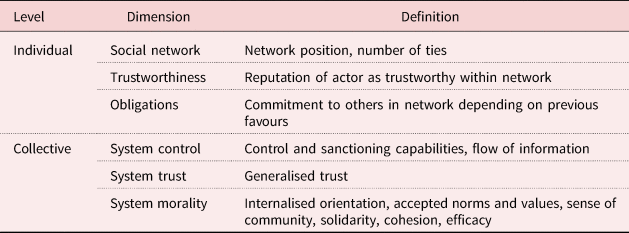
Against this theoretical background, social capital in a retirement village can be analysed as an individual property, referring to the social relations of a resident in terms of their social network, their trust and obligation capital they have built up, as well as a collective attribute, referring to the functioning of the community as a whole and the norms and values governing it. The most important dimensions of social capital are summarised in Table 1. This framework allows the general analysis of social capital, but it is important to note that it can be experienced differently according to age and other attributes such as gender, ethnicity or disability, which can shape the experience (see e.g. Burt, Reference Burt1998; Goulbourne and Solomos, Reference Goulbourne and Solomos2003; Cheong et al., Reference Cheong, Edwards, Goulbourne and Solomos2007).
Overview of social capital

Review data
In this review, qualitative and quantitative evidence on social capital in retirement villages are synthesised. Integrating quantitative and qualitative studies allows for a more in-depth and contextual understanding and integrated analysis (Pearson et al., Reference Pearson, White, Bath-Hextall, Salmond, Apostolo and Kirkpatrick2015). The process of this review involved identifying relevant articles and making decisions about article inclusion. Finally, the evidence is analysed to find answers to the research questions to what extent retirement villages are able to foster an environment rich in social capital. The findings are organised along the identified dimensions of social capital.
This literature review has used Web of Science and Google Scholar to search for any published and grey literature, using the keyword ‘social capital’ and its key dimensions (‘friendship’, ‘social network’, ‘norms and values’, ‘trust’, ‘community’, ‘social cohesion’) and terms related to the retirement accommodation (‘retirement village’, ‘continuing care retirement community’). Besides using electronic databases, additional articles were retrieved by searching through the references of the previously retrieved literature.
The following inclusion criteria for literature were used: (a) written in English, (b) involving participants in larger-scale retirement homes, (c) involving residents in retirement housing, (d) published up to November 2019, (e) (a dimension of) social capital was a key theme, and (f) full text available. Both peer-reviewed and non-peer-reviewed articles are included to allow for a broader perspective on social capital as this allowed the inclusion of further research reports. Inclusion criterion (b) guaranteed comparable accommodation types as only residents in larger-scale retirement homes which are age-segregated and aim to provide a home for life are researched. These retirement communities generally go under the name of retirement village or continuing care retirement community (CCRC). Literature on smaller schemes (less than around 50 residents), naturally occurring retirement communities, mixed-age residential developments or nursing homes is excluded. As the focus of this literature review is on the perspective of residents, criterion (c) implies that any literature reviews or studies that only use data collected from the retirement housing management and providers are excluded (e.g. Croucher and Bevan, Reference Croucher and Bevan2010; Liddle et al., Reference Liddle, Scharf, Bartlam, Bernard and Sim2014). Further, in line with criterion (e), articles solely about (mental) health or quality of life were excluded as it was reasoned that the selected articles would not explicitly refer to the community aspect of the retirement living.
After the initial retrieval of abstracts through the keyword search, they were read and discarded if they did not meet the inclusion criteria. After obtaining the full texts of the remaining studies, article references and citations were searched for additional relevant articles. After a first reading of the full articles and further exclusions in line with the inclusion criteria mentioned, 34 articles were left as a background for the present review. These studies include non-peer-reviewed reports. Three studies are interim or technical reports related to later publications and are not separately counted in the following, giving a total unique number of 31 research studies. They represent the USA (N = 13), the UK (N = 10), Australia (N = 5), New Zealand (N = 2) and Israel (N = 1), with the earliest study dating back to 1984 and the most recent one from 2019.
Results
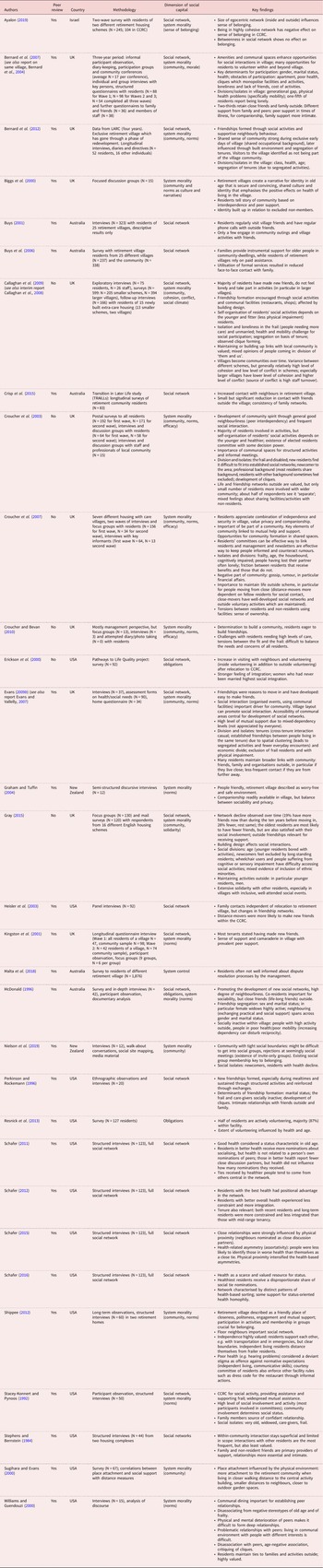
The final review includes 31 unique studies which researched social capital in retirement villages. Table 2 presents a list of the studies with selected information about key findings. The social capital domain assigned follows the framework outlined in the previous section.
Description of studies

Notes: UK: United Kingdom. USA: United States of America. CCRC: continuing care retirement community. LARC: Longitudinal Study of Ageing in a Retirement Community.
Individual social capital
Social network
The social network is the most studied dimension of social capital in retirement villages (N = 20), analysing different facets of a social network and how new friendships are formed and previous ones maintained. Research has generally found that residents make new friends at the retirement village and become socially integrated (Stacey-Konnert and Pynoos, Reference Stacey-Konnert and Pynoos1992; McDonald, Reference McDonald1996; Perkinson and Rockemann, Reference Perkinson and Rockemann1996; Buys, Reference Buys2001; Kingston et al., Reference Kingston, Bernard, Biggs and Nettleton2001; Heisler et al., Reference Heisler, Evans and Moen2003; Evans and Vallelly, Reference Evans and Vallelly2007; Callaghan et al., Reference Callaghan, Netten, Darton, Bäumker and Holder2008, Reference Callaghan, Netten and Darton2009; Evans, Reference Evans2009b; Croucher and Bevan, Reference Croucher and Bevan2010; Bernard et al., Reference Bernard, Liddle, Bartlam, Scharf and Sim2012). These new ties were especially important to provide social activity and companionship, but were also sources of low-level support in times of illnesses, to help in emergencies and regarding small favours in everyday life, such as giving lifts or helping with groceries (Stacey-Konnert and Pynoos, Reference Stacey-Konnert and Pynoos1992; Bernard et al., Reference Bernard, Bartlam, Biggs and Sim2004, Reference Bernard, Bartlam, Sim and Biggs2007; Shippee, Reference Shippee2012).
Friends at the retirement village were most often made through social activities and in communal facilities the villages provide, as these offer opportunities for formal and informal meetings (Stacey-Konnert and Pynoos, Reference Stacey-Konnert and Pynoos1992; Perkinson and Rockemann, Reference Perkinson and Rockemann1996; Croucher et al., Reference Croucher, Pleace and Bevan2003; Bernard et al., Reference Bernard, Bartlam, Biggs and Sim2004, Reference Bernard, Bartlam, Sim and Biggs2007, Reference Bernard, Liddle, Bartlam, Scharf and Sim2012; Evans and Vallelly, Reference Evans and Vallelly2007; Callaghan et al., Reference Callaghan, Netten, Darton, Bäumker and Holder2008, Reference Callaghan, Netten and Darton2009; Evans, Reference Evans2009b). In particular, many studies (N = 7) have highlighted the importance of communal spaces such as restaurants and coffee shops, and of shared mealtimes to foster encounters between residents which can then lead to the development of friendships (Perkinson and Rockemann, Reference Perkinson and Rockemann1996; Williams and Guendouzi, Reference Williams and Guendouzi2000; Croucher et al., Reference Croucher, Pleace and Bevan2003; Bernard et al., Reference Bernard, Bartlam, Biggs and Sim2004, Reference Bernard, Bartlam, Sim and Biggs2007; Callaghan et al., Reference Callaghan, Netten, Darton, Bäumker and Holder2008, Reference Callaghan, Netten and Darton2009; Croucher and Bevan, Reference Croucher and Bevan2010; Gray, Reference Gray, Powell and Chen2015). Research has shown that the majority of residents are generally active and involved in organisations which foster the formation of new relationships (Stacey-Konnert and Pynoos, Reference Stacey-Konnert and Pynoos1992; Croucher et al., Reference Croucher, Pleace and Bevan2003; Bernard et al., Reference Bernard, Bartlam, Biggs and Sim2004, Reference Bernard, Bartlam, Sim and Biggs2007; Callaghan et al., Reference Callaghan, Netten, Darton, Bäumker and Holder2008, Reference Callaghan, Netten and Darton2009). The physical layout has also been shown to influence friendship formation strongly, with most frequent contact happening with neighbouring residents (Bernard et al., Reference Bernard, Bartlam, Biggs and Sim2004, Reference Bernard, Bartlam, Sim and Biggs2007, Reference Bernard, Liddle, Bartlam, Scharf and Sim2012; Evans and Vallelly, Reference Evans and Vallelly2007; Callaghan et al., Reference Callaghan, Netten, Darton, Bäumker and Holder2008, Reference Callaghan, Netten and Darton2009; Evans, Reference Evans2009b; Shippee, Reference Shippee2012; Schafer, Reference Schafer2015; Gray, Reference Gray, Powell and Chen2015).
While most residents in retirement villages generally found it easy to make friends, previous research has also identified social divisions and strata of isolates. Frailty and health in general can be considered the most important line of division in the context of retirement villages. In most to all villages, there has been observed some tension between the fit and the frail, with the frail (in particular the immobile and very old) becoming isolated (Stacey-Konnert and Pynoos, Reference Stacey-Konnert and Pynoos1992; McDonald, Reference McDonald1996; Williams and Guendouzi, Reference Williams and Guendouzi2000; Croucher et al., Reference Croucher, Pleace and Bevan2003, Reference Croucher, Hicks, Bevan and Sanderson2007; Bernard et al., Reference Bernard, Bartlam, Biggs and Sim2004, Reference Bernard, Bartlam, Sim and Biggs2007, Reference Bernard, Liddle, Bartlam, Scharf and Sim2012; Evans and Vallelly, Reference Evans and Vallelly2007; Callaghan et al., Reference Callaghan, Netten, Darton, Bäumker and Holder2008, Reference Callaghan, Netten and Darton2009; Evans, Reference Evans2009b; Croucher and Bevan, Reference Croucher and Bevan2010; Schafer, Reference Schafer2011, Reference Schafer2012; Shippee, Reference Shippee2012; Gray, Reference Gray, Powell and Chen2015; Nielson et al., Reference Nielson, Wiles and Anderson2019). Frailty and sensory impairments can make it difficult for residents to leave their homes and thus take part in the social life of the village (Williams and Guendouzi, Reference Williams and Guendouzi2000; Croucher et al., Reference Croucher, Pleace and Bevan2003; Callaghan et al., Reference Callaghan, Netten, Darton, Bäumker and Holder2008, Reference Callaghan, Netten and Darton2009) and cognitive impairment can make it difficult to hold up communication and interaction with other residents (Croucher et al., Reference Croucher, Hicks, Bevan and Sanderson2007; Croucher and Bevan, Reference Croucher and Bevan2010; Shippee, Reference Shippee2012; Gray, Reference Gray, Powell and Chen2015). Health in general has shown to become a valuable resource in retirement settings and works as a status resource (Schafer, Reference Schafer2011, Reference Schafer2012, Reference Schafer2015, Reference Schafer2016).
While age and frailty are generally correlated, age by itself can also lead to certain divisions as a single retirement village generally combines different generations (Bernard et al., Reference Bernard, Bartlam, Biggs and Sim2004, Reference Bernard, Bartlam, Sim and Biggs2007; Croucher and Bevan, Reference Croucher and Bevan2010; Gray, Reference Gray, Powell and Chen2015). Residents of retirement villages have mentioned how different tastes in music and dancing can lead to discussions between generations and how younger residents can be bored by conversations of the older ones (Bernard et al., Reference Bernard, Bartlam, Biggs and Sim2004, Reference Bernard, Bartlam, Sim and Biggs2007).
Marital status and sex have been identified as important determinants in friendship formation (McDonald, Reference McDonald1996; Perkinson and Rockemann, Reference Perkinson and Rockemann1996). While some studies have found that widows (Stacey-Konnert and Pynoos, Reference Stacey-Konnert and Pynoos1992) and the unmarried (Callaghan et al., Reference Callaghan, Netten, Darton, Bäumker and Holder2008, Reference Callaghan, Netten and Darton2009) often end up being socially isolated, others have highlighted how uncoupled residents become highly involved; in particular, if previous responsibilities as care-giver have dissolved (McDonald, Reference McDonald1996). In general, care-givers are also often shown to be socially excluded as they often have limited availability to participate in social activities (Stacey-Konnert and Pynoos, Reference Stacey-Konnert and Pynoos1992).
Another division is found in regard to finances, e.g. between residents that receive benefits and those that do not (Croucher and Bevan, Reference Croucher and Bevan2010), or leaseholders and house/apartment owners (Evans and Vallelly, Reference Evans and Vallelly2007; Callaghan et al., Reference Callaghan, Netten, Darton, Bäumker and Holder2008, Reference Callaghan, Netten and Darton2009; Evans, Reference Evans2009b; Bernard et al., Reference Bernard, Liddle, Bartlam, Scharf and Sim2012). Many studies have also identified segregation between newcomers and older residents (Croucher et al., Reference Croucher, Pleace and Bevan2003; Bernard et al., Reference Bernard, Liddle, Bartlam, Scharf and Sim2012; Schafer, Reference Schafer2012; Gray, Reference Gray, Powell and Chen2015; Nielson et al., Reference Nielson, Wiles and Anderson2019).
All of these aforementioned divisions can be exacerbated by the physical design, i.e. when different activities take place at different locations, or when different tenures or care-levels live in different parts of the village (Evans and Vallelly, Reference Evans and Vallelly2007; Evans, Reference Evans2009b; Bernard et al., Reference Bernard, Liddle, Bartlam, Scharf and Sim2012; Shippee, Reference Shippee2012). This reduces the opportunities for mixing and social interaction.
Many schemes are rather homogeneous (due to entry criteria, similar income, coming from similar places) which residents comment on as a desirable feature (Croucher and Bevan, Reference Croucher and Bevan2010) while too much variety (in particular on health levels) has been seen critically (Evans and Vallelly, Reference Evans and Vallelly2007; Evans, Reference Evans2009b). Due to the homogeneity in their composition, previous research has hardly had the opportunity to assess the role of other social demographic characteristics such as ethnicity in friendship formation. Gray (Reference Gray, Powell and Chen2015) has found mixed evidence on how ethnic minorities are integrated into retirement villages; while some develop cliques, others showed an environment appreciative of diversity.
In general, many studies have reported on some cliques; cliques can lead to the exclusion of some residents from facilities and activities (Perkinson and Rockemann, Reference Perkinson and Rockemann1996; Croucher et al., Reference Croucher, Pleace and Bevan2003; Bernard et al., Reference Bernard, Bartlam, Biggs and Sim2004, Reference Bernard, Bartlam, Sim and Biggs2007; Callaghan et al., Reference Callaghan, Netten, Darton, Bäumker and Holder2008, Reference Callaghan, Netten and Darton2009; Gray, Reference Gray, Powell and Chen2015; Nielson et al., Reference Nielson, Wiles and Anderson2019); additionally, they foster gossip and rumour (Croucher and Bevan, Reference Croucher and Bevan2010). The community studied by Nielson et al. (Reference Nielson, Wiles and Anderson2019) has particularly tight social boundaries; residents report experiencing rejections at seemingly social events and existing social group memberships are key to belonging.
While new friends were made after moving in, it is also important to residents to maintain a life and relationships with kin and non-kin outside the retirement village (Stacey-Konnert and Pynoos, Reference Stacey-Konnert and Pynoos1992; McDonald, Reference McDonald1996; Williams and Guendouzi, Reference Williams and Guendouzi2000; Buys, Reference Buys2001; Croucher et al., Reference Croucher, Pleace and Bevan2003; Bernard et al., Reference Bernard, Bartlam, Biggs and Sim2004, Reference Bernard, Bartlam, Sim and Biggs2007; Evans and Vallelly, Reference Evans and Vallelly2007; Callaghan et al., Reference Callaghan, Netten, Darton, Bäumker and Holder2008, Reference Calasanti, King, Twigg and Martin2009; Evans, Reference Evans2009b; Croucher and Bevan, Reference Croucher and Bevan2010). It is ties to outside friends and family which are more intimate and give deeper levels of support than ties to village friends (Stephens and Bernstein, Reference Stephens and Bernstein1984; Stacey-Konnert and Pynoos, Reference Stacey-Konnert and Pynoos1992; McDonald, Reference McDonald1996; Perkinson and Rockemann, Reference Perkinson and Rockemann1996; Bernard et al., Reference Bernard, Bartlam, Biggs and Sim2004, Reference Bernard, Bartlam, Sim and Biggs2007). However, the quantity of face-to-face contact with outside friends and family has been shown to reduce after relocation to a retirement village (Buys et al., Reference Buys, Miller and Barnett2006; Crisp et al., Reference Crisp, Windsor, Butterworth and Anstey2015). While having a life outside is generally valued, there is mixed evidence on how involved residents are with the wider community; some studies report that a large fraction of residents are involved in the community (McDonald, Reference McDonald1996; Evans and Vallelly, Reference Evans and Vallelly2007; Evans, Reference Evans2009b), while it is the minority in other retirement villages (Buys, Reference Buys2001; Croucher et al., Reference Croucher, Pleace and Bevan2003).
Generally, research finds that involvement with the broader community depends on where residents have lived previously: distance-movers that are new to the area rely more on fellow residents for social contacts and the retirement village for activities, while residents that come from the same locality can maintain their life outside better (Croucher et al., Reference Croucher, Pleace and Bevan2003; Evans and Vallelly, Reference Evans and Vallelly2007; Evans, Reference Evans2009b; Croucher and Bevan, Reference Croucher and Bevan2010). There is mixed evidence on how the distance to the previous location influences integration into the retirement village: while distance-movers have been shown to have made more friends after moving in (Heisler et al., Reference Heisler, Evans and Moen2003) and it has been found that the socially inactive in the village are those which are highly active outside (McDonald, Reference McDonald1996), Erickson et al. (Reference Erickson, Dempster McClain, Whitlow, Moen, Pillemer and Moen2000) found that volunteering activity inside the retirement village often comes as an addition to volunteering outside. Furthermore, links to the wider local community are also influenced by age, health and transportation opportunities, with the younger, healthier and those with better transportation opportunities being more involved (Bernard et al., Reference Bernard, Bartlam, Biggs and Sim2004, Reference Bernard, Bartlam, Sim and Biggs2007; Gray, Reference Gray, Powell and Chen2015).
Obligations
Obligations refer to the favours and investments residents have undertaken for others and the community as a whole. Obligation capital refers to the number of obligations other actors owe them; they arise from advances that lead to indebtedness. In the case of retirement villages, residents generally commit favours and chores for the community as a whole by volunteering, and for specific other residents.
The majority of residents are shown to be active volunteers, are organising activities for the community and are representing them in the form of a residents committee in resident–staff meetings (Stacey-Konnert and Pynoos, Reference Stacey-Konnert and Pynoos1992; Erickson et al., Reference Erickson, Dempster McClain, Whitlow, Moen, Pillemer and Moen2000; Croucher et al., Reference Croucher, Pleace and Bevan2003; Bernard et al., Reference Bernard, Bartlam, Biggs and Sim2004, Reference Bernard, Bartlam, Sim and Biggs2007; Callaghan et al., Reference Callaghan, Netten, Darton, Bäumker and Holder2008, Reference Callaghan, Netten and Darton2009). Filling these roles is sometimes difficult as it can be considered a burden (Croucher et al., Reference Croucher, Pleace and Bevan2003; Croucher and Bevan, Reference Croucher and Bevan2010) but, also, high involvement is a sign of status (Stacey-Konnert and Pynoos, Reference Stacey-Konnert and Pynoos1992). In general, these roles often depend on the younger and fitter residents (Croucher et al., Reference Croucher, Pleace and Bevan2003; Resnick et al., Reference Resnick, Klinedinst, Dorsey, Holtzman and Abuelhiga2013).
While co-residents are an important source of support and help in some situations and friendships are reinforced through exchanges, it has been suggested that residents make a clear distinction between what kind of support one can expect from co-resident friends versus family and staff; these relationships do not work as substitutions (Bernard et al., Reference Bernard, Bartlam, Biggs and Sim2004, Reference Bernard, Bartlam, Sim and Biggs2007). Residents are important in times of illness and incapacity, and help in emergencies and exchange everyday favours but are not, for example, carers for longer-term illnesses (Stacey-Konnert and Pynoos, Reference Stacey-Konnert and Pynoos1992; Bernard et al., Reference Bernard, Bartlam, Biggs and Sim2004, Reference Bernard, Bartlam, Sim and Biggs2007; Shippee, Reference Shippee2012). It has been stated that residents distance themselves from frailer residents as living independently is generally highly valued in retirement villages (Shippee, Reference Shippee2012) and increasing dependency can disturb the reciprocity between residents (McDonald, Reference McDonald1996). Also, it has been shown that not all residents appreciate a mix of dependency levels and lack understanding and tolerance in regard to different levels of frailty (Evans and Vallelly, Reference Evans and Vallelly2007; Evans, Reference Evans2009b).
Collective social capital
System control
System control refers to the availability of social control and a certain level of attention to the fate and actions of other members of an entire network which requires a certain flow of information.
Retirement villages often have a residents committee to have some control and be in more direct contact with the management (Croucher et al., Reference Croucher, Pleace and Bevan2003; Croucher and Bevan, Reference Croucher and Bevan2010). Informational flows between management and residents can be an issue of critique, with residents not knowing about processes (Malta et al., Reference Malta, Williams and Batchelor2018), but newsletters are seen as an effective way to keep people informed about a range of issues, also to counteract rumours (Croucher and Bevan, Reference Croucher and Bevan2010). Retirement villages also have been shown to have sanctioning capabilities as facilities’ rules, such as dress codes for dinners, are enforced in some of them (Shippee, Reference Shippee2012).
System morality
A number of studies of retirement villages discuss dimensions on system morality, solidarity, community, norms and values, and cohesion and efficacy (N = 18), most often investigating if and how a sense of community has developed.
In general, many residents of retirement villages report a shared sense of community or a community spirit which has developed or is developing over time (Biggs et al., Reference Biggs, Bernard, Kingston and Nettleton2000; Croucher et al., Reference Croucher, Pleace and Bevan2003; Bernard et al., Reference Bernard, Bartlam, Biggs and Sim2004, Reference Bernard, Bartlam, Sim and Biggs2007,Reference Bernard, Liddle, Bartlam, Scharf and Sim2012; Evans and Vallelly, Reference Evans and Vallelly2007; Callaghan et al., Reference Callaghan, Netten, Darton, Bäumker and Holder2008, Reference Callaghan, Netten and Darton2009; Evans, Reference Evans2009b; Shippee, Reference Shippee2012); retirement villages are even described as feeling like a big family (Shippee, Reference Shippee2012). It is generally seen as important to be part of the community (Croucher and Bevan, Reference Croucher and Bevan2010). Social interaction at organised events and in communal facilities are mentioned as important drivers for the community and for developing a sense of belonging (Evans and Vallelly, Reference Evans and Vallelly2007; Evans, Reference Evans2009b; Shippee, Reference Shippee2012; Gray, Reference Gray, Powell and Chen2015), suggesting that it is the friendship networks that are created which are relevant for community development and the sense of belonging (Ayalon, Reference Ayalon2019). The physical layout can further influence the perception of community (Sugihara and Evans, Reference Sugihara and Evans2000; Evans and Vallelly, Reference Evans and Vallelly2007; Evans, Reference Evans2009a), e.g. it has been shown that people who live more centrally and have smaller distances to neighbours and activities are generally more attached to the community (Sugihara and Evans, Reference Sugihara and Evans2000).
The retirement community in itself is also often put in relation to the wider community. Visitors to the village are generally seen as not being part of the community (Callaghan et al., Reference Callaghan, Netten, Darton, Bäumker and Holder2008, Reference Callaghan, Netten and Darton2009; Croucher and Bevan, Reference Croucher and Bevan2010; Bernard et al., Reference Bernard, Liddle, Bartlam, Scharf and Sim2012). There is a great sense of ownership about the facilities in the village (Croucher and Bevan, Reference Croucher and Bevan2010) and opening these up to the wider community generally leads to mixed feelings (Croucher et al., Reference Croucher, Pleace and Bevan2003; Callaghan et al., Reference Callaghan, Netten, Darton, Bäumker and Holder2008, Reference Callaghan, Netten and Darton2009; Croucher and Bevan, Reference Croucher and Bevan2010). It has also been noted how the narrative of identity is built up in relation to the excluded non-members (Biggs et al., Reference Biggs, Bernard, Kingston and Nettleton2000).
While combining the fit and the frail in communities and social networks has been pointed out as difficult, it has also been found that mixing residents with extra-care needs with fit and active people leads to widespread informal helping behaviour between neighbours and extensive solidarity with other residents (Gray, Reference Gray, Powell and Chen2015). The literature suggests that retirement villages are marked by a high degree of neighbourliness and mutual help, with neighbours helping each other with mobility issues and other everyday favours (Stacey-Konnert and Pynoos, Reference Stacey-Konnert and Pynoos1992; McDonald, Reference McDonald1996; Biggs et al., Reference Biggs, Bernard, Kingston and Nettleton2000; Kingston et al., Reference Kingston, Bernard, Biggs and Nettleton2001; Croucher et al., Reference Croucher, Pleace and Bevan2003; Graham and Tuffin, Reference Graham and Tuffin2004; Evans and Vallelly, Reference Evans and Vallelly2007; Evans, Reference Evans2009b; Bernard et al., Reference Bernard, Liddle, Bartlam, Scharf and Sim2012). This widespread helping behaviour is often highlighted as a key element of the community (Croucher and Bevan, Reference Croucher and Bevan2010). While support is valued, Shippee (Reference Shippee2012) also highlights that independence is valued in retirement villages. Disrupted communication is an offence against normative expectations, leading to the further exclusion of frail residents (Shippee, Reference Shippee2012); poor health can be seen as a deviant status leading to stigmatisation in a community that tries to describe itself as active. This can lead to disassociation with peers and age-negative associations (Williams and Guendouzi, Reference Williams and Guendouzi2000).
It has been found that there is extensive solidarity with other residents (Gray, Reference Gray, Powell and Chen2015) and support, especially in times of bereavement, which has been discussed as leading to a ‘lowering of the morale’ in the village (Bernard et al., Reference Bernard, Bartlam, Biggs and Sim2004, Reference Bernard, Bartlam, Sim and Biggs2007). Comparing different kinds of schemes, Callaghan et al. (Reference Callaghan, Netten, Darton, Bäumker and Holder2008, Reference Callaghan, Netten and Darton2009) find generally relatively high levels of cohesion and low levels of conflict in schemes, but especially larger villages have higher levels of conflict.
Summary and implications for future research
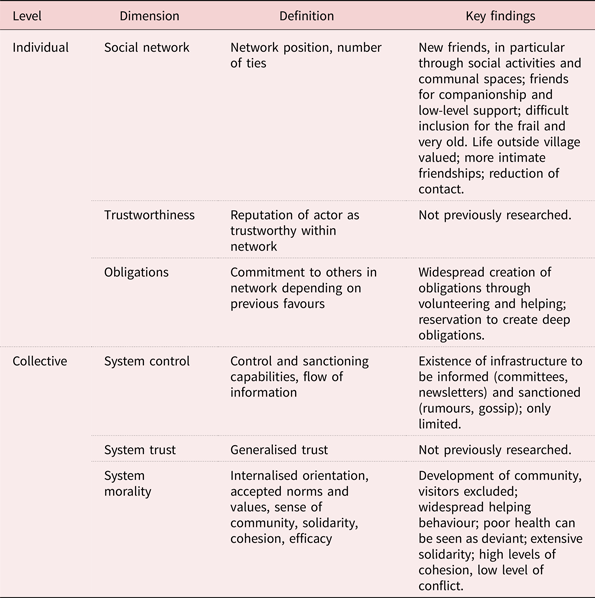
This literature review aimed to summarise to what extent retirement villages fulfil their promise of an engaging place to grow older, offering an active life and social engagement, fostering community and solidarity. A summary of the key findings is given in Table 3.
Overview of social capital and key findings

The reviewed literature has largely focused on the social network of older people, norms in a retirement village and the development of a community. This is in line with the vast amount of research on social networks and gerontology in general which has increased in the past few decades (Cornwell and Schafer, Reference Cornwell, Schafer, Ferraro and George2016; Ayalon and Levkovich, Reference Ayalon and Levkovich2019), exploring, for example, how social networks change throughout the lifecourse and lifespan (see e.g. Cornwell et al., Reference Cornwell, Laumann and Schumm2008; McDonald and Mair, Reference McDonald and Mair2010; English and Carstensen, Reference English and Carstensen2014) and how they relate to measures of health and wellbeing (see e.g. Ashida and Heaney, Reference Ashida and Heaney2008).
While the social network is the most researched domain of social capital in retirement villages, there has only been one socio-centric complete network study in a continuing care community, discussed in Schafer (Reference Schafer2011, Reference Schafer2012, Reference Schafer2015, Reference Schafer2016). The socio-centric approach allows the mapping of the complete social network of a village and analysis of how different structural properties can influence individual attributes and vice versa, and can thus greatly enhance previous findings (for a comparison of networks in different housing schemes, see also Ayalon et al., Reference Ayalon, Yahav and Lesser2018). Besides gaining a full network of the residents inside the village, previous research can be extended by also asking about outside ties, such as former friends and family, in the fashion of Ayalon (Reference Ayalon2020). In line with this, it is also of interest to investigate what level of social capital residents bring into the village when moving in and what role this might play in both moving into a village and integrating into an existing resident community.
Many studies have also highlighted that retirement villages are generally considered friendly places where people talk and neighbours help each other. Peer support is a vital attribute of these communities with a norm of support at work. However, residents also value independence and do not want to become responsible carers for other residents (Shippee, Reference Shippee2012). These findings suggest that residents seem hesitant to build up too much obligation capital with others. While the atmosphere of neighbourliness and mutual support is generally valued in retirement villages, it is also important to residents to maintain a high level of independence (in contrast, for example, to nursing homes). Mixed dependency levels generally lead to the development of a norm of neighbourliness and helping behaviour; this is not appreciated by all residents, suggesting this leads to the build-up of obligations. It could be expected that older people do not want to build up obligations with frailer and older residents who might never have the chance to reciprocate and ‘pay back’; this highlights an interesting area for future research.
System control is also discussed to some extent. Residents are generally interested in being informed about happenings in the village and their neighbours, and the existence of gossip has been noted. Newsletters have been highlighted as one way to inform residents and distribute information. However, this has all only been discussed to a limited extent. Further research could explore more how information travels in a retirement village and how the interaction between management and residents is structured. So far, existing research has mostly only described institutions that are in place to spread information, such as regular meetings.
The notions of trust and trustworthiness have hardly been discussed in previous literature, neither on a specific intra-individual level nor on the basis of generalised trust. This might be due to the fact that a lack of trust can be considered a sensitive topic. Nevertheless, trust is a core dimension of social capital and should be assessed in future research.
The development of system morality has been widely discussed in its notion of developed norms and the experience of a community. Other domains have received less attention, i.e. collective action problems, organisation of social movements and the experience of solidarity are only discussed to a very limited extent in research on retirement villages; however, it has been a topic of research on other retirement communities. For example, Andel and Liebig (Reference Andel and Liebig2002) discuss how retirement communities in California have successfully fought the development of a new airport. Croucher (Reference Croucher2006) also observes collective action and campaigning: she discusses how residents of a retirement community in England have campaigned to grant planning permissions for the development of land in a green belt and how residents have opposed extensions of a pub's licensing hours in another scheme. Lawrence and Schigelone (Reference Lawrence and Schigelone2002) have studied a small CCRC with only 20 residents and looked at the domain of solidarity. Through semi-structured interviews and focus groups, they unravel the relevance of communal coping with the stressors of ageing. Individual problems are coped with as a community (dealt with as something that is commonly shared: ageing).
Overall, the negative side of social capital and community living have also only been discussed to a limited extent. It has been noted that there exists some clique building, exclusion of outsiders, gossip and certain lines of segregation, but the so-called dark side of social capital has never been a focus of a study and could offer further opportunities for research (Portes, Reference Portes1998). Further, the focus of the majority of previous studies is on non-marginalised residents, i.e. fit and engaged residents belonging to a demographic majority (white women). For example, while it has been mentioned that disability can lead to more isolation, there has been no study focusing on the experiences of frailer residents who rely more strongly on support. Additionally, most retirement villages are homogeneous in their demographic composition which has led to a lack of systematic research on, for example, ethnic diversity. It is important for future research to explore the consequences retirement living has for residents belonging to a minority group, particularly when avenues of inequalities intersect and residents belong to multiple disadvantaged groups (e.g. by employing an intersectional analysis, see e.g. Crenshaw, Reference Crenshaw1991; Calasanti and King, Reference Calasanti, King, Twigg and Martin2015). In this context, it could, for example, be explored how frail men experience life in a retirement village as these might suffer exceptionally from being removed from the productive workforce (see e.g. Phillipson, Reference Phillipson1982; Calasanti and King, Reference Calasanti, King, Twigg and Martin2015). Following this, it can also be questioned to what extent retirement villages might even contribute to a discriminatory environment by marketing and promoting themselves based on successful ageing and youthfulness (see e.g. Gibbons, Reference Gibbons2016).
From a methodological standpoint, future research should include a control group in the analysis which is necessary when aiming to make causal claims about retirement village living. While previous studies have employed a wide range of methods, both qualitatively and quantitatively, only a few have explicitly compared retirement village residents to a control group of other older people. Comparing studies on other forms of retirement housing suggests that retirement villages do offer a more social choice than other housing options, e.g. Walters and Bartlett (Reference Walters and Bartlett2009) find a lack of social networks in a mixed-age residential development in Australia, Sheehan (Reference Sheehan1986) also finds more social isolation in public senior housing and Potts (Reference Potts1997) stresses the importance of intimate relationships with outside housing family and friends when analysing data of a very large retirement community with over 8,000 residents. To date, there are only a few studies which explicitly make comparisons between residents of a retirement village and a control group: in the study of Ayalon (Reference Ayalon2019), she compares the effects of social networks in two different retirement housing options; Bernard et al. (Reference Bernard, Bartlam, Biggs and Sim2004, Reference Bernard, Bartlam, Sim and Biggs2007) compare health scores between people living in a retirement village and those of the local community, comparing their resident-data with data from a different study; Buys et al. (Reference Buys, Miller and Barnett2006) compare family visitation patterns of residents of a retirement village with older people in community dwellings; and Crisp et al. (Reference Crisp, Windsor, Butterworth and Anstey2015) and Kingston et al. (Reference Kingston, Bernard, Biggs and Nettleton2001) not only send out questionnaires to residents of a retirement village, but also to community samples of older residents.
Even when a control group has been included in the study, self-selection into retirement villages might still be an issue. Sociability is generally mentioned as an important driver to move into a retirement village (e.g. Bernard et al., Reference Bernard, Bartlam, Biggs and Sim2004, Reference Bernard, Bartlam, Sim and Biggs2007), making it reasonable to expect that residents are a self-selected group with specific values and interests that align with communal living and activities. As randomly assigning older people to housing choices is not feasible, it is necessary to work with advanced statistical methods to control for this, such as propensity score matching or collecting longitudinal data.
Conclusions
Retirement villages are a popular choice for older people in the USA, Australia and New Zealand, and are gaining popularity in Europe, in particular in the UK. As it is a type of accommodation that addresses current policy demands and reflects the preferences for active and independent ageing, it can be expected to continue growing in demand in many Western countries. While previous research suggests that such novel forms of senior housing offer promising modes to address different dimensions of social capital, there are still a number of gaps in the literature and additional research is needed.
Future research should use a clear conceptualisation of social capital to address the concept in a unifying fashion. As the concept of social capital has features on both an individual and a community level, further research can be situated on both levels. This distinction implies different research strategies, suggesting a mixed-method approach with research methods complementing one another (Van Deth, Reference Van Deth, Castiglione, van Deth and Wolleb2008).
On an individual level, it will be of interest to ask who invests how into social capital and the underlying reasons, as well as how individual attributes, past investment and the new neighbourhood influence individual investments into social capital. When researching social capital as a community asset, it is of interest to describe the collective social capital that has developed within a retirement village, as well as investigate the interplay of individual social capital and the perception of the community. While much has been done in the area of social capital in retirement villages, there are still considerable gaps for future research to address. Starting with a clear conceptualisation of social capital, future research should aim to explore previously neglected domains of social capital and employ clear methodologies, sampling control groups and making use of state-of-the-art statistical approaches.