Introduction
Gametogenesis is the biological process of gamete formation occurring in the gonads and underlined by meiosis, the unique process of cell division whose final target is the production of mature haploid gametes competent for fertilization. Spermatogenesis is a complex process of proliferation and differentiation of spermatogonia, the male germ cell precursors give rise to primary and secondary spermatocytes and round spermatids. During spermiogenesis, the last phase of spermatogenesis, the spermatid undergoes a dramatic structural remodelling that transforms it from a spherical shape to the typical one of a mature spermatozoon consisting of the head, the neck and the tail. A crucial event associated with spermiogenesis is sperm nuclear compaction due to the condensation state of chromatin. This packaging differs from the chromatin in somatic cells (Ward and Coffey, Reference Ward and Coffey1991) and occurs by the replacement of the DNA-linked histones with transition proteins in the spermatocyte that are later replaced by basic protamines (P1 and P2). This process creates a specific protamine ratio and leads ultimately to tightly packaged chromatin (Poccia, Reference Poccia1986; Curry and Watson, Reference Curry, Watson, Grudzinskas and Yovich1995; Balhorn et al., Reference Balhorn, Cosman, Thornton, Krishnan, Corzett, Bench, Kramer, Hud, Allen, Prieto and Gagnon1999; Hao et al., Reference Hao, Ni and Yang2019), with a compact and hydrodynamic nuclear structure aimed both to protect the sperm genomic integrity and to improve sperm motility (Evenson et al., Reference Evenson, Witkin, de Harven and Bendich1978; Caron et al., Reference Caron, Govin, Rousseaux, Khochbin and Jeanteur2005). The mature chromatin contains ∼85% protamines and 15% histones, whose retention is associated with epigenetic information regulating important gene expression involved in embryo development (Ward, Reference Ward2010; Ihara et al., Reference Ihara, Meyer-Ficca, Leu, Rao, Li, Gregory, Zalenskaya, Schultz and Meyer2014). In addition to the biological role of the histone-bound chromatin, a protamine anomaly associated with an increased level of histones may account for incorrect DNA chain folding.
Correct spermatogenesis and appropriate animal and human sperm chromatin condensation are associated with sperm maturity, functionality and fertilization potential. Evidence is provided that altered sperm chromatin condensation may affect the dynamics of DNA methylation reprogramming in the male pronucleus and that both male and female pronuclei show a tendency of decreased size leading in turn to a lower fertilization rate (Rahman et al., Reference Rahman, Schellander, Luceño and Van Soom2018). Furthermore, it is well documented that different degrees of decondensed chromatin in a sperm population may exert detrimental effects on normal embryo development, ongoing and term pregnancy and live birth outcome (Sakkas et al., Reference Sakkas, Urner, Bizzaro, Manicardi, Bianchi, Shoukir and Campana1998; Esterhuizen et al., Reference Esterhuizen, Franken, Lourens, Van Zyl, Müller and Van Rooyen2000; Evenson and Jost, Reference Evenson and Jost2000; Agarwal and Said, Reference Agarwal and Said2003; Virro et al., Reference Virro, Larson-Cook and Evenson2004; Lin et al., Reference Lin, Kuo-Kuang Lee, Li, Lu, Sun and Hwu2008; Kazerooni et al., Reference Kazerooni, Asadi, Jadid, Kazerooni, Ghanadi, Ghaffarpasand, Kazerooni and Zolghadr2009; Ward, Reference Ward2010; Talebi et al., Reference Talebi, Vahidi, Aflatoonian, Ghasemi, Ghasemzadeh, Firoozabadi and Moein2012; Booze et al., Reference Booze, Brannian, Von Wald, Hansen and Evenson2019; Jerre et al., Reference Jerre, Bungum, Evenson and Giwercman2019; Kutchy et al., Reference Kutchy, Menezes, Ugur, Ul Husna, ElDebaky, Evans, Beaty, Santos, Tan, Wills, Topper, Kaya, Moura and Memili2019).
In ∼50% of couples infertility is due to male factors (Daumler et al., Reference Daumler, Chan, Lo, Takefman and Zelkowitz2016). Clinical screening of sub-fertile men starts with the evaluation of sperm parameters according to WHO guidelines (World Health Organization, 2010). The conventional spermiogram investigates sperm concentration, motility and morphology. However, over the latter decades there has been increasing evidence that these parameters have poor prognostic value for fertilization success and therefore it is recommended that a sperm functionality test is associated with traditional semen analysis (Lefièvre et al., Reference Lefièvre, Bedu-Addo, Conner, Machado-Oliveira, Chen, Kirkman-Brown, Afnan, Publicover, Ford and Barratt2007; Shamsi et al., Reference Shamsi, Imam and Dada2011).
In particular, sperm genomic integrity has been shown to affect sperm functionality together with fertilization and developmental success and pregnancy outcome (Lewis and Aitken, Reference Lewis and Aitken2005; Lewis et al., Reference Lewis, Agbaje and Alvarez2008). Systematic reviews by Zini (Zini et al., Reference Zini, Boman, Belzile and Ciampi2008; Zini, Reference Zini2011) have demonstrated that sperm genomic damage is associated with reduced natural and intrauterine insemination (IUI), lower in vitro fertilization (IVF) and pregnancy outcome, and higher risk of recurrent pregnancy loss (Hammadeh et al., Reference Hammadeh, Stieber, Haidl and Schmidt1998; Esterhuizen et al., Reference Esterhuizen, Franken, Becker, Lourens, Müller and van Rooyen2002; Sreenivasa et al., Reference Sreenivasa, Kavitha, Vineeth, Channappa and Malini2012; Coughlan et al., Reference Coughlan, Clarke, Cutting, Saxton, Waite, Ledger, Li and Pacey2015).
In assisted reproductive technologies (ART), IUI is the first therapeutic treatment in couples with unexplained infertility and/or in cases of normal male factors combined with mild female factors (Tomlinson et al., Reference Tomlinson, Amissah-Arthur, Thompson, Kasraie and Bentick1996; Starosta et al., Reference Starosta, Gordon and Hornstein2020). However, it is common practice that, after three IUI attempts, IVF and/or intracytoplasmic sperm injection (ICSI) is suggested. Currently ICSI is the most common technique used to overcome severe male infertility, giving rise to the birth of millions of babies worldwide since the 1990s (Palermo et al., Reference Palermo, O’Neill, Chow, Cheung, Parrella, Pereira and Rosenwaks2017; Haddad et al., Reference Haddad, Stewart, Xie, Cheung, Trout, Keating, Parrella, Lawrence, Rosenwaks and Palermo2021).
All techniques used in ART, from IUI through to IVF to ICSI, require pre-preparation of the spermatozoa based on the removal of seminal plasma and in vitro capacitation. Swim-up (SU) and density gradient centrifugation (DGC) are the most widely used techniques aimed to recover an enriched high-quality sperm population (Henkel and Schill, Reference Henkel and Schill2003). In this study, using the acidic aniline blue staining test on human semen samples, we compared three different sperm preparation methods to evaluate the best protocol by which to enrich the population of mature spermatozoa for use in ART.
Materials and methods
Patients and sperm preparation
In total, 15 seminal fluids from patients attending the Centre of Assisted Fertilization (CFA, Naples, Italy) for primary infertility and with written informed consent, were randomly selected on the basis of the following parameters: normal pH, volume ≥ 4 ml, sperm number ≥ 5 × 10⁶/ml, normal morphology ≥ 2% and progressive motility > 10 %. Samples were collected by masturbation after 2–5 days of sexual abstinence. Each sample was processed after liquefaction at room temperature for at least 30 min and then classified according to the reference values suggested by the WHO (World Health Organization, 2010). Microscopic examination of sperm number and velocity was quantified using a Makler counting chamber (Sefi Medical Instruments). Sperm morphology was evaluated using Papanicolaou stain-coated slides (TestSimplets, Waldeck Gmbh, Germany) and scored according to the Krüger strict criteria (Krüger et al., Reference Krüger, Acosta, Simmons, Swanson, Matta, Veeck, Morshedi and Brugo1987). To avoid intravariability, sperm concentration, motility and morphology were evaluated always by the same experienced observer.
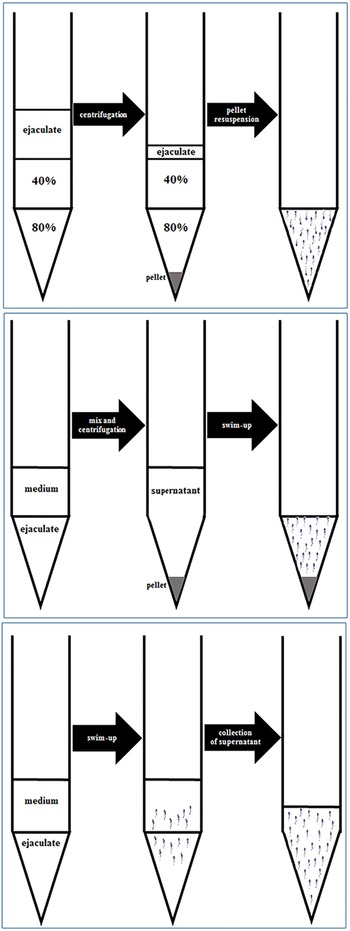
Each sample of seminal fluid was split into four aliquots as follows: (i) raw ejaculate as control; (ii) ejaculate subjected to discontinuous DGC; (iii) ejaculate subjected to swim-up from the pellet after centrifugation (SU-P); (iv) direct swim-up from the ejaculate (SU-E) without centrifugation (Fig. 1).
Three sperm preparation techniques. Top panel: density gradient centrifugation (DGC); middle panel: ejaculate subjected to swim-up from the pellet after centrifugation (SU-P); and bottom panel: direct swim-up from the ejaculate (SU-E) without centrifugation.

All the preparations and centrifugations were performed in conical tubes and dilutions and pellet resuspensions were made in Sperm Preparation Medium (SPM, ORIGIO, Måløv, Denmark).
DGC were performed by stratifying 1 ml of 40% gradient (Origio, Måløv, Denmark) over 1 ml of 80% gradient. Next, 1 ml of ejaculate was then gently layered on the 40% gradient and centrifuged at 200 g for 20 min at room temperature. The pellet was then removed and resuspended in 0.4 ml of SPM.
SU-P were performed by mixing 1 ml of ejaculate with 2 ml of SPM and centrifuged at 300 g for 3 min. Then the supernatant was removed and 0.5 ml of SPM was gently stratified over the compact pellet and incubated for 1 h at 37°C. Then 0.4 ml of the supernatant containing spermatozoa was gently collected without disturbing the interface between the pellet and the medium.
SU-E was performed by gently stratifying 0.5 ml of SPM on 1 ml of ejaculate and incubating for 1 h at 37°C. Next, 0.4 ml of the upper layer containing spermatozoa was gently collected without disturbing the interface between the ejaculate and the medium.
To obtain reproducible data and a consistency between the control and the treated samples, after the treatments, each sample was observed for evaluating sperm concentration and motility to detect the count and motility of spermatozoa to be submitted for the decondensation test.
Nuclear chromatin decondensation test
This test allows the identification and discrimination of the ratio of histones and protamines in sperm nuclei. Briefly, 10 µl of each aliquot was spread and smeared on a glass slide previously washed in 70% ethanol and allowed to dry at room temperature. Smears were then fixed in 4% (v/v) buffered glutaraldehyde for 30 min and then rinsed in phosphate-buffered saline (PBS; Sigma, Italy) and in distilled water for 20 s each. Slides were left to air dry at room temperature and then stained with 5% aqueous aniline blue (Sigma, Italy) 5% mixed with 4% acetic acid for 15 min. Slides were then rinsed twice in distilled water to remove the excess of aniline and air dried. At least 200 spermatozoa were counted per slide using a phase-contrast microscope (Nikon, ×1000 magnification). Three categories of head staining intensities were observed as unstained, partially stained and fully stained.
Three different operators blindly performed microscopic evaluations of either sperm count, motility and SDI and the mean values in each group were compared.
Statistical analysis
Statistical analysis was carried out using Systat 11.0 release. Before the analyses, percentage values were transformed in arcsin and homogeneity of variances and their normal distribution were tested. Hypothesis testing was performed by parametric tests, which included linear regression analysis (LRA) and analysis of variance (ANOVA), Coefficients of correlation (R) were recorded for each LRA model. A probability (P) value of ≤ 0.05 was selected as a criterion for a statistically significant difference; a P-value of ≤ 0.001 was selected for high significant difference.
Results
The average age of the patients involved in this study was 37.9 ± 2.0 years (range from 23 to 57 years). Seminal fluid selection was based on sperm concentration and forward motility. Only samples exhibiting at least 5 × 10⁶/ml and 10% forward motility were used in this study. Concerning sperm morphology, from the 15 seminal fluids 13 had normal morphology ≥ 3%, whereas two had normal forms ≥ 2%.
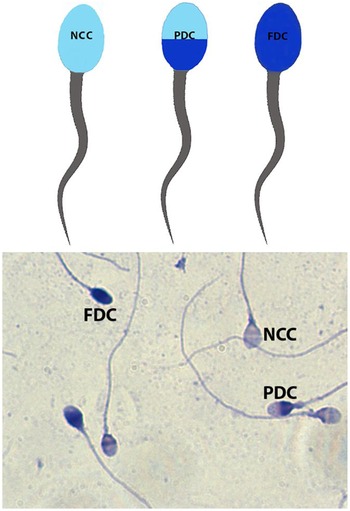
Using the aniline blue decondensation test, three types of sperm head staining were evaluated as follows: (i) unstained pale blue for normally condensed chromatin (NCC), (ii) partial pale and blue stained for partially condensed chromatin (PDC), and (iii) intense blue stained for highly decondensed chromatin (FDC) (Fig. 2). We considered PDC as decondensed spermatozoa as this pattern may reflect the amount of residue histones that however is a mandatory epigenetic marking for embryo development.
Top panel: three categories of sperm head chromatin condensation: normally condensed sperm head (NCC); partially decondensed sperm head (PDC) and fully decondensed sperm head (FDC). Bottom panel: phase-contrast photomicrograph of a sperm population including the three categories of condensed/decondensed sperm heads.

The percentage of sperm exhibiting chromatin decondensation was expressed as the sperm decondensation index (SDI) and evaluated as the percentage of decondensed cells over the total number of sperm examined.
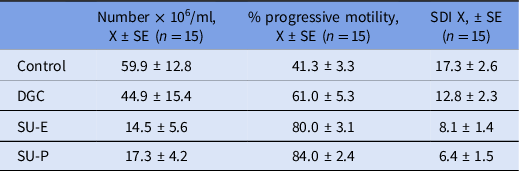
Sperm number, progressive motility and SDI in control and after the three preparation methods are summarized in Table 1.
Mean and standard error of sperm concentration, motility and decondensation (SDI) observed in the three study groups

The mean sperm concentration in the control decreased after all three treatments, however, was not significantly different with respect to the DGC (59.9 ± 12.8 vs 44.9 ± 15.4) and significantly different to the other two treatments (59.9 ± 12.8 vs 14.5 ± 5.6 in SU-E and vs 17.3 ± 4.2 in SU-P, respectively; P ≤ 0.001). No significant differences were reported between the two SU treatments. A different trend was observed for sperm progressive motility that significantly increased between control and the three preparations and between DGC and the two swim-up (41.3 ± 3.3 vs 61.0 ± 5.3 in DGC, vs 80.0 ± 3.1 in SU-E and vs 84.0 ± 2.4 in SU-P; P ≤ 0.001). Similarly, for the sperm number no significant differences were observed between SU-E and SU-P.
Nuclear chromatin decondensation rate (SDI, threshold value > 30%) was evaluated in the freshly produced ejaculate and after three different preparation methods. From 15 semen control samples, 87% showed normal SDI in a range between 5 and 24 % whereas 13% showed abnormal SDI with percentage values of 35–36%. No significant correlation was observed between control and DGC treatment (17.3 ± 2.6 vs 12.8 ± 2.3; P > 0.05), nor between DGC and SU-E (12.8 ± 2.3 vs 8.1 ± 1.4; P > 0.05). In contrast, a high significant difference was observed between control and both the two swim-up techniques (17.3 ± 2.6 vs 8.1 ± 1.4 in SU-E and vs 6.4 ± 1.5in SU-P; P ≤ 0.001).
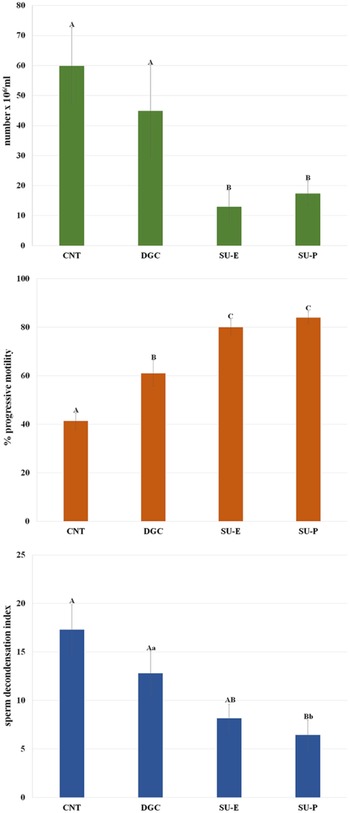
Comparing the SDI decrease between DGC and the two swim-up, these were significant only vs SU-P (P < 0.05) whereas no correlation existed between DGC and SU-E (Fig. 3).
Sperm number (top panel), sperm forward motility (middle panel), and sperm decondensation index (SDI) (bottom panel) for: fresh ejaculate control (CNT) and after preparation by density gradient centrifugation (DGC), direct swim-up from the ejaculate (SU-E) and ejaculate subjected to swim-up from the pellet after centrifugation (SU-P). A vs B, P-value ≤ 0.001 (top and bottom panels). A vs B vs C, P-value ≤ 0.001 (middle panel); A vs B, P-value ≤ 0.001; a vs b, P-value ≤ 0.05 (bottom panel).

Discussion
It is well established that semen characteristics play a fundamental role in the outcome of infertility treatments (Zhao et al., Reference Zhao, Vlahos, Wyncott, Petrella, Garcia, Zacur and Wallach2004). In this study, we showed a significant effect of different sperm preparation methods with respect to sperm nuclear tertiary structure.
In particular, we highlighted the finding that the two different SU methods represented the best techniques able to lower the SDI in seminal fluids, showing variations in semen parameters as number, motility, morphology and SDI. According to Sellami and colleagues (Sellami et al., Reference Sellami, Chakroun, Ben Zarrouk, Sellami, Kebaili, Rebai and Keskes2013), who suggested that chromatin decondensation is independent of basic parameters, our samples allowed us to evaluate the objective effect of the preparation methods on the SDI by excluding the interference of other conventional sperm parameters. The role of the spermatozoon was to activate the oocyte, probably via a soluble sperm factor, provide the centrioles and deliver a haploid genome into the oocyte (Wilding and Dale, Reference Wilding and Dale1997; Dale et al., Reference Dale, Wilding, Coppola and Tosti2010; Tosti and Ménézo, Reference Tosti and Ménézo2016). To become a mature spermatozoon, the haploid spermatid undergoes modifications leading to a striking compaction and remodelling of the chromatin. Several techniques set up to detect the rate of chromatin compaction are based on either staining or binding. The physiological method is based on the capacity to bind hyaluronic acid via hyaladherins, which are expressed on the sperm surface upon sperm maturation. Several studies have demonstrated that the capacity to bind hyaluronic acid was correlated with low levels of chromatin maturity and condensation (Torabi et al., Reference Torabi, Binduraihem and Miller2017). Nonetheless other methods have been tried such as erythrocyte–sperm separation; staining with aniline blue was found to be the most reliable, rapid and low cost method to identify condensation due to correct spermiogenesis (Soygur et al., Reference Soygur, Celik, Celik-Ozenci and Sati2018).
There is evidence that a mature chromatin is essential for fertility in humans and other mammals (Rathke et al., Reference Rathke, Baarends, Awe and Renkawitz-Pohl2014), in fact fertilization and ongoing pregnancy failure after ART have been shown to positively correlate with abnormally condensed sperm chromatin in the partner seminal fluid (Mohamed and Mohamed, Reference Mohamed and Mohamed2012; Irez et al., Reference Irez, Sahmay, Ocal, Goymen, Senol, Erol, Kaleli and Guralp2015, Reference Irez, Dayioglu, Alagöz, Karatas and Güralp2018). However, contrasting data have been presented by other groups. In a prospective clinical study, in fact, Gandini et al. (Reference Gandini, Lombardo, Paoli, Caruso, Eleuteri, Leter, Ciriminna, Culasso, Dondero, Lenzi and Spanó2004) obtained pregnancies and normal delivery even in the presence of high levels of SDI in either conventional IVF or ICSI. Similarly, results from 154 ICSI cycles showed that abnormal chromatin condensation did not correlate with fertilization rate, embryo score and/or pregnancy rate (Karydis et al., Reference Karydis, Asimakopoulos, Papadopoulos, Vakalopoulos, Al-Hasani and Nikolettos2005). In humans, seminal plasma is a collection of spermatozoa with different characteristics of maturity, vitality, morphology and genomic integrity. In the ART clinical practice sperm, preparation methods have been developed to mimic the natural selection process occurring in the female reproductive tract by also using a medium that resembles the tubal environment. The further aims of these methods were to select spermatozoa with ideal concentrations, motility and morphology to be associated with functional fertilization competence (Vaughan and Sakkas, Reference Vaughan and Sakkas2019). However, both processing and incubation conditions were shown to negatively affect the DNA integrity of ejaculated human spermatozoa (Zini et al., Reference Zini, Finelli, Phang and Jarvi2000; Matsuura et al., Reference Matsuura, Takeuchi and Yoshida2010).
To obtain a subpopulation of numerous and highly motile spermatozoa, the classical SU for sperm preparation based on a two-step washing procedure was described by Bob Edwards in the late 1960s (Edwards et al., Reference Edwards, Bavister and Steptoe1969, Reference Edwards, Steptoe and Purdy1980). Later on, density gradients were developed to process oligoasthenoteratozoospermic patients to enhance sperm recovery and motility and to separate the so-called ‘good spermatozoa’ from immotile, senescent and dead spermatozoa, in addition from germinal line cells, leukocytes, epithelial cells and cytoplasmic bodies (Gorus and Pipeleers, Reference Gorus and Pipeleers1981; Gellert-Mortimer et al., Reference Gellert-Mortimer, Clarke, Baker, Hyne and Johnston1988; Henkel and Schill, Reference Henkel and Schill2003). Nonetheless, sperm processing, a mandatory step for ART procedures, can itself exert iatrogenic sperm damage compromising fertility potential (Mortimer, Reference Mortimer1991; Muratori et al., Reference Muratori, Maggi, Spinelli, Filimberti, Forti and Baldi2003). In fact, both these techniques rely on centrifugation steps that are aimed at removing the components of seminal plasma that may interfere with the sperm capacitation process (Erel et al., Reference Erel, Senturk, Irez, Ercan, Elter, Colgar and Ertungealp2000).
It is well established that sperm centrifugation may generate oxidative stress due to the removal of antioxidants from seminal plasma (Sabeti et al., Reference Sabeti, Pourmasumi, Rahiminia, Akyash and Talebi2016). In contrast, although centrifugation also removes leukocytes that are the main source of reactive oxygen species (ROS) it may, in turn, promote new ROS production due to the centrifugation time and forces (Ghaleno et al., Reference Ghaleno, Valojerdi, Janzamin, Chehrazi, Sharbatoghli and Yazdi2014).
ROS in elevated levels and the absence of antioxidant defences may generate loss of sperm motility of membrane fluidity and a mitochondrial potential decline, together with a generalized impairment of fertilization success (Amaral et al., Reference Amaral, Lourenço, Marques and Ramalho-Santos2013; Zorn et al., Reference Zorn, Vidmar and Meden-Vrtovec2003). Among the main mechanisms by which ROS impairs the sperm functionality, lipid peroxidation and DNA integrity damage are included. Nonetheless, sperm vulnerability to ROS has been shown since the 1940s; it is also well established that low levels of ROS are necessary and beneficial for sperm capacitation. Due to this clinical relevance, a balance between ‘good’ and ‘bad’ ROS seems to be achieved by identifying pro- and antioxidant management strategies in either in vivo or in vitro fertilization (Aitken et al., Reference Aitken, Jones and Robertson2012; Aitken, Reference Aitken2017). For sperm preparation, procedures involving high intracellular ROS generation, among a vast variety of antioxidants, have highlighted the key role of albumin due to its ability to prevent DNA damage by neutralizing lipid peroxide-mediated impairment to either sperm plasma membrane and chromatin (Twigg et al., Reference Twigg, Fulton, Gomez, Irvine and Aitken1998a).
Contrasting data have been reported for ROS production after centrifugation-based sperm processing (Aitken and Clarkson, Reference Aitken and Clarkson1988; Aitken et al., Reference Aitken, Buckingham, West, Wu, Zikopoulos and Richardson1992; Zalata et al., Reference Zalata, Hafez and Comhaire1995; Twigg et al., Reference Twigg, Irvine, Houston, Fulton, Michael and Aitken1998b; Li et al., Reference Li, Zhou, Liu, Lin, Liu, Xiao and Lin2012) further highlighting the need to identify new procedures aimed at minimizing collateral DNA integrity damage. In particular, Iwasaki and Gagnon (Reference Iwasaki and Gagnon1992) showed that repetitive washing and centrifugation increased ROS species formation by 20-fold to 50-fold; however, more recent studies have reported no enhancement of oxidative stress following sperm preparation (Takeshima et al., Reference Takeshima, Yumura, Kuroda, Kawahara, Uemura and Iwasaki2017).
A recent 2-year survey on more than 500 IVF cycles compared single and double centrifugation gradient sperm preparation methods, demonstrating good clinical outcomes in term of fertilization, embryo and blastocyst formation, pregnancy and live birth rates. However, an increased sperm DNA fragmentation index was observed, along with reduced sperm concentration, progressive motility and even normal morphology for the double centrifugation, suggesting that the latter subjected spermatozoa to excessive mechanical stress with potential impairment of reproductive processes (Dai et al., Reference Dai, Wang, Cao, Yu, Gao, Xia, Wu and Chen2020). In contrast, other similar clinical surveys on high numbers of couples enrolled in IVF programmes showed that sperm DNA damage levels were negatively correlated with IVF pregnancy outcomes, corroborating the fact that sperm DNA damage is a useful parameter for predicting the clinical pregnancy rate. Due to the frequent evidence that sperm with a high level of DNA damage negatively correlate with the IVF outcomes, the contrasting results may account for a possible DNA damage threshold that should be reached for generating adverse fertilization, development and pregnancy rates (Zhang et al., Reference Zhang, Zhu, Jiang, Chen, Chen and Dai2016, Reference Zheng, Song, Wang, Liu, Zhu, Deng, Zhong, Tan and Tan2018).
Although the choice of the more suitable preparation method should remain at the discretion of the operator and should be based on the quality ‘in toto’ of the semen, in clinical practice DGC has almost totally replaced the SU, being less time consuming and permitting a higher concentration of sperm collected. In this study, we demonstrated that the decrease in sperm SDI after DGC was not significantly lower than the control, however high variability was observed. In fact, in two of 15 samples SDI did not change and in one sample SDI even increased. In light of these results DGC should be avoided for sperm preparation due both to the lack of improvement of the SDI ratio and because of potential damage induced by the double centrifugation.
In contrast with the two SU methods tested, we obtained a consistent and highly significant decrease in chromatin decondensation in the recruited sperm population with respect to the control. In the latter, only one of the 15 SDI values remained equal to the control, whereas in the SU-E one in 15 SDI values remained equal and one was greater than the control. From these data it is worth noting that DGC is less capable of selecting normally condensed spermatozoa compared with the other two SU techniques.
Previous studies have demonstrated the efficiency of preparation techniques in eliminating decondensed spermatozoa. In 1994, it was shown that glass-wool filtration was a superior method for separating normally condensed spermatozoa compared with the SU procedures; however, several disadvantages were reported such as a decreased sperm motility and damage due to the sample contamination by glass-wool fragments (Henkel et al., Reference Henkel, Franken, Lombard and Schill1994; Sánchez et al., Reference Sánchez, Villagrán, Risopatrón and Célis1994; Henkel and Schill, Reference Henkel and Schill2003).
The effectiveness of the SU method in oligospermic samples was observed, although a worse sperm number recovery was achieved (Adiga and Kumar, Reference Adiga and Kumar2001), In contrast, Sakkas et al. (Reference Sakkas, Manicardi, Tomlinson, Mandrioli, Bizzaro, Bianchi and Bianchi2000) showed a decrease in poorly condensed chromatin evaluated by chromomycin (CMA3) staining after PureSperm and Percoll gradients techniques. In this study, we used aniline blue staining as CMA3 use is rather controversial, in fact nonetheless some authors have used CMA3 for evaluating sperm chromatin decondensation. A recent study highlighted that CMA3 and the terminal deoxynucleotidyl transferase dUTP nick end labelling (TUNEL) test for detection of sperm DNA fragmentation have the same target, therefore giving rise to misleading results (Manicardi et al., Reference Manicardi, Bianchi, Pantano, Azzoni, Bizzaro, Bianchi and Sakkas1995; Ménézo, Reference Ménézo2021).
To our knowledge this is the first study that compared the effects of two different SU techniques on chromatin decondensation evaluated using an aniline blue test. In all the comparisons no significant differences were detected between SU-E and SU-P, however a trend of higher number and motility and SDI decrease favoured the SU-P, which was also corroborated by a significant SDI difference between DGC and SU-P. This may be attributed to the fact that SU-P relies on the stratification of the medium on a very compact pellet and the supernatant recovered is free from the components of the ejaculate. In contrast, SU-E, with no net interface between ejaculate and medium, may be more susceptible to disturbing vortices exerted by the pipette when collecting the supernatant. Therefore, when used for IUI and IVF, it should need a further centrifugation step to eliminate possible harmful residues in ejaculate components. This manipulative problem is strictly related to the ability of the operator and the fluidity of the seminal plasma. Consistently with other studies that suggested SU-P to be the best option for minimizing sperm DNA fragmentation (Volpes et al., Reference Volpes, Sammartano, Rizzari, Gullo, Marino and Allegra2016), here SU-P appears to be the best selection method to decrease decondensation, even in samples showing SDI values within the threshold of 30%.
At present there are no recognized standard values for chromatin decondensation suggested by the WHO (World Health Organization, 2010). In ART, it was suggested that a normal semen sample generally should contain less than 25% stained spermatozoa. Subsequently, other studies from clinical observations identified a threshold value over 30%, as no pregnancy was achieved following in vitro fertilization and ICSI with semen samples exceeding this percentage (Evenson et al., Reference Evenson, Jost, Marshall, Zinaman, Clegg, Purvis, de Angelis and Claussen1999, Reference Evenson, Larson and Jost2002; Ménézo et al., Reference Ménézo, Hazout, Panteix, Robert, Rollet, Cohen-Bacrie, Chapuis, Clément and Benkhalifa2007; Giwercman et al., Reference Giwercman, Lindstedt, Larsson, Bungum, Spano, Levine and Rylander2010).
Furthermore, it was speculated that even the apparently normally condensed spermatozoa in the remaining 70% may be susceptible to alterations and multiple defects.
Large numbers of studies over the last decade have addressed the problem of sperm genomic integrity and its repercussions for fertilization potential and outcome in fertile and infertile couples. Most of these studies, however, have taken in consideration DNA fragmentation and its effect on fertility and embryo development and pregnancy outcome (Evenson and Wixon, Reference Evenson and Wixon2006; Rex et al., Reference Rex, Aagaard and Fedder2017; Simon et al., Reference Simon, Emery and Carrell2019). Fragmentation is the ‘other face’ of genome disorders and consists of a break in the filament of DNA, mostly induced by apoptotic process and oxidative stress (Muratori et al., Reference Muratori, Tamburrino, Marchiani, Cambi, Olivito, Azzari, Forti and Baldi2015).
During spermiogenesis, DNA fragmentation is a physiological process occurring to facilitate the nuclear ‘transition proteins’ in the chromatin remodelling process. However, here, specific enzymes are able to repair the interruptions (Boissonneault, Reference Boissonneault2002). A further DNA repair occurs also in the oocyte following fertilization (Ménézo et al., Reference Ménézo, Dale and Cohen2010; Setti et al., Reference Setti, Braga, Provenza, Iaconelli and Borges2021); however, to our knowledge there is no similar repair mechanism for chromatin decondensation. Chromatin decondensation needs to be evaluated in couples with idiopathic infertility. In recent studies it was suggested that centrifugation be eliminated in the swim-up method, supporting our data that SU-P appears to be the best suited sperm preparation (Saylan and Erimsah, Reference Saylan and Erimsah2019; Meitei et al., Reference Meitei, Uppangala, Sharan, Chandraguthi, Radhakrishnan, Kalthur, Schlatt and Adiga2021). However, as a light centrifugation was necessary in this study to fully eliminate decapacitating factors in the seminal plasma, we provide significant evidence that SU-P with short centrifugation steps reduced SDI and increased the number and forward motility of sperm recruited. This was irrespective of the technique to be used, whether it be IUI, IVF or ICSI. In fact, for IUI, even if less spermatozoa are recruited they are superior in their maturity, and less exposed to centrifugation stress. Similarly, for ICSI, it appears mandatory to lower the SDI in the sperm population suitable for injection, as damaged chromatin packaging may contribute to the failure of sperm nucleus decondensation and fertilization (Sakkas et al., Reference Sakkas, Urner, Bianchi, Bizzaro, Wagner, Jaquenoud, Manicardi and Campana1996).
Problems of sperm genomic integrity are increasing in both animals and humans due to the chemical–physical stress in our present day environment. Sperm DNA damage may be generated by a variety of different stressors. In humans, in particular, in addition to passive stress from the environment, an incorrect life style and related diseases such as cancer, diabetes and obesity may also impair gamete quality and functionality (Babakhanzadeh et al., Reference Babakhanzadeh, Nazari, Ghasemifar and Khodadadian2020; Gallo et al., Reference Gallo, Boni and Tosti2020). Furthermore, the increase in the average age of couples enrolled in IVF programmes leads to the well known paternal effect that, by affecting the sperm quality, has serious consequences on fertility, embryo development, pregnancy and the offspring health (Simon et al., Reference Simon, Murphy, Shamsi, Liu, Emery, Aston, Hotaling and Carrell2014; Gill et al., Reference Gill, Jakubik-Uljasz, Rosiak-Gill, Grabowska, Matuszewski and Piasecka2020; Couture et al., Reference Couture, Delisle, Mercier and Pennings2021).
In conclusion, many studies have claimed that the structural organization of sperm chromatin is vital for the functioning of the spermatozoa, related fertilization success and embryo development and quality (Bungum et al., Reference Bungum, Humaidan, Axmon, Spano, Bungum, Erenpreiss and Giwercman2007; Galotto et al., Reference Galotto, Cambiasso, Julianelli, Valzacchi, Rolando, Rodriguez, Calvo, Calvo and Romanato2019). There is a consensus associating sperm chromatin condensation test with conventional semen analyses, indicating it as a diagnostic tool to predict sperm fertilizing ability and reproductive success in the routine of the ART laboratory (Lefièvre et al., Reference Lefièvre, Bedu-Addo, Conner, Machado-Oliveira, Chen, Kirkman-Brown, Afnan, Publicover, Ford and Barratt2007; Tosti and Fortunato, Reference Tosti and Fortunato2012; Kim et al., Reference Kim, Kang, Kim, Oh, Kim, Ku, Kim, Moon and Choi2013). New techniques for sperm selection in ART have been developed in the few last years such as motile sperm organelle morphological examination, molecular binding techniques, flow cytometry, Raman spectrometry, horizontal sperm migration, migration sedimentation and rheotaxis (Henkel, Reference Henkel2012; Oseguera-López et al., Reference Oseguera-López, Ruiz-Díaz, Ramos-Ibeas and Pérez-Cerezales2019; Baldini et al., Reference Baldini, Baldini, Silvestris, Vizziello, Ferri and Vizziello2020; Meitei et al., Reference Meitei, Uppangala, Sharan, Chandraguthi, Radhakrishnan, Kalthur, Schlatt and Adiga2021; Romero-Aguirregomezcorta et al., Reference Romero-Aguirregomezcorta, Laguna-Barraza, Fernández-González, Štiavnická, Ward, Cloherty, McAuliffe, Larsen, Grabrucker, Gutiérrez-Adán, Newport and Fair2021). Many of these techniques were also tested to see if they were able to decrease DNA lesions in the final sperm sample used for IVF. However, the original method, such as SU, remains the simplest, most efficient and cheapest method in clinical practice for isolating the most competent spermatozoa.
In this study, we compared three sperm selection techniques, highlighting the highly significant efficacy of SU from pellet in improving sperm number and motility and decreasing the sperm decondensation rate in different populations of spermatozoa. Other technical advantages of SU-P are the reduction in toxic components from the seminal plasma and the fact that it may require less centrifugation steps that should be avoided to reduce ROS generation.
Acknowledgements
We thank Fiammetta Formisano for art graphic and Alessandra Gallo for performing statistical analysis.
Conflict of interest
Authors declare no conflict of interest.
Funding
No funds, grants, or other support was received.
Ethics approval
The study was approved by the Ethics Committee of the Centro Fecondazione Assistita, Naples, Italy (reference no. 1/2021). Written informed consent to participate in this study was obtained from all patients.