Introduction
Mental illness creates major public health and economic burdens while causing considerable pain to patients and their families. Collectively, mental disorders account for the worldwide loss of 185 million years of healthy life due to disability and premature death (Murray et al. Reference Murray, Vos, Lozano, Naghavi, Flaxman and Michaud2012). Estimates of the lifetime prevalence of mental illness – the percentage of individuals who have ever experienced a mental disorder – vary widely (Moffitt et al. Reference Moffitt, Caspi, Taylor, Kokaua, Milne, Polanczyk and Poulton2010). Such estimates indicate the scope of mental illness, aid measurement of its economic burden, guide decisions on resource allocation toward mental health services and research, and inform the development of etiological theories. Accurate estimates are therefore imperative.
Most prevalence estimates come from epidemiological surveys, like the Epidemiological Catchment Area program (Regier et al. Reference Regier, Myers, Kramer, Robins, Blazer, Hough, Eaton and Locke1984), the National Comorbidity Survey (NCS; Kessler et al. Reference Kessler, McGonagle, Zhao, Nelson, Hughes, Eshleman, Wittchen and Kendler1994), the National Comorbidity Survey Replication (NCS-R; Kessler et al. Reference Kessler, Berglund, Demler, Jin, Merikangas and Walters2005) and the National Epidemiologic Survey on Alcohol and Related Conditions (Compton et al. Reference Compton, Thomas, Stinson and Grant2007; Hasin et al. Reference Hasin, Stinson and Grant2007). The major strength of these surveys is their use of nationally representative samples, but they are believed to underestimate the lifetime prevalence of mental disorders because of documented recall failure in one-time, retrospective assessment, with respondents forgetting specific symptoms associated with remote episodes of mental illness (Simon & VonKorff, Reference Simon and VonKorff1995; Angst et al. Reference Angst, Gamma, Neuenschwander, Ajdacic-Gross, Eich, Rossler and Merikangas2005). Epidemiological surveys might also underestimate lifetime prevalence due to a lack of rapport between researchers and participants, which may prevent the latter from disclosing private information during brief meetings with an unfamiliar interviewer. Prospective prevalence studies, which assess individuals repeatedly over time to detect who develops a mental disorder, can minimize problems with both recall failure and rapport.
Prospective prevalence estimates
In an early prospective study of 591 Zurich adults assessed six times over the course of 20 years, Angst et al. (Reference Angst, Gamma, Neuenschwander, Ajdacic-Gross, Eich, Rossler and Merikangas2005) found that their cumulative prevalence rates of mental disorder categories were comparable with rates in the NCS. Subsequent studies have yielded different results. In a study of 352 New Englanders assessed three times between the ages of 21 and 30 years, Tanner et al. (Reference Tanner, Reinherz, Beardslee, Fitzmaurice, Leis and Berger2007) reported considerably higher lifetime prevalence rates. In 2010, Moffitt et al. (Reference Moffitt, Caspi, Taylor, Kokaua, Milne, Polanczyk and Poulton2010) found that cumulative prevalence rates in a New Zealand cohort (n = 1000) assessed four times between the ages of 18 and 32 years were twice as high as rates in the NCS, NCS-R and the New Zealand Mental Health Survey. Finally, in their study of a multi-cohort North Carolina sample (n = 1420) assessed up to nine times from a minimum age of 9 to age 21 years, Copeland et al. (Reference Copeland, Shanahan, Costello and Angold2011) concluded that whereas ‘[o]nly a small percentage of young people meet criteria for a DSM disorder at any given time, … most do by young adulthood’ (p. 252). In sum, while only a few studies have estimated the lifetime prevalence of mental disorders prospectively, most of these studies suggest that many more people experience mental illness than is commonly believed.
Of the four prospective studies reviewed above, two examined change in the lifetime prevalence of mental illness over time. Tanner et al. (Reference Tanner, Reinherz, Beardslee, Fitzmaurice, Leis and Berger2007) found that the lifetime prevalence of all disorders increased significantly between the ages of 21 and 30 years. Using imputed data, Copeland et al. (Reference Copeland, Shanahan, Costello and Angold2011) found that the cumulative prevalence rate of any well-specified mental disorder increased from around 14% at the age of 9 years to 70% at the age of 21 years in the longest-studied cohort; the cumulative prevalence rate of any mental disorder (including ‘not otherwise specified’ disorders) increased from around 28% to 90%. Both studies thus suggest that the lifetime prevalence of mental disorders increases substantially throughout adolescence and young adulthood.
Gender differences and co-morbidity
The NCS indicated that the lifetime prevalence of mental illness varies by gender (Kessler et al. Reference Kessler, McGonagle, Zhao, Nelson, Hughes, Eshleman, Wittchen and Kendler1994). Some prospective studies have examined gender differences. Consistent with extant research, Angst et al. (Reference Angst, Gamma, Neuenschwander, Ajdacic-Gross, Eich, Rossler and Merikangas2005), Tanner et al. (Reference Tanner, Reinherz, Beardslee, Fitzmaurice, Leis and Berger2007) and Copeland et al. (Reference Copeland, Shanahan, Costello and Angold2011) found higher rates of substance use disorders in males than in females, and the first two studies found higher rates of depression and anxiety in females. Compared with males, females had higher odds of a lifetime diagnosis of depression, post-traumatic stress disorder (PTSD) and phobia at the age of 30 years and, in the case of PTSD, at the ages of 21 and 26 years (Tanner et al. Reference Tanner, Reinherz, Beardslee, Fitzmaurice, Leis and Berger2007). Males had higher odds of a lifetime diagnosis of an alcohol use disorder at all three ages and had higher odds of a lifetime diagnosis of a drug use disorder at the ages of 26 and 30 years. Additional prospective research is necessary to confirm the magnitude and temporal stability of these gender differences.
The NCS also revealed that ‘the vast majority of lifetime disorders … were comorbid disorders’ (Kessler et al. Reference Kessler, McGonagle, Zhao, Nelson, Hughes, Eshleman, Wittchen and Kendler1994, p. 11). Few prospective studies have investigated co-morbidity in representative community samples. In a prospective study that reassessed a probability subsample of NCS participants 10 years later, Swendsen et al. (Reference Swendsen, Conway, Degenhardt, Glantz, Jin, Merikangas, Sampson and Kessler2010) examined which baseline mental disorders predicted the subsequent onset of substance use disorders. They found that behavioral disorders and pre-existing substance use disorders were the best predictors, with strong support also for certain anxiety and mood disorders. Researchers have studied if co-morbidity rates vary by age group in retrospective assessment. Using NCS-R data, King-Kallimanis et al. (Reference King-Kallimanis, Gum and Kohn2009) investigated co-morbidity of major depressive disorder (MDD) with anxiety disorders and dysthymia in older (65+ years) versus younger (18–64 years) adults. They found that 12-month and lifetime co-morbidity rates generally did not vary by age group. In those rare instances where there were significant differences, co-morbidity rates were higher among younger adults. The authors concluded that co-morbidity is high across the lifespan. Prospective research that can assess co-morbidity over time in the same sample is needed.
Limitations of existing research
Despite its important contributions, current prospective research has limitations. In particular, prospective prevalence studies have assessed either only a few common mental disorders or only classes of disorders (e.g. ‘any behavioral disorder’). Additionally, Moffitt et al. (Reference Moffitt, Caspi, Taylor, Kokaua, Milne, Polanczyk and Poulton2010) and Angst et al. (Reference Angst, Gamma, Neuenschwander, Ajdacic-Gross, Eich, Rossler and Merikangas2005) used international samples, provided past-year appraisals of mental disorders at each assessment, and did not consider mental disorders developing before the ages of 17 and 19 years, respectively. Copeland et al. (Reference Copeland, Shanahan, Costello and Angold2011) enquired about the 3 months preceding each assessment and did not assess participants past the age of 21 years. Thus, although these studies show that the aggregation of cross-sectional data over repeated assessments can lead to increased prevalence rates, missing from the literature are estimates of lifetime risk when assessments are aggregated such that all intervening time is accounted for.
Furthermore, there is a need for prospective research on gender differences in the lifetime prevalence of mental disorders, on co-morbidity between disorders, as well as on changes in prevalence and co-morbidity patterns as individuals age.
The present study
We extended existing research by examining the lifetime prevalence of and co-morbidity between alcohol dependence, cannabis dependence, nicotine dependence, antisocial personality disorder (ASPD) and MDD in a statewide Minnesota sample assessed four times between the ages of 17 and 29 years. We focused on externalizing disorders and depression because they are common, typically begin in adolescence to young adulthood, pose major public health, economic and societal problems, and were measured throughout the duration of the study. Additionally, the ages studied encapsulate the period of greatest risk for the development of externalizing disorders, making these disorders a suitable target.
First, we examined the lifetime prevalence of all disorders at the ages of 17 and 29 years in the full sample as well as separately in males and females. Second, we studied the lifetime co-morbidity between disorders at the ages of 17 and 29 years in the full sample. Our aim was to obtain accurate estimates of the percentage of individuals who have ever experienced a mental disorder and of the co-occurrence among disorders within individuals' lifetimes. Furthering this aim, our study has the following strengths: a large (n = 1252) sample that is representative of the Minnesota population and has very low attrition (<10%); reliable and comprehensive assessment methods; evaluation of previously unexamined mental disorders; and coverage of all the time between assessments and before the initial assessment.
Method
Participants
The sample comprised 578 male and 674 female same-sex twins who were part of the Minnesota Twin Family Study (MTFS), a longitudinal study of mental disorder in two cohorts aged 11 and 17 years at intake. Details on the MTFS are provided in Iacono et al. (Reference Iacono, Carlson, Taylor, Elkins and McGue1999) and Iacono & McGue (Reference Iacono and McGue2002). Participants were selected from Minnesota state birth records with birth years spanning 1971 to 1985. Over 90% of the twin pairs who survived infancy were successfully located. To be eligible, participants had to reside within 1 day's drive of Minneapolis, live with at least one biological parent, and have no physical or intellectual deficiencies that could prevent them from completing a day-long in-person assessment. Of the families that remained in our recruitment pool, 17% declined to participate. Parents in participating families did not differ significantly from parents in non-participating families on self-reported rates of mental disorder but had slightly more years of education and a modestly higher maternal occupational status (Iacono et al. Reference Iacono, Carlson, Taylor, Elkins and McGue1999). Participating parents resembled Minnesota parents with at least one child of their own living at home, according to 1990 Minnesota census data (Holdcraft & Iacono, Reference Holdcraft and Iacono2004).
The present study included only participants from the age 17 years cohort. These participants were assessed during the years in which they turned 17 years old (mean = 17.48, s.d. = 0.46), 20 years old (mean = 20.67, s.d. = 0.57), 24 years old (mean = 24.70, s.d. = 0.97) and 29 years old (mean = 29.62, s.d. = 0.61), with the last assessment occurring in 2002–2008. All intake and most follow-up assessments were completed in person. In a minority of cases, participants completed follow-up interviews by telephone because they were unable to visit the university. Of the 578 males assessed at intake, 83% completed their first follow-up assessment, 92% completed their second follow-up assessment, and 92% completed their third follow-up assessment. Of the 674 females assessed at intake, 93–94% completed each follow-up assessment. Males were significantly less likely than females to complete the first follow-up assessment [χ 2(1, n = 1252) = 32.74, p < 0.001] but did not differ significantly from females in participation at the second or third follow-up assessment [χ 2(1, n = 1252) = 2.32, p > 0.1 and χ 2(1, n = 1252) = 1.99, p > 0.1, respectively].
Procedures and measures
All study procedures were approved by the University of Minnesota's Institutional Review Board, and participants gave written informed consent or assent, as appropriate, with parents providing written consent for minors. Interviewers had completed either a bachelor's degree or a master's degree in psychology and had received extensive training. Participants were assessed on their alcohol, nicotine and illicit drug use via a modified version of the expanded Substance Abuse Module (Robins et al. Reference Robins, Cottler and Babor1987) that supplements the Composite International Diagnostic Interview (CIDI; Robins et al. Reference Robins, Wing, Wittchen, Helzer, Babor, Burke, Farmer, Jablenski, Pickens, Regier, Sartorius and Towle1988). Depression was assessed with the Structured Clinical Interview for the Diagnostic and Statistical Manual of Mental Disorders (DSM) (SCID; Spitzer et al. Reference Spitzer, Williams and Gibbon1987), and ASPD was assessed with the SCID-II. At the intake assessment only, a parent was asked about the twins’ symptoms of mental disorders using a parent version of the Diagnostic Interview for Children and Adolescents–Revised (Reich & Welner, Reference Reich and Welner1988). Following best estimate guidelines, symptoms were considered present if reported by either the child or the parent. Symptom presence was decided by two advanced clinical psychology graduate students through a consensus procedure.
Diagnoses were made according to the criteria of the revised third and fourth editions of DSM (DSM-III-R and DSM-IV; APA, 1987, 1994). κ Reliabilities exceeded 0.80 for all disorders (Iacono et al. Reference Iacono, Carlson, Taylor, Elkins and McGue1999). Participants were considered to have experienced a mental disorder within their lifetimes if they had received a diagnosis at any of four assessments. The time period assessed included all of the time preceding the initial assessment as well as the time elapsing between assessments, making it possible to obtain a lifetime diagnosis at the final assessment. Participants' lifetime diagnostic status was computed if a diagnostic determination (i.e. disorder present or absent) was available for at least one of the four assessments. This was a conservative approach, as it was possible that participants who had not met criteria for a mental disorder by their most recent assessment went on to develop a disorder but did not attend subsequent assessments.
Because DSM-III-R was in use when the MTFS began, this study used DSM-III-R criteria at intake and the first follow-up assessment. We used DSM-IV criteria beginning with the second follow-up assessment, when DSM-IV diagnoses were available for all participants. To check if our lifetime prevalence rates varied as a function of the two criteria sets, we re-ran our analyses using only DSM-III-R diagnoses throughout all four assessments. Only for alcohol dependence and ASPD did the DSM-III-R prevalence rates fall outside of the combined DSM-III-R/-IV rates’ confidence intervals (CIs) and, even then, the departure was small.
Comparison with other prevalence studies
We compared our prospective lifetime prevalence rates with rates from the NCS and NCS-R, two ‘gold standard’ prevalence surveys, as well as with rates from prospective studies reporting on the same or similar diagnoses as ours.
Diagnoses in both the NCS and NCS-R were based on in-person interviews with the CIDI. The NCS and NCS-R used DSM-III-R and DSM-IV criteria, respectively. The NCS sample included 8098 respondents, of whom 22% were aged 15–24 years, 32% were aged 25–34 years, 28% were aged 35–44 years, and 18% were aged 45–54 years (Kessler et al. Reference Kessler, McGonagle, Zhao, Nelson, Hughes, Eshleman, Wittchen and Kendler1994). After weighting the sample to account for non-response, to adjust for differential probabilities of selection, and to approximate the US national population, the percentages of individuals in the different age groups were 25, 30, 27 and 18%, respectively. The NCS-R unweighted sample consisted of 9282 respondents, of whom 33% were aged 18–34 years, 31% were aged 35–49 years, 21% were aged 50–64 years, and 16% were aged 65 years and above (Kessler et al. Reference Kessler, Berglund, Chiu, Demler, Heeringa, Hiripi, Pennell, Walters, Zaslavsky and Zheng2004). In the weighted sample, these percentages were 32, 32, 21 and 16%, respectively.
Regarding the prospective comparison samples, diagnoses in Moffitt et al. (Reference Moffitt, Caspi, Taylor, Kokaua, Milne, Polanczyk and Poulton2010) and Tanner et al. (Reference Tanner, Reinherz, Beardslee, Fitzmaurice, Leis and Berger2007) were derived from the Diagnostic Interview Schedule for DSM-III-R and also DSM-IV (Robins et al. Reference Robins, Helzer, Cottler and Goldring1989, Reference Robins, Cottler, Bucholz and Compton1995). Angst et al. (Reference Angst, Gamma, Neuenschwander, Ajdacic-Gross, Eich, Rossler and Merikangas2005) used the Structured Psychopathological Interview and Rating of the Social Consequences for Epidemiology, a semi-structured diagnostic interview. All diagnoses of interest to the present study were made on the basis of DSM-III-R criteria, DSM-IV criteria, or combinations of the two.
Analytic plan
We used generalized estimating equations (GEE; Liang & Zeger, Reference Liang and Zeger1986) to adjust for the correlation between members of a twin pair, specifying an exchangeable correlation structure. GEE provides population-averaged parameter estimates when data are nested within higher-order groups, such as individuals in a family.
We computed 95% CIs for all prevalence and co-morbidity estimates. Two estimates were judged to be significantly different from one another if each fell outside of the other's CI.
Results
Lifetime prevalence
Full sample
As shown in Table 1, we examined the lifetime prevalence of externalizing disorders and depression at intake (age 17 years) and at the final assessment (age 29 years). To contextualize our rates, Table 1 also lists rates for the 18–29 years age group in the NCS-R, the entire NCS-R (age 18+ years), the NCS (ages 15–54 years), and the prospective Moffitt et al. (Reference Moffitt, Caspi, Taylor, Kokaua, Milne, Polanczyk and Poulton2010), Tanner et al. (Reference Tanner, Reinherz, Beardslee, Fitzmaurice, Leis and Berger2007) and Angst et al. (Reference Angst, Gamma, Neuenschwander, Ajdacic-Gross, Eich, Rossler and Merikangas2005) samples.
Lifetime prevalence of mental disorders in MTFS and comparison samples

Data are given as percentage (95% confidence interval).
MTFS, Minnesota Twin Family Study; NCS-R, National Comorbidity Survey Replication; NCS, National Comorbidity Survey; MDD, major depressive disorder; ASPD, antisocial personality disorder.
a Data from Moffitt et al. (Reference Moffitt, Caspi, Taylor, Kokaua, Milne, Polanczyk and Poulton2010).
b Data from Tanner et al. (Reference Tanner, Reinherz, Beardslee, Fitzmaurice, Leis and Berger2007).
c Data from Angst et al. (Reference Angst, Gamma, Neuenschwander, Ajdacic-Gross, Eich, Rossler and Merikangas2005).
d The NCS provides prevalence rates for major depressive episode, Moffitt provides prevalence rates for depression, Tanner provides prevalence rates for ‘major depression’, and Angst includes subthreshold symptoms of depression.
e Sample size = 1250.
f The NCS and NCS-R provide prevalence rates for drug dependence, but not for cannabis dependence in particular.
g Sample size = 1247.
In the MTFS, lifetime prevalence rates of all mental disorders more than doubled between the ages of 17 and 29 years, with no overlap between the CIs for rates at the two ages. Lifetime prevalence rates were higher at the age of 29 years in the MTFS than in the NCS or any age group of the NCS-R, with rates from the latter surveys falling outside of our rates’ CIs in all cases. There was also notable variation within the prospective samples, with our rates tending to be higher than those of Angst et al. (Reference Angst, Gamma, Neuenschwander, Ajdacic-Gross, Eich, Rossler and Merikangas2005) and lower than those of Moffitt et al. (Reference Moffitt, Caspi, Taylor, Kokaua, Milne, Polanczyk and Poulton2010).
Gender differences
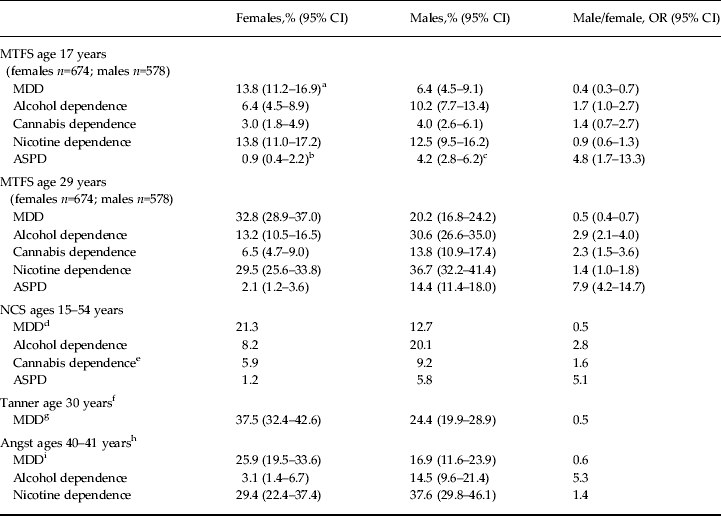
Table 2 displays the lifetime prevalence rates of all mental disorders in the MTFS and comparison males and females, where available. In the MTFS, lifetime prevalence rates of all mental disorders tripled between the ages of 17 and 29 years for males and more than doubled for females. CIs for rates at the two ages overlapped only for female cannabis dependence and female ASPD. Only for female ASPD did the prevalence rate at the age of 29 years fall within the CI of the age 17 years rate. Our lifetime prevalence rates at the age of 29 years were higher than NCS rates for both males and females, with NCS rates falling within our rates’ CIs only for female cannabis dependence and female ASPD. Again, there was variation within the prospective samples, with our rates occupying an intermediate position.
Lifetime prevalence of mental disorders in MTFS and comparison females and males

MTFS, Minnesota Twin Family Study; CI, confidence interval; OR, odds ratio; MDD, major depressive disorder; ASPD, antisocial personality disorder; NCS, National Comorbidity Survey.
a Sample size = 672.
b Sample size = 670.
c Sample size = 577.
d The NCS provides prevalence rates for major depressive episode, but not for major depressive disorder.
e The NCS provides prevalence rates for drug dependence, but not for cannabis dependence in particular.
f Data from Tanner et al. (Reference Tanner, Reinherz, Beardslee, Fitzmaurice, Leis and Berger2007).
g Tanner provides prevalence rates for ‘major depression’.
h Data from Angst et al. (Reference Angst, Gamma, Neuenschwander, Ajdacic-Gross, Eich, Rossler and Merikangas2005).
i Angst includes subthreshold symptoms of depression.
Odds ratios (ORs) allow comparison of males' and females' lifetime prevalence rates. At the age of 17 years, MTFS males had significantly lower odds of MDD than their female counterparts and tended to have higher odds of externalizing disorders, although significantly higher only for ASPD. By the age of 29 years, the gender gap had narrowed for MDD – while still remaining significant – and widened for the externalizing disorders such that men had significantly higher odds of alcohol and cannabis dependence as well as ASPD. ORs show that the magnitude of gender differences did not vary between the MTFS at the age of 29 years and the comparison studies, with one exception: the gender difference in alcohol dependence was larger in Angst et al. (Reference Angst, Gamma, Neuenschwander, Ajdacic-Gross, Eich, Rossler and Merikangas2005) compared with the other studies.
Lifetime co-morbidity
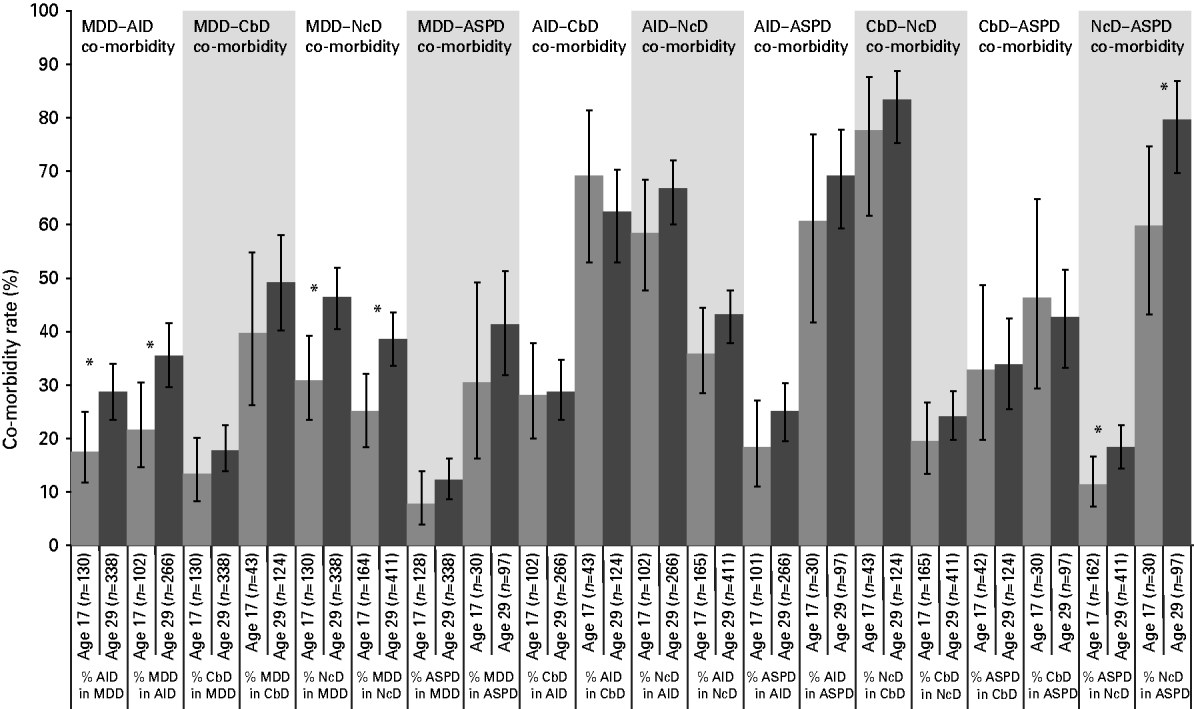
Fig. 1 shows lifetime co-morbidity rates in MTFS participants at the ages of 17 and 29 years. The first four columns show co-morbidity rates for MDD and alcohol dependence. In the first two columns, we can see the percentage of those with a lifetime diagnosis of MDD who also had a lifetime diagnosis of alcohol dependence. At the age of 17 years, this percentage was 17%; at the age of 29 years, the percentage was significantly higher at 28%. The next two columns show the percentage of those with a history of alcohol dependence who also had a history of MDD. This percentage was 22% at the age of 17 years and 35% at the age of 29 years – again a significant difference. The remaining columns of Fig. 1 show analogous lifetime co-morbidity rates for other pairs of disorders.
Lifetime co-morbidity rates for pairs of disorders in the full Minnesota Twin Family Study sample. Each column shows the percentage of individuals with a lifetime diagnosis of a given disorder that have a lifetime diagnosis of a co-morbid disorder, with 95% confidence intervals represented by vertical bars. For instance, the first two columns indicate what percentage of those with a lifetime diagnosis of major depressive disorder (MDD) has a lifetime diagnosis of alcohol dependence (AlD) at the age of 17 years and at the age of 29 years. The next two columns take those with a lifetime diagnosis of AlD and indicate what percentage has a lifetime diagnosis of MDD at the age of 17 years and at the age of 29 years. CbD, Cannabis dependence; NcD, nicotine dependence; ASPD, antisocial personality disorder. * Co-morbidity rates at the ages of 17 and 29 years fall outside of each other's 95% confidence intervals.

Of the 10 disorder pairings shown in Fig. 1, there are three where lifetime co-morbidity rates were significantly different at the age of 29 years than at the age of 17 years. The three pairings indicate that MDD–alcohol dependence, MDD–nicotine dependence and ASPD–nicotine dependence were more highly co-morbid (on a lifetime basis) at the age of 29 years than at the age of 17 years. Lifetime co-morbidity was also higher at the age of 29 years among other disorder pairings, though not significantly. Only for alcohol dependence–cannabis dependence and ASPD–cannabis dependence was lifetime co-morbidity either the same or lower at the age of 29 years compared with at the age of 17 years. Follow-up analyses indicated that the two ‘cannabis exceptions’ cannot be attributed to unusual patterns of missed assessments.
Discussion
Lifetime prevalence by age 29 years
This study examined the lifetime prevalence of common mental disorders in a statewide Minnesota sample assessed prospectively between the ages of 17 and 29 years. Given the importance of prevalence rates in informing public policy and etiological research, our aim was to obtain accurate estimates of the percentage of individuals who experience a mental illness within their lifetimes. Toward this aim, we studied a representative community sample with very low attrition over time, used high-quality assessment methods, and covered all of the time between assessments and before the initial assessment to optimize the accuracy of our estimated lifetime rates. We found that lifetime prevalence rates of all disorders more than doubled between the ages of 17 and 29 years, with more than a quarter of individuals meeting criteria for MDD and over a fifth experiencing alcohol dependence by the latter age. Furthermore, our prospective rates at the age of 29 years were consistently higher than rates from leading epidemiological surveys in line with expected differences between prospective and retrospective prevalence estimates. Despite variation in the prevalence estimates of prospective studies, our lifetime prevalence rates accord with most prospective estimates in showing that multiple assessments given to participants as they age catch more cases of mental illness than a single retrospective survey given to people of different ages.
Examining gender differences, we found that females had higher rates of MDD and tended to have lower rates of externalizing disorders than males. Between the ages of 17 and 29 years, the gender gap narrowed somewhat for MDD – while still remaining significant – and widened for the externalizing disorders. At the age of 29 years, the magnitude of gender differences in our sample resembled findings in retrospective and other prospective samples. Our results corroborate previous findings that the twenties are a period of gender convergence for depression (Galambos et al. Reference Galambos, Barker and Krahn2006) and gender divergence for at least some externalizing disorders (Tanner et al. Reference Tanner, Reinherz, Beardslee, Fitzmaurice, Leis and Berger2007). This indicates that emerging adulthood is an especially high-risk period for the development of mental illness in males. Future research should investigate the reasons for this heightened risk.
Lifetime co-morbidity by age 29 years
In general, lifetime co-morbidity was higher at the age of 29 years than at the age of 17 years and was significantly higher for MDD–alcohol dependence, MDD–nicotine dependence and ASPD–nicotine dependence. This shows that individuals who have a history of a given disorder are more likely to have had a co-morbid disorder if they are in their late twenties compared with their late teens. Thus, lifetime co-morbidity increases over the course of emerging adulthood. There were two exceptions to this rule: lifetime co-morbidity was the same or lower at the age of 29 years compared with at the age of 17 years for alcohol dependence–cannabis dependence and ASPD–cannabis dependence. It is unclear why these two ‘cannabis exceptions’ do not follow the same trend as other disorder pairings. Unusual patterns of missed assessments do not seem to account for this difference. More research is necessary to clarify these findings.
Our analyses do not explore the causal links behind observed co-morbidity patterns. Swendsen et al. (Reference Swendsen, Conway, Degenhardt, Glantz, Jin, Merikangas, Sampson and Kessler2010) suggest that pre-existing mental disorders, including behavioral, mood, anxiety and other substance use disorders, can predict the later onset of substance use problems, but other studies find associations in the reverse direction (Breslau et al. Reference Breslau, Novak and Kessler2004; Semple et al. Reference Semple, McIntosh and Lawrie2005). While future research should continue to examine causal factors underlying co-morbidity, the contribution of the current study is to demonstrate that co-morbidity tends to increase with age across emerging adulthood. This finding has important implications for intervention and research, as discussed below.
Limitations
This study has some limitations. First, the sample was predominantly Caucasian and consisted of a single cohort. Therefore, our findings may not generalize to other races or across generations. The fact that our sample consists of twins should not limit the generalizability of our results because twins do not differ consistently from non-twins in their symptoms of mental disorder (Kendler et al. Reference Kendler, Martin, Heath and Eaves1995). Second, only MDD and externalizing disorders were examined. We do not know if the prevalence patterns found for these disorders apply to other disorders as well. But (1) the fact that lifetime prevalence rates for all examined disorders increased significantly across emerging adulthood and (2) the consistency with which our and other prospective prevalence rates were higher than retrospective rates suggest that these results are likely to hold for unexamined disorders. Third, between-study methodological differences complicate comparison of our prevalence estimates with those of retrospective and other prospective studies. Fortunately, methodological differences do not seem to be systematically related to differences in prevalence estimates. For instance, highly structured diagnostic instruments produced both low (e.g. NCS and NCS-R) and high (e.g. Moffitt et al. Reference Moffitt, Caspi, Taylor, Kokaua, Milne, Polanczyk and Poulton2010) prevalence estimates, and the same was true of less structured instruments; e.g. our study produced relatively high prevalence estimates, whereas Angst et al. (Reference Angst, Gamma, Neuenschwander, Ajdacic-Gross, Eich, Rossler and Merikangas2005) produced lower estimates. Additionally, the consistency with which prospective prevalence rates tended to exceed retrospectives rates suggests that this finding is not an artifact of specific methodological factors, especially given considerable methodological variation among prospective studies. Fourth, participants were not assessed prior to the age of 17 years; rather, they provided lifetime reports at this age. This means that even our prospective lifetime prevalence rates may underestimate the actual prevalence of mental illness. Still, since the age of 17 years is relatively early in the lives of our participants, assessments at this age probably revealed mental health problems experienced at a younger age.
Prospective research has been criticized by some for producing artificially high prevalence rates due to the aggregation of false-positive diagnoses over time. The high quality of our assessment method, which includes in-person semi-structured interviews, a case conference to review the adequacy of every assessed symptom, and high inter-rater reliability, means that this concern is minimized. Another objection to prospective research is that elevated prevalence rates may be due to ‘sampling biases inherent in loss to follow-up’ (Merikangas, Reference Merikangas2011, p. 213). All of our participants were retained in the sample as long as they attended one of four assessments. This was a conservative approach, as it was possible that participants who had not met criteria for a mental disorder by their most recent assessment went on to develop a disorder but did not attend subsequent assessments. As a result, loss to follow-up did not lead to inflated prevalence rates in this study.
Implications
The present study shows that emerging adulthood is a high-risk period for the development of mental illness, with the lifetime prevalence and co-morbidity of mental disorders increasing over this time. Our results also indicate that considerably more individuals experience mental illness than is suggested by the extant literature and, thus, that mental illness is a relatively common occurrence. These findings have important implications for the estimation of economic burden, resource allocation toward mental health services, the development of etiological theories, and advocacy organizations for the mentally ill.
Measures of economic burden are typically based on prevalence estimates ascertained from a single assessment for a given year. They provide a snapshot of the costs of mental illness at a particular point in time and may not generalize to later years. Conversely, accurate lifetime prevalence estimates allow calculation of the costs incurred throughout a generation's lifetime.
Our relatively high prevalence and co-morbidity estimates may indicate that more resources should be allocated toward mental health services. Future studies need to investigate the precise implications of such high rates for policy purposes. How many additional resources should policymakers allocate toward mental health services, and which services should they target to accommodate best individuals detected in prospective, but not retrospective, research? The high incidence of mental disorders during emerging adulthood suggests that this is a critical time for prevention efforts and that schools, universities and community youth organizations may be important targets.
The results of this study have implications for the development of etiological theories. Our relatively high prevalence estimates raise concern that etiological theories based on retrospective estimates of mental disorder may neglect to account for sizeable segments of the population affected by mental illness. In addition, our identification of increasing lifetime co-morbidity with age suggests that co-morbidity is probably more widespread than thought, which necessitates research into understanding what accounts for this increase with development. Finally, advocacy organizations may be able to benefit from our findings by publicizing the commonness of mental illness to counteract stigmatization of the mentally ill.
Acknowledgements
This work was supported by grants from the National Institutes of Health (no. R37 DA 05147 and R01 AA 09367, to W.G.I.) as well as a Graduate Research Partnership Program grant from the University of Minnesota (to N.R.H).
Declaration of Interest
None.