Introduction
The treatment of patients presenting with submandibular sialolithiasis has evolved over the years, but generally varies according to size and number of calculi, their location within the ductal system, and the available technology and local surgical expertise. Whereas in the past many patients with proximal calculi would have been managed by submandibular gland excision, more recent organ-preservation techniques have been described. Conservation techniques developed include interventional sialendoscopy, extracorporeal shock wave lithotripsy, interventional radiology and direct transoral sialolith removal. Each conservation technique has advantages and limitations; some techniques require repeated visits before resolution, while others require special equipment and expertise which often means added cost and extra time allocation.
The success rate of interventional sialendoscopy is approximately 80–85 per cent.Reference Nahlieli and Baruchin1–Reference Papadaki, McCain, Kim, Katz, Kaban and Troulis4 Reasons for failure include inability to pass the endoscope down the duct lumen, and inability to extract the sialolith. Late complications may occur due to ductal stricture formation.Reference Nahlieli and Baruchin1
Extracorporeal shock wave lithotripsy is a noninvasive procedure which may require up to three clinic visits for treatment.Reference Zenk, Bozzato, Winter, Gottwald and Iro5, Reference Iro, Zenk, Waldfahrer, Benzel, Schneider and Ell6 Most centres report success with this technique in approximately one-third of patients, with another third remaining symptom-free despite only partial stone removal.Reference Zenk, Bozzato, Winter, Gottwald and Iro5
Interventional radiology uses the basket retrieval technique to remove salivary calculi, and has a reported success rate of 75–85 per cent.Reference McGurk, Escudier and Brown7, Reference Iro, Zenk, Escudier, Nahlieli, Capaccio and Katz8 The main reason for failure of this technique is thought to be tethering of calculi to the salivary duct.
Direct transoral surgical removal of sialoliths has a reported success rate of approximately 90–95 per cent.Reference McGurk, Escudier and Brown7, Reference Zenk, Constantinidis, Al-Kadah and Iro9, Reference Park, Sohn and Kim10
Previously, our department had pursued a policy of direct surgical dissection and excision of calculi. However, in view of several recent reports advocating removal of submandibular salivary calculi using approaches involving sophisticated technology, we decided to review our own experience of salivary calculi treatment using more traditional instrumentation.Reference Nahlieli and Baruchin1–Reference Marchal, Dulguerov, Becker, Barki, Disant and Lehmann3 In particular, we needed to assess whether our patients' outcomes could possibly be improved by the use of technology such as sialendoscopy.
In this paper, we describe our outcomes for transoral removal of submandibular calculi. We also compare our results to those of other conservation techniques, and assess the relative cost-effectiveness of our approach.
Patients and methods
We undertook a retrospective review of all submandibular calculi treated in our otorhinolaryngology – head and neck surgery department between June 2001 and May 2009. Sixty patients were identified. All relevant medical records were retrieved and the following patient data collected: age, site of calculi, imaging studies, number of calculi retrieved, anaesthesia type, number of surgical procedures, duration of surgery, length of hospital stay, complications and follow up.
For all these patients, the expected standard of care was to attempt in the first instance transoral excision of calculi.
The procedure was deemed successful when all calculi were removed and the patient was symptom-free. Failure was recorded when patients had recurrent symptoms and required submandibular gland excision. Six-month follow-up data were sought for all patients.
All data were entered into a Statistical Package for the Social Sciences database for statistical analysis. Nominal data were analysed using the chi-square test. The Mann–Whitney test was applied for ordinal and scale variables to assess differences between groups.
Surgical technique
Distal submandibular duct calculi are usually removed under local anaesthesia. Once the calculus has been identified, a temporary silk stay suture is looped around the submandibular duct proximal to the calculus, to prevent it from moving proximally. An incision is then made directly onto the calculus with a scalpel. The stone usually then simply extrudes into the oral cavity.
A calculus that is located proximally in the parenchyma or hilum of the submandibular gland is usually removed under general anaesthesia. The assistant plays a crucial role in this surgery, applying upward digital pressure onto the submandibular gland in order to elevate the gland and its hilum into the operative field. If the procedure is conducted under local anaesthesia, then patients are asked to apply the external digital pressure themselves. The calculus can usually be located by the surgeon using a forefinger in the mouth; an incision is then made directly over the stone. Blunt dissection down onto the stone then exposes the calculus. Care must be taken to dissect directly onto the calculus, using a finger to guide the instrument. This technique avoids damage to the lingual nerve, and works best if the calculus is greater than 7 mm in size. Calculi smaller than 7 mm are difficult to palpate and are more likely to be mobile. In such cases, the submandibular duct is first exposed in its mid-portion and then dissected proximally. The stone is then approached by a linear incision in the duct just distal to or directly over the calculus. Flushing of the duct with saline can be a useful adjuvant manoeuvre.
Results and analysis
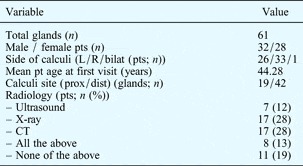
Transoral removal of submandibular calculi was attempted for 61 submandibular glands. Twenty-seven right and 34 left-sided submandibular glands were involved (Table I). Forty-two glands had distal calculi in Wharton's duct, while 19 had proximal calculi.
Patient data
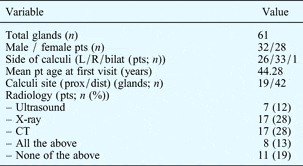
Pts = patients; L = left; R = right; bilat = bilateral; prox = proximal; dist = distal; CT = computed tomography
The mean operating time ± standard deviation (SD) was 28 ± 13 minutes. Forty-one patients underwent the procedure under local anaesthesia and 19 patients under general anaesthesia. Seven patients (11 per cent) required subsequent resection of the submandibular gland; all these procedures were performed under general anaesthesia. The location and average size of calculi remained stable throughout the study period. In the first half of the study period, six of 28 patients undergoing transoral removal of submandibular duct calculi subsequently required submandibular gland removal. In the second half of the study period, only one of 32 patients undergoing the same procedure required subsequent submandibular gland removal. This difference was statistically significant (chi-square, p = 0.028).
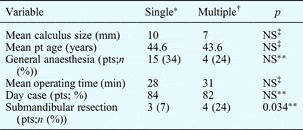
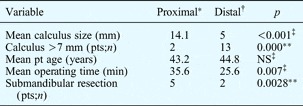
Patients with multiple stones were at higher risk of submandibular gland excision, compared with those with single stones (p = 0.034) (Table II). A higher risk of submandibular gland excision was also seen for patients with calculi in the proximal portion of the duct, compared with patients with distal calculi (p = 0.0028) (Table III).
Data for transoral removal of single and multiple calculi
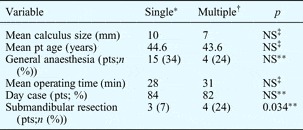
*n = 44 submandibular glands; †n = 17 submandibular glands. ‡Mann–Whitney U test; **chi-square test. NS = not significant; pts = patients; min = minutes
Data for transoral removal of proximal and distal calculi
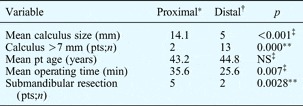
*n = 19 submandibular glands; †n = 42 submandibular glands. ‡Mann–Whitney test; **chi-square test. Pts = patients; NS = not significant; min = minutes
Fifty-one patients were treated with day-case (out-patient) surgery, while nine patients stayed overnight after surgery. One patient's sialolith could not be retrieved but the patient became asymptomatic. Multiple stones were encountered in 19 cases (28 per cent), with two, three, four and more than four sialoliths being retrieved in nine, two, three and three patients, respectively.
Calculi larger than 7 mm in size were significantly more likely to be located in the proximal part of the duct (p < 0.001) (Table III). The mean maximum sialolith size ± SD was 9 ± 7 mm. The mean operating time ± SD for patients with calculi of 7 mm or less was 25 ± 10.50 minutes; the equivalent time for patients with calculi larger than 7 mm was 35 ± 16 minutes.
At the time of writing, the average cost of surgery in our institution, for cases conducted under local anaesthesia, was NZ$3/minute. The cost for cases conducted under general anaesthesia was NZ$13/minute, while an overnight stay cost NZ$850. In the current study, the average cost per case was calculated by taking into consideration the operating time and the cost per minute (for general or local anaesthesia as appropriate), adding any overnight stay cost and then averaging. We also included in the calculation the cost of any subsequent related surgery, such as submandibular gland excision. Based on this method, the overall mean cost per surgical procedure in the current study was NZ$409.46 (approximately £197).
Discussion
Seven (11 per cent) of our patients had calculi successfully extracted but later presented with persistent pain and ductal swelling of the submandibular gland. Most of these patients had been treated early in the study period. The recurrent problems generally became evident within 10 weeks (range, three to 15 weeks). Our success rate for cases treated during the second half of the study period was significantly better (p = 0.028), at 97 per cent, and was as good as could be expected in any centre that removes calculi transorally.Reference Zenk, Constantinidis, Al-Kadah and Iro9–Reference Capaccio, Bottero, Pompilio and Ottaviani11 This suggests the presence of a learning curve. It is not clear how many calculi need to be removed before satisfactory expertise is acquired. Most of our patients who required submandibular gland excision following a failed transoral procedure had strictures and fibrosis of the submandibular ductal system (identified on histological examination of the surgical specimen). This type of pathology may benefit from interventional sialendoscopy to dilate the ductal stenosis, thereby avoiding the need for gland removal.
• Many organ-preservation techniques have been developed to remove submandibular calculi, most recently sialendoscopy
• Transoral removal of submandibular calculi is equally as successful as newer techniques, and is more economical
Our patients' demographic data were similar to that reported in other studies.Reference Ziegler, Steveling, Seubert and Muhling2, Reference Zenk, Bozzato, Winter, Gottwald and Iro5 Calculi located in the proximal part of the submandibular duct were more difficult to access and took longer to excise, compared with distal duct calculi (p = 0.007). Overall, our technique for transoral removal of submandibular calculi took 28 minutes on average, whereas interventional sialendoscopy takes a reported average time of 71 minutes.Reference Marchal, Dulguerov, Becker, Barki, Disant and Lehmann3 This is probably because the latter technique requires the submandibular duct to be dilated, and calculi may need to be broken down into smaller pieces before they can be removed.
We found that the overall cost of a single transoral submandibular duct calculus removal procedure was NZ$409 (approximately £194). By comparison, the estimated cost of one interventional sialendoscopy procedure, calculated following the method of Marchal et al., would be NZ$638 (approximately £307); this does not include the cost of procurement and maintenance of new equipment, staff training, or any later surgery required.Reference Marchal, Dulguerov, Becker, Barki, Disant and Lehmann3
Overall, transoral removal of submandibular calculi using traditional techniques in experienced hands appears to be more economical and equally effective, compared with other techniques using more sophisticated technology.
Patients suspected of having other ductal problems, and whose imaging studies do not show a calculus, should be considered for diagnostic sialendoscopy.
This study was limited by being retrospective. Furthermore, one patient's records were incomplete, and two other patients could not be contacted to establish their late follow-up status.
We recognise that interventional sialendoscopy is a desirable tool that has an important role in patients with submandibular duct problems. However, patients with sialolithiasis of the submandibular duct can be successfully treated transorally using traditional instrumentation, which is more economically viable in our setting and has success rates equivalent to other techniques.
Conclusion
From our experience it is apparent that the majority of submandibular calculi can be managed without the need of sialoendoscopy on the one hand, or full submandibular gland excision on the other. However, this approach is probably a “volume sensitive” procedure, where success rates improve with experience. In experienced hands this approach is a more cost effective option that the alternatives.