Introduction
Autism spectrum disorder (ASD) is characterized by impairments in social communication and interaction, face and affect recognition, and the ability to see the world from another person’s perspective. Visual processing problems have been suggested to underlie these impairments.Reference Behrmann, Thomas and Humphreys 1
Studies on non-social visual processing in ASD have reported an enhanced ability in local visual processing and in finding embedded targets in large figures.Reference Pellicano, Gibson, Maybery, Durkin and Badcock 2 Some studies have also reported that individuals with ASD have global visual processing problems,Reference Van der Hallen, Evers, Brewaeys, Van den Noortgate and Wagemans 3 namely problems in integrating parts to form a whole.Reference Olu-Lafe, Liederman and Tager-Flusberg 4
As ASD can be considered as a continuum ranging from mild traits in the general population to the severe form of the disorder,Reference Baron-Cohen, Wheelwright, Skinner, Martin and Clubley 5 the atypical visual processing style of focusing on details rather than the whole, has also been found in individuals with higher levels of ASD-traits. The existing evidence shows that a higher level of ASD-traits is associated with a higher perceptual capacity and superior visual search,Reference Almeida, Dickinson, Maybery, Badcock and Badcock 6 an enhanced ability to find embedded targets in a large figureReference Grinter, Van Beek, Maybery and Badcock 7 and a bias toward local visual processing,Reference van Boxtel and Lu 8 but also with problems in global visual processing.Reference Grinter, Maybery and Van Beek 9
However, because the samples of the studies described above are either clinical (samples pool individuals with ASD diagnosis and varying levels of ASD-traits) or represent university students, their findings do not necessarily generalize to subgroups at risk for both ASD and poorer visual processing. Our and others’ previous studies have demonstrated that individuals born preterm (<37 gestational weeks) display a higher risk of ASD and/or ASD-traits,Reference Pyhälä, Hovi and Lahti 10 , Reference Class, Rickert, Larsson, Lichtenstein and D’Onofrio 11 and have problems in visual processing.Reference Pyhälä, Lahti and Heinonen 12
In this study, we examined if ASD-traits and visual processing performance are associated in young adults born preterm at very low birth weight (VLBW; <1500 g), and if the associations vary between the preterm VLBW and term (gestational age ⩾37 weeks) groups. We also studied if the degree of intrauterine growth restriction as reflected in small for gestational age (SGA; less than or equal to −2 s.d. according to Finnish growth charts)Reference Pihkala, Hakala, Petri and Raivio 13 and appropriate for gestational age (AGA; −2 s.d. to +2 s.d.)Reference Pihkala, Hakala, Petri and Raivio 13 birth weight modified any potential associations between ASD-traits and visual processing tasks in the preterm VLBW group. As VLBW is associated with a higher level of ASD-traits and poorer visual processing skills, we hypothesized that higher ASD-traits would be associated more strongly with poorer visual processing in the preterm VLBW than in the term-born group.
Method
Participants
Participants came from the second young adult follow-up of the Helsinki Study of Very Low Birth Weight Adults.Reference Pyhälä, Hovi and Lahti 10 , Reference Pyhälä, Lahti and Heinonen 12 The original cohort comprised 335 discharged (survival rate 70.7%) infants born preterm at VLBW (1978–1985) and treated in the neonatal intensive care unit at Helsinki University Central Hospital in Finland. A control group comprised infants born at term and not SGA, which was matched for sex and birth hospital with the preterm group.Reference Hovi, Andersson and Eriksson 14
In young adulthood, 113 VLBW and 105 term-born controls participated in the second follow-up visit,Reference Pyhälä, Lahti and Heinonen 12 including a questionnaire of ASD-traits and tests of visual processing. Of the VLBW participants, 101 (37 born SGA, 64 born AGA) and of the term-born controls, 104 did not have neurosensory impairments (cerebral palsy, developmental impairment, blindness and hearing impairment; n=6) and provided data simultaneously on study variables. None of the participants reported an ASD diagnosis.
A written informed consent form was signed by all participants. The study protocol was approved by the Ethics Committee for Children’s and Adolescents’ Diseases and Psychiatry at the Helsinki and Uusimaa Hospital District.
Autism spectrum traits
The Autism-Spectrum Quotient (AQ) is a self-rated questionnaire, comprising 50 questions on a four-point dichotomized scale.Reference Baron-Cohen, Wheelwright, Skinner, Martin and Clubley 5 AQ yields a Total sum score (50 items) and Social interaction (40 items) and Attention to detail subscores (10 items), with higher scores indicating higher ASD-traits. The AQ scores have good discriminant validity.Reference Hoekstra, Bartels, Cath and Boomsma 15 In our sample, internal consistency (Cronbach’s α) for the Total, Social interaction and Attention to detail scores were 0.78, 0.81 and 0.58, respectively.
Visual processing
The Rey–Osterrieth Complex Figure Test (ROCF) comprises three test conditions measuring visuospatial processing: copy, immediate recall and delayed recall.Reference Rey 16 The test yields accuracy scoresReference Taylor 17 and reproduction times when copying the figure, drawing it immediately thereafter from recall and drawing it after recall 35 min later. Visuospatial cognitive ability was assessed using the Block Design subtest of the Wechsler Adult Intelligence Scale (WAIS)-III.Reference Wechsler 18
Covariates
These included sex and head circumference (cm) at birth, extracted from hospital records and converted into s.d. scores by sex in relation to gestational age.Reference Pihkala, Hakala, Petri and Raivio 13 Adult head circumference (cm) was measured during the clinical visit and highest education of either parent (categorized according to Statistics Finland) was reported by the participant. Age at testing was calculated from dates of birth and testing. Full scale Intelligence Quotient (IQ) was estimated using WAIS-III subscales Block Design, Vocabulary, Similarities and Digit Span using the Finnish normsReference Wechsler 18 (this was adjusted for only in the ROCF analyses).
Statistical analyses
We evaluated potential selection bias by comparing those in the original sample and not followed up with those participating in this study on pre-, post- and neonatal factors.
Due to the skewed distributions, we transformed (logarithmic, square, square root or rank-normalization using Blom’s formula) the study variables to attain normality (please see footnote of Fig. 1) and to improve linear model fitting. To facilitate interpretation and provide effect size estimates variables were converted into s.d. units with a mean of 0 and s.d. of 1.
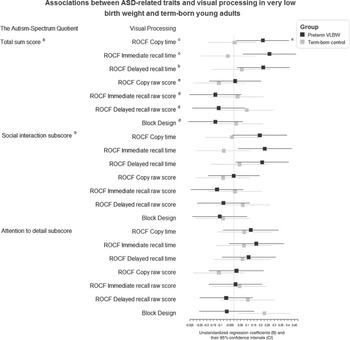
Associations between Autism-Spectrum Quotient (AQ) scores and Rey-Osterrieth Complex Figure Test (ROCF) time and raw scores and Block Design score in the VLBW and control groups. Unstandardized regression coefficients (B) and their 95% confidence intervals (CI) indicating the increase in autism-spectrum quotient scores in s.d. units per each ROCF and Block Design s.d. unit score increase in a model adjusting for sex and age at assessment (Model 1). When adjusting further for highest education of either parent, current head circumference and head circumference s.d. score at birth (Model 2), and further, for full intelligence quotient (Model 3; only in ROCF analyses), all associations stayed statistically significant (P-values <0.05).aNot significant after controlling for inflation of Type II error rate due to multiple testing with a false detection rate (FDR) procedure setting the FDR across seven tests at 0.05.Variables were transformed to attain normality and improve linear model fitting using bsquare-root, clogarithmic or dsquare transformations, or were erank-normalized using Blom’s formula.

Linear regression analyses tested associations between AQ scores and visual processing scores, first, in the VLBW and control groups separately, and then tested if the associations varied between the groups in a regression model that included VLBW v. term×AQ score interactions. We controlled the associations between AQ Total sum score and all visual processing scores for inflation of Type II error rate due to multiple testing with a false detection rate (FDR) procedureReference Benjamini and Hochberg 19 setting the FDR across seven tests at 0.05. We did not apply the FDR procedure to the AQ Social interaction and Attention to detail subscores, because the AQ Total sum score is a composite of these scores with subscores being highly correlated with the Total score (r=0.94 and 0.37, both P-values <0.001, respectively). We made adjustments for covariates in three different models (models described in Fig. 1).
We also explored if the associations were different in the VLBW-SGA (n=37) and AGA (n=64) groups, and then included the AGA v. SGA×AQ score – interaction term to the models to test if the associations between the groups were significantly different.
Results
In comparison with those in the original sample and who did not participate in the follow-up, the participants in this study did not differ in pre-, post- or neonatal factors (birth weight, birth weight standard deviation score, birth head circumference, birth head circumference standard deviation score, birth length, gestational age, maternal pre-eclampsia, maternal age at birth, parity, multiple birth, sex, maternal smoking during pregnancy) (P-values >0.05 for differences between non-participants and participants in the VLBW and control groups).
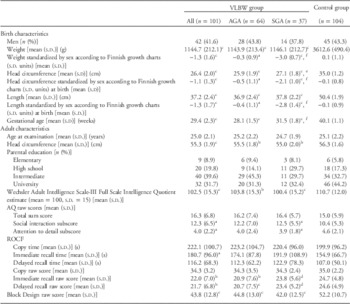
Table 1 shows, in accordance with our previous report,Reference Pyhälä, Lahti and Heinonen 12 that the VLBW group had lower ROCF Immediate and Delayed recall, Block Design and Full scale IQ scores, and they performed slower on the ROCF Immediate recall task. Also in accordance with our previous report,Reference Pyhälä, Hovi and Lahti 10 the VLBW group had higher AQ Social interaction subscores (indicating higher ASD-traits) and lower Attention to detail subscores (indicating lower ASD-related attention to detail traits), but there were no significant differences between the VLBW-AGA and VLBW-SGA groups in these scores.
Descriptive characteristics of the sample

VLBW, very low birth weight; AGA, VLBW with appropriate birth weight for gestational age (birth weight for gestational age−2 s.d. to +2 s.d. according to the Finnish birth weight charts);13 SGA, VLBW with small birth weight for gestational age (birth weight for gestational age less than or equal to−2 s.d. according to the Finnish birth weight charts)13; AQ, Autism-Spectrum Quotient; ROCF, Rey–Osterrieth Complex Figure Test.
Missing information: head circumference at birth (n=3, all VLBW-AGA), height at birth (n=1 VLBW-AGA), head circumference at adulthood (n=10, five VLBW-AGA and five controls), ROCF copy time (n=1 VLBW-SGA), ROCF immediate recall time (n=1 VLBW-AGA).
a P<0.05 for difference against the control group.
b P<0.01 for difference against the control group.
c P<0.001 for difference against the control group.
d P<0.05 for difference between the VLBW-AGA and VLBW-SGA groups.
e P<0.01 for difference between the VLBW-AGA and VLBW-SGA groups.
f P<0.001 for difference between the VLBW-AGA and VLBW-SGA groups.
AQ sum scores and visual processing
Figure 1 shows that among preterm VLBW adults, higher AQ Total sum score was associated with slower performance in all three ROCF time conditions (Copy, Immediate recall and Delayed recall) (Models 1–3), and higher AQ Social interaction subscore was associated with slower performance in ROCF Immediate and Delayed recall time conditions (Models 1–3). However, the association between AQ Total sum score and ROCF Copy time score did not survive the FDR correction. The effects were of small to medium size (Cohen’s f 2 ranges from 0.05 to 0.16). These associations were not significant in the term group. We then reran the analyses of Model 1 using unstandardized transformed variables to investigate the clinical significance of the effect sizes of AQ Total sum score on the ROCF Immediate and Delayed recall time scores. Then, using the unstandardized regression coefficients, we back-transformed the ROCF time scores to conclude how many seconds slower the performance was per each one-point increase in AQ Total sum score. On the Immediate recall condition, the performance time was 1.4 s slower, and on the Delayed recall condition, it was 3.1 s slower for every one-point increase in the AQ Total sum score (range of scores 0–50).
Interaction analyses revealed that the associations between AQ Total sum score and Immediate recall time condition [F (1,196)=4.79 P=0.03 for VLBW v. term×AQ Total sum score interaction in Model 1; P-values <0.03 for Models 2–3], and the association between AQ Social interaction subscore and Immediate recall time condition [F (1,196)=4.39 P=0.04 for VLBW v. term×AQ Social interaction in Model 1; P-values <0.04 for Models 2–3] were statistically significantly different between the VLBW and the term groups. Other interaction estimates with the time variables showed a similar trend, but they were not statistically significant (P-values >0.07 for VLBW v. term×AQ score interactions). There were no significant associations between AQ scores and ROCF raw scores in the VLBW or term group, and no significant interactions (P-values >0.10 for VLBW v. term×AQ score interactions).
In the term group higher scores in AQ Attention to detail subscore were associated with better performance in Block Design (Models 1–2). This association was not significant in the VLBW group, and VLBW v. term×AQ Attention to detail subscore interaction showed the same trend (P-values >0.06, Models 1–2).
In the VLBW-AGA group, higher AQ Total score and Social interaction subscore was associated with slower performance in ROCF time conditions (Copy, Immediate recall and Delayed recall, P-values <0.05 in Model 1–3 except the AQ scores and Copy time score P-values >0.07 in Models 2–3). In the VLBW-SGA group none of these associations were significant (P-values >0.63). P-values for interactions between AGA v. SGA×AQ Total score were 0.58, 0.06 and 0.12, and for AGA v. SGA×AQ Social interaction subscore 0.90, 0.74 and 0.08, for the three ROCF time conditions, respectively. In the VLBW-SGA group, higher AQ Social interaction subscore was associated with lower Delayed recall raw scores (P=0.047, Model 1, P-values >0.26, Models 2–3), in the VLBW-AGA group this association was not significant (P=0.97). P-value for interaction between AGA v. SGA×AQ Social interaction subscore was 0.62.
Discussion
We found that a higher level of ASD-traits was associated with slower performance in visual processing tasks among young adults born preterm at VLBW. This association was characteristic to those born preterm at VLBW as indicated by a statistically significant interaction and no significant association among adults born at term. The degree of intrauterine growth restriction in the VLBW group did not modify any associations between ASD-traits and visual processing tasks, though our sample size which enabled us to detect main effects, may have been under-powered to detect significant interaction effects.
In the VLBW group, after correcting for multiple testing, a higher level of ASD-traits was associated with slower performance speed in the ROCF Immediate and Delayed recall conditions. However, the accuracy of the copied figure was not associated with ASD-traits, concurring with a recent meta-analysis.Reference Van der Hallen, Evers, Brewaeys, Van den Noortgate and Wagemans 3 Although processing speed in the ROCF has not been studied previously, the significant finding related to the associations between ASD-traits and slower speed in the ROCF task is in line with previous research on individuals with ASD indicating that they are slower in perceiving global order.Reference Van der Hallen, Evers, Brewaeys, Van den Noortgate and Wagemans 3 Prior studies have documented difficulties in making the developmental shift from the part-oriented approach to drawing the ROCF in childhood to the global approach in adulthood associated with ASD.Reference Tsatsanis, Noens and Illmann 20 We thus suggest that slower performance on the ROCF in association with higher levels of ASD-traits in our sample of VLBW adults reflects difficulties in global processing.
The current findings fit the weak central coherence (WCC) theory, which originally proposed that ASD-traits associate with both enhanced processing of details and impaired global processing skills. This pattern results in difficulties to combine local information to create a coherent global form.Reference Happé 21 The reason why we saw this association only in the VLBW group may relate to the higher variability of ASD-traits and visual processing difficulties in the VLBW group compared with the control group. Previous studies of global processing difficulties associated with ASD-traits in samples of university students have not controlled for preterm birth or low birth weight. Because preterm birth occurs in one in every 10 deliveries worldwide,Reference Blencowe, Cousens and Oestergaard 22 it is possible that those samples may have included participants who were born preterm or at VLBW. Note that we also had a single observation in the control group of an association between higher attention to detail and better performance on the Block Design task, suggesting better local visual processing (see Simmons et al.Reference Simmons, Robertson and McKay 23 for review). This aspect of enhanced local visual processing has specifically been emphasized in later versions of the WCC theory.
Slower processing speed has been reported to be associated with higher levels of problems in communication in high-functioning children with ASD, indicating that processing speed may moderate communication skills and deficits in ASD.Reference Oliveras-Rentas, Kenworthy, Roberson, Martin and Wallace 24 Whether the current finding of slower visual processing speed reflects slower processing speed in general, is an intriguing question and should be investigated further.
There were several strengths in our study, including a longitudinal case control study design with detailed information on neonatal and birth characteristics. We also used standardized, validated methods to measure visual processing and ASD-traits, and controlled for possible false positive findings with multiple outcomes. Limitations of this study include follow-up-related sample attrition. Although non-participation was not related to any of the multiple pre-, post- and neonatal factors, we cannot rule out that participants could have been healthier than non-participants or might have differed in some unmeasured way, for example in terms of their own cognitive abilities, educational attainment, genetic or behavioral factors.
In conclusion, we are to our knowledge the first to show that in adults born preterm at VLBW, a higher level of ASD-traits is associated with a slower global visual processing style, whereas these associations were not found in the group born at term. This effect was similar whether intrauterine growth restriction had been present or not. Our results show that the associations between visual processing and ASD-traits might be restricted to individuals born preterm. Further studies will tell whether this result repeats in relation to prenatal programming in other contexts than premature birth, or whether this is a specific prematurity-related finding. This observation bears also clinical relevance as it suggests cumulative social and neurocognitive problems in VLBW individuals. Future studies should take into account the role of prematurity and low birth weight when examining the relations between ASD-traits and visual processing. Second, opposite to some previous research, our findings were related to global visual processing, whereas we did not find an association of ASD-traits and enhanced local visual processing in the VLBW group. This could reflect a specific visual processing style in the VLBW group associated with ASD-traits, supporting previous findings of phenotypic differences in ASD between those born preterm and term.Reference Bowers, Wink, Pottenger, McDougle and Erickson 25
Acknowledgments
None.
Financial Support
The study was part of the Helsinki Study of Very Low Birth Weight Adults that has been funded by the Academy of Finland, the Emil Aaltonen Foundation, the Finnish Foundation for Diabetes Research, the Finnish Medical Society Duodecim, Foundation for Pediatric Research, the Finnish Special Governmental Subsidy for Health Sciences, the Jalmari and Rauha Ahokas Foundation, the Juho Vainio Foundation, the Maud Kuistila Memorial Foundation, the Novo Nordisk Foundation, the Päivikki and Sakari Sohlberg Foundation, the Signe and Ane Gyllenberg Foundation, the Sigrid Juselius Foundation and the Yrjö Jahnsson Foundation. The funders had no role in design or conduct of the study, collection, management, analysis or interpretation of the data, or preparation, review or approval of the manuscript.
Conflicts of Interest
None.
Ethical Standards
The authors assert that all procedures contributing to this work comply with the ethical standards of the relevant national guidelines on human experimentation (Medical Research Act) and with the Helsinki Declaration of 1975, as revised in 2008, and has been approved by the institutional committees (the Ethics Committee for Children’s and Adolescents Diseases and Psychiatry at the Helsinki and Uusimaa Hospital District).