Introduction
The metabolic syndrome (MS) represents a set of risk factors that are closely linked to insulin resistance (IR).1 The National Cholesterol Education Program Adult Treatment Panel (NCEP-ATP III) indicates that factors such as overweight, especially abdominal obesity and physical inactivity promote the development of IR. It also establishes the MS diagnostic criteria when three or more of the following five components are present: high waist circumference (WC), elevated blood pressure (BP), low high-density lipoprotein cholesterol (HDL-C), elevated triglycerides (TG) and high fasting glucose (GLU).1 The use of adapted criteria for children has been proposed by Cook et al.Reference Cook, Weitzman and Auinguer2
Mainly based upon European studies the importance of nutrition during pregnancy, infancy and early childhood in the origin of chronic adult diseases such as obesity, diabetes and cardiovascular disease, has been established.Reference Prentice3 Barker and coworkers have shown that malnutrition during pregnancy favors the incidence of infants with low-birth weight (BW) as well as macrosomia; both groups have a greater predisposition to develop various components of MS and IR.Reference Barker, Osmond and Golding4, Reference Hales, Barker and Clark5
Although many Chilean studies have shown the influence of maternal nutritional status on fetal growthReference Mardones, Urrutia and Villarroel6, Reference Mardones, García-Huidobro and Ralph7 and there have also been some reports about the presence of components of MS and IR in Chilean children and adolescents, none of these included the association between components of MS and fetal growth.Reference Casanueva, Milos and Lopetegui8–Reference Eyzaguirre, Silva and Román14
The objective of this study was to investigate for the first time in Chile, the association between prenatal growth and the components of MS, including IR, in schoolchildren.
Methods
During the years 2009 and 2010, a retrospective cohort study of children attending fifth and sixth grades at 14 public primary schools in the county of Puente Alto, located in the city of Santiago, Chile, was conducted. All 3521 children attending school were invited to participate with a letter addressed to their parents.
The information of the children who entered this study was linked to the perinatal data using the national individual identification number; perinatal data was collected by the Civil Registry and later refined by the Statistics Unit of the Ministry of Health of Chile.15
The perinatal variables used in this study were: BW, birth length (BL) and gestational age (GA) of delivery. They were determined in maternity hospitals immediately after delivery by trained personnel.Reference Mardones, Urrutia and Villarroel6, Reference Mardones, Villarroel and Karzulovic16 Newborns were weighed, in most cases, using an electronic balance Tanita 1583 (Tanita Corporation, Arlington Heights, IL, USA) with an accuracy of 10 g, or an electronic scale, Seca® 345 (Secacorp, Hamburg, Germany) with an accuracy of 20 g. Crown–heel length was measured on a custom-made neonatometer to the nearest 1 mm. GA was estimated with the date of the last menstrual period; when this data was inaccurate, an early obstetric ultrasound was used. This ultrasound examination is available for most women before 20 weeks gestation in Chile. The majority of these scans are performed with a Voluson® 730 PRO ultrasound machine (GE Healthcare, Chalfont St Giles, UK) or a Acuson® 120 XP (Acuson Inc., Mountain View, CA, USA).Reference Mardones, Urrutia and Villarroel6 Ultrasound examinations are sometimes not available in primary health care; in those situations GA is usually estimated by a postnatal clinical examination of the newborn performed by the physician.
The criteria of Cook et al. Reference Cook, Weitzman and Auinguer2 were used to define MS, when at least three out of five of its components were present, as defined by the following cut-off points: WC ⩾90th percentile;Reference Fernandez, Redden and Pietrobelli17 BP, either systolic (SBP) or diastolic (DBP) ⩾90th percentile;18 HDL-C ⩽40 mg/dl; TG ⩾110 mg/dl and GLU ⩾100 mg/dl. Recently proposed cut-off points of homeostasis model assessment (HOMA)-IR, according to sex and pubertal maturation, were used to classify IR.Reference Barja, Arnaiz and Domínguez19
The evaluation at each school was made by a Nurse and a Nutritionist. Height and weight were measured using a stadiometer and a beam-scale Seca®, with an accuracy of 50 g, while being barefoot and lightly clothed. The final height and weight were the respective averages of three measurements; in the latter, the average weight of their clothes was deducted. We calculated body mass index (BMI = weight in kg/height2 in m) expressed in percentiles and z-scores.20 Nutritional status was classified according to BMI percentiles as; normal: 5 to 84, overweight: 85 to 94, obesity: ⩾95 and underweight: <5.20 WC was measured with inextensible tape on the upper lateral border of the right ilium in the mid-axillary line at the end of an exhalation;21 three measurements were averaged and we used ⩾90th percentile as cut-off value.Reference Fernandez, Redden and Pietrobelli17 The triceps and subscapular skinfolds were measured with a Harpenden® caliper using a standard technique;21 both were used to calculate the percentage of fat mass (%FM) using slaughter equations,Reference Slaughter, Lohman and Boileau22 previously validated in Chilean children.Reference Urrejola, Hodgson and Icaza23, Reference Liberona, Castillo and Engler24 A Critikon® Dinamap Pro 100 BP monitor was used according to international norms and the averages of three measurements of SBP and DBP were obtained and classified as abnormal using the ⩾90 percentile of the same reference.18 A voluntary private self-report of pubertal status was requested by observation of standardized photos of breast development in girls and genitalia in boys, including the presence of pubic hair.Reference Tanner25
Venous blood samples were collected for determination of GLU (Gluco-quant method, glucose/hexokinase, Roche Diagnostics GmbH, Mannheim, Germany) and insulin (immunoassay direct luminometer chemotherapy, ADVIA Centaur® XP, Bayer HealthCare LLC, Kyowa Medex Co., Japan), this method measures concentrations of insulin from 0.5 to 300 mUI/ml (sensitivity 0.5 mUI/ml) with a coefficient of variation of 3.48% and 6.17% for concentrations of 23.51 and 62.49 mUI/ml, respectively. The formula developed by Mathews et al. Reference Matthews, Hosker and Rudenski26 was used to calculate HOMA-IR = [(GLU (mmol/liter) × insulinemia (mUI/ml))/22.5].
Student's t test for independent samples to compare averages and Pearson's χ 2 test for proportions comparison were used. Contingency tables were used to assess significant associations between children presenting MS components and IR with risk categories of dichotomized perinatal variables, that is, BW < 2500 g, BL < 50 cm and GA < 37 weeks. A χ 2 test was also applied to assess possible U-shaped associations between MS components and IR with perinatal variables, that is, either BW or BL or GA, divided in various categories in the contingency tables; the Bonferroni correction was used to compute statistically significant differences of the proportions with the presence of MS components between the extreme categories and the lowest value found in an intermediate category. Poisson regression was used to model count data from those contingency tables for testing linear and quadratic behaviors. Stepwise linear regression models ascertained the joint associations of BW, BL and GA on the MS components, including the IR. After selecting MS components, including IR, with a significant association, covariance analysis (ANCOVA) was used to determine the effects of the same perinatal variables now adjusted for sex, pubertal age according to Tanner and %FM; all or part of those variables could be confounders that potentially influence the components of MS, including IR.1, Reference Barja, Arnaiz and Domínguez19, Reference Ying Lee, Huxley and Wildman27–Reference Acevedo, Tagle and Kramer29 For all analysis SPSS 17.0 was used. Significant P-value was defined as ⩽0.05.
Parents or their representatives signed an informed consent form and boys/girls an informed acceptance form. The study was approved by the Ethics Committees of the School of Medicine (Pontificia Universidad Católica de Chile) and FONDECYT.
Results
Of the total of 3521 eligible subjects, 1602 were girls and 1919 were boys. 31.5% of the girls and 44.5% of the boys refused to participate (P < 0.0001). 2174 children and adolescents signed the informed acceptance forms and entered the study. There were no significant differences between those who participated or those who did not with respect to their mean values of BW, BL, GA and maternal years of education; P-values were: 0.074, 0.15, 0.15 and 0.072, respectively.
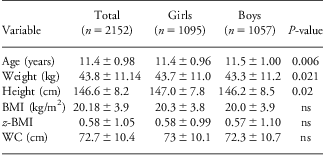
Complete information at birth was obtained for 2152 children (98.9%), of which 50.9% were girls and 49.1% boys. Table 1 shows mean age for the entire sample, which was 11.4 years, and the anthropometric characteristics by sex. Weight was significantly higher for girls and the opposite was true for height. Prevalence of overweight in the entire sample was 37.6% while obesity reached 14.8%; 80.3% of the children self-reported being pubertal.
Anthropometric measures (mean ± s.d.) by gender in 2152 children from Puente Alto, Chile, 2009–2010Footnote *
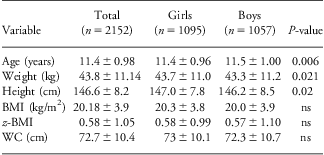
* BMI, body mass index; z-BMI, z-score for body mass index; WC, waist circumference.
The prevalence of MS and IR were 7.6% and 24.7%, respectively. Regarding the MS components frequency distribution in the total sample, TG ⩾110 mg/dl was the most common with 25.6%, followed by 18.8% for WC ⩾90th percentile, 17.2% for HDL-C ⩽40 mg/dl, 13.9% for BP ⩾90th percentile (SBP reached 99% of those cases) and 8% for GLU ⩾100 mg/dl.
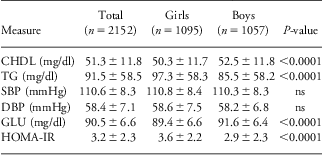
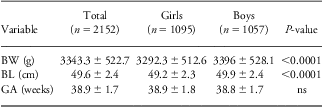
Table 2 shows the mean values of the MS components by gender. Significantly higher concentrations were found for HDL-C and GLU in boys, whereas mean values for TG and HOMA-IR were significantly higher in girls. Results of Table 2 for each sex were also adjusted for BMI and for age. P-values for non-adjusted and adjusted for BMI and age comparisons gave similar results and are not presented. With regard to perinatal variables, BW and BL were significantly higher among boys (Table 3).
MS and IR components (mean ± s.d.) by gender in 2152 children from Puente Alto, Chile, 2009–2010Footnote *
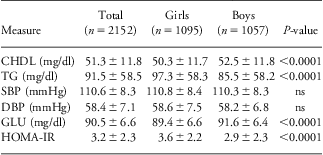
* MS, metabolic syndrome; IR, insulin resistance; HDL, high-density lipoprotein; CHDL; HDL cholesterol; TG, triglycerides; SBP, systolic blood pressure; DBP, diastolic blood pressure; GLU, glucose; HOMA, homeostasis model assessment.
Perinatal characteristics (mean ± s.d.) by gender in 2152 children from Puente Alto, Chile, 2009–2010Footnote *
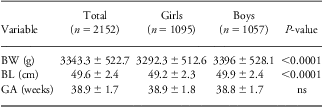
* BW, birth weight; BL, birth length; GA, gestational age.
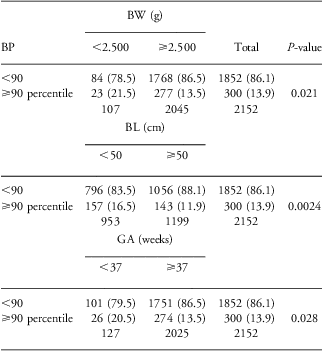
In contingency tables, BP was negatively associated with dichotomized categories of perinatal factors (Table 4). The proportions of children with BP ⩾90th percentile were significantly higher in BW < 2500 g, BL < 50 cm and GA < 37 week categories.
Associations of abnormal values of BP with risk categories of perinatal factors in 2152 children from Puente Alto, Chile, 2009–2010 – values are n (%)Footnote *
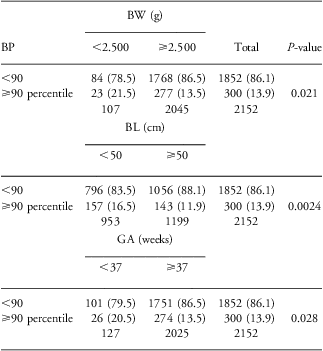
* BP, blood pressure; BW, birth weight; BL, birth length; GA, gestational age.
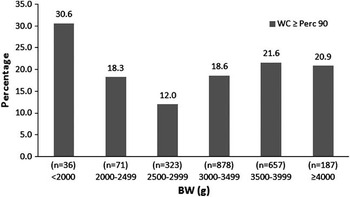
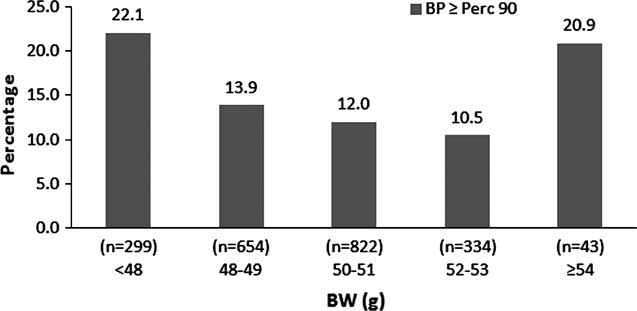
The presence of MS was not associated with perinatal factors. Figures 1 and 2 show the only two U-shaped associations found. They were between BW with WC ⩾90th percentile and between BL with BP ⩾90th percentile. Differences of WC ⩾90th percentile proportions between extreme BW categories, < 2000 g and ⩾4000 g, with an intermediate category (2500–2999) were significant (P < 0.001; Fig. 1). Differences of BP ⩾90th percentile proportions between extreme BL categories, < 48 cm and ⩾54 cm, with an intermediate category (52–53 cm) were significant (P < 0.001; Fig. 2).
Association of WC ⩾90th percentile with various categories of BW. Puente Alto, Chile, 2009–2010. BW, birth weight; WC, waist circumference.

Association of BP ⩾90th percentile with various categories of BL. Puente Alto, Chile, 2009–2010. BL, birth length; BP, blood pressure.
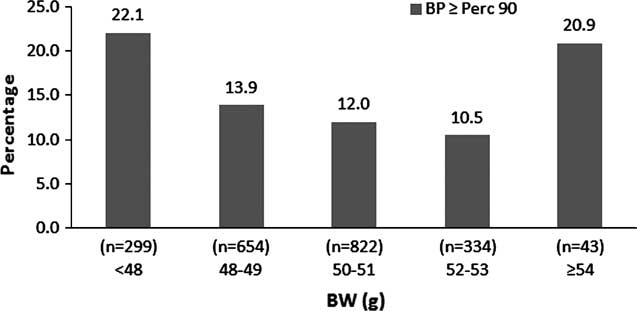
The Poisson regression that analyzed the association between BW and WC ⩾90th percentile confirmed a quadratic positive term with P-value = 0.001; the model with a linear term was not significant. The Poisson regression also analyzed the association between BL and BP ⩾90th percentile and resulted in two behaviors: a linear negative term and a quadratic positive term, having P-values of 0.001 and 0.01, respectively. When including the linear and quadratic behaviors together, both remained significant meaning that the general tendency is negative but allowing a relevant curve or quadratic component.
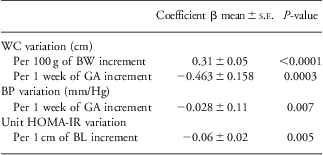
The stepwise linear regression selected the following components of MS, including IR, as associated with perinatal factors: (a) WC inversely associated with GA and directly associated with BW, (b) BP inversely associated with GA and (c) HOMA-IR inversely associated with BL (Table 5).
Perinatal variables selected by a stepwise linear regression on WC, BP and HOMA-IR in 2152 children from Puente Alto, Chile, 2009–2010Footnote *
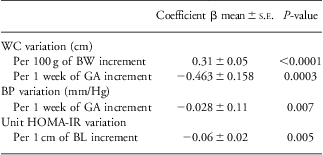
* WC, waist circumference; BP, blood pressure; HOMA, homeostasis model assessment; IR, insulin resistance; BW, birth weight; GA, gestational age; BL, birth length.
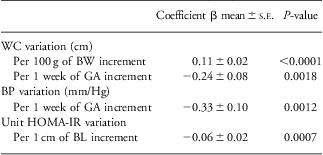
Table 6 presents the same associations as shown in the previous analysis (Table 5) but now adjusted for gender, %FM and self-report of pubertal maturation, which did not influence the direction of the findings. Furthermore, P-values did not change markedly. However, there were some effects detailed below.
Perinatal variables selected by a stepwise linear regression on WC, BP and HOMA-IR, after adjustment by gender, %FM and pubertal maturation, in 2152 children from Puente Alto, Chile, 2009–2010Footnote *
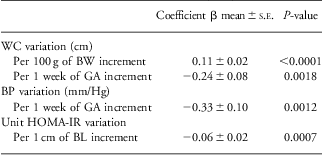
* WC, waist circumference; BP, blood pressure; HOMA, homeostasis model assessment; IR, insulin resistance; FM, fat mass; BW, birth weight; GA, gestational age; BP, blood pressure; BL, birth length.
In the WC model the slope of the association with BW was reduced to one-third; meanwhile, the association with GA was reduced to one-half. In that case the slopes for %FM and self-reported pubertal status on WC were positive and negative, respectively, with an important effect in both cases; significant slope values were 0.80 cm of WC change for one percent of FM, −5.72 cm of WC change for pubertal status 1, −4.75 cm of WC change for pubertal status 2 and −3.20 cm of WC change for pubertal status 3.
In the BP model the slope of the association with GA was increased more than 10 times in the adjusted model. In that case the slopes of the regressions on BP for sex and self-reported pubertal status were negative and much higher than the positive slope for %FM. Significant negative slope values were: −0.86 mm/Hg of BP change for female sex, −7.94 mm/Hg of BP change for pubertal status 1, −7.16 mm/Hg of BP change for pubertal status 2, −5.66 mm/Hg of BP change for pubertal status 3 and −4.53 mm/Hg of BP change for pubertal status 4. A significant positive value of 0.17 mm/Hg of BP change was found for one percent of FM.
In the HOMA-IR-adjusted model the slope of the negative association with BL was similar. In that case the slopes of the regressions on HOMA-IR for sex and self-reported pubertal status were non-significant and the positive slope for %FM was rather low reaching a value of just 0.09 HOMA-IR units for one percent of FM.
Discussion
The sample of children from 14 public schools from Puente Alto County represents the largest number of children studied in the last few years in Chile.Reference Casanueva, Milos and Lopetegui8–Reference Eyzaguirre, Silva and Román14, Reference Liberona, Castillo and Engler24 MS and IR prevalences were 7.6% and 24.7%, respectively, showing an important prevalence of metabolic risks; the latter almost joining the rather high prevalence of overweight (37.6%).
The main results of this study show that two of the three studied prenatal factors, BL and GA, were independently and inversely associated to HOMA-IR as well as with WC and BP, respectively. These results were consistently shown for the first time in our country in all multivariate analyses performed. On the other hand, it was also observed in the stepwise multiple regressions that BW was positively associated to WC. However, it is important to note that lower and higher BW categories presented a higher proportion of children with WC ⩾90th percentile than intermediate categories in the contingency tables showing a U-shaped association.
Mean values of weight, height, TG and HOMA-IR were higher for girls, whereas mean HDL-C was higher for boys, generally in correspondence with other recent national studies of anthropometry or MS components in children of similar ages.Reference Burrows, Leiva and Weistaub12–Reference Eyzaguirre, Silva and Román14, Reference Liberona, Castillo and Engler24
The most frequently observed MS components were TG, WC, HDL-C and BP, whereas GLU was the less frequently observed; this distribution of components has been considered characteristic for children.Reference Freedman, Serdula and Srinivasan28
It has been suggested that the inverse association between BL and HOMA-IR may be explained by the observation that short BL babies have a higher ratio of fat to lean body mass; as muscle tissue is the most important tissue for the storage and oxidation of GLU, individuals with a higher fat to muscle ratio are at increased risk of the metabolic consequences of IR.Reference Eriksson, Forsén and Tuomilehto30, Reference Eriksson, Yliharsila and Forse′n31 A negative association between birth size, as estimated by BW, and HOMA-IR has been shown but only after adjustment for weight.Reference Murtaugh, Jacobs and Moran32
Regarding the independent negative association of GA with WC, recent reports from younger children have suggested a tendency for a higher central adiposity in pre-term children.Reference Kytnarova, Zlatohlavková and Kubena33, Reference Durmuş, Ay and Hokken-Koelega34 Our results in older children give further support for those publications; follow-up studies would lend more information on this aspect.
Some epidemiological studies have suggested that arterial hypertension is a chronic disease that begins in childhood, and that prematurity is potentially associated with the development of hypertension in childhood and adulthood. However, the possibility of an inverse association of GA with BP, which has been systematically reviewed for children in a small number of available studies, recently concluded that the majority of them failed to show that association;Reference Coelli, Nascimento and Mill35 our study supports this possibility.
Other studies support the idea that BW, rather than GA, can negatively influence BP. One study from Finland demonstrated that SBP was higher in children who were born at term but were small for their GA relative to full-term children who had an adequate weight for their GA, after adjusting for current BMI, meaning that an important influence of current body size was apparent;Reference Rahiala, Tenhola and Vanninen36 in that study the most important differences in mean values between the two groups were in BW and BL rather than GA. Similar results were found in a cohort study that included five low- and middle-income countries; inverse and significant associations were found between BW and SBP and DBP.Reference Adair, Martorell and Stein37 A recent Chilean study in children between 4 and 16 years demonstrated an inverse exponential association between BW and BP, which persisted even after adjusting for BMI and pubertal status;Reference Martinez-Aguayo, Aglony and Bancalari38 the authors concluded that the associations observed may be partially explained by fetal programming of the hypothalamic–pituitary–adrenal axis. Another multinational study, which included 3–6 year old Chilean children, first found a negative association between body size at birth and raised BP.Reference Law, Egger and Dada39 On the other hand, a study of Chinese adult found that SBP had an independent U-shaped relationship with BW.Reference Tian, Cheng and Song40
The U-shaped association between BW and WC found in this study has scarcely been reported in the literature; only two recent studies with similar results were found.Reference Murtaugh, Jacobs and Moran32, Reference Tian, Cheng and Song40 The former observed this U-shaped association and in addition found a similar relation with FM index and subscapular skinfold.Reference Murtaugh, Jacobs and Moran32 The latter study found that subjects with the lowest and the highest BW categories had higher risks of developing abdominal obesity, compared with those in the category of BW 2500–3499 g, an observation that is highly similar to our results.Reference Tian, Cheng and Song40 Following a study published in 1992,Reference Law, Barker and Osmond41 recent studies have consistently shown an inverse association between BW and central obesity in children, adolescents and adults.Reference Laitinen, Pietiläinen and Wadsworth42, Reference Dolan, Sorkin and Hoffman43 Oken and GillmanReference Oken and Gillman44 concluded that there is a paradox of increased adiposity at both ends of the BW spectrum: higher BMI with higher BW and increased central obesity with lower BW; the latter association may be mediated through changes in the hypothalamic pituitary axis, insulin secretion and sensing and vascular responsiveness. BW has recently been shown to be inversely associated specifically with visceral fat rather than subcutaneous abdominal fat in adults;Reference Rolfe, Loos and Druet45 this association was apparent only after adjustment for adult BMI, suggesting that rapid postnatal weight gain, rather than BW alone, leads to increased visceral fat.
One of the major findings in the present study was a U-shaped association between BL and BP and a negative association with HOMA-IR. In the contingency tables the BL risk category selected as significantly associated with BP ⩾90 percentile was < 50 cm, which reached 44.3% in the studied population, similarly to the national proportion.15 The importance of maternal height, length at birth and length during infancy for the future health and productivity of the populations has recently been raised by different groups.Reference Uauy, Kain and Corvalan46–Reference Victora, Adair and Fall48
The two U-shaped associations found in this study, that is, BW with WC ⩾90th percentile and BL with BP ⩾90th percentile, are similar to those found in previous studies,Reference Barker, Osmond and Golding4, Reference Hales, Barker and Clark5 and suggest that having a larger sample size may permit to ascertain similar associations with other MS components and IR. The latter can be derived from the observation that malnutrition during pregnancy, reflected by a higher proportion of cases with low BW as well as macrosomia, which shows a U-shaped association, can also be related to various components of MS and IR in the two extremes during childhood.Reference Barker, Osmond and Golding4, Reference Hales, Barker and Clark5
The effects of the associations between the MS components and HOMA-IR with the perinatal factors, as estimated by the respective slopes observed in the stepwise regressions, were rather weak. For example, the change of 1 week in GA was associated with a change of −0.463 cm in WC. Observed effects were modified after adjustments in the first two models presented. In the case of the WC variation, the most important factor negatively adjusting BW and GA effects was pubertal status; it is well known that WC increases with age and pubertal status.Reference Fernandez, Redden and Pietrobelli17 In the case of the BP variation, the most important factor negatively adjusting BW effect was pubertal status; non-pubertal status prevents from BP elevation as recently reported.Reference Li, Huang and Cruz49 For HOMA-IR variation, the slope of the association with BL was similar, denoting a scarce influence of adjustment and supporting the above made comment on the important role of BL.
The original sample consisted of 3521 school-aged children, however, 31.5% of girls and 44.5% of boys did not accept to participate. This suggested a sample bias towards an over representation of girls. However, the final study sample included 50.9% of girls and 49.1% of boys, showing a similar gender distribution as the national distribution in Chile. Information at birth was complete for 98.9% of the included subjects, and their mean GA, BW and BL values were similar to the national live birth averages. This suggests that our study sample is representative of the national distribution.15 Furthermore, there were no significant differences between participants and non-participants with regard to their mean values of BW, BL, GA and maternal years of education.
In summary, the linear associations found between the MS components and HOMA-IR with perinatal factors were rather weak. This fact may be partly explained by the young age of the study population. One alternative explanation could be the U-shaped nature of the associations. Strengths of the paper include a large representative sample size. The associations between prenatal and metabolic factors will probably become stronger with a longer follow-up.
A possible limitation of this study is that pubertal status was determined by self-report. However, this is a method widely used in population studies. Good correlations have been reported between self-report and scores given by health personnel for boys and girls.Reference Coleman and Coleman50 Two studies done in China support the use of self-report in population studies when no specific individual evaluations are needed.Reference Chan, Sung and Kong51, Reference Chan, Sung and Nelson52
Acknowledgments
The authors thank the participation of the field team, Ms Berta Cassis and Gianina Salomó, and the teachers who helped them in the 14 schools of Puente Alto County, Santiago, Chile. Source of funding: The study was supported by FONDECYT (National Fund for Science and Technology, Chile) (Project no. 1090594).