

1. Introduction
Historically, most health insurance plans have been agnostic as to the value of care received, and reimburse based on volume, not value. The truth is that the value of health care can vary a lot. Value-based health insurance, or insurance that sets up incentives based on value of care instead of volume of care delivered, catalyzes improvements in health care information technology, care processes, and care integration (Fisher et al., Reference Fisher, Shortell, Kreindler, Van Citters and Larson2012). Recent work indicates that value-based insurance is associated with trends that are expected to lead to improved population health, such as reductions in inpatient and emergency department utilization, and improvements in preventive care and chronic disease management (Kaufman et al., Reference Kaufman, Spivack, Stearns, Song and O'Brien2017; McClellan et al., Reference McClellan, Udayakumar, Thoumi, Gonzalez-Smith, Kadakia, Kurek, Abdulmalik and Darzi2017). The long-term impacts are yet unknown, given the relatively recent introduction of value-based insurance design.
Despite the uncertainty in long-term outcomes, policies continue to encourage the spread of value-based insurance design. The Patient Protection and Affordable Care Act (ACA) established the Center for Medicare and Medicaid Innovation (CMMI), which started the State Innovation Model (SIM) program in 2013 (Shrank, Reference Shrank2013). The SIM program aims to drive the development of effective value-based insurance designs and has set a target for states awarded SIM grants to shift 80% of care from fee-for-service or volume-based to value-based payment contracts (Rajkumar et al., Reference Rajkumar, Conway and Tavenner2014).
In 2014, Washington (WA) state received a SIM Round 2 Model Test Award to test reforms in health care payment and service delivery including value-based insurance programs (Centers for Medicare and Medicaid Services, 2014). One of the five major initiativesFootnote 1 developed under the WA State SIM grant is the creation of two value-based accountable care insurance programs available to public employees, which launched in 2016. The initial roll-out included five counties within the state, encompassing the Seattle and Vancouver regions. In 2017, four more counties were included and expanded the geographic area to include western WA (Spokane area). This particular reform lowers out of pocket costs, through lower premiums, without increasing individual financial risk in the case of bad health outcomes through stable co-payments and co-insurance rates. Premiums charged for single individuals decreased by 30%, without increasing co-payments or out-of-pocket maximums.
It is widely accepted that access to post-retirement insurance influences retirement rates (Rogowski and Karoly, Reference Rogowski and Karoly2000; Gruber and Madrian, Reference Gruber and Madrian2001; Blau and Gilleskie, Reference Blau and Gilleskie2006, Reference Blau and Gilleskie2008; Madrian, Reference Madrian2005; Boyle and Lahey, Reference Boyle and Lahey2010; Nyce et al., Reference Nyce, Schieber, Shoven, Slavov and Wise2013; Fitzpatrick, Reference Fitzpatrick2014; Shoven and Slavov, Reference Shoven and Slavov2014). Much less is known about the relationship of insurance offered during employment, either specifically related to value-based insurance or more generally about the level of premiums paid, and retirement decisions. We know of only one study that examines the role of health insurance premiums in the retirement decision, which finds that increases in post-retirement premiums delays retirement (Johnsonet al., Reference Johnson, Davidoff and Perese2003).
This paper examines the opposite phenomenon, a decrease in employee-paid premiums during employment, and the subsequent relationship to labor market behavior. Decreasing the relative premiums paid during employment increases the relative costs of leaving the state-employment sector, potentially delaying or reducing the number of people leaving state-employment. However, it also acts as an exogenous increase in the budget constraint in the short-term, allowing for increased savings, which could hasten leaving the state-employment rolls. Since non-Medicare retirees can maintain the 30% premium reduction in retirement, we hypothesize this policy will lead to increased retirements that keep people on the state-employee insurance rolls. Thirdly, in the long-run, if value-based insurance delivers better health to their enrollees (Choudhry et al., Reference Choudhry, Fischer, Avorn, Schneeweiss, Solomon, Berman, Jan, Liu, Lii, Brookhart, Mahoney and Shrank2010, Reference Choudhry, Avorn, Glynn, Antman, Schneeweiss, Toscano, Reisman, Fernandes, Spettell, Lee, Levin, Brennan and Shrank2011; Gibson et al., Reference Gibson, Mahoney, Ranghell, Cherney and McElwee2011; Wertz et al., Reference Wertz, Hou, DeVries, Dupclay, McGowan and Malinowski2012), this could delay retirement by allowing individuals to be healthy enough to work longer. This uncertainty in the predicted response warrants empirical investigation in order to both gauge the sign and the magnitude of these labor market effects.
Using administrative data from state employees in WA, we test the impact of the introduction of a value-based insurance reform on retirement decisions through the decrease of premiums and no change in financial risk of health shocks borne by the individual. We first study who is likely to take up the new insurance product. We find that the peak switching age is 34–45, and state employees close to the retirement ages are less likely to switch insurance and sign up for the new value-based insurance programs, even after accounting for whether the network of doctors individuals have used in the past is in the accountable care network. Second, we examine two labor market outcomes; retiring and remaining in the state-employee health insurance plan and leaving the state-employee health insurance rolls altogether. We find that younger workers who signed up for the value-based insurance product are less likely to leave state employment. Further we find that value-based insurance available to both workers and retirees leads to a downward shift in the age of retirement. These findings are consistent with the financial incentives around employment embedded in this health insurance reform.
2. Background and data
2.1 WA state health insurance
2.1.1 Pre-reform
Prior to 2016, state workers and retirees could get health insurance through Group Health, Kaiser Permanente, and the Uniform Medical Plan (UMP). All insurance companies had four products – a high deductible plan, a ‘classic’ plan, and two variants for ‘smart-health’, where individuals could do more screening and more reporting back to the insurance company about activities and health behaviors in exchange for a premium deduction. Kaiser (concentrated in the WA suburbs of Portland, Oregon) and Group Health (concentrated in Seattle-King County and Spokane, WA) run relatively closed health insurance and provider systems, and accounted for 34% of the active state-employee enrollment in 2015. UMP offered traditional, fee for service health insurance coverage, and enrolled 66% of active employees in 2015 (HCA 2015). While UMP had a preferred provider network, which led to lower co-insurance rates and decreased paperwork for patients, the preferred provider network was very inclusive. As the primary insurance provider within the state with a mandate to have an adequate network of providers in all counties, most health care providers in the state were within the UMP preferred provider network.
2.1.2 2016 reforms
In 2016 (enrollment in Fall 2015), the state introduced UMP-Plus, a new value-based insurance plan that has two networks. UMP-Plus is a self-insured health plan, administered by Regence BlueShield and Washington State Rx Services. There are two networks of providers – one was offered by the University of Washington Medicine Accountable Care Network (UW) and the other by Puget Sound High Value Network (PSHVN). Employees and retirees that are not enrolled in Medicare who live in the 5-county Puget Sound region for the 2016 calendar year (King, Kitsap, Pierce, Snohomish, and Thurston counties) were the first eligible.
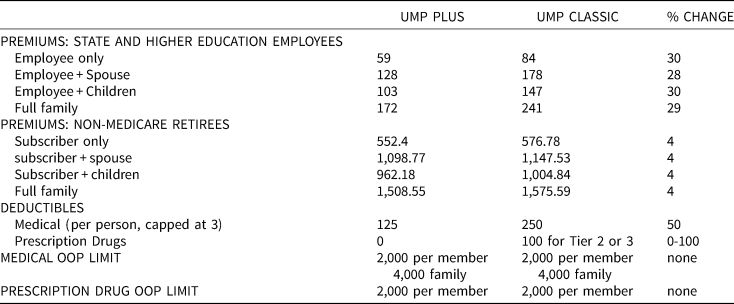
The new plan promised lower premiums, lower deductibles, coordinated provider networks, and the same insurance coverage as provided in UMP Classic. See Table 1 for a benefit and cost comparison between UMP Plus and UMP Classic. While this combination of lower premiums and same coverage typically means higher co-payments for services delivered, the copayments were identical between UMP Classic and UMP Plan plans if one used the network providers within the UMP Plan (HCA 2016a). The providers were also promised to collaborate to reduce unnecessary care, they were to be committed to using best practices and research-based medicine, and to work with you to make the best decisions for your own health. This was touted as an especially valuable benefit for members who have multiple providers (HCA 2016b).
Comparison of UMP-Plus and UMP-Classic

While the insurance coverage is similar and out-of-pocket costs are lower, the one major change from a consumer-perspective is the creation of a network. It is worth noting that, due to the mandate to have adequate coverage for all state employees, UMP Classic, even the Preferred Provider Network, offers tens coverage of tens of thousands of providers, and nearly every provider within the state. Thus any network created would be narrower, even if not that narrow objectively. UW Medicine claims to be the most comprehensive health care network in the Puget Sound region, offering over 1,000 primary care providers, 1,000 clinics, 5,000 specialists, 33 urgent care clinics, 15 hospitals, and 15 emergency departments in 2016 (https://www.hca.wa.gov/assets/ump/ump-plus-uwmedacn-coc-2016.pdf), and expanded in 2017. It includes specialized hospitals like Seattle Children's, Mary Bridge Children's hospital, and the Seattle Cancer Care Alliance. PSHVN is slightly smaller, and operates in some different areas, although still had a network with over 1,000 primary care providers and 5,500 specialists in 2017.
While the networks had the possibility of being unique, there is overlap in providers between the networks. There is one large provider within both networks who operates in King, Pierce, and Kitsap counties, and both networks contracted with Seattle Children's hospital.
One way to gauge the narrowness of the network is to examine how many people in UMP Classic in 2015 were primarily seeing doctors that eventually became affiliated with UMP-Plus. Our calculations suggest that out of 48,188 state employees living in the 5-county region in 2015 eligible to switch, almost 20% were seeing doctors that were later affiliated with one of the UMP-Plus networks. This is similar for the 2017 expansion in the 4-county region, with almost 20% of state employees already seeing doctors that were later affiliated with a network.
While these reforms were enacted due to the state winning additional funding from the CMMI as part of the State Innovation Model, it is important to note that no SIM funding went to subsidizing premiums for state employees. In addition, no additional revenues were raised – the funding rate is set by the legislature and did not change around this time, and the employer contribution to premiums is set by collective bargaining agreement. In 2017–2019, it was set to be 85% of the total weighted average of the projected health care premiums across all plans (HCA 2018). Negotiated prices and the ACNs accepting both upside and downside financial risk to maintain or improve their quality metrics while decreasing costs of treating their patients is the long-term goal in keeping these contracts and ACN plans financially sustained. The lower premiums and out-of-pocket costs could be offered in the first year because the Health Care Authority ‘spent’ the anticipated savings developing a higher value insurance product. To ensure the savings were captured, the provider networks had to accept the downside risk – if they did not achieve the savings they would have to pay the deficit.
2.1.3 Enrollment
As of January 2016, after the first open enrollment offering these plans, 10,571 beneficiaries, or 3% of the non-Medicare beneficiaries, we enrolled in a UMP-Plus plan. Enrollment has been increasing since. In 2017, the UMP-Plus extended its geographic reach to four more counties: Skagit (only UW-ACN); Spokane (only PSHVN); Yakima (only PSHVN); and Grays Harbor (both). There are plans to continue expansion in 2019.
There were five primary goals for this health insurance reform. (1) Improve health of state employees. (2) Improve member experience. (3) Improve quality of care. (4) Reduce costs trends over the life of the contract. (4) Decrease inappropriate utilization. However, changes in one of the key benefit programs could also change the employment decision.
2.1.4 Other insurance trends in the state of WA
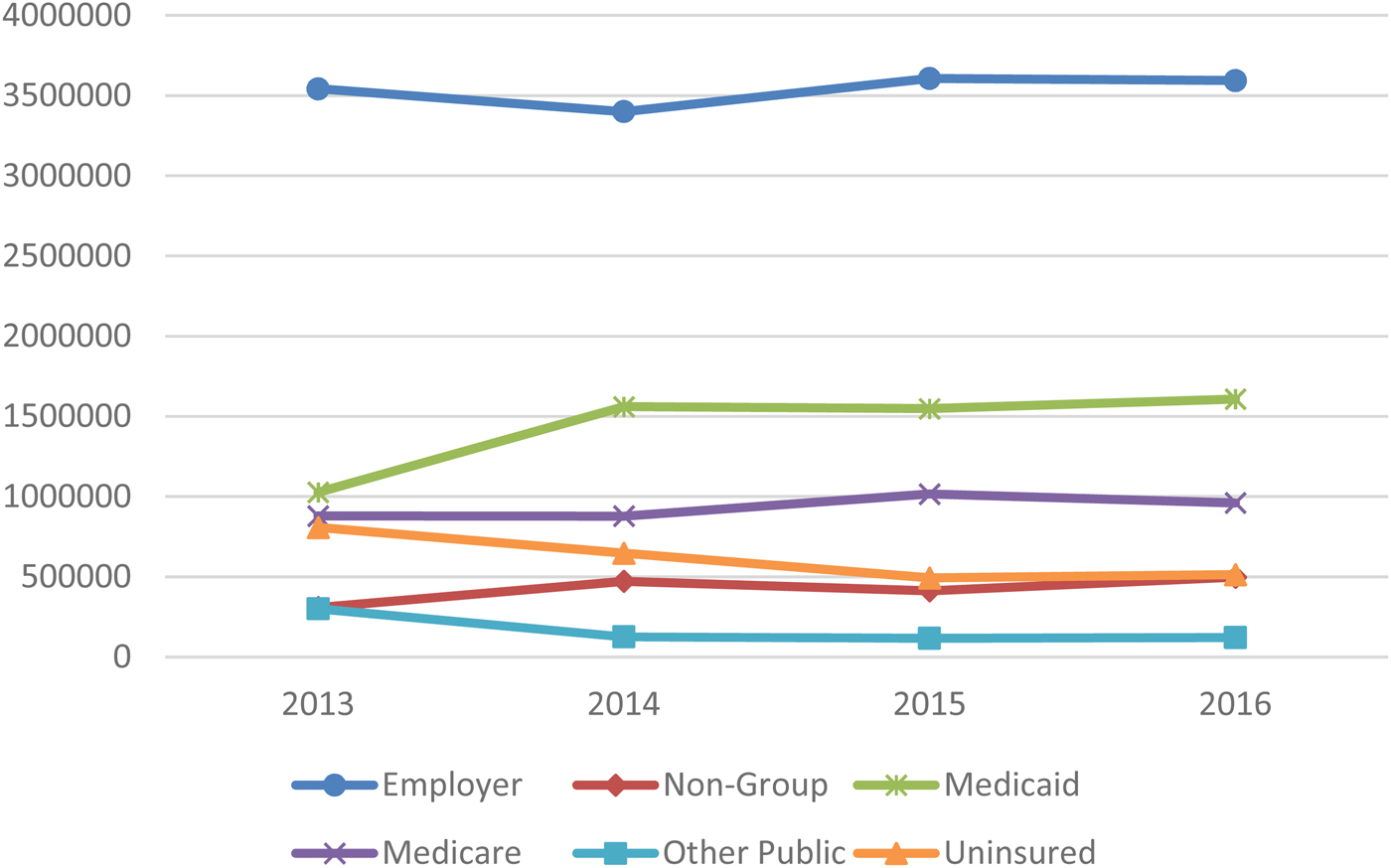
Health insurance markets during these years was far from stagnant. Many major provisions of the Affordable Care Act started in January 2014 – the individual mandate, the health insurance exchanges (WA state ran its own exchange), federal subsidies, removal of pre-existing condition clauses, and Medicaid expansion. However, WA was one of the five states that was using a CMS waiver to allow for early Medicaid expansion – as of 2011, Medicaid was available to residents of WA up to 133% of the poverty line – so 2014 was less of a change for Medicaid-eligible population than in other states. When examining the trends of health insurance coverage (Figure 1), they are actually fairly stable between 2014 and 2016 in WA state, despite the changes in the overall market. The biggest changes during this time period are the decrease in the number of uninsured and an increase in the non-group market. Employment-based health insurance hovers around 50% of the market during this entire time, or almost 3,600,000 people in 2016 (Kaiser Family Foundation, 2016). The public employee market enrolled in UMP, studied here, is roughly 2.6% of the total employer-based market in the state.
Health Insurance Trends: Washington State.

3. Data
We use longitudinal administrative data for UMP-covered employees, containing information from January 2013 to December 2017, at the per-member-per-month level. We limit the sample to examine individuals under the age of 65 who are not enrolled in Medicare, since Medicare enrollees were not eligible for UMP-Plus. We also limit analysis to individuals age 20 and above. With these age-based restrictions, our data cover approximately 50,000 state employees and retirees over the 5-year period.
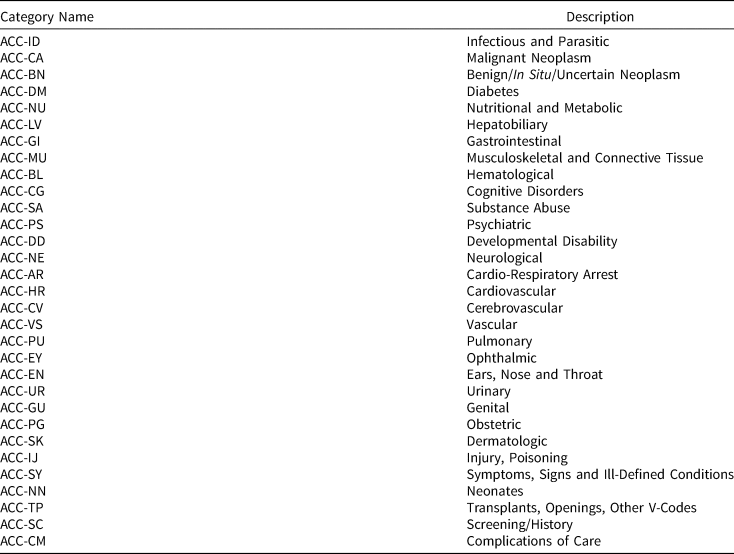
The dataset contains limited personal information but fairly comprehensive information about health and health insurance. We have demographic information including age, gender, and the county in which the beneficiary lives. We have some information about employment and the sector in which the individual works through the reason of health insurance eligibility (active state employee, commodity commissionFootnote 2, K-12 employment, post-secondary education employment, leave without pay, COBRA, and retiree benefits). We have individual health information, which includes self-reported smoking status and claims-based indicators for a previous diagnosis in any of 31 categories of disease/illness used for risk adjustment (see Appendix Table A1 for a full list of these conditions).
The database provides fairly comprehensive information about the insurance contract. We know who is insured under the plan (Employee only, employee and child, employee plus spouse, employee, and family), and the type of insurance plan (UMP Classic, UMP Plus (UW or PSHVN), UMP consumer-driven health plan (CDHP)). We also know whether the doctors they primarily saw in a year were enrolled, either eventually enrolled for years 2014–2015, or concurrently for years 2016–2017, in either UMP-Plus plan.
We use the reason for health insurance eligibility and the longitudinal nature of the database to define two labor market behaviors of interest. First, one could maintain insurance through the state employee pool but retire from state employment. For most employees, this could be done after 10 years of state employment, and is separate from eligibility for retirement benefits. This would be measured in the administrative data by changing the reason for eligibility for health insurance, and converting from active state-employee to retiree. We define retirement if the eligibility status changes to retiree benefits for at least 3 months, to minimize the effect of administrative errors in the data. If they retire and remain uncovered by Medicare, they are eligible for UMP-Plus and keep the 30% discount on premiums.
Second, they could leave the state-employee health insurance rolls altogether. This could be due to retirement from the state-sector, switching employment-sectors, or leaving the labor force. We define leaving the state-employee health insurance sector if the eligibility status changes to COBRA or the individual leaves the dataset for at least 6 consecutive months, in order to pick up sustained changes in employment and minimize the effect of any administrative errors in the dataset. Leaving the state-employment rolls altogether does not maintain their health insurance premium discount.
4. Methodology
4.1 Who signs up for UMP-Plus?
First we examine the correlation between individual characteristics and their propensity to sign up for a UMP-Plus plan. We select the sample of individuals who are eligible to sign up for UMP-Plus – active employees and retirees under the age of 65, non-Medicare eligible, who live in one of the treated counties during the roll-out period. We estimate the following regression via GLM:
 $$UMP-Plus_{i,\; t + 1} = \beta _1 + \beta _2{\rm X}_{i,t} + \varepsilon _{it}$$
where UMP − Plus i,t+1 is a 0/1 variable indicating whether the individual signed up for a UMP-Plus contract in time t + 1 (2016 or 2017). Xi, t are the covariates measured in the baseline year t. These covariates include beneficiary demographics (age in 5-year age bands, gender, county of residence, 31 aggregated condition categories (ACC) based on previous diagnoses (Cid et al., Reference Cid, Ellis, Vargas, Wasem, Prieto and Scheffler2016)), insurance contract characteristics in the baseline year (Contract Type (individual, spouse, child); and eligibility type (active employee, K-12 coverage, commodity commission coverage, cobra coverage, retiree coverage, other coverage).
4.2 Labor market behavior
Second we examine the correlation between labor market behavior and UMP-Plus enrollment using the following OLS regression model:
 $$L_{i,\; c,\; t} = \beta _1 + \beta _2{\rm X}_{i,\; t} + \beta _3{\rm H}{\rm I}_t + C_c + m_t + y_t + \varepsilon _{it}$$
where L is an indicator for leaving the active state-employee insurance rolls, either through retirement or leaving as defined above. HI is a vector of health insurance plans, UMP-Classic, UMP CDHP, and UMP-Plus. C, M, and Y are county, month, and year fixed effects, respectively. X is the vector of covariates as defined above.
We also test for heterogeneity in the relationship between health insurance and labor market behavior by age by including interaction terms. Finally, we test whether there are different relationships among those who, prior to the intervention, were primarily seeing doctors who joined an ACN during the post-period. For the retirement outcome, we limit the sample to those ages 45–65, since we observe no retirements prior to age 45 in the data.
To estimate the effect that UMP-Plus has on employment behavior on the entire population, we capitalize on the geographic-specific implementation design and use a difference-in-difference framework to evaluate the effect of health insurance reform on employment. We estimate the following regression:
 $$\eqalign{R_{i,\; c,\; t} = \,&\beta _1 + \beta _2{\rm X}_{i,\; t} + \beta _35C_t + \beta _4Post2016_t + \beta _55C_t \times Post2016_t \cr \; \; & + \beta _64C_t + \beta _7Post2017_t + \beta _84C_t \times Post2017_t + y_t + \varepsilon _{it}} $$
where 5C is an indicator variable for living in the five treated counties, Post2016 is an indicator for 2016 or 2017, and the interaction term identifies the difference in labor market behavior in the 5-county region after the introduction of UMP-Plus. Likewise, 4C is an indicator variable for living in the later-treated four counties, Post2017 is an indicator for 2017 after intervention, and the interaction term identifies the difference in labor market behavior in the 4-county region after the introduction of UMP-Plus. Finally, we also check for heterogeneity of the effect by age by including two additional interaction terms with age and the post-intervention and county interaction terms. All standard errors are clustered at the county-level.
5. Results
5.1 Who switches to value-based health insurance
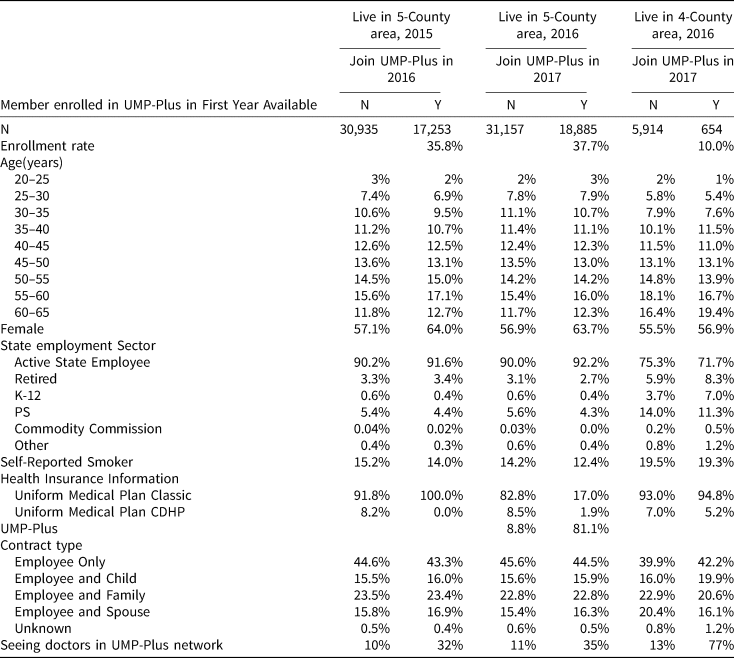
Table 2 provides the descriptive statistics for the subsample of state employees and retirees who are eligible to switch to a UMP-Plus contract in 2016 or 2017. The first columns report the characteristics for people in 2015 who were first eligible to sign up for UMP-Plus in 2016, the second set of columns reports the characteristics for people living in the original 5-county region and eligible to sign up in 2017, and the third set of columns presents the 2016 characteristics for those in the 4-county region who are first eligible to sign up for UMP-Plus in 2017.
Descriptive Statistics: Switching to UMP-Plus Sample

We find the initial enrollment rate to be over one-third of eligible workers and retirees in 2016. Most of these individuals were active employees (92%), most were female (64%) and all were enrolled in the UMP Classic (100%) plan prior to enrolling in UMP-Plus. Otherwise the descriptive characteristics look very similar to those who were eligible but did not sign up for UMP-Plus in 2016.
In year 2, over 80% of employees and retirees who signed up for UMP-Plus in 2016 stayed in UMP-Plus in 2017, while also gaining more traction within the UMP Classic insurance group. Individuals who were insured with the consumer-directed high deductible plan (CDHP) were unlikely to switch to UMP-Plus coverage within the first 2 years of the roll-out in the 5-county region. Like in 2016, employees and retirees who joined UMP-Plus in 2017 were more likely to be female, less likely to be a self-reported smoker, more likely to be covering the employee and spouse, and more likely to be an active state employee.
The enrollment rate within the 2017 4-county expansion area was much lower, 10%, in the first year. There are geographic differences in the type of employees eligible for UMP-Plus in this new geographic region, with an increase in employees working in education and already retired, which is not surprising given that Olympia, the state capital, was covered in the first expansion. The descriptive statistics suggest that individuals who signed up for UMP-Plus from the 4-country region were more likely to be retired, K-12 teachers, covered under UMP-Classic, and insuring themselves or themselves and a child, compared to similarly eligible individuals who did not sign up for UMP-Plus. Not surprisingly, individuals who were already seeing doctors that were in a UMP-Plus network were more likely to sign up for UMP-Plus, but this is of particular note with the 2017 expansion area.
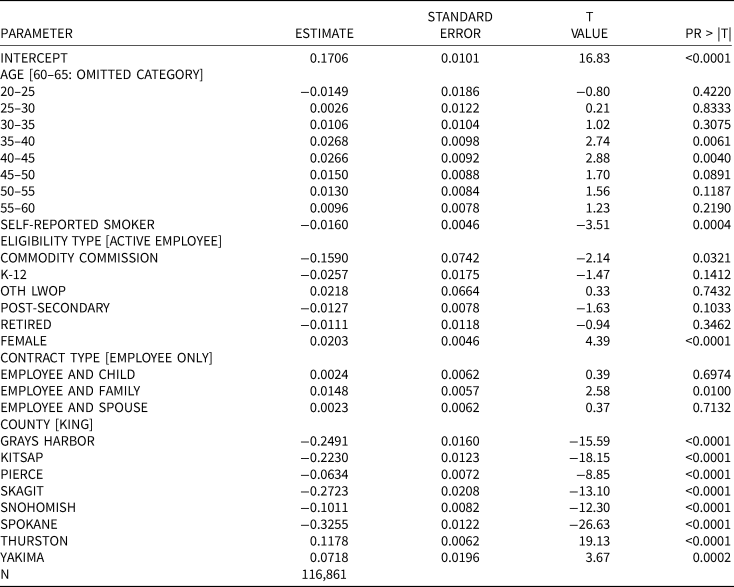
Table 3 presents the regression results where we examine what covariates are correlated with signing up for UMP-Plus. Ages 60–65, the reference group, and age 20–25, are the least likely to sign up for UMP-Plus, even conditioning on their health as measured by the risk categories and self-assessed smoking status. Peak age for switching are ages 35–45. Smokers are less likely to switch to UMP-Plus than non-smokers (reference). We do not find much difference in enrollment rates based on how one earns eligibility to health insurance; those who are on the commodity commissions are less likely than everyone else to switch to UMP-Plus, but that is a relatively small group. Interestingly, those insuring both the employee and their families are the most likely to switch to UMP-Plus, followed by those insuring just the employee (reference group). Residents of King (reference group), Thurston, and Yakima Counties are most likely to sign up for UMP-Plus. This could be due to network density in these densely populated areas, or due to concentrated marketing efforts in these large urban areas and large employers.
GLM Results: Switching to UMP-Plus

Note: Sample includes state employees between the ages of 20 and 65 residing in King, Pierce, Snohomish, Thurston, and Kitsap Counties in 2015 or 2016 and living in Yakima, Spokane, Skagit, or Grays Harbor in 2016, and thus geographically eligible to switch insurance providers. Regression also includes dummy variables for the 31 ACC conditions, as well as year indicators.
5.2 Impact on retirement
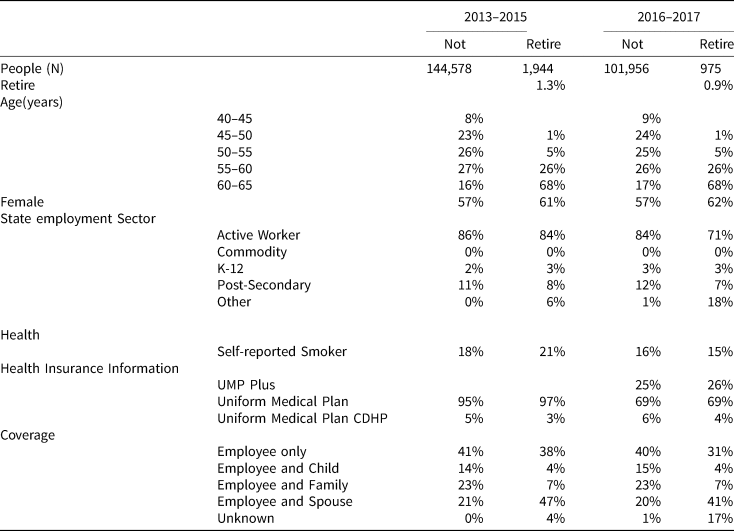
Table 4 presents the descriptive statistics of the sample we use to estimate the impact on retirement, state employees throughout the state, age 40 and above. We see low retirement rates before the age of 65, of roughly 1%. Observed retirements are highly skewed in the age distribution, with over 70% occurring between 60 and 65, and almost all of them occurring age 55 and older. Much like the previous sample, most are active state workers, and predominantly female. Consistent with changes in household structure as people age, most people who retire are insuring only themselves or themselves and a spouse.
Descriptive statistics: retirement sample

Notes: Sample includes UMP-insured state-employees who are between the ages of 40 and 65 and not enrolled in Medicare.
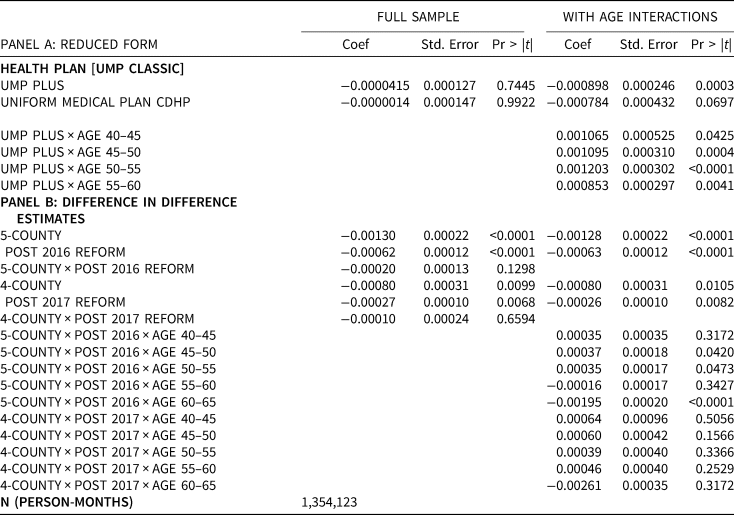
Table 5 presents the regression results examining retirement. Panel A presents the reduced form regression, which measures the correlation between UMP-Plus and retirement, but also has potential selection bias. Panel B presents the difference-in-difference estimates, which is more likely to be interpretable as causal. Panel A shows that overall, there is not a strong relationship between being in UMP-Plus and retirement. However, when we examine retirement patterns by age, we do see that UMP-Plus enrollees retire at earlier ages than those enrolled in UMP Classic plans, with the reference category being age 60–65.
Retire from state-employment results

Notes: Sample includes UMP-insured state-employees who are between the ages of 40 and 65 and not enrolled in Medicare. Other covariates included in the model include year, county of residence, 31 aggregated condition categories (ACC) based on previous diagnoses, insurance contract characteristics in the baseline year (Contract Type (individual, spouse, child); and eligibility type (active employee, K-12 coverage, commodity commission coverage, cobra coverage, retiree coverage, other coverage).
Panel B presents the difference-in-difference model results, which estimates the impact of the health insurance reform on the overall retirement patterns in the state-employment sector. Again, we find no impact on retirement overall, but we do find a difference in the age distribution of retirement in the five counties that introduced UMP-Plus, with retirements occurring at younger ages. We find no impact of retirement behavior within the four counties that introduced UMP-Plus later.
5.3 Impact on leaving state-employee health insurance rolls
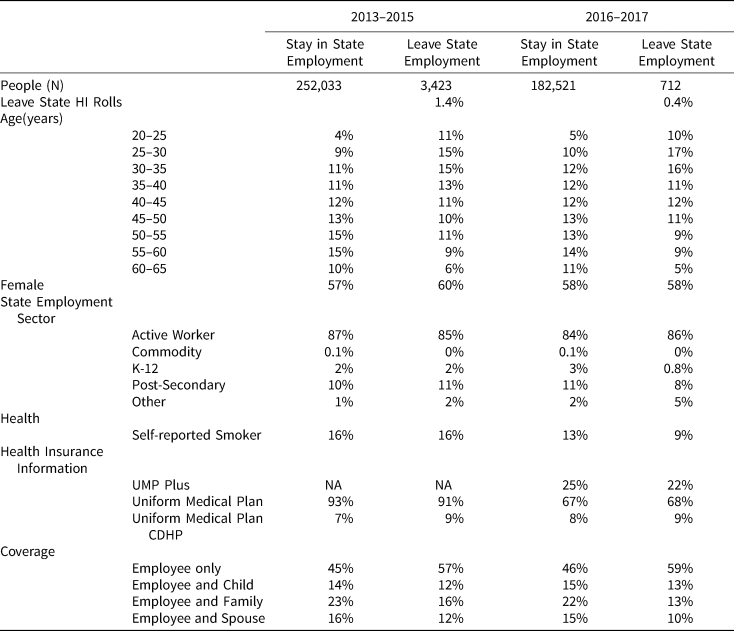
Table 6 presents the descriptive statistics for the sample we estimate the impact of UMP-Plus on leaving state-employment sector. We have roughly 255,500 individuals in the base years (2013–2015), of which 1.4% leave state-employment. We have 183,233 people in the post-UMP-Plus years, of which only 0.4% leave. In both periods, individuals who leave state-employment are younger, on average, with a slight shift younger in the age distribution among leavers between the pre- and post-periods. Again, most individuals are women, most are active employees, and most are insuring themselves or themselves plus their family.
Descriptive statistics: leave state-health insurance rolls sample

Notes: Sample includes UMP-insured state-employees who are between the ages of 40 and 65 and not enrolled in Medicare.
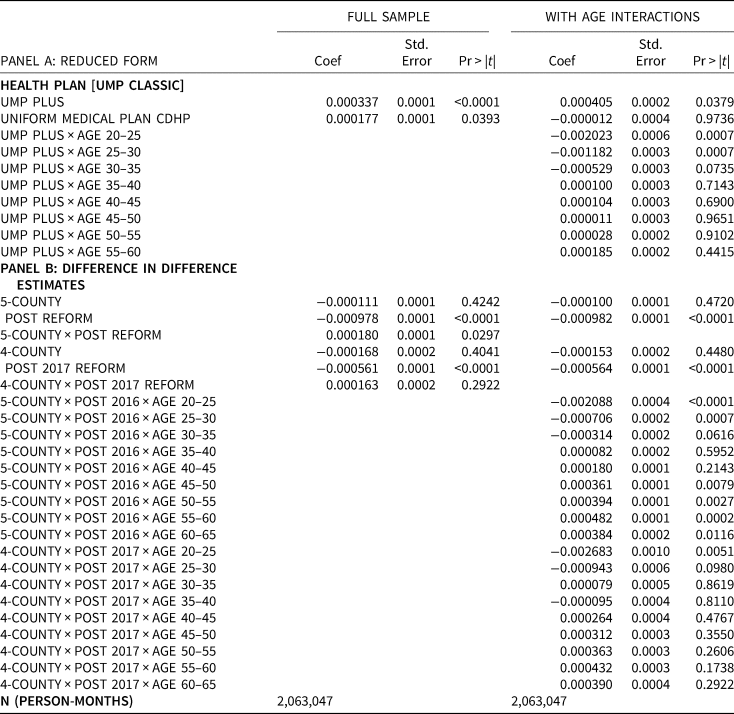
Table 7 presents the regression results in the same format as Table 5. The people who take up UMP-Plus are more likely to leave state-employee health insurance rolls, which is counter to theoretical prediction. When we examine the relationship by age, we find that while overall UMP-Plus enrollees are more likely to leave state-employment health insurance rolls, younger UMP-Plus enrollees, age 20–35, are less likely to leave state-employment health insurance rolls than those in UMP-Classic.
Leave state-employment health insurance rolls results

NOTES: Sample includes UMP-insured state-employees who are between the ages of 20 and 65 and not enrolled in Medicare. Other covariates included in the model include year, county of residence, 31 aggregated condition categories (ACC) based on previous diagnoses, insurance contract characteristics in the baseline year (Contract Type (individual, spouse, child); and eligibility type (active employee, K-12 coverage, commodity commission coverage, cobra coverage, retiree coverage, other coverage).
When we examine panel B, using difference-in-difference estimators, we find that UMP-Plus acted to retain younger workers in both regions it was introduced. However, within the 5-county region, UMP-Plus also led to an increase in the number of older workers (age 45–65) who left the state-employment health insurance rolls.
6. Policy implications
Employment-sponsored insurance is not going away, nor is its concern about price nor its influence over employment behavior. As employers, insurers and providers struggle with how to maintain high quality while decreasing costs, employers have the additional concern of how it will impact their employee's decisions to work, retire, or shift employers. This work suggests that one strategy that could help firms retain younger workers is offering lower out-of-pocket premiums on health insurance. This is a tax-subsidized way to provide younger workers higher incomes and it makes them less likely to leave the employer. However, firms must also be careful of the impact on older workers. This work shows that lowering premiums on health insurance in both employment and retirement can lead to earlier retirement ages and more older workers leaving the sector.
7. Conclusions
The state of WA increased its health insurance offerings by two through creating value-based insurance networks. In the first year, they achieved an impressive switching rate of approximately one-third of eligible workers, but this was dampened dramatically to 10% in 2017 when they expanded the intervention area. The first year switching rate is comparable to a large private employer, who more than doubled the number of choices and was able to get switching rates above 30% (Fronstin and Roebuck, Reference Fronstin and Roebuck2017). Even in year 2, the switching rate was better than has been achieved in Medicare, where approximately 5% of Medicare Advantage members switch to Traditional Medicare, and vice versa, in recent years (Newhouse et al., Reference Newhouse, Price, Huang, McWilliams and Hsu2012).
This analysis shows that, regardless of the impact value-based insurance has on actual health, decreasing premiums without increasing financial risk to the participant has the potential to increase employee retention among younger workers. An important caveat is that these results are in the short-term; before wages or the wage-to-fringe-benefit ratio would have time to adjust, and with the state acting as a first-mover. The impact on retention may not be sustainable in the long-term. Further, if firms decrease costs to both employees and retirees, it can lead to a shift down in the age distribution of retirements.
There are a lot of questions left unanswered. There is a big difference in the estimated effect of the intervention between the two geographic regions. More work should be done to understand why, both in terms of the dramatic drop in the enrollment rate and in terms of the outcomes themselves. Future work should strive to understand why UMP-Plus is leading more older workers to leave state-employment health insurance sector, contrary to theoretical predictions. Descriptively, individuals who leave the state-employment sector after having signed up for UMP-Plus, compared to individual who leave who were insured by another product, are more likely to be female (64% vs. 58%), to be active state employees (92% vs 85%), and more likely to be insuring themselves and a child (18% vs. 12%). Yet we lack the data here to understand why these workers responded by leaving the state-employment health insurance sector. Future work should also assess the impact on retirement through changes in health. We do not anticipate any effects health insurance may have on health to impact retirement behavior within the first 2 years, but has potential in the long-term.
Acknowledgements
I would like to thank Elaine Albertson and Bailey Ingraham for research assistance and Lingmei Zhou for outstanding programming support. The paper benefitted from working with the entire University of Washington SIM Evaluation team, especially the ‘PM3 sub-team’, including Douglas Conrad, Lydia Andris, David Grembowski, and Suzanne J. Wood. Special thanks go to Shuva Duwadi and Karen Jensen at the Health Care Authority, without whose efforts we would have never procured the data.
Funding
The project described was supported by Grant Number 1G1CMS331406 from the Department of Health and Human Services, Centers for Medicare & Medicaid Services, and directly funded by a subcontract with the Washington State Health Care Authority. The contents of this publication are solely the responsibility of the authors and do not necessarily represent the official views of the US Department of Health and Human Services or any of its agencies, or the Washington State Health Care Authority. The research presented here was conducted by the awardee. Findings might or might not be consistent with or confirmed by the findings of the independent federal evaluation contractor.
The study was approved by the Washington State Institutional Review Board, Project D-071416-A17.01
Appendix
Washington State Health Care Authority Clinical Classification codes used for Risk Adjustment