Introduction
Agriculture is one of the significant sectors of almost all developing economies because it engages a big portion of the population in employment and provides inputs for its industrial sectors (Johnston and Mellor, Reference Johnston and Mellor1961). Thomas Malthus famous Theory (Malthus, Reference Malthus1798) of the population is increasing exponentially, and resources to feed it increase arithmetically led to a debate about the growing population of the world and a possible shortage of resources to feed this ever-growing population. Historically, there have been efforts to increase the agricultural output, particularly rice and wheat. For instance, the Green Revolution of the 1950s in Latin America and later on in Asia during the 1960s resulted in introducing high yielding seeds for wheat and rice. It subsequently increased the per hectare production manifold and helped produce this food at lower prices than ultimately benefited the entire global population with lower food prices (Evenson and Gollin, Reference Evenson and Gollin2003).
These efforts of increasing agricultural output and its contribution to the economy increased further after World War II due to the development of different types of machinery and the use of chemicals learned during war times, both results being effectively transferred to increase the production of the agriculture sector. This transformation led to an increased usage of chemicals, pesticides, etc., in farming, which generated the debate of choice between organic and inorganic farming. Organic farming refers to farming that involves increasing soil fertility and maximizing the efficient use of local resources while avoiding the use of agrochemicals, genetically modified organisms or many synthetic compounds (Akhtar and Malik, Reference Akhtar and Malik2000; Gomiero et al., Reference Gomiero, Pimentel and Paoletti2011). In simple words, it is growing food without the aid of synthetic pesticides and chemical fertilizers (more of natural farming with the use of modern machine tools for increased productivity). In contrast, inorganic farming includes modern agriculture with high yielding seeds genetically modified for high yield (hybrid seeds), syndetic pesticides and chemicals to increase production per unit of land.
In recent times, consumers have been more health and environment conscious. Therefore, organic farm products have got more value as compared to inorganic products. However, the lack of awareness among farmers in developing countries, the aim of having large ‘quantity’ rather than ‘quality’ is restricting the cultivation of organic food. Therefore, the debate between organic and inorganic farming leads to a ‘good way’ and ‘a bad way’ of growing food keeping various issues (such as health, land fertility, production per unit of land and cost of production) associated with both types of farming.
The current study contributes to the literature on organic and inorganic farming in several unique ways. First, it combines several additional factors (environment, economic, social, consumers and farmers, and health) in context while considering the choice between the two types of farming. Second, the study employs quantitative multi-criteria decision-making techniques for choice between the farming types. As clear from a literature review in the next section, multicriteria decision methods (MCDM) are not applied earlier in a farming choice decision. Thus current study adds from methodological perspective to the debate of the choice of farming. Third, the study focuses on a developing country, Pakistan, thus making the findings applicable to many other developing nations that had agriculture sectors with the engagement of a large number of employers and also being the major contributor to the GDP either directly or indirectly. Finally, the study uses a hybrid model based on two multi-criteria decision-making techniques, namely analytic hierarchy process (AHP) and Technique for Order Preference by Similarity to Ideal Solution (TOPSIS), thus making it an exciting study for integrating two different MCDM techniques of ranking and choice and apply it in agricultural farming choice research. The use of MCDM based hybrid model of AHP- TOPSIS though is not unique (e.g., Lin et al., Reference Lin, Wang, Chen and Chang2008; Berdie et al., Reference Berdie, Osaci, Muscalagiu and Barz2017; Ali et al., Reference Ali, Sabir and Muhammad2019) but it has not previously been applied into the context of the farming choice decision.
The rest of the study is organized as follows; Section ‘Literature review’ is a literature review. Section ‘Methodology’ is the methodology of the study. This section also discusses the background and application of the TOPSIS-AHP method used in the study. Section ‘Study area, study design and data’ is on debating the study area, the study design and the data used. Section ‘Results and discussion’ presents results and a discussion on results. Section ‘Conclusion’ concludes the paper.
Literature review
There is abundant literature discussing different aspects of conventional, organic, or inorganic farming or comparisons of it. Gimeno-García et al. (Reference Gimeno-García, Andreu and Boludab1996) studied the use of other inorganic fertilizers and pesticides to impact soil fertility in Valencia, Spain. Their study was based on field experiments. It concluded that although a different type of inorganic fertilizers and pesticides does influence soil, their influence is lower than the standard set by the European and Spanish legislation.
The comparison between different types of farming is extensively undertaken in scholarly literature. However, much of this work discusses organic and conventional farming while considering various aspects. For instance, Gabriel et al. (Reference Gabriel, Sait, Kunin and Benton2013) studied the cost (measured in terms of reduction in agricultural yield) and benefits (measured in terms of biodiversity) for agrarian management in their study of the relationship between organic and conventional farming in England. They found a reduction of biodiversity with increasing crop yield and about 54% lower production gain for organic fields than the traditional field. Similarly, Gomiero et al. (Reference Gomiero, Pimentel and Paoletti2011) also compared organic and conventional farming and considered several different aspects to both types of farming, such as soil characteristics, yields, CO2 abatement, impact on biodiversity and energy uses. They concluded that organic farming is a better option than conventional farming. Mondelaers et al. (Reference Mondelaers, Aertsens and Van Huylenbroeck2009) also reported that organic farming is positively linked with agro and biodiversity with increased production per unit of land compared to conventional farming.
Biodiversity and types of farming is also a focused area of scholarly literature. For example, Maeder et al. (Reference Maeder2002) reported findings of 21 years long field studies that were set up to study biodiversity and soil fertility of organic and conventional farming. They said lower yield with enhanced soil fertility, increased biodiversity and less dependent on external inputs such as fertilizers and energy for organic farms. Similarly, Gabriel et al. (Reference Gabriel2010) studied the impacts of farms types and land use at multi spatial scales (field, farm and landscape) on biodiversity. They reported that at the farm level, biodiversity depends on the farming choice between organic or conventional. A review study by Hole et al. (Reference Hole2005) focused on the impact of organic and inorganic farming on biodiversity. They compared various studies relative to biodiversity and organic farming. Hole et al. (Reference Hole2005) reported a wide range of taxa (such as birds, animals (mammals and invertebrates) and arable flora) that can be benefited from organic management through an increase in abundance and species richness. Furthermore, the study also emphasized reduced use of chemical pesticides, inorganic fertilizers and sympathetic control of non-cropped habitats.
Some other aspects, such as environmental factors, land disturbance and water usage, also focus on scholarly literature while comparing various types of farming. For instance, Wood et al. (Reference Wood, Lenzen, Dey and Lundie2006) compared conventional and organic agriculture in Australia, using some factors such as energy requirement, land disturbance, water use, employment and greenhouse emission. Their results suggested that organic farming had higher energy use and greenhouse gases emission compared to conventional agriculture. However, organic farming is better for food production than traditional farming while considering direct water usage, labor input and local benefits. Norton et al. (Reference Norton2009) compared the consequences of non-organic and organic farming on habitat and management for a total of 250 farms land from England. Their study concluded that organic farms were more heterogeneous in the landscape, with greater field and farm complexity than non-organic farms.
Studies that compare the choice between organic and inorganic farming is scarce. However, some studies on organic and inorganic farms comparison for grapes (Waykar et al., Reference Waykar, Yadav, Shendage and Sale2006), rice and wheat (Sujatha et al., Reference Sujatha, Eswara Prasad and Suhasini2006) in India. Waykar et al. (Reference Waykar, Yadav, Shendage and Sale2006) reported a benefit-cost ratio of 1.37 and 1.52 respectively for grape organic and inorganic farms in Maharashtra, India, using a sample of 60 farms. Sujatha et al. (Reference Sujatha, Eswara Prasad and Suhasini2006) did a similar kind of comparison using a multi-stage random sampling technique based on primary data collected from rice and cotton farms in Andra Pradesh, India. They reported higher labor costs with a higher return for both crops in organic farming.
In contrast, the cost of fertilizers and pesticides was higher for inorganic agriculture, with a lower return for both crops than organic farming. Epule (Reference Epule, Chandran, Unni and Thomas2019) is a review study that, based on already published literature, presents the conceptual issues related to organic and inorganic farming followed by both types of farming role on global food security. They concluded that organic agriculture could reduce global food insecurity, but beyond a certain point, it's the combination of both types of farming that can result in a better outcome.
Norton et al. (Reference Norton2009) is based on a field survey from farmers obtained from 250 farms lands and a comparison of that information. Gabriel et al. (Reference Gabriel, Sait, Kunin and Benton2013) used the landscape of equal sizes for organic and conventional farms and then clustered them for comparison purposes. A similar kind of methodologies was also adopted by Gabriel et al. (Reference Gabriel2010) using a multi-scale hierarchical sampling design. Gomiero et al. (Reference Gomiero, Pimentel and Paoletti2011) employed a descriptive approach in which different factors such as soil characteristics, yield and CO2 abatement were compared for organic and conventional farming using the evidence available from published scientific and scholarly studies. Maeder et al. (Reference Maeder2002) is based on 21 years of field studies that compared biodiversity and soil fertility from conventional and organic farming. Wood et al. (Reference Wood, Lenzen, Dey and Lundie2006) used input-output based life cycle analysis to compare traditional and organic farming.
Some studies do discuss organic, conventional and inorganic farming in Pakistan. For example, Waqas et al. (Reference Waqas, Hong, Maruf, Rana, Saima and Ali2017) reported that organic and conventional farming are the two most common types of farming in Pakistan. Farming is mainly dependent on the use of chemical fertilizers and pesticides. It is also important to highlight that not all animal can digest phytates that are part of livestock feed and as a consequence not digested phytates ends up in manure and later in soil (Sun et al., Reference Sun2017). This manure, if used as a fertilizer, can have harmful ecological impacts (Wu et al., Reference Wu2015). However, farmers are hesitant to switch to organic farming because of expect a lesser return and are not fully aware of the benefits of organic farming.
Furthermore, some pesticides such as Glyphosate is used to kill unwanted plants (herbicides) but the use of glyphosate for a longer period could have severe health outcomes for humans (e.g., Jaisi et al., Reference Jaisi2016; Li et al., Reference Li2018; Sun et al., Reference Sun, Li and Jaisi2019). Also, the heavy usage of pesticides and chemical fertilizers reduces soil fertility, organic matter and crop production (Waqas et al., Reference Waqas, Hong, Maruf, Rana, Saima and Ali2017). Furthermore, both approaches vary from case to case within rural-urban areas. In rural areas, farming is based on a more conventional method than in urban areas. However, Waqas et al. (Reference Waqas, Hong, Maruf, Rana, Saima and Ali2017) is based on a field survey and use only mean statistics.
It may be noted that the findings of scholarly literature (from Pakistan) report that inorganic farming is more profitable for farmers compared to organic farming. For instance, ul Hussain and Khan (Reference ul Hussain and Khan2017) did a field survey of 444 farms (rice and wheat) consisting of 220 organic and 224 inorganic farms in three districts of Punjab province of Pakistan. Their survey reveals that farmers had concerns about the market for organic products being not developed, organic inputs not being readily available, lesser support from the government and lack of zoning. They applied statistical tests while using factors like soil's health, cost of input, profitability and yield from both methods. They concluded that conventional and organic farming are equally profitable, with organic farms showing lesser input costs.
Additionally, organic farming converse soil fertility. Mehmood et al. (Reference Mehmood, Anjum, Sabir and Arshad2011) used a survey from randomly selected villages within the district of Sheikhupura, Punjab. They applied descriptive analysis and statistical tests and concluded that net income from inorganic farming was higher than net income from organic farming. The study links these findings to the lower cost for inorganic agriculture, unavailability of the market for organic products and smaller landholding by farmers. The benefit-cost ratio for organic farming was 1:1.08, and for inorganic, it was 1:1.01.
The studies explored in this section used different aspects of traditional, organic and inorganic farming. It is clear from the literature survey that there is little scholarly work that compares organic and inorganic farming, even though there are many comparison studies between conventional and organic farming. Also, the factor considered for comparisons are mainly biological (e.g., Maeder et al., Reference Maeder2002; Gomiero et al., Reference Gomiero, Pimentel and Paoletti2011) or are focused on biodiversity and soil fertility. Hardly any of these studies combine biological, social and economic factors in a single research and consider farmers and consumers. Farmers are the essential stakeholder in developing countries; however, there is hardly any study that discusses whether replacing conventional farming with organic farming is economically viable for the farmers. If organic farming can provide sound environmental and health effects (and farmers know that too), but if it cannot give the farmers their required economic return, it may be not attractive for the farmers to adopt organic farming. This aspect of organic and inorganic framing is not explored fully. Finally, despite the usage of methods comparison (ranging from field surveys to the meta-analysis and input-output based life cycle analysis) being applied to compare various types of farming, none of the earlier studies uses multi-criteria decision-making techniques.
The current study contributes to the literature some of these identified gaps by providing a comparison of organic and inorganic farming. The study combines social, economic aspects of farming. The study also considers farmers and consumers, and factors that may influence the choice between organic and inorganic farming. The study also uses modern decision-making techniques based on multi-criteria decisions making as explained and undertaken in subsequent sections.
Methodology
Theoretical background and basis for a hybrid model
This research is based on MCDM. MCDM consists of constructing a global preference relation for a set of alternatives evaluated using several criteria (Jankowski, Reference Jankowski1995). Selection of the best actions from a set of alternatives, each of which is assessed against multiple and often conflicting criteria. Accordingly, the MCDM problem must have four elements: goals, objectives, criteria and alternatives.
In this study, the goal is the choice between organic and conventional farming. The objective is to select the best alternative (the type of farming) using several criteria. The main criteria considered for this choice are economic, social and environmental (all three dimensions of sustainability). The study focuses on farmers by providing them with an awareness that will help them decide between conventional or organic farming during the cultivation of the crops.
MCDM is a collection of techniques that have become more popular and developed in recent years, and it has a wide range of applications in different fields of sciences and management. In the current study, the two popular MCDM techniques are AHP and TOPSIS based hybrid models. These methods are explained in the below sub-sections.
Analytic hierarchy process (AHP)
AHP was developed by Saaty (Reference Saaty1980). This method has become popular in recent years for ranking and selecting the best alternative considering various criteria. More recent literature on AHP is refugee studies (Ali et al., Reference Ali, Sabir and Muhammad2019), location choice (Ali et al., Reference Ali, Butt, Sabir, Mumtaz and Salman2018) and energy optimization (Ali et al., Reference Ali, Butt, Sabir, Mumtaz and Salman2018). According to (Ali et al., Reference Ali, Sabir and Muhammad2019), AHP can be applied in the following four steps;
Step 1
In this step, the comparison matrix [C] is completed using rating as equally preferred to 1, moderately preferred to 3, strongly preferred to 5, strongly preferred to 7 and significantly preferred to 9. A value of 1 is assigned if the alternative is compared with itself. If a choice is preferred over the second alternative, then the weight of the second alternative will be the reciprocal of the first alternative.
Step 2
In this step comparison matrix [C] matrix is converted to the normalized matrix [Norm C]. To find the normalized weight (Wi) of each criterion by using the normalization of the geometric mean of rows in the comparison matrix

Step 3
Average row values. This is the Criteria Weights vector {W}
Step 4
Step 4 consist of several small things. First consistency check on [C] is performed. And then, a Weighted sum vector {Ws} is calculated by multiplying the consistency ratio (CR) with the criteria weights vector. Afterwards, the consist vector {Cons} is calculated by dividing the weighted sum vector over the standards weights vector. Now the value of λ as the average of values in the consistency vector is calculated. Finally, the consistency index is evaluated and are used to calculate the CR. It may be noted that if the CR is less than 0.1, then the criteria weight vector is valued. Otherwise, an adjustment in C is required to undertake until the CR becomes consistent [for more details on it, please see Ali et al. (Reference Ali, Sabir and Muhammad2019)].
Technique for order preference by similarity to ideal solution (TOPSIS)
TOPSIS was first developed by Hwang and Yoon (Reference Hwang and Yoon1981). It is one of the best methods of MCDM. Its basic principle is that the chosen alternative should have the shortest distance from the positive ideal solution and the farthest distance from the negative ideal solution. This technique helps to find the best ideal alternative among different conflicting criteria.
The different steps of TOPSIS, as also listed in (Ali et al., Reference Ali, Sabir and Muhammad2019), are listed below.
Step 1
Construct of the decision matrix that is expressed below in Equation (2):

Step 2
The normalized decision matrix is constructed in this step

Step 3
Construct a weighted normalized decision matrix; each column of the normalized decision matrix is multiplied by its associated weight. Assume that the weight of each criterion is wj for j = 1 2……n
The element of the new matrix become:

Step 4
Ideal Positive and ideal Negative solution is determined from;
Positive Ideal Solution:

Where $V_j^\ast \; = \{ max\;( {v_{ij}} ) if\;j\in J; \;\{ min\;( {v_{ij}} ) \;if\;\;j\in J^{\prime}$
Negative Ideal Solution:

Where $V^, = \{ min\;( {v_{ij}} ) if\;j\in J; \;\;\{ {max\;( {v_{ij}} ) if\;\;j\in {J}^{\prime}} \}$
Step 5
For each alternative, separation measures are calculated;
Positive separation:

Negative separation:

Step 6
Relative closeness to the ideal solution is calculated

$C_i^\ast$ Value closest to 1 is selected.
This particular study employs a hybrid model based on a combination of AHP-TOPSIS. The use of such hybrid models is not new in the literature. For instance, Berdie et al. (Reference Berdie, Osaci, Muscalagiu and Barz2017) used the AHP-TOPSIS hybrid model to select the best-integrated software based on customer requirements, project maintenance and time consumption. However, it has not been applied in farm choice decisions earlier.
Study area, study design and data
Study area
This study is focused on the choice between organic and inorganic farming in Pakistan. Historically, the agriculture sector has been one of the most critical contributors to Pakistan's GDP. In 1951, about 71% of the total labor force of the country was engaged in the agriculture sector, and it was contributing 53.2% to the country's GDP (SBP, 2015). However, the agriculture share reduced to 32.4% by 1975, 25.9% by 2000 and around 25.5% by 2015 (SBP, 2015). Currently, the agriculture sector contributes 19.53% to GDP with a growth rate of 3.81% during 2018 and absorbing about 42.3% of the total labor force (MoF, 2018). Also, agriculture crops are the primary growth drivers, contributing approximately 37.22% to the entire sector (Spate and Learmonth, Reference Spate and Learmonth2017). It will also be essential to mention that the significant share of Pakistan export (around 72%) is from the agriculture sector (MoF, 2018).
The earlier literature on farming choice in Pakistan is focused more on the use of statistical tools (statistical tests or a limited number of factors that affect the choice of farmers for farming), and none of these studies combines economic, social and environmental factors along with farmers and consumers the two critical stakeholders in this entire process. This particular study is undertaken to bridge this gap of literature.
Study design
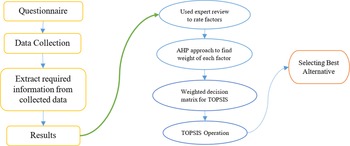
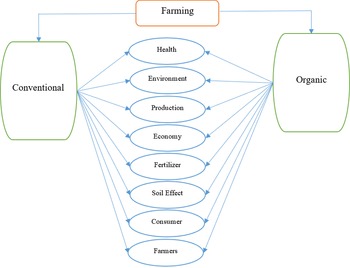
The study employs an MCDM based hybrid model using AHP-TOPSIS. The study design is described in Figure 1. After initially preparing the objectives and study of scholarly literature, a survey was undertaken (details of the survey are placed in the next section). This survey collected information from the farmers on their choice between organic and inorganic farming and factors that influence their decision to choose between farming types. These factors are listed in Figure 2. Once this information is collected, expert opinion was soughed through another survey to rank various factors used in this study. Finally, AHP and TOPSIS were applied to select the best alternative.
Overview of research process.

List of different attribute.

Data
The choice of organic and inorganic farming affect both farmers and consumers. Farmers are concerned about higher production, economic and soil effects. Consumers are worried about their health and the impact of agriculture on the environment. Therefore, to consider these two issues, two different surveys were undertaken for this study.
These surveys were undertaken via online questionnaires; however, manual distribution of questionnaires when required at some places. The first survey was for the consumers. The consumers were asked about their purchasing of agricultural products, the location from where they buy their agricultural products (wholesale, retail and supermarket), their knowledge about organic farming, their preferences for buying organic and inorganic agricultural products. In total there was 105 respondent to the survey.
Agricultural experts conducted the second survey. This survey had a total of 69 responses from agriculture experts.Footnote 1 Agriculture experts included employees of the agriculture department, academic members working in agriculture and other agriculture-related officials in government and the private sector. The survey asked about their opinion of preferring organic farming over inorganic farming for Pakistani farmers based on environment, health and chemical usage. They were also asked to express their opinion on Pakistan farmers' unawareness of organic agriculture. Based upon the information collected from different agricultural experts, the pairwise comparison has been prepared, which help us find out the relative importance of each attributes toward each criteria using rating as equally preferred to 1, moderately preferred to 3, strongly preferred to 5, very strongly preferred to 7 and significantly preferred to 9.
Results and discussion
The AHP approach was applied as described in section ‘Analytic hierarchy process (AHP)’. First, the normalized matrix was calculated, and from that priority, the vector was calculated in Table 1. This priority vector shows the relative importance of each attribute. AHP approach is used to find out the relative weight of each attribute that is later used in TOPSIS. After calculating the priority vector, it was necessary to check the consistency of the computed matrix. Accordingly, λmax and CR using Equations (1) and (2) are calculated, respectively. The CR < 0.1 indicates that the calculated matrix is consistent, and the process can proceed further.
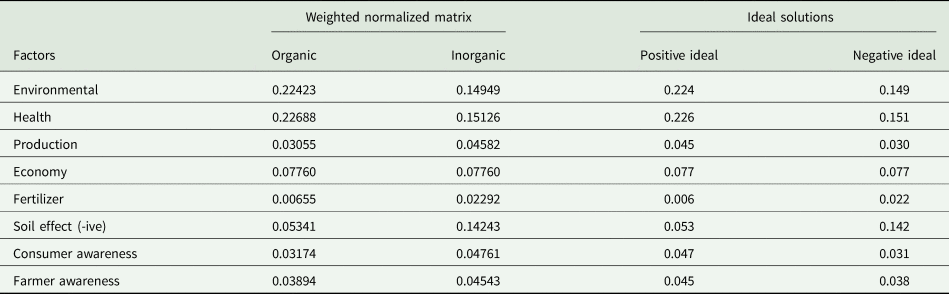
Weighted normalized matrix and ideal solutions

To find the best alternative, TOPSIS is used along with relative weight calculated by AHP in Step 3. Weights were assigned to each attribute, considering three decision-makers, consumers, farmers and agricultural professionals. These values were derived from the conducted survey. Also, weight was given to each decision-maker based on their farming knowledge, and it is 0.25, 0.25 and 0.50 for consumers, farmers and agricultural professionals. Afterwards, a normalized decision matrix is constructed using Equation (3). Then using priority vector weighted normalized matrix is calculated using Equation (4). Positive ideal and negative ideal solutions are computed in this step, and values are calculated using Equations (5) and (6). As the name suggests, these are the best possible combination of attributes for each criterion (Table 2).
Consistency ratio

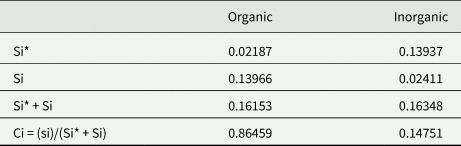
In the final step of the application of the Hybrid model based on AHP-TOPSIS, separation measures are calculated for both positive ideal ( $S^\ast _i$ ) and negative ideal (S i) solution using Equations (7) and (8), respectively. The values of ideal solutions are shown in Table 3. Relative closeness (C i) to the ideal solution is calculated in this step using Equation (9). Its value is also shown in Table 3. Value of relative closeness determines the best alternative among different conflicting criteria. 0 < C i < 1, which means it's within the range.
Relative closeness

Discussion
The result consists of two tables, i.e. Tables 1 and 3. Table 1 shows the influence of the number of criteria such as environmental benefits, health benefits, production, economy, fertilizer, social effect, consumer awareness, farmer awareness on the choice between organic and inorganic farming. The environmental impact and production are more positive and close to the positive ideal solution than inorganic farming. However, economic factors are comparable for both organic and inorganic farming as indicated by their equal values of the weighted normalized matrix and their equal values for closeness to the ideal solution. Additionally, it is also clear from the analysis that organic farming has a more substantial positive effect on health than inorganic farming.
Furthermore, the yield from organic farming is low compared to inorganic farming. However, unlike in organic agriculture, organic farming does not degrade soil properties that may not cause reduced yield in the future. The results also show that there is lesser awareness among farmers and consumers about organic products.
Table 3 shows the ranking of TOPSIS. Based on different criteria of conflicting attributes, the best choice between conventional and organic farming using TOPSIS is presented in Table 3. Organic farming is ranked as the best alternative by TOPSIS after hypothesizing positive and negative ideal solutions and calculating relative closeness to the ideal solution.
These findings imply that organic farming is good for the environment, health impacts and productivity; however, there is less awareness about organic farming among farmers and consumers, raising two potential problems. There is lesser or little demand for organic products in Pakistan from consumers. On the other hand, the absence of organic product demand combined with more inferior awareness of the farmers causes a lesser inclination to switch to organic farming from conventional or inorganic farming. In summary, though every farmer wants to obtain the maximum return from their farming with more secondary input use and though farming in terms of yield may be better than organic initially, that makes it a significant hurdle for farmers shifting toward organic farming in developing countries like Pakistan. However, considering the health and environmental benefits of organic farming, it seems that organic farming may be a better choice. However, please note that not all organic farming can be environmentally friendly always (e.g., Smith et al., Reference Smith, Kirk, Jones and Williams2019). Furthermore, soil fertility is badly influenced by the use of chemical fertilizers in inorganic farming that can be beneficial to have a higher yield in the short run. However, in a more extended period, inorganic farming degrades soil fertility.
Conclusion
This paper aimed to find out the best alternatives between organic and inorganic farming using a hybrid model based on AHP and TOPSIS and using several conflicting criteria, most of which have been ignored by earlier studies on the subject matter. The criteria could be clustered into three major items that are production, health, economic perspectives.
Data were collected based on questionnaires from consumers, farmers and agricultural experts. A hybrid model based on AHP-TOPSIS was applied to select the best alternative while using all the conflicting criteria such as environmental, health, production, economy, fertilizer, social effect, consumer awareness and farmer awareness. The study concludes that organic farming may be a better choice compared to inorganic farming in the context of Pakistan. While generalizing these findings, one must consider that not all organic farming can always be preferable. For instance, (Smith et al., Reference Smith, Kirk, Jones and Williams2019) did use life-cycle assessment to study the net greenhouse gases (GHG) effects if all of England and Wales food production is converted to organic. They concluded that although switching organic, in general, will reduce net greenhouse emissions, but considering more land to cover the domestic supply shortages, the net GHG emissions are higher for organic farming compared to inorganic farming. As far as these findings are concerned, there is a lack of awareness of the organic products in consumers. Also, the farmers are lesser aware of organic farming and combined with little or no demand, it is perhaps the major hurdle for Pakistan farmers to switch to organic farming.