




No CrossRef data available.
Article contents
SHAPING CERAMIC RESEARCH AT THE MAYA SITE OF CUELLO, BELIZE
Published online by Cambridge University Press: 11 July 2003
Abstract
Traditional analyses of ceramics from Maya Lowland archaeological sites have focused on descriptive typologies to define site and regional chronologies. However, T. Patrick Culbert's groundbreaking work on the ceramics of Tikal (1993) utilized vessel shapes, as well, involving an analytical system of two levels: shape classes and shapes. His systematized modal analysis and concentration on vessel-shape classes, in conjunction with a focus on the importance of deposit types and site-formation processes, revolutionized what ceramics can tell us about prehistoric Maya behavior. The same approach was applied to the research on the Cuello ceramics presented here to gain a better understanding of the behavior associated with ceramic-vessel usage during the Preclassic period at this northern Belize site.
Information
- Type
- Research Article
- Information
- Copyright
- © 2003 Cambridge University Press
The primary function of most ceramic analyses in archaeology is to develop a ceramic sequence both to provide a time line for dating deposits within a site and to compare the site's chronological history with that of others in the region (Gifford 1976; Willey et al. 1967). During his fifteen years of ceramic research at Tikal, Culbert (1993) not only established an excellent Tikal ceramic sequence (Table 1) but also demonstrated the utility of employing three independent but crosscutting systems of classification for the pottery.
The ceramic chronology of Tikal, Guatemala

The first system he used was a traditional type/variety analysis. However, as is the case from many excavated contexts, surface preservation of sherds was so poor as to limit the usefulness of a classificatory system based on surface treatment. The second approach involved the visual inspection of pastes. Although it was technically unsophisticated, this approach often demonstrated correlations with ceramic types or shapes—or, in some cases, it proved to be temporally diagnostic. The third system, an analysis of vessel shapes (Culbert 1993), has had a far greater and more lasting impact on subsequent ceramic analyses; it has also expanded the kinds of questions that can be answered beyond the temporal and stylistic to include social and behavioral variation in the prehistoric record. Finally, and in conjunction with these three approaches, Culbert carefully defined the kinds of deposits from which the ceramics came—one of the first attempts in which a ceramicist recognized that the sources of ceramics, and archaeological-site-formation processes, are important considerations for the ceramicist.
Culbert's analysis of Tikal vessel shapes involves an analytical system of two levels: shape classes and shapes. Shape classes are major divisions based on the size of the vessel, body proportions, and the kind of orifice, and they often shows a strong correlation with function, such as the traditional classification of plates, dishes, and bowls. Shapes are subdivisions of shape classes, differentiated by wall or neck shape and modifications such as ridges or flanges. They are less tied to the function of the vessel and change more rapidly through time than the more encompassing shape classes.
In quantifying these shape classes, Culbert found it additionally useful to breakdown his analysis into four major shape categories: wide-mouth jars, narrow-mouth jars, large-capacity bowls, and serving vessels (Table 2). The advantages of an analysis of vessel shapes were readily apparent for the large quantity of sherds produced by the Tikal Project excavations; further, shapes provided greater variation than types and changed more rapidly through time. For example, minor changes in lip shape and decoration of large storage bowls separate the Late Classic Ik Complex utilitarian vessels from the subsequent Imix Complex; however, the medially ridged plates and barrels of the Ik Complex are replaced by beveled lip plates and cylinders in Imix, and these changes in serving-vessel shapes are so common as to make differentiation between the two complexes impossible to miss (Culbert 1993).
Tikal vessel shape classes

Culbert defined a number of deposit kinds at Tikal, including the standard midden, fill deposit, and special deposits such as burials and caches. However, he added to that list the “mixed grab bag” to describe the typical deposit found at Tikal in association with small structures that includes a mixture of artifacts from all the time periods in which people lived or engaged in activities at that location. In addition, Culbert (1993) identified the concept of a “problematical deposit,” which represents a mixed group of situations and content. As all ceramicists should recognize, the presence of different ceramics in different archaeological contexts can provide information about social organization and prehistoric behavior, and Culbert was among the first to quantify these differential presences—and, therefore, the prehistoric use of different vessel shapes—in a variety of contexts.
RESEARCH AT CUELLO
In 1979, research on the Preclassic-period ceramics from Cuello, Belize (Figure 1), began in a project directed by Norman Hammond (1975, 1976, 1978, 1991) with the establishment of an independent typology for the site for chronological assessments (Table 3). This work was made easier by the earlier, excellent analysis by Duncan Pring (1977) but hampered in part by the fact that only a few sites at that time had recorded similar early Middle Preclassic pottery.
The ceramic chronology of Cuello, Belize


Map of northern Belize showing the location of the site of Cuello.
Although the surface preservation of material was unusually excellent throughout all phases, it soon became clear that, as was the case at Tikal, type/variety classification had limited utility beyond chronological inference. In fact, surface finishes from the Early Middle to the Middle Preclassic period remained so consistent that differences in vessel shape and lip and rim treatments were used to differentiate between Swasey and the subsequent Bladen ceramics (Kosakowsky 1983, 1987; Kosakowsky and Pring 1998).
Using Culbert's work with vessel-shape classes at Tikal in conjunction with the examination of kinds of deposits as a model for looking at the Cuello pottery, I attempted to analyze the distribution of vessel-shape classes within different types of archaeological deposits (Kosakowsky 1983). These deposits were first classified as follows: (1) private locations—that is, the interior spaces of small household structures and any middens associated with those structures; (2) public spaces, including patio floors and refuse associated with larger ceremonial structures—that is, the pyramid; and (3) special deposits such as chultunes, caches, and burials. Vessel-shape classes for Cuello were determined to include wide-mouth jars, narrow-mouth jars, bottles, and a variety of bowl and dish forms, depending on time period, that probably served multiple functions such as cooking and serving, as well as for mortuary and cache assemblages (Kosakowsky 1983).
During the early Middle Preclassic Swasey and Bladen Complexes at Cuello there is little difference in the frequency distributions of vessel shapes between public and private contexts (Tables 4 and 5), and the percentage of unslipped wide-mouth jars inside structures is slightly higher than that outside structures (in Swasey 7.8% vs. 0%; in Bladen, 2.9% vs. 1.7%). The rest of the shape distributions are fairly similar. Because large, unslipped wide-mouth jars were probably used for storage of both food and water, this distribution is not surprising. In addition, the use of interior and exterior space for similar domestic activities in the early Middle Preclassic no doubt would explain the similar distribution of vessel shapes (Kosakowsky 1983).
Frequency distributions of Swasey vessel-shape classes in private and public contexts (rim sherds only; n = 322)

Frequency distributions of Bladen vessel-shape classes in private and public contexts (rim sherds only; n = 1,377)

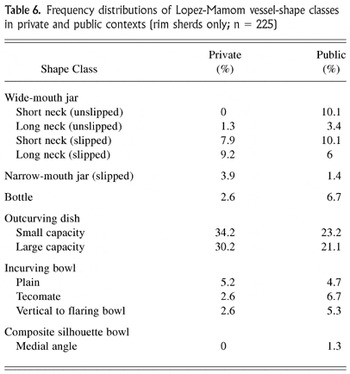
In the Middle Preclassic Lopez-Mamom Complex, the pattern seems to shift somewhat strikingly (Table 6), with the greatest percentage of unslipped wide-mouth jars in the outdoor public spaces (13.5% vs. 1.3% indoors), implying perhaps that outdoor space in the Middle Preclassic was used as an extension of indoor space. In addition, the aesthetic preference in the Middle Preclassic for outcurving dishes, a prominent feature of all Lowland Maya sites with Mamom occupation, further complicates interpretations concerning the prehistoric behavior associated with the ceramics (Kosakowsky 1983).
Frequency distributions of Lopez-Mamom vessel-shape classes in private and public contexts (rim sherds only; n = 225)

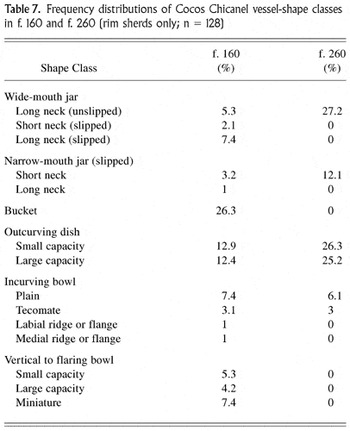
For the Middle Preclassic period at Cuello, small sample sizes precluded comparisons across structures at the site, but Late Preclassic Cocos Chicanel samples were large enough to examine patterns of vessel-shape distribution in both public and private spaces and across structures. During the middle facet of the Late Preclassic, two coeval structures, f. 160 on the south side of a patio and f. 260 on the north end of the patio (Gerhardt 1988), contained strikingly different vessel-shape distributions (Table 7). Structure f. 160 contained a disproportionate number of bowls and dishes relative to jar forms, and f. 260 contained an unusually large number of wide-mouth and narrow-mouth jars. A more appropriate inference based on these ceramic shape distributions is to view the patio group as a unit, rather than as separate households or activity loci, with the northern structure used for food storage and the southern building for food preparation and serving. The southern building had a masonry substructure and hearth, while the northern, the larger of the two, was constructed of timber and did not contain a hearth, lending further credence to this interpretation.
Frequency distributions of Cocos Chicanel vessel-shape classes in f. 160 and f. 260 (rim sherds only; n = 128)

Special contexts such as caches, burials, and chultunes throughout Cuello's occupation history provide further evidence for drawing inferences about the prehistoric behavior associated with ceramics. Analyses of vessel shapes used in caches and burials have shown that there was no specialized set of mortuary vessels; the same frequency distributions are found in these contexts as in midden and fill deposits from the site, with the exception of unslipped wide-mouth jars, which never appear in mortuary or cache contexts (Kosakowsky 1983).
The ceramics found in the three Cuello chultunes tell a slightly different story (Kosakowsky 1983; Kosakowsky and Pring 1998). The two Late Preclassic chultunes contain ceramics whose vessel shapes overlap in frequency distributions with all other contexts. However, the Middle Preclassic Bladen chultun, f. 361, contained an unusual set of ceramic types not found previously at Cuello and a larger-than-normal percentage of small bowls and thin-walled cups. The stratigraphic evidence from this chultun suggested a single episode of dumping, and a study of the lithics from this feature by Rebecca McSwain (personal communication, 1994) identified a statistically higher incidence of burned lithic material, suggesting the possibility of ritual burning. Faunal remains were restricted, with large concentrations of deer, and Norman Hammond, Amanda Clarke, and Sara Donaghey (1995) have posited that the refuse in this chultun may have resulted from the ceremonial consumption of chicha related to an episode of feasting. The ceramics show little or no use wear, and the presence of relatively restricted vessel shapes of small bowls and cups supports the serving and consumption of liquids. These kinds of inferences are critical to our understanding of the development of such societal behaviors as ritual and ceremonialism, often reflected in restricted function-pottery and in social ranking and differentiation. Answering questions concerning prehistoric social variation based on ceramic evidence has been facilitated by the examination of vessel shapes rather than types.
FINAL COMMENTS
The ceramic research carried out at Cuello and my subsequent work at many other sites in northern Belize have been influenced strongly by Culbert's contributions to the study of Maya ceramics. Culbert's (1993) work on the Tikal ceramic sequence and the establishment of a typology, providing chronological comparability across sites in the Maya Lowlands, could easily stand alone as a major contribution to our corpus of knowledge about Tikal and the ancient Maya. However, it is his systematized modal analysis and concentration on vessel-shape classes, in conjunction with his understanding of the importance of deposit types and site-formation processes, that have truly revolutionized what ceramics can tell us about prehistoric behavior. It is this kind of careful attention to detail, such as differential use of ceramics by different segments of a population, that ultimately will have the potential to inform on social variation among the ancient Maya.
RESUMEN
Los análisis tradicionales de la cerámica de los Maya de las tierra bajas en sitios arqueológicos se han centrado en tipologías descriptivas para definir las cronologías de los sitios y de las regiones. Sin embargo, el trabajo de T. Patrick Culbert (1993) sobre la cerámica de Tikal utilizó un sistema analítico de dos niveles: formas de las vasijas y clases de formas de las vasijas. Su análisis y concentración modales sistematizados en clases de formas de las vasijas, conjuntamente con un foco en la importancia de los tipos del depósito y de los procesos de la formación del sitio revolucionaron lo que puede decirnos la cerámica sobre el comportamiento prehistórico de los Maya. Este mismo método fue aplicado a la investigación sobre la cerámica de Cuello presentada aquí para ganar una comprensión mejor del comportamiento asociado al uso de la cerámica durante el Preclásico en este sitio norteño de Belice.
ACKNOWLEDGMENTS
I acknowledge two primary individuals who have aided in the research presented here. The Cuello Project and much of my subsequent field research in Belize was done under the direction of Norman Hammond, Boston University, and I thank him for his generous intellectual, financial, and emotional support throughout the years. Second, and most important, my love and thanks go to T. Patrick Culbert, my dissertation adviser, mentor, colleague, fellow Wildcat fan, and friend. I owe Pat an enormous debt of gratitude for everything he has contributed to both my “archaeological” and “non-archaeological” life, and both have been enriched in knowing him.
References
REFERENCES
Culbert, T. Patrick
1993
The Ceramics of Tikal: Vessels from the Burials, Caches, and
Problematical Deposits.
Tikal Report No. 25, Part A.
University Museum, University of Pennsylvania,
Philadelphia.
Gerhardt, Juliette C.
1988
Preclassic Maya Architecture at Cuello, Belize.
BAR International Series 464.
British Archaeological Reports,
Oxford.
Gifford, James C.
1976
Prehistoric Pottery and the Ceramics of Barton Ramie in the Belize
Valley.
Papers of the Peabody Museum of Archaeology and Ethnology Vol. 18.
Harvard University,
Cambridge, MA.
Hammond, Norman (editor)
1975
Archaeology in Northern Belize: British Museum–Cambridge
University Corozal Project 1974–75 Interim Report.
Centre of Latin American Studies.
Cambridge University,
Cambridge.
Hammond, Norman (editor)
1976
Archaeology in Northern Belize: British Museum–Cambridge
University Corozal Project 1976 Interim Report.
Centre of Latin American Studies.
Cambridge University,
Cambridge.
Hammond, Norman (editor)
1978
Cuello Project 1978 Interim Report.
Publication No. 1.
Archaeological Research Program. Douglass College, Rutgers
University,
New Brunswick, NJ.
Hammond, Norman (editor)
1991
Cuello: An Early Maya Community in Belize.
Cambridge University Press,
Cambridge.
Hammond, Norman,
Amanda Clarke, and
Sara Donaghey
1995
The Long Goodbye: Middle Preclassic Maya Archaeology at Cuello,
Belize.
Latin American Antiquity
6:120–128.Google Scholar
Kosakowsky, Laura J.
1983
Intra-site Variability of the Formative Ceramics from Cuello,
Belize: An Analysis of Form and Function.
Ph.D. dissertation, University of Arizona, Tucson.
University Microfilms,
Ann Arbor, MI.
Kosakowsky, Laura J.
1987
Preclassic Maya Pottery at Cuello, Belize.
Anthropological Papers of the University of Arizona No. 47.
University of Arizona Press,
Tucson.
Kosakowsky, Laura J., and
Duncan C. Pring
1998
The Ceramics of Cuello, Belize: A New Evaluation.
Ancient Mesoamerica
9:55–66.Google Scholar
Pring, Duncan C.
1977
The Preclassic Ceramics of Northern Belize.
Ph.D. dissertation, University of London.
University Microfilms,
Ann Arbor, MI.
Willey, Gordon R.,
T. Patrick Culbert, and
Richard E.W. Adams
1967
Maya Lowland Ceramics: A Report from the 1965 Guatemala City
Conference.
American Antiquity
32:289–315.Google Scholar
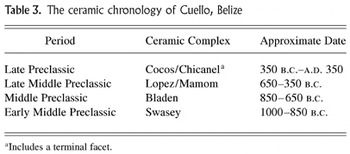
The ceramic chronology of Cuello, Belize
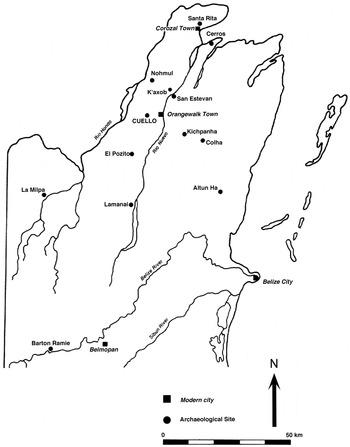
Map of northern Belize showing the location of the site of Cuello.
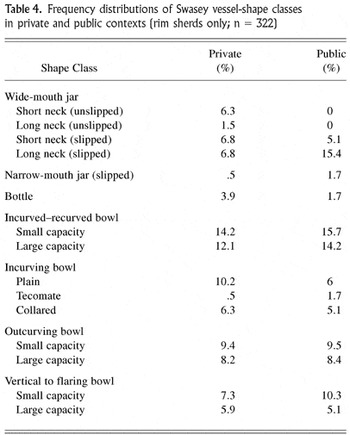
Frequency distributions of Swasey vessel-shape classes in private and public contexts (rim sherds only; n = 322)
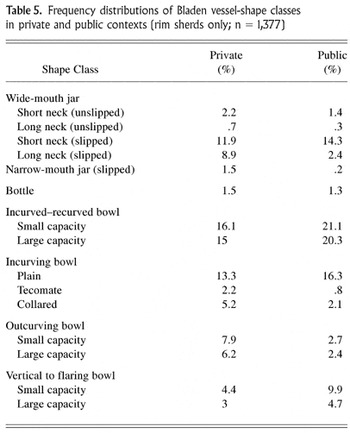
Frequency distributions of Bladen vessel-shape classes in private and public contexts (rim sherds only; n = 1,377)
Frequency distributions of Lopez-Mamom vessel-shape classes in private and public contexts (rim sherds only; n = 225)
Frequency distributions of Cocos Chicanel vessel-shape classes in f. 160 and f. 260 (rim sherds only; n = 128)
 You have
Access
- 2
- Cited by