Thirty years of research has positioned entrepreneurial orientation (EO) as an important construct in both the entrepreneurship (Covin & Wales, Reference Covin and Wales2019) and strategic management literatures (Anderson, Kreiser, Kuratko, Hornsby, & Eshima, Reference Anderson, Kreiser, Kuratko, Hornsby and Eshima2015). Defined as ‘a frame of mind and a perspective about entrepreneurship that are reflected in a firm's ongoing processes and corporate culture’ (Dess & Lumpkin, Reference Dess and Lumpkin2005, p. 147), EO is an important catalyst of organizational growth, profitability, and ultimately, organizational performance (Rauch, Wiklund, Lumpkin, & Frese, Reference Rauch, Wiklund, Lumpkin and Frese2009). Despite meta-analytic findings that suggest a corrected direct effect between EO and firm performance (r c = .24), Rauch et al. (Reference Rauch, Wiklund, Lumpkin and Frese2009) suggest moderator variables beyond industry attributes may explain additional variance in the relationship between EO and organizational outcomes. In the years since the publication of Rauch et al.'s (Reference Rauch, Wiklund, Lumpkin and Frese2009) meta-analysis, numerous scholars have considered the moderating influence of strategic alliances (Brouthers, Nakos, & Dimitratos, Reference Brouthers, Nakos and Dimitratos2015), top management team transformational leadership behaviors (Engelen, Gupta, Strenger, & Brettel, Reference Engelen, Gupta, Strenger and Brettel2015), CEO psychological traits (Palmer, Niemand, Stöckmann, Kraus, & Kailer, Reference Palmer, Niemand, Stöckmann, Kraus and Kailer2017), and national culture (Markin, Gupta, Pierce, & Covin, Reference Markin, Gupta, Pierce and Covin2018), among others, to better understand the relationship between EO and firm performance. However, several authors (Anderson et al., Reference Anderson, Kreiser, Kuratko, Hornsby and Eshima2015; Covin & Wales, Reference Covin and Wales2012, Reference Covin and Wales2019; Rauch et al., Reference Rauch, Wiklund, Lumpkin and Frese2009) also raise key questions regarding the conceptualization and measurement of EO that consequently require further investigation and clarification in order to shed light on the boundary conditions of the EO–firm performance relationship.
More specifically, prominent EO scholars have challenged conceptualizations of EO that are situated exclusively in the perspectives of top leaders and encouraged scholars to consider how EO may permeate throughout an organization. In order to reconcile the inherent conceptual differences surrounding seminal EO studies (e.g., Covin & Slevin, Reference Covin and Slevin1989; Lumpkin & Dess, Reference Lumpkin and Dess1996; Miller, Reference Miller1983), Wales, Covin, and Monsen (Reference Wales, Covin and Monsen2020) suggest that EO values may manifest behaviorally across organizational levels such that the entire organization may engage in ‘being entrepreneurial’ (p. 640). Such sentiments are consistent with Lumpkin and Dess’ (Reference Lumpkin and Dess1996) notion of EO as an organization configuration, whereby an emphasis on entrepreneurial activities supported by top managers is manifest throughout the organization by way of the firm's unique structure, routines, or culture. Indeed, Lumpkin and Dess (Reference Lumpkin and Dess1996) note that entrepreneurial processes emanating from top managers ‘encompass many aspects of the organization's culture [and] shared value system’ (p. 139). In this manner, it is not sufficient for only a firm's top managers to be entrepreneurially oriented – instead, it is critical for entrepreneurial activity to be undertaken by employees at all levels within the firm. Accordingly, in order to advance our collective understanding of EO, an emphasis on multilevel investigations of EO is warranted (Wales et al., Reference Wales, Covin and Monsen2020) to determine how the shared nature of EO may impact firm performance.
A review of the entrepreneurship literature suggests the absence of a measure of EO that can be effectively used to capture its strength, or within-firm rater agreement. In perhaps the most comprehensive treatment of EO measurement to date, Covin and Wales (Reference Covin and Wales2012) note that although Covin and Slevin's (Reference Covin and Slevin1989) 9-item scale is perhaps the most common measure of EO, limitations of this measure do exist. Measures of EO based on Miller (Reference Miller1983) and Covin and Slevin's (Reference Covin and Slevin1989) conceptualizations include some items that are forced-choice or ipsative (cf., Kline, Reference Kline2013), resulting in scales that do not have true semantic differential anchors (Keh, Nguyen, & Ng, Reference Keh, Nguyen and Ng2007). These may result in unwanted or spurious covariance (Baron, Reference Baron1996; Ray, Reference Ray1990). Additionally, the focus of these measures for two of the subscales (cf., innovativeness and risk taking), is on firm leadership only, explicitly restricting the construct exclusively to perceptions of leaders, making this approach problematic to assessing EO strength. In some cases, perspectives of leaders do permeate the organization (Wales et al., Reference Wales, Covin and Monsen2020; Wales, Monsen, & McKelvie, Reference Wales, Monsen and McKelvie2011), making the assessment of their views a firm-level construct. But, we cannot be certain of this phenomenon without measuring perceptions more broadly and subsequently assessing agreement. Given the proliferation of measures that assess EO in empirical studies, the development of a psychometrically valid and reliable measure of EO that allows for the derivation of EO strength is consistent with numerous calls for investigations to better understand the nomological network of EO (Anderson et al., Reference Anderson, Kreiser, Kuratko, Hornsby and Eshima2015; Covin & Wales, Reference Covin and Wales2019; George, Reference George2011; Rauch et al., Reference Rauch, Wiklund, Lumpkin and Frese2009). For example, Rauch et al. (Reference Rauch, Wiklund, Lumpkin and Frese2009) note, ‘future research effort needs to develop reliable and valid scales of the dimensions of EO’ (p. 779) and George (Reference George2011) echoes this sentiment with his assessment that ‘the time may have come to develop a new EO scale’ (p. 1310).
Therefore, the purpose of this paper is threefold. First, in response to calls for more advanced scale development in entrepreneurship research (cf., Anderson et al., Reference Anderson, Kreiser, Kuratko, Hornsby and Eshima2015; Covin & Wales, Reference Covin and Wales2019; Crook, Shook, Morris, & Madden, Reference Crook, Shook, Morris and Madden2010; George, Reference George2011; Rauch et al., Reference Rauch, Wiklund, Lumpkin and Frese2009; Slavec & Drnovšek, Reference Slavec and Drnovšek2012), we employ a four-study design to develop and validate a reliable measure of EO that is suitable to assess EO strength. Second, in response to Wales et al. (Reference Wales, Monsen and McKelvie2011), we demonstrate that sampling EO from only top levels of an organization may overstate the manifestation of EO. In doing so, we answer Wales et al.'s (Reference Wales, Monsen and McKelvie2011) call for future EO research to ‘examine perceptions of organizational EO from multiple respondents across different levels or areas of the firm utilizing validated measures of EO’ (p. 914) by drawing on measurement strategies from outside of the entrepreneurial research literature. Third, in line with the strong culture hypothesis (Denison, Reference Denison1984; Kilmann, Saxton, & Serpa, Reference Kilmann, Saxton and Serpa1986), we show that the interactive effect of EO and EO strength improves our understanding of the EO–firm performance dynamic. In this manner, we extend previous research by considering strength of EO as a salient moderator of the EO–firm performance relationship.
Theoretical framework and hypotheses
In order to address research questions that position EO as a firm-level variable, we must first verify that it is a shared perception across the organization. In order to do so, the measures and design choices used to assess perceptions must align with the conceptualization of EO as a cultural (rather than a top leadership) phenomenon. We draw on a robust EO literature, the Wales et al.'s (Reference Wales, Monsen and McKelvie2011) model of EO pervasiveness, and traditions in the measurement of organizational culture (a firm-level, shared perception), to propose a system of measurement, sampling, and analysis that allows us to more deeply examine the relationship between EO and firm-level performance.
Conceptualization and measurement of entrepreneurial orientation
Perhaps, the most fundamental issue facing the conceptualization and measurement of EO has been the fluidity of the dimensions comprising the EO construct. Since Miller's (Reference Miller1983) initial conceptualization of EO, scholars have employed a variety of different configurations of EO, both conceptually and empirically. Miller (Reference Miller1983) originally conceptualized EO to encompass firm level innovativeness to engage in new product development, organizational risk-taking to allocate resources in the pursuit of new opportunities in uncertain environments, and organizational proactiveness to anticipate competitor actions and to position the firm to meet the challenges of the future. Building on Miller's (Reference Miller1983) definition of EO, Lumpkin and Dess (Reference Lumpkin and Dess1996) offered significant advances in the measurement of EO to include two additional dimensions: competitive aggressiveness and autonomy. Competitive aggressiveness is the ability to outperform rival firms by engaging in strategic posturing and autonomy is the extent to which firm leaders bring new ideas, products, or services to fruition (Lumpkin, Cogliser, & Schneider, Reference Lumpkin, Cogliser and Schneider2009). Consequently, researchers have conceptualized EO as both unidimensional and multidimensional constructs including as few as one dimension to assess EO (i.e., conceptualizing EO as only competitive aggressiveness, Covin & Covin, Reference Covin and Covin1990; conceptualizing EO as only proactiveness, Becherer & Maurer, Reference Becherer and Maurer1999) to as many as six dimensions (Morgan & Strong, Reference Morgan and Strong2003), extending the seminal conceptualizations of Miller (Reference Miller1983) and Lumpkin and Dess (Reference Lumpkin and Dess1996).
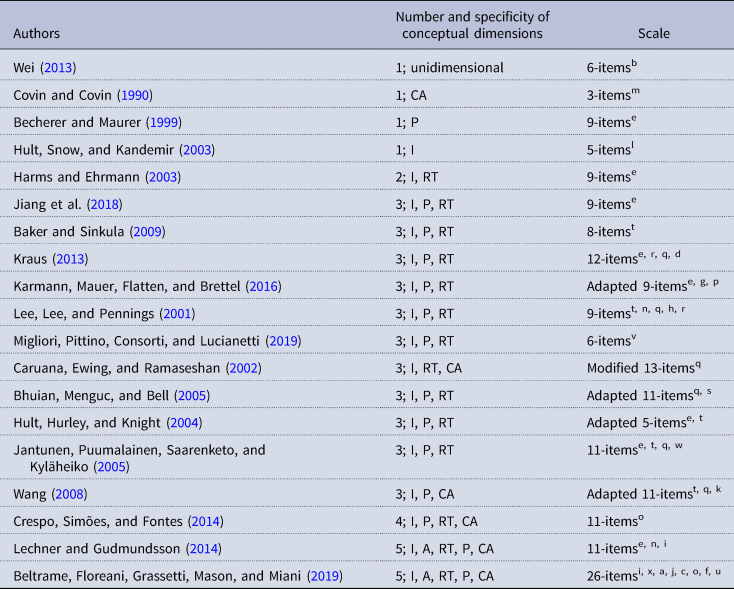
As indicated in Table 1, a review of the literature suggests no fewer than 19 different configurations of conceptual dimensions employing items from at least 24 different studies have been used, exemplifying Rauch et al.'s (Reference Rauch, Wiklund, Lumpkin and Frese2009) assertion that ‘EO researchers preferred to experiment with adaptations of the scale rather than consistently sticking to one particular measurement’ (p. 767). For parsimony, we present in Table 1 only one exemplar study for each configuration. Therefore, although there are many studies which have conceptualized EO with three dimensions (e.g., proactiveness, risk-taking, and innovativeness) and employed Covin and Slevin's (Reference Covin and Slevin1989) 9-item scale, we present only one such study (i.e., Jiang, Liu, Fey, & Jiang, Reference Jiang, Liu, Fey and Jiang2018) in Table 1.
Examples of variance in the number and specificity of conceptual dimensions, items, and scales employed to assess EO

A = autonomy; CA = competitive aggressiveness, I = innovation/innovativeness; P = proactiveness, RT = risk taking.
aAcedo and Jones (Reference Acedo and Jones2007); bAtuahene-Gima and Ko (Reference Atuahene-Gima and Ko2001); cCalantone, Cavusgil, and Zhao (Reference Calantone, Cavusgil and Zhao2002); dCovin and Slevin (Reference Covin and Slevin1986); eCovin and Slevin (Reference Covin and Slevin1989); fEngel (Reference Engel1970); gGeorge and Marino (Reference George and Marino2011); hHage (Reference Hage1980); iHornsby, Kuratko, and Zahra (Reference Hornsby, Kuratko and Zahra2002); jHult and Ketchen (Reference Hult and Ketchen2001); kHurt, Joseph, and Cook (Reference Hurt, Joseph and Cook1977); lHurley and Hult (Reference Hurley and Hult1998); mKhandwalla (Reference Khandwalla1976/1977); nLumpkin and Dess (Reference Lumpkin and Dess1996); oLumpkin and Dess (Reference Lumpkin and Dess2001); pMiller and Friesen (Reference Miller and Friesen1978); qMiller and Friesen (Reference Miller and Friesen1982); rMiller (Reference Miller1983); sMorris and Paul (Reference Morris and Paul1987); tNaman and Slevin (Reference Naman and Slevin1993); uSpreitzer (Reference Spreitzer1995); vWalter, Auer, and Ritter (Reference Walter, Auer and Ritter2006); wWiklund (Reference Wiklund1998); xMorgan and Strong (Reference Morgan and Strong2003).
A second conceptualization and measurement issue concerns whether EO is best depicted as a reflective or formative construct (Anderson et al., Reference Anderson, Kreiser, Kuratko, Hornsby and Eshima2015; Covin & Wales, Reference Covin and Wales2012). Although Covin and Wales (Reference Covin and Wales2012) tend to favor reflective models, Anderson et al. (Reference Anderson, Kreiser, Kuratko, Hornsby and Eshima2015) advocates that formative measurement models are the most accurate depiction of the construct. Such disagreement surrounding the modeling of the latent construct suggests ‘there is a fundamental difference in the core EO construct as discussed by these author sets’ (Covin & Wales, Reference Covin and Wales2019, p. 7). Accordingly, additional research is necessary to clarify this concern.
A third conceptualization and measurement issue centers around whether EO is an organizational-, group-, or individual-level phenomenon and the level at which it should be measured (Wales et al., Reference Wales, Monsen and McKelvie2011). Although Covin and Wales (Reference Covin and Wales2019) contend ‘EO is a strategic-level construct’ (p. 11), other scholars contend it is likely EO may reside at different levels within an organization (Covin et al., Reference Covin, Rigtering, Hughes, Kraus, Cheng and Bouncken2020; George, Reference George2011; Wales et al., Reference Wales, Covin and Monsen2020). Consequently, new measures of EO that allow for the assessment of shared perceptions may better capture this phenomenon. Although EO was originally conceptualized as a firm-level construct, Wales et al.'s (Reference Wales, Monsen and McKelvie2011) model of EO pervasiveness challenges future research to consider how EO permeates both vertically and horizontally throughout an organization, representing a departure for conventional conceptualizations. We agree with this conceptualization, particularly in light of research on organizational climate that assumes consensus of multiple actors as to their experiences within the firm (James, Demaree, & Wolf, Reference James, Demaree and Wolf1984). Thus, instead of the traditional view that EO is a firm-level construct that is relatively homogenous across the organization, the model of EO pervasiveness suggests that the manifestation of EO may be both homogenous and heterogeneous within different hierarchical levels in the organization, or within different subunits. Accordingly, advancement of the EO literature would benefit from a measure and research protocols that allow for better deployment of appropriate composition models of the EO construct (Chan, Reference Chan1998). As Chan (Reference Chan1998) notes, in foundational conceptualizations of organizational climate (cf. James et al., Reference James, Demaree and Wolf1984), confirmation of the shared perception of individual experiences allows aggregation to the group or organization level, which is necessary when interested in group or organizational performance. Moreover, adopting a dispersion composition model would allow researchers to investigate EO strength as a firm-level (rather than industry-level) attribute that could moderate the EO–performance relationship (Rauch et al., Reference Rauch, Wiklund, Lumpkin and Frese2009).
Fourth, choices about respondent sampling impact both conceptual and empirical aspects of EO. Traditionally, in order to obtain sample sizes necessary to understand the relationship between EO and organizational performance (Dess & Lumpkin, Reference Dess and Lumpkin2005), EO researchers have used single-respondent, self-reported data to measure EO (Lyon, Lumpkin, & Dess, Reference Lyon, Lumpkin and Dess2000). Although a design choice that results in a larger sample size, sampling only one organizational respondent does not allow us to investigate whether perceptions of EO are shared. Taking this approach, perceptions of firm-level EO are typically provided by the CEO (Wiklund & Shepherd, Reference Wiklund and Shepherd2003a, 2003Reference Wiklund and Shepherdb) or another top management team member, such as a managing director (Brettel, Chomik, & Flatten, Reference Brettel, Chomik and Flatten2015; Wiklund, Reference Wiklund1999). The underlying assumption in this approach is that top management team members are generally responsible for creating and implicating strategic initiatives (Wiklund & Shepherd, Reference Wiklund and Shepherd2003a, 2003Reference Wiklund and Shepherdb) and are knowledgeable informants about firm-level entrepreneurial activity (Covin & Wales, Reference Covin and Wales2019). Alternatively, the EO pervasiveness argument offered by Wales et al. (Reference Wales, Monsen and McKelvie2011) conceptualizes EO as a shared value that spans across vertical levels within an organization, requiring researchers to measure perceptions of values appropriately, and compose variables in thoughtful ways. Thus, perceptions of a firm's cultural orientations, such as EO, should be considered in light of agreement, or strength, oftentimes across multiple levels in an organization's hierarchy (cf., Chatman, Caldwell, O'Reilly, & Doerr, Reference Chatman, Caldwell, O'Reilly and Doerr2014; Denison, Reference Denison1984; Wiener, Reference Wiener1988). Despite adopting the theoretical view that EO is an organizational-level variable composed of the EO across the organization, studies tend to investigate only the perceptions of EO content held by top executives (Covin & Wales, Reference Covin and Wales2019), thus functionally eliminating the ability to confirm agreement and investigate EO strength.
Finally, there may be an underestimation of the relationship between EO and firm-level performance due to these conceptual and design choices. When EO researchers do not measure the ‘shared’ component of the construct, they ‘only skim the culture that surrounds the top executives’ (Czarniawska-Joerges, Reference Czarniawska-Joerges1992, p. 174), and therefore may limit the explanatory power of the EO construct in measuring firm performance. Specifically, employees on the front lines are often times responsible for the behaviors that shape organizational performance (Covin et al., Reference Covin, Rigtering, Hughes, Kraus, Cheng and Bouncken2020). Accordingly, the practice of sampling only top executives limits our understanding of the EO–firm performance dynamic. It is also conceivable that top leaders may espouse both entrepreneurial behaviors and risk taking (Anderson et al., Reference Anderson, Kreiser, Kuratko, Hornsby and Eshima2015), but reward systems and hiring practices may result in individual contributor behavior that is not innovative, risky, or proactive. In sum, we endorse a sampling and measurement strategy that better captures the organizational-level manifestation of EO and allows for the investigation of EO strength, which is in alignment with EO as a pervasive phenomenon.
EO as a shared perception
The Wales et al.'s (Reference Wales, Monsen and McKelvie2011) model of EO pervasiveness offers three competing theoretical frameworks to evaluate how organizations develop and manifest attitudes and perceptions supporting entrepreneurial activity. The ambidextrous model contends that firms aim to balance between ambidextrously pursuing both entrepreneurial activity with more conservative initiatives, deliberately restricting the exhibition of EO attitudes. The cyclical wave model argues that organization may alter their focus on EO based on time periods accentuated by varying degrees of change (e.g., dynamic vs. inert). Finally, the continuous morphing model is most relevant to our research questions. This final model characterizes EO as ‘a phenomenon that is both spatially and temporally homogeneous in its pervasiveness throughout the entirety of the firm’ (Wales et al., Reference Wales, Monsen and McKelvie2011, p. 907). In this manner, members at all levels throughout the organization demonstrate a shared perception of EO that is consistent both vertically and horizontally within the organization. According to Wales et al. (Reference Wales, Monsen and McKelvie2011), the continuous morphing model ‘is likely to occur through a consistent shared [italic added for emphasis] vision paired with the rapid and holistic diffusion of adaptations to firm structures and processes throughout the entirety of the firm’ (p. 907). In order to assess the validity of the continuous morphing model, it is essential to consider the shared nature of EO. Therefore, looking to the organizational culture literature for precedent, entrepreneurship scholars may improve construct development of EO by following a basic tenant of the conceptual definition of culture – values, perceptions, and orientations are shared. James and his colleagues (James, Reference James1982; James, Joyce, & Slocum, Reference James, Joyce and Slocum1988) established that when researchers study perceptions of cultural orientations gathered from individuals as a group- or organization-level variable, they must first demonstrate that individual ratings have an acceptable level of agreement. However, within the EO literature, the single-respondent, self-report approach to assess EO is recognized as the norm (Brettel et al., Reference Brettel, Chomik and Flatten2015; Rauch et al., Reference Rauch, Wiklund, Lumpkin and Frese2009; Wang, Reference Wang2008).
In addition to theoretical reasons for gathering data from across the organization when assessing EO (Wales et al., Reference Wales, Monsen and McKelvie2011), there are practical reasons as well. Gathering perceptions from multiple levels in an organization (and ensuring agreement) is particularly important when one considers the potential for markedly different experiences among top leaders when compared to those of employees at lower levels of the organization. Louis’ (Reference Louis, Frost, Moore, Louis, Lundberg and Martin1985) theory of cultural penetration may partially explain this phenomenon. Cultural penetration is the extent to which the characteristics of an organization's culture are distributed across an organization (Louis, Reference Louis, Frost, Moore, Louis, Lundberg and Martin1985). Louis proposed three types of penetration – sociological, psychological, and historical – that impact the dispersion of cultural orientations throughout an organization. Furthermore, Saffold (Reference Saffold1988) defines vertical sociological penetration as ‘the degree to which cultural manifestations are shared across different groups within the organization’ (p. 551). Vertical penetration, then, refers to the extent to which the cultural characteristics are transmitted through the hierarchy of the organization such that those characteristics are shared. Building on Louis’ (Reference Louis, Frost, Moore, Louis, Lundberg and Martin1985) work, Martin (Reference Martin2002) proposed a three-perspective theory of culture. A key tenet of this approach is an emphasis on the unlikely circumstance that ‘people in an organization at different levels and in different positions/occupations – and with different personalities – would have the same experiences and attach the same meaning to the organization and what it values’ (Schneider, Ehrhart, & Macey, Reference Schneider, Ehrhart and Macey2013, p. 370). Moreover, perceptions of values exist at all levels in organizations, and these perceptions interact with perceptions at other levels in an organization (Agle & Caldwell, Reference Agle and Caldwell1999). Therefore, surveying one person per organization may misrepresent the shared values of the organization.
Compounding this issue, when only one top leader is surveyed, he or she may take cues as to the quality of EO by considering financial performance. This creates an autocorrelation and the potential for assuming this result to be evidence of a strong EO–firm performance relationship. A review of the literature suggests as much. Studies surveying CEOs (Wiklund & Shepherd, Reference Wiklund and Shepherd2003a, 2003Reference Wiklund and Shepherdb) and top management team members (Wiklund, Reference Wiklund1999) overwhelmingly report positive relationships between EO and firm performance. However, findings from one pioneering study conducted by Monsen and Boss (Reference Monsen and Boss2009) suggested that hospital staff members reported lower levels of risk-taking, proactiveness, and innovativeness than their managers. Such findings suggest the possibility of heterogeneity of EO across vertical organizational levels. To our knowledge, studies relating EO strength and organizational performance have yet to be conducted.
Thus, following our work in scale development, our first objective in this study is to show that perceptions of EO are different based upon the respondent's level in the organization, providing further evidence that sampling multiple employees from multiple levels is imperative. We hypothesize the following:
Hypothesis 1: Average assessment of EO is positively associated with respondent's level in the organization.
EO strength as a moderator of firm performance
Respectively, within the organizational culture literature, culture strength has emerged as an important variable linking shared norms and values to organizational outcomes (Chatman et al., Reference Chatman, Caldwell, O'Reilly and Doerr2014). Specifically, culture strength is defined as ‘the degree to which [organizational] members agree about a broad set of cultural norms’ (Chatman et al., Reference Chatman, Caldwell, O'Reilly and Doerr2014, p. 786). By extension, the degree to which organizational members share perspectives about entrepreneurship and engage with relevant processes is proposed as a linking variable in our model. In other words, when a majority of organizational members – leaders, managers, and operational employees – engage in their work with an entrepreneurial mindset, we are more likely to see organizational level outcomes that reflect this shared frame of mind.
Several theorists reference the strong culture hypothesis as a way to describe this quality of culture (Denison, Reference Denison1984; Lim, Reference Lim1995; Saffold, Reference Saffold1988; Schneider, Salvaggio, & Subirats, Reference Schneider, Salvaggio and Subirats2002), and it is particularly relevant as we consider the impact of perceptual agreement of EO on organizational performance. Put forth by Denison (Reference Denison1984), the strong culture hypothesis asserts that ‘an organization with a high level of shared meaning, a common vision, a “clanlike” attitude toward members, and a high level of normative integration will perform well’ (p. 20). Future refinement to this hypothesis by Kilmann et al. (Reference Kilmann, Saxton and Serpa1986) contended that the pervasive nature of culture would impact firm performance. They ask, ‘Is the culture seen the same way by all members or is the culture seen very differently by different members within the organization?’ (Kilmann et al., Reference Kilmann, Saxton and Serpa1986, p. 88), posing that the answer is an important consideration when investigating organizational culture. All told, these notions and adjacent theories such as the attraction–selection–attrition model (Schneider, Reference Schneider1987) suggest that like-minded individuals are attracted to organizations, socialized to act in similar ways, and ultimately share interpretations of the organizational environment.
Neglecting to consider the degree of similarity in perceptions of EO impacts our understanding of the EO construct in two fundamental ways. First, failing to assess the congruency of cultural perceptions violates a fundamental assumption about culture – it is defined as ‘shared values’ (Chatman & Spataro, Reference Chatman and Spataro2005). Few studies in the entrepreneurship or strategic management literatures assess firm-level orientations in a way that ensures sharedness across the organization. A hallmark of the organizational culture perspective has been the employment of inter-rater reliability and inter-rater agreement, namely interclass correlations and r WG, to assess a sense of ‘sharedness’ among raters (James et al., Reference James, Demaree and Wolf1984) before aggregating individual responses to proxy group or organizational-level variables. Action following the call from Schneider et al. (Reference Schneider, Salvaggio and Subirats2002) to employ inter-rater agreement in organizational culture and orientation research has been mixed, as some authors report inter-rater agreement (Chatman & Spataro, Reference Chatman and Spataro2005), while others neglect to aggregate individual responses to the group entity before conducting group-level analyses (Adkins & Caldwell, Reference Adkins and Caldwell2004; Lee & Yu, Reference Lee and Yu2004; Sørensen, Reference Sørensen2002).
Second, within the entrepreneurship literature, the notion of perceptual agreement of EO among organizational members has not been investigated though ‘strength of EO’ appears to be a salient aspect of Wales et al.'s (Reference Wales, Monsen and McKelvie2011) continuous morphing model of EO. Strength can be defined as the degree of variance in the shared perceptions of an organization (Schneider et al., Reference Schneider, Salvaggio and Subirats2002). Within the EO literature, the efficacy of EO strength in predicting group and organizational level performance has not been investigated to date. Thus, although the relationship between EO and firm performance is well established (Markin et al., Reference Markin, Gupta, Pierce and Covin2018; Rauch et al., Reference Rauch, Wiklund, Lumpkin and Frese2009), Wales et al.'s (Reference Wales, Monsen and McKelvie2011) continuous morphing model of EO in conjunction with the strong culture hypothesis (Denison, Reference Denison1984) suggests EO strength may enhance the relationship between EO and firm performance. According to Wales et al. (Reference Wales, Monsen and McKelvie2011), superior firm performance will result from ‘the proliferation of EO attitudes and behaviors throughout the entirety of the firm characterizes an organization that is in a continuous state of morphing and adapting its structure and processes in response to emerging opportunities for new entry or renewal’ (p. 907). In this manner, EO, as a manifestation of an organization's culture, will guide and reinforce behavior at the individual-, group-, and ultimately organizational levels of analysis. Furthermore, as suggested by Kilmann et al. (Reference Kilmann, Saxton and Serpa1986), once organizational actors possess a common understanding of formal goals and objectives, individual behavior may be aligned to ensure the organization accomplishes its goals and objectives and in turn, impact the operational and financial performance of the enterprise. Taken together with Wales et al.'s (Reference Wales, Monsen and McKelvie2011) model of EO pervasiveness, a firm's EO will be most effective when individual actors share a common perspective of the firm-level, strategy-making entrepreneurial actions. As such, we suggest EO strength, defined as the degree to which employees agree about EO (cf., Chatman et al., Reference Chatman, Caldwell, O'Reilly and Doerr2014), will moderate the relationship between EO and firm-level financial performance.
In this study, we aim to look at two organizationally relevant outcome variables: revenue growth and profit growth, as Combs, Crook, and Shook (Reference Combs, Crook, Shook, Ketchen and Bergh2005) show that revenue and profitability are the two most common growth measures used in the strategy literature. We also control for such industry variables as dynamism, concentration, and munificence (cf. Dess & Beard, Reference Dess and Beard1984), as previous research has empirically demonstrated that controlling for industry characteristics is important in assessing the impact of EO on firm-level performance (Rauch et al., Reference Rauch, Wiklund, Lumpkin and Frese2009). Thus, we hypothesize the following:
Hypothesis 2: EO strength moderates the relationship between EO and firm performance after controlling for industry influences, such that as EO strength becomes more homogenous across an organization, (a) revenue growth and (b) profit growth increase.
Method
Scale development
In order to create a scale amenable to measure the strength of EO, we first developed a pool of potential survey items following the guidelines established by Hinkin (Reference Hinkin1998). We drew on existing studies grounded in the work of Miller (Reference Miller1983) and Covin and Slevin (Reference Covin and Slevin1989) from the entrepreneurship literature to identify construct items that had been empirically tested in previous research. Next, we performed an inter-rater reliability assessment to address the consistency of the potential items (cf. Carmines & Zeller, Reference Carmines and Zeller1991). Specifically, we asked a panel of seven experts (defined as academic researchers actively involved in studying entrepreneurship) to match potential individual survey items with our construct of EO. Values greater than .70 are typically acceptable for consistency estimates of inter-rater reliability (Crocker & Algina, Reference Crocker and Algina1986). Therefore, when an individual item received an inter-rater reliability score of less than .70, it was dropped from the item pool.
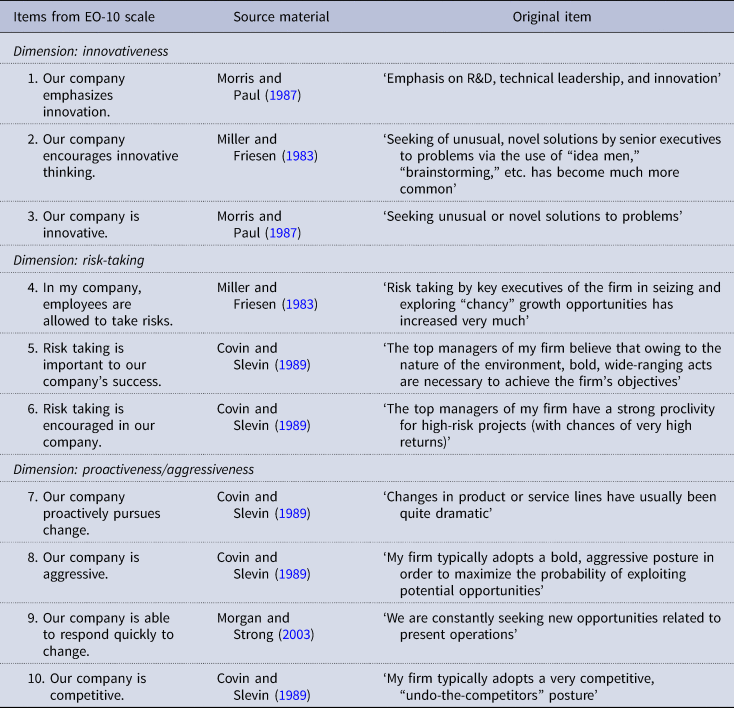
Once we established both content and agreement for construct validity of the items, we created an initial survey. To be consistent with previous EO studies, we ultimately created a 10-item scale (EO-10) to reflect Miller's (Reference Miller1983) and Covin and Slevin's (Reference Covin and Slevin1989) three sub-dimensions: innovativeness, risk-taking, and proactiveness/aggressiveness. Table 2 indicates the final items that comprise the EO-10 scale, the source material, and the original item. We used a 5-point agree/disagree Likert scale as found in the organizational behavior literature on culture strength (cf., Chatman et al., Reference Chatman, Caldwell, O'Reilly and Doerr2014; Chatman & Spataro, Reference Chatman and Spataro2005) to survey all employees within organizations.
Items comprising the EO scale

Data collection
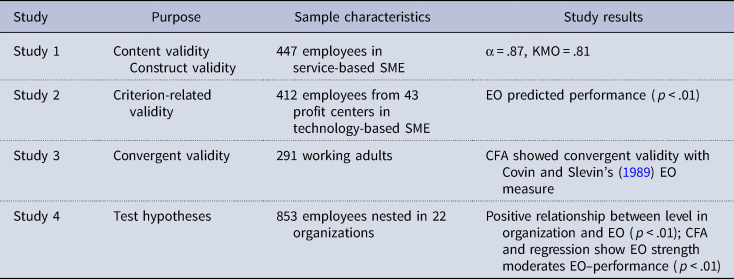
Consistent with Hinkin (Reference Hinkin1998), we utilized four separate studies to ensure proper validity, reliability, and dimensionality of EO to verify the psychometric properties of the EO-10 scale. Studies 1, 2, and 3 were designed solely to ensure that we had created a reliable and valid measure of EO. Study 4 attempted to show the link between EO, EO strength, and firm-level financial performance.
In these four studies, we extended the nature of the sample beyond typical EO studies by gathering responses from multiple sources. Many researchers have collected data from large cross-sectional samples, but as a tradeoff, they only collect responses from one person per company. As previously discussed, EO can be considered as a cultural belief system (Miller, Reference Miller1983) and a set of shared values (Wales et al., Reference Wales, Monsen and McKelvie2011). Therefore, basic perceptual agreement is necessary to the conclusion that a variable is, in fact, a shared phenomenon (James, Reference James1982; James et al., Reference James, Joyce and Slocum1988). Consequently, we surveyed multiple employees in studies 1, 2, and 4, whereas in study 3, we employed a cross-sectional sample to establish convergent validity. A summary of the four studies appears in Table 3, including purpose, sample characteristics, and study results.
Sample details

Study 1: content and construct validity
In study 1, a paper-based survey containing the 10-item scale was sent to 884 full-time employees in a service organization to initially assess the EO-10. A total of 447 employees completed the survey, yielding a response rate of 66.8%. Sixty-four percent of respondents were women, the average age was 41.3 years, and the average organizational tenure of respondents was 12.9 years.
The study demonstrated acceptable metrics in terms of dimensionality and reliability. The EO-10 scale yielded an alpha score of .87, which exceeded the threshold of .70 established by Nunnally (Reference Nunnally1967). We also used exploratory factor analysis (EFA) to assess initial dimensionality. A scree plot indicated multiple dimensions for EO. Additionally, the Kaiser–Meyer–Olkin (KMO) measure of sampling adequacy was .81, well above the recommended value of .50 (Kaiser, Reference Kaiser1974), and Bartlett's test of sphericity was significant (p < .05).
Study 2: criterion-related validity
In order to verify results in study 1 and to examine criterion-related validity of the EO-10, we used an electronic version of the EO-10 to survey 1,950 full-time employees representing 43 profit centers in a U.S.-based technology organization. A total of 412 employees completed the survey, yielding a response rate of 21.1%. In this male-dominated industry, 71% of respondents were men, the average age of respondents was 39.0 years old, and the average organizational tenure of respondents was 11.2 years.
To establish criterion-related validity, we used second-source financial performance data, defined as a composite score revenue and sales growth, across the organization's 43 unique profit centers. Consistent with study 1, we assessed the internal reliability of the EO-10 measure using Cronbach's alpha with a reliability measure of .90, again exceeding the threshold of .70.
To assess criterion-related validity, we examined the relationship between EO and financial performance. Specifically, to test criterion-related validity, we used hierarchical ordinary-least squares regression modeling. We found initial evidence for establishing criterion-related validity. Specifically, we found that EO was significant and positively related to firm performance (p < .01).
Study 3: convergent validity
For the purpose of replicability, the EO-10 scale was designed to possess the same subdimensions as Covin and Slevin's (Reference Covin and Slevin1989) seminal 9-item scale. Therefore, it was necessary to test for convergent validity. To test for convergent validity between the EO-10 measure and Covin and Slevin's (Reference Covin and Slevin1989) measure, we collected data from 291 working adults using Amazon.com's Mechanical Turk (MTurk) crowdsourced survey data system, as previous studies (Buhrmester, Kwang, & Gosling, Reference Buhrmester, Kwang and Gosling2011) have found MTurk to be a reliable source of data. The electronic survey consisted of items to measure the EO-10 scale, as well as Covin and Slevin's (Reference Covin and Slevin1989) 9-item EO scale. To qualify for the study, subjects were required to be 18 years of age or older and employed at least 35 h or more per week at their primary place of employment. Respondents received $1 for completing the survey. Fifty-four percent of respondents were women, the average age of respondents was 42.3 years, and the average organizational tenure of respondents was 13.7 years.
We used EFA instead of confirmatory factor analysis (CFA) (cf., Mussel, Reference Mussel2010). EFA can test for entirely new factor structures, whereas a CFA can suggest modification to an a priori structure, making it less useful for study 3 purposes. Given the data were normally distributed, a maximum likelihood extraction method and Varimax rotation were used for both measures (cf., Fabrigar, Wegener, MacCallum, & Strahan, Reference Fabrigar, Wegener, MacCallum and Strahan1999). Results from the EFA provided strong support for our three a priori subdimensions, providing strong evidence for convergent validity. Specifically, a single factor was identified and individual factor loadings for the subdimensions of the EO-10 scale and the Covin and Slevin (Reference Covin and Slevin1989) scale averaged .82. The KMO measures of sampling adequacy was .88, well above the recommended value of .50 (Kaiser, Reference Kaiser1974), and Bartlett's test of sphericity was significant (p < .01).
Moreover, correlations provided strong support for convergent validity. We would expect that the new EO-10 scale would correlate with the Covin and Slevin (Reference Covin and Slevin1989) scale. This expectation was supported with correlations of .52, .66, and .51 for innovativeness, proactiveness/aggressiveness, and risk-taking, respectively, between the EO-10 and the Covin and Slevin (Reference Covin and Slevin1989) scales.
Study 4: EO strength and firm-level performance
In study 4, we used the EO-10 measure to investigate the extent to which EO impacts financial performance across multiple firms and industries and to assess whether EO strength moderated this relationship. We sent surveys to every employee across multiple organizations to address issues related to sampling methodology illustrated (e.g., case studies that survey all employees in one organization or a single respondent from many organizations). Specifically, we surveyed each employee in 22 organizations nested in 19 industries. To reduce the possibility of sub-culture contamination, companies were all (1) independently owned businesses, as opposed to ownership of a parent organization; (2) single-product companies; and (3) with a single geographic site. Of the 19 industries, six were manufacturing based, six were service based (e.g., engineering or insurance), four were retail based (including wholesalers), and three were healthcare based.
Across the sample, the average size of each organization was 122 employees, with companies ranging in size from 70 to 816 employees. Fifty-three percent of respondents were women, the average age of respondents was 41.6 years old, and the average organizational tenure of respondents was 9.8 years. To adequately measure EO strength, we required a minimum of 30 respondents from each company to be included in the study. The average response rate across the 22 organizations was 31.8%.
EO strength
A well-accepted measure of agreement – r WG(J) (James, Reference James1993; James et al., Reference James, Demaree and Wolf1984) was used to measure EO strength in each organization. We examined a uniform null distribution, as well as a slightly-skewed null distribution, as the slightly-skewed null distribution is more representative of the distribution of the responses. Using the slightly skewed null, responses from 19 of the 22 companies exceeded or approached the .70 threshold for strong agreement (LeBreton, James, & Lindell, Reference LeBreton, James and Lindell2005) and statistics ranged from .30 to .86.
Firm-level performance
We felt it was necessary to measure performance longitudinally, as dimensions such as EO evolve over time and therefore would have a dynamic effect on firm performance. Therefore, we drew on previous research that has examined organizational actions on financial performance over time (cf., Short, Ketchen, Bennett, & du Toit, Reference Short, Ketchen, Bennett and du Toit2006). A 5-year period was chosen, as this is an often-used timeframe found in the entrepreneurship literature (Wang, Reference Wang2008). Specifically, to measure performance, both revenue growth rates and profit growth rates were examined (cf., Combs et al., Reference Combs, Crook, Shook, Ketchen and Bergh2005). We examined objective measures of financial performance, thus employing a second source of data.
Control variables
Since there were 19 unique industries represented in study 4, it was necessary to consider the influence of industry impact for research that investigates firm-level financial performance (Christensen & Gordon, Reference Christensen and Gordon1999). Therefore, we used Dess and Beard's (Reference Dess and Beard1984) approach by recognizing influences derived from: (1) munificence – the capacity of an industry to foster revenue growth; (2) dynamism – the degree of industry change; and (3) competitive concentration. All three control variables were measured using NAICS data, according to algorithms provided by Dess and Beard (Reference Dess and Beard1984) and Weinzimmer, Nystrom, and Freeman (Reference Weinzimmer, Nystrom and Freeman1998).
Results
Descriptive statistics, correlations, and reliabilities
To test hypothesis 1, we used the full sample of 853 respondents to examine whether a respondent's level in an organization influenced her or his perception of EO. Results showed a significant positive relationship between perceived EO and level in the organization, suggesting strong support for hypothesis 1 (r = .21, p < .001). Moreover, a simple regression showed that an individual's level within their organization accounts for 8.5% of variance in perceptions of EO.
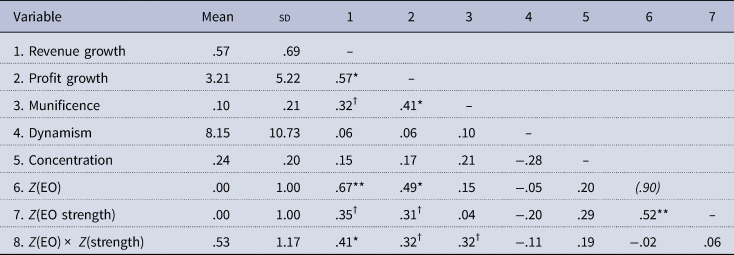
To test for the moderated effects of strength on the EO–performance relationship, it was necessary to collapse our dataset to n = 22 as we were measuring firm-level financial performance. Additionally, in order to test for the moderating effects of culture strength, it was necessary to take the standardized Z-scores for both EO and EO strength. Although standardizing scores will not impact the direct effects of EO and EO strength on performance, it will decrease the possibility of multicollinearity with the interaction term (cf., Baron & Kenny, Reference Baron and Kenny1986). As seen in Table 4, EO is related to both revenue growth (p < .01) and profit growth (p < .05), and EO strength is moderately related to both revenue growth (p < .10) and profit growth (p < .10). Note that because we standardized these variables, the interaction term, [Z(EO) × Z(strength)] is not correlated with either main effect, but is modestly correlated with both revenue growth and profit growth (p < .10).
Means, standard deviations, correlations, and reliabilities

Notes: N = 22.
†p < .10, *p < .05, **p < .01.
Confirmatory factor analysis
Before testing our hypotheses, we ensured adequate fit of our measurement model. We tested the EO-10 measure utilizing a competing CFA framework (Bagozzi & Yi, Reference Bagozzi and Yi2012) in Mplus 7.11 (Muthen & Muthen, Reference Muthen and Muthen1998–2012). We tested a baseline three-factor model and one alternative model to ensure the three dimensions of EO were distinct from one another. Consistent with Covin and Wales (Reference Covin and Wales2012) conceptualization of EO as a reflective construct, we modeled EO as a second-order latent construct comprised of three, first-order latent constructs: innovativeness, risk-taking, and proactiveness/aggressiveness. For innovativeness, we assigned our three individual items as latent indicators. Similarly, for risk-taking, we assigned our three individual items as latent indicators. Finally, for proactiveness/aggressiveness, we assigned our four individual items as latent indicators. Using a three-factor model demonstrated adequate fit of EO (χ2 = 186.41; df = 30; p < .001; RMSEA = .07; CFI = .96; SRMR = .04). Additionally, all of the latent indicators had statistically significant loadings on their intended constructs (p < .001), and the three first-order latent constructs had statistically significant loadings on EO (p < .001). Our alternative model indicated a poor fit compared to our original measurement model. The alternative model depicted EO as a first-order latent construct using the 10-item scale identified earlier. Fit indices suggested a poor fit (Δχ2 = 3,282.37; df = 60; p < .001; RMSEA = .30; CFI = .11; SRMR = .35) compared to our baseline three-factor model, even though all of the latent indicators had statistically significant loadings (p < .01). Accordingly, our baseline model suggested the strongest fit with the data.
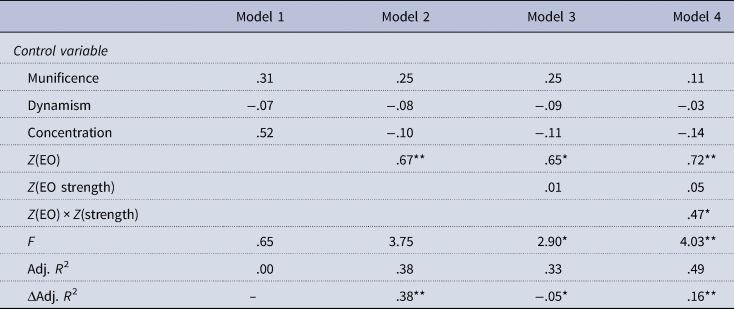
To examine the moderating influence of EO strength in hypotheses 2a and 2b, we used hierarchical regression analyses. As seen in Table 5, we employed four models to assess the degree to which EO, EO strength, and the interaction term [Z(EO) × Z(strength)] impacted revenue growth. Results in the full model (model 4) show support for hypothesis 2a. Specifically, introduction of the moderator in model 4 significantly increases the explained variance (Δr 2 = .16, p < .01) and is significant at the p < .05 level.
Moderated regression results for revenue growth

Notes: N = 22.
*p < .05, **p < .01.
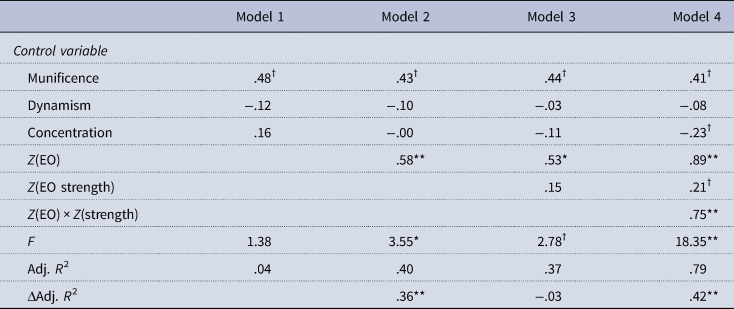
Similarly, as seen in Table 6, we employed four models to assess the degree to which EO, strength, and the interaction term [Z(EO) × Z(strength)] impacted profit growth. Results in the full model (model 4) also show support for hypothesis 2b. Specifically, introduction of the moderator in model 4 significantly increases the explained variance (Δr 2 = .42, p < .01) and is significant at the p < .01 level.
Moderated regression results for profit growth

Notes: N = 22.
†p < .10, *p < .05, **p < .01.
Discussion
The findings from our study and their implications make several significant contributions to the broader entrepreneurship literature that help extend our theoretical and empirical understanding of EO. Most importantly, the results of this study introduce the notion of EO strength into the discourse surrounding moderators of the EO–firm performance relationship. By considering the nature of shared perceptions of EO across hierarchical levels within an organization, we integrate Wales and colleagues' model of EO pervasiveness with the strong culture hypothesis (Denison, Reference Denison1984). Accordingly, our findings suggest that when EO is integrated into a firm's culture and a common understanding of EO is shared among individuals throughout the organization, the EO–firm performance relationship is amplified. To our knowledge, we offer the first empirical evidence that answers Wales et al.'s (Reference Wales, Monsen and McKelvie2011) theoretical question regarding the vertical pervasiveness of EO: ‘How does the homogeneity or heterogeneity of EO across levels influence firm outcomes and performance?’ (p. 915). In response to Wales et al. (Reference Wales, Monsen and McKelvie2011), our findings suggest homogeneity of EO across organizational levels, as indicated by EO strength, positively impacts organizational profit growth and revenue growth.
A second contribution is the development of the EO-10, a psychometrically valid and reliable measure of EO which is suitable to assess EO strength. Notably, the scale developed in this study allows us to ‘parse’ measures of organizational culture and focus on consensus, as recommended by Chatman et al. (Reference Chatman, Caldwell, O'Reilly and Doerr2014). Specifically, we have attended closely to item wording to ensure that individual respondents are asked to report their experiences of EO, which then can be assessed for agreement. Methodologically, we extend our understanding of EO by answering calls by George (Reference George2011) and Rauch et al. (Reference Rauch, Wiklund, Lumpkin and Frese2009) to develop and test a reliable and valid measure of EO. We answered this call by developing a scale that is also suitable to measure EO strength. Using a four-study design, the measure created in this study is reliable and it shows criterion-related validity when predicting firm-level performance. Additionally, we were able to demonstrate convergent validity between the EO-10 and Covin and Slevin's (Reference Covin and Slevin1989) measure. Thus, we support the works of Rauch et al. (Reference Rauch, Wiklund, Lumpkin and Frese2009) and George (Reference George2011), as both authors call for more reliable and valid scales of EO and the work of Chatman et al. (Reference Chatman, Caldwell, O'Reilly and Doerr2014), who advocate for further investigation of ‘strong cultures’ within organizations (p. 785).
Third, our study also confirms and extends the work of previous meta-analytic research that has examined the direct effect of EO on firm-level performance (cf., Markin et al., Reference Markin, Gupta, Pierce and Covin2018; Rauch et al., Reference Rauch, Wiklund, Lumpkin and Frese2009) by identifying an important boundary condition to the EO–firm performance relationship: EO strength. The positive association of EO strength with the EO–firm performance relationship suggests that in order to increase financial performance, top-, middle-, and first-level managers and non-managerial employees must possess a common understanding of the firm's internal strategic entrepreneurial processes. Our findings are consistent with the strong culture hypothesis of Denison (Reference Denison1984) which suggests that organizations will perform well when ‘the culture of an organization…must also fit the business environment’ (p. 20). Put differently, when employees at all levels across the organizational hierarchy exhibit a strong, shared entrepreneurial mindset, it is likely the firm will be able to meet the challenges and opportunities of the business environment.
Fourth, findings from hypothesis 1 support the research of Monsen and Boss (Reference Monsen and Boss2009), suggesting that employees at different levels in an organization will possess different perceptions regarding the level of EO. Specifically, the positive findings from hypothesis 1 suggest that leaders have a more positive view of the organization, resulting in higher scores on a measure of EO. Consistent with previous research (Floyd & Lane, Reference Floyd and Lane2000), our findings suggest that as individuals are promoted to leadership positions commensurate with increasing responsibility within the firm, they begin to become more immersed in the strategy-making process and therefore, will be more familiar with the EO of the firm. However, considering the strong culture hypothesis (Denison, Reference Denison1984), the extent to which perceptions of EO are shared will determine the internal processes that guide individual behavior. When individuals at all levels of an organization engage in an entrepreneurial fashion characterized by innovativeness, risk-taking, and proactiveness, such participation in this type of culture will help develop work habits that will be conducive for supporting the organization's goals in the long run.
Fifth, findings from hypotheses 2a and 2b have potential for complementing the existing way in which we measure EO. Although previous researchers have measured EO based on the perception of a single respondent from each organization, we showed that the sharedness, or strength of EO not only has a direct effect on financial performance, but also and more importantly, EO strength significantly moderates the relationship between EO and performance. This supports Wales et al.'s (Reference Wales, Monsen and McKelvie2011) continuous morphing model, contending that when members at all levels throughout an organization demonstrate a shared perception of EO that is consistent both vertically and horizontally, it will increase the likelihood of improved performance. Specifically, according to Wales et al. (Reference Wales, Monsen and McKelvie2011), superior firm performance will result from ‘the proliferation of EO attitudes and behaviors throughout the entirety of the firm characterizes an organization that is in a continuous state of morphing and adapting its structure and processes in response to emerging opportunities for new entry or renewal’ (p. 907). Finally, by drawing on measurement approaches from the organizational culture literature, we also support the work of Dess and Lumpkin (Reference Dess and Lumpkin2005), as they contend that EO is reflected in a corporate culture.
Practical considerations
Our research amplifies prescriptive calls to managers to encourage and support the cultural values attributed to EO, namely innovativeness to engage in new ways to create value, the ability to take risk to allocate resources in the pursuit of new opportunities, and the ability to be proactive to anticipate competitor moves and to position the firm to meet future challenges. Managers may accomplish this in several ways. First, given research suggesting a relationship between EO and a firm's learning orientation (Wang, Reference Wang2008), it is essential for managers to help employees understand the organization's vision and in turn become more open minded and committed to learning and problem-solving (Senge, Reference Senge1990). In this manner, employees throughout the organization may begin to engage in opportunity recognition as they develop their abilities to not only identify entrepreneurial opportunities, but also to act on them (Ardichvili, Cardozo, & Ray, Reference Ardichvili, Cardozo and Ray2003).
Second, there is need for mangers to role model EO if it is to become pervasive throughout the entire organization. Drawing on social learning theory (Bandura, Reference Bandura1977), as top managers model the cultural values attributed to EO, it is likely that lower level employees may begin to learn and in turn, develop greater perceptions of EO. Indeed, transformational leadership behaviors of top executives have been shown to influence the EO–firm performance relationship (Engelen et al., Reference Engelen, Gupta, Strenger and Brettel2015).
Third, top managers need to be cognizant that employee perceptions of EO may fluctuate based on one's functional background. For example, employees involved in research and development or corporate strategy may be more perceptive of a firm's EO (Dess & Lumpkin, Reference Dess and Lumpkin2005). Accordingly, job rotation programs may help employees better understand their firm's EO (Ortega, Reference Ortega2001).
Finally, given strong organizational cultures are more likely to attract, select, and retain like-minded individuals (Schneider, Reference Schneider1987), organizations with high degrees of EO strength are likely to leverage human resource practices which will facilitate entrepreneurial activity. Research on the interplay between EO and high performance work systems (Messersmith & Wales, Reference Messersmith and Wales2013), contends that a firm's human resource practices are critical in driving behaviors associated with EO. It is likely that firms with a shared sense of EO, as captured by EO strength, will be better positioned to leverage their firm's human capital.
Strengths, limitations, and future research directions
As with all research studies, there are both strengths and limitations to this work. One strength of this study is multi-source data: in study 4, we employed three sources of data, as firm performance measures were objective measures of performance taken from company financial statements, industry-control variables were derived from NAICS-level data, and employee data were collected via self-report surveys. Although we cannot exclude the possibility that some of our results occurred in part from response bias, problems associated with common-methods bias are minimized given three different data sources were used (Podsakoff, MacKenzie, Lee, & Podsakoff, Reference Podsakoff, MacKenzie, Lee and Podsakoff2003).
Second, similar to other studies investigating shared perceptions within an organizational context, there exist a trade-off between maximizing the organizational sample size and maximizing the number of individual responses per organization. Although our results in study 4 were significant, our sample size at the organizational level is admittedly small. Given we gathered data from 853 individuals, they are nested within 22 organizations, which decreases the statistical power of our analyses. Although we still found statistically significant results, a larger sample of organizations, while still maintaining a relatively high number of individual responses per organization, would allow for more types of analyses. However, considering the vast majority of EO research relies on self-reported data from single informants which invites the possibility for common method variance (Podsakoff et al., Reference Podsakoff, MacKenzie, Lee and Podsakoff2003), we believe our decision to obtain numerous ratings of EO from organizational actors across multiple organizational levels from a smaller representative number of firms offers a step in the right direction and a unique contribution to our understanding of EO.
In this study, we created a measure of EO suitable to assess EO strength, the EO-10, which is consistent with previous conceptual and empirical research. The EO-10 does indeed reflect the three dimensions first suggested by Miller (Reference Miller1983) and operationalized by Covin and Slevin (Reference Covin and Slevin1989). As future studies continue to develop this construct, it is imperative to consider strength of EO measures as well as content of EO measures. We ensured agreement among respondents using a well-accepted measure of agreement – r WG(J). Including this practice more routinely in entrepreneurial research can be advantageous, as the very definition of EO suggests that basic perceptual agreement is necessary.
Although findings from this study suggest that the sharedness of perceptions of EO positively impacts firm performance, future research may consider how these perceptions develop across levels and over time. For example, future studies may investigate how EO trickles-down from top managers to individual contributors, or how EO trickles-up from individual contributors to middle managers. Although a trickle-down model of EO is consistent with upper echelon theory (Hambrick & Mason, Reference Hambrick and Mason1984), a trickle-up model may emerge as individual contributors may be responsible for devising and implementing entrepreneurial ideas or processes and consequently, middle- and top-managers may then integrate these ideas into the overall organizational strategy (Floyd & Wooldridge, Reference Floyd and Wooldridge1999).
Conclusion
Our study has combined measurement conventions from the entrepreneurship and organizational culture literature studies to enhance our understanding of how EO impacts firm performance. From an entrepreneurship perspective, we focused on a priori measures of culture content, where we identified potential attributes (e.g., risk-taking, innovation, and aggressiveness) and hypothesized how these specific attributes impact performance. From an organizational culture perspective, we focused ex post facto on culture agreement, in order to investigate how strength of culture impacts performance. We find both approaches fruitful, as we provide evidence that both perspectives help to explain the variance in firm performance.
Although we do not believe strength of EO will (nor should) replace content-based EO constructs, we also believe that EO strength transcends the inherent difficulties with identifying a universal set of constructs predictive of firm performance. This is reasonable when one considers EO will only be predictive of performance to the degree to which it is necessary for market success. EO strength, however, transcends the differential importance of EO content, focusing on how much people agree on what others in the organization value and normatively accept. In sum, both content of culture and strength of culture are important to our understanding of the impacts of EO on organizational performance. Ultimately, we recommend a greater faithfulness to the underpinnings of the EO construct; namely, that perceptions of EO are widely shared. Doing so would implore researchers to carefully sample from multiple levels in the organization, while also ensuring agreement before testing hypotheses.
Our study is a natural extension of ongoing attention devoted to the conceptual development and measurement of EO. Several meta-analyses (Markin et al., Reference Markin, Gupta, Pierce and Covin2018; Rauch et al., Reference Rauch, Wiklund, Lumpkin and Frese2009) have chronicled the state of EO–firm performance relationship over the past 30 years with several authors calling for more advanced measurement techniques. Moreover, Wales et al.'s (Reference Wales, Monsen and McKelvie2011) model of EO pervasiveness offers an exciting roadmap for future study that will continue to advance our understanding of EO. In this study, we sought to bridge the ‘past’ and ‘future’ of EO research. Through employing a four-study design, we sought to improve upon existing EO scales and provided evidence for a valid and reliable multidimensional measure of EO. With an eye toward the future, we introduced the notion of EO strength as an important boundary condition to the EO–firm performance relationship and implore future EO researchers to consider the sharedness of EO perceptions across the organizational hierarchy. In doing so, we hope to further advance our collective understanding of EO in contemporary organizations.