
I. INTRODUCTION
Pure aluminum has been widely used for manufacturing industrial products due to its low density, high ductility, good electrical, and heat conductivity. However, the coarse grains deteriorate mechanical properties.Reference Metz, Flemings and Flemings1,Reference Zhang, Tang, Shao and Xu2 The most effective way to obtain fine grain size in the Al matrix of the castings is to introduce nuclei into the melt using grain refiners, which usually contain TiAl3, TiB2, and (Al, Ti)B2 particles.Reference Easton and StJohn3–Reference Alamdari, Dube and Tessier5 TiAl3 is a more powerful nucleating substrate than TiB2 and AlB2.Reference Zhang, Kelly, Easton and Taylor6 TiB2 does not nucleate grains alone.Reference Mohanty and Gruzleski7 Its nucleation potential is significantly enhanced by the formation of a monolayer of Al3Ti compound on the TiB2 surface.Reference Fan, Wang, Zhang, Qin, Zhou, Thompson, Pennycook and Hashimoto8 Al–B master alloys have been reported to possess a better grain refining efficiency than that of Al–5% Ti–1% B.Reference Guzowski, Sigworth and Sentner9–Reference Birol11 However, the potential of AlB2 particles in the grain refinement of purity aluminum is still inconsistent.
The AlB2(111) surfaces and Al(111)/AlB2(0001) interfaces were studied by first-principles calculations to clarify the heterogeneous nucleation potential of α-Al grains on AlB2 particles in purity aluminum, elucidating the poor nucleation potential of α-Al grains on AlB2 particles.Reference Han and Dai12,Reference Wang, Chen, Fu, Gao and Li13 The block-like AlB2 particles have better grain refinement efficiency and resistance against fading on pure aluminum even at an addition concentration below the Al–B eutectic.Reference Wang, Chen, Fu, Xu, Fu and Li4 However, it was observed that AlB2 particles cannot refine the grains in commercial purity Al (CPA).Reference Kori, Murty and Chakraborty14 Therefore it is fundamentally important to investigate the morphology and distribution of boride particles in the master alloy.
Equal channel angular pressing (ECAP) has been proved to be one of the most promising severe plastic deformation techniques for controlling the distribution and size of particles.Reference Valiev, Estrin, Horita, Langdon, Zehetbauer and Zhu15 Al–5% Ti and Al–5% Ti–0.25% C master alloys have been processed by ECAP for enhancing the grain refinement efficiency.Reference Zhang, Watanabe, Kim, Liu and Bian16–Reference Wei, Mao, Wei, Alexandrov and Hu18 As a result of ECAP, a transition from platelet shapes to blocky particles has been observed for the Al3Ti phase. However, the role of AlB2 particles processed by ECAP to refine grains in CPA ingots is not clear.
The present work is motivated to explore the possibility of enhancing the grain refining efficiency in CPA ingots inoculated by the Al–B master alloy subjected to the ECAP process. The effect of the number of ECAP passes on the size of the AlB2 particles, the grain size of CPA ingots with and without adding the Al–3% B master alloy have been investigated. The grain refining performance and fading resistance of the Al–3% B master alloy on the CPA ingots have been evaluated.
II. EXPERIMENTAL PROCEDURES
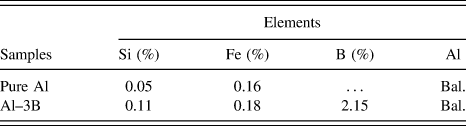
The Al–3 wt% B master alloy ingots with dimensions of 500 × 250 × 40 mm3 were supplied by Xuzhou Huasheng Aluminum Co. Ltd. (Jiangsu, China) After removing the oxidation layer and surface defects, the billets with a size of 12 × 12 × 80 mm3 were cut in the longitudinal direction. The CPA (99.79 wt% Al) was used to verify the grain refining performance of the Al–3% B refiner before and after ECAP processing. The composition of the CPA ingot and Al–3% B master alloy is shown in Table I.
Compositions of the commercial pure Al and Al–3% B master alloy (wt%).

ECAP of the Al–B master alloy was conducted at room temperature with a pressing speed of 0.2 mm/s using a die with a channel angle ϕ = 110° and the outer arc of curvature angle ψ = 0°. All samples were pressed using a molybdenum disulfide lubricant and without rotation between the consecutive passes, which has been designated as route A.Reference Langdon, Furukawa, Nemoto and Horita19 The number of ECAP passes was equal to 1, 2, 4, 6, and 8 passes.
The Al–B master alloy in states either before or after the ECAP process was added into the Al melt heated up to 1033 K using the 5 kW electric resistant-heating furnace. After three times of mechanical stirring of the melt, the Al melt was poured into a ring steel mold with an outside diameter of 45 mm and inner diameter of 25 mm. The sample was cut horizontally at 20 mm distance from the bottom. The sectioned surface was polished and etched in a hydrofluoric acid (2.5 mL), nitric acid (12.5 mL), and water (85 mL) reagent, and then the macrostructural evolution was investigated.
The chemical element B (introduced by the Al–B alloy subjected to four passes of ECAP) was added into the Al melt for the grain refinement performances of CPA ingots. The concentration of B in the Al melt was 0.02, 0.04, 0.06, 0.08, 0.10, 0.12, 0.14, 0.16, 0.18, and 0.20 wt%, which was added at 1033 K for 60 min and three times of mechanical stirring.
To study the fading resistance, the Al–B alloy after four ECAP passes was added into the Al melt resulting in an addition of 0.04% B in CPA ingots. The resistance against fading was studied after different holding time.
The mean size of α-Al grains was calculated by using a mean linear intercept method. The pure Al cast samples with additions of Al–B refiner before and after ECAP were studied by the method of optical microscopy. All samples were polished and etched in a hydrofluoric acid (1 mL), nitric acid (5 mL), and hydrochloric acid (5 mL) reagent. X-ray diffraction (XRD) measurements were performed on a D/max-2500 pc X-ray diffractometer (Rigaku, Tokyo, Japan) equipped with a Cu target operating at 40 kV/100 mA. A series of θ–2θ scans were performed to record the XRD patterns between 30° and 100° at room temperature.
III. RESULTS AND DISCUSSION
A. Effect of ECAP passes on the microstructure of the Al–B master alloy
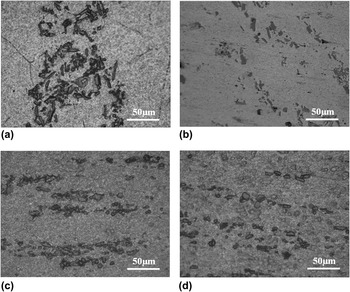
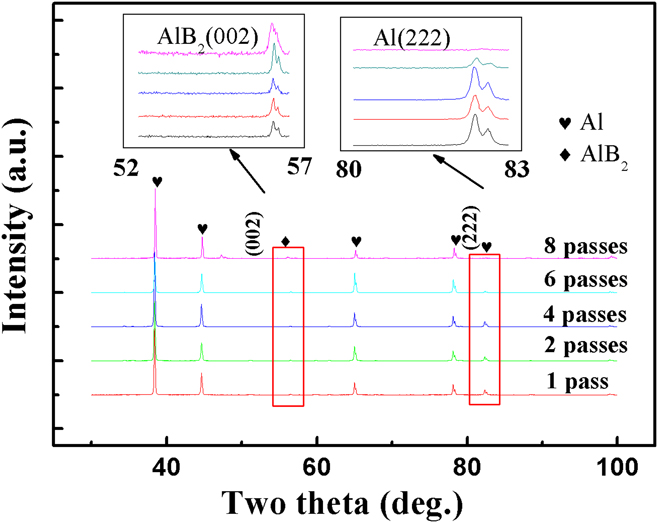
Optical photographs of the Al–3% B alloy before and after ECAP are shown in Fig. 1. The needle-like AlB2 particles in the cluster were observed in the as-cast Al–3% B alloy. They are the typical features in the conventional Al–B master alloys.Reference Nafisi and Ghomashchi10,Reference Wang, Chen, Fu, Gao and Li13 The AlB2 particles were fragmented into fine and blocky particles, and distributed uniformly in the matrix, as represented in Figs. 1(b)–1(d). There are two types of Al-borides in Al–B master alloy, AlB2 and AlB12. The former is favored thermodynamicallyReference Nafisi and Ghomashchi10,Reference Wang20 while the latter is a high temperature phase which is stable only above 975 °C. The existence of the AlB2 phase was identified by the XRD analysis (Fig. 2). The presence of the AlB12 phase was not revealed in the XRD patterns.
Optical micrographs of the Al–3% B master alloy before and after ECAP: (a) 0 pass, (b) 1 pass, (c) 4 passes, and (d) 6 passes. The AlB2 particles were fragmented into the fine and blocky particles and distributed uniformly in the matrix.

XRD patterns of the Al–3% B master alloy processed by ECAP.

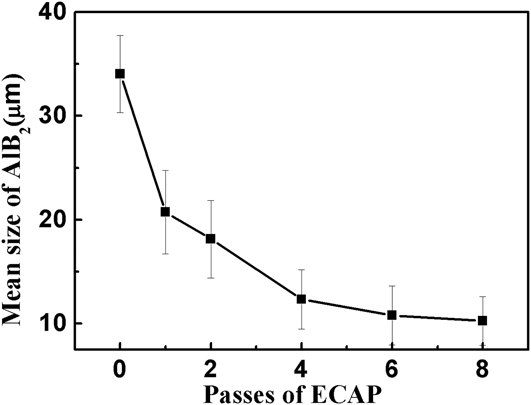
As can be seen in Fig. 3, there is a significant decrease in the size of the AlB2 particles with an increase of the number of the ECAP passes. It reduces from ∼34 to ∼12 μm after four ECAP passes. Beyond that, there is a limitation for the mean size of AlB2 particles equal to about 10 μm. Similarly, the mean size of Al3Ti particles after three or five ECAP passes is to be about 10 μm.Reference Zhang, Hosoda, Kim and Watanabe17,Reference Wei, Mao, Wei, Alexandrov and Hu18 It indicates that it is feasible to refine needle-like AlB2 particles in the cluster into the blocky particles by the ECAP process.
The mean size of AlB2 particles in the Al–3% B master alloy against the number of ECAP passes.

B. Grain refining performance of CPA ingots inoculated by the Al–B master alloy after ECAP
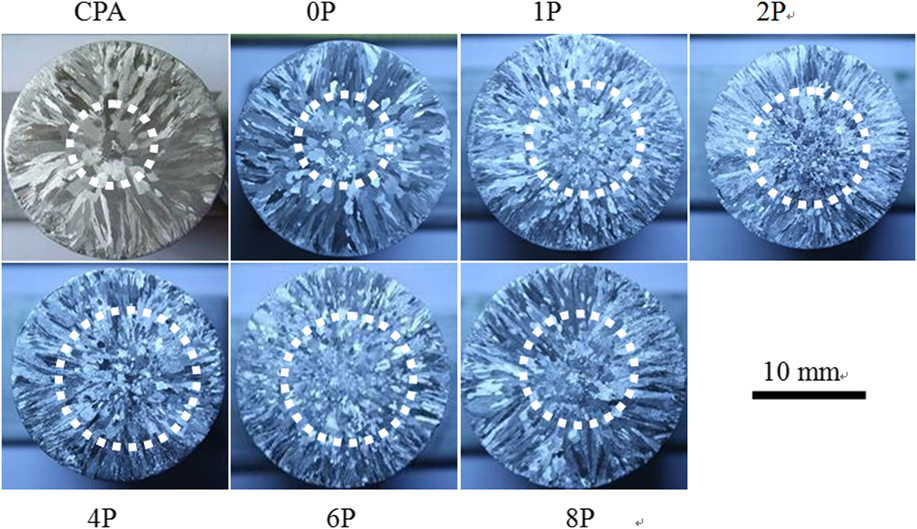
The macrostructures of CPA ingots inoculated by the Al–B master alloy before and after the different numbers of ECAP passes are shown in Fig. 4. It is shown that without the addition of Al–B refiner, the majority of grains are columnar and the volume fraction of the coarse equiaxed α-Al grains is small in the center. When the Al–B refiner was added to the Al melt, the α-Al columnar grains and the equiaxed grains were refined, and they are smaller than that without adding the Al–B alloy. After adding the Al–B refiner by ECAP to the Al melt, there are a large number of fine equiaxed α-Al grains and some fine columnar grains, showing the better grain refinement efficiency than that before ECAP. Furthermore, the proportion of the fine equiaxed α-Al grains tends to expand form the center to the edge with increasing the number of ECAP passes.
Macrographs of CPA ingots inoculated by the Al–3% B master alloy against the number of ECAP passes.

A free growth of crystal from the particle model was proposed by Greer et al.Reference Greer, Bunn, Tronche, Evans and Bristow21 The undercooling required for free growth ΔT fg is given by
 $$\Delta {T_{{\rm{fg}}}} = {{4\sigma } \over {\Delta {S_{\rm{v}}}d}}\quad ,$$
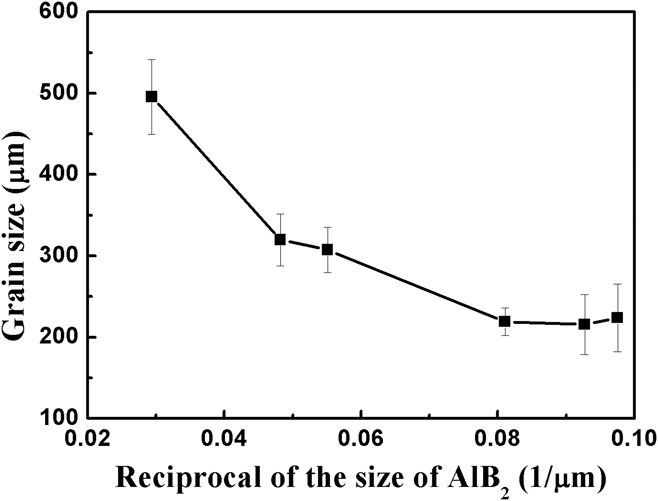
where σ is the solid–liquid interfacial energy, ΔS v is the entropy of fusion per unit volume, d is the nucleant particle diameter. As the undercooling is increased, progressively smaller particles become centers for free growth, which occurs as soon as the required undercooling is reached. However, the smaller particles do not mean the better grain refine efficiency because the onset of growth is controlled by the growth restriction rather than by nucleation. The relation of the mean grain size with the reciprocal of the size of AlB2 particles is shown in Fig. 5. The grain size decreases rapidly before the size of AlB2 particles is reduced to ∼12.3 μm, after that it slightly increases. It is in agreement with that there appears to be an optimum average particle diameter,Reference Greer, Bunn, Tronche, Evans and Bristow21 in this case of ∼12.3 μm.
The mean grain size versus the reciprocal of the size of AlB2 particles.

C. Effect of B contents on grain refining performance of CPA ingots
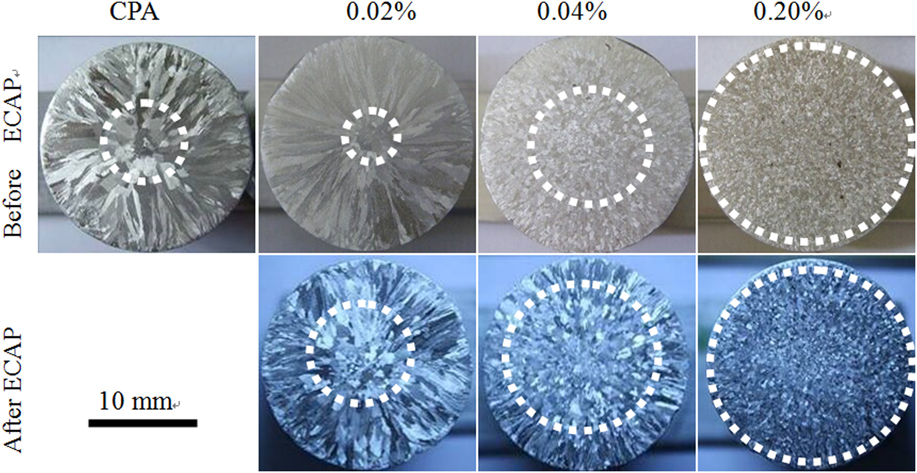
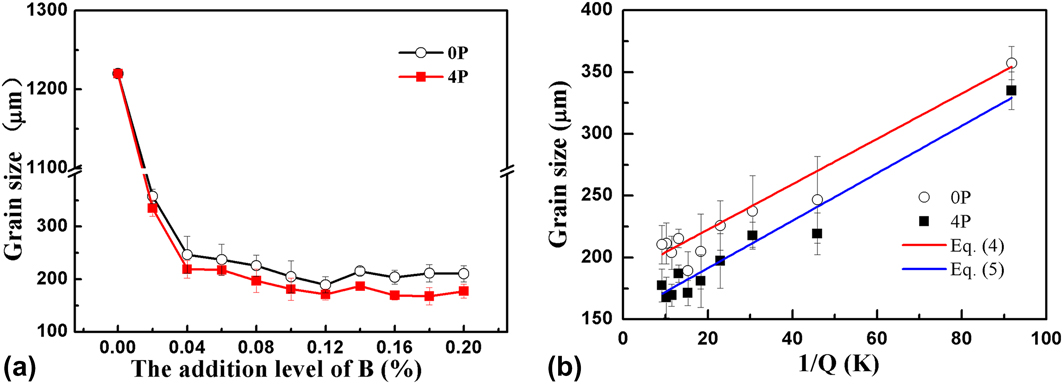
The macrostructures of CPA ingots inoculated by the Al–B master alloy before and after four passes of ECAP are shown in Fig. 6. The zone of the equiaxed grains in the center of the CPA ingots inoculated by the Al–B master alloy after ECAP is larger than that of the counterparts before ECAP. The effect of B contents on the grain size of CPA ingots is shown in Fig. 7(a). The grain size of α-Al was reduced from the initial ∼1200 to 247 μm (before ECAP) and 219 μm (after ECAP), respectively, when the B content is 0.04%. After that the grain size is slightly decreased.
Macrostructure of CPA ingots inoculated by the Al–B master alloy before and after four passes of ECAP. The addition of B contents into the CPA ingots is 0.02, 0.04, and 0.20%.

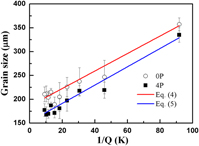
(a) The effect of B contents on the mean grain size of α-Al and (b) the mean grain size of α-Al versus the 1/Q.

When inoculating CPA ingots with the Al–B master alloy, not only the AlB2 particles were needed to be heterogeneous nucleation substrates, but also the impurity elements such as Fe and Si are also required to trigger heterogeneous nucleation.Reference Wang, Chen, Fu, Gao and Li13 The main impurity elements of Fe and Si in the Al–B master alloy are taken into account in the melt. The final grain size is determined by both the nucleant particles and the solute restriction of grain growth.Reference Easton and StJohn22 The average grain size can be described asReference Easton and StJohn23–Reference Wang, Liu, Qiu, Taylor, Easton and Zhang25
 $$d = a + {b \over Q}\quad ,$$
where a and b are empirical constants. The intercept, a, corresponds to the maximum number of successfully activated nuclei and the slope, b, is related to the potency of the nucleant particles. Q was originally derived to be inversely proportional to the growth rate of the primary phase, defined as the grain growth restriction (GRF):
 $$Q = m\left( {k - 1} \right) \cdot {C_0}\quad ,$$
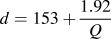
where m is the slope of the liquidus, C 0 is the solute concentration in the melt, and k is the equilibrium partition coefficient. The values of parameters are m = −6.6 and k = 0.11 for Si, m = −3.0 and k = 0.02 for Fe in the Al melt.Reference Easton and StJohn23,Reference StJohn, Qian, Easton and Cao24 The mean grain size of α-Al, d, varies with 1/Q is shown in Fig. 7(b). The equation between d and 1/Q for the addition of Al–B refiner without ECAP and after four ECAP passes is fitted, respectively, by the equations:
 $$d = 186 + {{1.84} \over Q}\quad ,$$
 $$d = 153 + {{1.92} \over Q}\quad .$$
In Eqs. (4) and (5), there is little difference between the slopes. While more nuclei are introduced, the term, a, decreases,Reference StJohn, Qian, Easton and Cao24,Reference Wang, Liu, Qiu, Taylor, Easton and Zhang25 indicating that ECAP processing could introduce more nuclei particles in one unit volume because the AlB2 particles were fragmented during ECAP. Therefore, the impurity elements cannot be ignored since they are indispensable to restrict the growth of initial columnar grains.Reference Wang, Chen, Fu, Gao and Li13
D. Enhancement of fading resistance of the Al–B master alloy by ECAP
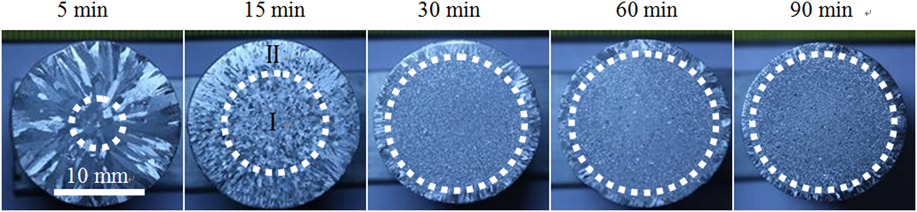
To investigate the resistance against fading, the Al–B alloy after four passes of ECAP was added into the Al melt with an addition of 0.04% B. The macrographs of CPA ingots inoculated by Al–B refiner subjected to ECAP with different holding times are shown in Fig. 8. These macrographs are characterized by the equiaxed zone I and columnar zone II, respectively. With an increase of holding time, the equiaxed zone I is expanded. The sample was mainly covered by the equiaxed grains in 30 min. As the holding time increases, a distinct increase of the equiaxed zone is not observed, which means the Al–B refiner subjected to ECAP has an excellent resistance against fading.
Macrostructure of CPA ingots inoculated by the Al–B master alloy subjected to 4 ECAP passes with different holding times.

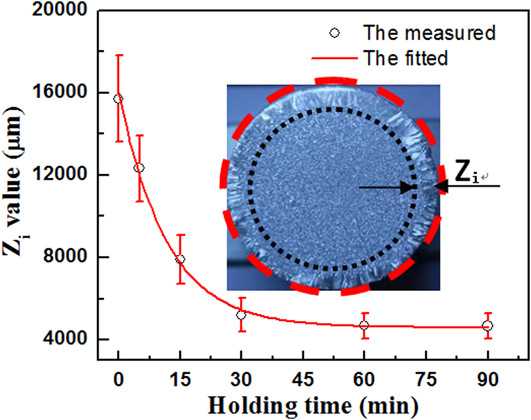
Figure 9 represents the length of the initial columnar grain Z i, which was measured by the width of zone II, with holding time t. The fitted curve is determined by
 $${Z_{\rm{i}}} = 4598 + 11{\rm{,}}453 \cdot {{\rm{e}}^{ - 0.086t}}\quad .$$
The length of the initial columnar grains Z i with the holding time t.

It is noted that the zone of the initial columnar grain Z i is decreased with the holding time, after 30 min, the variation of the initial columnar grain Z i is slight. On the contrary, the length of the initial columnar grain Z i was linearly proportional to the square root of the holding time t when high purity aluminum (99.85% Al) was inoculated by the Al–3B master alloy.Reference Wang, Chen, Fu, Gao and Li13 The main reasons are not only originated from the lower cooling rate under an approximately isothermal condition but also due to without the mechanical stirring of the melt. AlB2 particles with the size below 12.8 μm could survive after settling. As it was above mentioned in Fig. 3, after four passes of ECAP, there are a sufficient number of AlB2 particles with the diameter of ∼12 μm. When the mechanical stirring is applied to the Al melt, it will not lose their grain refine efficiency, resulting in an excellent resistance against fading. The enhanced resistance against fading was also found in Al–5% Ti–0.25% C master alloys subjected to ECAP.Reference Zhang, Watanabe, Kim, Liu and Bian16
IV. CONCLUSIONS
The effect of the number of ECAP passes on the size of the AlB2 particles, grain size of CPA ingots with and without adding the Al–3% B master alloy have been investigated. The grain refining performance and fading resistance of the Al–3% B master alloy on the CPA ingots have been evaluated. It is concluded that
(1) The mean size of AlB2 particles was significantly reduced from ∼34 to ∼12 μm after four passes of ECAP. With increasing the number of ECAP passes, there is a limitation for the mean size of AlB2 particles equal to about 10 μm. The fine blocky AlB2 particles were uniformly distributed in the Al matrix.
(2) Inoculated by the Al–B master alloy subjected to ECAP, the grain size of α-Al was decreased from ∼1200 to ∼180 μm after four passes of ECAP. With an increase of the number of ECAP passes, the grain size tends to be saturated. The grain size of α-Al decreases rapidly before the size of AlB2 particles is ∼12.3 μm, after that it slightly increases, indicating that there appears to be an optimum average particle diameter, in this case of ∼12.3 μm.
(3) When the B content is 0.04%, the grain size of α-Al was refined from the initial ∼1200 μm to 247 μm (before ECAP) and 219 μm (after ECAP), respectively. With increasing the B contents in the Al melt, the grain size is slightly decreased.
(4) For the addition of Al–B refiner without ECAP and with four passes of ECAP, the grain size of α-Al, d, could be well fitted by the GRF:
 $d = 186 + {{1.84} \over Q}$ and $d = 153 + {{1.92} \over Q}$, respectively. It indicates that the ECAP process could introduce more nuclei particles in one unit volume because the coarse AlB2 particles were fragmented during the ECAP. Meanwhile, the impurity elements cannot be ignored since they are indispensable to restrict the growth of the initial columnar grains.
(5) The Al–B master alloy subjected to ECAP has an enhanced resistance against fading. The length of the initial columnar grain Z i is decreased with the holding time, Z i = 4598 + 11,453·e−0.086t.

ACKNOWLEDGMENTS
The authors are grateful to be supported by Natural Science Foundation of Jiangsu Province, P.R. China under Grant No. BK20131144, the Priority Academic Program Development of Jiangsu Higher Education Institutions (PAPD), the Top-notch Academic Programs Project of Jiangsu Higher Education Institutions (TAPP), the Ministry of Education and Science within the framework of the Project No. 16.1969.2017/PCh, and the Science and Technology Bureau of Jiangsu Province, P.R. China under Grant No. BY2016029-19.