INTRODUCTION
In the past two decades studies of the ancient Maya have been invigorated by growing interest in the human body. The richness of the body as a hermeneutic, offering many potential approaches and insights, means that this emerging literature has taken divergent paths in the exploration of social, symbolic, and experiential issues surrounding Maya culture. Grounded in phenomenology, Rosemary Joyce (e.g., Reference Joyce, Meskell and Preucel2004, Reference Joyce2005) has been the leading theorist of ancient Maya embodiment, taking as her main themes: performance of subjective experience, citationality, and bodily inscription, ideas influenced by the feminist philosopher Judith Butler. For Joyce, the body has no intrinsic or “natural” meaning apart from its constitution through the body's actions, conceived as performances, such as habitual patterns of dressing. Stephen Houston and colleagues' 2006 monograph The Memory of Bones: Body, Being, and Experience among the Classic Maya, foreshadowed by “An Archaeology of the Senses” (Houston and Taube Reference Houston and Taube2000), represents yet another milestone. Expanding in new directions, they engage physiological and sensory components of the body, while also amassing a wealth of linguistic and hieroglyphic data to help understand it emically. More recently, Matthew Looper's (Reference Looper2009) book on Classic Maya dance is, appropriately, situated in a theorized view of the body, which he positions in a complex, interactive relationship with aesthetics and agency. Broadly viewed, this selective picture of the literature indicates that study of the body among the ancient Maya, while still very much in progress, has reached a stage where certain fundamental notions have been established. The body is recognized as mediatory—of action in the world, and between individual and society. Its fluctuating identities are understood as historically contingent and constituted by actualized cultural conceptions, these being subject to control by society and state.
This article veers in yet another direction by looking at cultural conceptions surrounding a particular body part, the female breast, with special interest in the history of its representation during the Late Classic period (ca. a.d. 550–850). As a study in iconography, attempting to identify pictorial conventions and their associative meanings, the approach taken here is in many ways at variance with trends in embodiment studies which explicitly reject a search for systematic codes or fixed meanings that could be construed as semiotic systems (Joyce Reference Joyce2005; Looper Reference Looper2009:10). Joyce (Reference Joyce2005:145) prefers to view representations of the body as “records of stereotyped embodied performances that served as models, or…citational precedents for the embodied gestures of living people.” However, this does not account for the fact that the construction of images is wed to an internal system of reference emphasizing, for instance, dyadic contrasts and other didactic devices, not necessarily in synch with historically contingent trends in popular culture (as in the case of archaisms) and perhaps never emulated as such. The construction of body imagery is often guided by principles following artistic convention different than the social construction of a living body.
Scheper-Hughes and Lock (Reference Scheper-Hughes and Lock1987:18) note that “Symbolic and structural anthropologists have demonstrated the extent to which humans find the body ‘good to think with.’” Certainly, the female breast is a case in point. It is among the oldest and most prolific subjects of world art whose representation is highly variable, constructed according to specific tastes and ideals held by different societies at different times. Crosscultural assumptions about images of breasts—that they must have been deployed as erotic ornaments, fertility symbols, or objects of desire—therefore need to be questioned. Marilyn Yalom's (Reference Yalom1997) A History of the Breast makes this clear in the framework of Western art where the breast was exploited for a variety of religious, political, erotic, and commercial purposes. It is fascinating to see that even during the staunchest periods of Western naturalism, the breast continued to be shaped, formally and symbolically, by idiosyncratic cultural conventions. Certainly, Maya artistic formulations of the breast, which are as complex as any, need to be added to the historical record.
In ancient Maya art, breasts played an important role in constructing female personae and even contributed by their absence, in situations where they would be expected, to the construction of other gender categories. As will be discussed below, breast absence was strategically deployed in the Classic Maya pictorial system to blur gender categories. Making the Maya case more interesting, the breast was treated in conceptual ways, comparable to symbols and hieroglyphs, an approach catalyzed by the interaction between pictorial imagery and hieroglyphic writing (Stone and Zender Reference Stone and Zender2011). The encoding of the breast is especially evident on painted Late Classic pictorial ceramics, the most informative visual media for studying the breast in Maya art. In this paper selected details of painted ceramic vessels illustrate features of breast depiction; the reader can find them in full context and in color in roll-out photographs available in the Maya Vase Database by Justin Kerr (http://www.famsi.org/research/kerr/index.html), identified by the “Kerr number” provided here in the illustration captions. Some are also published in the six volumes of The Maya Vase Book (Kerr Reference Kerr1989–2000). In addition, this study considers pictorial evidence from Late Classic ceramic figurines. Illustrated figurines are of the hand-modeled type with detached limbs and appliqué, from Jaina Island, Campeche, although Southern Lowland figurines, often cast in molds and less well defined, seem to follow similar patterns. Images of women with exposed breasts in Maya art are largely restricted to these as well as a few other portable media, such as carved shell. Women's breasts are, in general, never depicted in large-scale public art featuring aristocratic women. More will be said about this variance later.
My inspiration to write this paper came from reading Beth Cohen's (1997) article, “Divesting the Female Breast of Clothes in Classical Sculpture.” Besides realizing that a study of female breasts was equally fertile ground in Maya art, it struck me that this issue is made more compelling when breasts are both covered and uncovered. In other words, not only is the exposed breast a meaningful expression but so is its “absence” when strategically hidden by clothing, as this puts into play a dyadic code of absence (clothed) vs. presence (naked). It can be inferred from Cohen's article that the ancient Greeks capitalized on the absence/presence contrast to construct non-normative images of women, made possible by the fact that adult women were never supposed to show their breasts in public; therefore when one or both breasts were revealed in a work of art, the subject was understood as unusual in some manner (representing, for instance, a goddess, Amazon, or seduction victim). While operating in a different historical framework in which adult women regularly went bare-breasted, ancient Maya artists nevertheless exploited the absence/presence contrast of breast signification linked to specific thematic situations, as well as playing upon shape contrasts. In consort with other contextual details, these contrasts helped to define status categories pertaining to women, such as gender, age, and class, which are intimately connected (Joyce Reference Joyce2005:141), as well as insinuating supernatural or mortal status. In the following pages, I will attempt to describe contrastive visual strategies and other basic features of breast representation.
As body parts go, female breasts have wide semantic latitude. This is partly because the breast itself is not static, transforming in a manner that mirrors women's life stages. Because the form of the breast changes in synch with certain biological processes, such as ageing and pregnancy, breast morphology serves as an index in the truest sense in that it suggests inferences about the female body by being tied to critical fluctuations. Getting at more subtle connotations of the breast in Maya art is, however, difficult when dealing with an ancient society with limited written records. In an attempt to recover more recondite allusions, I have turned to ethnographies dealing with medical discourse pertaining to the hot-cold syndrome, which can broaden our understanding of the breast as a cultural construct and communicative sign in Classic period Maya art. Through this material, I hope to show that even though male voyeurism played a role in breast display in Maya art, another, in my view, more dominant role, was to convey notions of power, competence, and social bonds associated with women, and this accounts for the remarkable variety of approaches to women's breasts in pictorial imagery.
BREAST EXPOSURE AND SOCIAL REALITY AMONG THE ANCIENT MAYA
It is important to keep in mind the ancient Maya's customs regarding breast exposure. Unlike the ancient Greeks, it was acceptable for adult women to go bare-breasted; this they did by just wearing a skirt. It also seems that a loose-fitting top falling below the breasts was not considered improper (Figure 2b). However, the lower portions of outfits were kept lengthy, as there seem to have been taboos against revealing any part of the body usually covered by a skirt, the knees being the upper limit of hemlines. A similar sort of modesty can still be seen in the Maya highlands. In San Pedro La Laguna at Lake Atitlan, young girls cannot go without a skirt even when bathing (Paul Reference Paul, Rosaldo and Lamphere1974:293), while Hendrickson (Reference Hendrickson1995:127, Note 10) recounts a story of Kaqchikel women embarrassed about exposing their lower legs even in front of other women. Perhaps because of similar restrictions, the breast and shoulder area were prime targets for displaying women's bare flesh in the pre-Hispanic period, as pictorial representations seem to indicate.
Confirmation of female breast exposure as a routine practice is given by the sixteenth-century Spanish bishop, Diego de Landa (Tozzer 1941:126), who indicated that women went topless in central Yucatan, remarking on the fullness of their breasts as evidence of their excellent nursing abilities. He added, oddly given the hot climate, that women did not do this in coastal regions but wrapped cloth around their chests; however, pre-Hispanic figurines of women from coastal Campeche and Quintana Roo point to the same practices as in central Yucatan. It is unimaginable that Maya women wore fewer clothes after the imposition of Christianity, and, despite Landa's assertion, going topless for comfort in daily activities was probably commonplace among women living in all parts of the hot lowlands (Proskouriakoff Reference Proskouriakoff and Lothrop1961:81). It may have been most typical in private, domestic settings (Houston et al. Reference Houston, Stuart and Taube2006:42), perhaps more so in commoner households, but was nevertheless seen by Landa in public venues. Indeed, Q'eqchi' women living in the muggy climate of southern Belize went bare-breasted in the twentieth century, as I personally witnessed. Given this, images of bare-breasted women in Classic Maya art should not automatically be taken as risqué or seen ipso facto as unusual.
It seems, however, that baring the female breast was not always appropriate according to social etiquette. Understanding how this related to class, age, and the formality of the occasion, is challenging. While the primary evidence, ancient art, presents a selective picture of social reality, it suggests that women of highest rank were not inclined to present themselves this way, at least in public, nor was it a typical mode of dress in formal settings, and that breast-revealing clothing was more commonplace among lower-class women, associated principally with married, domestic “hardworking” women, especially old women whose domesticity is referenced by upper body nudity. It is also possible that breast display among unmarried adult women had sexual overtones. The art does not reveal regional variation in female body exposure, as indicated by Landa. Classic period ceramic figurines from highland Guatemala depict bare-breasted women, and if this is indicative of social reality, it suggests that oppressively hot weather was not the only motivating factor for this practice.
BREAST EXPOSURE AND COSTUME IN MAYA ART
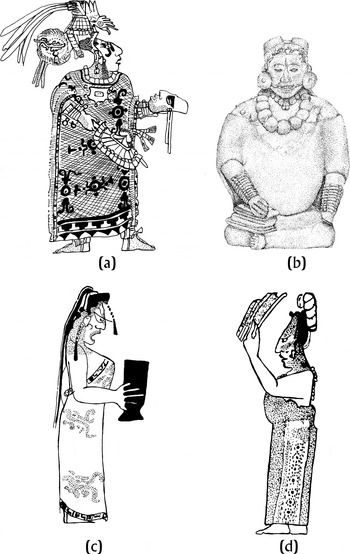
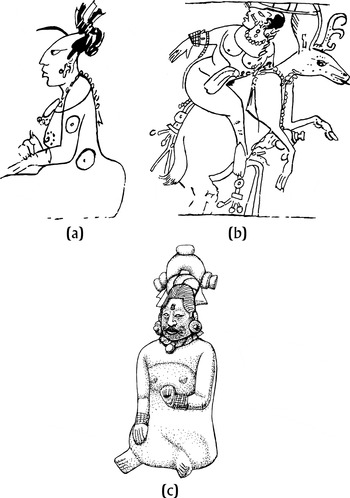
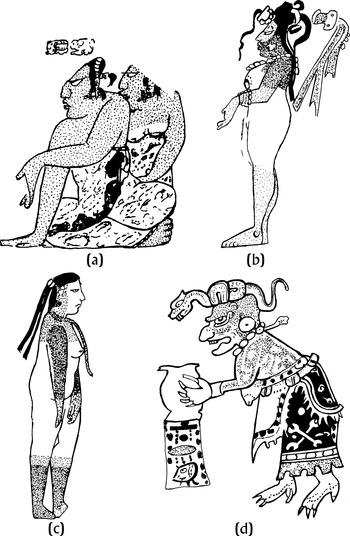
Breast exposure is related to fashion, which shows a number of variations in Maya art. Standard women's fashion from the Classic period has been discussed by Taylor (Reference Taylor1984, Reference Taylor and Kerr1992). I will address clothing only in the broadest outlines with an eye toward how it did or did not facilitate breast display. The most modest outfits covered breasts as well as shoulders. The greatest body coverage was achieved by the huipil, a long sack-like dress stitched up the sides, usually worn over a skirt, only the lower border of which can be seen (Figure 1a and 3b). These long, intricately-woven huipils recall the sobrehuipil worn today in highland Guatemala, which comprise a woman's most costly formal attire (Hendrickson Reference Hendrickson1995:138; Mayén de Castellanos Reference Mayén de Castellanos1986). Women's bodies were also well covered by the quechquemitl, a kind of over-blouse with rounded edges, left open on the sides, worn with a skirt; these are commonly seen on ceramic figurines (Figure 1b). I might mention that the Nahuatl terms huipil and quechquemitl do not reflect emic categories of women's clothing for the ancient Maya. In fact, Schele (Reference Schele1997:24–27) invokes the Yukatec term k'ub for the huipil, which she identifies with both the long tunic-like garment and shorter over-blouse. My use of huipil and quechquemitl is simply for conveniently discriminating the two garments.
Examples of breast-covering costumes: (a) Huipil. Painted vase, Tikal Str. 5D-46, Tomb B. Drawing by the author (after Kerr Archive No. K2695); (b) Quechquemitl and skirt. Jaina figurine. Drawing by Anne Chojnacki (after Baquedano [Reference Baquedano1993:40]); (c) Sarong. Painted vase. Drawing by the author (after Kerr Archive No. K6059); (d) Chest sash and skirt. Painted vase. Drawing by the author (after Kerr Archive No. K5062).

Less modest garments covered the torso, including the breasts, but left shoulders and upper chest bare. This typically consists of a single, long cloth wrapped under the arms, which Taylor (Reference Taylor1984:19; Reference Taylor and Kerr1992) calls a “body wrap” or “sarong.” While covering breasts, this garment sometimes provocatively exposed cleavage (Figure 1c). Figurines of women with a suckling infant depict them wearing a sarong pulled down on one side to reveal a single breast (Schele Reference Schele1997:36–37), an apparent convention for nursing. Comparable to the sarong in terms of body coverage is a skirt worn with a separate cloth wrapped across the chest, or “chest sash” (Taylor (Reference Taylor1984:19), presumably the garment referred to by Landa (Figure 1d). The huipil and sarong (Figures 1a and 1c) are the most common garments for women in Maya art of the Southern Lowlands, while the skirt-quechquemitl (Figure 1b) enjoyed more popularity to the north; for instance this outfit is common on Jaina figurines from north coastal Campeche and is typical of Late Postclassic art of Yucatan, including the codices.
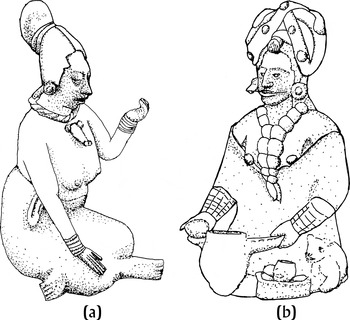
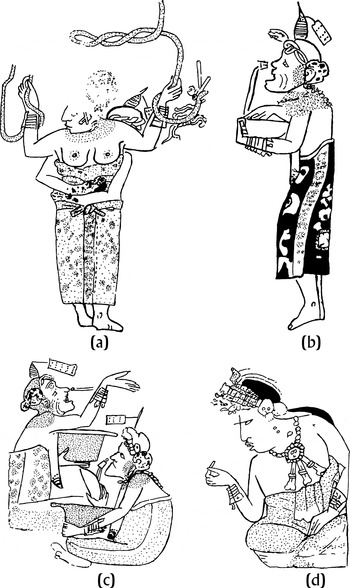
Breasts were fully exposed when women wore only a skirt (Figures 2a and 10a). This mode of dress is practically exclusive to ceramic figurines and painted depictions of women on polychrome ceramics, with a handful of exceptions occurring in monumental or public art, all in unusual circumstances. These include the Late Preclassic San Bartolo murals which have several bare-breasted females (Saturno et al. Reference Saturno, Taube and Stuart2005); however, it is important to note the mythological nature of the scene, which is the main context of female nudity in all narrative media. Also unusual is a carved circular stone from Tonina showing a woman baring one breast (Houston et al. Reference Houston, Stuart and Taube2006:Figure 6.4). A painted stucco sculpture said to be from a building façade in Yucatan shows a bare-breasted woman wearing royal insignia (Figure 14c).
Examples of breast-exposing costumes: (a) Woman in skirt. Jaina figurine (after Miller Reference Miller1975:Figure 7); (b) Sagging bodice. Jaina figurine (after Schele Reference Schele1997:42, Plate 26). Drawings by the author.

Women's breasts could be exposed in ways other than just wearing a skirt. Jaina figurines depict women in huipils and quechquemitls with necklines so low-cut that they fall below the breasts (Figure 2b). The breasts are indicated by appliqué nipples stuck onto a generic modeled body; however, women wearing only a skirt have breasts modeled in their entirety (Figure 2a). At the extreme, some pottery scenes and figurines depict completely nude, adult women (e.g., Figure 9b and 9c). However, the figurines may originally have worn perishable costumes, and the painted scenes are again mythological or thematically exceptional, for instance involving violence against women (Houston et al. Reference Houston, Stuart and Taube2006:207–209); they do not reflect quotidian practice, since it was taboo for women to expose much of the lower body.
THE SCOOPED NECKLINE GARMENT AND FEMININE BEAUTY
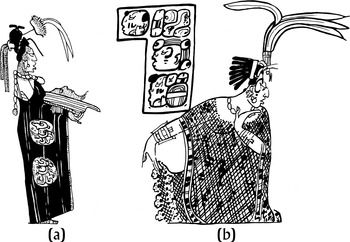
Figurines show women's garments with wide-cut necklines (Figure 1b). There are correlates to this in painted ceramics where necklines are so wide that they expose shoulders and upper arms (Figure 3a). A narrower, albeit low-cut, neckline just reveals the upper chest (Figure 3b). On figurines the wide-necked quechquemitl is usually modeled with a clay slab, but the tighter scooped neckline, as I henceforth call the narrower version, is usually indicated with slip paint on figurines. There are, then, technical differences in the construction of these two styles of neckline. Garments which hide the breasts but still plunge at the neck are common female attire on painted ceramics and figurines (but are rare in monumental art) and confirm that slashing the neckline provided the best opportunity for revealing women's bare skin.
Low-cut necklines on women's costumes: (a) Drooping huipil. Painted vase (after Kerr Archive No. K6316); (b) Scooped neckline huipil worn by Tikal woman. Note visible breast. Painted vase (after Kerr Archive No. K2573). Drawings by the author.

The curving scooped neckline was such a conventional female costume design that it became codified and part of an arsenal of feminine traits sometimes used abstractly in Maya art. This neckline encoded the idea not just of “pretty” women, but also ones who command respect; they may be ladies of the court, respectable commoner women, or goddesses. In painted media these women are beautified using conventions of anatomy and hairstyle (e.g., Figure 3b), and among figurines, women with scooped necklines are bejeweled and have intricate hairdos. In general the scooped-neckline garment seems to encode feminine beauty associated with women in their youthful reproductive years, and by extension, female fertility, a concept conveyed by the trope of youthful beauty.
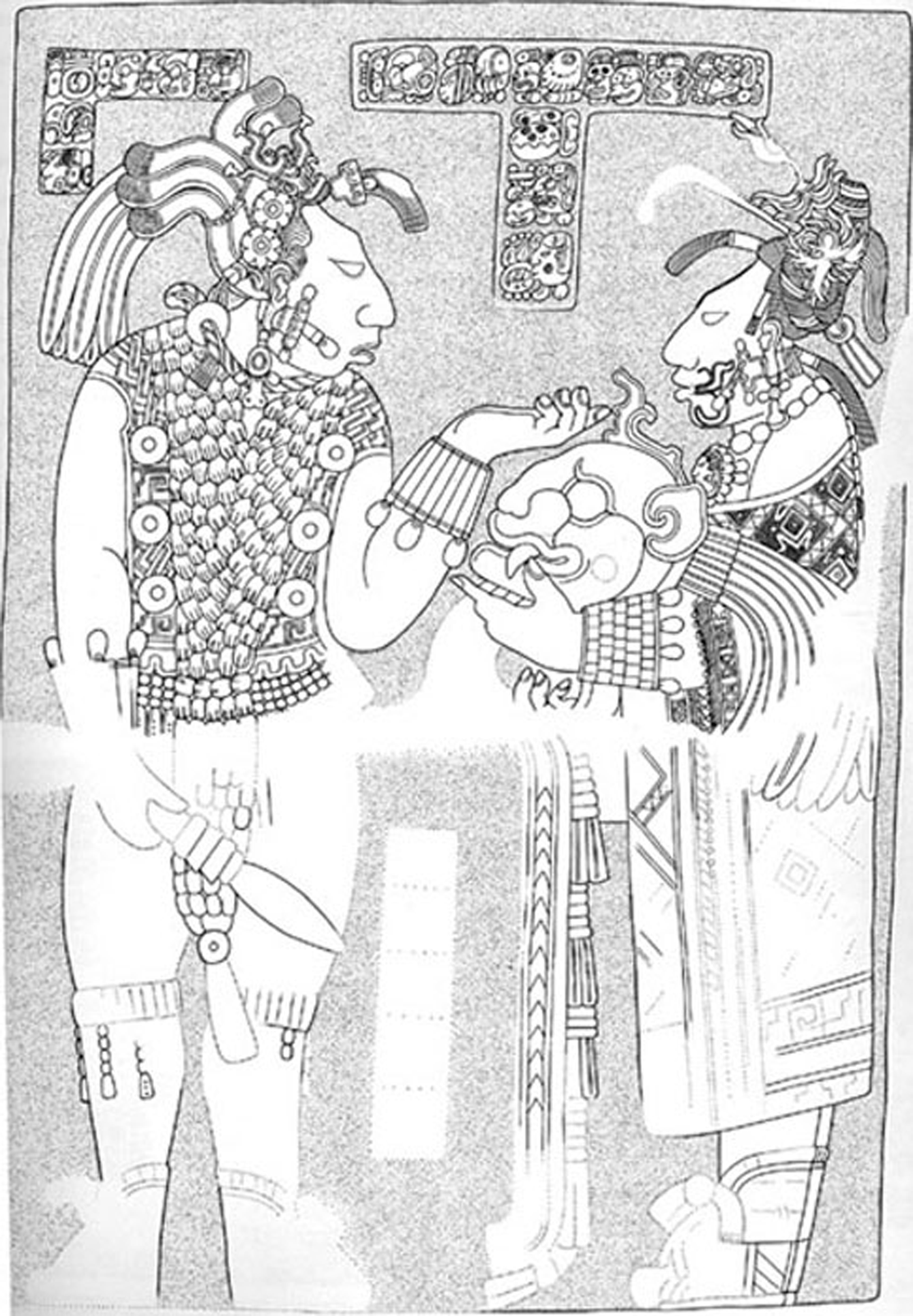
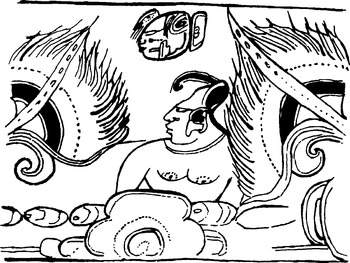
Youthful feminization implied by the scooped-neckline garment is made clear in a rare example of an aristocratic woman dressed in this manner in monumental sculpture, seen on the eighth-century Lintel 26 from Yaxchilan (Figure 4). Here, Lady K'abal Xook, holding the shield and feline headdress of her husband, Itzamnaaj Balam II, wears a huipil with a plunging neckline that seems intentionally daring, as Proskouriakoff (Reference Proskouriakoff and Lothrop1961:87) long ago observed. The treatment of her head, which, like the breast, was targeted in constructing female stereotypes in Maya art, is feminized beyond the usual in monumental sculpture. Her head is not covered by an angular headdress but shows off the intricate twists of her hairdo, including forelock, a “small tuft of hair centered at the front of the head” (Robertson Reference Robertson and Benson1985:30), and ponytail, all of this alluding to her femininity. The forelock, though worn by males, as in this scene, nevertheless is a female diagnostic, codified as a dark forehead disk in the IXIK logograph introducing female names (see, for example, the glyphic caption in Figure 3b). The elongated, tapered head of Lady K'abal Xook is another feminine trait and in her hair are round, feathery ornaments. Lady K'abal Xook's feminine beauty is so “textbook,” in the treatment of the head, especially the curvilinear intricacy of her hairstyle and the exposure of the shoulder-chest area, that it must have contributed some crucial meaning (Joyce Reference Joyce and Klein2001:124–125). Displaying stereotypical female beauty, such as this, was a way of alluding to women's fertility. If this were the case in Lintel 26, also suggested by the toad design on her huipil, which among modern Tzotzil is associated with the earth and fertility (Morris Reference Morris1985:76), it may bear on the military equipment she clutches (near her breast, by the way). For instance, she might be empowering these objects through her fertility or affirming women's support of the male culture of warfare, a practice suggested elsewhere in the visual record. Schele noted (1997:19), for instance, that the Tablet of the Slaves and Palace Tablet from Palenque specifically show women holding a sacred war object in the form of the “flint-shield” glyphic expression for war, u tok' u pakal. Moreover, noblewomen wearing the scooped-neckline garment witness the bloody captive sacrifice in the aftermath of a battle, painted in Room 2, Bonampak; and Lady K'abal Xook's bloodletting on Yaxchilan Lintel 25 invokes a military figure with shield and spear. Doubtless, women's ritual affirmation of military ideology was important for the Classic Maya. This was clearly the case in later Aztec society where women and militaristic themes frequently converge in ritual performance, exemplified by the feast of Ochpaniztli dedicated to Toci (Durán Reference Durán, Horcasitas and Heyden1971:229-337).
Aristocratic woman with feminized features, including twisted hairstyle and low-cut huipil. Yaxchilan, Lintel 26. Drawing by Ian Graham (Graham and Von Euw Reference Graham and Euw1978). Reproduced courtesy of the President and Fellows of Harvard College.
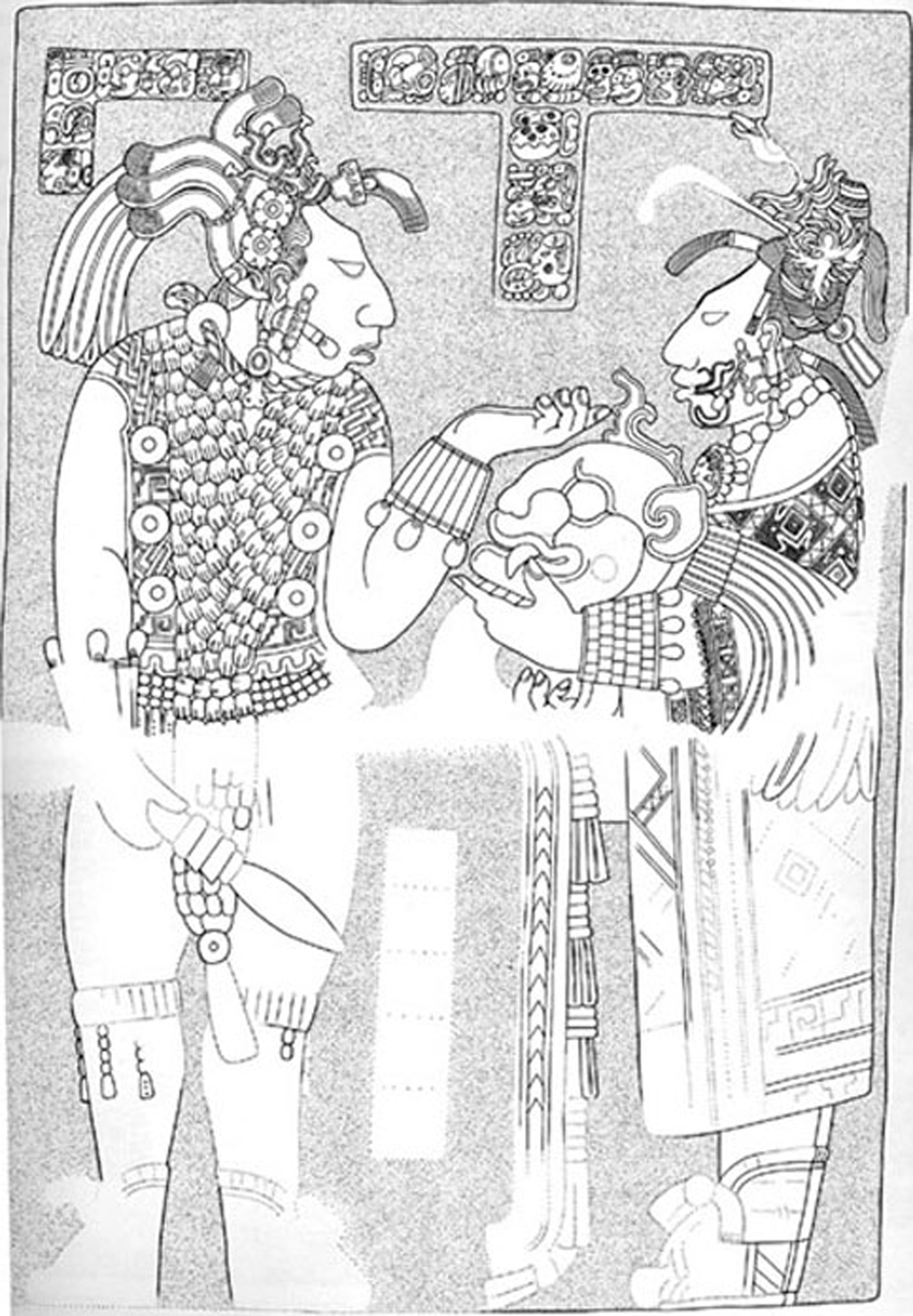
Is it significant that Lady K'abal Xook holds a shield and helmet? We might consider this in light of ethnographic accounts in the Maya area indicating that fertile women were believed to possess innate power that could affect things with which they came in contact. As will be discussed later, fertile women's proximity to male-gendered equipment was sometimes believed to have dire consequences for men and was avoided; however, in other situations female contact was sought by men, encouraging women's power to be transmitted through ritual acts. For instance, Guiteras-Holmes (Reference Guiteras-Holmes1961:43) mentions that Tzotzil farmers ask their wives to step over or hold baskets containing maize grains used for planting or instead place their spinning equipment or objects of personal adornment (i.e., that have touched the woman's body) in such baskets. The Yaxchilan scene may likewise show something beneficial happening from female contact with male-gendered objects, suggesting that the ancient Maya also believed effects arose from a fertile woman touching male equipment. This would explain the exceptionally feminized portrayal of Lady K'abal Xook on Lintel 26. It suggests something else: whereas Lady K'abal Xook appears to play a secondary role in the scene, a pretty ritual assistant to her husband, it may be that her feminine appearance references her power. Lady K'abal Xook does not look like this in Lintels 24 and 25, located in the same building (Structure 23), where her neck is smothered by a jade collar, her head, by an angular headdress, and the imagery conveys a more mystical side of her personality. In other words Lady K'abal Xook's feminine appearance on Lintel 26 does not subvert her authority and agency but rather points to one of its sources.
In portable media, women's breasts can be seen despite the fact they are wearing clothes. On painted ceramics the breast contour and nipple are made visible through clothing (Figure 5a and 5b). In pottery figurines the garment clings to the woman's body revealing the breasts (Figure 5c). In painted versions, the garment usually has the diagnostic scoop neckline under discussion (Figure 5a and 5b). Often the woman's arms can be seen through clothing as well; therefore, one might argue that this is a mere drawing convention—the artist sketched in the arms and breast and then added clothes over this. Another possibility is that the clothes are really see-through, some kind of gauze weave, perhaps. This may be the case for a striding woman painted in a recently discovered mural from Calakmul whose entire body outline is visible through her clothing; she may in fact be wearing a gauze weave dress. However, I believe most of the images in question are constructions of a young beauty using a pastiche of codes, one being the breasts, another being the scooped neckline, and others related to the treatment of the head: elongated, tapered, near bald pate (distantly recalling the hereditary frontal baldness of Yucatecan women [Redfield and Villa Rojas Reference Redfield and Rojas1962 [1934]:182]), intricate hairdo adorned with baubles, and narrow upswept eye. I now believe that, conceptually, the breasts are not seen through the clothes but that both breasts and clothing are simultaneously present, a kind of piling on of symbols that disregards naturalism and is commonplace in Mesoamerican art.
Breast visible while covered by clothing: (a) Painted vase (after Kerr Archive No. K2603); (b) Painted vase (after Kerr Archive No. K1182); (c) Jaina figurine (after Kerr Archive No. K5779). Drawings by the author.

One pictorial vase shows a mythological scene that reveals the codified nature of these feminized elements and how they can be combined conceptually. The image is of a female standing waist-deep in symbolically-represented water (Figure 6); in fact, her glyphic name means something like “Lady Water.” Her youthful femininity is indicated by a series of signs. On the head are the—here exaggerated—forelock, bald pate, elongated head, and upturned eyes. Her generic body outline is feminized by breasts and the scooped neckline. The latter is remarkable because the figure is intended to be topless, indicated by the lack of costume and comparison with related vase scenes featuring bare-breasted women standing in water (Robicsek and Hales Reference Robicsek and Hales1981:Vessels 80–84). Nor do these curved lines delineate a necklace, which should consist of round beads and hug the neck tightly. Rather, this woman (Figure 6) is conceptually constructed using conventional signs. Even the breasts look glyph-like (see Figure 7).
Mythical scene of naked woman with stylized breasts and indication of scooped neckline associated with femininity. Painted vase. Drawing by the author (after Robicsek and Hales [1981:Vessel 30]).

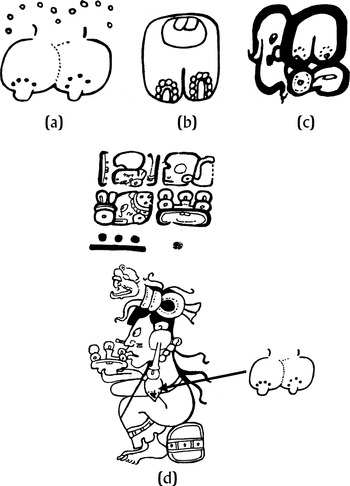
Breast hieroglyph and conventional breast form: (a) Stela 14, Piedras Negras (after drawing courtesy of John Montgomery); (b) Throne 1, F4, Piedras Negras (after Houston et al. [2006:Figure 1.3f]); (c) Name caption, Altar Vase, Altar de Sacrificios (after Adams [Reference Adams and Hammond1977:Figure 3f]); (d) Dresden Codex, page 15c (after Lee Reference Lee1985). Drawings by the author.

This is not surprising given that the female breast was hieroglyphically encoded. Illustrated here are examples from Piedras Negras, Throne 1 (Houston et al. Reference Houston, Stuart and Taube2006:Figures 1–3) and Stela 14 (Christophe Helmke, personal communication 2008) (Figure 7a and 7b), and in pictorial ceramics, the so-called “Altar Vase” from Altar de Sacrificios (Marc Zender, personal communication 2008) (Figure 7c). Chu' is a broadly disseminated term for “breast” in lowland languages (Houston et al. Reference Houston, Stuart and Taube2006:41). It has been proposed that the breast sign encodes syllabic chu acrophonically derived from chu' “breast” (Grube and Nahm Reference Grube, Nahm and Kerr1994:702); however, this reading is still tentative. Like the penis glyph (logographic AAT), the breast sign was used as a linguistic building block of larger compounds rather than meaning the body part portrayed. The example in Figure 7c, for instance, forms part of the spelling of the name of a male wahy character suggested to read buch-te-chan (Grube and Nahm Reference Grube, Nahm and Kerr1994:702).
The form of the breast hieroglyph is variable but does show consistency in the delineation of nipples and dotted aureole—a convention of Maya breast depiction—at the bottom of essentially two curved lines. This is the same conventional breast treatment seen in the vase figure (Figure 6). Motifs glyphically codified are particularly susceptible to such conceptual usage in Maya art (Stone and Zender Reference Stone and Zender2011). For instance, on page 15c of the Dresden Codex (Lee Reference Lee1985), the breast of Goddess I is displayed as a sign marking her gender, positioned with disregard to naturalism and oriented downward like the hieroglyph (Figure 7d). I would speculate that the scooped neckline added to the nude woman's body in Figure 6 is also a sign imparting information about her status, even though it is out of place otherwise; this image supports the idea that clothing and breast signs can co-occur in unrealistic ways when they function on a conceptual level.
As the foregoing demonstrates, the visibility of breasts in relation to clothing does not necessarily mirror realistic dress. It can be driven by iconographic conventions and narrative agenda, and this is especially the case in such graphic media as pictorial ceramics that are symbolically dense. In this view costume and breast exposure are parallel codes, each modifying a constructed message. Costume engages women's social prestige in a way that breast exposure cannot, while breasts convey messages about biological characteristics, albeit culturally construed. This is why women with elegant costumes, often gloriously woven, and, contrary to realism, have visible breasts seen through or at the side of the garment, not just in Classic Maya art (e.g., Figure 3b) but also Postclassic central Mexican art (McCafferty and McCafferty Reference McCafferty and McCafferty1994:Figure 11). The Maya examples are not see-through garments in most cases; rather breast exposure and costume each comment in their own way.
If these images of costumes in relation to breasts are conceptual, it suggests that another type of garment that partly exposes the breast is not realistic either, but the result of synchronic signification of dress and breast exposure. In these cases the woman wears a tight-fitting garment midway between a sarong covering the chest and a skirt wrapped under the breasts (Figures 8 and 13b). The garment covers half the breast or exposes a good part of the breast while curling over it, as though both hiding and revealing. Such clothing seems impractical, if not impossible, to wear and might better be understood in terms of parallel codes. The allusion may be to an attractive, fertile, but still respectable, woman. The partial exposure of the breast could also have had erotic overtones, as partial or full concealment of eroticized body parts is a common ploy to enhance sexual allure (Yalom Reference Yalom1997:3).
Partly-exposed breasts using improbable clothing: (a) Half of bosom covered by sarong. Painted vase (after Kerr Archive No. K504); (b) Sarong curls over breast revealing nipple. Painted vase (after Kerr Archive No. K559). Drawings by the author.

BODY DECORATION AND THE WHITE BREAST
The fact that Landa (Tozzer 1941:126) mentioned the delicate designs tattooed on women's upper bodies is noted by Houston et al. (Reference Houston, Stuart and Taube2006:19). Landa also observed that women did not tattoo their breasts, and this is confirmed in Classic Maya art. On pictorial ceramics women's body and face decorations are often elaborate. Intricacy was an aesthetic preference for women's self-adornment and characterizes body paint, hairstyle, and textile designs. An especially common form of body paint is a swathe of red covering the side of the face, running down the neck and forming a curve around the shoulders (Figures 1c, 3a, and 9b). This paint pattern is worn by men but is more consistent with women and seems to be a female trademark. Noting this common style of body decoration on polychrome ceramics, Houston et al. (Reference Houston, Stuart and Taube2006:23) suggest that it served to mark a visual separation of the head from the chest. However, we might consider Landa's (Tozzer 1941:126) assertion that women wore a red paste (probably made from annatto) to protect themselves from the sun. The face, chest, and shoulder paint pattern seen in Maya art is suited to protect a good deal of the upper body that women typically expose when wearing a sarong, and is also cosmetically attractive.
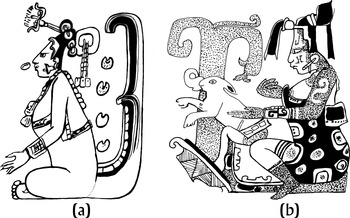
White breasts as an iconographic convention: (a) Court scene with young women. Painted vase (after Kerr Archive No. K2914); (b) Mythical Maize God scene with naked maiden. Painted vase (after Kerr Archive No. K4358); (c) Attack scene with subjugated women. Painted vase (after Kerr Archive No. K5451); (d) Chek Chel in world creation scene from the Dresden Codex, page 74 (after Lee Reference Lee1985). Drawings by the author.

While women may have delicate designs applied to their upper chests, decoration stopped short of the breasts. In fact, the undecorated, light-toned appearance of female breasts and other “private” body parts seems to have been conventional. In a vase scene showing nubile women sitting behind a lord, one has her breasts exposed, and they are shown as stark white (Figure 9a). The white color may not just suggest undecorated skin but possibly less-tanned skin. This is implied by images of naked women on vases who have a white body from breasts to knees, exactly where the body is protected by clothing (Figure 9b and 9c). This could be white body paint, which was used, especially on women's faces, but I think these examples represent untanned lighter skin (also see K3069), highlighting the loss of clothing by seeing its traces. Adhering to these conventions is the famous painting of the old Goddess O, Chak Chel, from page 74 of the Dresden Codex (Figure 9d). She wears red decoration on her face, neck, and upper body typical of women and also has intricate upper chest patterns, another female trademark; however, her breast hanging under her arm is stark white; the deliberateness of this is best judged in a color facsimile. The combination of red shoulder paint with white breasts and torso may be a feminizing convention of great antiquity in Maya art. It is seen on a nude female depicted on the North Wall of the Late Preclassic San Bartolo murals. Her distinct white body color is pointed out by Saturno et al. (Reference Saturno, Taube and Stuart2005:11, Figure 26a). The color white has a number of feminine associations in Maya thought (Vail and Stone Reference Vail, Stone and Ardren2002:210).
THE HOT-COLD SYNDROME AND WOMEN'S FERTILE BODIES
Depictions of breasts in Maya art should not be viewed as a detail, like fingers and toes, complementing a natural rendering of women's exposed bodies. The breast was deployed in a conceptual and strategic manner aimed at qualifying female actors in matters ranging from moral character to social and spiritual potency. The breast's range of signification was linked to cultural conceptions of the body. Recovering them for the Classic Maya is no easy matter considering the remoteness of the era and its limited written records, making Houston el al.'s (2006) review of epigraphic and linguistic evidence especially important. I would like to approach ideas about the female body differently by drawing inferences from ethnographically attested classification systems used in medical diagnosis and curing in indigenous Maya communities, often characterized as “popular” or “folk” medicine. In terms of bodily conceptions, medical discourse is especially eye-opening because of its deep involvment in the construction of normative standards (Foucault Reference Foucault1978:67). To get at this information, we must turn to ethnographic data, which I believe retains patterns of belief and attitudes about the body that can be projected into the pre-Columbian past.
As documented ethnographically, the etiological framework of indigenous Maya medicine is grounded in classification systems concerning the body and things with which it comes in contact. Most important are hot-cold classifications, which intersect with an axis of strong-weak (Adams and Rubel Reference Adams, Rubel and Nash1967:335). These classifications characterize fluctuating conditions of the body and explain the causes of its vulnerabilities, strengths, and potential danger to others. As is well known, the sixteenth-century Spanish conquest of the Americas brought with it Hippocratic humoral medicine rooted in a hot-cold, wet-dry diagnostic system. George Foster (Reference Foster1993) has argued that all of Latin America's hot-cold systems, including that of Mesoamerica, where he did fieldwork, are the product of wholesale diffusion, medical knowledge absorbed by indigenous people from Spanish doctors, clinics, and pharmacies and transmitted generationally. If that were indeed the case, bodily conceptions revealed in hot-cold ethnographic data would have little relevance to the present study.
However, Foster's perspective has been challenged, notably by López-Austin (Reference López-Austin, de Montellano and Montellano1988:272–276). Citing pre-Hispanic retentions in the hot-cold syndrome around Mexico City, among other evidence, López-Austin believes that hot-cold classification pertaining to the body and medicine was in place in Mesoamerica before European contact. He sees such Nahua concepts as the tonalli as a logical precursor. More recently, Chevalier and Sánchez (Reference Chevalier and Bain2003:Chapter 9) have presented a methodical and, in my estimation, convincing rebuttal to Foster's position. Part of it hinges on the fact that many features of Spanish humoral medicine are conspicuously absent in Mesoamerica, such as the concept of four humors and the wet-dry diagnostic axis. In their view, the hot-cold component thrived for a very good reason in Mesoamerica: the cognitive framework for it already existed. An older generation of Maya ethnographers generally took a more neutral position claiming that Maya folk medicine was a fusion of pre-Hispanic and humoral concepts (see Adams and Rubel Reference Adams, Rubel and Nash1967:342; Greenberg Reference Greenberg1984; Neuenswander and Souder Reference Neuenswander, Souder, Neuenswander and Arnold1977:97; Redfield Reference Redfield1941:305; Redfield and Redfield Reference Redfield and Redfield1940:78; Redfield and Villa Rojas 1962 [1934]:372; Wisdom Reference Wisdom and Tax1952:120). For instance, Redfield and Villa Rojas (1962 [1934]:372) note that “ojo” or “evil eye” is of Old World origin, yet associating it with menstruating women—and it is also ascribed to pregnant women—is likely pre-Hispanic.
A repeated assertion in the Maya ethnographic literature, dating as far back as the 1940s (Redfield and Redfield Reference Redfield and Redfield1940), is the ascription of what might be seen as negative associations to women regarding hot-cold states. Even the fact that relative to men, women are thought of as “cold” in ordinary circumstances (Devereaux Reference Devereaux and Strathern1987:91; Guiteras-Holmes Reference Guiteras-Holmes1961:4, 306; Hanks Reference Hanks1990:111–112; Neuenswander and Souder Reference Neuenswander, Souder, Neuenswander and Arnold1977:116; Rosenbaum Reference Rosenbaum1993:Chapter 4) seems to put them in a weaker position than men. For instance, in the case of the Tzotzil, Rosenbaum (Reference Rosenbaum1993:69) notes that women's sexual organs are seen as cold and loci of feminine weakness.
A key issue surrounding women in the hot-cold spectrum is their fluctuating level of heat driven by biological processes, particularly those related to reproduction, such as childbirth, pregnancy, lactation, and menstruation. One rationale for this is offered by Greenberg (Reference Greenberg1984:187) working among the Mam: heat intensifies with social intimacy related to reproduction, while cold is associated with the asocial. During states such as pregnancy, women are believed to have unusually high or “excessive” heat, posing a number of dangers (Adams Reference Adams1952:16; Guiteras-Holmes Reference Guiteras-Holmes1961:133; Hendrickson Reference Hendrickson1995:Chapter 4; Neuenswander and Souder Reference Neuenswander, Souder, Neuenswander and Arnold1977:100–101). It should be noted that excessive heat is not unique to women. Men become excessively hot and dangerous from working in the sun or women from merely working near a fire (Adams and Rubel Reference Adams, Rubel and Nash1967:343; Neuenswander and Souder Reference Neuenswander, Souder, Neuenswander and Arnold1977:101; Redfield and Villa Rojas 1962 [1934]:161). Excessive heat due to women's fertility-related biology is believed to make them weak and vulnerable (Adams and Rubel Reference Adams, Rubel and Nash1967:335; Redfield and Villa Rojas 1962 [1934]:161; Wisdom Reference Wisdom1940:312, Reference Wisdom and Tax1952:129–130). Because of this, pregnancy and other female conditions are typically viewed as illnesses (Boremanse Reference Boremanse1998:77; Greenberg Reference Greenberg1984:187; Hanks Reference Hanks1990:112; Paul and Paul Reference Paul and Paul1975:707). Among the K'iche' bodily heat is transferred to both blood and breast milk (Neuenswander and Souder Reference Neuenswander, Souder, Neuenswander and Arnold1977:100). Equivalence between these fluids is made in other parts of Mesoamerica (Monaghan Reference Monaghan and Klein2001:285). Chevalier and Sánchez (Reference Chevalier and Bain2003:54) report in the Sierra de Santa Marta, Veracruz, that nursing is considered risky for the mother in that it depletes her “water of life,” much like blood loss. Here, even nursing makes a woman weak and vulnerable.
Maya ethnographers portray women's intensified heat as a state of imbalance, one that is not only detrimental to a woman's health, but also can affect others in undesirable ways, making “hot” women threatening. Women's excessive heat accompanies what is sometimes called “strong blood” (Adams Reference Adams1952:16; Wisdom Reference Wisdom1940:308). In the Tz'utujiil village of San Pedro La Laguna, a woman possessing this is considered promiscuous, barren, and a pariah (Paul Reference Paul, Rosaldo and Lamphere1974:291). Female heat correlates with sexual promiscuity (Hanks Reference Hanks1990:112) and this also carries an element of danger (Devereaux Reference Devereaux and Strathern1987:101). Women's excessive heat can be injurious, especially to males and children in general, and is a recognized cause of disease, associated with “evil eye.” For instance, Holland (Reference Holland1964:275), working among the Tzotzil, reports a disease, tsu jem k'at, afflicting the genitalia of male children after being visited by a pregnant woman. The mere glance of a pregnant woman can sicken a child because her heat can penetrate the child's body (Holland Reference Holland1964:164). Something similar is reported by Wisdom (Reference Wisdom1940:326) among the Ch'orti', where pregnant and menstruating women are believed to possess a harmful wind that not only injures others but is also the source of their own spiritual pollution. Here, too, curses are especially associated with women (Wisdom Reference Wisdom1940:333). The belief that pregnant women have “evil eye,” are ritually polluted, and can cause illness is widely reported (Adams Reference Adams1952:62; Manning Reference Manning1999:317; Neuenswander and Souder Reference Neuenswander, Souder, Neuenswander and Arnold1977:115; Redfield and Villa Rojas 1962 [1934]:182–183; Wisdom Reference Wisdom1940:314). Pregnant women's proclivity to cause illness in children is also related to emotional imbalance, such as wanting a child in the first place (Adams Reference Adams1952:16, 62; see also Paul Reference Paul, Rosaldo and Lamphere1974:295).
Redfield and Villa Rojas (1962 [1934]:169, Note 1) report in Yucatan that when a girl's menses begins she is capable of emitting a “virgin wind” that can make other children sick. Menstruating girls are told not to look at children or yard animals, lest they kill them, in San Pedro (Paul Reference Paul, Rosaldo and Lamphere1974:291). Paul (Reference Paul, Rosaldo and Lamphere1974:298) describes a Pedrano view of female fertility conceived in magical terms as an instrument of punitive power. Men can be destroyed by contact with women's menstrual blood, and women are believed to, and apparently do, connive to arrange such contact as vengeance. Women can be detrimental to masculine work activities where coming in contact with a woman's garment or utensil—even a lowly pottery sherd—can spoil the entire effort (Redfield and Villa Rojas 1962 [1934]:169). In San Pedro, the Tz'utujiil believe that a husband's masculinity can be destroyed by his wife's proximity to his farming tools or his contact with her work equipment (Paul Reference Paul, Rosaldo and Lamphere1974:184).
By sifting through these ethnographic data, certain themes emerge about women's bodies considered on the hot-cold spectrum. Most striking is the issue of women's biologically-driven, fluctuating state of excessive heat and its deleterious effects. According to this view, women have an innate potential to inflict harm on others related to their reproductive role. Aberrant behaviors, such as promiscuity, issuing curses, or producing lethal emanations, are also attributed to women because of heat imbalance. We might compare this perspective with one found in a fairly recent study of the hot-cold syndrome by Chevalier and Sánchez (Reference Chevalier and Bain2003) concerning Popolucas and Nahuas in the Sierra Santa Marta, Veracruz. While reporting on a wholly different ethnic region, the authors are clearly dealing with related phenomena. Chevalier and Sánchez reiterate some of the same points made about women in the Maya ethnographic literature: that menstruation and pregnancy are hotter than normal states (Reference Chevalier and Bain2003:26, 54) and that women's heat can be harmful to children, animals, and plants (2003:56). Women in a state of excessive heat, indeed, should not go near agricultural fields because they may cause flowers to wither (2003:163). Their model looks at the larger picture; however, with less sense of the aberration and stigma that permeates the Maya literature. The indigenous perspective portrayed by Chevalier and Sánchez (Reference Chevalier and Bain2003:47) is one in which women's fluctuating heat, although reaching an intense, potentially dangerous level, is viewed as normal and necessary. Hot and cold states are expected to rise and fall in regular cycles, even on a daily basis (one heats up in the day and cools off at night). In fact, the absence of expected fluctuations is considered a greater cause for alarm. Understanding the hot-cold syndrome as a continuously fluctuating cycle, Chevalier and Sánchez (Reference Chevalier and Bain2003:24, 41–47) position it within a cycle of “heliotropic movement” related to the life cycle and agricultural cycle: born in water (cold), mature and gain strength in the sun (hot), and eventually burn up and dry out due to heat insults. Fluctuations in heat are therefore required, even if destructive, for the continuation of life. Their broad, philosophical perspective provides different shades of understanding women's condition than the more fragmented data typically presented in Maya ethnographies, some of which reflect earlier generations of scholarly thinking.
MEDICAL KNOWLEDGE AND THE BREAST AS AN INDEX OF A FERTILE WOMAN
Hot-cold data provide a general framework for proposing that the ancient Maya attributed innate power to a woman's body, a power that they may have seen as fluctuating in intensity and character over her life course. Ethnographic reports typically describe this power as harmful in mundane interactions; however, in ritual it was likely harnessed to empower things for desirable ends. Yaxchilan Lintel 26 (Figure 4) was earlier interpreted in this light. Given the ominous connotations of pregnancy in hot-cold classifications, its association with illness and danger, it is noteworthy that Maya art is bereft of naturalistic representations of pregnant women. In fact, a bloated abdomen was a conventional sign of illness, disease, and death (likewise in modern folk medicine the abdomen and umbilicus are implicated in disease process). Bloated stomachs are seen on disfigured males, skeletal beings, and other grotesques. The woman shown giving birth on The Birth Vase (Taube Reference Taube and Kerr1994) has a standard body shape, even though she is pregnant (Figure 10a). It seems depicting pregnant women naturalistically was avoided or had inherent ambiguity given the association of bloating with death and disease.
Strategies of breast exposure on The Birth Vase: (a) Woman, with full, round frontal breasts, giving birth; (b-c) Aged divine midwives with deflated, hanging breasts; (d) Woman with covered breasts. Drawings by the author (after Kerr Archive No. K5113).

Rather than stomach or genitals, breasts played a major role in cueing a woman's fertile state in Classic Maya art. Beautiful women's breasts are typically shown as full and large. While this may seem aimed purely at voyeuristic enjoyment, it could also reflect a state for women understood within the system of medical knowledge. As reported by Chevalier and Sánchez (Reference Chevalier and Bain2003:54), women's bodies are in a strong position when full of the “water of life,” something depleted by pregnancy and nursing, which make them weak. Full round breasts suggest a hydrated body, possessing a host of positive connotations.
Breast display may have cued a woman's fertile body, but within this broad category there was a range of narrower significations regarding her status—is this a proper married woman, an unmarried woman, a seductress, etc.? Such semantic refinements could be conveyed by context, as breast exposure had no single fixed meaning; this had to be scenically or otherwise cued. The woman on The Birth Vase, actually giving birth, an act associated with fertility, has full round breasts shown frontally (Figure 10a), while the old midwives who surround her have flat breasts in profile (Figure 10b and 10c). On the other hand, a woman consulting a diviner has covered breasts as her fertility is not the key issue regarding her status (Figure 10d). For the women whose breasts are exposed on the Birth Vase, fertility is critical—for the old women, the lack of it. Here context and contrast (the juxtaposition of old and young, covered and uncovered) make the connotations of the parturient's exposed breasts apparent.
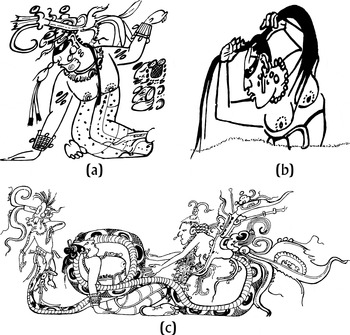
A different sense of exposed breasts emerges in images of goddesses and mythical females, represented on painted ceramics. Most supernatural females are topless, often displaying breasts frontally and/or prominently (Figure 11). Goddesses and mythical actors account for the majority of bare-breasted women seen on painted vases. In a similar vein, complete female nudity on pictorial ceramics (e.g., Figure 9b) largely concerns mythology and the supernatural. This can be explained by the fact that the archetypal and dramatic nature of mythology often demands nude female actors in portrayals that are not constrained by social norms. Even the Popol Vuh has a story of naked maidens doing their wash by a river to seduce their fathers' enemies (Christenson Reference Christenson2003:242), hardly a realistic scenario. Breast exposure of goddesses also served to denote their typological classification, something of utmost concern in the organization of the pantheon. This role for the breast is most evident in the Postclassic period Maya codices whose only female actors are goddesses (e.g., Figures 7c and 9d) and over 90% of them are bare-breasted. With goddesses, the youthful round breast sometimes carries a sense of danger, transgression, or seduction along the lines of Thompson's (Reference Thompson1939) characterization of the promiscuous Maya Moon Goddess. This recalls ideas about female fertility, excessive heat, threatening magical power, and the danger of sexuality reported in the hot-cold system (see also Vail and Stone Reference Vail, Stone and Ardren2002:222–224). The Serpent-Woman Theme, seen on a series of codex-style vases (Figure 11c), where the goddess' breasts can be enormous to the point of appearing abnormal, where a phallic serpent passes between her legs, and she is lusted after by a decrepit old god, is rife with such transgressive sentiments. Several demonic underworld goddesses are shown with prominent frontal breasts, also suggesting a threatening aspect rather than just classifying them as such or providing erotic interest (Figure 11a and 11b). The implications of danger in excessive sexual libido and female fertility are fully consonant with ethnographically-attested medical discourse.
Prominent breasts of young goddesses; (a) Underworld death goddess. Painted vase (after Kerr Archive No. K2286); (b) Underworld goddess pulling hair. Painted vase (after Kerr Archive No. K6979); (c) Example of Serpent-Woman-Old-God Theme on Codex-style vases. Painted vase (after Kerr Archive No. K5862). Drawings by the author.

On the other hand, historical women appearing in courtly scenes or accompanying male actors on painted ceramics rarely fully expose their breasts by donning only a skirt. More often their breasts are made visible while they still wear clothing, or they wear low-cut sarongs that reveal part of the breast (Figures 3b, 5a, and 5b). This limitation on breast exposure for historical women suggests a different concern in defining them than the mythical actors, one tied to their social status. In terms of constructing this pictorially, clothing and costume appurtenances are indispensable; therefore clothing cannot easily be dispensed with. Hints at seeing women's breasts while a fair bit of clothing is worn, using the techniques earlier described, such as x-ray appearances and bodices curling over breasts, seems to be a compromise between the requisite display of social rank and biological status.
The sculpted ceramic figurines of women, as isolated representations, are different than images of women on painted ceramics who appear in narrative scenes delineated by graphic conventions and symbols and are juxtaposed in contrastive ways to construct meaning. A substantial number of figurines present a standard type of attractive, well-dressed woman sporting an intricate hairdo and wearing handsome jewelry. Here the preferred mode of exposing the breasts is the low-slung quechquemitl or huipil (Figure 2b). Breasts are also seen through clothing (Figure 5c), as in painted vases, by having garments cling around the breasts. These figurines seem to embody proper married women, but may not be ones of the highest class. They portray positive female stereotypes, often associated with domestic labor, such as weaver, corn grinder, and child caregiver (Joyce Reference Joyce and Claassen1992, Reference Joyce2000a:68–69). They more readily show idealized, non-supernatural women bare-breasted than in any other media, something that may correlate with their frequent association with domestic compounds and household rituals.
THE POST-MENOPAUSAL WOMAN'S BREASTS
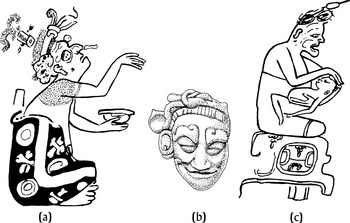
Classic Maya art constructs adult female stereotypes along the lines of two overarching categories, a young, fertile woman and an old, post-menopausal, grandmotherly woman, a binary division that has ethnographic and ethnohistoric parallels (Manning Reference Manning1999; Stone Reference Stone1990). It is also recognized that the post-menopausal grandmother figure had (and still has) a respected—to a degree privileged—place in society, ritual life, and ideology (Stone Reference Stone and Miller1988:76–77, Reference Stone1990; Vail and Stone Reference Vail, Stone and Ardren2002:224–226). One function was to serve as midwife, and this was tied in religious thought to a powerful role as primordial creator goddess. In the Popol Vuh the old, mighty, creator goddess, Xmucane, is given the respected title i'yom or “midwife” (Christenson Reference Christenson2003:62–63; Manning Reference Manning1999:308–310). The preeminent aged goddess in the Classic period is dubbed Goddess O; her diagnostic traits, such as a jaguar ear and serpent head tie, have been described by Taube (Reference Taube1992:99–105) who also discovered her role as midwife on The Birth Vase (Taube Reference Taube and Kerr1994). Unfortunately, there are precious few depictions of Goddess O in Classic Maya art, mainly occurring on several painted vases and figurines (Figures 10b and 12a). However, a modeled stucco head of this character, thought to be from the Palenque area and originally placed on a building (Grube and Gaida Reference Grube and Gaida2006:Plate 35), is a tantalizing hint that there were cult shrines dedicated to her within Classic Maya cities (Figure 12b). Objects such as this make all too clear our limited grasp of her importance in religious practices sponsored by the elite, possibly elite women.
Goddess O and aged women: (a) Goddess O as curer. Painted vase (after Kerr Archive No. K6020); (b) Goddess O head from architectural context. Carved stucco, 17.1 cm high (after Grube and Gaida [2006:Plate 35]); (c) Old woman wears thread-wrapped spindle on head. Painted vase (after Kerr Archive No. K5451). Drawings by the author.

Data concerning the cognized view of the body of a post-menopausal woman in the hot-cold system are not entirely consistent. In some Maya ethnographies, aged bodies are considered cold and weak. Among the K'iche' aged bodies are cold “because they have no more strength” (Neuenswander and Souder Reference Neuenswander, Souder, Neuenswander and Arnold1977:116). Chevalier and Sánchez (Reference Chevalier and Bain2003:Chapter 2), on the other hand, suggest that heat increases with age and, while it stimulates growth early on, it eventually desiccates and ruins the body, causing death. An aged body may seem inferior because of its weaknesses, but this is not always the case. Recall that fertility-related biological processes of young women give them “hot blood,” infusing them with a contagion so dangerous that they are not supposed to approach certain classes of people, such as children. Infertile, elderly women can “do no harm” in this regard; their bodies are neither fertile nor dangerous. Manning (Reference Manning1999:317) affirms that old women make good midwives precisely because they are past their reproductive stage, and, apart from not having to look after young children, they are safe with respect to fertility's potential dangers and may freely act in a healing capacity.
This fact should color how we view the breasts of aged women depicted in Classic Maya art. I would aver that the motif of the old woman's breast, characteristically flattened, is a semantically dense sign and not just a caricature of aged anatomy. We can understand its sense in terms of the fact that bodily heat in native folk medicine generally intensifies with the efficacy and strength of the body's biological processes. Thus, bodies that do not work well, that are physically weak or ineffectual, such as breasts that will not lactate, are cold. The idea of the flat, aged breast as an ineffectual body part is suggested by an entry in Wisdom's Ch'orti' vocabulary, cited by Houston et al. (Reference Houston, Stuart and Taube2006:40), that relates a post-ejaculatory, flaccid penis to an old woman's breasts. The comparison may not just be that they both hang limply, but that they are useless and dried up.
The fact that an old woman's breasts do not work well, apparent in their deflated, dry state, is not necessarily a bad thing, as just stated. I propose that the two stereotypical types of breasts seen in Maya art first, contrast with each other primarily on the basis of fullness versus flatness as a sign of efficacy and health, and second, encode biologically-based female power but each of a different sort. The young breast invokes female fertility and can convey either the benefit or danger of its power. The deflated breast is a sign of female power associated with elderly women. In modern communities older, mature women typically are expert healers, herbalists, and midwives (Oakes Reference Oakes1951:184, Plate 9; Watanabe Reference Watanabe1992:190; Wisdom Reference Wisdom1940:354), and the flattened breast implies mastery of those skills as well as domestic skills, like weaving; and it is the heads of old women in Classic Maya art that carry the spindle to signal this (Figure 12c). The flattened breast also connotes social power that accrues with advanced age (Houston et al. Reference Houston, Stuart and Taube2006:49). This is succinctly put by Watanabe (Reference Watanabe1992:123) for the Mam who characterize old age as “sexually sterile but socially powerful.” For depictions of old women in Maya art, signs of bodily weakness suggest other forms of power. Ironically, the sagging, ineffectual breast is a critical marker of this prestigious status.
COVERED BREASTS IN CLASSIC MAYA PUBLIC ART
While the breasts of female figures are both hidden and revealed in small-scale media, the breasts of aristocratic, historical women shown in monumental public art, especially stone reliefs and large murals, are never exposed, and in fact these women tend to wear generous garments masking much of their anatomy. This suggests an etiquette of female body exposure tied to elite rank, the formality and prestige of ceremonies, and an appropriate level of decorum established by art media. In a series of publications exploring issues of sex and gender, Rosemary Joyce (see, for example, 2000a:59–67, 2000b) has proposed ways of looking at women's constrained body exposure in public art. She concludes that male protagonists are presented in a more emphatically sexual light in contrast to women whose sexuality is suppressed; basing much of this on the fact that more of men's naked bodies are exposed than women's due to the disparity of clothing (e.g., Figure 4). No one can deny that Maya art has sexual interests, both obvious and veiled (Stone Reference Stone and Miller1988); however, I would like to suggest other ways of looking at this apparent gendered difference in bodily display.
Women's voluminous clothing is understood in Joyce's analysis as a means of suppressing their sexual status (Joyce Reference Joyce2000a), something gauged by the degree of “exposed body parts” (Joyce Reference Joyce and Klein2001:116–117). The formula for sexuality is the physical body revealed—naked skin and, for men, their facial hair (Joyce Reference Joyce2000a, Reference Joyce, Voss and Schmidt2000b, Reference Joyce and Klein2001). However, sexual imagery may involve strategically hiding anatomy or revealing body parts that have nothing to do with primary or secondary sexual characteristics. It is also important to remember that Maya men wore far skimpier clothing than women in routine life (something true in much of native Mesoamerica and North America). To what extent was this mode of dress in real life symptomatic of an emphasis on male sexual status and suppression of women's (who could, in domestic settings, go topless), or was it related to dress adapted to gendered work activities? While the display of naked male flesh in battle, ballgame, hunting, and ritual scenes has been interpreted by Joyce in a sexual light, it is also part of the practicality of dress that people saw day-in and day-out. It's possible that a king with richly appointed cloth, jade, and feather trappings, such as Itzamnaaj Balam II on Yaxchilan Lintel 24 (Joyce Reference Joyce, Voss and Schmidt2000b:Figure 15.1), would not be admired so much for his naked thigh as his sumptuous costume. This determination is ultimately subjective; but Joyce acknowledges that the phalli of aristocratic males were also discreetly covered in Classic Maya public art, even when performing phallic bloodletting.
In monumental public art, feminizing traits so commonplace in portable media are more restrained or absent in the case of breast exposure. Joyce construes this as a neutralization of female sexual status. However, it may result from an overarching concern with wealth and power relations communicated by generous, elaborate costume. The absence of feminizing traits on women in public art is also in the area of the head, as the head was a prime site of female identity as pictorially constructed. In public art, women's heads are often covered in angular headdresses, full of iconographic information but leaving no room for the elongated head and frilly hair treatment. The huipil covers body contours and a jade collar fills in the usually exposed neck area. I concur with Joyce (2000:60) that these unrevealing costumes are deliberate choices but see them in terms of the construction of an identity based on wealth, dynastic affiliation, and mystical connections with the supernatural, as well as observance of an etiquette of body exposure in formal settings.
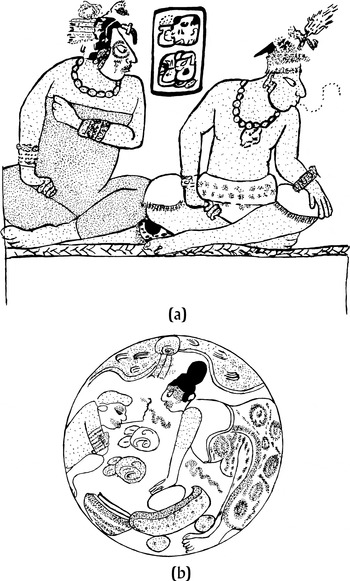
While women's naked flesh is obscured by costume, it is not entirely accurate to characterize women's body type as sexually neutral on public monuments (Joyce Reference Joyce2000a:60). Scholars have noted the characteristic plumpness of women in Classic representations (Houston et al. Reference Houston, Stuart and Taube2006:51). Indeed, the ideal female body tended toward the large and hefty. Often in male-female complementary pairs, the woman is at least as large as, if not larger than, the male counterpart as seen, for instance, at Palenque in the Tablet of the Slaves and Dumbarton Oaks Panel 2 (Schele and Miller Reference Schele and Miller1986:Figure VII.3), but also on painted ceramics showing imposing women seated with their lordly husbands (Figure 13a). In discussing “semantics of body shape,” Anne Becker (Reference Becker and Csordas1994:102) observes, “Aesthetic preferences for body shape and size are informed by core societal values.” This is certainly the case for the hefty bodies of women in Maya art. I doubt that their corpulence simply mirrors an aesthetic appreciation of fat, but rather invokes women's physical strength and health—a vital fluid-filled state in indigenous medical terms—and their mastery of domestic labor. This competence was not only a source of their own pride but also very appealing to men. Ethnographic studies in some Maya communities indicate men fear they will perish if not taken care of by a wife and are especially worried they will starve to death if ground corn and tortillas are not prepared for them. The stereotype of the ideal wife as hard worker is expressed by Mam men of Santiago Chimaltenango in their characterization of a productive woman as “strong, fat and very handsome” (Wagley Reference Wagley1949:21). Joyce (Reference Joyce and Claassen1992) herself has cogently argued that women's productive labor is central to their stereotypical representation in Maya art, and I believe that gendered activities account more for men and women's costume disparities than concern for sexual display. Female physical strength and work capacity cannot be divorced from women's identity as sexual beings; ethnographically, the exchange of both sex and labor form the fundamental basis of the marital bond (Devereaux Reference Devereaux and Strathern1987:93). This attitude is delightfully apparent in a painted plate showing a scrawny man relaxing with a cigar while his gargantuan wife busily makes his masa for tamales—truly a male fantasy of a desirable hefty woman and domestic bliss (Figure 13b).
Imposing stature and blocky body shape of women: (a) Throne scene with nobleman and wife. Painted vase (after Kerr Archive No. K4996); (b) Domestic scene of large woman grinding corn for husband. Painted plate (after Kerr Archive No. K1272). Drawings by the author.

Women's large girth can be appreciated even when they wear a voluminous huipil, which gives them a characteristic boxy shape. This blocky body silhouette (e.g., Figures 1a, 3b, and 4) is conventionally feminine. Curvaceous and swirling lines are as well, so kneeling women shown on Yaxchilan lintels, with their squarish bodies and swirling hemlines, projected feminine appeal and are not sexually neutralized by their clothing. There is far more fabric present than needed to cover their bodies; evidently the cornucopia of fabric had positive and possibly sensual connotations. Who is to say how sexually alluring such an image appeared to a viewer inculcated into this kind of aesthetic appreciation of a woman's body?
BREAST ANOMALIES
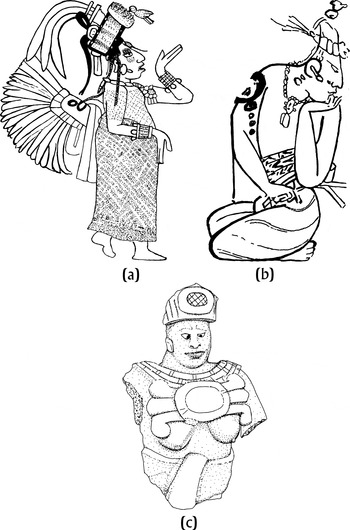
As mentioned earlier, one of the most potent contrastive strategies of breast signification is absence versus presence. This is not just when the breast is covered, thereby making it “absent,” but when it is uncovered and absent. One repeated occurrence of this absence consists of very feminine-looking figures depicted on vases that are nude from the waist up but have no visible indication of breasts. Was this anatomical detail an option that could be omitted? Was the omission something inadvertent and unimportant if the context were clear? Or were the breasts left out for deliberate reasons? Some cases of breast omission are striking and possibly were deliberate ways of constructing other gender identities. One vase depicts an apparent woman, cued unequivocally by her skirt, hair, and boxy body shape, performing a playful dance with a phallic-nosed male (Taube Reference Taube, Hanks and Rice1989:Figure 24-14). This feminized individual wears a delicate open-weave top, resembling a loose gauze weave, through which the entire chest area can plainly be seen and where there are no traces of breasts (Figure 14a). I proposed that this woman is a female impersonator whose very lack of breasts in conjunction with feminine traits made this apparent (Stone Reference Stone1995:144–145). Female impersonation is still commonly practiced in Maya ritual performance, both in comic and serious dances, and certainly was a feature of pre-Hispanic culture. Another ambiguously gendered figure on a vase is indicated as female by the skirt and feminized gestures: gracefully twisting, with one hand touching the chin (Figure 14b). This apparent female has neither breasts nor indication of the dark wispy hair so characteristic of women. The question can be raised if this is a woman or feminized male. To offer speculation, the figure could represent the wife or concubine of the adjacent seated lord—in this mythical scene an anthropomorphized monkey-like figure—but is not a woman per se, and instead may be a Two-Spirit feminized male, a type of Third Gender that surely existed in ancient Mesoamerica (López-Austin Reference López-Austin, de Montellano and Montellano1988:303; Looper Reference Looper and Ardren2002). If that were the case, it is interesting to see that the gendered indicators are preserved in the skirt and style of body gestures, but the anatomical breasts are omitted. Perhaps Third Genders were constructed pictorially through mixed characteristics.
Breast anomalies: (a) Female impersonator in humorous ritual dance (after Kerr Archive No. K1549); (b) Feminized figure lacks breasts, suggesting gender ambiguity (after Robicsek and Hales [1981:Vessel 68]); (c) Bare-breasted woman in large-scale architectural sculpture. Painted carved stucco, 70 cm high (after Maya: The Barbachano Ponce Mayan Art Collection [1976:No. 148]). Drawings by the author.

That conventions structured breast exposure in Maya art is best appreciated when these conventions are violated, as they are in a painted stucco sculpture in a private collection, said to be from a Classic period building in Yucatan. The torso was found separate from the head (Maya: The Barbachano Ponce Mayan Art Collection [1976:Number 148]). But even without the head, the torso, if authentic, is anomalous in showing a bare-breasted, apparently high-status woman in a large-scale sculpture that was displayed on a public building (Figure 14c). While this in itself is unique, neither clothed nor bare-breasted women wear an insignia such as this one does, a trefoil-ended pectoral usually associated with male ceremonial attire or as an insignia of male gods. This last anomaly may provide evidence that the pieces of the sculpture were cobbled together; but even if the torso alone has integrity, it represents something unusual. The suggestion of lines painted on the face, barely evident in the photograph, could mean that this is an old woman.
CONCLUSIONS
The female breast in Maya art has been recognized primarily as a site of erotic interest (Houston et al. Reference Houston, Stuart and Taube2006:42; Joyce Reference Joyce, Gustafson and Travelyan2003) or part of the caricature of an aged woman. This paper discusses its capacity to encode a range of information by its presence, absence, shape, and context. The breast as social construct is also hinted at by technological features. This concerns the fabrication of Jaina figurines of women where the preponderance of attention, in terms of refinement and detailed appliqué, is given to that part of the body above the waist: the face, head, and breast-shoulder area. Corson (Reference Corson1976:17) noted this for a recurrent type of female figurine from Jaina (e.g., Figures 1b and 2b) and drew a contrast with the lower body and covering garment (a skirt or bottom of a huipil), which form an unarticulated solid mass. A similar disparity was observed among female figurines from Piedras Negras (Schlosser Reference Schlosser1978:135). This technical variance can be understood as an adherence to pictorial conventions for constructing feminine stereotypes in all media of Classic Maya art where the most nuanced discrimination is generally in the head, breast, and shoulder area. Skirts had an emblematic quality as a quintessentially female garment, as discussed by Klein (Reference Klein2000) for the Aztecs. However, more attention was paid to the head and chest area, especially so among figurines where skirt patterns are often disregarded. This underscores the fact that these figurines are not so much dedicated to capturing faithful likenesses as constructing socially meaningful bodies.
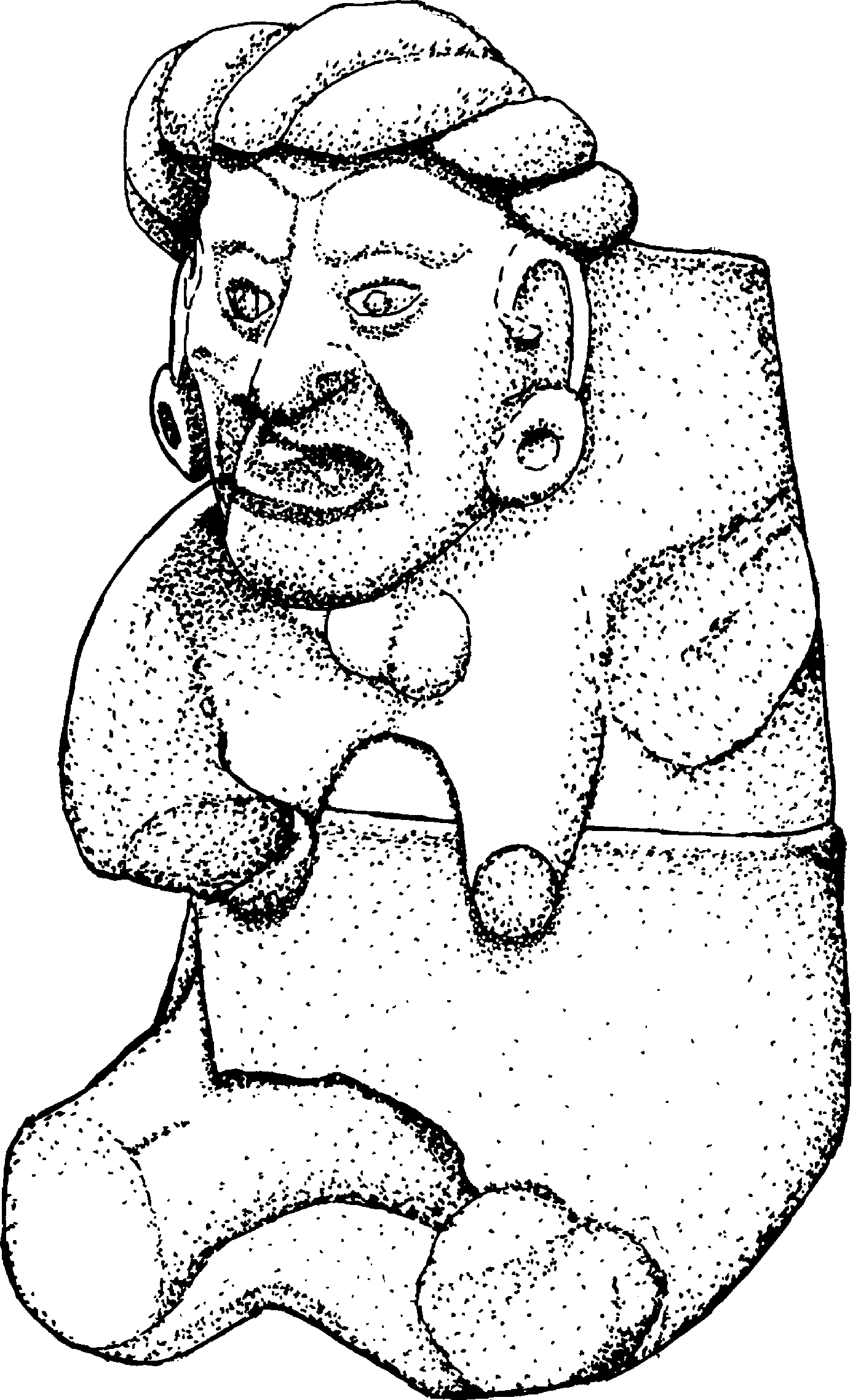
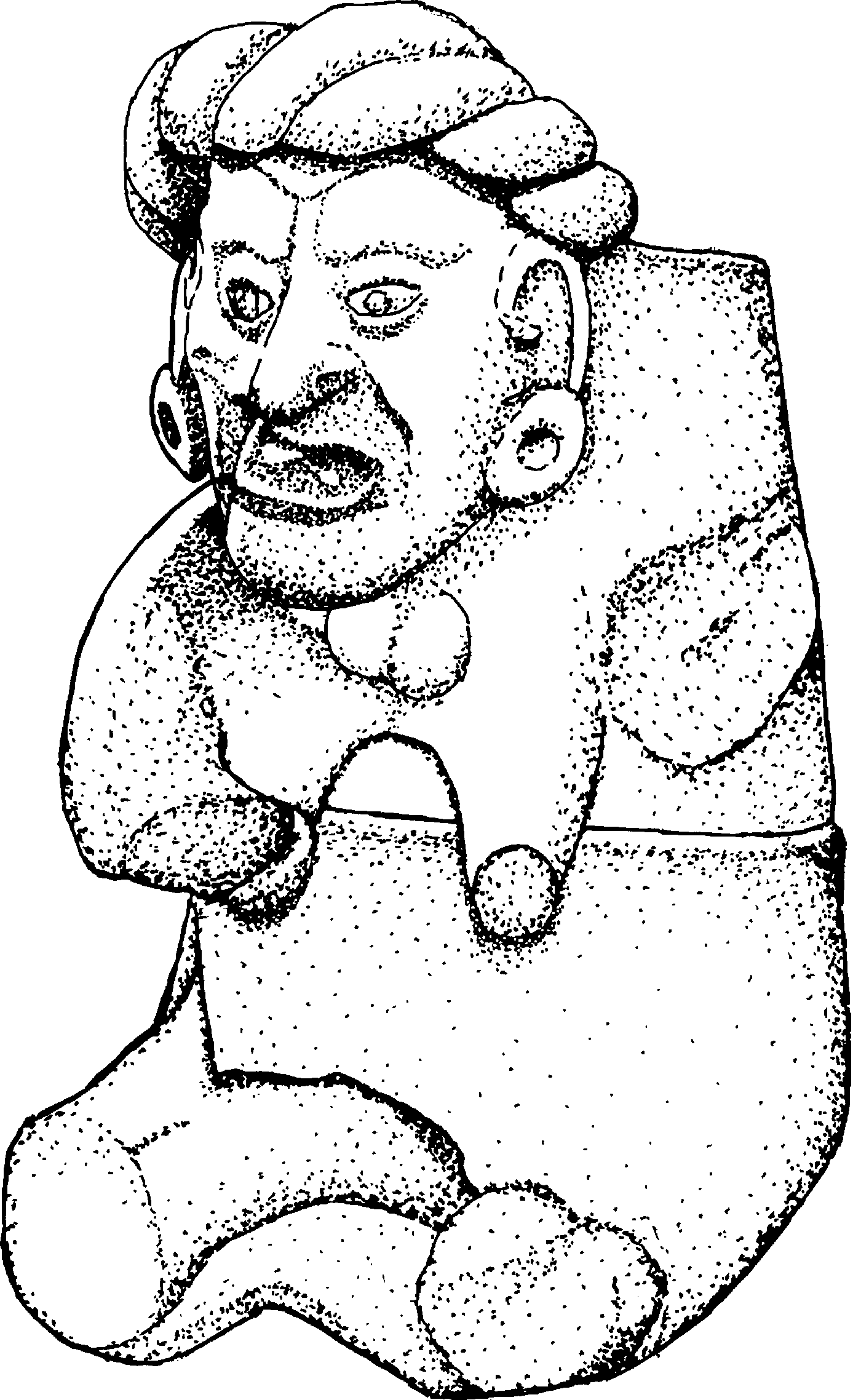
The interconnection of figurine technology and the breast as an autonomous sign is most evident in figurines of old women. Often their sagging breasts were added as independent units to a torso. The body was crafted first; then a slab skirt added over it. The flat breasts were then attached to the chest wall so that they can hang over the top of the skirt (Figure 15); this would be physically impossible if the breasts were not put in place after the construction of the body and skirt. Although not true in every case, old women's breasts stereotypically hang over their skirts (Figures 10b and 12a), and so the technology works in the service of this convention. In some cases these added breasts are not well blended into the body and look like strange chest ornaments rather than anatomy. Alberti (Reference Alberti2001) interpreted similar technological features of breast construction on Late Bronze Age faience figurines of a serpent-wielding goddess from Knossos—here the breasts and part of the clothing were fabricated as a single unit—as evidence of the breasts' role in crafting a sexed and gendered body comparable to clothing and other body ornamentation. In other words, the breasts were not conceived as an extension of natural anatomy but served the same socially constructive role as costume.
Construction of a ceramic vessel depicting an old woman shows the addition of breasts as separate unit from body. Structure 24, Yaxchilan. Drawing by the author (after Schele [1997:50, Plate 34]).
As a sign, the breast suggests fertility-related biological status as filtered through a cultural lens. The signifying power of the breast thus expands through a chain of associative properties. These properties are not just on the body's surface but are also internal and unseen, as suggested by hot-cold data. I would argue that these cultural constructs referenced by the breast, for both young and old women, allude to variant strains of female power (whether harmful or beneficial), tied to bodily conceptions, a power in women's bodies but visible on the surface through the breasts. Breasts can be an index of women's power. Although Maya art is infused with an androcentric bias, this did not result in the universal objectification of women or their breasts in purely sexual terms. The implications of the breast within the cognized view of the body were part of the mindset of male and female alike. Much as the phallus did for men, breasts could convey female power through an associative chain that involved practices (bloodletting for men, nursing or other domestic duties for women, or curative roles for old women) as well as properties inherent to the body. The contrastive, dyadic nature of the youthful and aged breast in the Classic period, used as a device to construct female stereotypes, argues against reading the exposed breast of young women too narrowly in terms of sexual desire; the contrast between young and old women's breasts is certainly not limited to a distinction based on erotic attaction.
Interestingly, the shape contrast between youthful and aged breasts was lost in the Late Postclassic Maya codices where breasts of young and old goddesses are identical and seem to serve a generic role identifying female deities, a general pattern of Postclassic Mesoamerican art. This suggests that the concern for creating nuanced social and semantic distinctions driving these contrasts in Classic depictions was not operative in the codices with their emphasis on divine patrons of seasonal almanacs. In the codices it can be argued that the breast was an obligatory marker of the female body, while the chests of male gods are flat and unmarked (Vail and Stone Reference Vail, Stone and Ardren2002); this role may have contributed to the breast's uniform appearance in the codices. The “marked” status of the feminine form also suggests an androcentric perspective as unmarked forms tend to stand for what is understood to be universal and dominant (Butler Reference Butler1990:17).
Although gauging the full panoply of Maya art is impossible, my sense is that breast exposure for historical women, who wear just a skirt, occurs rarely in the corpus of painted ceramic vessels. On the other hand, ceramic figurines frequently show women exposing their breasts. This may reflect a less courtly context for the figurines, and concomitantly figurines depict women's routine domestic labor more directly and frequently. Breast exposure was not fully compatible with images intended to emphasize high social status, and often breasts were made visible even though chests were ostensibly covered by clothing, not for the sake of propriety, but to gain the prestige benefit of clothing. Mythical and divine women, on the other hand, frequently expose their breasts. For defining goddesses, breast exposure was, on one level, a useful typological tool. In addition, mythology is not bound by the norms of human society and is freer to manipulate the body for dramatic effect. These dissimilar approaches suggest varying ways of understanding breast exposure in different thematic contexts. The association of women's breasts with power inherent to their bodies as well as their domestic and medical competence suggests that women's bodies were seen on some level as instruments of their own agency and not just a means of objectifying them (Butler Reference Butler1990:17). Maya art is rife with structural parallels. The breast is in many respects a counterpart to the phallus, each encoded hieroglyphically and each serving as a mystified body part and potent communicator of ideas. While the symbolic force of male genitalia in Maya art has been recognized, the female breast has not been given its due.
RESUMEN
Los senos femeninos han sido un motivo importante en la historia del arte mundial y esto es igualmente cierto del arte maya prehispánico, donde las mujeres con los senos expuestos son comúnmente representadas. Era un costumbre aceptable para las mujeres llevar sólo una falda sin cubrir el pecho o llevar una blusa suelta, exponiendo así los senos. Esta práctica es confirmada en ejemplos numerosos del arte prehispánico, y también fue observada por el obispo de Yucatan, Diego de Landa, en el siglo XVI. Imágenes de las mujeres con los senos expuestos fueron producidas principalmente durante el período clásico tardío visto entre vasijas pintadas, figurillas de cerámica y otros objetos portátiles; por otro lado, son raros en el arte público monumental donde los cuerpos de las mujeres aristocráticas nunca se presentaron sin cubrir el pecho. En lugar de reflejar algunas cualidades universales de cuerpos naturales, los senos femeninos fueron concebidos según los gustos, valores y supuestos sobre el cuerpo humano predominante en la sociedad maya antigua. Por ejemplo, los senos ideales, normalmente para las mujeres fecundas, mostrados plenos y grandes, nunca aparecían decorados con pintura roja y frecuentemente eran coloreados en pintura blanca. El filtrado de los senos a través de un lente cultural estimuló las representaciones artísticas muy conceptuales, por ejemplo, hacer los senos visibles, aunque la figura es totalmente vestida. La representación de los senos se ha normalizado en un jeroglífico cuya lectura todavía no se ha establecido; muchas imágenes muestran la misma estilización como el jeroglífico, es decir con el pezón en la parte inferior del seno.
La utilidad simbólica de los senos deriva en parte del hecho de que su forma física no es estática sino que cambia de acuerdo a las etapas de la vida de las mujeres, como el envejecimiento o el embarazo. La forma de los senos, por lo tanto, podría ser utilizado como un índice del estado biológico de la mujer. La distinción más básica se hizo entre los senos plenos de las mujeres fecundas y los senos delgados y planos de las mujeres viejas post-menopáusicas. Los artistas mayas entendieron el potencial semiótico de los senos y utilizaron el principio de contraste, en la morfología de los senos y si fueron expuestos u ocultados por medio de la ropa, o fueron extrañamente ausentes, para construir los estereotipos femeninos que varían por la edad, la clase, el estado sobrenatural y la ambigüedad de género. Los senos señalaron más que la edad de la mujer o su capacidad reproductiva, sino también se refiere a las cualidades internas del cuerpo femenino que tenían connotaciones de la agencia, la competencia, el poder y el peligro. Estos significados más esotéricos pueden extrapolarse a partir de estudios etnográficos de la medicina maya del pasado reciente. El sistema de caliente-frío atribuía un calor excesivo a las mujeres fecundas y otras calidades de poder y peligro. El cuerpo frío de una mujer vieja, mientras que es "débil," fue visto como liberado de la sexualidad excesiva y su peligro inherente, lo que sugiere otras formas de competencia. Estos datos etnográficos sobre los cuerpos de las mujeres en el discurso médico arrojan luz sobre los senos como un índice de estereotipos femeninos basados en la edad y fertilidad de la mujer.
ACKNOWLEDGMENTS
My thanks to Alice Kehoe, Julia Guernsey, and Reiko Ishihara for commenting on a draft of this paper. I also thank Christophe Helmke and Marc Zender for pointing out glyphic information. Suggestions by Carolyn Tate and an anonymous reviewer were not just helpful but even changed the substance of this paper. I owe a debt of gratitude to Roberto Nodal for polishing my Spanish summary.