


Introduction
Interweaving history with fiction, Tommy Orange’s highly acclaimed debut novel There There (2018) recounts the violence perpetrated against Indigenous peoples in America to explore issues of identity and authenticity.Footnote 1 Chapter 2 of the novel includes an encounter between Dene Oxendene, an aspiring Oakland filmmaker enrolled in the Cheyenne and Arapho Tribes, and Rob, a hipster-outsider, fastidiously bald and bearded, who plans to take advantage of ‘dirt cheap’ rents to move into West Oakland.Footnote 2 They are both waiting to be interviewed by a funding panel. Dene wants a grant for a storytelling project that will relate the Urban Indian experience. Their terse conversation turns on Gertrude Stein’s remark about her former childhood home, ‘there is no there there’.Footnote 3 For Rob, the comment affirms his own disparaging, supercilious view of the city as lifeless and empty; a terra nullius. He tells Dene, ‘I mean, no one’s really from here, right?’.Footnote 4 For Dene, Stein’s remark chimes with his thinking about identity; how the encasement of ancestral lands in ‘glass and concrete and wire and steel’ changes the remembrance of the past.Footnote 5 Controlling his urge to punch Rob, Dene accepts that there is no ‘there’ to be recovered, but nevertheless considers his communities, struggling rather than flourishing, to be rooted in the city. Orange writes: ‘An Urban Indian belongs to the city, and cities belong to the earth. Everything here is formed in relation to every other living and nonliving thing from the earth’. There is no there in Oakland but ‘[b]eing Indian has never been about returning to the land. The land is everywhere or nowhere’.Footnote 6
Dene and Rob’s encounter brings the colonising pressures of gentrification and the creative energy to decolonise sharply into view. Orange does not use the term, but Dene’s unstructured, community-centred project – one that Orange himself planned to get off the ground – is designed to explode old stereotypes and challenge colonial attitudes. His aspiration is not a million miles from Unsettling America’s aim to document the ‘mental, spiritual, and psychological decolonization and liberation’ that ‘can only come from below and within’.Footnote 7
Decolonisation is the focus of our analysis of Occupy Oakland (OO), one of the camps set up in 2011 following mass protests in New York and the occupation of Zuccotti Park. We link the failure to decolonise OO to the promotion of ‘real democracy’, the hallmark of the Occupy movement. Our argument is that the attempt to channel the militancy Occupy unleashed across diverse, internally divided communities, exposed the fractures within the 99% (as undifferentiated as ‘the working class’ for the IWW) and privileged the norms of the dominant groups therein. Groups of that size can never be homogenous and will always splinter: OO’s decision-making processes enabled the antagonism without providing routes to constitutional transformation. Rather than enabling challenge, revision and adjustment, to forestall or manage secession, or lessen its harms, its rules about legitimate action scuppered mutual aid, creating mistrust and division, which could have been accommodated had the emphasis not been on unity and fidelity to problematic foundational constitutional ideals. Decolonising initiatives were arbitrated by a demos that claimed to speak for the 99%, against those who spoke for a specific subcommunity: the indigenous peoples of Oakland. The failure of the motion to decolonise OO in December 2012, an important symbolic change, and the subsequent, separate establishment of Decolonize Oakland in opposition to OO exposed the problems of trying to galvanise a single constituent power and the fragility of anticonstitutional, grassroots democracy.
Our account of OO’s constitutional weakness follows the main lines of Acheron and King’s first-hand account of the camp.Footnote 8 Reflecting on OO’s demise, they acknowledge the role that city and state forces exerted to evict the occupiersFootnote 9 but argue that ‘long-term organizing’ demands critical reflection on ‘brief ruptures’: ‘Occupy Oakland is not dead, nor has it failed as a movement; rather, Occupy Oakland has failed to properly define and evaluate success as a movement’. To this end, they invoke Joe Hill: ‘Don’t mourn, organize (and attack!)’.Footnote 10
In this chapter, like the last, we suggest that critical reflection of the virtues of the Occupy Wall Street (OWS) movement ought to be conducted through a constitutional lens. At a considerable distance from the action, we suggest that any postmortem should include a reflection on the homogenising, colonising tendencies of ‘democratisation’ and the missed opportunity to foreground the pluralising propensity of anarchy.
The chapter proceeds as follows: we begin (Occupy and Oakland) with a short history of Occupy and present an account of Oakland’s municipal politics and urban development to contextualise the grievances affecting the rise of OO. The second part (OO and the Dimensions of ‘Real Democracy’) shows how OO was constitutionalised through Occupy as a forum for ‘real democracy’, organised locally as a hub for multiple community campaigns and how it gained international recognition as a pro-democracy movement resisting state violence. We argue that OO struggled to reconcile the outwardly anarchist normative commitments of OWS with local political imperatives. The city’s governing institutions heightened tensions within the camp, seeding tensions that eventually proved disintegrative.
The third part (The Camp at Oscar Grant Plaza) uses the architecture of anarchist constitutional politics we outlined in Chapter 1 to describe the main camp pitched outside City Hall, the institutions, rules and decision-making processes OO adopted to sustain its version of ‘real democracy’.Footnote 11 We argue that OO was a de facto constitutional movement which appealed to democracy and a single constituent power, the 99%, to create a single point of authority. Interests were not sublimated, but the democratic consensus broke down after the spectacular general strike of November 2011. In the struggle to speak in the name of the people, the camp divided non-violent ‘democrats’ from violent ‘anarchists’, and ‘decolonisers’ from ‘occupiers’. In the final part (Decolonize Oakland) we argue that the fragility of the bonds uniting the 99% were subsequently confirmed when a motion tabled to change OO’s name to Decolonize Oakland in December, after the eviction of the camp, failed to meet the threshold required by its rules. In different ways, both arguments demonstrated that the pressures on plural constituencies to conform to consensual democratic norms were uncontainable.
Occupy and Oakland
The hopes that brought Occupy into being had been stirred by protests in Tahrir Square and the 15-M/Indignados anti-austerity movement in Spain. The aim of Occupy’s initiators was to halt the perceived corporate takeover of American democracy.Footnote 12 On the 4th of July 2011, the anti-consumerist media collective Adbusters launched the hashtag ‘#OccupyWallStreet’ to urge Americans to reassert their independence. The enemy, the ‘greatest corrupter of our democracy’ was Wall Street, ‘the financial Gomorrah of America’. In the tactical briefing that followed, this call became a full-blown struggle for democracy. Reworking the revolutionary slogan ‘no taxation without representation’, Adbusters demanded ‘representation not corporation’ and invited ‘20,000 people to flood lower Manhattan’. The message was simple: ‘#OccupyWallStreet September 17th. Bring Tent’.Footnote 13
Observers agree that Occupy burned like a firecracker in the winter of 2011–12 and that it was quickly extinguished.Footnote 14 They disagree about the significance of the trail it blazed. On the underwhelmed pole of the spectrum, Alasdair Robert, professor of public policy at the University of Massachusetts, Amherst, argued that it had only ‘exposed the limitations on popular protest against the failures of the neoliberal project’.Footnote 15 On the enthusiastic end, Noam Chomsky described the Occupy movement as the most impressive US mobilisation since Vietnam. In a matter of months, it had focused attention on the grotesque wealth inequalities engendered by neoliberalism, injected an idea of class oppression back into public imaginationFootnote 16 and reasserted values of community and solidarity in democracy.Footnote 17 For Micah White, the Adbusters editor who sent the first tweet, the more sobering lesson was that mass mobilisation did not work. He had hoped that the Manhattan occupation would drive corporate finance out of government, just as the protesters in Tahrir Square had toppled President Mubarak in Egypt. President Obama would have to choose between the ‘will of the people’ and the corporations. In the event, the President preserved the status quo, just as the Egyptian army had done when it sacrificed Mubarak.Footnote 18 However, in retrospect, White described Occupy’s demise as ‘constructive’. Splintering ‘into a thousand shards of light’, it taught ‘a lot about some of the failed tactics used by contemporary activists’.Footnote 19
A second point of consensus is that Occupy inherited the alterglobalisation movement’s ‘anarchist sensibility’.Footnote 20 Resurrecting the social justice campaign slogan ‘this is what democracy looks like’, Occupy also adopted the anarchistic commitments to horizontalism, decentralisation and active participation through consensus and open-source decision-making.Footnote 21 The virtues of Occupy’s anarchism are much disputed, but the appropriateness of the ‘small-a’ anarchist labelling is not.Footnote 22 That is not to say that all Occupiers were anarchists but that the involvement of activists familiar with, if not predisposed to anarchistic practices, gave Occupy an anarchist flavour.Footnote 23 This was the case in the New York ‘mother camp’Footnote 24 and, according to Barbara Epstein, also in Oakland.Footnote 25
The third point of agreement is that the movement was ‘multifaceted’ and characterised by ‘complexity and multidimensionality’.Footnote 26 The Guardian logged 750 events worldwide, from Dhaka to Vienna, Brazil to Bosnia, some attracting tens of thousands of supporters, others only handfuls.Footnote 27 No one camp tells the story of the movement.
The Oakland Occupation was inaugurated on 10 October 2011, nearly a month after the 17 September launch set by organisers in New York.Footnote 28 The main camp was set up outside the city hall at Frank H. Ogawa Plaza, immediately renamed in memory of Oscar Grant, a twenty-two-year old Black retail worker, shot dead by a transport officer on 7 January 2009. The General Assembly (GA) started recording minutes on 17 October. A mass rally and march on 22 October, organised to spur participation, marked the official launch. A police raid, involving the use of what Oakland Police referred to as ‘less-than-lethal munitions’,Footnote 29 resulted in temporary eviction on 24 October. However, by 27 October, the camp was back in the Plaza. After the city served a series of eviction notices from 12 November, the police moved in again on 14 November and permanently removed the camp (see Figure 6.1).Footnote 30 OO continued to organise, but after the final eviction, it fractured into rival organisations: OO, Decolonize Oakland and The Oakland Commune.Footnote 31
Timeline of Occupy Oakland.

In this brief period, OO established a reputation internationally as one of the most vital camps in the global movement. The ferocity of police violence deployed against it helped raise its media profile. But it was the general strike called on 2 November to protest the violence of the camp’s first eviction that catapulted it into the headlines. Supported by an estimated 30,000 workers, it shut down the Port of Oakland.Footnote 32
Analysts turn to the city’s political culture to explain OO’s vitality. A caricature portrait in the New York Times Magazine noted that in Oakland, ‘the revolutionary pilot light is always on’. As the birthplace of the Black Panthers and one of the best-known Hell’s Angels’ clubhouses, it was ‘the last refuge of radical America’.Footnote 33 In a nuanced sociological analysis, Marche and Velut argue similarly that the city was Occupy’s perfect ground. It hosted ‘a vibrant postwar labor movement’ and a tradition of Black militancy and social justice campaigning that was ‘not limited to being the Black Panther’s birthplace’. A set of ‘historically entrenched local conflicts’, they noted, had spawned a strong social activist network which sprang into life as soon as the camp was established.Footnote 34
The picture that emerges from the scholarly literature is that the ground for OO had been prepared by 150 years of police brutality, corruption, the systemic rigging of the property market, segregation and a reckless public investment policy that had been driven by cheap credit from China and mimicked nationwide.Footnote 35 Racism was endemic to all this.
The activities of the Riders, police gangs that had run riot in the 1980s in predominantly Black areas of the city, defined Oakland’s recent history of policing. As a result of their antics, the Oakland Police Department (OPD) had been placed under federal court oversight.Footnote 36 But trust in the police had not been restored. As Winston and Bondgraham note, Oscar Grant’s killing was an immediate reminder of the OPD’s long history of covert, illegal and arbitrary practices.Footnote 37
By the early 2000s, pressures on inner-city communities were felt by the rapid gentrification of the old ‘red-lined’ neighbourhoods, areas formerly settled by poor communities excluded from financial services. The flight of affluent tech workers priced out of San Francisco’s property market exacerbated the problems.Footnote 38 Financed by speculative, risky borrowing,Footnote 39 development programmes put investors at the heart of the city’s urban planning and placed public services in their laps. The shiny new public spaces investors bankrolled were aggressively patrolled to keep the poor corralled in the deprived ‘crime’ districts they had been pushed into.Footnote 40
When the financial crisis struck in 2007–8, African American and Latino homeowners were hit hardest.Footnote 41 The crash was especially intense in California. As the pioneer of ‘speculative urbanism’, or borrowing against the prospect of future growth, the state was at its ‘epicentre’.Footnote 42 Cuts in federal revenues sparked by the sharp fall in property taxes, combined with the rising cost of servicing the public debt, drove several cities to the brink of bankruptcy, leading to drastic cuts in public services and further unemployment.
In Oakland, the foreclosures spiked in what remained of the old low-income districts and correlated with years of predatory lending.Footnote 43 An estimated 35,000 homes were lost to foreclosure after 2007. In 2011, the rate of foreclosure was more than double the national average.Footnote 44 A report for the Oakland anti-poverty network by the Urban Strategies Council documented the ‘colossal opportunity’ foreclosures created ‘for those individuals and corporate entities with the financial resources to play the real estate investment game’. Oakland became rich picking for outside investors.Footnote 45
As Marche and Velut remark, when markets collapsed in 2008, Oakland residents had no trouble connecting the local with the global, past and present, and the iniquities of capitalism with dispossession.Footnote 46 A favourable report on Occupy in the Black Panther magazine Commemorator described Oakland as a city where the ‘disparity in living conditions’ between ‘haves’ and the ‘have nots’ left the latter unable to secure a ‘living wage income […] decent housing’ or ‘access to a reasonably competitive education system’. Social divisions, entrenched in class exploitation and ‘intertwined with racial and sexual’ oppression had too often kept ‘the 99% confused and fighting among themselves’. Occupy was the counter: a struggle for ‘“community control,” “self-determination” and “liberation” from the 1%’.Footnote 47
As the Commemorator implied, Occupy provided a platform for multiple groups to voice a complex set of grievances. While it is impossible to draw any hard and fast conclusions about Occupy from the Oakland experience, it is possible to explore the way that ‘real democracy’, the hallmark of the movement, operated in specific locations. In the following section, we consider how it shaped OO’s constitution.
Occupy Oakland and the Dimensions of ‘Real Democracy’
By affiliating with OWS, OO constituted itself as a local node in a global pro-democracy movement, highlighting the local effects of (and contributions to) the structures of global capitalism, and locating resistance to the latter in the streets.Footnote 48 The antagonism of the local authorities also helped OO establish its credentials as a flagbearer for real democracy through transnational solidarity with activists in Tahrir Square, Barcelona, London and elsewhere. We consider each of these dimensions of OO’s make-up in turn and then consider how Occupy’s pro-democracy stance complicated OO’s constitutional drives.
The GA of OWS constituted itself and the wider Occupy movement by its subscription to founding principles. These were articulated in three documents: the ‘Principles of Solidarity’, agreed on 23 September 2011, the ‘Declaration of the Occupation of New York City’ agreed on 29 September 2011, and the ‘Statement of Autonomy’ developed to coordinate external communication on 10 November 2011, shortly before the nationwide camp evictions.Footnote 49
One of the central purposes was to clarify the nature of political ties that held the collective together. ‘The Declaration of the Occupation of Wall Street’ adopted the language of individual rights to reject the corporate neoliberal political system that prioritised ‘profit over people, self-interest over justice, and oppression over equality’. The aspiration was to promote a politics based on trust, shared grievance and solidarity in protest. The Flowchart, drawn by Rachel Schragis, the Call to Action Working Group and other members of the GA of OWS,Footnote 50 illustrated the interconnections (see Figure 6.2).
Flowchart of the Declaration of the Occupation of NYC, 2011, by Rachel Schragis, with the Call to Action Working Group and other members of the General Assembly of Occupy Wall Street.
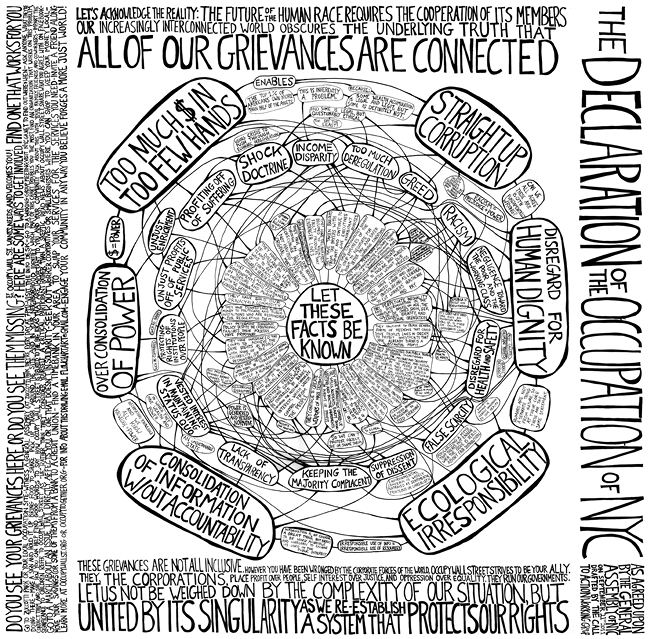
Figure 6.2 Long description
This iconic image of the hundreds of intersecting grievances of the Occupy Wall Street movement is highly detailed. The lists are depicted in a wheel, not unlike Father Hegarty's iconic image. The central hub of the wheel includes the words 'let these facts be known'.
Making oblique reference to the Gettysburg Address, the Statement of Autonomy established OWS and Occupy as a ‘people’s movement’: ‘party-less, leaderless, by the people and for the people’. As the Principle of Solidarity clarified, politics was not about politicking and leveraging advantage, but about building community through engagement: ‘Engaging in direct and transparent participatory democracy; Exercising personal and collective responsibility; Recognizing individuals’ inherent privilege and the influence it has on all interactions; Empowering one another against all forms of oppression; Redefining how labor is valued; The sanctity of individual privacy; The belief that education is a human right’ (Occupy Wall Street 2011a. Principles of Solidarity).
The camps that sprang up worldwide often adopted OWS principles wholesale, while others tailored them to local conditions. The London camp outside St. Pauls (LSX) drafted an Initial Statement and a Statement of Autonomy adapting the templates OWS shared. Indeed, London’s Statement of Autonomy amounted to a statement of solidarity that aligned LSX to Occupy by its detachment from institutional politics. Like OWS, it prioritised ‘collective resources, dignity, integrity and autonomy above money’, extending a welcoming hand to individuals willing to ‘engage in participatory as opposed to partisan debate and democracy’, and organisations ready to review their ‘institutional frameworks of work and hierarchy’ in the light of LSX’s ‘principles’ and ‘modes of action’. Modifying OWS’s cultural references, London referred to Magna Carta to affirm its singular relationship with ‘the people’, and its independence from ‘business, political parties, and advertisers’. Yet having conjured an English radical tradition, it urged Londoners to follow OWS’s lead: ‘Re-discover your humanity, common sense, understand you are not agents of the government but human beings with a birth right’.Footnote 51
Like other Occupy camps, the OO GA aligned itself with the wider movement formally and informally. In the first case, it adopted the movement’s antiparliamentary hallmarks. The statement recorded in the GA minutes read: ‘Occupy Oakland does not endorse any political party or politician, and does not seek the endorsement of any party or politician. We do not recognize the authority of politicians’.Footnote 52 In the second, OO aligned itself with Occupy through solidarity. After New York authorities postponed the clearance of Zuccotti Park on 14 October, the OO GA issued a statement against the violence meted out to OWS protestors.Footnote 53 OO also marched in support of students striking at Berkeley,Footnote 54 and when San Francisco’s main camp was raided on 16 October, the GA appealed for ‘supplies, batteries, water etc’, as well as bodies to reinforce the frontline formed to resist an anticipated second assault.Footnote 55 Solidarity was sometimes also expressed in tangible acts of mutual aid. Oakland received tents and funds for medical and legal use from OWS.Footnote 56
However, local observers argue that OO was rooted in the locality. For Acheron and King, it grew from ‘issues like opposition to the gang injunctions, fighting school closures and solidarity with workers in struggle’.Footnote 57 In Bay of Rage’s shouty analysis, the ‘rebellion that unfolded in front of City Hall’ was a ‘convergence of preexisting local movements and antagonistic tendencies all looking for a fight with capital and the state while learning to take care of each other and our city’.Footnote 58 Indeed, referring disparagingly to the vagaries of ‘populist slogans about the 99%’, ‘savvy use of social networking’ and ‘shady figures running around in Guy Fawkes masks’, Bay of Rage described OO and Occupy as conjoined not analogous movements. According to its assessment, OWS was the main island in ‘a colorful but confused archipelago of anti-financial indignation’, while the ‘rebel town of Oakland’, striking camp directly outside the City Hall, was a genuinely revolutionary attack on institutional power. Leaving the hostility to OWS to one side, the observation reinforces the view that OO operated on different levels. Bay of Rage argued that OO threw down the gauntlet to the city’s enemies, ‘local government, the downtown business elite and transnational capital’,Footnote 59 while also recognising that many of those who thronged to the Plaza were pulled by different levers.
Occupy Oakland accordingly spoke in multiple registers, across time and space. The invitation issued on 20 October to join the occupation in Oakland declared solidarity with OWS, Occupy San Francisco, and Indigenous Resistance Day, marked since 1992 on 12 October, the date of Columbus’s fateful landing in the Americas. As part of the Bay Area and Oakland’s political community, OO also quickly affirmed its support of striking workers, students and prisoners.Footnote 60 The statement agreed by the GA on 26 October read:
We commit to offer practical and creative support to those who walk out from union or non-union work places, with or without union leadership.
This statement also applies to student strikes.
By issuing this statement, we wish to send a message to everyone in this city, that if you are fighting back, then we have your back […]
We, as members of Occupy Oakland, send our support for your strike against the cruel and inhumane conditions of imprisonment.Footnote 61
Likewise, OO tailored Occupy’s politics to meet local and regional priorities. Choosing not to organise on 17 November, the date chosen by OWS to celebrate its two-month anniversary,Footnote 62 OO organised a day of action on 19 November, calling it ‘Liberate Oakland’. It was publicised as an event to mobilise ‘workers and families against the institutions that are responsible for inequality’.Footnote 63 The original rationale was to ‘expand the Occupy movement’ by calling for an ‘end [to] police attacks on our communities’, defend Oakland schools and libraries, demand ‘housing for all’, end foreclosures and denounce ‘a capitalist system build on inequality and corporate power that perpetuates racism, sexism and the destruction of the environment’.Footnote 64
The GA’s most audacious solidarity action, billed as ‘Occupy Strikes Back’, organised for 12 December after the camp had been cleared, targeted Goldman Sachs as a major shareholder in the marine terminals and EGT, the grain exporter, with whom the longshore workers were in dispute.Footnote 65 Here, local politics served as a lynchpin for a national action. Working with activists in other cities, funding four other West Coast groups and leafletting rank-and-file workers in San Francisco, the OO GA orchestrated a port shutdownFootnote 66 which extended along the West Coast from San Diego to Seattle.Footnote 67
The international profile OO gained by these audacious acts, which aggravated tensions between the occupiers and the city authorities, was unrivalled. All eyes, it seemed, were on Oakland. Occupy camps habitually identified with other pro-democracy struggles, and following the framing of Adbusters’ initial call, GAs often aligned Occupy with the ‘Arab Spring’.Footnote 68 But in Oakland’s case, the connections were explicit and forged through the shared experience of state violence or what Bruff calls ‘authoritarian neoliberalism’.Footnote 69
After the first camp eviction on 25 October, groups of activists protested in Cairo in Oakland’s support.Footnote 70 On 9 November, the GA responded to Tahrir’s call to Occupy for global solidarityFootnote 71 by resolving to march on the Federal Building to ‘speak about the US government’s complicity in the repression of Egyptian people’ and to the county jail to ‘connect the imprisonment of political prisoners in Egypt to prisoners in the US and everywhere’.Footnote 72 It also endorsed a letter which read:
We watched in tears as the military council took power, protecting the remnants of the old government, and defending the system of economic oppression which continues to exploit and drive your people into poverty. It seems that they did not understand the now infamous chant: The people want the downfall of the regime […] it has continued to kill protestors, viciously remove occupiers from Tahrir, conduct ‘virginity tests’, and persecute thousands through unjust military trials. Ridding yourselves of Mubarak was the first step, but now it is more evident than ever that the people will only be truly free when the whole system is abolished.
[but…] It has become clear that if we build shelters, develop safe spaces for people of color, women, the poor, trans and queers, if we set up open kitchens, create free schools – if we attempt to imagine a world without capitalism, we will be quashed by the capitalists and their army of police.
And so we stand with you. We are you […] Oakland and Egypt are one hand!Footnote 73
As the letter indicates, OO discovered multiple points of connection with pro-democracy activists in Egypt. From this perspective, the factors influencing local struggles were less significant than the common global predicament. ‘Democracy’ was the means to imagine other worlds, in defiance of the neoliberal claim that there was no alternative. The possibility of building a global movement had already been floated in the so-called movement of movements of the early noughties. Its companion slogan, used in 1999 in Seattle against the World Trade Organisation, was ‘this is what democracy looks like’. Occupy made this enactment of democracy its own and, binding it to a set of wider anarchist-inflected norms and practices, in OO and elsewhere, elaborated it as a form of anticonstitutional resistance.
Real Democracy and Anticonstitutionalism
‘Real democracy’, like representative liberal democracy, refers to a process of decision-making, a political culture, and a set of values. In Occupy, the concept was used as an analytic for domination in liberal democracy. Just as Jonas Staal perfected the art of the stateless state to expose the violence and corruption of ‘ultranationalism’,Footnote 74 Occupy used ‘real democracy’ to parody and expose elitism and the competitive majoritarianism of mainstream electoral systems. For Simon Tormey, real democracy spoke to ‘an emergent discourse that sees representative politics and the function of representing others as complicit in injustice’.Footnote 75 Appealing to values of respect and dignity, transparency and equality, it pushed against exploitation, patriarchy, racism, colonialism and imperialism.Footnote 76
Situating Occupy in a long struggle for ‘communal self-governance’ in America, David Graeber added the ‘real’ to contrast democracy with constitutionalism, attack elitism, representative government, and economic inequality.Footnote 77 His contention was that the US Founding Fathers had appropriated the language of democracy to advance elite interests, but only once the institutions of government had nullified democracy’s prospect. His critique of elitism chimed with Ellen Meiskins Wood’s Marxist analysis of the rise of bourgeois liberal democracy.Footnote 78 However, by focusing on the process of constitutionalisation, rather than the Founding Father’s wranglings about republican political theory, Graeber conceptualised democracy as the popular antidote to constitutionalism. As ‘old as history, as human as intelligence itself’, democracy was everywhere, lacking precise intellectual or cultural root or institutional form but always initiating change directly at the grassroots and in active, prefigurative action.Footnote 79 Occupy was just one expression.
The injustices of corporate capitalism that Graeber traced to constitutionalism were at the forefront of Occupy literature. The Declaration of Wall Street, which he had a non-trivial hand in preparing,Footnote 80 used the language of ‘them and us’, or the 1% and 99% as the conflict was later reframed, to set out what Occupy was against: ‘foreclosures’, ‘colonialism’ and ‘environmental degradation’. Charging corporations with a substantial list of violations, OWS urged ‘the people of the world’ to ‘assert your power’.Footnote 81 According to the Principles of Solidarity, the occupation was intended to resist the collusion between the banks and the state, and ‘reclaim our mortgaged future’.Footnote 82
In Oakland, the contestation of democracy similarly pitted the occupation against corporate power and elitism. The media committee’s first press release gives a succinct picture of OO’s outlook. It spoke to three constituencies: the 99%, the politicians and the media. The appeal to the 99% was collectively to ‘plan actions and mobilize real resistance’, defend against the ‘economic and physical war’ being ‘waged against’ local communities. Politicians and the 1% were warned: ‘Stand aside!’. They should not expect ‘a list of demands’. In keeping with the leaderless practice adopted at Wall Street,Footnote 83 OO would not be nominating ‘leaders’, issuing ‘tactical or strategic directives’ or elaborating ‘a uniform message or political platform’. There was nothing that political elites could do to make the occupation ‘go away’. The pithy message to the media was: ‘Our struggle won’t fit in a 15 second soundbite’.Footnote 84
However, the GA’s efforts to establish OO as the mouthpiece for the 99% ran aground as participants wondered who the 99% included? Before the first camp eviction, at least one person in the GA thought that Mayor Jean Quan, the first woman and first Asian-American to achieve the position, should be considered an ally.Footnote 85 Debates about community outreach and solidarity even sparked questions about the designation of the police: did the 99% include ‘government workers, city workers, and the police’? Or were the police automatically classified as part of 1% ‘until they join’ the movement?Footnote 86
The confusion in the GA was amplified by the authorities’ attempts to claim the same ground. Mayor Quan initially identified herself with the 99%.Footnote 87 When the GA called for a general strike to ‘Liberate Oakland, Shut Down the 1%’ in response to the first eviction, she reaffirmed her support for the 99%.Footnote 88 On the eve of the December West Coast Port Shutdown, she spoke again on behalf of the 99%. Exploiting the ILWU’s refusal to support the action, Quan encouraged OO to ‘keep the Port open’ and protect ‘the livelihoods of many of the 99% here in Oakland and throughout Northern California’.Footnote 89 Outraged by Quan’s decision to allow the camp to rebuild in the Plaza after the first eviction, Oakland police released an open letter describing her as the ‘establishment’ and calling itself ‘the 99% fighting for better working conditions’.Footnote 90 Similarly, the Port Authority set itself up as the guardian of the 99%’s interest. In an open letter to ‘the community’ issued in advance of the 2 November general strike, it appealed against the port’s closure because it was ‘where the 99% work’.Footnote 91
The question, ‘who are we for and who are we against?’, central to any founding constitutional moment, was temporarily resolved as the Mayor and police pitched themselves, albeit shakily, against OO. The question of Quan’s allyship was settled when she called for the Plaza to be restored as a free speech area, facilitating the first eviction. A prank letter created by an OO hacker brilliantly exposed the void between real and fake democracy by writing on her behalf that the camp was just ‘the kind of experiment in mutual aid and direct democracy’ the city needed.Footnote 92
Ultimately, the rhetorical battle was played out in the streets. As stories about the excessive police violence used to evict the camp in October flooded the international media, Mayor Quan consolidated OO’s opposition by issuing a press release thanking police for their ‘peaceful’ handling of the situation. For the Treasurer of the California Nurses Association, this put her squarely with the 1%: in the ‘shameful company’ of mayors ‘whose response to public expression of protest is repression rather than respect for the rights of free speech and assembly’.Footnote 93 The general strike on 2 November dramatically linked OO, schools and unions against the city and the police. As King notes, ‘the fact that 20,000 people responded to an organic call to shut down the city that was unapologetically and unambiguously anti-capitalist’, and shifted the demos and locus of democracy from city hall to the plaza.Footnote 94
Yet these struggles for real democracy were continually contested by the 99% as it mobilised against the 1%. For some, real democracy pressed the people’s complaints non-violently. For others, this rendering of ‘diversity of tactics’ exposed the biases of the predominantly white elites who controlled OO’s levers of power. The disagreement about violence and the use of ‘anarchist’ tactics, exposed some of the fissures of the decolonisation debate. Before we show how the arguments played out, we discuss the camp’s organisation and decision-making arrangements.
The Camp at Oscar Grant Plaza
As Bay of Rage contend, the decision to locate camp outside City Hall and rename the Plaza Oscar Grant was a provocation. Completed in 1998 at the cost of $6 million,Footnote 95 Frank Ogawa Plaza is the size of approximately two football pitches and close to Oakland’s glossy civic centre. Its amphitheatre, designed by architect Michael Pyotok, was intended to host ‘cultural performances, festivals, campaign speeches, important public announcements, ceremonies and celebrations’ and serve as a place of protest and demonstration.Footnote 96 In all these guises, it was supposed to enhance the grandeur of the City Hall: the theatre turns the publics’ gaze directly towards it. As an anti-representative body, Occupy was not supposed to be there.Footnote 97
The camp did not survive for long, but in the short period of its existence, OO set up a host of institutions, agreed rules and decision-making processes. In other words, it constitutionalised ‘real democracy’.
Institutions
According to the Oakland-Frazier Report, an independent report commissioned by the city authorities to investigate the violence that erupted around the 25 October raid, the camp consisted of about 147 tents. It maintained a kitchen, library, bathroom facilities and a childcare area.Footnote 98 Alongside these physical institutions, OO also ran innumerable committees.Footnote 99 There were also ‘caucuses’ for ‘Women/Trans/Queer, People of Color’, a ‘Jewish contingent’ and an ‘Anarchist group’.
The ‘bulk of the organizing of Occupy Oakland’ was ‘produced through [these] various committees, working groups and caucuses’.Footnote 100 They ran everything in the camp and, both before and after the occupation, connected it to local unions, neighbourhoods, and community groups in the city. Likewise, caucuses played a key role in promoting OO’s actions to the city’s communities.Footnote 101 Towards the end of the camp’s life, proposals were made to establish further affinity groups and to take the skills learned in the camps to neighbouring communities. On 4 November, a Community Democracy Neighbourhood Project was proposed to create neighbourhood assemblies, mirroring those in Spain, Greece and Egypt; on 9 November the creation of an OO Plugin Committee was floated to encourage occupiers to get more involved in local initiatives and campaigns.
As in most OWS camps, the central forum for dealing with problems was the GA. The OO GA served as a forum for discussion, a platform for announcements and a decision-making body.Footnote 102 Unlike LSX, which routinely described the GA as sovereign, Oakland resisted this labelling. However, the GA was alone empowered to speak for the occupation. For OO, it was the city’s primary and only legitimate institution.Footnote 103 When City Hall attempted to open negotiations, the GA refused. Mayor Quan confessed her disappointment and put the rebuff down to the ‘anarchist element in the general assembly’.Footnote 104 But in October, the mayor’s office was informed ‘that the proper channel for dialog with Occupy Oakland is through the General Assembly’. Individuals ‘representing the City’ were welcome to submit proposals to the GA and ‘address the General Assembly’. But they should not expect special treatment: they could participate ‘in their role as a community member’ not as city officials. Like anyone else, they could ‘come to camp meetings to air grievances as announcements’. The resolution continued:
By approving this resolution we refuse to acknowledge the City’s rule of law. By adopting this resolution we are taking a stand against their process. By approving this resolution we are giving the city a fair voice, something denied to many Occupiers by the City’s process. By adopting this resolution we avoid indirect decision making. By approving this resolution we reject the tyranny of representation […] This resolution is meant to encourage the City to air grievances in the only forums acceptable to us – ours and ours alone as human beings. We will not respond to them on their terms – we will only respond to the city on our terms!Footnote 105
In the camp, the GA played an overlapping harmonising and coordinating role. The GA was a ‘process we have collectively cultivated […] to reach agreement while building a mutually respectful community’.Footnote 106 By getting ‘everyone involved in decision-making’, it built consensus on collective actions,Footnote 107 and served as a hub for city-wide organising, ‘a participatory gathering of Oakland community members and beyond’.Footnote 108 The GA’s opening call to the 99% was an invitation ‘to come together, meet one another, listen to each other, and build power for ourselves’. A statement issued on 17 November, at the end of the camp’s life, reiterated this aim: the GA was ‘a medium for our community to report back on their workings and future actions’.Footnote 109 The GA discharged its role by operating in conjunction with the network of committees, subcommittees and caucuses that collaborated through it.
A contribution greeted with ‘lots of applause’ at the GA gave a flavour of the camp’s ethos: ‘It’s anticapitalist! “An injury to one is an injury to all!” Long live the OO movement. More power to the people’.Footnote 110 Not all camps embraced the anticapitalist norm, fewer still in terms borrowed from the IWW, but in Oakland, the commitment to anticorporate or anticapitalist struggle went hand-in-hand with the deactivation of power inequalities. A common view was that global capitalism was inextricably part of the local structure of domination. The call issued by the Oakland Feminist Bloc to back the general strike was: ‘All women, transgender people, etc. come to the Feminist Bloc and march with us to the port. We are against capitalism, because under capitalism we suffer and are controlled’.Footnote 111
The anti-capitalist, anti-white supremacist and anti-patriarchal Croatoan Collective characterised OO as one of the most racially and ethnically diverse Occupy encampments worldwide.Footnote 112 Whether or not this was true, the legacy of the Atlantic slave trade, white settler colonialism, civil rights and the militancy of Black Panthers were all keenly felt.
The GA became a place of catharsis, which acknowledged domination to affirm non-dominating practices. Identifying as a ‘woman’ a ‘person of color and a queer person’, one participant at the GA made the point that society routinely excluded and silenced people with her characteristics. In contrast, the GA ‘is a place to speak!’Footnote 113 Faith groups from white, black and indigenous communities participated in the GAs and led vigils and blessings to promote learning and respect. The GA passed a resolution expressing solidarity with the Chochenyo Ohlone people, the indigenous inhabitants of the land. It acknowledged the United States as a ‘colonial (and imperial) nation’ and ‘non-indigenous people’ as ‘guests upon stolen indigenous land’. Recognising that ‘Occupy Oakland’ existed on ‘already occupied land’, it extended ‘an open hand of humility and friendship’ respectfully inviting indigenous peoples to ‘join the uprising against corporate greed’ and ‘share their wisdom and guidance.Footnote 114 On the 13 November, the GA reserved time to tell the history of colonisation to honour the lands on which the camp stood. It included an ancestral blessing: ‘You are loved, you are a blessing, and you are sacred the way you are. You have dignity. You bring wisdom and gifts to share’.Footnote 115
The Oakland GA also declared the camp a ‘sanctuary for all people with or without papers’, opposing Immigration and Customs (ICE) raids and declaring the Secure Communities programme ‘racist and unjust’.Footnote 116 The resolution, passed with 96% approval (215 yes, 8 no and 11 abstain), declared:
Occupy Oakland already has immigrants who are part of our occupation, and we are dedicated to expanding our occupation and representing the progressive and anti-racist sentiments of the vast majority in this city. We declare proudly: ‘With and without papers – we are all Californians – and invite in the Latino/a, Asian, Arab, and other immigrant communities of Oakland to support and join us’.Footnote 117
Anti-oppression initiatives were also pursued by the caucuses. The People of Color caucus promoted respect through solidarity. Its aim was to make the occupation ‘a space that is welcoming and inclusive of the diverse communities of Oakland (and the bay area)’. Its strategy was to learn ‘from each other’s histories of struggle’ and challenge ‘oppressive ideas, behaviors, and politics, even – or especially – when they come from ourselves or our comrades’.Footnote 118 On 17 November, it organised a vigil to ‘honor our ancestors that died resisting colonial domination’. The event spotlighted the role that Indigenous peoples and African Americans had played in anticolonial struggle:
Our foremothers and our forefathers, ancestors who fought and rebelled from day one of this land occupation: Slave Revolters, Freedom Fighters, Migrant Workers, Indigenous Warriors, Indentured Servants. WE PROUDLY HONOR inspirational figures from our diverse backgrounds and the resiliency [sic] of our communities that brought us to this pivotal moment in time. We will draw upon this collective spirit to guide us forward.Footnote 119
The Women/Queer/Transgender group worked to the same ends, spearheading campaigns against sexism and racism.Footnote 120 On 24 October, within a week of the camp’s establishment, the Safer Spaces team, ‘a volunteer committee of Queer and Queer allied people’,Footnote 121 started to examine procedures to ‘implement policies and interventions that we all agree upon’.Footnote 122 In the same spirit, it also worked ‘to address issues of trauma and oppression within the movement, towards the goals of increased participant sustainability and collective liberation’.Footnote 123
At times, it seemed as though this was a labour of Sisyphus. A letter discussed at the GA on 21 October highlighted ‘violence and verbal attacks in the form of racism, sexism’, a lack of respect and compassion.Footnote 124 The Women’s caucus made repeated calls at the GA to ‘keep each other in check’. On 23 October, it extended the announcement: ‘Do not comment on women’s appearance. Do not cat-call, or whistle. Do not touch people, or go into tents. Do not invite others into your tent. Do not tell women to do things for you. Ask to be included before coming into the circle’.Footnote 125 The following day, it added: ‘do not expect women to do your work – we are not servants! do not go into tents or invite people into your tent in a harassing manner, do not ask whether someone is a man or a woman. No means no. This is important because people are leaving the camp due to this behavior. Stop it’.Footnote 126
Yet the determination to resist the entrenchment of power inequalities was pronounced. Confronting colonial, patriarchal and cis-gendered structures of violence through institutionalisation was a primary concern for the camp. Its process embodied anarchistic ideas of community and solidarity that were integral to ‘real democracy’. As one participant put it: ‘This is an anarchy experiment, in a way, so what do we do about violence and harassment? Society’s problems come in here. All of us should feel like it’s our job to come together as a group and mediate issues. We need to stick together as a group’.Footnote 127 The implication was that democratic unity was a sink for socialised habits of oppression and that the GA and working groups were equipped to address and fix them. Yet norms of pluralism, diversity and learning, particularly on intersectionality and anti-oppression politics, were severely tested by the rules on tactical diversity and by the 99%’s hegemonic view of real democracy’s primary aim.
Rules
Oakland had relatively little time to agree camp rules, because, compared to OWS and LSX, it was founded slightly later and under the cloud of police brutality and evictions. Nevertheless, within the first weeks of its operation, OO had formulated a set of rules for the 1%, as well as rules for the camp and for the conduct of its actions.
One rule for the 1% applied to the media. It addressed the basic ‘conflict of interest’ between its reporting function and profit motive. Wary that its ‘inextricable ties to corporate interests’ would imperil the quality of the news coverage, OO encouraged journalists to document the GA’s processes and ‘report on a diversity of voices and opinions’. But they were first required to contact the media tent, asked to desist from photographing or filming ‘people who are sleeping, receiving medical treatment’ or otherwise unwilling to be photographed or filmed. They were also asked to keep out of the kitchen, kids’ zone, and medical spaces. Explicit permission was required before private conversations or meetings were recorded.Footnote 128
The second rule for the 1% related to the police. The camp was declared a ‘cop-free zone’. Whereas the London GA contemplated asking police to come and deal with persistent camp violence, Oakland prohibited entry. The rule was that police would be asked ‘politely to leave’ if they wandered into the camp. If they refused, ‘campers are called to come out and form a large group in front of the police officers and yell, “Go home! Go home!”’.Footnote 129
Some of the significant camp rules were prompted by the need to manage OO’s financial arrangements. At the start of the occupation, OO had no bank account. Interim arrangements were made with The Long Haul, a not-for-profit anarchist social centre, to act as a financial sponsor. According to this arrangement, Oakland funds would be used only to undertake ‘public outreach programs and education’ or procure ‘food and medical supplies’. If the camp folded, unspent monies would be given to the National Lawyers Guild, the American Civil Liberties Union or Food Not Bombs, all tax-exempt charities.Footnote 130
Occupy Oakland’s fundraising efforts and OWS’s donation of $20,000 precipitated further discussions. An emergency finance proposal agreed on 7 November put the funds in a trust controlled by a local lawyer and accessible to three members of the finance team. Two days later, the GA discussed processes and priorities for the allocation of funds raised by the donation. One suggestion was to establish a spokes council on the OWS model (where committees are organised like spokes around a communal axle). Another was to offer microfinance loans to the local community. The clearance of the camp scuppered further discussion. However, on 11 November, the GA agreed on a financial resource allocation and transparency process. This required working groups to develop their own internal approval processes and allowed them to register up to three people as finance officers with the GA. Groups could request funds up to $100 and would be required to provide receipts for spending. The GA would discuss requests for more than $300 in one week. The GA’s finance committee planned to organise external oversight to prepare statements.Footnote 131
The camp devised rules to govern off-camp conduct too. It affirmed OO’s commitment to the independence of the groups working within it. Everyone was free to take ‘autonomous action’ in or outside the camp, with or without the GA’s permission. Groups were also free to decide whether to seek the GA’s endorsement for their actions.Footnote 132 Implicitly recognising the divisiveness of the debate about protest tactics and the principle of non-violence, the rule was designed to free the GA from taking a decision on legitimate actions. It read: ‘In order to keep the General Assembly from being bogged down with discussion regarding each action, and in order to allow for diversity of tactics, the General Assembly allows the announcement of any autonomous action rather than requiring a proposal to be brought forth to be voted on’.
OO’s line followed the long-established principle of ‘diversity of tactics’ common in the anarchist movement, and agreed by the OWS GA in Tompkins Square Park, prior to the Day of Rage on 17 September. As one of the authors of the policy, David Graeber explained that diversity of tactics meant urging non-violence while leaving decisions to ‘individual conscience, rather than imposing a code on anyone’. The animating principle was solidarity. This meant: ‘We will not turn in fellow protesters to the police. We will treat you as brothers and sisters. But we expect you to do the same to us’.Footnote 133
In OO, accepting tactical diversity meant being ‘tolerant of any approach and respect different forms of protest, while being aware of our privilege or lack of it, especially when engaging with the police’:
[…] some people may want to attempt to have calm conversations with them, urging them to be non-violent.
Some people may want to sit down in front of lines of police.
Some people may want to express their anger by yelling at the police.
Some people may want to attempt to remove police barriers.
Some people may want to disrupt traffic or banks
Some people may prefer to remain on the sidewalk.Footnote 134
As an example of police engagement intended to flesh out the principle of toleration, the text hinted at the scope of tactical diversity but did not quite test its limits.
The camp’s relationship with the wider community was a perennial topic of debate at the GA forum. On 14 November, the GA passed a ‘Neighborhood Assembly’ agreement. This supported the formation of community councils in North, West and East Oakland. OO would build solidaristic relationships with these councils and councils would report to the Oakland GA. However, ‘Occupy Oakland’s General Assembly will not dictate to these councils or vice-versa’. They would ‘make their decisions autonomously, just as Occupy Oakland makes its decisions autonomously from Occupy Wall Street’.Footnote 135
In sum, Oakland’s rules brought a rudimentary self-governing federation into being, consolidating the ‘ongoing grassroots work’ that activists were ‘doing from below’. For Acheron and King, this was OO’s real strength and the hope for future organising.Footnote 136
Decision-Making
The constitutional issue raised by the norms and rules was about the mechanisms or procedures available to resolve conflicts created between OO’s constituencies and the autonomous bodies – its working groups and councils and the GA. While occupiers gave a lot of thought to conflict resolution in the camp, it gave less consideration to the relationships between groups operating under the aegis of the GA. Real democracy was supposed to fill the gap.
Following the practice adopted by OWS, the Oakland GA adopted consensus decision-making (CDM) and used a modified process (supermajority) to consider proposals. Those with 90% approval passed as official OO resolutions.Footnote 137 If not, proposers could withdraw the proposal for further work or, where it had achieved 70% approval on the first round of voting, adopt at least one ‘friendly amendment’ and move to a second round. The 90% rule then re-applied.Footnote 138
In a sympathetic critique of Occupy’s consensus politics, Andrew Cornell argued that CDM ‘melded with the process of mass General Assemblies’ to become ‘intimately associated with a faith in the concept of prefigurative politics’.Footnote 139 In other words, the performance of consensus was considered, mistakenly in Cornell’s view, as a demonstration of the new world being brought into existence. The slogan borrowed from the alterglobalisation movement, ‘this is what democracy looks like’ encapsulated this idea. But it was adopted as a default, and there was very little discussion of the theory. One facilitator in the London GA described it as ‘deep democracy’.Footnote 140 In Oakland, CDM was said to be ‘about collective wisdom’ rather than the aggregation of interests.Footnote 141 But how CDM sat within the wider constitution of the camps was never fully articulated.
More time was given to the description of the process, rather than its intended (or unintended) outcomes, and whether CDM could meet them. The CDM process was explained at the start of every GA. It required that everyone master the intricate hand gestures, some for debates and others for voting, to enable ‘the entire community to co-facilitate’.Footnote 142 One participant reported:
GAs began with an introduction, including the hand signals of approval (twinkling fingers), disapproval (limp fists nicknamed ‘Quan hands’ after our mayor) and impatience (rolling arms to signal time to wrap up a rambling or off-topic speech).Footnote 143 Then we separated into smaller groups for the ‘forum discussion’. […] There were many groups of about twenty people each. In my group the participants were diverse, respectful and lively.Footnote 144
Consensus demanded careful, diligent facilitation. GAs attracted between 200 and 900 participants, though at least 1,607 turned out on 26 October to discuss the proposal for the general strike.Footnote 145 Not everyone felt that the facilitators behaved fairly. On 17 October, the minutes of the GA record that someone using the handle ‘a small voice’ aired concerns about the variable number of facilitators, random changes to the structure of the meetings, inconsistent note taking and the availability of minutes. Identifying instances of domination in the camp, ‘a small voice’ also thought that timekeeping was uneven, allowing ‘certain people’ to ‘speak longer than others’, and that facilitators were sometimes lax in calling out abusive behaviour. There was a ‘need for equity’ and ‘respect’ for others addressing the GA.
just as a jumping off point, i want to voice a concern with you about issues of equity […] i’m concerned that certain people are being shouted down by the audience, and that this behavior is okayed or even encouraged by people who are acting in leadership roles on the stage […] some people are getting opportunities to use the mic again and again, while others are not. i just wonder how fair this is? one speaker was given 4 minutes to speak (i timed it) while others had 90 seconds. again, i ask about fairness.Footnote 146
‘a small voice’ had an acute sense of justice. They noted that facilitators had ‘discretion to structure the process as needed based on the type of proposal that is on the table, the general attitudes of the assembly, and the number of attendants at the GA’.Footnote 147 But in response to ‘a small voice’, one facilitator admitted to bending the rules ‘of my own will without consulting anyone’, both by giving one speaker translating into Spanish ‘over 4 min’ to everyone else’s ‘1min 30 sec’ and also cutting short ‘speakers without new thoughts or direction’ who threatened to bore ‘everyone to death’.Footnote 148 The participant named ‘a small voice’ was unconvinced:
my concern about time keeping was not directed toward giving people extra time for translation […] this regarded other instances (in the past) of people (english speakers) being given less time or more time. i’ve had those moments where i found my mind wandering a bit, but still – everyone is due their time no matter your thoughts about what they are saying. otherwise, the process is bullshit and there is no reason for us to comply with the social contract of sitting there for 2 hours and going along with the program. i find myself now shouting out of turn sometimes because i am starting to distrust the process. i don’t want to be that way, but if y’all aint gonna uphold the precious process, it makes me not care to do so either.Footnote 149
To deliberate on proposals made by members or committees, the GA adopted ‘Occupy Oakland’s Collective Decision Making Process’. Mimicking processes established in the wider labour movement, it specified that proposals had to be endorsed by three or more people and submitted either in hard copy or via email in advance. Texts were published on social media before the GA meetings. Proposers would introduce the proposals at the GA and answer any clarifying questions from the community. In the second stage of the process, members of the community weighed the pros and cons of the proposal. Proposers were then able to address any remaining concerns and consider amendments. Voting started once this process was complete.Footnote 150 One of the high points of Oakland’s modified consensus decision making process MCDM was the passing of the proposal on 26 October for a ‘General Strike: We propose that people walk out of schools and jobs, and converge downtown to shut down the city on November 2, 2011’. This was passed by a thumping: 1,484 yeses to 36 nos, and 77 abstentions – a supermajority of 96%.
However, the use of pre-submitted proposals and MCDM was not problem-free.Footnote 151 Requiring supermajorities meant that proposals that achieved well over 50% of the vote routinely fell. For example, on 23 October, a proposal to the GA entitled ‘Friendly Neighbor Policy: Zero tolerance for racism, sexism, harassment, violence. Be respectful of all people and visitors. Let our revolutionaries sleep between 12 am and 9am’, fell despite a 63% majority, and a large proportion of abstentions. Similarly, the Decolonize Oakland proposal fell with 68.5% of the vote (198 voted for, 91 voted no, and 19 abstained).
The Facilitation Committee nominally embraced disagreement as an integral part of CDM, suggesting that the absence of conflict was a sign of malaise: ‘Conflict is inevitable and healthy in a group. It shows that community members are taking ownership and sharing their ideas honestly’. Yet conflict was conceptualised as a stepping stone to resolution: no conflict was intractable. In the event that a dispute ‘escalates and ceases to be constructive’, the committee explained, facilitators would introduce ‘small group discussion, focus groups’ or ‘fish bowls’ to reach consensus.Footnote 152 Crucially, the possibility of permanent disunity was not seriously entertained, and processes or principles that might have managed this were never imagined, let alone invented.
Treating resolutions as agreements on ‘things that affect everyone’, the GA lacked mechanisms to deal with conflicts created by autonomous actions that affected or were perceived to affect everyone in the movement. And yet, the relationship between the GA and the committees and working groups was inherently conflictual. While the GA was the only body authorised to pass resolutions and issue statements on OO’s behalf, everyone was free to take ‘autonomous action’ in or out of the camp, with or without the GA’s permission. Groups were also free to decide whether to seek the GA’s endorsement for their actions.Footnote 153
As numbers dwindled, particularly after winter set in and the camps had been evicted, quorum became harder to meet, meetings became less frequent, and OO started to peter out.Footnote 154 As we argued in Chapter 5, no democratic movement worth its salt can claim to be so without participation and the amplification of communal voice. But the priority given to democratisation and the conflation of politics with democracy exposed the limits of OO’s anarchism. The debates about non-violence and the Decolonize Oakland proposal bring this out in stark relief.
The organisation of the OO camp reflected its democratic ambitions and constitutional weakness. On the one hand, OO embraced diversity as a manifestation of real democracy’s break with liberal representation and capitalist domination. On the other, the GA never properly aired fundamental disagreements about core commitments. The demos agreed to check each other’s privilege by promising to treat each other with respect while glossing discussion of the power asymmetries that underpinned concepts of white privilege and rival moral and tactical views on direct action. The violence perpetrated against OO stretched the fragile consensus between constituents to breaking point. Tensions boiled over after the general strike on 2 November. Real democracy spectacularly collapsed as new coalitions asserted their commitment to non-violence and ultimately detached the struggle against the corporate takeover of democracy from the demand to decolonise.
Decolonize Oakland
In one sense, the attempt to decolonise OO can be interpreted as an attempt to reconstitute the camps. But OO was reliant on MCDM to address fundamental disagreements.Footnote 155 While it was assumed that consensus could tolerate a high level of difference, the association of decolonisation with violence dramatically reduced it, and ultimately exposed consensus’ conservative tendencies. We unpack two dimensions of the decolonisation debate by showing how the politics of decolonisation became entangled in an argument about tactical diversity. The dispute was sometimes represented as a division between unruly ‘anarchist’ direct actionists and non-violent resisters. This pejorative labelling had dogged the IWW, too. In OO, it raised questions about the balances of power between constituent groups and the willingness to practice mutual aid between them.
The argument about tactics reached its peak on ‘Move-In Day’,Footnote 156 an action on 28 January 2012 which met with tear gas, rubber bullets, beanbag rounds, mass arrests and widespread condemnation across the city.Footnote 157 But it had been building since the 2 November general strike. Using this as our focus, we explain why the rejection of violence was interpreted as an assertion of white privilege and consider why the process of critical self-reflection embedded in the camp subsequently failed to trigger OO’s constitutional reset.
Violence, Non-violence and the General Strike
The general strike was organised in response to the excessive violence of the police raid on 25 October, when ‘500 police in riot gear from cities all over central California’ used ‘flash grenades’ and rubber bullets before moving in with ‘armored vehicles’ to restore the Frank Ogawa Plaza to City Hall.Footnote 158 The injured included an Iraq war veteran, Scott Olsen, hit by a police projectile.Footnote 159 The aim of the general strike was ‘shut down Oakland and the 1%’. OO’s call read:
Occupy Oakland is calling on workers and students to join on November 2, 2011 to participate in a general strike. We are asking that all workers go on strike, call in sick, take a vacation day or simply walk off the job with their co-workers. We are also asking that all students walk out of school and join workers and community members in downtown Oakland. All banks and large corporations must close down for the day or demonstrators will march on them.
The Occupy Oakland Strike Assembly has vowed to picket and or occupy any business or school which disciplines employees or students in any way for participating in the November 2, 2011 General Strike. Please email […] if you are the subject of any disciplinary action.
Occupy Oakland recognizes that not all workers, students and community members will feel able to strike all day long on November 2, 2011 and we welcome any form of participation which they feel is appropriate. We urge them to join us before or after work or during their lunch hours.Footnote 160
The GA’s publication, Occupied Oakland Tribune, pictured a ‘a work stoppage and blockade of the city as well as school walkouts and occupations’. To set the mood, a frontpage item described the ‘carnival spirit’ of the city’s first general strike in 1946, when people had danced in the streets to Bing Crosby and Andrews Sisters 1944 chart-topper, ‘Pistol Packin’ Mama, Lay That Pistol Down’. The title was indicative of the atmosphere the GA wanted to create.Footnote 161
Initial media accounts reported that the OPD had kept a low profile and that the strike had indeed ‘passed off with good humour and without trouble’.Footnote 162 Estimates of the numbers who walked out vary, but local union support was strong, and the city was brought to a grinding halt.Footnote 163 Many businesses decided to close and those that stayed open ‘posted signs declaring their support’.Footnote 164 After a day of activity on the waterfront and a series of statements attesting to the Port of Oakland’s uninterrupted operation, a crowd stretching some 300 metres across ‘six lanes of traffic’ also forced it to shut down.Footnote 165
Reports of property damage filtered into later coverage. The next day, the New York Times still described the mood as ‘jovial’ but juxtaposed descriptions of ‘ice cream vendors’ pushing their carts alongside marches with reports of spray painting. Banks and other businesses were left with ‘several broken windows’.Footnote 166 Oakland North reported that a ‘substantial number of businesses were vandalized’. An estimated eighty paving stones were removed from the Plaza, presumably to accomplish the task. Wells Fago, Chase Bank, Bank of America and the OPD were all targeted: windows smashed, and buildings tagged with graffiti. Oakland Police Department incident reports record skirmishes with ‘men wearing black hoodies’ and staff from the City Hall being escorted from the buildings while ‘anarchists all masked up’ attacked Tully’s coffee shop located on the Plaza, even though it was reputedly sympathetic to Occupy.Footnote 167
The report posted on the Oakland site declared the action an outstanding success and, as if to recall the mood of 1946, emphasised the ‘festive atmosphere’ at the camp. Strikers had listened to ‘[s]peeches’ and ‘impromptu music jam sessions’. Rock and roll ‘echoed off the office towers as Oaklanders and Bay Area workers celebrated a hard-won victory of the 99%’.Footnote 168 Property damage was mentioned in passing in a postscript and explained as a response to OPD provocation:
some demonstrators set fire to trashcans and built barricades in the streets. Others attempted to extinguish the flames. Unknown persons broke several local shop windows and spray painted slogans on numerous buildings. Police used tear gas and batons, injuring a number of protestors seriously including one who went without medical attention for 18 hours before finally being transferred to Highland Hospital with a broken spleen. About 80 people were reportedly arrested.Footnote 169
Notwithstanding the brutality of police violence, the property destruction caused upset and anxiety in OO. Associated Press reported that ‘several supporters’ turned out the day after with scrubbing brushes and cleaning solutions to ‘remove graffiti left by vandals the previous night’.Footnote 170 In an open letter posted on the Oakland site, a writer identifying as anarchist denounced the behaviour of the ‘anarchist’ minority:
You had a chance. You had an opportunity of historic proportions – HISTORIC PROPORTIONS. An opportunity to step up and voice your ideas – IDEAS. An opportunity to contribute, as anarchists, to the fresh and evolving reorganization of society from the ground up […] This was your chance to organize and build something new. This was your chance to show the world that anarchism is a valuable perspective through which to view society, through which to change society, and through which to promote intelligent solutions to the problems of society. This was your chance to represent the constructive ideas behind anarchism and contribute to the clarification and reevaluation of what it means to be an anarchist as understood by the vast majority of the population. This was your chance. And you fucking blew it.Footnote 171
A persistent worry was that public support for OO would drain away if the ‘anarchists’ were given free reign. On 4 November, the strike committee informed the GA that labour organisations were reluctant to support OO unless it committed to non-violence.Footnote 172 An article in Oakland North reported that Community Rejuvenation Project, a nonprofit group set up to support social movements with ‘illegal street art’, had condemned the attacks on property as misguided and destructive.Footnote 173 But there was an issue of principle, too.
When the city started to serve eviction notices after the general strike, the pressure on OO to clarify its position on tactical diversity intensified.Footnote 174 An announcement on 6 November appealing to unity of ‘MLK types and Malcolm X types’ indicated that consensus on the existing policy was breaking down.Footnote 175 On 9 November, the GA was presented with two proposals. One attempted to bridge differences by appealing to ‘individuals employing Black Bloc tactics to use self-restraint and forethought’ and not ‘to destroy local businesses’. The other called for a prohibition on ‘destructive actions that threaten Occupy Oakland’. It shouted:
OCCUPY OAKLAND SEEKS TO EXPAND THE OCCUPY MOVEMENT TO EFFECTIVELY DEMAND THAT THE 1% PAY THEIR FAIR SHARE AND THAT OUR SOCIETY MEET THE NEEDS OF THE 99%;
and
TO THAT END OCCUPY OAKLAND HAS INVITED FAMILIES, CHILDREN, THE ELDERLY AND ALL OTHER SECTORS OF THE 99% TO OCCUPY OAKLAND EVENTS;
PHYSICAL ATTACKS AGAINST PERSONS AND PROPERTY ENDANGER THE SAFETY OF THESE PERSONS AND LIMITS PARTICIPATION IN THE OCCUPY MOVEMENT;
and
SUCH ATTACKS ARE CONDONED BY NEITHER THE MAJORITY OF OCCUPY MOVEMENT PARTICIPANTS NOR THE VAST MAJORITY OF THE 99%;
THEREFORE, BE IT RESOLVED THAT THOSE WHO LAUNCH PHYSICAL ATTACKS ON PEOPLE OR PROPERTY ARE NOT WELCOME TO DO SO AT OR NEAR OCCUPY OAKLAND EVENTS AND ENCAMPMENT.Footnote 176
The first failed, attracting only 15% approval, and the second was withdrawn for the sake of unity while the camp faced eviction. But the fractures, pushed to breaking point, forced OO to clarify its democratic norms.
The advocates of OO’s decolonisation were also internally divided. Contributing to a discussion of movement building on 24 October, one participant at the GA said:
I saw the Indigenous Grandmothers speak. their message was pertinent – violence in self defense vs violence as a people’s movement. if people’ movement uses it, we lose. violence is a trick. decisions we make now will affect seven generations. this land is sacred. question how we ‘occupy’ and instead ‘decolonize’. break the separation between peoples and be proud to be a human being.Footnote 177
Others advocated non-violence for fear of exposing Oakland’s most marginalised communities to greater insecurity. As one participant noted on 9 November: ‘White privilege informs the tactics used here, and we need to examine that. Some people can afford to employ any tactic and can afford to go to jail. Others are more vulnerable’.Footnote 178
The opposing view was that the advocacy of non-violence amounted to a refusal to acknowledge the reality of the low-intensity conflict that OPD was waging against them, and a demand that they fight back with their hands behind their backs. An open letter to ‘those seeking a “nonviolent” resolution from the Occupy Oakland General Assembly’, posted on 13 November, noted that theorists of non-violence ‘emphasize that violence is inherent in political structures such as patriarchy, capitalism and the state’, and were as interested in developing ‘a comprehensive strategy of resistance and disruption’ as those ‘honoring a diversity of tactics’ in OO. It continued: ‘Yet, what I have heard over and over again since the November 2nd General Strike is that until Occupy Oakland passes a resolution that adopts a ‘nonviolent’ stance, the majority of Oakland residents will not support the movement. To me, this is an embarrassing excuse to remain complicit in the face of state sanctioned violence’.Footnote 179 Worries about tactical diversity were not solely to blame for OO’s failure to embrace decolonising initiatives. But after the general strike, the prospect of violence shrouded the arguments. Two of the six clarifying questions put to proposers seeking GA endorsement for a march to decolonise the Bay Area on 10 November were about violence: ‘Will this be a nonviolent march without destruction?’; ‘How will you ensure that this remains nonviolent?’Footnote 180 If other factors also played against decolonisation, the general strike left decolonisers on both sides of the tactics debate marginalised by those who presumed to speak in the name of the 99%.
The Decolonisation Debate
The pressure to decolonise Occupy universally started to build after John Paul Montano, an Anishinnaabe teacher of Nishnaabe language, published ‘Open Letter to the Occupy Wall Street Activist’ at the start of October 2011.Footnote 181 Querying the appropriateness of the ‘Occupy’ label, Montano wryly observed that the campaign for ‘justice and equality’ had failed to mention ‘that the very land upon which you are protesting does not belong to you – that you are guests upon […] stolen indigenous land’.Footnote 182
Disquiet about the intersectional politics of Occupy was also expressed at the OWS GA. As one member of the People of Color working group explained, the label ‘occupy’ was a barrier to recruitment: ‘we are working on bringing more people of color participation for people who don’t relate to occupying because this base has been occupying sense [sic] 1492 and people of color labor have been exploited sense [sic] the beginning of time. So we don’t want to recolonize that occupy’.Footnote 183 But the contradiction was baked into the movement’s founding documents.
For advocates of decolonisation, the defence of the Occupy brand looked like an obstinate refusal to confront entrenched racial hierarchies. Now that a downwardly mobile white middle class had, albeit belatedly, latched on to the disfunctions of capitalism, it appeared that it remained wedded to a resistance model that preserved its privilege.Footnote 184 As a former participant in four occupations, Emahunn Raheem Ali Campbell argued that ‘the term “Occupy,” […] related to past and current efforts of militarization and occupation, which not only exclude necessary engagement of those who take projects of anti-imperialism and anti-militarization seriously, but also reconstitutes, through language and activism, these very practices’.Footnote 185 The disconnect between protest and privilege was evident, he argued, in the OWS chant to police: ‘we are the ninety-nine percent! So are you!’Footnote 186 It was indicative, Campbell argued, of ‘major gulf between white Occupiers and people of color not only in terms of how both groups view the repressive state apparatus, but also what working class consciousness and alliances mean’. For Campbell, it was inconceivable that a class-conscious police force would change the force’s ‘racist practices’.Footnote 187 The signatories to ‘DisOccupy’ reiterated the argument: ‘Movements led by those without the lived experience of day-to-day violence and generational poverty cannot produce justice, transformation, and dignity for those of us who live on the margins and on the streets’.Footnote 188 The main epistemic barrier to militant organising and political imagination was the concept of the 99%:
They continue the chants of We Are the 99% even as more and more people recognize that it is an empty slogan. How can a movement that includes soccer moms who insist that they don’t want to overthrow the government but just want the government to properly take care of their needs stand side-by-side with an anti-authoritarian leadership that wants ‘insurrection?’ Such contradictions make the entire 99% concept meaningless except as an imagined citizenship in a new nationalist identity.Footnote 189
Striking camp after these arguments had begun to gather steam, OO confronted the politics of occupation head on. The GA’s solidarity statement not only resolved to ‘seek genuine and respectful involvement of indigenous peoples in the rebuilding of a new society on their ancestral lands’ but also make up for OWS’s insensitivity. As ‘a signal to the national “Occupy Wall Street” movement’ and the Indigenous peoples who had ‘felt excluded’, OO aspired to ‘“Decolonize Oakland” and […] “Decolonize Wall Street”’.Footnote 190 Yet OO neither changed its name to recognise the injustice of colonisation nor develop mechanisms to address claims about the entrenchment of white power.
The name change was voted down at the GA on 4 December 2011. Drafted by Corrina Gould, Morning Star Gali, Krea Gomez, and Anita DeAsis, the proposal was titled ‘Decolonize Oakland: Creating a More Radical Movement’. It opened with a statement of solidarity with the Chochenyo Ohlone people, the original residents of the Oakland area who had ‘survived a brutal colonial history and ongoing occupation’ of their ancestral lands, and it argued that decolonising Oakland would entail a root-and-branch reform of the colonial tendencies in the Occupy movement, most obviously its choice of moniker.
For the authors, the language of occupation was tainted by associations with the then occupations of ‘Iraq, Palestine and Afghanistan’, and it evoked the colonising tendencies of ‘corporate capitalism’, through the socio-economic means of ‘foreclosures’, ‘gentrification’, ‘segregation’, ‘police occupation’ and the appropriation of public lands. To occupy ‘echoes’ and ‘normalizes’, ‘colonialism under a new name’. While they recognised OO’s achievements, they also pointed out where it could push further:
The divisions that exist between the 99% and the 1% are built on colonial relations. It is our lands, our labor, our bodies, and our voices that have been stolen; at the encampment at Ogawa/Grant Plaza and in our local neighborhoods, we have come together to decolonize our minds, restructure our relationships to one another, and build political institutions that meet the needs of all people. What we are doing is decolonizing Oakland. Let us choose a name that reflects our actions and beliefs. Decolonize Oakland! Liberate our communities! Practice freedom!Footnote 191
The analysis was endorsed by the Safer Spaces committee. On 4 December, it argued that power and sustainability of the movement depended on the name change. The ‘voices of those people who are most impacted by oppression, marginalization, and state violence’ had to be amplified. They were ‘the experts on the realities of economic inequalities in this country’.Footnote 192 But they were being silenced. However, the significance of the Occupy brand, its adopted principles and the ‘larger connection to the national movement’Footnote 193, loomed large in the minds of some objectors. ‘Decolonisation’ was also deemed ‘divisive’. One objector asked, ‘How are we as one movement going to stay together against people who want to keep the name Occupy?’ Another remarked: ‘How will the 99% going [sic.] to feel included with a word like “decolonize?” I would like to give a friendly amendment – what about the word “transform?”’Footnote 194 Continuing the thought, someone else said:
In our group, some people liked the term ‘occupy’ because it’s a good brand and it connects to OWS. We agree that all people’s voices should be heard, but we don’t know how to make decolonize, liberate, and occupy meld together as one. Some people in our group preferred ‘liberate’ than ‘decolonize’ because ‘de-’ sounds negative.Footnote 195
The argument about power was advanced most forcefully by the Croatoan Collective after the failure of the decolonisation proposal. The group, which described itself as ‘people of color, women, queers, and poor people’,Footnote 196 labelled the Decolonize Oakland proposal a charade; a public relations exercise in which ‘white allies’ addressed ‘the audience as though it were homogenously white’ and ‘explained that renouncing their own white privilege meant supporting the renaming proposals’. It represented ‘a repeated feature of a dominant strain of Bay Area anti-oppression politics’, one that was less interested in ‘mobilizing people of color, women, and queer for independent action’ than it was in erasing the ‘presence of people of color in interracial coalitions’, by foregrounding white guilt.Footnote 197
The Croatan Collective opposed the stipulation that ‘black and brown communities must not defend themselves against racist attack or confront the state, including using illegal or “violent” means’.Footnote 198 Yet the challenge it mounted to OO centred on its failure to counter domination. OO, it argued, appealed to ‘the performance of an image of legitimate victimhood for white middle class consumption’ and borrowed tactics used against ‘60s-era militants of color like Stokely Carmichael and H. Rap Brown, and even Martin Luther King Jr.’ to speak in the name of ‘authentic Oaklanders’ and dub opponents ‘outside agitators’.Footnote 199 Anticolonisation struggles, Croatan continued, ‘were violent, disruptive, and radically unsafe for individuals who fought and died for self-determination’.Footnote 200 OO’s 99% was not committed to this struggle, but to tweaking the existing balances. Those who shouted ‘power belongs in the hands of the most oppressed’, addressed a ‘liberal white’ audience that wrongly conceptualised power ‘as something which is granted or bestowed by the powerful’.Footnote 201
For King, the decolonisation debate begged four hard questions: (i) ‘How do we come together, from different experiences, identities and politics, and work together in a way that is mutually respectful without sacrificing core commitments to our respective movements?’, (ii) ‘How do we provide security for people in our movements?’, (iii) What is security? And (iv) ‘How can militant direct action take place in a way that doesn’t turn vulnerable populations into police targets?’.Footnote 202 As King acknowledged, there are no easy answers. The problem was that these debates were neither fully fleshed out nor could be because of the reliance on democratic processes that were prone to reinforce, rather than challenge, prevailing power inequalities.
Conclusion
This chapter has used the case of OO, an iconic encampment in an inspirational movement, to explore the place of democracy in anarchist constitutionalising. We have argued that the association of mass participatory CDM with ‘real democracy’ pushed the limits of mainstream political debate, highlighting widely acknowledged democratic deficits created and sustained by ‘regimes of domination’.Footnote 203
What the appeal to democracy occluded, however, was the prior failure of the movement to constitute itself anarchistically and to confuse or conflate decision-making with empowerment. Challenging and rebalancing power is so much more than identifying a demos and empowering a people by enfranchising them. As the Decolonize Oakland movement shows, the people constituted as the 99% can stifle as well as empower social change.
The chapter has shown that in the face of routine violence perpetrated by the state, anarchist and non-anarchist activists were able to come together, build their encampments in horizontal and egalitarian ways, by disaggregating power, writing rules, constitutions and developing decision-making procedures, all with an eye to challenging the structures of global power in town squares worldwide. The Occupy movement imperfectly demonstrated that the historical legacy of transatlantic slavery and the dispossession of indigenous peoples can be reckoned with collaboratively and democratically but that the constitutional measures to safeguard that process are not incidental to the act of building consensus.
Occupy Wall Street demonstrated that grassroots popular movements can challenge the effects of egregious inequalities. The recent student debt jubilee led by the Democratic party would be inconceivable without the actions of OWS, and of course, its key architects, David Graeber in particular. But for these successes, the Occupy Movement attempted to confront elite power with a demos that was internally divided yet constituted as a unified popular sovereign. External pressures, and ‘diversity of tactics’, brought Occupy’s constitutional weaknesses to the surface. The turn to real democracy was a tripwire for the movement in the absence of a wider anarchist constitutional politics. While the Decolonize Oakland statements, the Statements of Solidarity, Principles of Autonomy and the Declaration of the Occupation of the City of New York were monumental, they were unable to accommodate plural and sometimes conflictual aspirations and demands. The embrace of anarchy may have helped OO to constitute itself differently and also, perhaps, cultivate a political culture accepting of dissent. It is to this latter topic that we now turn.

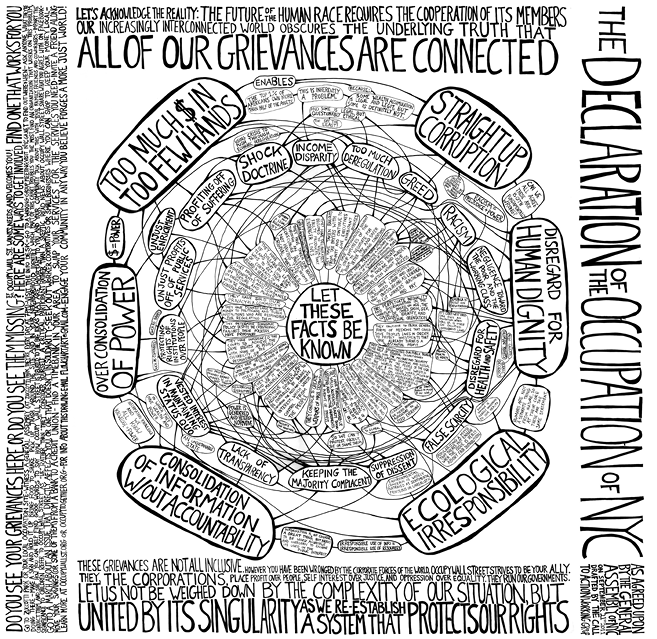

 Open access