Non-flying mammals have been recognized as pollination vectors for decades (Carthew & Goldingay Reference CARTHEW and GOLDINGAY1997, Goldingay et al. Reference GOLDINGAY, CARTHEW and WHELAN1991, Rourke & Wiens Reference ROURKE and WIENS1977), but only recently have studies focused on demonstrating their importance in global pollination processes (Goldingay et al. Reference GOLDINGAY, CARTHEW and WHELAN1991), and reports of non-flying-mammal pollination exist in every continent in the southern hemisphere (Willmer Reference WILLMER2011). Non-flying mammals can be part of highly specialized pollination systems or just occasional visitors (Johnson & Pauw Reference JOHNSON and PAUW2014, Rourke & Wiens Reference ROURKE and WIENS1977), serving both specialist and generalist pollination niches.
Worldwide, non-flying mammals acting as pollinators are a diverse group and include marsupials, rodents, primates and carnivores. Well-documented examples report at least 60 species of non-flying mammal that pollinate across 20 plant families (Willmer Reference WILLMER2011). In America, reports of flower visitation by non-flying mammals primarily include primates and carnivores (Janson et al. Reference JANSON, TERBORGH and EMMONS1981, Willmer Reference WILLMER2011), but other taxa, such as rodents, are also thought to be key pollinators for multiple species. Yet, flower visitation by rodents has been reported only twice in the Americas: Lumer (Reference LUMER1980) presented evidence of an unidentified rodent visiting flowers of Blakea sp. (Melastomataceae) in Costa Rica; while Cocucci & Sersic (Reference COCUCCI and SERSIC1998) described the pollination of Caiophora coronata (Loasaceae) by the mouse Graomys griseoflavus (Muridae) in Argentina. Considering that non-flying mammals are important pollinators in other regions (Carthew & Goldingay Reference CARTHEW and GOLDINGAY1997, Willmer Reference WILLMER2011), more research is necessary to understand the role of this group as pollinator of Neotropical plants.
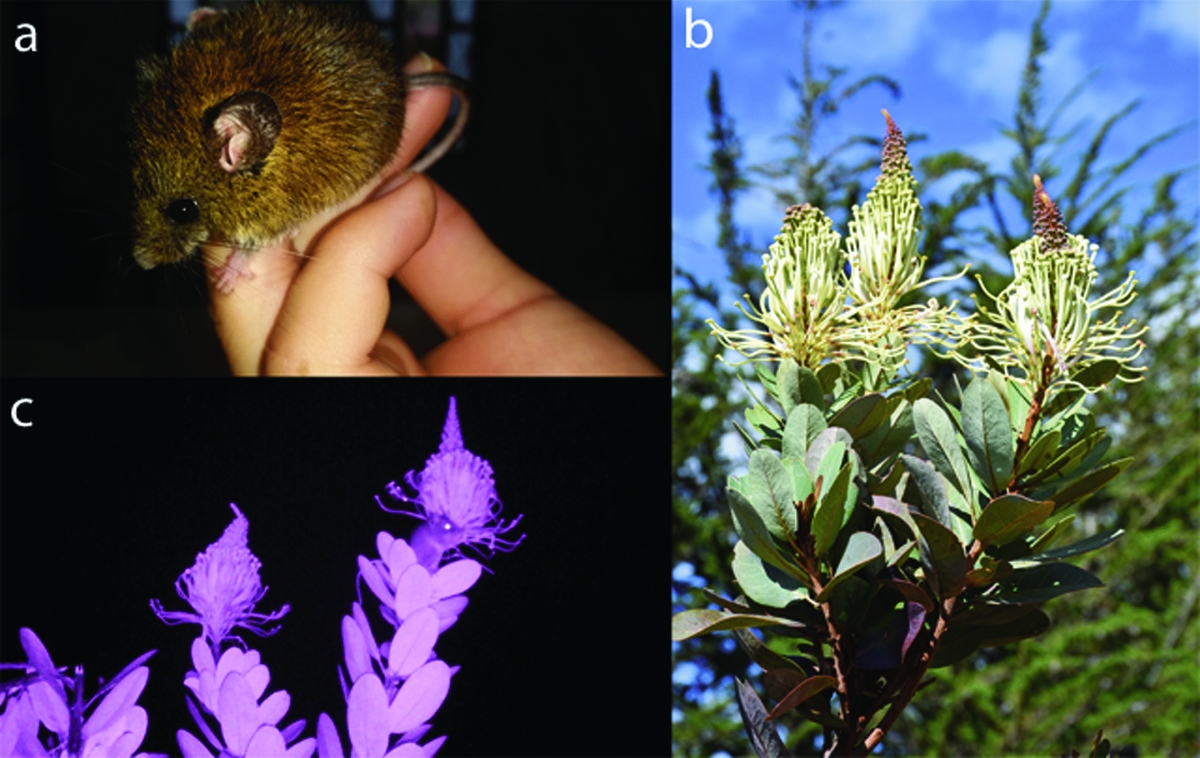
In this study we present evidence for rodent visitation to Oreocallis grandiflora (Lam.) R.Br. (Figure 1a), a widespread Andean tree (Proteaceae). We found that the mouse Microryzomys altissimus (Cricetidae) (Osgood 1933) (Figure 1b)visits inflorescences and transports pollen of O. grandiflora. This is the first record of flower visitation by rodents in the Neotropical Andes to our knowledge.
Specimen of Microryzomys altissimus, trap captured (a). Oreocallis grandiflora (Lam.) R. Br., from the study site ‘El Gullán’ (photo by Pedro Machado) (b). M. altissimus visiting O. grandiflora. The individual can be seen on the far right of the inflorescence (c).

Our study was conducted in El Gullán Biological Station (3°20′17.35″S, 79°10′16.89″W), at 3000–3400 m asl, in the southern Andes of Ecuador. El Gullán is located 52 km south from the city of Cuenca in Azuay Province. This site is characterized by high-elevation montane shrubland vegetation. Rain patterns in the study site are seasonal with a wet period from September to May and a dry season from June to August. Fieldwork was conducted during both rainy and dry seasons, from May 2014 to February 2016.
Oreocallis grandiflora is native to the Andean highlands, and is the only species in the genus Oreocallis (Prance & Plana Reference PRANCE and PLANA1998). It is distributed from southern Ecuador to northern Peru, at 1000–4000 m asl. Oreocallis grandiflora occupies a variety of vegetation types, including montane forest, montane shrublands and elfin forest (Weston Reference WESTON and Kubitzki2007). In El Gullán, it is a common species that occupies shrubby habitats and open grasslands. Oreocallis grandiflora has terminal inflorescences, composed of whitish protandric flowers that feature a modification of the upper part of the style in the form of a pollen presenter, petal colour may vary from white to dark pink geographically (Hazlehurst et al. Reference HAZLEHURST, TINOCO, CÁRDENAS and KARUBIAN2016). It grows as a shrub or tree up to 6 m in height. A complete botanical description of the species can be found in Pennington (Reference PENNINGTON, Prance, Plana, Edwards and Pennington2007). In the studied population, nectar availability remains constant throughout day and night hours, and has a nectar standing crop of 15.1 ± 1.5 µl on average throughout both day and night, with a mean sugar concentration of 27.8% ± 1.6% Brix (Hazlehurst et al. Reference HAZLEHURST, TINOCO, CÁRDENAS and KARUBIAN2016). Anthesis occurs at any time, during both day and night.
To study potential pollinators visiting O. grandiflora we used camera traps (Moultrie M-990i MCG-1) triggered by motion sensors, and camcorders equipped with infrared lights (Bell and Howell DNV16HDZ). Camera traps and video cameras were positioned 0.5–1.5 m away from inflorescences. Cameras started recording at nightfall, at around 18h00, and were removed by dawn, at around 05h00. Overall, during our study period we completed 241 h of camera-trap images and 80 h of video recordings.
In February 2016, we employed 40 Sherman traps to capture potential rodent visitors to O. grandiflora. The traps were set up on the base of O. grandiflora plants for three nights. We used the guide by Patton et al. (Reference PATTON, PARDIÑAS and D'ELÍA2015) to identify rodents to species. Moreover, we took pollen samples from the fur of captured individuals using clear adhesive tape. Later, pollen samples were identified under a microscope, using a reference palynological collection. Images from camera traps and video footage were analysed and compared with the individuals captured, to identify the rodent species visiting O. grandiflora.
Video footage and camera trap images revealed flower visitation by one rodent species, identified as Microryzomys altissimus (Figure 1c). This identification was confirmed with live-captured animals.
Individuals recorded in the footage videos were clearly feeding from the nectar of O. grandiflora flowers (Supplementary video 1). In total, 22 visits were documented. During the visits, M. altissimus displayed a rather delicate manipulation of flowers, not causing any damage to flowers or inflorescences. While searching the inflorescence for nectar, different parts of the body, but mainly the abdomen, were in contact with pollen presenters and stigmas. A visit to a plant would include various inflorescences, or just one; the mice would take leaps between nearby inflorescences using the leaves as platforms, which could withstand their weight. The samples taken from the fur of captured individuals confirmed that M. altissimus transports pollen of O. grandiflora. Pollen was mainly distributed along the chest, feet and head.
The presence of O. grandiflora pollen on the fur of M. altissimus combined with the video footage of the fur making contact with floral reproductive structures suggest this mouse could be a potential pollinator. Controlled exclusion experiments could confirm actual pollination.
In addition to M. altissimus, we recorded floral visits by six hummingbird species: Aglaeactis cupripennis (Bourcier, 1843), Coeligena iris (Gould, 1854), Metallura tyrianthina (Loddiges, 1832), Heliangelus viola (Gould, 1853), Lesbia nuna (Lesson, 1832) and Lesbia victoriae (Bourcier & Mulsant, 1846); and a bat, Anoura geoffroyi (Gray, 1838). This diversity of taxa visiting O. grandiflora suggests a generalist strategy when attracting pollinators. A pollen presenter, nectaries located at the base of the flower, copious nectar, are all traits that predict ornithophily (van der Pijl Reference VAN DER PIJL1961). However, the high visibility of the inflorescence in terms of size and location, the creamy-white (somewhat dull) colouration, prolonged stigma receptivity, nocturnal and diurnal anthesis (Landázuri et al. unpubl. data), and relatively high nectar volume are all traits associated with mammal pollination (Baker Reference BAKER1961, Johnson & Pauw Reference JOHNSON and PAUW2014, Johnson et al. Reference JOHNSON, PAUW and MIDGLEY2001, Rourke & Wiens Reference ROURKE and WIENS1977, van der Pijl Reference VAN DER PIJL1961). Future research should investigate additional floral traits such as nectar phytochemistry, since some sugars such as xylose might act as an exclusive reward for rodents (Jackson & Nicolson Reference JACKSON and NICOLSON2002).
Little is known about the general ecology of M. altissimus. This species occurs at high altitudes of the central Andes, from central Colombia to Northern Peru (Patton et al. Reference PATTON, PARDIÑAS and D'ELÍA2015). In Ecuador, it inhabits páramo and high Andean forests, including mountain foothills at altitudes of 2000–4500 m asl (Tirira Reference TIRIRA2007). It shows arboreal habits (Carleton & Musser Reference CARLETON and MUSSER1995) and an omnivorous diet (Noblecilla & Pacheco Reference NOBLECILLA and PACHECO2012). Pollen samples taken from the fur of M. altissimus in our study also included pollen grains from two other unidentified plant species, suggesting that M. altissimus might be also visiting flowers of other plant species in our study area. In addition, even though rainfall seasonality in the study area can produce temporal variation in the availability of resources for animals, O. grandiflora produces flowers all year round and has constant nectar production throughout the day; therefore a stable resource source in the study area could influence foraging explorations by M. altissimus (Noblecilla & Pacheco Reference NOBLECILLA and PACHECO2012).
Hazlehurst et al. (Reference HAZLEHURST, TINOCO, CÁRDENAS and KARUBIAN2016) compared the pollination ecology of O. grandiflora in our study site, El Gullán, located at the northern limit of the distribution of the species, with a population at the southern limit of the species in southern Peru. Flowers from the northern distribution of the species were more whitish, had longer style length, and produced more nectar compared with the flowers from the southern population. Moreover, O. grandiflora in Peru was not visited by any mammal species, in contrast to our observations of bats and rodents visiting O. grandiflora flowers in Ecuador. Hazlehurst et al. (Reference HAZLEHURST, TINOCO, CÁRDENAS and KARUBIAN2016) postulated that non-flying mammals could be playing a role in the phenotypic differences among populations of O. grandiflora.
Studies of pollination interactions in O. grandiflora can offer the opportunity of increasing our understanding of the evolution of generalist pollination strategies, which could be accomplished by comparing the pollination performance among the different vertebrate groups that visit this plant. Moreover, Proteaceae are an old family originating in Gondwana in the Early Cretaceous (Barker et al. Reference BARKER, WESTON, RUTSCHMANN and SAUQUET2007, Johnson & Briggs Reference JOHNSON and BRIGGS1975, Weston & Barker Reference WESTON and BARKER2000), and early radiation of the group was likely influenced by interactions with pollinators. Today birds (Chalcoff et al. Reference CHALCOFF, AIZEN and EZCURRA2012, Collins & Rebelo Reference COLLINS and REBELO1987, Ford et al. Reference FORD, PATON and FORDE1979, Geerts & Pauw Reference GEERTS and PAUW2009), bats (Hazlehurst et al. Reference HAZLEHURST, TINOCO, CÁRDENAS and KARUBIAN2016) and non-flying mammals (Collins & Rebelo Reference COLLINS and REBELO1987, Johnson & Pauw Reference JOHNSON and PAUW2014, Johnson et al. Reference JOHNSON, PAUW and MIDGLEY2001, Melidonis & Peter Reference MELIDONIS and PETER2015, Wiens & Rourke Reference WIENS and ROURKE1978) pollinate Proteaceae in every continent where the family occurs; thus, it will be interesting to explore the role of phylogenetic conservatism or evolutionary convergence in Proteaceae floral traits that influence the use of the same pollinator groups across continents.
Supplementary material
To view supplementary material for this article, please visit http://doi.org/10.1017/S0266467417000025
ACKNOWLEDGEMENTS
Fieldwork for this project was assisted by students from the Universidad del Azuay, and volunteer Pedro Machado, who also contributed with O. grandiflora pictures. We would also like to thank Jenny Hazlehurst for the comments and suggestions. This work was conducted with a research grant from Decanato de Investigaciones, Universidad del Azuay.