Internalizing symptoms and disorders are among the most costly mental health problems in Western society (Collins et al., Reference Collins, Patel, Joestl, March, Insel and Daar2011). Research on internalizing symptoms has historically focused on the early adolescent ages and onward (e.g., Angold, Erkanli, Silberg, Eaves, & Costello, Reference Angold, Erkanli, Silberg, Eaves and Costello2002; Deković, Buist, & Reitz, Reference Deković, Buist and Reitz2004; Galambos, Barker, & Almeida, Reference Galambos, Barker and Almeida2003; Kovacs & Paulauskas, Reference Kovacs, Paulauskas, Cicchetti and Schneider-Rosen1984; Twenge & Nolen-Hoeksema, Reference Twenge and Nolen-Hoeksema2002). However, recent work has shown that rates of internalizing problems during childhood are comparable to those later in life, with 10% to 15% of US preschoolers meeting diagnostic criteria for a DSM anxiety or depressive disorder at any one assessment (Egger & Angold, Reference Egger and Angold2006; Keenan, Shaw, Walsh, Delliquadri, & Giovannelli, Reference Keenan, Shaw, Walsh, Delliquadri and Giovannelli1997). Such early-onset internalizing problems predict more severe and persistent later mental health problems (e.g., Christie et al., Reference Christie, Burke, Regier, Rae, Boyd and Locke1988; Kasch & Klein, Reference Kasch and Klein1996; Kovacs, Reference Kovacs1996). Therefore, understanding the development of internalizing symptoms during childhood may be key to preventing high costs associated with internalizing disorders across the life course.
The development of childhood internalizing symptoms can best be understood within a multilevel developmental psychopathology perspective, which draws on multiple levels of analyses in understanding adaptation and maladaptation across development (e.g., Calkins & Fox, Reference Calkins and Fox2002; Cicchetti, Reference Cicchetti, Beauchaine and Hinshaw2008; Cicchetti & Blender, Reference Cicchetti and Blender2006; Cicchetti & Dawson, Reference Cicchetti and Dawson2002; Sroufe & Rutter, Reference Sroufe and Rutter1984). According to this perspective, multiple contributors from different levels of biological and ecological influence co-act and interact in the development of psychopathology. Here, we focus on several risk factors at the child's level: gender, vagal regulation of cardiac activity, and behavioral regulation (externalizing symptoms). We also test how such individual-level risks interact with contextual risk, including maternal psychopathology, in increasing or alleviating risk for internalizing symptoms. Of note, one of the key constructs in our study, the child's physiological reactivity during challenge, illustrates how developmental influences can be risky or protective depending on the context in which they occur (Belsky & Pluess, Reference Belsky and Pluess2009; Ellis & Boyce, Reference Ellis and Boyce2005; Essex, Armstrong, Burk, Goldsmith, & Boyce, Reference Essex, Armstrong, Burk, Goldsmith and Boyce2011; Obradović, Bush, Stamperdahl, Adler, & Boyce, Reference Obradović, Bush, Stamperdahl, Adler and Boyce2010). Thus, our study will be informative about a key construct in the developmental psychopathology perspective, multifinality of outcomes, for children who display high versus low levels of vagal withdrawal when confronted with challenge (Cicchetti & Rogosch, Reference Cicchetti and Rogosch1999; Richters, Reference Richters1997).
Taken together, the present study draws on a multilevel perspective to describe developmental trajectories of internalizing symptoms in children aged 4 to 10 years old in a community sample, and to test sex differences in these trajectories. The study also examines how children's individual-level factors—including sex and vagal regulation of cardiac activity—and maternal risks interact in predicting internalizing symptoms, and whether these associations change across development. We use a multilevel modeling approach analysis, which capitalizes on repeated measurements from study participants to extract information about changes within the person and stable between-persons differences (Curran & Bauer, Reference Curran and Bauer2011; Hoffman & Stawski, Reference Hoffman and Stawski2009).
Trajectories of Internalizing Symptoms During the Childhood Years
Overall trajectories
Internalizing-spectrum symptoms primarily include symptoms of depression and anxiety, and social withdrawal and somatic changes (Achenbach & Edelbrock, Reference Achenbach and Edelbrock1983). Few studies have examined developmental trajectories of such internalizing symptoms before adolescence. To date, these studies typically report small, if any, overall increases in mother- and teacher-reported internalizing symptoms from ages 2 to approximately ages 8 to 10 (Colder, Mott, & Berman, Reference Colder, Mott and Berman2002; Gazelle & Ladd, Reference Gazelle and Ladd2003; Sterba, Prinstein, & Cox, Reference Sterba, Prinstein and Cox2007). Although overall changes appear to be small, evidence points to larger increases in internalizing symptoms among subsets of children, especially among children with individual-level (e.g., temperamental) and/or contextual-level (e.g., poor relationships) risks (Gazelle & Ladd, Reference Gazelle and Ladd2003).
Sex differences in trajectories
Internalizing symptoms are known to be more prevalent in females than in males from midadolescence (Angold et al., Reference Angold, Erkanli, Silberg, Eaves and Costello2002; Twenge & Nolen-Hoeksema, Reference Twenge and Nolen-Hoeksema2002; Zahn-Waxler, Klimes-Dougan, & Slattery, Reference Zahn-Waxler, Klimes-Dougan and Slattery2000) throughout the reproductive years. However, evidence for sex differences before midadolescence is mixed. A number of reviews suggested that, if anything, there may be a slight male excess in internalizing disorders before puberty (e.g., Angold & Worthman, Reference Angold and Worthman1993). Consistent with these suggestions, teacher-reported internalizing symptoms were higher in males than in females in one sample of kindergarteners, but subsequent changes in internalizing symptoms across the elementary school years did not differ by sex (Gazelle & Ladd, Reference Gazelle and Ladd2003). However, other community-based studies found no sex differences in initial levels of or changes in internalizing symptoms during the childhood years (Colder et al., Reference Colder, Mott and Berman2002). Finally, in a large community sample that was representative of several communities in the United States, a higher proportion of girls than boys had elevated and stable internalizing symptoms (Sterba et al., Reference Sterba, Prinstein and Cox2007).
Thus, although internalizing disorders are common in childhood, studies that have explicitly focused on changes in internalizing symptoms over time have generally reported that overall increases and sex differences in internalizing symptoms during the preadolescent years are small and/or limited to children with particular vulnerabilities. However, renewed attention to potential increases in internalizing symptoms during the preadolescent period, including sex differences in changes, is warranted. Puberty played a central role in doubling rates of internalizing disorders by ages 12–13 in previous cohorts (e.g., Angold, Costello, & Worthman, Reference Angold, Costello and Worthman1998). Secular changes in pubertal onset have since been documented, with pubertal processes in females currently beginning up to 2 years earlier compared to previous cohorts (Herman-Giddens, Reference Herman-Giddens2006). Therefore, we hypothesize that in our more recent cohort, we may observe increases in females' internalizing symptoms during the late middle childhood years.
Cardiac Regulation as a Correlate of Childhood Internalizing Symptoms
Neuroendocrine processes associated with the onset of puberty in females are not the only biological risk factors that have been linked to the development of internalizing symptoms. In this paper, we focus on the role of children's vagal regulation of cardiac activity, and its interaction with maternal risk, in the development of internalizing symptoms. Porges's polyvagal theory suggests that vagal regulation of cardiac activity often is involved in deficits in children's emotional regulation and social functioning, and thus could serve as one of the biological foundations of problem behaviors in children (Porges, Reference Porges2003, Reference Porges2007; Porges & Furman, Reference Porges and Furman2011). Here, we focus on interindividual differences in activity of the parasympathetic nervous system, using two specific measures.
First, we measure baseline respiratory sinus arrhythmia (RSA) when children are resting in the laboratory without being exposed to environmental challenge. High baseline RSA (which we also refer to as baseline vagal tone) is thought to reflect the organism's ability to support physiological and behavioral response when needed, and thus to reflect a higher capacity and flexibility in responding to environmental demands, including for regulating emotional reactivity (e.g., Calkins & Keane, Reference Calkins and Keane2004; Fortunato, Gatzke-Kopp, & Ram, Reference Fortunato, Gatzke-Kopp and Ram2013). For example, high baseline vagal tone has been linked with positive psychological adjustment and more successful regulation of negative emotions in children and adolescents (Beauchaine, Reference Beauchaine2001; Calkins & Fox, Reference Calkins and Fox2002) and in adults (Kok & Fredrickson, Reference Kok and Fredrickson2010). When the sample used here was studied at earlier ages (to age 5), higher levels of baseline vagal tone were associated with fewer internalizing symptoms (Calkins, Blandon, Williford, & Keane, Reference Calkins, Blandon, Williford and Keane2007).
Second, we measure changes in vagal activity during times of challenge. Porges's theory suggests that during times of challenge, vagal input to the heart is withdrawn, resulting in decreases in RSA and a freeing up of physiological resources that will allow the organism to engage with and address challenges encountered (Porges, Reference Porges2003, Reference Porges2007; Porges & Furman, Reference Porges and Furman2011). In calculating such vagal withdrawal, we subtract RSA during a laboratory challenge from baseline RSA. The resultant measure is referred to as vagal withdrawal (or change RSA, vagal regulation, suppression, reduction, or brake). It is viewed as a marker of parasympathetic-based physiological regulation, and assesses whether RSA decreases from baseline RSA when children encounter a challenge that requires active coping or emotional and behavioral regulation.
Vagal withdrawal during challenge is interpreted to reflect the organism's attention to and mobilization of resources to engage with and address that challenge. Nevertheless, the role of vagal withdrawal in psychopathology is less clear compared to the role of baseline vagal tone (Fortunato et al., Reference Fortunato, Gatzke-Kopp and Ram2013). A lack of vagal withdrawal (or “blunted” vagal withdrawal) and RSA augmentation in response to challenge has been associated with greater levels of externalizing-spectrum behaviors (e.g., Calkins, Graziano, & Keane, Reference Calkins, Graziano and Keane2007; Fortunato et al., Reference Fortunato, Gatzke-Kopp and Ram2013; Porges, Doussard-Roosevelt, Portales, & Greenspan, Reference Porges, Doussard-Roosevelt, Portales and Greenspan1996). However, the findings with respect to internalizing-spectrum symptoms and disorders are less consistent (Graziano & Derefinko, Reference Graziano and Derefinko2013). Some work suggests that low vagal withdrawal could restrict children's ability to successfully cope with stressors (Graziano & Derefinko, Reference Graziano and Derefinko2013). Some studies have reported evidence of lower withdrawal scores being associated with more internalizing symptoms (Gentzler, Santucci, Kovacs, & Fox, Reference Gentzler, Santucci, Kovacs and Fox2009; Schmidt, Fox, Schulkin, & Gold, Reference Schmidt, Fox, Schulkin and Gold1999). Other work suggests that it may be high levels of vagal withdrawal that are associated with dysregulated affect and internalizing-spectrum problems (Beauchaine, Reference Beauchaine2001; Fortunato et al., Reference Fortunato, Gatzke-Kopp and Ram2013; Friedman, Reference Friedman2007; Gazelle & Druhen, Reference Gazelle and Druhen2009; Hinnant & El-Sheikh, Reference Hinnant and El-Sheikh2009). The highest levels of vagal withdrawal have been reported in young people with particularly severe (Crowell et al., Reference Crowell, Beauchaine, McCauley, Smith, Stevens and Sylvers2005) and comorbid forms of internalizing symptoms (Calkins, Graziano, et al., Reference Calkins, Graziano and Keane2007). For example, using just age 5 data from the data set used here, Calkins, Graziano, et al. (Reference Calkins, Graziano and Keane2007) reported that children with comorbid internalizing and externalizing symptoms had the highest levels of vagal withdrawal across five different laboratory tasks.
In sum, high baseline RSA is typically universally associated with higher adaptation across different psychopathology outcomes. Evidence for associations between vagal withdrawal in response to challenge and internalizing symptoms is mixed, with some work suggesting that this measure has the potential to discriminate between externalizing and internalizing symptoms (Boyce et al., Reference Boyce, Quas, Alkon, Smider, Essex and Kupfer2001; Calkins, Blandon, et al., Reference Calkins, Blandon, Williford and Keane2007). Considering previous cross-sectional reports from our study, we expected that high vagal withdrawal would be associated with more internalizing symptoms, perhaps especially when high vagal withdrawal is combined with high externalizing symptoms. However, we also took into account several additional considerations, including heterogeneity of internalizing symptoms, contextual risk, and developmental–methodological considerations in further clarifying associations between cardiac regulation and internalizing psychopathology.
Additional Considerations in Understanding Cardiac Regulation–Internalizing Symptoms Associations
Heterogeneity in childhood internalizing symptoms
Much of the work examining children's internalizing symptoms and cardiac regulation has relied on relatively generic summary assessments of child internalizing psychopathology, such as the total internalizing symptoms scale of the Child Behavior Checklist (CBCL; Achenbach & Edelbrock, Reference Achenbach and Edelbrock1983). However, the internalizing symptoms assessed on this scale (anxious/depressed, somatic, and withdrawal symptoms) are quite heterogeneous and could have distinct physiological correlates (e.g., Antonijevic, Reference Antonijevic2006; Rottenberg, Chambers, Allen, & Manber, Reference Rottenberg, Chambers, Allen and Manber2007). Of note, the vagus nerve innervates not only the heart but also the viscera, including the stomach. In addition, the vagus nerve is involved in immune system–brain communications, including in the development of cytokine-induced somatic symptoms or “sickness behaviors” (e.g., Dantzer, Konsman, Bluthé, & Kelley, Reference Dantzer, Konsman, Bluthé and Kelley2000; Konsman, Parnet, & Dantzer, Reference Konsman, Parnet and Dantzer2002; Marsland et al., Reference Marsland, Gianaros, Prather, Jennings, Neumann and Manuck2007; Pavlov & Tracey, Reference Pavlov and Tracey2004; Thayer & Sternberg, Reference Thayer and Sternberg2006, Reference Thayer and Sternberg2010). Thus, it is possible that interindividual variation in vagal regulation is particularly closely associated with the somatic symptoms reported on the CBCL, including stomach aches, nausea, feeling sick, and physical problems without a known cause. Cross-sectional work from the preadolescent Tracking Adolescents' Individual Lives Survey sample suggested that the association of autonomic measures and internalizing symptoms could even be in opposite directions for somatic versus cognitive–affective symptoms (Bosch et al., Reference Bosch, Riese, Dietrich, Ormel, Verhulst and Oldehinkel2009).
Increased sensitivity to risky environments
A second consideration that has been raised in response to inconsistencies in findings regarding associations between vagal withdrawal and psychopathology is the possibility that vagal withdrawal may actually represent a double-edged sword in children's development, because its role may be highly dependent on contexts (Ellis & Boyce, Reference Ellis and Boyce2005; Essex et al., Reference Essex, Armstrong, Burk, Goldsmith and Boyce2011; Obradović et al., Reference Obradović, Bush, Stamperdahl, Adler and Boyce2010). High vagal withdrawal could create biological sensitivities that allow children to flourish in optimal environments. Furthermore, high vagal withdrawal could reflect adaptive coping with select stressors (e.g., Obradović, Reference Obradović2012). Conversely, in contexts characterized by overwhelming, “toxic” risks (Shonkoff & Garner, Reference Shonkoff and Garner2012), high vagal withdrawal could increase risk for children's internalizing psychopathology.
Environments created by mothers with high levels of internalizing symptoms have been described as emotionally disengaged from the child, with high levels of negative and depressive affect, depressive behaviors and cognitions, and increases in stressful life events in the environment of the child (e.g., Goodman & Gotlib, Reference Goodman and Gotlib1999). Furthermore, anxious and depressed mothers have sometimes been described as overintrusive and controlling (e.g., Lovejoy, Graczyk, O'Hare, & Neuman, Reference Lovejoy, Graczyk, O'Hare and Neuman2000; Wood, McLeod, Sigman, Hwang, & Chu, Reference Wood, McLeod, Sigman, Hwang and Chu2003). When coupled with a child's high capacity to engage with environmental challenge, maternal depression and anxiety could become overwhelming to the child (Beauchaine, Reference Beauchaine2001; Crowell et al., Reference Crowell, Beauchaine, McCauley, Smith, Stevens and Sylvers2005), and thus further enhance risks for child internalizing symptoms (e.g., Goodman & Gotlib, Reference Goodman and Gotlib1999; Sterba et al., Reference Sterba, Prinstein and Cox2007). Therefore, we hypothesize that high levels of vagal withdrawal will be particularly associated with internalizing symptoms in children whose mother suffers from high levels of internalizing symptomatology.
Changing associations across development
A third consideration is that the nature of the association between cardiac regulation and internalizing symptoms could change in late childhood/early adolescence with the onset of pubertal processes. One set of empirical findings has shown that risk factors that are linked with internalizing symptoms during other developmental periods (e.g., childhood and adulthood) may temporarily cease to be associated with internalizing symptoms during times of dramatic biopsychosocial change (e.g., Shanahan, Copeland, Angold, & Costello, Reference Shanahan, Copeland, Angold and Costello2011), including during adolescence when biological risk factors such as pubertal hormones and low birth weight may become more prominent in etiological pathways (e.g., Costello, Worthman, Erkanli, & Angold, Reference Costello, Worthman, Erkanli and Angold2007). During this time, stress systems could at least partially be recalibrated (Del Giudice, Ellis, & Shirtcliff, Reference Del Giudice, Ellis and Shirtcliff2011), perhaps accounting for at least some of the temporary suspensions of associations between risk factors and internalizing outcomes. Other sets of findings suggest that during later parts of adolescence, stress-sensitivity increases, especially in girls (e.g., Ge, Conger, & Elder, Reference Ge, Conger and Elder2001; Ge, Natsuaki, & Conger, Reference Ge, Natsuaki and Conger2006). In either scenario, the changing biological milieu and stress sensitivity could contribute to (potentially sex-differentiated) changes in associations between vagal regulation of cardiac activity and internalizing symptoms across development.
Developmental–Methodological Considerations
Inconsistencies in findings regarding vagal withdrawal and psychopathology have stimulated not only conceptual but also methodological thinking about how to best study vagal regulation of cardiac activity. Young children's baseline vagal tone demonstrates considerable stability across assessments, even when spaced years apart (e.g., Bornstein & Suess, Reference Bornstein and Suess2000; Perry et al., Reference Perry, Nelson, Swingler, Leerkes, Calkins and Marcovitch2013). Thus, interindividual differences in vagal tone are detectable even at a young age. However, measures of vagal withdrawal are much less stable. Such low stability may be adaptive considering that highly stable stress reactivity could prevent children from responding adaptively to changing environments and times. During the childhood years, correlations of vagal withdrawal from year to year are moderate in size at best (e.g., Calkins & Keane, Reference Calkins and Keane2004; Perry et al., Reference Perry, Nelson, Swingler, Leerkes, Calkins and Marcovitch2013), but often these correlations are small and nonsignificant (e.g., Bornstein & Suess, Reference Bornstein and Suess2000; Perry et al., Reference Perry, Nelson, Swingler, Leerkes, Calkins and Marcovitch2013), even across 2-week intervals (e.g., Doussard-Roosevelt, Montgomery, & Porges, Reference Doussard-Roosevelt, Montgomery and Porges2003).
Such instability poses a conundrum to developmental psychopathologists. On the one hand, the field strives to understand developmental changes in context. Therefore, changes in vagal withdrawal across time and contexts and their associations with psychopathology are often interpreted to reflect meaningful changes and adaptations. On the other hand, the field is also interested in stable interindividual differences in self-regulatory capabilities that protect individuals in the face of adversity or increases their susceptibility to the development of psychopathology, but such interindividual differences may not be well captured with any single vagal withdrawal score. It is possible that when we consider only single time-, situation-, or even task-specific measurements of vagal withdrawal, our understanding of any stable interindividual differences in vagal withdrawal and their role in the development of psychopathology will be incomplete.
Therefore, recent work has suggested capitalizing on multiple measurements of vagal withdrawal to differentiate stable interindividual differences in vagal withdrawal from within-person changes and fluctuations that could be situation specific, and to test how each of these aspects of vagal withdrawal is associated with psychopathology (Burt & Obradović, Reference Burt and Obradović2013). Consistent with this suggestion, we use a multilevel analytic strategy that capitalizes on four measurement points, allowing us to disaggregate within-person changes and fluctuations from between-persons stable differences in vagal withdrawal in order to better understand the signal between vagal withdrawal and internalizing psychopathology. We hypothesize that when we disaggregate vagal withdrawal observations over time into within-person changes/fluctuations versus more stable, traitlike between-persons differences, it will be the between-persons differences that are most strongly associated with children's psychopathology, a finding that has also been reported for other highly reactive physiological systems involved in stress regulation (e.g., Shirtcliff, Granger, Booth, & Johnson, Reference Shirtcliff, Granger, Booth and Johnson2005).
The Present Study
Taken together, the first goal of our study was to chart the developmental course of mother-reported internalizing symptoms from ages 4 to 10 in a relatively recent cohort of children, and to test sex differences in these trajectories. A second goal was to shed light on the role of baseline vagal tone and vagal withdrawal in children's internalizing symptoms. We expected that higher levels of vagal tone would be associated with lower internalizing symptoms but that higher vagal withdrawal would be associated with higher internalizing symptoms. A third goal was to test whether associations between vagal regulation of cardiac activity and children's internalizing symptoms would be modified by the presence of maternal internalizing psychopathology. In conducting our analyses, we acknowledge the heterogeneity of internalizing symptoms. We also test whether associations differ by age and by sex. We used data from the long-term longitudinal ongoing Right Track Study. Internalizing symptoms in this study had previously been studied to age 5 (Calkins, Blandon, et al., Reference Calkins, Blandon, Williford and Keane2007); the present study incorporates assessments at ages 7 and 10.5 years old and applies a multilevel modeling methodology in analyzing associations between vagal activity and trajectories of internalizing symptoms to late middle childhood.
Method
Participants
The current study used data from three cohorts of children who are part of an ongoing longitudinal study. The goal for recruitment was to obtain a sample of children who were at risk for developing future externalizing behavior problems that was representative of the surrounding community in terms of race and socioeconomic status (SES). All cohorts were recruited through child daycare centers, the county health department, and the local Women, Infants, and Children program. Potential participants for Cohorts 1 and 2 were recruited at 2 years of age (Cohort 1, 1994–1996; Cohort 2, 2000–2001) and screened using the CBCL 2–3 (Achenbach, Reference Achenbach1992) completed by the mother in order to oversample for externalizing behavior problems. Children were identified as being at risk for future externalizing behaviors if they received an externalizing T score of 60 or above. Efforts were made to obtain approximately equal numbers of males and females. This recruitment effort resulted in a total of 307 children. Cohort 3 was initially recruited when infants were 6 months of age (in 1998) for their level of frustration based on laboratory observation and parent report and were followed through the toddler period (for more information, see Calkins, Dedmon, Gill, Lomax, & Johnson, Reference Calkins, Dedmon, Gill, Lomax and Johnson2002). Children from Cohort 3 whose mothers completed the CBCL at 2 years of age (N = 140) were then included in the larger study. Of the entire sample (N = 447), 37% of the children were identified as being at risk for future externalizing problems at age 2. There were no significant demographic differences between cohorts with regard to gender, χ2 (2, N = 447) = 0.63, p = .73, race, χ2 (2, N = 447) = 1.13, p = .57, or 2-year SES, F (2, 444) = 0.53, p = .59.
Of the 447 originally selected participants, 6 were dropped because they did not participate in any data collection at 2 years old. An additional 12 families participated at recruitment, did not participate at 2 years of age, but did participate at later years. At 4 years of age, 399 families participated. Families lost to attrition included those who could not be located, moved out of the area, declined participation, or did not respond to phone and letter requests to participate. There were no significant differences between families who did and did not participate at age 4 in terms of gender, χ2 (1, N = 447) = 3.27, p = .07, race, χ2 (1, N = 447) = 0.65, p = .42, 2-year SES, t (432) = –0.92, p = .36, or 2-year externalizing T score, t (445) = 0.45, p = .65. At age 5, 365 families participated, including 4 who did not participate in the 4-year assessment. Again, there were no significant differences between families who did and did not participate in terms of gender, χ2 (1, N = 447) = 0.76, p = .38, race, χ2 (1, N = 447) = 0.14, p = .71, 2-year SES, t (432) = –01.93, p = .06, or 2-year externalizing T score, t (445) = 1.39, p = .17.
At 7 years of age, 350 families participated, including 19 who did not participate in the 5-year assessment. Again, there were no significant differences between families who did and did not participate in terms of gender, χ2 (1, N = 447) = 2.12, p = .15, race, χ2 (3, N = 447) = 0.19, p = .67, or 2-year externalizing T score, t (445) = 1.30, p = .19. Families with lower 2-year SES, t (432) = –2.61, p < .01, were less likely to participate in the 7-year assessment. At age 10, 357 families participated, including 31 families who did not participate in the 7-year assessment. No significant differences were noted between families who did and did not participate in the 10-year assessment in terms of child gender, χ2 (1, N = 447) = 3.31, p = .07, race, χ2 (3, N = 447) = 3.12, p = .08, 2-year SES, t (432) = 0.02, p = .98, or 2-year externalizing T score, t (445) = –0.11, p = .91.
At the 4-year laboratory visit, 67% of the sample was European American, 27% African American, 4% biracial, and 2% Hispanic, and families were economically diverse. Hollingshead (Reference Hollingshead1975) Four Factor Index of Social Status scores for our sample ranged from 14 to 66 (M = 42.43, SD = 10.64), meaning that families from each level of social strata captured by this scale were represented in the current sample. Scores ranging from 40 to 54 are representative of the middle class. Averaged across all ages, maternal internalizing symptoms were at M = 0.36, SD = 3.55 for the raw scores and M = 48.11, SD = 7.64 for the T scores. In the current analyses, the sample was limited to children who had at least one valid assessment of physiological data between ages 4 to 10 and who also had data on internalizing symptoms (N = 384 children; 176 male, 208 female).
Procedures
Children and their mothers came to our university-based laboratory to participate in the study. Consent from mothers and, beginning at age 4, verbal assents from children were obtained before data collection began. Mothers completed questionnaires in a private setting. Mother–child dyads participated in a number of tasks to measure emotional, behavioral, and psychophysiological regulation. Although laboratory procedures were not identical across time points, analogous age-appropriate tasks for children and their mothers were conducted at each time point as a way to maintain measurement equivalence. Mothers received an honorarium of $50 for every assessment that they participated in across the years of the study, and children received small age-appropriate toys for their participation.
Measures
Internalizing symptoms
Mothers reported their children's internalizing symptoms on the CBCL at each age (Achenbach & Edelbrock, Reference Achenbach and Edelbrock1983). Here, we focused on assessments at ages 4, 5, 7, and 10, which used the CBCL for 4- to 18-year-olds. The CBCL has been found to be a reliable index of behavior problems across childhood. The internalizing subscale consisted of 33 items that included the anxious/depressed (13 items), somatic complaints (12 items), and withdrawn subscales (8 items). Examples of anxious/depressed symptoms included “feels worthless or inferior,” “worries,” and “feels or complains that no one loves him/her.” Example somatic symptoms included “nausea, feels sick,” “headaches,” and “stomachaches.” Example withdrawn symptoms included “would rather be alone than with others,” “too shy or timid,” and “withdrawn, does not get involved with others.” Mothers rated their child on a 3-point scale (1 = not true, 2 = sometimes true, and 3 = often true). Because our goal was to model change over time, we used the raw scores, and not the age-adjusted T scores. Higher scores indicated higher internalizing symptoms. Across observations, bivariate correlations among the subscales were as follows: anxious/depressed–somatic: r = .50, p < .01; anxious/depressed–withdrawn: r = .60, p < .01; and somatic–withdrawn: r = .36, p < .01. Because the overall internalizing score and the scores representing each subscale were positively skewed, we used square-root transformed versions of the variables summarizing these scales.
Assessment of baseline vagal tone and vagal withdrawal
For the 4-, 5-, 7-, and 10-year assessments, vagal tone was assessed via an electrocardiogram (EKG) recording of children's RSA and heart rate (HR). Three disposable pediatric electrodes were placed on the child's chest in an inverted triangle pattern. The electrodes were connected to a preamplifier, the output of which was processed through a vagal tone monitor (Delta Biometrics, Inc, Bethesda, MD) for R-wave detection. At the 10-year assessment for Cohorts 2 and 3, updated equipment was used to collect HR in which HR-EKG collection varied slightly. For these cohorts, application of three disposable electrodes were placed on the child using Fetrode® leads in a similar inverted triangle pattern (right collarbone, lower left rib, and lower right side of the stomach). The Fetrode lead is less sensitive to gross motor movement compared to regular electrode leads. The electrodes were connected to a preamplifier, the output of which was processed through a vagal tone monitor (Biolog 399x; UFI; Morro Bay, CA) for R-wave detection. A data file containing the interbeat intervals for the entire period of HR collection was transferred to a laptop computer for later artifact editing (resulting from child movement) and analysis. Analyses were conducted with MXEDIT program for the 4-, 5-, 7-, and 10-year Cohort 1 assessments. For the 10-year Cohorts 2 and 3 assessments, Cardio Batch/Edit software (Brain-Body Center, University of Illinois at Chicago, Chicago) was used.
Both software programs used the Porges (Reference Porges2003) method for deriving RSA values. Editing the files consisted of scanning the data for outlier points. Identified outliers were replaced by dividing or summing them with the adjacent data so that the outliers would be consistent with the surrounding data. Only data files in which less than 10% of the data required editing were included in the current study. The Porges method of analyzing interbeat interval data applies an algorithm to the sequential heart period (HP) data. The algorithm uses a moving 21-point polynomial to detrend periodicities in HP that are slower than RSA. Next, a bandpass filter extracts variance in HP within the frequency band of spontaneous respiration in young children (0.24–1.04 Hz). The natural log (ln) of this variance is taken and reported in units of ln (ms)2. For each of the laboratory tasks, RSA was calculated every 30 s and the average across the 30-s epochs for each episode was used in subsequent analyses. Data were excluded if the standard deviation for an episode was over 1.0.
For the purposes of our data analysis, at each assessment, we used the baseline measurement of vagal tone and measurements of vagal tone taken during challenge tasks. Baseline RSA was generally obtained at the beginning of the laboratory visit while the child was resting in a chair or engaged in a quiet activity that would limit motion artifacts in the data. For example, during ages 4 and 5, children watched a 5-min segment of the videotape Spot. At the 7- and 10-year assessments, children were asked to sit still without talking for 2 and 4 min, respectively.
RSA withdrawal
RSA withdrawal was calculated as the difference between baseline RSA and average RSA during challenge tasks. Positive change scores represented a decrease in RSA from the baseline to the task, reflecting attempts at vagal regulation. Specifically, we focused on the average vagal withdrawal measured during frustration and teaching tasks here, which both were administered at ages 4, 5, 7, and 10. High irritability/low frustration tolerance is considered a common characteristic of children with internalizing disorders (Stoddard et al., Reference Stoddard, Stringaris, Brotman, Montville, Pine and Leibenluft2013; Stringaris, Reference Stringaris2011; Stringaris, Zavos, Leibenluft, Maughan, & Eley, Reference Stringaris, Zavos, Leibenluft, Maughan and Eley2012); thus, biological regulation in response to frustration tasks could be highly informative for understanding the development of internalizing symptoms. Example frustration tasks included instructing the child to draw perfect circles and then telling him/her in what ways the circles were not perfect, asking the child to sort candy for themselves but then taking the candy, and playing games that were “rigged” in a way that would elicit frustration in the child. Example teaching tasks included asking the mother to work on puzzles of increasing difficulty with the child and to assist the child when needed. Given our interest in mothers with internalizing symptoms, vagal withdrawal in these teaching tasks spent with mothers was also of particular interest here. Another approach to assessing vagal withdrawal at each age would be to average vagal withdrawal across all tasks administered during a given laboratory visit. Yet another approach would be to analyze vagal withdrawal observed in different tasks separately, which would have exponentiated the number of analyses conducted here.
SES scores
A weighted average of parental education and employment was used to calculate Hollingshead Four Factor Index of Social Status scores (Hollingshead, Reference Hollingshead1975). The range observed in the current sample indicated that families from each level of social strata captured by this scale were represented in the current sample.
Maternal internalizing symptoms
The Symptom Checklist 90—Revised (Derogatis, Reference Derogatis1986) was used to measure self-reported maternal psychopathology symptoms at each assessment. The 90 items were rated on how much distress they caused over the previous 7 days using a 5-point scale (0 = not at all, 1 = a little bit, 2 = moderately, 3 = quite a bit, and 4 = extremely). The correlation of the maternal depressive and anxious symptoms subscales across all assessments was r = .72, p < .01. Thus, for the present analyses, mothers' scores on the depressive and anxious symptoms subscales were averaged.
Child externalizing symptoms
The CBCL maternal report was used to assess externalizing symptoms (Achenbach & Edelbrock, Reference Achenbach and Edelbrock1983) at each age. The externalizing subscale consisted of 33 items that included the minor subscales of aggression and delinquency.
Analytic strategy
The analytic strategy was designed to examine trajectories of internalizing symptoms, including normative mean trajectories, sex differences in these trajectories, variation in trajectories, and sources of within- and between-persons variation in internalizing symptoms. Participants could have up to four observations between ages 4 and 10, creating a multilevel nested within-persons data structure. Multilevel modeling (MLM), also known as hierarchical linear, general linear mixed, or random coefficient models (Laird & Ware, Reference Laird and Ware1982), extends multiple regression to address nested data structures, such as the repeated measures structure of the current study (Bryk & Raudenbush, Reference Bryk and Raudenbush1987, Reference Bryk and Raudenbush1992).
Therefore, MLM using PROC MIXED in SAS (SAS Institute Inc., 2008) was performed to conduct growth curve analyses on repeated measures of internalizing symptoms, specifying the covariance matrix as unstructured. Level 1 here represents within-person change and Level 2 represents stable between-persons differences. Accordingly, at Level 1, age, and time-varying covariates (e.g., within-person change in baseline vagal tone) were included to model within-person change over time. At Level 2, time-invariant covariates (e.g., race/ethnicity, sex, and person mean of baseline vagal tone across time) were used to model between-persons stable differences in trajectories of internalizing symptoms.
A series of increasingly complex models were run in three steps. First, we tested unconditional means models with random intercepts but no predictors in order to establish baseline values for fit indices and to estimate the percent variance of internalizing symptoms at the between- versus within-person levels via the intraclass correlation (ICC = intercept variance/[intercept variance + residual variance]). This unconditional means model allows for an estimation of how much variation in internalizing symptoms from ages 4 to 10 is attributable to within- versus between-persons differences.
Second, an overall growth model was selected by testing a series of models with fixed and random age and age2 effects, and with two-way interactions between sex and age. The statements SUBJECT = ID and TYPE = UN were used to specify the nested/repeated data structure. The fit of other covariance structures, including autoregressive ones, were also tested, but they provided a worse fit to the data. The growth models presented were selected by comparing goodness of fit indices across models. Results from these models show the basic developmental course of internalizing symptoms, and indicate whether it varies by sex.
Third, we entered covariates into the model. We began by entering RSA baseline and RSA withdrawal variables. Because these variables were measured at each time point, they can be considered time-varying covariates. Some elaborations regarding the use of time-varying covariates are necessary here. As with internalizing symptoms, these time-varying covariates contain multilevel information about between- and within-persons differences (Curran & Bauer, Reference Curran and Bauer2011; Hoffman & Stawski, Reference Hoffman and Stawski2009). For example, the baseline vagal tone variable contains information about how a person's typical baseline vagal tone deviates from other people's typical baseline vagal tones (a between-persons, Level 2 effect) and how a person's baseline vagal tone at any one point deviates from the person's own typical or expected baseline vagal tone (a within-person, Level 1 effect).
Therefore, we created Level 1 within-person and Level 2 between-persons differences variables for both vagal tone and vagal withdrawal. The latter was created as the person-mean of vagal tone across all assessments. The former was created to indicate how much a person's vagal tone at the current assessment deviated from that person's typical vagal tone (i.e., their person mean). These within- and between-persons variables can also be created with regression analyses techniques that take into account expected mean changes in these time-varying covariates over time (Curran & Bauer, Reference Curran and Bauer2011; Hoffman & Stawski, Reference Hoffman and Stawski2009). When we conducted such analyses, results were similar to the pattern of results reported here. In our Results section, we also refer to Level 2 between-persons effects as traitlike and within-person Level 1 effects as statelike effects, because the ideas of trait and state are useful corollaries in understanding the multilevel models used here (Curran & Bauer, Reference Curran and Bauer2011; Nezlek, Reference Nezlek2007). In order to facilitate interpretation and to simplify the highly complicated analyses, we focused on disaggregating within- and between-persons effects for the physiological variables, but we treated maternal internalizing symptoms, child externalizing symptoms, and SES as time-invariant variables, using the person-means across all observations for these variables as each person's value on these variables.
Taken together, multilevel analytic models allow one to contextualize a person's time-varying physiological covariates, such as baseline vagal tone, by comparing it not only to other people's typical levels (e.g., other people's typical baseline vagal tone) but also to each individual's own typical or expected level (e.g., a person's typical baseline vagal tone). MLM can disaggregate these between- and within-person effects for continuous time-varying covariates (Curran & Bauer, Reference Curran and Bauer2011; Hoffman & Stawski, Reference Hoffman and Stawski2009). The use of MLM is also ideal because individuals with missing at random data can be incorporated (Kuo, Mohler, Raudenbush, & Earls, Reference Kuo, Mohler, Raudenbush and Earls2000). Thus, all available data could be included here, improving statistical estimation (Little & Rubin, Reference Little and Rubin1987) and the robustness of estimates (Schafer, Reference Schafer1997).
Results
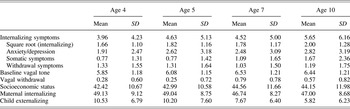
Descriptive statistics for all study variables are provided in Table 1.
Descriptive statistics of main study variables across all ages

Unconditional means and basic growth curve models
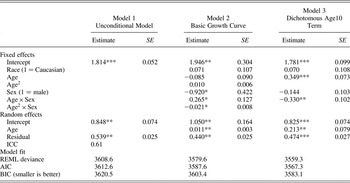
A first set of models established unconditional means models and growth curves of internalizing symptoms from ages 4 to 10 for children who had data on vagal withdrawal at least once between ages 4 and 10. The ICC calculated from Model 1 in Table 2 was 0.61 for the overall sample (0.59 for females, 0.64 for males). Thus, approximately 61% of the total variation in children's internalizing symptoms from ages 4 to 10 was due to between-persons variation (i.e., stable interindividual differences), whereas approximately 39% was due to within-person variation (i.e., within-person changes/fluctuations over time).
Fixed effects, random effects, and model fits for unconditional means model (Model 1) and basic growth curve models (Model 2) of square root transformed internalizing symptoms from ages 4 to 10
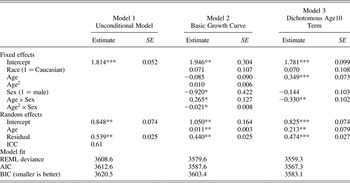
Note: Model 3 is a basic growth model that uses a dichotomized age term (1 = 10.5 years old, 0 = 4 to 7 years old). N = 1,311 observations from 384 children. ICC, intraclass correlation; REML, restricted maximum likelihood; AIC, Akaike information criterion; BIC, Bayesian information criterion. ICC was calculated as follows: intercept random effect/(intercept random effect + residual random effect)
*p < .05. **p < .01. ***p < .001.
Fixed effects
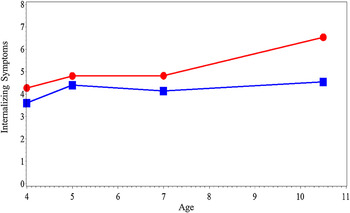
Next, growth curve models established the basic trajectory of internalizing symptoms (Model 2 in Table 2). Because of the possibility that trajectories of internalizing symptoms could become sex-differentiated during late childhood, interactions of the age and age2 coefficients with sex were tested. The highest order significant coefficient was the Age2 × Sex interaction. Figure 1 shows that there were essentially no increases in females' internalizing symptoms from ages 4 to 7, followed by relatively steep increases between ages 7 and 10. In comparison, the age and age2 terms were not significant when the analyses were conducted for males only.
(Color online) Mean internalizing symptoms in females (red line with circles online only) and males (blue line with squares online only) from ages 4 to 10.5 years old.

Additional analyses for illuminating patterns of change
An inspection of Figure 1 suggests that the steepest increases occurred between ages 7 and 10. Therefore, we created a dichotomous age10 term to better quantify change associated with this spline point (coded 0 at ages of <10 and 1 at age 10.5). The age 10 term was used in Model 3. Results showed that the Age 10 × Sex interaction was significant (b = –0.33, p < .01). When analyses were conducted separately by gender, the age10 term was significant (b = 0.35, SE = 0.07, p < .001 in females), but not in males (b = 0.02, SE = 0.07, p = .78).
Additional analyses examined patterns of change for each subscale of internalizing symptoms. ICCs were at 0.54, 0.42, and 0.49 for the anxious/depressed, somatic symptoms, and withdrawn subscales, respectively. For anxious depressive symptoms, the Age 10 × Sex interaction was b = –0.20, SE = .09, p = .02. For somatic symptoms, the interaction was b = –0.15, SE = 0.09, p = .09. Finally, for withdrawal, the interaction was b = –0.21, SE = 0.08, p = .007. Taken together, mother-reported internalizing symptoms during childhood were relatively stable. The model using the dichotomous age10 term (Model 3) was the most parsimonious model for capturing sex-differentiated changes in internalizing symptoms from ages 4 to 10, for the overall scale and each of the subscales. Therefore, all subsequent analyses expand on Model 3 when including additional covariates.
Clarifying associations between cardiac regulation and internalizing symptoms
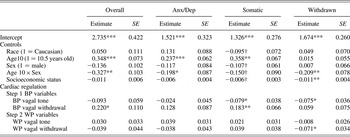
A next set of analyses (shown in Table 3) added the between-persons vagal regulation variables and the within-person vagal regulation variables to Model 3, controlling also for SES. Most associations with internalizing symptoms that were significant or marginally significant were with between-persons stable as opposed to the within-persons change variables. Among the three internalizing symptoms subscales, the strongest association was observed between higher levels of vagal withdrawal and more somatic symptoms. There were also significant association between higher baseline vagal tone and fewer somatic and withdrawal symptoms.
Associations of between- and within-person vagal variables with overall internalizing scale and internalizing subscales

Note: BP, between-persons; WP, within-person.
†p < .10. *p < .05. **p < .01. ***p < .001.
Because significant associations were primarily identified with the between-persons variables, and the within-persons variables also did not further interact with sex or age in the prediction of internalizing symptoms, the within-persons vagal tone and withdrawal variables were subsequently removed from all models. We should also note that no significant effects for either squared baseline vagal tone or squared vagal withdrawal emerged. Furthermore, the between-persons baseline vagal tone and withdrawal variables did not interact in the prediction of internalizing symptoms.
Interactions with sex and age
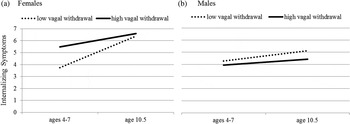
Next, we tested whether associations between the between-persons vagal variables and internalizing symptoms differed by age and sex or both. A three-way interaction among vagal withdrawal, age 10, and sex emerged in the prediction of overall internalizing symptoms (b = 0.58 SE = 0.23, p < .05), and in the prediction of the anxious/depressed subscale (b = 0.38, SE = 0.19, p = .05). Follow-up analyses, illustrated in Figure 2, showed that higher levels of vagal withdrawal were associated with internalizing symptoms only in girls aged 4 to 7 but not in older girls or in boys (b = 0.36, SE = 0.14, p = .02 for the association between vagal withdrawal and overall internalizing symptoms in young girls, and b = 0.01, SE = 0.23, p = .95 for the association between vagal withdrawal and overall internalizing symptoms in older girls). Figure 2 also illustrates that girls with high vagal withdrawal already had relatively high levels of internalizing symptoms in early middle childhood, which stay high, increasing only slightly into late middle childhood/early adolescence. In contrast, females with low vagal withdrawal had lower rates of internalizing symptoms in early middle childhood, but then increased more steeply, reaching levels that were comparable to those of girls with high vagal withdrawal. In girls with low vagal withdrawal, the age10 term was significant (b = 0.57, SE = 0.10, p < .001), but in girls with high vagal withdrawal, the age 10 term was not significant in predicting internalizing symptoms (b = 0.13, SE = 0.10, p = .18).
Mean internalizing symptoms in (a) females and (b) males with low versus high vagal withdrawal before and at age 10.5.

Interactions with maternal psychopathology
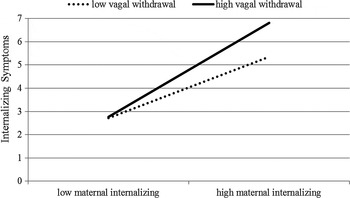
In a next step, we conducted analyses testing whether high vagal withdrawal confers a high risk for internalizing symptoms especially, or only, in the context of maternal internalizing psychopathology, and whether these processes change with age. There was a main effect of maternal internalizing symptoms on child internalizing symptoms (b = 0.68, SE = 0.15, p < .01); maternal internalizing symptoms was also associated with each subscale of internalizing symptoms. The results also revealed a three-way interaction among vagal withdrawal, maternal internalizing symptoms, and the age10 term in the prediction of overall internalizing symptoms (b = –0.76, SE = 0.33, p = .02), anxious/depressive symptoms (b = –0.75, SE = 0.35, p = .03), and withdrawal symptoms (b = –0.68, SE = –0.26, p < .01). Follow-up analyses showed that associations between vagal withdrawal and internalizing symptoms were especially strong in children whose mothers scored above the median on internalizing symptoms, but only between ages 4 to 7 (Figure 3) and not thereafter (b = 0.38, SE = 0.18, p = .04 for the association between vagal withdrawal and child internalizing symptoms in the context of high maternal internalizing symptoms at ages 4–7, and b = 0.17, SE = 0.29, p = .55 for the same association after age 7). In contrast, when maternal internalizing symptoms were below the median, vagal withdrawal and child internalizing symptoms were not associated (b = 0.06, SE = 0.11, p = .56). Thus, it is mostly in the high-risk context of maternal psychopathology that high vagal withdrawal is associated with increased risk for child internalizing symptoms, and anxious/depressed, and withdrawal symptoms in particular.
Between ages 4 and 7, high vagal withdrawal is associated with more internalizing symptoms in children in the context of high maternal internalizing symptoms.

Testing the moderating role of externalizing symptoms
Finally, previous work had reported that vagal withdrawal is highest in individuals with co-occurring internalizing and externalizing symptoms. Therefore, we tested whether the role of vagal withdrawal would be further modified by externalizing symptoms. There was a main effect of child externalizing symptoms on child internalizing symptoms (b = 0.09, SE = 0.01, p < .01). Furthermore, a two-way interaction between vagal withdrawal and externalizing symptoms emerged (b = 0.03, SE = 0.01, p < .05). Follow-up analyses indicated that high vagal withdrawal was only associated with increased risk for internalizing symptoms in the context of high externalizing symptoms, but not otherwise. Taking the vagal withdrawal by child externalizing symptoms into account did not change the significance of any of the previously reported interactions.
Discussion
Whether internalizing symptoms increase or remain at similar levels throughout childhood is currently not well understood. Moreover, the association of vagal regulation of cardiac activity and internalizing symptoms during these ages needs to be clarified. Here, we used a multilevel modeling analytic strategy to examine developmental trajectories of internalizing symptoms from ages 4 to 10 and to test sex differences in these trajectories. Furthermore, we drew on a multilevel conceptual framework to test whether changes in childhood internalizing symptoms would be predicted by interactions between children's physiological regulation and maternal internalizing symptomatology. We also tested whether associations between child vagal withdrawal and internalizing symptoms would differ by sex and age.
Results indicated that internalizing symptoms increased after age 7, but only in females. It is possible that with the earlier onset of pubertal processes in recent cohorts, sex differentiation in internalizing symptoms will be observed before the 12- to 13-year mark that had previously been established as a benchmark for sex-differentiated changes with earlier cohorts. Our sample consisted of approximately 30% African American children in whom puberty has been found to begin at earlier ages compared to Caucasian children (Herman-Giddens et al., Reference Herman-Giddens, Slora, Wasserman, Bourdony, Bhapkar and Koch1997). In addition, parts of the sample were initially overrecruited for externalizing symptoms. Thus, the racial composition of the sample and the higher percentage of children with early externalizing symptoms could have contributed to the earlier emergence of sex differences compared to previous cohorts and other studies. Maternal-reported child internalizing symptoms were quite stable from ages 4 to 10. Stability of maternal reports of child behavior are not a new finding. Stability coefficients for mother-reported externalizing behaviors from ages 4 to 10 in this sample were similarly high. More work is needed to test whether internalizing symptoms assessed from other reporters (e.g., teachers, fathers, or the child, to the extent possible) are similarly stable or whether high stability is, in part, a function of “generic” stability of maternal reports of child behavior.
The role of cardiac regulation in children's internalizing symptoms
For vagal regulation of cardiac activity, the strongest “signal” with respect to internalizing symptoms emerged when considering stable between-persons differences. The literature on vagal withdrawal and psychopathology had been characterized by a number of inconsistent findings, drawing attention to both methodological and conceptual refinements that may be necessary in understanding the role of parasympathetic reactivity in psychopathology. Our findings lend support to recent methodological suggestions that testing both stable and change aspects of vagal withdrawal in relation to psychopathology is worthwhile (Burt & Obradović, Reference Burt and Obradović2013).
Our results suggested that it was the stable, more traitlike aspects of vagal withdrawal that were associated with increased risk for internalizing symptoms during preadolescence. However, it is possible that with respect to other outcomes, including more in-the-moment and approach-type disruptive and behavioral symptoms, it will be deviations from these typical vagal withdrawal levels that will be most strongly associated with psychopathology. Any single score of vagal withdrawal represents a mixture of more stable and the more in-the-moment aspects. Only longitudinal designs with multiple measurements can tease these aspects apart. In addition to the multilevel analytic techniques used here, state–trait models and other latent variable approaches reviewed by Burt and Obradović (Reference Burt and Obradović2013) are also promising approaches for disaggregating the different types of information contained within single scores.
Additional nuances in studying cardiac regulation–internalizing symptoms associations
Our findings illustrated that when studying cardiac regulation–internalizing symptoms associations, the heterogeneous nature of internalizing symptoms should be considered and a disaggregation into the more somatic and the more cognitive–affective internalizing symptoms may be warranted (Bosch et al., Reference Bosch, Riese, Dietrich, Ormel, Verhulst and Oldehinkel2009). Given that the vagus nerve connects the brain not only with the heart but also with the viscera, it was not surprising to see that it was the somatic symptoms that were most strongly associated with the vagal variables assessed here. Such somatic symptoms have been found to be promising markers for identifying risk for psychopathology even decades later (Shelby et al., Reference Shelby, Shirkey, Sherman, Beck, Haman and Shears2013). The associations detected here could, in part, be indicative of the role of the vagus nerve in immune system–brain communications (e.g., Dantzer et al., Reference Dantzer, Konsman, Bluthé and Kelley2000; Konsman et al., Reference Konsman, Parnet and Dantzer2002; Marsland et al., Reference Marsland, Gianaros, Prather, Jennings, Neumann and Manuck2007; Pavlov & Tracey, Reference Pavlov and Tracey2004; Thayer & Sternberg, Reference Thayer and Sternberg2006, Reference Thayer and Sternberg2010) that may also play a role in the development of some internalizing disorders (Raison, Capuron, & Miller, Reference Raison, Capuron and Miller2006). A better understanding is needed of whether children with low baseline vagal tone, high vagal withdrawal, and high somatic symptoms go on to meet thresholds for internalizing disorders and associated impairments at later points in time, and thus, whether vagal regulation, in conjunction with high somatic symptoms, could be a promising risk marker for later internalizing disorders.
Our findings further suggest that the developmental story of the role of vagal regulation of cardiac activity may differ for somatic symptoms versus anxious/depressive symptoms. High vagal withdrawal was relatively robustly associated with somatic symptoms across development, and no differences in association were identified across ages and males versus females. Conversely, associations between high vagal withdrawal and anxious/depressive symptoms were conditional upon developmental stage and sex. Only in the preadolescent girls was high vagal withdrawal significantly associated with anxious/depressive symptoms (and the overall internalizing scale), but not in the older girls or boys. Previous research had suggested that the onset of puberty brings along new biological factors that contribute to rising rates of internalizing symptoms in females during their reproductive years. The emergence of these new biological factors may at least temporarily suspend associations between other risk factors and internalizing symptoms (Shanahan et al., Reference Shanahan, Copeland, Angold and Costello2011). Furthermore, it is possible that stress systems are at least partially being recalibrated during this time (Del Giudice et al., Reference Del Giudice, Ellis and Shirtcliff2011). The Right Track sample will be assessed again at ages 15 and 17 years old; thus, future work with this sample will test whether associations between vagal withdrawal and anxious/depressive symptoms come back online in females at later points in development or whether they have been permanently altered during puberty.
Cardiac regulation–internalizing symptoms associations in the context of maternal risk
During preadolescence, some findings were generally consistent with sensitivity to context hypotheses (Ellis & Boyce, Reference Ellis and Boyce2005; Essex et al., Reference Essex, Armstrong, Burk, Goldsmith and Boyce2011; Obradović et al., Reference Obradović, Bush, Stamperdahl, Adler and Boyce2010). Specifically, preadolescent girls with high vagal withdrawal were only at risk for higher internalizing symptoms in the context of high maternal internalizing symptoms. Parenting behaviors of mothers with high levels of depressive and anxious symptoms have long been characterized as emotionally disengaged with high levels of negative and depressive affect, behaviors, and cognitions. Maternal internalizing symptoms are also associated with parenting behaviors that increase stressful life events in the environment of the child (e.g., Goodman & Gotlib, Reference Goodman and Gotlib1999). If a child has a high capacity to direct attention to such stressors, but at the same time is unable to change the stressors or successfully cope with them, such stressors could become overwhelming and “toxic” (Shonkoff & Garner, Reference Shonkoff and Garner2012). Thus, consistent with sensitivity to context ideas, it may be that children with high vagal withdrawal thrive only in contexts of environmental support but are especially negatively affected in contexts of overwhelming risks (Beauchaine, Reference Beauchaine2001; Crowell et al., Reference Crowell, Beauchaine, McCauley, Smith, Stevens and Sylvers2005). Despite the extensive documentation of risk environments created by mothers with high internalizing symptomatology, it is, of course, also possible that the effects of maternal internalizing psychopathology identified here at least partially represent genetic risk.
Taken together, our findings added even more layers to thinking about vagal regulation and psychopathology during childhood. A recent meta-analysis reported that the overall effect size of associations between vagal withdrawal and psychopathology tends to be small (Graziano & Derefinko, Reference Graziano and Derefinko2013). Recent reviews have also pointed out that associations between vagal variables and psychopathology could differ depending on (a) the psychopathology outcome considered, (b) the task used to assess vagal withdrawal, (c) the typical contextual risk in the child's rearing environment, (d) the developmental phase that the child is currently in (Fortunato et al., Reference Fortunato, Gatzke-Kopp and Ram2013), (e) whether the sample is community based or clinical (Graziano & Derefinko, Reference Graziano and Derefinko2013), and (f) the methodology used in assessing vagal activity (Graziano & Derefinko, Reference Graziano and Derefinko2013). Our results further suggest that these associations could depend on (g) whether it is the stable aspects of vagal withdrawal or measurement-point-specific fluctuations that are being considered, (h) which domain of internalizing symptoms is being considered, and (i) the gender of the person.
The possibility that the nature of the association between RSA and psychopathology may depend on nine or more facets makes this a conceptually rich field for developmental psychopathologists embracing multilevel and contextual perspectives. At the same time, the potential complexities contribute to difficulties in distinguishing between what is a finding indicative of an actual signal rather than a chance finding or “noise” in RSA–psychopathology associations. The present study is not immune to this criticism. An important task for the field in moving forward is to have an ongoing discussion about how to acknowledge and incorporate contingencies and complexities while also having appropriate safeguards against overinterpretation of chance findings.
Multilevel analytic techniques and multilevel conceptual approaches
One aim of our study was to take a multilevel approach to understanding the development of internalizing symptoms during the earlier parts of childhood. It is important to note that in the field of developmental psychopathology the term multilevel is used to refer to both conceptual and to methodological/statistical approaches, with different meanings in each context. The term multilevel is used conceptually to characterize models that incorporate different domains of influence on development and examine how these levels of influence combine in shaping the development of the person, leaning, for example, on Bronfenbrenner's (Reference Bronfenbrenner1979) ecological theory and person-oriented frameworks by Magnusson, Cairns, and others (Cairns & Cairns, Reference Cairns, Cairns, Cairns and Cairns1994; Cairns, Elder, & Costello, Reference Cairns, Elder, Costello, Cairns, Elder and Costello1996; Magnusson, Reference Magnusson, Pervin and John1999a, Reference Magnusson1999b).
Analytically, multilevel modeling refers to techniques that can model nested data structures such as repeated-measures data. However, such analytic approaches could be devoid of conceptual multilevel thinking. For example, had we used our multilevel modeling analytical approach, but drawn on variables from one domain at risk for internalizing symptoms only and not considered interactions across domains, our analyses would not have reflected multilevel conceptual thinking, despite using multilevel modeling techniques in SAS. Thus, a clear distinction between conceptual multilevel thinking and multilevel analytic techniques is important, as well as the awareness that multilevel analytic techniques cannot replace multilevel conceptual thinking (see also Sterba & Bauer, Reference Sterba and Bauer2010).
Limitations and future directions
The current study had several limitations. First, the measurement of internalizing symptoms was assessed via maternal reports, and results could differ when using different reporters of internalizing symptoms. Nevertheless, it is notable that measures of child physiological regulation were associated with maternal reports of children's internalizing emotions, cognitions, behaviors, and somatic symptoms. Second, our measurement of internalizing symptoms did not allow us to distinguish between children's anxious and depressive symptoms. Past research has primarily reported sex-differentiated changes in depressive symptoms around the time of puberty; future research with recent cohorts should test whether sex-differentiated changes in anxious/depressive symptoms in late middle childhood are primarily driven by depressive symptoms or to what extent anxiety symptoms contribute to these emerging sex differences. Third, although the racial/ethnic composition of the sample corresponded to that of the counties from which it was drawn, the sample was limited mostly to Caucasian and African American participants, and the processes studied here should also be examined in other racial/ethnic groups, including Latino and Asian groups. Fourth, we did not assess puberty at age 10; thus we cannot verify whether increases in females' internalizing symptoms between ages 7 and 10 were driven by an early puberty group.
Fifth, we used complex analytic techniques here that allowed us to test whether developmental trajectories of internalizing symptoms differ in subgroups characterized by sex, vagal regulation, and maternal internalizing psychopathology. Other types of statistical techniques, such as growth mixture models, can also capture such heterogeneity (as, for example, in Sterba et al., Reference Sterba, Prinstein and Cox2007). Given our interest in sex differences, subscales of internalizing symptoms, and the moderate overall sample size, such techniques could have been difficult to implement, and they could have been prone to local solutions, misclassification, and overextraction (Bauer, Reference Bauer2007; Bauer & Curran, Reference Bauer and Curran2003; Hipp & Bauer, Reference Hipp and Bauer2006). Nevertheless, our findings and the many contingencies of the effects of vagal regulation of cardiac activity on psychopathology suggest that the use of person-oriented models remains a worthwhile pursuit in this area of research. Sixth, as with any developmental–observational work, the nature of the laboratory-based tasks changed across assessment waves to be age appropriate. It is possible that changes in tasks contributed to findings of changing associations. However, had we kept age 4 tasks identical over time, we surely would have failed to measure the same constructs over time.
Despite these limitations, our findings contribute to clarifying the developmental course of early internalizing symptoms in a recent cohort, and to clarifying and contextualizing associations between vagal regulation of cardiac activity and internalizing symptoms. Future work should extend these types of analytic approaches to investigating externalizing symptoms. Future work should also test whether there are specific aspects of the environment created by mothers with high internalizing symptoms that might help account for the development of internalizing symptoms in children with high vagal withdrawal.