Introduction
Besides the great importance of natural selection, the most prolific of Darwin's sub-theories is considered to be the idea that all forms of life descend from a common ancestor. That idea was immediately supported by his contemporaries and presented a great explanatory power (Mayr, Reference Mayr2004). A necessary corollary of common ancestry is the conclusion that a single organism should have been the ancestor of all forms of life on Earth. Since Woese et al. (Reference Woese, Kandler and Wheelis1990) described the three domains of life, classical evolutionary theory considers this last universal common ancestor (LUCA) as the branching point on which Bacteria, Archaea and Eukarya separated on the tree about 3.5 billion years ago (Woese et al. Reference Woese, Kandler and Wheelis1990). In this sense, contemporary researchers have been discussing how should LUCA's constitution be as a cellular organism presenting an ancestor genome harbouring a complete set of genes to encode proteins for replication, transcription, translation and basic metabolic machinery (Harris et al. Reference Harris, Kelley, Spiegelman and Pace2003; Koonin, Reference Koonin2003; Delaye et al. Reference Delaye, Becerra and Lazcano2005; Ouzounis et al. Reference Ouzounis, Kunin, Darzentas and Goldovsky2006; Glansdorff et al. Reference Glansdorff, Xu and Labedan2008; Mushegian, Reference Mushegian2008; Kin and Caetano-Anollés, Reference Kim and Caetano-Anollés2011; Kannan et al. Reference Kannan, Li, Rubinstein and Mushegian2013).
However, after decades of study, new evidences indicate that the LUCA of all living entities should have existed before this initial branching point that originated cellular organisms (Nasir et al. Reference Nasir, Kim and Caetano-Anolles2012; Forterre, Reference Forterre2013a, Reference Forterreb). One of the main evidences for these new findings was the discovery of huge viral genomes and the verification that hundreds of genes from viruses did not present clear counterparts in the genomes of cellular organisms. These new evidences tend to move LUCA earlier in time into a branch point on which viruses separated from cellular organisms, even if one consider that viruses have been cellular at first (Nasir et al. Reference Nasir, Kim and Caetano-Anolles2012; Forterre, Reference Forterre2013a; Nasir & Caetano-Anollés, Reference Nasir and Caetano-Anollés2015).
The cellular LUCA, now renamed as LUCellA is consensual to have existed in the branching point of cellular organisms. Now, one needs to start to consider that a LUCA might have existed long before the first appearance of cells (Koonin et al. Reference Koonin, Senkevich and Dolja2006; Caetano-Anolles and Seufferheld, Reference Caetano-Anolles and Seufferheld2013; Forterre et al. Reference Forterre, Krupovic and Prangishvili2014). Here, we discuss the nature of LUCA in the light of the new data about viruses, as well as, new information about the origin of ribosomes, tRNAs and the translational machinery. The prolificacy of these new approaches are opening new challenges to the studies on the origin of life, challenging the replication dogma and even restructuring the concept of life itself.
The classical theory
The search for understanding about the origin of man and the origin of all living entities emerged with human intelligence and it is expressed in every culture, being a subject of great anthropological interest. However, it was just after the publication of the ideas proposed by Charles Darwin, in Reference Darwin1859, that the subject has been considered and analysed in the light of modern science. In his book, Darwin suggests that all living organisms are related by ascendency, and therefore they are all derived from ancestral species, which migrate around the world and diversify, generating the amazing biodiversity of organisms (Darwin, Reference Darwin1859). They evolved by a fractal-like branching emanating from the buds of the Tree of Life (ToL) along the evolutionary process of genome-organism-environment modifications over time.
The existence of a first, primitive organism, ancestor of all the living forms is a necessary corollary of Darwin's theories. According to Mayr (Reference Mayr2004), the common ascendance should be one of the fifth sub-theories of Darwin and it is the one that mostly helped his contemporaries to understand and explain regularities in taxonomy and systematics. Currently termed the Last Universal Common Ancestor or LUCA, its form, constitution, timeline and other characteristics have been the subject of intense discussions within the scientific community. Since the 1950s, after the discovery of the DNA structure and throughout the seventies until the maturation of molecular biology, a new chapter on the identity of LUCA emerged, with the possibility of understanding the molecular constitution of all living beings. With this new approach it has been possible to identify common biochemistry and metabolic characteristics, which have been conserved in all living organisms (Delaye et al. Reference Delaye, Becerra and Lazcano2005; Glansdorff et al. Reference Glansdorff, Xu and Labedan2008; Mushegian, Reference Mushegian2008). These main characteristics that sparked life must have arisen in this very first ancestral LUCA and perpetuated through the biodiversity explosion of life on Earth.
Another important milestone in the modern definition of the very first ancestor of all living forms was the work of Carl Woese. Working with the sequencing of ribosomal RNA molecules, Woese discovered that the prokaryotic world was not uniform and could be divided in two main clades named Eubacteria and Archaebacteria (Woese et al. Reference Woese, Kandler and Wheelis1990). Woese's work is not important solely by its results, but also due to his methodology. He sequenced molecules considered highly conserved among all living entities, i.e. he sequenced constituents of the ribosomes. Woese also discovered that Archaebacteria presented a number of intermediate characteristics that would make them some sort of mixture between Eubacteria and Eukaryotes. Also, he showed that many of the first discovered archaeas were capable of living in extreme environments (e.g. high temperatures) such as those that existed on early Earth and therefore, archaeas have been considered the most ancestral forms of life.
However, since Woese's original work, it has been shown that both Eubacteria and Archaea can live in high temperatures and also that Archaea could live in mesophilic environments. Thus, the modern view suggests that LUCA would be a cellular organism residing exactly in the place on which Eubacteria and Archaeabacteria branched, one major evidences suggest that eukaryotes came later and are chimera (Woese et al. Reference Woese, Kandler and Wheelis1990).
In this classic view, only complex cellular organisms presenting reasonably big genomes (measured in orders of megabases) and a basic and efficient metabolism are considered to define the constitution of LUCA. In this sense, many researchers have been searching for the most basic constitutions of LUCA's genome, metabolism and other cellular attributes.
LUCA as an organism
Among the processes that were already present in the classic interpretation of LUCA, it is frequently suggested that LUCA would harbour (i) a reasonably complex ancestor genome with information stored in a chromosome-like DNA molecule, (ii) an established genetic code and (iii) genes encoding not only molecules from the information storage machinery but also (iv) a complex basal metabolism, with sophisticated enzymes used for the energetic metabolism through glycolysis and the citric acid cycle (Penny & Poole, Reference Penny and Poole1999).
The recent development of modern techniques for genome sequencing is allowing a deeper comprehension of the most conserved genes existing in all living entities. These data have enabled global comparative analysis of gene and genome compositions and aided the identification of conserved metabolic routes acting in all living organisms. Statistical models using hundreds of genes are allowing the development of the most likely ancestor genome that might have existed in the classical version of LUCA. Much of the reasoning used in this comparative analysis of genomes in the search of LUCA's gene content is based on the idea that if a gene or process is present in all known organisms, it must have been a homology, i.e. it must have been present in the LUCA. Delaye et al. (Reference Delaye, Becerra and Lazcano2005) analysed 20 genomes of cellular organisms and from this global analysis his group suggested precisely, which genes and processes should be present in the LUCA's genome. Among the results, essential pathways related to the processing of RNAs were shown to be conserved in the organisms studied, indicating that they were most likely present in the genome of life's ancestor.
Some studies propose that most enzymes involved in DNA replication are not conserved in every organism, suggesting that this process might have emerged several times after diversification of LUCA (Leipe et al. Reference Leipe, Aravind and Koonin1999; Forterre, Reference Forterre2013b). Thus, it is suggested that LUCA should have had a RNA-based genome, which would place LUCA in a time previous to that suggested by the classic theory. In this perspective, LUCA may have lived in the RNA world and therefore would not be able to be an organism because it was not cellular.
Other authors suggest that the genome of LUCA was highly complex and had at least 1000 genes, a number very close to the average sized genome of bacteria (Mushegian Reference Mushegian2008). Hunters of LUCA genes try to identify groups of genes that are seen in organisms from the three domains of life (Penny & Poole, Reference Penny and Poole1999; Delaye et al. Reference Delaye, Becerra and Lazcano2005; Kannan et al. Reference Kannan, Li, Rubinstein and Mushegian2013). However, a considerable number of genes, when analysed individually, show phylogenies incompatible with the phylogeny of the domain to which they belong (Mushegian, Reference Mushegian2008). This observation is caused mainly due to the results of the process of Lateral Gene Transfer (LGT) and thus, raises questions about their presence in the LUCA. These genes may have arisen after LUCA diversification, but, due to LGT, spread quickly among early-derived organisms. In this way, the use of gene ubiquity in all domains of life as a support for the overview of the LUCA gene content might not have corresponded to the ancestor genome, even though it may be considered a valid approximation.
Furthermore, the analyses that attempted to reconstruct LUCA's genome were performed using cellular organisms as parameters. In this context, virus genomes were seen as a case of genomic reduction or as parts of the ancestor genome that escaped from a cellular context. However, recent analyses have placed the virus position earlier in time as prior or contemporary to the emergence of the cellular LUCA (Bamford, Reference Bamford2003; Koonin et al. Reference Koonin, Senkevich and Dolja2006; Forterre et al. Reference Forterre, Krupovic and Prangishvili2014; Nasir & Caetano-Anollés, Reference Nasir and Caetano-Anollés2015). Therefore, it is necessary to re-analyse the hypothetical ancestral genomes to take viral genomes data into account. Thereby, we can understand better the branch point on which living organisms departed, and thus, comprehend better the essential biological functions that were the baseline for the generation of biological diversity. The theoretical idea of an organism such as the LUCA has proven to be extremely attractive and even necessary under Darwinian considerations, though the biological complexity of the methods used to unfold these questions present challenges to the concept. The thought about the emergence of the LUCA will be necessarily hypothetical, since it is placed deep in the past. Researchers have no certainties about the relevance of lateral gene transfer events at the beginning of the biological systems and how these events may have contributed to the genome of LUCA. We also know very little about gene evolution among gene families and how a gene actually forms another gene putatively by divergence after duplication. Another important conundrum here would be in understanding how an initial genome of an organism such as LUCA has been formed departing from either a replicator molecule or a chemistry-based proto-metabolism.
New virus genomes challenge classical LUCA interpretations
The studies about gene and genome composition between organisms along the ToL have defined the genetic nature of the LUCA focused on cellular organisms. This fact evidences not only the importance of Woese's work but also the central role of cell theory in Biology. Thus, the emergence of this very first biological entity should have begun in an organism already containing DNA, RNA and metabolism based in proteins, together with sophisticated transcription and translation machineries working with repair and recombination systems, along with regulation of gene expression and control of cell division (Penny & Poole, Reference Penny and Poole1999).
In this scenario, the viruses are considered as derivatives of cellular organisms; this way, its origin was after the emergence of LUCA. However, with deeper understanding on the genetic constitution of viruses, new questions about LUCA emerged, such as how to explain the existence of genes present only in these organisms? Besides, there has been shown that some genes are known exclusively in giant viruses, with the absence of any close orthologues in cellular organisms (Filée, Reference Filée2013; Forterre, Reference Forterre2013a). How did these genes come to exist?
Two scenarios are frequently proposed: (i) the first suggesting that these genes are actually derived from a cellular line diversified from LUCA and further becoming extinct during the evolutionary process; and (ii) another suggesting that due to high DNA mutation rates in viruses, the genetic similarity has been lost with their cellular counterparts, leaving no clear evidences of common ancestry (Forterre & Prangishvili, Reference Forterre and Prangishvili2009).
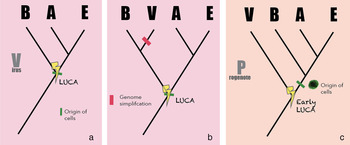
Recent theories suggest that viruses may have been contemporary to what modern theory considers LUCA (LUCellA), which followed a parallel evolutionary history to cellular organisms (Bamford, Reference Bamford2003; Koonin et al. Reference Koonin, Senkevich and Dolja2006; Forterre et al. Reference Forterre, Krupovic and Prangishvili2014; Nasir & Caetano-Anollés, Reference Nasir and Caetano-Anollés2015). However, if one accepts this model, then LUCA as we see today, would be a most recent ancestor only to cellular organisms and not for all organisms as a whole. So, it has been proposed that the actual LUCA should move backwards in time to include the ancestor of cells and viruses. In Fig. 1, we show some alternative scenarios with different points of view about the position of viruses in the tree of life, which raises another question: ‘Which basic essential form appeared first: cells or viruses?’ As viruses are most commonly parasites of cells, it is normally assumed that they appeared later (Moreira & López-García, Reference Moreira and López-García2009) but now some researchers are suggesting the opposite (Koonin et al. Reference Koonin, Senkevich and Dolja2006; Forterre et al. Reference Forterre, Krupovic and Prangishvili2014). What if the virus were the first essential form of life? And what is more, could this question be tested under the scrutiny of modern science? Is this scientific in a Popperian point of view? How should we test it and prove it to be false? Is there any way to approach this question empirically? Genomic information is uninformative at this point, once the number of mutations among them is oversaturated, meaning that there should be almost none nucleotide in the whole DNA molecule on which homology can be traced among cellular organisms and virus and that would represent a given nucleotidic position in the LUCA's genome. All the nucleotidic positions therefore are assumed to have mutated multiple times with many associated events of insertions and deletions, storing no traceable information of the very first nucleic acid molecule.
Alternative theories to take account of adding virus into the tree of life. In figures, B, Bacteria; A, Archaea; E, Eukaryotes. (a). Classical interpretation of LUCA's theory, viruses are discounted mainly because they are considered as a simplification from the Bacteria clade as shown in (b). An alternative view is shown on (c), for the first time LUCA is seen earlier than cells. Progenotes are considered in that perspective.

Other hypotheses suggest that viruses have played an important role in the evolution of cellular organisms, having a direct influence in a number of important events, such as: (a) DNA emergence as the genetic material and its replication mechanisms; (b) the origin of the eukaryotic nucleus, in the diversification of the three domains of life; (c) the emergence of cellular envelopes replacing lipid membranes; and (d) the development of the alternative genetic codes, among others (Forterre, Reference Forterre2006, Reference Forterre2013b). These assumptions indicate a complex scenario in the understanding of the constitution of this very first form of life on Earth, in the particular moment on which chemistry became biology and the LUCA has arisen by self-organization of physical-chemistry forces operating in the atomic and molecular level. In the face of new data, which has been accumulated, it is necessary to develop and explore both modern theories and possible new concepts for the ancestor of all living organisms, which might have been a molecule, an organism or a community.
LUCA as a molecule
The discovery of the catalytic activity of RNA molecules in the 1980s (Kruger et al. Reference Kruger, Grabowski, Zaug, Sands, Gottschling and Cech1982; Guerrier-Takada et al. Reference Guerrier-Takada, Gardiner, Marsh, Pace and Altman1983) initiated the emergence of a new perspective for the origin and evolution of biological systems, in which RNA played a central role in the early molecular evolutionary process (Gilbert, Reference Gilbert1986). It is frequently assumed that many essential molecules that existed during the early days of biological evolution are not dispensed with. Highly successful, these molecules developed and perpetuated to the present day as key molecules in the functioning of living organisms. Among the molecules that probably arose very early in the biological systems, the large subunit of the ribosomal RNA that composes the ribosomes in cellular organisms are considered as a possible turning point in molecular evolution (Fox, Reference Fox2010). Even more specifically, a part of this molecule called the Peptidyl Transferase Center (PTC) is considered by some as having an essential role in evolution, since this catalytic ability of getting together amino acids is crucial for protein synthesis and thus, for a first transition from a RNA world to a Ribonucleoprotein world, as seen in modern organisms (Hury et al. Reference Hury, Nagaswamy, Larios-Sanz and Fox2006; Davidovich et al. Reference Davidovich, Belousoff, Bashan and Yonath2009; Fox Reference Fox2010; Tamura, Reference Tamura2011, Petrov et al. Reference Petrov, Bernier, Hsiao, Norris, Kovacs, Waterbury, Stepanov, Harvey, Fox and Wartell2014).
All known cellular organisms have the PTC conserved and the process of reading the information contained in the messenger RNA, in general, is similar in all life forms. Would the common ancestor of all life forms be a part of the largest subunit of the ribosomal RNA? When thinking about LUCA as a molecule, and more specifically, as the large subunit of the ribosome or even more specifically as the PTC, there is an extensive modification into the junction point on which all living organisms came to be. Here the nature of LUCA is changed, since it places the common point of origin in a time where the RNA was the information-carrying molecule and the cellular systems were still starting to maturate. Root-Bernstein & Root-Bernstein (Reference Root-Bernstein and Root-Bernstein2015, Reference Root-Bernstein and Root-Bernstein2016) suggest that the primitive ribosome worked as ribozyme, as well as a primitive genome with properties of self-replication.
The ‘molecular LUCA’ approach provides an explanatory power to important differences found in biological systems that are essential in modern organisms and suggests that strikingly important processes, such as the DNA replication mechanism might have arisen several times during evolution (Leipe et al. Reference Leipe, Aravind and Koonin1999; Forterre, Reference Forterre2013b).
However, the theory that PTC should be seen as LUCA imposes new conceptual challenges, mainly into the concept of life itself. Life ceases to be related to replication processes and turns to be related to the rise of chemical and molecular order: an auto-organized system that assembles molecules together and can be restructured by solely physical-chemical laws with the absence of any code. The ‘replication process’ should be considered as a necessity of these order-forming atoms capable of reacting and staying together by the forces of the laws of physics and chemistry. Considering that the Earth has had a particular sort of geology defined by gravity and other physical constraints such as the size of the sun and the periods of days and years; and given the constitution of molecules such as the ones present during the early period of Earth's history, this sort of molecular system formation might be seen as necessary. The forces of physics will act on atoms and molecules so that they must react given their concentration and subatomic compositions. New arrangements provided by centuries and millenniums allowed the other parts of the ribosome to attach to the initial assembly of life also by necessity.
However, this point of view imposes new explanatory challenges. Currently, we can separate the biological entities in ribosomal/cellular organisms and non-ribosomal/non-cellular organisms, i.e. viruses. In this context, despite the fact that viruses do not have ribosomes, and the possibility of PTC being considered as LUCA, we must conclude that viruses emerged after the organization of the genetic code.
LUCA as a coding/decoding process
The observation that viruses do not have ribosomes might be seen as a falsification of the PTC-LUCA theory. However, it is important to note that although viruses may not have ribosomes, they do have a genetic code that can be read by a ribosome. This is also compatible with the possibility that viruses were contemporary to the emergence of the translational system and that they may have developed in parallel to the development of cellularity. Based on the absence of ribosomes in viruses and since they use the same basic principles to decode genetic information, one can think of a LUCA as the emergence of the genetic code and their decoding system. In this case, LUCA should be understood as a molecular process of changing information between two molecules that already existed due to necessity: the oligonucleotides and the amino acids. Thus, LUCA ceases to be an isolated molecule and begins to be recognized as the origin of biological information per se, which therefore must have arisen in conjunction with a primitive decoding system. It could also be interpreted as the first signal of symbiosis in the physical-chemical world, a particular moment in the history of the Universe in which two non-living molecules start to work together to produce a higher level of complexity, to the benefit of both. The oligonucleotides ‘use’ the polypeptides to perform better catalysis, while the latter ‘uses’ the former in order to be produced in higher quantities and in a precise order.
Some of the most salient and unanswered questions on this subject should be: how did the codifying function evolve, how did it begin and why has it both been retained and evolved to produce this translationally efficient universal genetic code that exists in all living entities? The idea that proposes LUCA as ribosome or PTC must be differentiated from the idea of LUCA as the process of formation of the coding/decoding system. In the PTC hypothesis discussed earlier, there is only catalysis, without codification. In this case, one can assume that LUCA as the process of the coding/decoding is a better place to define the last life ancestor since the ribosome as we know nowadays is a further, necessary derivation of the process itself. Anyway, the ribosome observed today in cellular organisms is a clear descendant of the translator LUCA. From this perspective, we can trace back all biological entities under a single common point that perpetuated until today. Without the translation system the coding would not make sense. In this case, of course, viruses must have emerged after LUCA.
Those that defend this theory conceive that life processes must be understood as a coding/decoding system. Some of them could be comfortable to say that even memes or cultural replicators might be considered to be also alive, even in a strict sense. However, the most scientific assumptions would consider that the sole code that can be attached to the concept of life should be a code of chemical molecules.
LUCA as the translation process
The idea of a single individual organism such as LUCA comes from the initial suggestions proposed by Darwin and took shape during the decades that followed his proposition. With the increase in knowledge about the nature of living organisms, this idea was consolidated as predominant, especially when comparing the similarity between various biological processes in all life forms. It is frequently assumed nowadays that the sharing of a single structured genetic code by all living entities is the proof that a construct such as a LUCA actually existed.
At the same time, it is amazing to realize that this code can be slightly different for some organisms using a couple of different codons to codify some amino acids and stop signals (Osawa, Reference Osawa1995; Santos et al. Reference Santos, Moura, Massey and Tuite2004). The codons may be different, but the molecular logic is the very same. From the reading of a messenger RNA code, the entire ribonucleoprotein complex modifies its 3D structure in a way that attracts a given population of tRNAs bringing a specific amino acid attached to its 3’ site to bind the PTC site. Recent works presented evidences that transfer RNAs should be primordial and should have organized the formation of the biological system and the translational machinery (Tamura, Reference Tamura2011; Farias et al. Reference Farias, do Rêgo and José2014a, Reference Farias, Rêgo and Joséb). In this scenario, LUCA can be seen as a process or, even more clearly, as the translation of a chemical information. In this sense, we could understand the origin of LUCA as the exact moment on which a chemical translation force arose and allowed polymers of nucleotides to send their information and organize contiguous sets of amino acids to build chemically sophisticated polypeptides. The decodification from a sophisticated chemically built quantic alphabet (ATCG) produced by a non-reactive molecule, as a nucleic acid, finds its way to pass information to more reactive molecule of a polypeptide capable of interacting with others in the medium and producing useful work for the entire complex, helping it to ‘live’ and disseminate over other microenvironments. Here, it can be hypothesized that nucleic acids were capable of self-replication and catalysing reactions in an RNA-based world. At the same time, polypeptides could be formed and replicated by physical-chemical laws. The ‘sparking of creation’ was joining these two processes together. Contemporary theories try to explain how this translational code has been built, not through the control of a ‘smarter’ coding nucleic acid molecule, as frequently though, but as a collaborative work of pre-biotic chemistry and self-organization.
This molecular interaction has proven to be amazingly efficient to keep and replicate the code, probably maintaining the whole non-cellular system after the production of a couple of organized and useful polypeptides. This should be the first glimpse that a non-cellular form of life might actually have existed, though nobody would deny that the advent of cells was a particularly important moment in the history of life, at least as important as the translation.
On the other hand, PTC-LUCA advocates want to bring the origin of life into the realms of molecules and atoms. One can suggest that the translation process should be considered as a complexification of the PTC theory itself and therefore consider their advocates as supporters of the LUCA as translation theory too. Therefore, the rise of the PTC can be seen as the emergence of a new order in chemical self-organization that has further evolved to the translational process.
LUCA as a replicator
Initially proposed by Richard Dawkins in his best-seller, ‘The selfish gene’, the idea of LUCA as a replicating molecule has generated controversy, as well as gaining followers throughout decades. For Dawkins (Reference Dawkins1977) a molecule that would spread in the world needed to have two characteristics: being capable of replicating its own form before it gets destroyed or dies; and be able to mutate slightly due to environmental stress factors. These are the sole characteristics that an original molecule should have in order to initiate the spark of life. Well, if such a molecule is replicated before it is destroyed, then very quickly one turns into two, two becomes four etc, as in geometric progression. The chemical nature of the replicator is not relevant at the initial moment and the only important thing to know is that the replicator should be a polymeric molecule that would be able to replicate itself by getting together the monomers to form a self-copy. Once a small population of these molecules has been found in a given microenvironment, it is suggested that the monomers would become scarce due to the number of replicators needing them in order to make a copy of themselves. At this point, natural selection starts to act. Here, Darwinians will argue that: if there is natural selection, there is life. Molecular natural selection would select molecules that: (i) replicate faster; (ii) replicate their code better and (iii) endure for longer. The molecules that replicate faster will have more offspring, the ones that replicate their code better would make better self-copies that will be as efficient in replication as their parents and molecules that endure for longer would thus be able to produce more offspring and stand the test of time. Further steps would require these replicators to discover methods of protecting themselves from attack by other molecules trying to destroy them and subsequently use their monomers to replicate their own information. Over millenia, the evolution of these systems would have produced the first cells and then complex organisms.
During an important period, the replicator line of reasoning has been used by the RNA-world advocates to support their theory (Gilbert, Reference Gilbert1986; Lazcano & Miller, Reference Lazcano and Miller1996; Dworkin et al. Reference Dworkin, Lazcano and Miller2003; Yarus, Reference Yarus2015). According to them, it was clear that this polymeric substance proposed was RNA, mainly because it is the sole molecule capable both of carrying the code and catalyzing chemical reactions in a reasonable fashion. As a single stranded nucleic acid, RNA is capable of adopting multiple 3D structures that can be used to catalyse chemical reactions. However, as a nucleic acid, it has a limited power to interact chemically with metabolites. Somehow, the ‘blind’ process of evolution made RNAs find their way to translate their coded information so that more chemically versatile molecules, namely proteins, could be made. On the other hand, they were also capable of saving their most relevant code for self-replication in a more stable, double-helix molecule with a less reactive form of sugar (i.e. deoxy-sugar), as well as a methylated nitrogenous base (namely, methyl uracil or thymine) and thus DNA has been added to the system.
Although highly explanatory, the replicator theory for LUCA completely puts aside the existence of chemical proto-peptide metabolism that is considered canonical by chemists and physicists. Hence, LUCA as replicator considers the origin of life as a conceptually similar point to those that advocate the RNA world theory.
LUCA as a community
Another common way on which researchers reason about the constitution of the LUCA is thinking of LUCA as a community composed of quasi-organisms with intense changing of genetic material by LGT (Root-Bernstein & Dillon, Reference Root Bernstein and Dillon1997; Woese, Reference Woese1998; Shenhav et al. Reference Shenhav, Oz and Lancet2007; Root-Bernstein, Reference Root-Bernstein2012; Markovitch & Lanet, Reference Markovitch and Lancet2014; Norris et al. Reference Norris, Reusch, Igarashi and Root-Bernstein2014). We can understand quasi-organisms as organisms with incomplete biological systems and presenting some degree of dependence to other quasi-organisms. Each of these quasi-organisms might have contained partial, complementary pathways and exchanged metabolites in a microenvironment on which a huge population lived in symbiotic relationships with one another (Root-Bernstein & Dillon, Reference Root Bernstein and Dillon1997; Hunding et al. Reference Hunding, Kepes, Lancet, Minsky, Norris, Raine, Sriram and Root-Bernstein2006; Gross et al. Reference Gross, Fouxon, Lancet and Markovitch2014). After subsequent events of genetic transfer, the genetic homogenization in the community might have arisen before an initial explosion of diversity. In some sense, this theory would explain the stepwise formation of LUCA as an organism and may be seen as a precursor of it. Woese (Reference Woese1998) suggested that LUCA may not have been a single organism, but a community of them, named progenotes. This community would be composed by genomes still in maturation, with a rudimentary translation system acting at low efficiency, an imprecise coding system allowing the synthesis of small peptides due to inaccuracy of the coding/decoding system. In this scenario, functional proteins acting as enzymes should have been originated by statistical sampling processes operating in the DNA code. Efficiency in the coding/decoding system made possible evolutionary advantage in some progenotes and therefore, enabled the maintenance of the system under formation and allowed natural selection to operate at the molecular level. It is also suggested that, in this age of progenotes, due to the lack of complete independence from the genomes of progenotes, LGT was a major evolutionary force that must have made possible that proteins, correctly encoded, had been fixed in a sub-community and spread to many individuals in a given community. In this context, lateral gene transfer, which became a secondary mechanism to gene dispersion in modern organisms, has proven to be the main mechanism in the promotion of gene dispersion in the era of progenotes. In this scenario on which the LUCA was a community and several sub-systems evolved independently, there has been an intense exchange of products selected in each of the independent evolving sub-systems. Thus, it is frequently thought that the evolutionary time for the emergence of the modern cellular systems could be drastically reduced, since genomes may have been assembled in parts or modules simultaneously, in each of these small biological factories of information (Shenhav et al. Reference Shenhav, Oz and Lancet2007; Root-Bernstein, Reference Root-Bernstein2012; Norris et al. Reference Norris, Reusch, Igarashi and Root-Bernstein2014). Another interesting perspective presented in this scenario is the possibility that viruses emerged as a remnant of the early progenote era, following an independent evolutionary pathway, before the ‘tweaking’ of the genetic and physiological content in the community. However, due to its origin in this progenote community, viruses maintained the interactions with the other biological organizations that emerged after the diversification of an ancestral community. From this perspective, one can suggest that individuals in the original community could have had their sub-systems compartmentalized, however, not necessarily cellularized. The emergence of cellularization has been the route followed by a group of individuals in the community, after the maturation of essential biological systems to cellular physiology. This view puts the formation of the LUCA earlier than proposed by classical theory, with the process of the origin and organization of life being older than currently assumed.
Last considerations
In many ways, theoretical ideas about the nature of LUCA challenge the classical view about the concepts of life itself. The traditional view of LUCA normally defines it as the origin of cells and reflects the importance of the ‘cell theory’ to the entire field of biology. In the place where all cellular organisms converge, at the crossroads between Bacteria, Archaea and Eukaryote, there is a point at which chemistry has been blessed with the essence of life. However, new theories about LUCA suggest that all non-cellular systems could be considered to be alive. And so, what should life be? And how did it get started on Earth? It may be time to expand biology into the realms of chemistry and physics.
Life could have been originated on Earth due to the agglomeration of basic chemical molecules operating in the regularity of geochemical cycles on the planet. There is an intrinsic physical-chemical dynamic of the planet that operates due to the periodic cycles of the day and the year. The transitional movement of the planet along its own axis and its position to the Sun generates a day of about 24 h, during which molecules get together and separate in a regular way over and over again. Earth orbiting the sun in the period of about 365 days also generates a broader regular cycle allowing molecules to aggregate and separate. The continuous deposition of chemical molecules attracted by light and heat comes to generate complexity. The ‘syncronical’ order of the cycle probably allowed the complexity of the geochemical molecular systems to increase, initially by assembling atomic components and later to the assemblage of more complex molecules. At some point, an aperiodic crystal comes to respond to these modifications and generates a chemical code, capable of replication and also capable of transferring its boring chemical information into a more chemical complex and reactive molecule.
Contemporary views about the concept of life are frequently polarized between (i) the necessity of genetic information storage and maintenance and (ii) metabolism. Such distinctions are frequently based on the nature of the first biological molecule and its importance to life. Evolutionary geneticists frequently favour the fact of information storage and consider the RNA as first molecules, while classical biochemists know better the relevance of metabolism and enzymatic activity to life and consider proteins as the initial path as well as metabolism as the unifying process for living entities. Besides, amino acids are well known to be less complex and easier to be produced by chemical and physical forces than nucleic acids in most physical-chemical scenarios suggested for the early Earth (Miller, Reference Miller1953; Parker et al. Reference Parker, Cleaves, Dworkin, Glavin, Callahan, Aubrey, Lazcano and Bada2011, Reference Parker, Zhou, Burton, Glavin, Dworkin, Krishnamurthy, Fernández and Bada2014).
Even if polypeptides came to be formed earlier, a third and more reasonable path for the igniting of life would happen when chemically mature small polymers of nucleic acids and proteins started to act together in a sort of chemical symbiosis. This way, the genetic information processing and storage is considered as essential to life as the catalytic processes and metabolism. The first point on which life would therefore be established may be seen in the exact moment on which the formation of the informational relationship among these chemically different polymers had happened. The selection and maintenance of the codon to amino acid attributions as the formation of a genetic code such as the one shared by all living beings (including viruses) would be the first glimpse of what life would turn out to be.
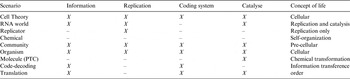
The multiplicity of views described here is still limited, as many keep considering the concept of life in different ways, such as the origin of cells, the origin of an aperiodic polymeric and ordered replicator molecules, the origin of catalysis itself, the origin of the genetic code, the origin of replicators with effective catalytic activity, the origin of chemical transformations, the assembly properties of molecules and self-organization. In Table 1, it is shown the correlation between LUCA's idea, the main process involved in the organization of the LUCA and the main concept of life for each idea.
The possible scenarios to the nature of Last Universal Common Ancestor, the biological characteristics and the main concept of life in each scenario

The X indicates the presence of the characteristics in the scenario.
Genomics and molecular biology are bringing science to a higher level of comprehension about the biological structure of organisms as well as a better understanding about the evolutionary relationships among them. This knowledge leads to new challenges into the understanding of the nature of the LUCA of life on Earth. Characteristically, the discussions have been centred in nucleic acid first defenders against protein-first advocates.
Besides which, a cellular dogma for the origin of life has never been officially broken and viruses have been excluded from the discussions about LUCA. However, the finding of a new group of viruses re-ignited the discussion on the nature of LUCA and brings under the spotlight the necessity of a more profound understanding about the biology of early organisms and their relevance in the evolutionary process. Therefore, a revision on the concept of the LUCA becomes necessary.
Here we show some different lines of thought about the nature of the LUCA of all life forms. Molecules or biological process appear as alternative ways to think about the nature of LUCA. Additionally, to the concepts present in this review, Jheeta (Reference Jheeta2015) suggest another scenario of the origin of LUCA, the lipid world hypothesis, where vesicles could have acted as attractor to the organizations of the first life form. From the moment we accept the possibility of a molecule, a process or a community to be considered as the intersection point common to all living organisms, we should naturally diversify our perspective about how to understand the concept of life.
As already noted, the standard forms of thinking about the concept of life are frequently polarized between informational replicators and proto-metabolic, self-assembled chemical complexes. When one acknowledges that a molecule, a biological process or even a community might be the common link among all living organisms, it becomes necessary to admit new perspectives about what life should be. On the other hand, even if one decides to consider the origin of cells as the origin of LUCA, as the traditional theory propounds, it is certain that the ‘chemical symbiosis’ between nucleic acids and proteins was a crucial point in the evolution of an early, pre-cellular forms of life. No matter, the origin of translation has clearly happened earlier than the origin of viruses once both DNA and RNAs viruses present functional genetic codes. Three points in time have been important to point out: (i) the origin of the PTC; (ii) the origin of the coding/decoding process; and (iii) the emergence of the fully functioning ribonucleoprotein translational machinery. These processes are described in the most likely chronological order and provide a new vision of the ancestral processes operating in every extant organism, including viruses. In this case, this First Earthling Being (FEBe) was at least capable of (i) replicating a nucleic-acid based genome, (ii) translating their nucleic-acid information into polypeptides and (iii) performing protein-based catalytic activity.
Acknowledgements
Many thoughts described here have been originated in the Second International Symposium on Evolutionary Biology, happened in João Pessoa (PB), Brazil, in December 2014. We were very much inspired by presentations and informal conversations with the Nobel Laureate Ada Yonath as well as Antonio Lazcano, Loren Williams, Gustavo Caetano-Anoles, Simonetta Gribaldo, Fabrício Santos, Charbel El-Nani, among others.