Introduction
There is an established literature discussing goals for ethics education in physiotherapy,Footnote 1 and in healthcare more generally.Footnote 2 A common educational goal is to equip students who later become health practitioners, to not only know about the ethical principles guiding their practice, but to also recognize when and how these principles might apply and assist these future practitioners in the care that they provide for patients and families.Footnote 3 However, there is ongoing debate about the most appropriate educational methods and supporting pedagogy for achieving these goals within formal ethics education.Footnote 4
Different teaching approaches in the health ethics education literature are underpinned by implicit or explicit pedagogical understandings of what types of knowledge, skills, and attitudes students need to be ethically competent practitioners.Footnote 5 For example, if ethics in practice is viewed as a capacity to make and justify ethical decisions,Footnote 6 then educational methods will focus on skills in critical thinking and analysis, including how to apply and weigh established ethical principles and norms.Footnote 7 If ethics is viewed as a means of developing a particular character or professional disposition, then ethics education will focus on what constitutes good or “virtuous” attributes and dispositions for a health professional.Footnote 8 Ethics as a form of advocacy would be underpinned by teaching skills that promote and raise awareness of patients’ rights,Footnote 9 and ethics as moral agency would require a focus on the capacities to be morally responsible and accountable in the context of one’s professional identity.Footnote 10
An awareness of ethics educational approaches, underpinning pedagogy, and practical goals enables educators to purposefully design ethics curricula to equip students for the multidisciplinary and ethically complex environments that they will encounter as health professionals.Footnote 11 In health practice, ethical issues and challenges do not map neatly to the biomedical principles of beneficence, nonmaleficence, autonomy, or justice.Footnote 12 Instead, they depend on particular contexts, involve people holding differing values about what matters for health and well-being, and are influenced by broader political, financial, and cultural drivers, therefore going beyond a process of linear and logical weighing of principles.Footnote 13 As a consequence, there is increasing interest in teaching methods that assist students to move beyond knowing about normative ethical principles and values toward developing the capacity to recognize the ethical dimensions of their work within different health contextsFootnote 14 so that they acquire not only knowledge of ethical norms but sufficient moral imagination and courage to use those principles in imaginative, creative, responsible, and accountable ways.Footnote 15
Using narratives has been proposed as an effective pedagogical approach to stimulate students’ moral imagination, increase their awareness of their emotional reactions to ethical issues,Footnote 16 and enhance their capacity to recognize the moral dimensions of clinical experiences.Footnote 17 In health humanities curricula, narratives in a variety of “texts,” including literature, film, visual arts, and other creative modes of cultural production have been used to facilitate moral reflection by providing opportunities for students to gain insight into broader and more complex contexts than the healthcare setting.Footnote 18 Rebecca Garden writes that narratives explored in cultural products are an invaluable means to promote a more critical and nuanced understanding of the social contexts of health, “particularly the power relations and social norms in the clinic that contribute to disparities and discrimination, as well as the social factors that contribute to disease and disability.”Footnote 19 According to Garden, engagement with narratives through the arts establishes “foundations for empathetic understanding, as well as a respect for patients’ authority, by raising questions about assumptions, stereotypes, language, and the nature of representation itself.”Footnote 20
The visual arts have also been increasingly used in health education to promote observation skillsFootnote 21 and to foster a deeper understanding of patient perspectives, including compassion for self and others,Footnote 22 although these latter outcomes are often noted anecdotally as a byproduct of observation-skill-focused interventions. An educational program at McMaster University—“The Art of Seeing”—sought to nurture learner empathy through visual literacy activities. The authors reported that participants believed that the program encouraged them to appreciate the viewpoint of others, and explicitly helped them to connect with the personal viewpoints and narratives of others.Footnote 23 Research in the field of tertiary museum education more broadly demonstrates that the visual arts have the capacity to activate productive ways of thinking and feeling that are valuable in cross-disciplinary learning contexts. For example, qualitative studies demonstrate that using visual arts as a pedagogical approach assists in eliciting vivid and tangible experiences, stretching the imagination, increasing emotional self-awareness, and providing access to tacit knowledge.Footnote 24 These experiences and opportunities for metacognition within art museums are typically highly valued by both students and academics.Footnote 25
These studies highlight potential benefits of using visual arts in ethics education.Footnote 26 However, we have not found descriptions of specific programs that have ethics education as their goal. This article contributes to discussions about ethics education pedagogy and teaching by presenting and evaluating the use of the visual arts as an educational approach designed to increase students’ engagement with ethical thinking and reflection. We describe a sequence of ethics education strategies over a 3 year Doctor of Physiotherapy program. We focus particularly on the final year professional ethics assessment task requiring students to write a narrative essay based on a visit to an art gallery within the university. We discuss the underlying pedagogy for this assessment task, and highlight the learning outcomes we observed through thematic analysis of examples of students’ writing, based on their choice of art work.
An Ethics Curriculum: Pedagogy and Practice
Author CD has been responsible for the formal ethics curriculum for a 3 year graduate entry Doctor of Physiotherapy at University 1 for the past 10 years. The sequencing of educational methods and assessment in the first 2 years aligns with the idea of ethics education as a form of rational and logical thinking through which ethical issues are identified and ethical principlesFootnote 27 are applied deductively to weigh the benefits and burdens of possible actions, to identify the most ethically appropriate action.Footnote 28 In the first year of the physiotherapy degree, students are provided with information via an introductory lecture about fundamental biomedical ethical principles,Footnote 29 and professional codes of conduct relevant to health practice. There is no formal assessment of this lecture-based knowledge. In the second year, students are asked to write an essay based on their experience of clinical practice following a 2 week observational placement in a public hospital. In this essay, students are asked to identify and distinguish between how observed clinical decisions and conduct align with the specific norms or rules to which they were introduced in the first year. They are also asked to discuss how, and on what basis, clinicians make decisions when ethical ideals conflict with each other; for example, when a patient would prefer not to attend rehabilitation, but the physiotherapist would prefer that the patient attend.
Third Phase of Ethics Education Curricula in Detail
The third phase of the ethics education curricula involved a collaboration between authors HG and CD, resulting in a trial of a novel approach to ethics teaching (narrative and visual arts) in the final year of the program. HG has been responsible for developing and delivering visual arts-based educational interventions for the Faculty of Medicine, Dentistry and Health Sciences at University 1 for the past 4 years, using the resources of the Ian Potter Museum of Art (IPMoA). These education sessions for students in health programs are typically delivered in a small group seminar model within the art gallery, where HG and the disciplinary-based faculty use art to facilitate student discussion.Footnote 30 Although visual art from all historical periods is used in visual arts educational engagements at IPMoA across the different disciplines, the ethics education module discussed in this article used contemporary art almost exclusively.
The third phase of the physiotherapy ethics education curricula offered the visual arts content, through a self-directed museum visit by students rather than through the typical seminar delivery in the museum. Students were given the choice of either writing a story about their clinical practice as a way of identifying and then analyzing ethical dimensions of clinical practice, or attending IPMoA in order to select a work of art as a trigger for a story that would raise an ethical issue pertinent to their past or future clinical practice. The educational goal of this third phase was to facilitate more creative and independent engagement with ethics related to health practice by enabling students to choose a work of art, identify how it related to an ethical issue in healthcare, and then refer to normative ethical principles to shed light on or help explain the ethical problem.
This final year ethics education activity involved three stages. Stage 1 was an interactive teaching session (co-presented by authors CD and HG) that included information about IPMoA, specifically the current exhibitions that students would encounter when they visited the museum. During the lecture, students actively participated in a practical exercise in basic visual analysis and art interpretation skills, based on a digitally projected image of a work of art from a current exhibition. A visual thinking strategies approach was utilized in this exercise, using a group discussion to equip students with an understanding of how to build meaning from observed visual object or artwork.Footnote 31 The authors then demonstrated how a close “reading” of an artwork could provide a platform for discussion of ethical issues, either directly related to the visual content or through analogy. In Stage 2 of the activity, students who chose to base their story on an experience with a work of art (as opposed to writing a story based on a clinical experience) visited IPMoA in their own time. As many students were not regular art museum goers, and were generally unfamiliar with contemporary visual art, the curator (author HG) provided all students with the opportunity to attend a guided walkthrough and discussion of the exhibitions. In Stage 3 of the activity, students wrote up and submitted their papers within a few weeks of the art museum experience. The guidelines for students’ ethical analysis of either the clinical experience or the artwork are described in Box 1.
Box 1. Assessment Task Description
Part A
Your task is to write a personal narrative of two pages about an event in your clinical experience
or
To refer to a painting/work of art that raises an issue about ethics in healthcare, and use this as the trigger for ethical reflection
Part B
The narrative in Part A should be written from your point of view (first person). The experience/artwork described should be something that has prompted you to stop and think about an ethical issue.
The narrative should not be a case study or case report, or a description of the event/experience/art. Instead it should include your thoughts and feelings in reaction to the clinical experience or artwork.
Use these questions to guide your reflection:
• Why have you chosen this story/or artwork?
• In what sense is your story ethically significant?
• What ethically significant issue/concept does your story/artwork raise?
• What ethical theories and principles have any bearing on this situation or issues raised? How do these theories and principles (1) explain the situation or (2) make it easier to understand, or (3) show why it is complex?
Comment on the process of writing the analysis about your narrative/artwork as a trigger, and about what it prompted you to think about.
Essay Analysis
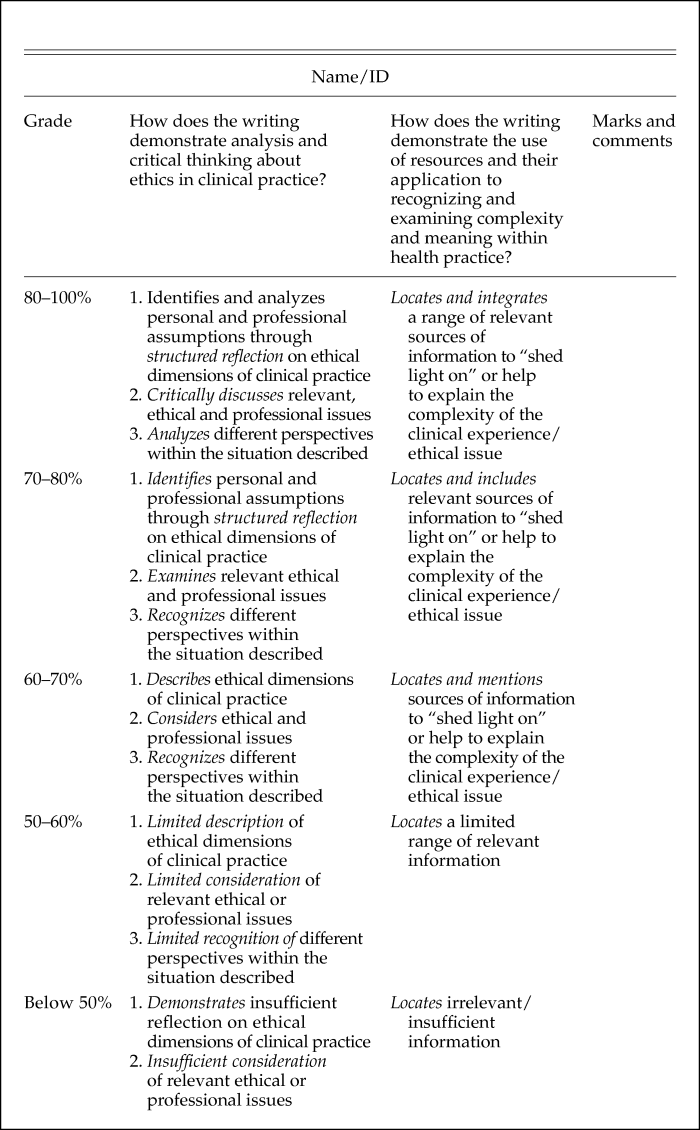
The marking guide (Box 2) awarded marks on the basis of students’ capacities to identify and integrate formal ethics knowledge with their personal and emotional responses to the artwork or clinical experience. Students in years 2015 and 2016 were invited to give consent for the authors to make a copy of their art-based papers and to present examples of their writing and artwork choices in a de-identified form for future presentations and publications. In 2015, 27 students (24 percent), and in 2016, 17 students (18 percent), opted to do the art-based essay in 2016. All students provided their informed consent. Following the formal marking process of the art essays by CD and HG, and after the marked papers were returned to students, each author independently reread the art-based essays. The data (in the form of student essays) were analyzed using both thematicFootnote 32 and content analysis.Footnote 33 Content analysis was used to identify and categorize the topics that students raised in their essays. A thematic approach was used to identify ideas and meanings conveyed by students in response to the artwork.Footnote 34 The analysis involved a process of close reading of the papers and identifying the ethical topics being raised (content), followed by an analysis of how students made sense of the artwork, what emotions and imaginative responses it triggered, and what links students made between their emotional responses and their formal ethical knowledge and/or clinical practice experience. The analysis resulted in the development of two overall themes (emotions and values, and lateral thinking) presented subsequently, with specific excerpts representing examples, attributed to students via their year of graduation.
Marking Guide: Ethics Essay

Essay Themes
The two recurring themes to emerge in students’ visual arts-based narrative writing were:
1) Emotions, ethical values, and professional identity
2) Lateral thinking through analogy and literature
Theme 1: Emotions, Ethical Values and Professional Identity
The first theme emerged from students’ reference to how the artwork made them feel, and how and why such a feeling resonated with or helped to explain ethical ideas and values in their health practice and experience. In the following two quotes, two students independently selected the same contemporary ceramic piece by Stephen Bird, depicting a hand pointing to a bird on a branch accompanied by the inscription “Singing not allowed!” The piece prompted these students to recall their response to witnessing a patient’s distress:
The innocent looking bird, perched on a branch and trying to sing in its natural environment prompted me to think about a patient I saw lying in bed, calling out to medical staff, only to be dismissed as they are told that they are “doing fine” or “need to continue with their course of treatment.” This made me feel a little uncomfortable, as we are taught to practice with a patient-centred approach, listening to what others have to say and respecting their autonomy. What if the bird too, was singing out for help, only to be silenced? (2015 student)
I chose this piece of artwork, as I felt as though the bird in this picture is not too dissimilar to the patient that I had seen previously. The patient lying in a hospital bed surrounded by people walking around dressed in scrubs and face masks, foreign machines beeping and the smell of sterile surfaces must feel as though they are a world away from the environment that they know as their norm. But still, there are people around and we as humans are used to communicating with other people, expressing our desires and being treated with respect and dignity. So when the patient asks for help and refuses to complete the treatment provided by medical staff, only to be instantly dismissed, they begin to feel like this bird; enclosed in a foreign environment and trying to speak out. (2015 student)
Some students linked specific visual features of the artwork as a way of pictorially representing an emotional feature of illness experience in general. A work by sculptor Hiromi Tango called Sea Tears Footnote 35 prompted one student to write
The relation between the sea and tears draws a comparison to drowning in one’s sorrow. The sea is vast and hopeless as well as beautiful, losing one’s self into disease or pathology can seem extremely hopeless and suffocating; like being trapped in the middle of the ocean. The ocean can be likened to one’s tears shed over a lifetime and the relation to the hippocampus show ties with memory and emotion and the feelings of losing hope, one’s sense of self, and the helplessness one can feel when those things are being stripped away from you like being caught in a rip-tide. (2015 student)
A number of students linked aspects of works of art to their own emotional responses, thoughts, and emerging professional identity. These types of links seemed to provide a richer language for them to make sense of or to describe what they had observed in their clinical experience, as well as triggering discussion and analysis of their emerging professional identity and the vulnerability they felt in thinking about their future professional selves. A series of very large paintings by artist William Mackinnon, depicting the experience of surfing as an anchor for emotional well-being in the context of depression, were chosen by a number of students. One student wrote of one of Mackinnon’s paintings, titled The Passage. Footnote 36
I selected Mackinnon’s artwork because at first glance I could relate to the surfers entering the water as I will soon enter private physiotherapy practice, a “mountain-like presence.” A surfer myself, I understood the fear when preparing to paddle out into the wild ocean. (2015 student)
Another student drew from the painting Seated Girl by Hugh Ramsay,Footnote 37 to draw attention to the experience of patients in the healthcare system, and the responsibility she felt to ensure that patients received appropriate attention:
The painting is a posterior view of the female; material is draped around her waist leaving her back, arms and shoulders exposed, while her hair is parted to either side baring her neck. It almost feels as though we are peering down at the female and in her state of vulnerability she is not aware of our presence. I feel that the work of a physiotherapist can sometimes be an invasion of [a person’s] privacy, although it is not intended to be …I will never forget how my presence as an observer made my patient feel, the embarrassed and uncomfortable look on her face and the way it made me feel. I now often request that my supervisors obtain permission regarding my presence as an observer, prior to my arrival into the room. As clinicians, we can learn from our experiences and the experiences of others, this in turn assists us in making ethically conscious decisions in the management of our patients. (2015 student)
Theme 2: Lateral Thinking Through Analogy and Diverse Literature
The second theme we identified in students’ writing was lateral and exploratory thinking evidenced by use of use of analogy as an explanatory tool and reference to diverse sources of literature, beyond normative ethics. In the first example, the meaning attributed to the sculpture Twitch by Julia Robinson, was used to convey a different ways of seeing a patients’ future following the loss of a limbFootnote 38:
You could see this piece as either the wooden leg being foreign or the other leg as missing and this analogously corresponds to how clinicians can often interpret the ethical principles that guide their role with a patient. Much alike to the glass half full or empty perception, you could perceive these limbs with stunning hope and potential in the future or with a sense of loss and melancholy. (2015 student)
Drawing upon the same piece of sculpture, another student drew an analogy between the sculpture and their experience of patients receiving suboptimal care.
It immediately gives the impression of person standing in front of you with an untold story of struggle. Robinson’s work seems to personify the ailments and injuries people experience and the journey towards a life of normality. I see a person who has been provided a quick fix rather than an appropriate level of care…“Twitch” appears to embody the physical and emotional toll from an injury as well as the vulnerability and fragile nature of the human body. (2015 student)
In the following quote, the student uses the painting by William Mackinnon, Light and Dark, 2016, from the series called Keeping the Black Dog at Bay Footnote 39 to depict her perceptions of a patient’s feelings and to situate the possible role of the therapist.
In this painting, a solitary car that has been driving along a dark, winding road is about to enter a dense forest…The only source of light for the driver is their car’s headlights, which brightly illuminates the path ahead. The driver’s final destination is depicted as a tranquil, undisturbed blue ocean that strongly contrasts the darkening sky in the background. On one of my clinical placements, I worked with Mr X, an acute stroke patient who was bed-bound due to his severe physical impairments. The difficultly of his situation was compounded by his non-English speaking background and the lack of interpreters—therefore, he was unable to verbally communicate his needs nor was he able to provide full informed consent to treatments such as his daily mobilisations. Like the lone driver, I think that Mr X may have felt just as isolated and vulnerable. The overwhelming sense of trepidation and the unknown, which is represented by the towering forest, are additional themes that he may have also identified with during this stage of his recovery. However, the car’s headlights are comparable to Mr X’s reliance on the physiotherapist to guide him along his road to recovery. The association between Light and Dark and my previous experience prompted me to wonder if it was ethically appropriate to proceed with Mr X’s mobilisations. (2016 student)
In the following quote, the student explained how the artwork prompted thinking about the steps involved in Gibbs’ Model of Reflection.Footnote 40 The thinking required for critical reflection about one’s own practice and experience were not part of the formal preparation or references provided for this subject, yet for this student, the artwork seemed to facilitate recall of broader approaches to thinking and reflection:
It has become apparent that despite coming from a science background, the role of art is still open to my very own interpretation. The way in which I may perceive a single piece of art is highly subjective and based on the lenses of my experience (current and/or past). Through a Gibbs Model of ReflectionFootnote 41 I am able to understand my own interpretation of TwitchFootnote 42 at the Ian Potter Museum and relate it to the complex interplay of the clinical experiences, feelings and reflections I was facing at the time…There was no right or wrong way of deciphering the art piece and for once that was freeing. I left the museum somewhat changed. (2015 student)
For a number of students, the experience of engaging with works of art at IPMoA prompted them to think beyond their own experience of the healthcare system, to the values of society more broadly and the role of health practitioners acting responsibly and morally within such a system. Responding to an exhibition by artist Brook Andrew, Sanctuary: Tombs of the Outcasts,Footnote 43 which explored the folly of war and the repercussions of conflict both in Australia and internationally, one student wrote:
We are made hyperaware by this exhibition that the current treatment of asylum seekers will most probably be condemned in the future, in the same way we lay moral blame on the actors of the past who mistreated Indigenous Australians…If we are to assume that the detention of asylum seekers is morally wrong, then it follows that someone must hold moral responsibility. What are then, the moral and ethical implications in providing healthcare (as an individual practitioner) to asylum seekers in detention?...Healthcare professionals working in detention centres are faced with a dual loyalty; a duty to provide ethical healthcare to those in need, and the obligation to follow the law. The ethical problem is that the latter restricts the former to the extent that Human Rights violations are pervasive, and the healthcare professional finds themselves contributing towards a system that is essentially making their patients sick. (2015 student)
The student concluded:
This exhibition reminds me that narrative matters. It not only changes our judgement of particular actions, but reinforces these actions, perhaps reinforces a status quo. (2015 student)
A further example of art stimulating broader and more lateral thinking about ethics beyond the individual clinician/patient realm was the following quote based on a photograph and painting of an Indigenous Australian football player lifting his jumper and pointing to his skin in front of thousands of fans. This was part of an installation by Indigenous Australian artist Tony Albert, called Once Upon a Time, which challenged racist attitudes in Australian rules football.Footnote 44
Reflecting on this photograph has prompted me to consider deeply the complex effect culture can have on healthcare provision and acceptance…although healthcare models incorporating culture have been designed, persistent health disadvantages within certain cultural groups, such as the Indigenous Australians, demonstrate that more work needs to be done in this area. (2016 student)
We found that students utilized a diverse range of literature to demonstrate their understanding of ethical complexity in healthcare. The art museum experience, in many cases, stimulated students to explore a wider sphere of ideas about healthcare ethics. In response to the final question of the assignment to comment on the process of using art as a trigger for ethical analysis, the following response represents many examples of students’ writing.
I feel that using artwork as a trigger for ethical issues in healthcare has expanded my interpretations of artwork, along with my knowledge of ethical issues surrounding [organ donation]…art is a very personal experience…what I see within the painting can be very different to the next person who views it…but it led me to an interesting spread of literature on ethical issues surrounding [organ donation]. (2016 student)
Discussion
In this article, we describe a sequence of ethics education strategies over a 3 year Doctor of Physiotherapy program, with a focus on the final year professional ethics assessment task involving the use of visual arts to stimulate exploration of ethics in healthcare. The intention of this assessment was to enrich and expand students’ thinking about health ethics by exposing them to unusual and provocative contexts through visual arts as a specific pedagogical strategy to discuss ethical norms and dimensions. Thematic analysis of students’ writing led to two key findings centered on emotional responses and lateral thinking.
Emotional engagement was evident by students’ use of artwork to refer to either their own emotions or the emotions they recalled experiencing in their clinical training. Emotions in ethical reasoning are increasingly recognized as triggers for ethical thinking and reflection.Footnote 45 Emotions are seen as important for enhancing moral sensitivityFootnote 46 because they work to alert practitioners to morally salient dimensions of clinical situations.Footnote 47 Acknowledging their impact in both the delivery and receipt of healthcare can assist in facilitating a more human connection within the healthcare encounter, including building patient trust and motivation to communicate and collaborate with health advice and management.Footnote 48 In students’ writing, use of emotions appeared to directly assist them in the ethical reasoning process of making sense of complex scenarios. By identifying and situating their feelings and their personal responses as part of the experience of healthcare, students seemed to use the artwork as “a marker or flag” for an ethically important element of their clinical experience.Footnote 49
The theme of lateral thinking including the use of analogy, emerged from students’ engagement with broader aspects of the identified ethical issue, that is, beyond the normative principles guiding their practice.Footnote 50 Lateral thinking, as defined by Edward de Bono, describes solving problems through an indirect and creative approach, using reasoning that is not immediately obvious, and involving ideas that may not be obtainable by using only traditional or expected logical steps.Footnote 51 The visual arts are generally understood to be a context in which lateral thinking is privileged. Contemporary artists in particular work in, and respond creatively to, a wide range of intellectual and emotional sources, including social relations, political power, and cultural beliefs and practices. Across this broad spectrum of stimuli, artists seek to present their own unique experiences to others. Through encounters with art, in the process of framing their interpretations of the art, viewers are encouraged to form new and possibly unexpected ways of conceptualizing their own experiences. This is a core tenet of visual art interventions across many disciplines in the tertiary education field.Footnote 52 In our data, students’ responses clearly demonstrated this effect. Students’ engagement with a work of art seemed to trigger lateral thinking to make sense of ethical dimensions within broad realms of healthcare.
Students’ use of lateral thinking was also evident in their rich use of analogy, in which they used information gained from one domain (visual arts) to solve a problem in another (health ethics).
Gentner et al.Footnote 53 suggest that employing analogies or metaphors involves referring to “familiar concrete domains to discuss less familiar or abstract domains.” The capacity to develop a sense of moral agency, moral imagination, and courage is a core condition for nurturing positive ethical behavior and ongoing dispositions to contribute to the ethical quality of a profession.Footnote 54
A further overarching aspect of students’ writing was that it demonstrated a level of independent thought about ethics. Students were free to choose a work of art and to make connections between that piece of art, their understanding of ethics, and their experience of clinical practice. They were guided to bring in normative ethical principles, but they did this to enhance their own understanding of the ethical problem they raised. The task of choosing a work of art and analyzing ethical dimensions in their own way gave students an opportunity to draw from themselves and their own understanding. This exploration of self-concept and self-reaction is highly relevant to becoming a critical beingFootnote 55 and a moral agent.Footnote 56 According to Wellbery and McAteer, giving students an opportunity to respond independently and with agency has the potential to usefully disrupt problematic practices in medical culture, alerting students to the possibility of that they can resist dominant (healthcare) discourses. These authors refer to the idea of students’ “seeing rightly,” a self-corrective process drawing from the language of mindfulness, in which everything is welcomed and nothing is shunned. In weighing multiple perspectives, observation becomes a reflective practice, introducing the possibility of choosing a witnessing platform that is consonant with the viewer’s (or student’s in this case) values and his or her idea of professional identity.Footnote 57
The current study provides some evidence to support the effectiveness of the use of the visual arts in promoting certain attitudinal changes toward healthcare ethics in students. The limitations of our report are that we did not analyze and then compare themes generated in students’ arts-based essays with other students’ writing, in which they completed the same task, but in which the trigger for ethical analysis was an event that they could recall from their clinical experience. Future research is required to analyze different written responses to visual arts, narratives, or case studies. A written essay is also a limited type of evidence, as it does not provide insight into students’ actual ability to better understand patient perspectives.Footnote 58 There is clearly more research needed to follow up students on the impact of this ethics education intervention and whether it provides sustainable learning that is transferrable in the clinical setting and makes a difference to their professional ethical development and the care they provide in practice.
Conclusion
In this article, we present data gathered from essays written after students had attended a museum. Students were free to choose a work of art, and were then guided to use it as a trigger for discussing an ethical issue as part of their final year ethics education assessment. Students used both normative professional ethics principles and ethics literature more generally to shed light on the ethical issue they had identified. We found that the use of artwork appeared to facilitate imaginative, emotional, and conceptual thinking about ethics and clinical experience (both past and future). Based on our analysis of students’ essays, integrating visual art into an ethics education framework did seem to assist in fostering access to feelings, not just intellectual understanding of ethical principles, and to facilitate students’ engagement with a broader literature to frame and make sense of the ethical dimensions of their clinical practice. Students’ analysis and commentary about the experience suggested that the opportunity to use images and art as a prompt enabled them to bring independent thought and choice, and from our perspective, they incorporated their own emerging professional identity into the ethical analysis and reflection. As one student noted, she left the museum “somewhat changed.”