I. INTRODUCTION
Wireless technology in microwave bands has been developed and used widely for communication and sensing applications [Reference Chang1, Reference Yasri, Lescop, Rioual, Gallée, Diler and Thierry2]. In communication applications, the wireless technology is used for transferring data, voice, image, and video to mobile devices. In sensing applications, the wireless technology is used for identifying unknown object which can reflect the microwave signals. The microwave bands have advantages with low atmospheric loss, large coverage area, and excellent penetration through many obstacles. However, the microwave bands have narrow bandwidth, narrow available electromagnetic spectrum, and overcrowded.
High-speed communication and high-resolution sensing through wireless technology are generally required. In order to meet these requirements, applying high operational microwave frequency into millimeter-wave bands is one of the promising solutions because of its large bandwidth and large available electromagnetic spectrum [Reference Dat, Kanno and Kawanishi3, Reference Shi, Huang and Pan4]. However, the millimeter-wave bands have relatively large propagation loss in air and metal cables. It can be compensated by using directional wireless communication or sensing to obtain effective operation by high-gain antennas with beam-steering controller. Recently, the wireless beam-steering can be realized using mechanical methods with an electrical motor or electronic method with phase shifter [Reference Lee, Park and Lee5, Reference Albani6].
By considering the millimeter-wave characteristics, directional wireless communication or sensing with small coverage area in pico/femto-cells can be developed through several schemes, such as point-to-point wireless, space-division-multiplexing-access, multiple-input–multiple-output, and so on. For enlarging the coverage area, several pico/femto-cells are connected in wired connection by cables. Since the millimeter-wave has large propagation loss in metal cable, optical fiber cables are the candidate for propagating the millimeter-wave through lightwave as the carrier, which is called the radio-over-fiber (RoF) technology [Reference Waterhouse and Novack7].
In the millimeter-wave RoF technology, converters between millimeter-wave and lightwave signals are the key devices for connecting the wireless millimeter-wave and optical fiber networks. For optical fiber downlink and wireless millimeter-wave uplink, a high-speed photo-detector and antenna can be used for converting a lightwave to millimeter-wave signals [Reference Mortazy, Wu and Liu8]. On the other side for wireless millimeter-wave downlink and optical fiber uplink, an antenna and high-speed optical modulator can be used for converting a millimeter-wave to lightwave signal [Reference Murata, Kohmu, Wijayanto and Okamura9–Reference Park, Pagan, Murphy, Luo, Jen and Herman12].
In this paper, we propose an array of patch-antennas with meandering-gaps on an optical modulator for wireless millimeter-wave beam-steering through high-speed RoF systems. By using the proposed device, wireless millimeter-wave can be received by the array of patch-antennas and directly modulated to lightwave by the optical modulator. The proposed device is used for wireless millimeter-wave downlink and optical fiber uplink. Furthermore, the wireless millimeter-wave can be steered using the meandering-gaps at the patch-antennas by controlling interaction between millimeter-wave and lightwave electric fields in electro-optic (EO) modulation. The directional wireless communication or sensing through photonic technology can be realized using the proposed device. The basic operations and analysis of the proposed device are discussed. In our experiment, 5 × 5 antenna array was designed and realized for device characterization and demonstration to wireless millimeter-wave beam-steering. As a result, five variations of wireless millimeter-wave beam-steering for one dimension (1D) in xz- or yz-planes with wireless millimeter-wave steerable beams of about ±30° could be obtained. Additionally, 25 variations of wireless beam-steering for two-dimension (2D) in xyz-space through orthogonal optical modulation could be obtained as well.
In the following sections, the device structure and operational principle, analysis, and design of the proposed device are discussed for 40 GHz millimeter-wave bands. Device fabrication, characterization, and demonstration are reported.
II. DEVICE STRUCTURE
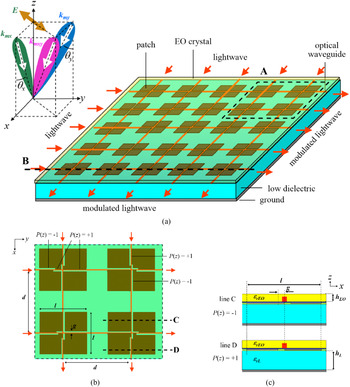
Figure 1 shows the structure of the proposed device in whole, top, and cross-sectional views. The proposed device consists of N × N patch-antennas with meandering-gaps fabricated on low dielectric constant material bonded with N × N orthogonal optical waveguides fabricated on a thin EO crystal. The patches, which are made of gold metal, were inserted between the EO crystal and low dielectric constant material for receiving wireless millimeter-wave signal. Half a wavelength of the designed millimeter-wave was set for the patch length (l) as the fundamental mode antenna characteristic. The gap width (g) was set very narrow in micrometer order for generating strong millimeter-wave electric field. As shown in cross-sectional view of Fig. 1(c), the optical waveguides are located on one side of the gap edge for lightwave propagation. The overlapping area between the gap and optical waveguide is for EO modulation. A buffer layer was inserted between the EO crystal and patches. The reverse side of the low dielectric constant material was covered with a ground metal.
Structure of the proposed device (a) whole view, (b) top view for A-plane, and (c) cross-sectional views along C- and D-lines.

The basic operation of the proposed device for wireless receiver and optical modulator was discussed in microwave bands [Reference Wijayanto, Murata and Okamura13, Reference Wijayanto, Murata and Okamura14]. The device characteristics for microwave frequency and irradiation angle dependences have also been reported. Based on the results, the directivity of the proposed device can be controlled for receiving certain direction of the wireless microwave signal. It can be controlled by considering transit-time and interaction between microwave and lightwave electric fields along the gaps [Reference Yariv15]. Since the polarity of standing-wave in the microwave electric field between the gap edges is always in opposite direction, this phenomena can be used to invert the polarization for manipulating the interaction between microwave and lightwave electric fields along the gaps. Therefore, meandering-gaps along the optical waveguides are adopted for controlling the wireless microwave/ millimeter-wave beam-steering. The number of optical waveguides and meandering-gap variations correspond to the millimeter-wave wireless to enable steering in certain direction along the xz- or yz-plane. Additionally, 2D wireless millimeter-wave beam-steering in the xyz-space can be realized by considering two lightwave outputs from orthogonal optical waveguides. The N × N optical waveguides correspond to the variation numbers of 2D wireless millimeter-wave beam-steering.
III. DEVICE ANALYSIS
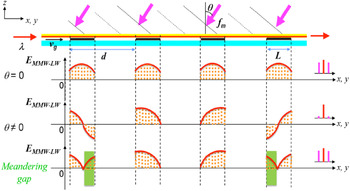
The operation principle of the proposed device is understood by considering the EO modulation polarity change due to polarization inversion of the millimeter-wave electric field in the meandering-gaps. Figure 2 shows the cross-sectional view of the proposed device along the optical waveguides. When the millimeter-wave wireless beam was irradiated to the device and steered to an angle of θ, the millimeter-wave was received by the patch-antennas and millimeter-wave standing-wave current was induced simultaneously on the patches. Millimeter-wave displacement current and strong electric field were induced across the gaps. The millimeter-wave electric field at hth patch observed by the lightwave is expressed in equations (1) and (2) by taking into account the transit time of lightwave (v g t = x–x′ and v g t = y–y′) [Reference Mortazy, Wu and Liu8, Reference Murata, Kohmu, Wijayanto and Okamura9].
 $$E_{MMW - LW}^h \left( x \right) = {E_0}\cos \left[ {\displaystyle{{2\pi {f_m}} \over {{v_g}}}x - dh\displaystyle{{2\pi {f_m}} \over c}{n_0}\sin {\theta _x} + {\varphi _x}} \right],$$
 $$E_{MMW - LW}^h \left( y \right) = {E_0}\cos \left[ {\displaystyle{{2\pi {f_m}} \over {{v_g}}}y - dh\displaystyle{{2\pi {f_m}} \over c}{n_0}\sin {\theta _y} + {\varphi _y}} \right],$$
where f m is the designed operational frequency of millimeter-wave, n 0 is the refractive index of the millimeter-wave in the air (n 0 = 1), θ x and θ y are the millimeter-wave incident angles along x- and y-axes, respectively, d is the distance between the antennas, v g is the group velocity of the lightwave, and φ x and φ y are the initial phases of the lightwave along orthogonal optical waveguides in the x- and y-axes, respectively.
Operational principle of the proposed device for an optical waveguide along a line-B in Fig. 1(a).

The refractive index change induced by EO effect is proportional to the millimeter-wave electric field observed by the lightwave. Therefore, the modulation efficiency of the proposed device is determined by sum of the integral of the induced index change through each gap by considering transit-time of the lightwave as shown in equations (3) and (4).
 $$\Delta \phi \left( {{\theta _x}} \right) = \displaystyle{{\pi {r_{33}}n_e^3} \over \lambda} {\rm \Gamma} \mathop \sum \limits_{h = 0}^N \int_{hD}^{hD + L} {P\left( z \right)} E_{MMW - LW}^h \left( {x;{\theta _x}} \right)dx,$$
 $$\Delta \phi \left( {{\theta _y}} \right) = \displaystyle{{\pi {r_{33}}n_e^3} \over \lambda} {\rm \Gamma} \mathop \sum \limits_{h = 0}^N \int_{hD}^{hD + L} {P\left( z \right)} E_{MMW - LW}^h \left( {y;{\theta _y}} \right)dy,$$
where P(z) is the polarity of millimeter-wave electric field due to the meandering gaps along the x- or y-axis as shown in Fig. 1(c), λ is the wavelength of the lightwave propagating in the orthogonal optical waveguides, r 33 is the EO coefficient, n e is the extraordinary refractive index of the EO crystal, Γ is a factor expressing the overlap between the induced millimeter-wave and lightwave electric fields where it depends on the location of the optical waveguides and patches by considering the EO crystal orientation and optical field polarization, L is the length of the patch as the interaction length between the millimeter-wave and lightwave, and N is the number of gap-embedded patches in the array structure.
In Fig. 2, the distance of the patches was set effectively for normal direction wireless millimeter-wave beam. In this case, the millimeter-wave electric field observed by the lightwave was in the same region. Therefore, effective optical modulation could be obtained. Then, when wireless millimeter-wave beam is shifted to other direction, the millimeter-wave electric field observed by the lightwave contained positive and negative regions. As a result, the modulation efficiency was degraded due to miss-matching condition. To compensate this degradation, polarization inversion by inversing the direction of spontaneous polarization at the negative regions with meandering-gaps was adopted. Therefore, effective modulation efficiency for certain direction of wireless millimeter-wave beam was obtained. Based on this, the proposed device can be designed for receiving several directions of wireless millimeter-wave beam by setting appropriate polarization inversion patterns.
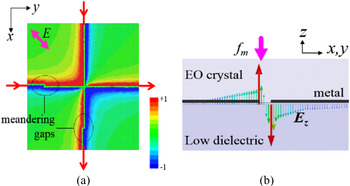
The patch-antennas with meandering-gaps are an important structure for receiving wireless millimeter-wave beam and generating strong millimeter-wave electric field. They were analyzed in 40 GHz millimeter-wave bands by using electromagnetic analysis software. The design parameters were set as follows: ε rL = 3.5; h L = 0.13 mm; ε rEO = (41, 41, 28); h L = 0.07; L = 1.6; t = 0.002; and G = 0.01 mm. The millimeter-wave frequency response was observed under irradiation of the plane wave in 40 GHz millimeter-wave bands with 45° polarization from the free space to the designed device. Figure 3(a) shows the electric field distribution on the reverse side of the EO crystal surface under irradiation of millimeter-wave wireless beam. A strong millimeter-wave electric field is induced across the gaps for EO modulation along the gaps and optical waveguides.
(a) The millimeter-wave electric field distribution on reverse side of the EO crystal surface. (b) The millimeter-wave electric field profile.

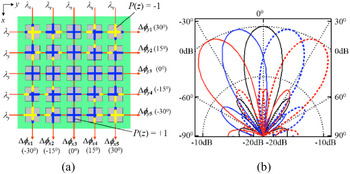
Since the polarity of the millimeter-wave electric field in the z-component between two edges of the gap has opposite direction as shown in Fig. 3(b), the polarity in EO modulation can be switched using meandering-gaps. The typical polarization inversion patterns with meandering-gaps were designed with antenna distance (d) of 2.3 mm as shown in Fig. 4(a). The calculated modulation efficiency as a function of millimeter-wave wireless beam-steering is shown in Fig. 4(b), when the designed millimeter-wave frequency of 38 GHz.
(a) The designed polarization inversion patterns of meandering-gaps. (b) The calculated millimeter-wave wireless beam-steering for 1D in xz- or yz-planes.

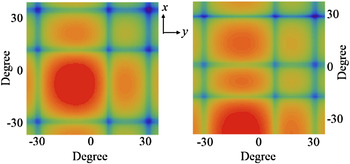
Furthermore, 2D millimeter-wave wireless beam-steering can be realized based on the observed 1D wireless beam-steering. It can be obtained by considering the two modulated lightwave from orthogonal optical waveguides along the x- and y-axes. The typical analyzed 2D wireless beam-steering is shown in Fig. 5 based on current experimental measurement results using the fabricated device. We can see that the wireless millimeter-wave beam can be steered for a certain position along the x- and y-axes. As a result, since the number of the antenna array is 5 × 5, 25 variations of 2D wireless beam-steering in the xyz-space can be obtained using the designed device.
The analyzed 2D millimeter-wave wireless beam-steering in xyz-space based on the two orthogonal 1D millimeter-wave wireless beam-steering.

IV. DEVICE EXPERIMENT
The designed device was fabricated and demonstrated experimentally. First, titanium diffusion carried out at 1100°C for 10 h was performed to fabricate the orthogonal optical waveguides on a 0.25 mm-thick z-cut LiNbO3 optical crystal [Reference Zhang, Hua and Pun16]. A 0.2 µm-thick SiO2 buffer layer was deposited on the LiNbO3 optical crystal. An array of patches with meandering-gaps was fabricated on the LiNbO3 optical crystal with 2 µm-thick gold film using thermal vapor deposition, standard photo-lithography, and a lift-off method, wherein the optical waveguides were aligned precisely onto one side of the gap edges as shown in Fig. 1(c).
A low dielectric material was covered with ground electrode on the bottom side. The top surface of a low dielectric material was covered with an optical adhesive for bonding process. In bonding process, the LiNbO3 optical crystal was flipped to 180°, so that the metal antennas were on the bottom surface of the LiNbO3 optical crystal. Then, the flipped LiNbO3 optical crystal was bonded to the low dielectric material by exposing to ultraviolet light [Reference Uddin, Chan, Tsun and Chan17]. Finally, the 0.25 mm-thick LiNbO3 optical crystal was polished using a polishing machine with diamond slurry to achieve the desired thickness of about 70 µm. The fabricated device is shown in Fig. 6(c).
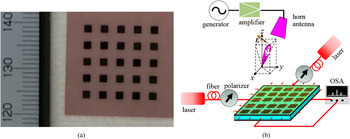
(a) Fabricated device and (b) measurement setup for millimeter-wave wireless beam-steering.

The characteristics of the fabricated device were measured experimentally with a measurement setup as shown in Fig. 6. Lightwave with operational wavelength of 1.55 µm from the laser were propagated to optical fibers and coupled to the fabricated device. Optical polarizers were inserted between the lasers and fabricated device and set to the z-axis by considering EO crystal orientation. Millimeter-wave in 40 GHz bands from a signal generator was amplified and irradiated to the fabricated device using a horn antenna. The output lightwave from the orthogonal optical waveguides were measured using an optical spectrum analyzer.
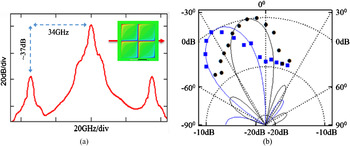
The fabricated device was measured for effective operation around 34 GHz millimeter-wave frequency. The typical measured optical sidebands by irradiation of 34 GHz wireless millimeter-wave frequency are shown in Fig. 7(a). We can see that the measured power ratio between optical sidebands and carrier is about −37 dB under 20 mW millimeter-wave irradiation. Since the power ratio is less than unity (<1 or <0 dB), it can be used for representing modulation efficiency or index. By considering Bessel function, the relative modulation index of the fabricated device under millimeter-wave irradiation is about 0.2 rad/W. The measured millimeter-wave wireless beam-steering characteristics are shown by the dots in Fig. 7 for the two waveguide with different polarization inversion patterns with meandering-gaps as previously shown in Fig. 4(a). We can see that, the millimeter-wave wireless beam can be received, converted to lightwave through EO modulation and steered using meandering-gaps. The measurement results were obtained for several wireless beam angles. The measured wireless beam steering was slightly shifted compared with the calculation results because the millimeter-wave operational frequency has been changed due to fabrication error. This can be resolved by performing the fabrication process precisely. Based on this result, basic operations of the millimeter-wave wireless beam-steering using patch-antennas with meandering-gaps on an EO modulator have been proven.
(a) Typical measured optical sidebands from lightwave output and (b) the measured millimeter-wave wireless beam-steering in xz- or yz-planes.

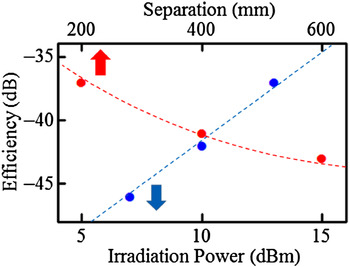
The modulation efficiency of the fabricated device is also an important parameter. Large modulation efficiency can also be obtained by using large millimeter-wave irradiation power and good enough separation between the antenna transmitter and fabricated device. The measured modulation efficiency for several millimeter-wave irradiation power and separation is reported in Fig. 8. Furthermore, the modulation efficiency of the proposed device can be improved internally by adding array antenna number with higher EO coefficient such as EO polymer, and so on.
The measured modulation efficiency for several millimeter-wave irradiation power and separation.

V. CONCLUSION
A new array of patch-antennas with meandering-gaps on an optical modulator for wireless millimeter-wave beam-steering through high-speed RoF systems has been proposed. Its operational principle, analysis, and experimental demonstration were reported. By using simple meandering-gaps, interaction between millimeter-wave and lightwave electric fields in EO modulation can be manipulated for steering wireless millimetere-wave beam. Therefore, N variations of 1D and N × N variations of 2D wireless beam-steering can be realized using the proposed device with low millimeter-wave loss and no external power supply requirement. The proposed device using the fabricated 5 × 5 patch-antennas with meandering-gaps was demonstrated experimentally in 40 GHz millimeter-wave bands. Wireless millimeter-wave beam-steering with steerable beam of ±30° can be obtained using the fabricated device. Furthermore, 25 variations of 2D wireless beam-steering were obtained using two modulated lightwave from orthogonal optical waveguides. The proposed device is promising to be applied in millimeter-wave/ tera-hertz bands for future directional wireless communication and sensing with high-speed and high-resolution operation.
ACKNOWLEDGEMENTS
The authors would like to thank Dr. H. Shiomi and Dr. K. Kitatani from Osaka University Japan and Dr. T. Umezawa Dr. K. Inagaki, and Mr. S. Nakajima from National Institute of Information and Communication Technology (NICT) Japan, for their constructive comments and valuable suggestions during discussion and helpful supports during device fabrication and experimental measurement. Y. N. Wijayanto, A. Kanno, T. Kawanishi, and N. Yamamoto would like to thank the Ministry of Internal Affairs and Communications, Japan, for the financial support partly through the project entitled “Research and Development of high-precision imaging technology using 90 GHz band linear cells” funded by the “Research and Development to Expand Radio Frequency Resources.”
 Yusuf Nur Wijayanto received his B. Eng. degree in Electrical Engineering from Institut Teknologi Sepuluh Nopember Indonesia in 2004, the M. Eng. and Ph. D. degrees in Electrical Engineering from Osaka University, Japan, in 2010 and 2013, respectively. From 2004 to 2005, Dr. Wijayanto was with the PT. Solusi Citra Indonesia Jakarta. Since 2005, he joined the Indonesian Institute of Sciences (LIPI) Indonesia. In 2014, he joined the National Institute of Information and Communications Technology, Japan. His works are related to high-speed electro-optic modulators, wireless radio to optical signals converters, and fiber-wireless technology. Dr. Wijayanto is a member of IEEE Photonics, InOS, and INSTICC. Dr. Wijayanto was the recipient of the LIPI Inventor Award in 2015, the Japan Society of Applied Physics (JSAP) Young Scientist Oral Presentation Award in the 60th JSAP Spring Meeting in 2013, the IEEE Photonics Society, Japan Young Scientist Award in 7th APMP 2012, and the ECO-MATES Promotion Award in the ECO-MATES 2011.
 Atsushi Kanno received his B. Sc., M. Sc., and Ph. D. degree in Science from the University of Tsukuba, Japan, in 1999, 2001, and 2005, respectively. In 2005, Dr. Kanno was with the Venture Business Laboratory of the Institute of Science and Engineering, University of Tsukuba. In 2006, he joined the National Institute of Information and Communications Technology Japan. His research interests are microwave/millimeter-wave/terahertz photonics, ultrafast optical communication systems, and lithium niobate optical modulators. Dr. Kanno is a member of the Institute of Electronics, Information and Communication Engineers (IEICE), the Japan Society of Applied Physics (JSAP), and the Institute of Electrical and Electronic Engineers (IEEE).
 Hiroshi Murata received his B. Eng., M. Eng., and D. Eng. degrees in Electrical Engineering from Osaka University, Osaka, Japan in 1988, 1990, and 1998, respectively. Prof. Murata is now Associate Professor in Division of Advanced Electronics and Optical Science, Graduate School of Engineering Science, Osaka University. His works are concerned with integrated optics, non-linear optics, microwave/millimeter-wave photonics, and polarization-reversal technologies. He is the author or coauthor of more than 180 technical publications and also holds several patents. He was the Technical Program Committee Chair of MWP/APMP 2014, an Associate Editor of the IEICE Electronics Express in 2009–2012 and the Guest Editor of the Journal Advances in OptoElectronics on the Special Issue: “Progress in Domain-Engineered Photonic Materials,” in 2007–2008. He is a member of IEEE Photonics and MTT societies, OSA, EuMA, JSAP, and Laser Society of Japan. He was the recipient of the 35th EuMC Microwave Prize in 2005.
 Tetsuya Kawanishi received his B. Eng., M. Eng., and Ph. D. degrees in Electronics from Kyoto University, Japan, in 1992, 1994, and 1997, respectively. From 1994 to 1995, he was with Production Engineering Laboratory, Matsushita Electric Industrial (Panasonic) Company, Ltd. In 1997, he was with Venture Business Laboratory, Kyoto University for researching on electromagnetic scattering and near-field optics. In 1998, he joined Communications Research Laboratory, Ministry of Posts and Telecommunications (now NICT) Japan. In 2004, he was a Visiting Scholar with Department of Electrical and Computer Engineering, University of California USA. Presently, in 2015, he is the Professor in the Department of Electronic and Physical Systems Waseda University and working on high-speed optical modulators and RF photonics. He is a regular member of IEICE, JSAP, and a fellow member of IEEE. He received URSI Young Scientists Award in 1999 and Young Scientists Award in the field of Science and Technology in 2006, from MEXT Japan.
 Naokatsu Yamamoto received the Ph. D. degree in Electrical Engineering from Tokyo Denki University, Tokyo, Japan, in 2000. In April 2001, he joined the National Institute of Information and Communications Technology; NICT, Tokyo, Japan where he is presently the Director of Lightwave Devices Lab. He was also with Tokyo Denki University as a Visiting Professor from December 2013 and the Ministry of Internal Affairs and Communications as a Deputy Director from July 2012 to September 2013. His research interests include nanostructured materials and III-V semiconductor QD and their photonic device applications in photonic transport systems. He proposed many types of novel crystal growth techniques and successfully developed QD photonic devices. Recently, he has proposed the use of 1.0 and 1.3 µm waveband photonic transport systems to develop a novel optical frequency resource for optical communications.
 Yasuyuki Okamura received his B. Eng., M. Eng., and D. Eng. degrees in Electrical Engineering from Osaka University, Osaka, Japan in 1973, 1975, and 1978, respectively, for studies on anisotropic optical waveguides. From 1978 to 1981, he worked for Kokusai Denshin Denwa Corporation (KDD), where he was engaged in developing ultra-low loss optical fibers. From 1981 to 1996, he was with the Department of Electrical Engineering, Faculty of Engineering Science, Osaka University. From 1996 to 2003, he was a Professor of Department of Optomechatronics, Faculty of Systems Engineering, Wakayama University, Wakayama, Japan. From 2003, he has been a Professor of Division of Advanced Electronics and Optical Science, Graduate School of Engineering Science, Osaka University. He is now the Vice President of Osaka University. His present work has been concerned with optical engineering, electro-magnetic theory, microwave circuits and antennas, and random media. He is a member of the IEICE, JSAP, and IEEE.