Introduction
In the management of the trauma patient, vital signs are considered important clinical indicators for the clinician as evidenced by their inclusion in trauma team activation criteria, and much emphasis is placed on them in current trauma training.Reference Kohn, Hammel, Bretz and Stangby1, 2 Despite evidence challenging the usefulness of vital signs in the trauma setting, their measurement still remains a core component of early trauma care, when little objective information (other than perhaps the visible injury or mechanism) is known.Reference Brasel, Guse, Gentilello and Nirula3
Both tissue injury and ischemia cause tachycardia and hypertension mediated via the sympathetic nervous system (SNS) in a manner similar to that of the fight-or-flight reaction.Reference Foex4 The response to tissue injury attenuates the cardiovascular response to hemorrhage through a reduction in sensitivity of the baroreceptor and depressor reflexes.Reference Foex4 The result is that relative cardiovascular stability is maintained longer; however, for clinicians this makes hemorrhage more difficult to diagnose when injury is present.Reference Foex4 Pain only attenuates the vagal component of the baroreceptor reflex, leaving the sympathetic component intact.Reference Pickering, Boscan and Paton5 Sympathetic nervous system activation may therefore result in measurable tachycardia, tachypnea, and hypertension, although these are not usually seen unless pain intensity and duration is sufficiently high.Reference Hamunen, Kontinen, Hakala, Talke, Paloheimo and Kalso6, Reference Hsieh, Ståhle-Bäckdahl, Hägermark, Stone-Elander, Rosenquist and Ingvar7 The exact details of this relationship remain unclear, but it is possible that sufficient pain may, like injury, obscure the cardiovascular response to hemorrhage,Reference Bantel and Trapp8 making clinical detection of its presence more difficult.
Spine immobilization using a firm cervical collar, head restraints and a spinal board is advocated by the Advanced Trauma Life Support (ATLS) course material as a precaution against causing or worsening a spinal cord injury in an injured or potentially injured person.2 This inevitably results in pain and discomfort.Reference Kwan and Bunn9-Reference Walton, DeSalvo, Ernst and Shahane13 Kwan et al reviewed 17 randomized controlled trials (RCTs) in order to evaluate the effect of spinal immobilization on healthy subjects.Reference Kwan and Bunn9 Of these RCTs, four used pain and another four used discomfort as an outcome measure. All the studies showed that subjects reported a significant increase in pain or discomfort when immobilized.Reference Kwan and Bunn9 A thorough search of current literature databases (including the British Nursing Index, EMBASE, CINAHL, MEDLINE and Google Scholar) was undertaken, searching for papers that describe an association between vital signs and spinal immobilization. This search revealed five papers of varying quality, describing respiratory restriction associated with spinal immobilization using various devices, though none of these papers included comments on the respiratory rate (RR).Reference Kwan and Bunn9, Reference Bauer and Kowalski14-Reference Ay, Aktaş, Yeşilyurt, Sarıkaya, Cetin and Ozdoğan17 No literature could be found describing the effect of spinal immobilization on heart rate (HR) or systolic blood pressure (SBP).
Given the paucity of literature, it is not known whether sustained pain and discomfort caused by spinal immobilization may be a sufficient stimulus to affect a patient's vital signs. If so, this effect will need to be taken into account during evaluation of vital signs in the injured, spinal immobilized patient, as immobilization may—like tissue injury— make detection of hemorrhage difficult. This study aimed to establish whether the pain and discomfort associated with spinal immobilization and the maneuvers commonly used in injured patients (eg, log roll) affect the HR, BP and RR. The null hypothesis was that there are no effects.
Methods
A prospective, unblinded, repeated-measure study was used to test the null hypothesis. To power the study to 80% (α = 0.05), 52 subjects were required to reject the null hypothesis if the mean differences in HR, RR and SBP were 10 beats per minute, 2.5 breaths per minute and 7.5 mm Hg, respectively (a priori consensus among authors). Uninjured, healthy, adult volunteers were recruited from staff in Derriford Hospital's Emergency Department (ED) (Plymouth, UK) and from paramedic students at Plymouth University. Subjects were excluded from participation if they: (1) had known cardiovascular or respiratory disease; (2) were taking any medications known to affect the heart rate (eg, sympathomimetics or antihypertensive medication); (3) were pregnant; (4) suffered with back problems (including previous back surgery); or (5) developed a symptomatic bradycardia (pulse <60), tachycardia (pulse >120), hypotension (SBP <90) or any hypertension (SBP >180) before or during data collection. Informed consent was obtained from all participants. The study received ethical approval through the NHS South West 1 Research Ethics Committee (REC) (10/H0203/25) and University of Cape Town REC (014/2010).
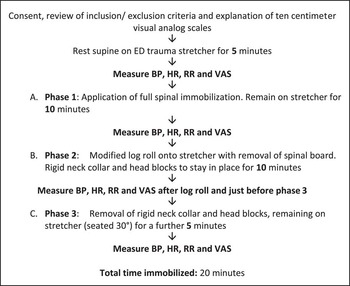
Outcomes measured were the resting HR, BP, RR, pain VAS and discomfort VAS; these were compared with values 10 minutes after full spinal immobilization (Phase 1), following the log roll (Phase 2), 10 minutes after removal of spinal board (Phase 3), and final resting values. Clinically relevant outcome measures (a priori determined) were mean differences for HR, RR and SBP of ≥ 10 beats per minute, 2.5 breaths per minute and 7.5 mm Hg, respectively. The strategy employed for data collection is shown in Figure 1.
Strategy Employed to Collect Data from Healthy Volunteers

The first author collected all the data, and as subjects were uninjured, performed a modified log roll in Phase 2 of the study. Heart rate and SBP were obtained using the same manual, electronic sphygmomanometer for all subjects, and RR was manually counted over a minute. Full spinal immobilization consisted of a correctly-sized rigid neck collar, rigid spinal board and head blocks. Discomfort and pain were measured separately using a 100-point visual analog scale (VAS). An evaluation of discomfort also was made using a 100-point VAS. This scale has been used previously in spinal immobilization literature as a subjective measure of tissue ischemia.Reference Walton, DeSalvo, Ernst and Shahane13, Reference Hauswald, Hsu and Stockoff18
Data were analyzed using SPSS Statistics version 19 (IBM, Armonk, New York USA). Mean, median, standard deviation (SD), range and 95% confidence intervals (CIs) were used to describe the data sets. Friedman's analysis of variance (ANOVA) was used to evaluate SBP, HR, RR, pain VAS and discomfort VAS. A Wilcoxon signed-rank test (with a Bonferroni correction to control for the family-wise error) was used for post-hoc testing for pain VAS and discomfort VAS.Reference Field19 Effect size was determined using Pearson's correlation coefficient (r).Reference Field19 The correlation coefficient (r) is a useful test, not only to measure strength of a relationship, but also to measure the strength of an experimental effect between two variables (r = 0.10, 0.30 and 0.50 denote small, medium and large effects respectively).Reference Field19 Statistical tests were two-sided and a P < .05 was deemed statistically significant (with the exception of the Bonferroni correction where P < .01 was used to indicate significance).Reference Field19 Finally, data were transformed to z-scores to allow expression of values in SD units, thus allowing direct comparison among the vital signs, pain VAS and discomfort VAS data sets.Reference Field19
Results
Data were collected from 53 subjects (11 male) and there were no missing data points.
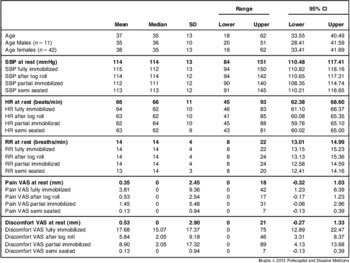
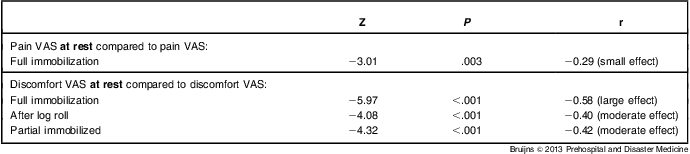
Friedman's ANOVA for SBP, HR and RR showed statistically significant differences within their respective data sets (P < .05, .01 and .01 respectively), but when compared to outcome measures, these differences were not clinically relevant (Table 1). The pain and discomfort VAS also showed statistically significant differences within their respective data sets (Friedman's ANOVA, P < .001 for both). Outcome measures were not set for the pain and discomfort VAS; these were further evaluated using the Wilcoxon signed-rank test and effect size (r) measurement, where post-hoc analysis revealed a significant mean difference. The mean differences among discomfort at rest, discomfort with spinal immobilization, logroll, and partial immobilization significant (P < .001 each) and effect sizes were −0.58, −0.4 and −0.42 respectively (Table 2). The mean difference between pain at rest and pain with spinal immobilization was the only significant finding on post-hoc analysis (P = .003) although the effect was small (0.13).
Descriptive Statistics of Age and Data Sets (control group in bold)

Abbreviations: SBP, systolic blood pressure; SD, standard deviation; RR, respiratory rate; VAS, visual analog scale
Significant Findings When At Rest Control Group Mean Compared to Other Group Means
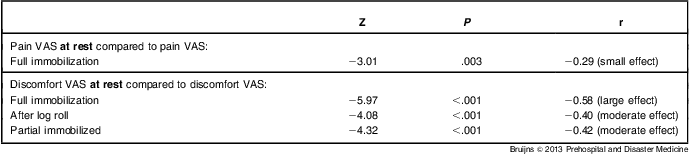
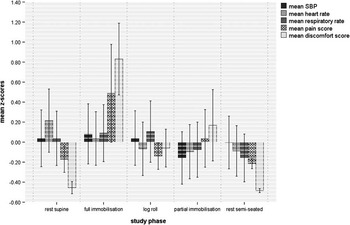
Figure 2 (supplementary file online) gives a graphical interpretation of the data sets using z-scores (values can be found in Table 4, supplementary file online). These show the significant variation (95% error bars) in the discomfort VAS despite insignificant changes in SBP, HR and RR.
Comparing Data Sets Using z-Scores (95% confidence interval lines displayed for mean SBP, HR, RR, pain and discomfort score in each study phase)

Discussion
This study is the first in a series of studies to evaluate the physiological effects that confound the prognostic inferences of vital signs in injury. Despite a significant increase in discomfort (moderate to high effect) and pain (small effect), the volunteers’ SBP, HR and RR did not show any clinically relevant changes. The z-scores in Figure 2 (online) allow cross-comparison of groups (as demonstrated by the 95% CI error bars) and show that, despite a significant increase in pain and discomfort (also described in Table 2), changes in SBP, HR and RR remained clinically irrelevant. This finding appears to be similar to previous reports on the effect of acute pain observed both in the ED and the prehospital environment.Reference Lord and Woolard20-Reference Bendall, Simpson and Middleton22 These papers have without exception shown that—at least where acute injury is concerned—pain and vital signs showed no meaningful clinical correlation. As described in the introduction, the relationship between acute pain and the autonomic system has not been definitively described, and variability exists as to when a painful stimulus will result in a significant SNS response.Reference Bantel and Trapp8
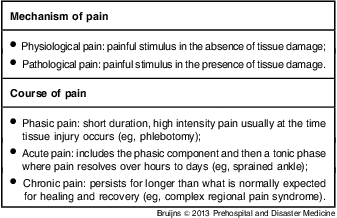
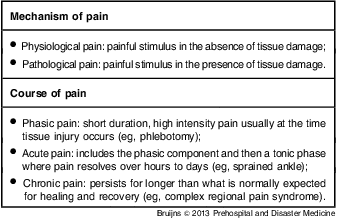
One way to look at this is to consider the mechanism by which pain is induced (Table 3). Pain stimulated in the absence of tissue damage can be seen as physiological (protective or warning), whereas pain stimulated in the presence of tissue damage is pathological, as tissue injury has already occurred.Reference Smith23 The specific course of the pain is also important (Table 3): phasic pain describes a short duration, high intensity pain, usually as trauma or tissue injury occurs. Acute pain following trauma or tissue injury not only has a phasic component but usually also a tonic component that continues at a lower intensity which can last for hours to days.Reference Smith23 In spinal immobilization, discomfort and pain worsen with full immobilization, and are reduced when restraints are relaxed or removed (Figure 2, online). In this study there was no phasic component, a relatively low tonic component of pain (median pain VAS = 0), and discomfort (a proxy for tissue ischemia) after ten minutes reached only a median VAS of 15 (out of 100). This appears not to be sufficient to cause a clinically detectable SNS response, and it would seem that a more intense or prolonged stimulus (or both) would be required for the SNS effect to become clinically relevant.Reference Smith23
Definitions Relating to the Course and Mechanism of PainReference Smith23
It is thus important to consider other causes of abnormal vital signs, such as hemorrhage, head or spinal injury, associated medical problems or medications.2 The relationship between hemorrhage and abnormal vital signs has been well described, but even here it should be noted that normal vital signs are not unusual in some cases, despite significant hemorrhage.2, Reference Brasel, Guse, Gentilello and Nirula3 Anxiety, too, may increase serum catecholamine and cortisol levels and decrease baroreflex sensitivity, resulting in abnormal vital signs.Reference Virtanen, Jula and Salminen24, Reference Watkins, Blumenthal and Carney25
Limitations
There are a few limitations to this study which are important to note. The study took place outside the true clinical setting. The study protocol allowed for a relaxed environment, employing a procedure all participants were familiar with. This was purposeful in order to reduce the possible confounding effect of anxiety. This study was not powered to allow subgroup analysis of gender differences that may have applied, and it is possible that the female predominance may have affected results. It is also possible that a longer period of spinal immobilization would have resulted in abnormalities. However, in the review of randomized controlled trials on the effects of spinal immobilization on subjects, Kwan et alReference Kwan and Bunn9 referenced testing times of 10 minutes in three of the 10 studies reviewed. The current study was based on this figure, though in fact the immobilization lasted for 20 minutes (10 minutes fully immobilized and 10 minutes partially immobilized). In planning the study protocol, the authors felt that 10 minutes was a safe duration of exposure to a rigid spinal board. Given the low pain and discomfort scores observed following 10 minutes of spinal immobilization, it is questionable whether further study is required to evaluate this. The subjects were uninjured and it is possible that the addition of discomfort from spinal immobilization to that already being suffered as a result of an injury might have more physiological effect than in an uninjured person.
Conclusion
Health care professionals working in the ED or prehospital environment should be aware that spinal immobilization does not contribute significantly to physiological derangements of SBP, HR and RR. It would follow that when physiological derangements are present, these should be considered to be due to another cause. Likewise it is important to note that since pain and discomfort reported by patients with spinal immobilization do not correlate with vital signs, abnormal values should not be considered a prerequisite for the appropriate treatment of pain or discomfort.