Introduction
Although a subject of debate, sepsis is described most commonly as a suspicion of infection plus Systemic Inflammatory Response Syndrome (SIRS).Reference Axelsson, Herlitz, Karlsson, Sjöberg, Jiménez-Herrera, Bång, Jonsson, Bremer, Andersson, Gellerstedt and Ljungström 1 Two or more of the following criteria being fulfilled is what defines SIRS: temperature >38°C or <36°C; heart rate >90 beats/minutes; respiratory rate >20 breaths/minute; pressure of carbon dioxide <32 mmHg; and/or white blood count >12,000/ µl or <4,000/ µl.Reference Vincent, Opal, Marshall and Tracey 2 The term “severe sepsis” is used for more severely ill patients with hypotension, hypo-perfusion, or organ dysfunction. The criteria for “severe sepsis” have changed somewhat over time and are revised at regular intervals by the Surviving Sepsis Campaign (SSC; Society of Critical Care Medicine; Mount Prospect, Illinois USA).Reference Bone, Balk and Cerra 3 In Sweden, a somewhat simplified version of these criteria is used.Reference Dellinger, Levy and Rhodes 4
The mortality rate for sepsis has been reported to vary between 13%-30%.Reference Ljungstrom, Steinum, Brink, Gardlund, Martner and Sjolin 5 - Reference Martin, Mannino, Eaton and Moss 7 The proportion of patients with sepsis transported to hospital by the Emergency Medical Services (EMS) has been reported to vary between three percent and 51%,Reference Flaatten 8 - Reference Studnek, Artho, Garner and Jones 10 to be in a more severe condition, and to have a higher in-hospital mortality.Reference Flaatten 8 - Reference Wang, Weaver, Shapiro and Yealy 11
The EMS crew has been reported to document a suspicion of sepsis in only 12%-20% of patients with sepsis.Reference Seymour, Carlbom and Engelberg 9 , Reference Groenewoudt, Roest, Leijten and Stassen 12 However, knowledge relating to the early suspicion of sepsis and its influence on the further treatment of patients’ sepsis is still limited.Reference Wallgren, Castren, Svensson and Kurland 13 An evaluation of whether the EMS clinician suspected a particular disease at the scene is often difficult due to co-morbidity and the fact that symptoms may be related to various diagnoses. In the light of these difficulties, the suspicion of sepsis may not be obvious or may be a parallel diagnosis which may not be reported beyond the primary suspicion.
Since the criteria for severe sepsis and septic shock are not yet used consistently within the Swedish medical care system, hospital databases were not able to be used to find these patients. Instead, patients with bacteraemia were chosen as study subjects with the specific emphasis on cases with “true pathogens,”Reference Herlitz, Bang and Wireklint-Sundstrom 14 such as Escherichia coli, Staphylococcus aureus, other Enterobacteriaceae species, and Streptococcus species.
Sepsis is a disease with high mortality. Very early treatment with antibiotics improves the prognosis.Reference Weinstein 15 Timely identification already by the EMS is therefore of utmost importance.
The study objective was to: (a) describe the early chain of care among patients with bacteraemia in relation to the use of EMS; and (b) describe factors of importance for the delay until the onset of antibiotic treatment. It was hypothesized that, for patients with suspect sepsis judged by the EMS clinician, the delay until the onset of antibiotic treatment would be shorter.
Methods
Inclusion Criteria
Inclusion criteria included: positive blood culture for bacteria; the patient should have been admitted to one of the three hospitals in the Municipality of Gothenburg (Sweden); and the blood culture should have taken place from February 1, 2012 through April 30, 2012.
Exclusion Criteria
Exclusion criteria included: age <18 years; and cases in which neither the EMS nor the emergency department (ED) were involved in the care.
Collection of Data
In all cases, information was collected from the hospital case record form and the EMS case record form. The study was approved by the Regional Ethics Committee of Gothenburg.
The EMS Organization
All ambulances were staffed with an Advanced Life Support unit, including a nurse and emergency medical technician.
Patients who were transported by the EMS were judged initially according to the Rapid Emergency Triage and Treatment System (RETTS).Reference Gaieski, Mikkelsen and Band 16 , Reference Widgren and Jourak 17 This system determines the need for emergency care (time to physician). The patient is triaged to a color. Red and orange mean immediate emergency care; yellow means emergency care as soon as possible; green means emergency care within a reasonable time but not urgent; blue means another priority level. Prioritization according to RETTS is based on vital parameters, symptoms, and signs.
Definition of Endpoint
The delay from arrival at hospital until the start of intravenous treatment with antibiotics was defined according to information available in the hospital records.
Statistical Methods
In the evaluation of proportions, Fisher’s exact test was used. In the evaluation of continuous variables, Wilcoxon’s two-sample test was used. A P value of <.05 was regarded as significant. Two-tailed tests were applied. The SAS software program (SAS Institute; Cary, North Carolina USA) was used for the analyses.
Results
In all, there were 696 positive blood cultures suggesting possible bacteraemia. Among these cases, the mean age was 76 years and 52% were men. However, in 388 cases (56%), there was no contact either with the EMS or with the ED. The majority of these patients had already been hospitalized when blood samples were drawn for blood culture. These patients were excluded from the study, so this report dealt with the remaining 308 patients where contact with either the EMS or the ED, or both, had been made.
Furthermore, among these 308 cases, only 188 (61%) had growth in the culture of “true pathogens.” This subset of 188 patients with growth in the culture of “true pathogens” will be described separately.
Comparison between Patients Transported and Not Transported by EMS
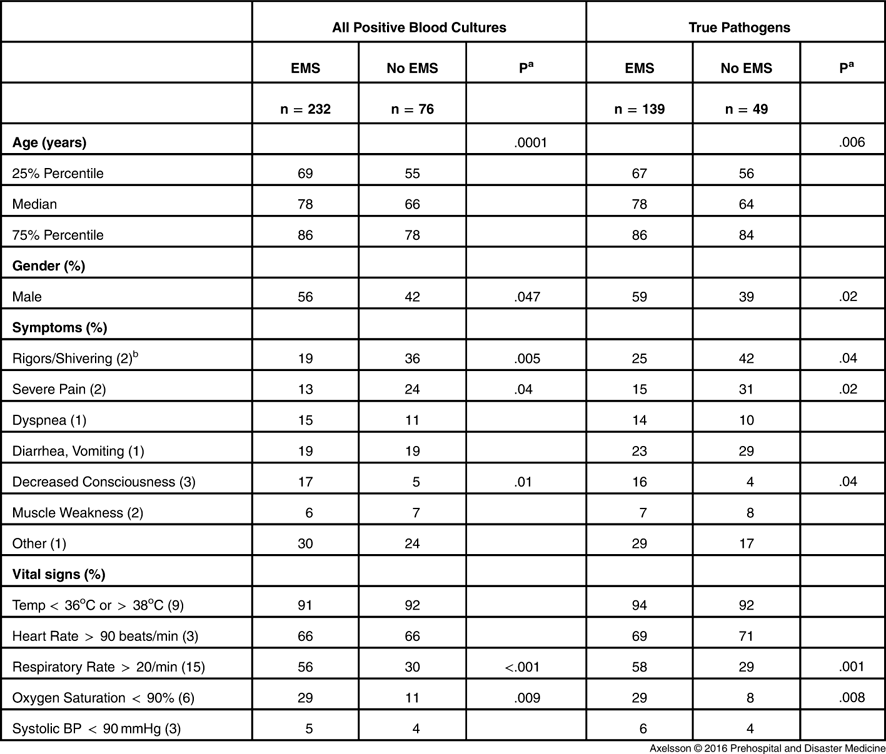
Age, Gender, and Initial Symptoms/Vital Signs (Table 1)
In all, 232 patients (75%) were transported by the EMS (74% among cases with “true pathogens”). As compared with patients who were not transported by the EMS, these patients were older and included more men. They had shivering or severe pain less frequently. On the other hand, they had a reduced level of consciousness, a respiratory rate above 20 breaths/minute, and an oxygen saturation below 90% more frequently.
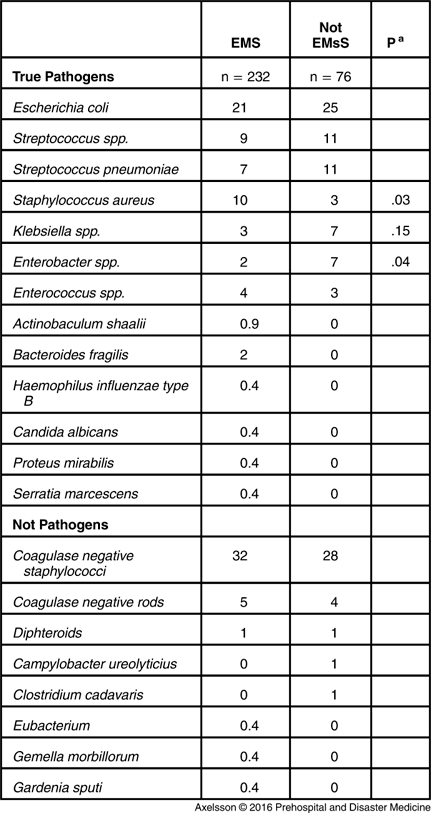
Aetiology ( Table 2)
The most frequent bacterium for both groups was Escherichia coli. The next most frequent bacteria were Staphylococcus aureus for the EMS-transported patients and Streptococcus species and Streptococcus pneumoniae among patients who were not transported by the EMS.
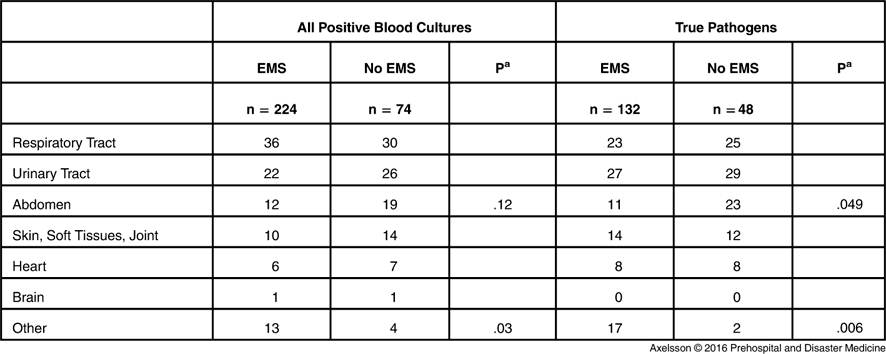
Affected Organs ( Table 3)
In both groups, the respiratory tract was the most common affected organ, followed by the urinary tract. When analyzing patients with “true pathogens” separately, the urinary tract was the most affected organ.
Mortality
The 28-day mortality rate among patients transported by the EMS was 14.9% versus 6.7% among those who were not (P=.07). The one-year mortality rate was 33.3% and 16.0%, respectively (P=.005).
Among patients with true pathogens, the 28-day mortality rate was 17.6% for EMS-transported patients versus 10.4% for those who were not transported by the EMS (P=.35). The corresponding one-year mortality rate was 33.8% and 20.8%, respectively (P=.10).
Patients Transported by the EMS
EMS Delay
The median delays for the following aspects of the early chain of care were: Call-in/Call-out at the dispatch center (five minutes); Call-out/Arrival of the EMS at patient’s side (16 minutes); Arrival at patient’s side/Start transport to hospital (19 minutes); and Start of transport/Arrival at hospital (13 minutes).
Initial Judgment by EMS
In 60% of the cases, the EMS nurse triaged the patients to red (32%) or orange (28%) for immediate emergency care. Among patients with growth of “true pathogens,” the corresponding figures were 35% and 32%, respectively. In 32% of EMS-transported patients, there was a suspicion of infection, but only in six percent was there a suspicion of septicaemia. Among patients with growth of pathogenic bacteria, the corresponding figures were 37% and seven percent.
Various Complications Treated before Arrival at Hospital
Complications that were treated before arrival at hospital occurred in order of frequency: high fever (7.0%), hypotension (5.0%), pain (4.0%), heart failure (2.0%), and hypoglycaemia (0.4%). Among patients with growth of pathogenic bacteria, the corresponding figures were high fever (7.0%), hypotension (6.0%), pain (4.0%), heart failure (0.0%), and hypoglycemia (0.7%).
Delay to Treatment with Antibiotics
In 84% of the 308 patients, information on time from arrival at hospital until start of intravenous antibiotics was available (70% for patients with growth of “true pathogens”).
Among all patients, the median delay was three hours and 15 minutes among those transported by the EMS and three hours and 58 minutes among those who were not (P=.18). Among patients with growth of “true pathogens,” the corresponding values were three hours and zero minutes for EMS-transported patients versus three hours and 59 minutes for those not transported by the EMS (P=.07).
Among the six percent of the patients in whom the EMS nurse had an initial suspicion of sepsis, the median delay from arrival at hospital until the start of treatment with intravenous antibiotics was one hour and 19 minutes versus three hours and 21 minutes for the EMS-transported patients in whom there was no such suspicion (P=.0006). For “true pathogens,” the corresponding figures were one hour and 19 minutes versus three hours and 15 minutes (P=.009).
Discussion
The main finding in this study was that, among patients with a “positive blood culture,” 75% were transported by the EMS. This population is older today than at the time of previous reports. These patients differed from those who were not transported by the EMS in terms of age, gender, and some initial symptoms. Among EMS-transported patients, there was an initial suspicion of sepsis in only six percent of cases and these patients had the shortest delay to treatment with antibiotics.
Epidemiology
The estimated annual incidence of bacteraemia with “true pathogens” based on the three-month evaluation was 125/100,000 patient years. This is high compared with what has been reported previously.Reference Dellinger, Levy and Rhodes 4 - Reference Angus, Linde-Zwirble, Lidicker, Clermont, Carcillo and Pinsky 6
The median age in this study population is somewhat higher than previously reported,Reference Ljungstrom, Steinum, Brink, Gardlund, Martner and Sjolin 5 and this can perhaps be explained by the fact that the population is older todayReference Widgren, Jourak and Martinius 18 than at the time of previous reports. It was found that the mortality rate was higher in the EMS-transported cohort. This might be explained by an even higher age among these patients and thereby increased co-morbidity, as reported among patients with chest pain.Reference Melamed and Sorvillo 19
Not surprisingly, patients with more severe sepsis tended to call for the EMS more frequently. The relatively high use of the EMS might be explained by the selection of cases, as only patients with a positive blood culture were included in the analyses.
Symptoms
Among patients who were not transported by the EMS, shivering and severe pain were the most common symptoms, whereas among those who used the EMS, shivering and diarrhea were the most frequent symptoms. However, a large group in both cohorts had other symptoms which highlights the fact that sepsis can mimic other diseases.Reference Wang, Weaver, Shapiro and Yealy 11 , Reference Weinstein 15
Early Judgment by the EMS Crew
One-third of the cases were judged as having infection, but only in six percent was there a suspicion of sepsis. The latter figure is lower than that previously reported.Reference Flaatten 8 , Reference Wang, Weaver, Shapiro and Yealy 11 However, 68% were judged, according to RETTS, as requiring immediate care. It is therefore surprising that only six percent of patients raised a suspicion of sepsis.
These data clearly indicate that there is room for improvement in the very early evaluation of patients with septicaemia by the EMS crew and that RETTS is an insufficient instrument for triaging these patients in the optimal fashion.
One reason for this is that, as an assessment tool, RETTS has not been tested scientifically for prehospital use.Reference Herlitz, Hjalte, Karlson, Suserud and Karlsson 20
Time to Antibiotics
The delay from arrival at hospital until the start of antibiotic treatment did not differ significantly in this study when comparing EMS-transported patients with those who did not use the EMS. This is not in agreement with the findings of Studnek at al who found that EMS-transported patients had a shorter delay to start of treatmentReference Seymour, Carlbom and Engelberg 9 with Early Goal Directed Therapy. However, in agreement with the findings of the same author, it was found in this study that an early suspicion of sepsis by the EMS crew was associated with a shorter delay to treatment with antibiotics.Reference Seymour, Carlbom and Engelberg 9 It is important to note that, despite the fact that a high proportion were judged as urgent cases according to RETTS, there was still a very long delay until antibiotics were given. The time to antibiotics did not differ significantly.
This highlights the potential of the early detection of sepsis with the aim of improving outcome.Reference Weinstein 15 The delay to antibiotics among patients in whom there was no suspicion of sepsis was remarkably long. Even one hour and 19 minutes among patients in whom there was a suspicion of sepsis can be regarded as relatively long.
Limitations
This study was performed during a three-month period when the risk of infection is at its highest. These data are therefore not representative of a population that was recruited during the course of one year.
Some of the blood cultures were judged as contaminations. These patients were still included in the analyses. A large proportion of these patients received antibiotics and obviously was treated as though they were suffering from sepsis. It is possible that, in some of these cases, there was a deficiency in the blood-sampling technique. The analyses in this study had a retrospective design and information was therefore missing for most variables. The overall rate of missing information for various variables differed between zero percent and five percent. These data were collected from an urban area and can therefore not be applied to non-urban areas.
Conclusion
Among patients with bacteraemia, 75% used the EMS, and these patients were older, included more men, and suffered from more severe symptoms and signs. The EMS nurse suspected sepsis in six percent of cases. Regardless of whether or not patients with true pathogens were isolated, a suspicion of sepsis by the EMS clinician at the scene was associated with a shorter delay to the start with antibiotic treatment. Better triage systems for the early identification of patients with sepsis are urgently needed.
Age, Gender, and Initial Symptoms

Abbreviations: BP, blood pressure; EMS, Emergency Medical Services.
a P value denoted if <.2.
b Number of patients with missing information.
Aetiology (%) when All 308 Patients were Included

Abbreviations: EMS, Emergency Medical Services; spp, species.
a P value denoted if <.2.
Affected Organs Focusing on Infection (missing information n=10)

Abbreviation: EMS, Emergency Medical Services.
a P value denoted if <.2.