Although contemporary understandings of democracy require a wide and inclusive franchise, such was not always the case. Nineteenth and early-twentieth century democracies in the making imposed myriad suffrage restrictions based on property, race, gender, residency, education and literacy. When the Western world undertook the long debate over the extension of mass suffrage, most participants viewed the underlying dynamic as a rich-versus-poor class conflict over redistribution, an interpretation that was shared by most academic studies. Although the traditional left-right cleavage is an enduring, well-traveled dimension of social conflict, the present-day developing world is heavily populated by plural societies in which ethnic identities are potent political forces alongside class. In such environments, are voting rights a class or an ethnic issue? Here, I argue that they are both, depending on the context: ethnic in public claims, but class in private preferences.
This article examines the class versus ethnicity debate via the entrée of illiterate voting rights. In material terms, illiteracy strongly correlates with poverty, yet in plural societies it often concentrates in identifiable ethnic groups as well. Studying illiterate voting rights thus provides a discrete window through which to examine a more general set of issues about class versus ethnic conflicts, and motivations based on material interests and identity concerns. Lebanon, a diverse society in which ethnic (sectarian) and class cleavages coexist, serves as the empirical venue for this research, although many other societies could serve in its stead. To be clear, illiterate voting rights are not in themselves politically salient in Lebanon, but this reality is an epistemological virtue rather than a vice. What is highly salient is the nebulous but discursively hegemonic and value-charged issue of sectarianism, the real topic of interest, on which this article gains empirical leverage via the relatively tangible and rhetorically pristine vehicle of illiterate voting rights.
Empirically, I use an augmented list experiment to compare the dynamics that drive public statements on and private preferences about illiterate voting rights. Direct questions yield sectarian answers that accord with conventional wisdom: Shiites, allegedly the least literate community in Lebanon, are more supportive of illiterate voting than are their Sunni or Christian peers. Unobtrusive questions, in contrast, yield answers about material deprivation: poor people, regardless of sect, are more supportive of illiterate voting than are well-off people. Although public discourse may privilege identity issues, private preferences appear to follow from more prosaic material interests.
This article makes several contributions to the study of both political behaviour and institutional choice in the diverse societies of the developing world. Theoretically, it examines the conditions under which countervailing ethnic and material interests motivate key social groups to adopt one set of positions in public but a different set in private. Methodologically, it disentangles what people say from what they think about voting rights – a substantively important advance, given that much of our prior empirical work has implicitly (but wrongly) assumed that the former is an accurate gauge of the latter. Empirically, it demonstrates that privately held preferences diverge in systematic ways from public discourse. The evidence I present raises questions not only about the degree to which ethnicity drives actual preferences (rather than just discourse about preferences), but also about people's inherent democratic commitments.
The rest of this article proceeds as follows. Section 1 develops theoretical arguments about public versus private support for voting rights, given competing class and ethnic motivations. Section 2 discusses sectarianism and voting rights in Lebanon, the article's empirical venue. Section 3 describes the Lebanese survey data and the augmented list experiment. Section 4 presents the results of the experiment. Section 5 concludes with the article's broader theoretical implications.
Voting rights, class and ethnicity
Voting is a numbers game, but which numbers matter? In nineteenth-century Europe, the salient figures were headcounts of rich and poor, and the debate over expanding the franchise was, in the words of a contemporary British Conservative, a class struggle ‘between property… and mere numbers’.Footnote 1 Yet in much of the contemporary developing world, the figures cited refer instead to ethnic demographics, in which the dynamic of ‘elections as census, census as elections’ exemplifies the ethnic narratives that drive the public discourse of many diverse societies.Footnote 2 Lebanon plays one version of the numbers game, as it focuses on the demographic weight of each sect to determine representation in government, and as its confessional communities watch the waxing influence of the country's burgeoning Shia population with disquiet.Footnote 3 How do voting rights enter the story in the diverse societies of the developing world? Are they a class issue or an ethnic issue?Footnote 4
Class and Ethnic Conflict Over Who Votes
Building on a long line of prior work, recent studies on the origins of democracy and the extension of the franchise have modelled a conflict between rich and poor over the distribution of material resources. In such models, the poor prefer high rates of taxation that redistribute wealth from the rich to themselves. Democratization occurs when its net costs to the rich are modest, which is most likely to be the case when (a) income inequality falls, which reduces the intensity of redistributive demands; (b) capital is mobile or difficult to tax, which reduces the eventual magnitude of redistribution and (c) costs to repression rise, which reduces the net value of non-democratic governance.Footnote 5
Conceptually, these narratives tell a parsimonious left-right story in which democratization and extending the franchise are contingent outcomes of a class struggle between rich and poor over material resources, with income level defining group membership and political interests.Footnote 6 Illiteracy, in turn, fits neatly into this class narrative because it strongly correlates with poverty and low endowments of human capital. Denying the vote to illiterates disfranchises an impoverished and marginalized segment of the potential electorate, whereas granting those rights shifts the median voter further to the redistributive left. Hence debates over illiterate voting rights are but one venue within which to wage the struggle between rich and poor.
In this simple left-right story, people's preferences about democracy are materialistic and individualistic: they pursue class interests for personal material gain, and motivations based on normative commitments or group identity concerns fall outside the purview of the model. Social diversity complicates this parsimonious story, however. In many developing world societies, ethnicity offers an alternative to class for defining group membership and thus introduces identity motivations into people's preferences about democracy and extending the franchise.Footnote 7 When ethnicity defines a salient social cleavage, illiteracy no longer fits as neatly or unambiguously as it once did into a class-based redistributive narrative. Illiterates may still be concentrated among the poor, but they may also be (and often are) concentrated within a particular ethnic group.
Literacy tests in the Jim Crow South corroborate the criticisms of purely class narratives when ethnicity is salient.Footnote 8 In addition to the obvious racial implications, obstructions to voting such as literacy requirements and poll taxes stimulated ‘the storms of agrarian radicalism and class resentment’ that threatened to divide rich and poor Southern whites, because such obstructions ‘could be turned against poor, illiterate whites as well as blacks’.Footnote 9 Elites transformed a potential class conflict into a racial one by introducing grandfather clauses and numerous other mechanisms that provided whites with a permanent loophole to suffrage requirements that would have effectively disfranchised them on class grounds. That poor whites should acquiesce to this outcome, much less support it enthusiastically, is difficult to explain in material terms, as they might alternately have secured greater material benefits by allying with blacks in a redistributive coalition against rich whites.
Jim Crow illustrates that ethnicity makes it harder to tell a purely material story. Still, many political economy-oriented studies emphasize the distributional dimension of ethnic competition.Footnote 10 In such studies, ethnicity is instrumental and valued as a means of enhancing material welfare rather than valued for its own sake. In contrast, a large body of work that draws on insights from social psychology suggests that identity motivations provide greater explanatory leverage for ethnocentric behaviour than does a purely distributive narrative.Footnote 11 Here, ethnic competition focuses not so much on material goods as on identity goods such as dignity, self-respect and recognition.Footnote 12 Still other studies synthesize these approaches by acknowledging that people pursue both material and identity interests simultaneously.Footnote 13
Material-Identity Trade-offs and Free-Rider Problems
In a compound story that more effectively accommodates the multiple motives to which people in diverse societies respond, individuals vary in their endowments along both material and identity dimensions. Hence, in addition to being rich or poor, people also belong to higher- or lower-status groups. The two dimensions may correlate, but ethnic groups typically represent parallel small-scale societies that are socio-economically diverse. Between-group differences in average material welfare contribute to collective status rankings, but the wide within-group variance around those averages implies considerable overlap in material conditions between the groups.Footnote 14
Table 1 abstracts to ideal-type combinations of endowments according to variation in personal material wealth and membership in high- and low-status groups. Illiterate voting rights influence welfare on both dimensions by redistributing wealth and altering relative group status. Such rights yield unambiguous outcomes for some endowment combinations. For wealthy, high-status types, illiterate voting reduces welfare on both dimensions; conversely, it enhances welfare on both dimensions for poor, low-status types. Other combinations, however, must trade off gains on one dimension against losses on the other. For material-rich but identity-poor people, illiterate voting redistributes their wealth but augments their social identity. Material-poor but identity-rich people, meanwhile, benefit from redistributive taxation but suffer losses in relative social status when members of a ‘lesser’ community acquire the same rights and privileges as their own community.
Welfare Effects of Illiterate Voting Rights Along Material (M) and Identity (I) Dimensions

There is an important asymmetry in the trade-off between material and identity goods, however. In particular, the rich pay the material costs of illiterate voting privately through redistributive taxes, while both rich and poor members of the group consume the identity benefits of dignity and recognition collectively. Social identity is a club good that is non-rival and non-excludable for all group members. These properties subject identity goods to the classic free-rider problem: all members benefit from higher social status, but each prefers to let others provide the collectively consumed good. Further compounding the problem is the fact that only the rich pay the material costs of provision. In effect, poor members of the lower-status group demand that their rich coethnics subsidize the increase in group status that comes with illiterate enfranchisement by obligating the latter to bear the costs of the increased redistribution that also accompanies those rights.
Analogously, illiterate voting implies an identity cost to the higher-status group via the diminution of relative status. Because social identity is non-rival and non-excludable, however, this identity cost is a collectively borne public bad distributed across rich and poor members alike. Compared to the diffuse group status losses, meanwhile, the material gains from redistribution concentrate among the poor. Opposing illiterate voting rights requires poor members of the higher-status group to forgo privately beneficial material redistribution to sustain the supply of a collectively consumed identity good. In effect, the rich implicitly demand that their poor coethnics accept a material-identity trade-off that they (the rich) do not have to make themselves. Although ethnicity can express class conflict in strongly ranked systems, it acts here as a barrier to class conflict by checking the demand for the redistribution of material resources.Footnote 15
Social Pressure and Preference Falsification
All else being equal, then, we might expect people to privilege private material interests over social identity outcomes that are vulnerable to free-riding. Nonetheless, empirical evidence suggests that people often articulate identity demands, sometimes even when they conflict with personal material interests.Footnote 16 Crucially, however, exercising voice is a public act rather than a private one. Consequently, it leaves people vulnerable to what Tocqueville and Mill identified as the tyranny of friends and neighbours: the pressure to adopt socially desirable public positions. When ethnic identities are politically salient, they significantly raise the cost of openly exercising the ‘selfish’ exit option to ‘abandon’ one's coethnics. Put more strongly, ‘exit has often been branded as criminal’ and denounced as ‘desertion, defection, and treason’.Footnote 17
Social pressure helps to mitigate the free-rider problem in the provision of identity goods by bestowing selective incentives (praise, honours) on people who advance the group's collective welfare and imposing selective disincentives (ridicule, ostracization) on those who defect. Yet such pressure only partially resolves the problem, because it influences public claims without changing private preferences. In Kuran's terms, social desirability affects people's reputational utility without altering the intrinsic utility they derive from the positions they publicly espouse. Individual efforts to bolster reputational utility, in turn, snowball into a ‘spiral of prudence’ that delinks society's observed distribution of public opinion from its latent distribution of private opinion.Footnote 18
Social desirability pressures people with unpopular beliefs to falsify their preferences by making public claims that differ from their private views.Footnote 19 As the pressure grows more powerful, people increasingly guard what Scott calls their ‘hidden transcripts’ behind ritualistic public ones – and ‘the more menacing the power, the thicker the mask’.Footnote 20 We usually imagine that preference falsification concentrates among the weak and dispossessed, such as Havel's celebrated greengrocer of Communist Europe who displays a poster bearing the slogan ‘workers of the world unite!’ out of prudence rather than conviction, ‘simply because it has been done that way for years, because everyone does it, and because that is the way it has to be’.Footnote 21 The weak are not, however, uniquely sensitive to social desirability pressures, which constrain people across the spectra of wealth and social status.
Preference falsification warps the distribution of public (but not private) opinion about illiterate voting due to the sometimes-consistent, sometimes-countervailing normative hegemonies of democracy and ethnicity. Of Table 1's ideal types, only poor, low-status people avoid social pressure to dissimulate, because widely hallowed norms of democratic inclusion and ethnic solidarity buttress their material- and identity-based interests in illiterate voting rights. These maxims conflict for high-status types, however: democratic mores check rich members’ inclinations to oppose illiterate voting openly, while expectations of ethnic loyalty limit their poor counterparts’ willingness to advocate in favour of such rights. Finally, rich members of low-status groups must navigate a double whammy of social desirability pressures: norms of democratic inclusiveness and ethnic solidarity both oblige them to express public preferences that are at odds with their material interests.
Hypotheses
What, then, can we say about illiterate voting rights in plural societies: are they a class issue or an ethnic issue? We can answer this question with two plausible rival hypotheses one based on identity interests, and the other on materialism. All else being equal:
Hypothesis 1 (Identity): Members of lower-status groups are more likely to support illiterate voting rights than are members of higher-status groups.
Hypothesis 2 (Materialism): Poor people are more likely to support illiterate voting rights than are rich people.
These two hypotheses reflect the reality that people pursue both identity and material interests concurrently. All else being equal, however, free-rider problems should discourage people from pursuing collectively consumed identity goods. Social pressure for ethnic solidarity, meanwhile, should penalize free-riders and those who ‘abandon’ their group for selfish pursuits, while rewarding partisans and team players who advance the group's collective welfare. We are thus left with a conundrum: free-rider problems hamper identity interests, while social desirability discourages material pursuits.
These two hypotheses make qualitatively different predictions about how preferences vary. To resolve the conundrum, however, we must distinguish between public and private preferences.Footnote 22 Both hypotheses should be correct, but each should successfully predict a different kind of answer: identity in public but material in private. People can contribute, or at least appear to contribute, to a collective identity good via discourse. As long as their public statements are not verifiable and their private preferences are not observable, they can avoid group sanctions by voicing support for identity interests in public while pursuing material interests in private.
Sectarianism and voting rights in Lebanon
Lebanon's sectarian communities were strongly ranked at the time of independence in 1943,Footnote 23 but these rankings obscured considerable within-sect heterogeneity and have grown milder over time. On average, Christians enjoyed higher levels of education and held higher-status and better-paying jobs than did their peers in the Muslim communities. Sunnis followed in the ranking, and then finally the Shia community, the members of which were mostly uneducated and systematically held low-status, low-paying jobs. Over the subsequent decades, however, the Muslim communities’ rising educational attainment and living standards have narrowed the gap with their Christian counterparts. We can observe the effects of this considerable, albeit imperfect, levelling in the country's illiteracy rates and measures of material well-being.
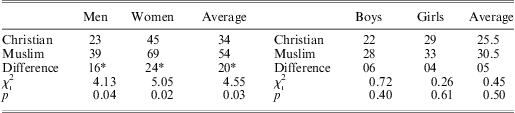
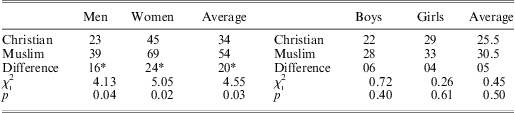
Despite a long-standing reputation for educational attainment, Lebanon's illiteracy rate currently hovers at 10–19 per cent.Footnote 24 Historically, illiteracy rates were highest in the rural areas and among women, and lower among Christians. Generational changes sharply reduced these disparities, however. Data from the early 1960s show that the yawning Christian-Muslim gap among rural adults largely disappeared among youths (Table 2).Footnote 25 Demographic inertia means that these generational differences persist in the form of lower illiteracy rates in Lebanon's Christian regions compared to its Muslim areas, although even in the former the rates vary significantly from district to district.Footnote 26
Rural Illiteracy Rates, Early 1960s27
*p < 0.05
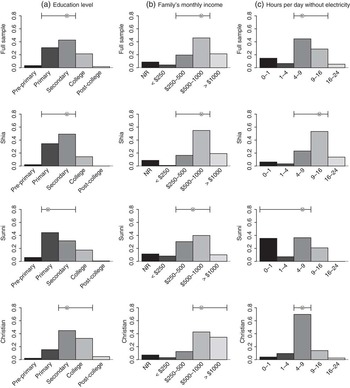
In the aggregate, Lebanon suffers from high income inequality; while over one-quarter of the population falls below the poverty line, the country's billionaires are worth just under one-quarter of Lebanon's annual gross domestic product (GDP).Footnote 28 Notwithstanding stereotypes to the contrary, this inequality does not follow from the dramatic between-community differences of an earlier era. Figure 1 summarizes several indicators of socio-economic status by sect from this project's survey data (details to follow). These data reveal that, in objective terms, today's community rankings are objectively much milder than those of the past.
Socio-economic status indicators with medians and interquartile ranges (author's survey data)

Figures 1a and 1b show that Christians remain somewhat better educated than their Sunni and Shia peers and enjoy somewhat higher incomes, although the differences are not stark. These data also suggest that the Shia community has closed the gap with its Sunni counterparts. On average, Shiites actually appear to be slightly better educated and slightly wealthier than Sunnis, although we must be circumspect about this observation due to the high sample non-response rate on the income question (about 10 per cent). As an alternative measure of material well-being, Figure 1c reports the average number of hours per day in which the electricity is off in respondents’ homes. These data conform with the conventional wisdom that the Shia community, on average, does indeed faces greater material deprivation than do Sunnis or Christians, although the community average is inflated by a subset of Shiites that never has electricity. Overall, Figure 1 reveals significant socio-economic heterogeneity in each of the communities, as well as considerable overlap between them – each sect's median response falls within the interquartile range of each of the others.
Nonetheless, status differences persist based on residual stereotypes of Christian advancement and (especially) Shia backwardness.Footnote 29 Although ‘poverty and illiteracy were the norm’ among the Shia at independence, the community experienced a ‘renaissance in education’ starting in the 1950s that produced a new middle class and an educated elite.Footnote 30 The community subsequently developed to the point where Shiites were no longer ‘as economically disadvantaged as the discourse about “disinheritance” and the stereotypes of the past made them out to be’. Yet the stereotypes persist; one civil society leader explained that ‘for a long time, the Sunnis looked down on them [the Shia], and they were looked on as the poor, illiterate ones by the Christians, even up to the 1990s’.Footnote 31
Despite sharing identity interests with their poorer co-sectarians, many of the emerging class of wealthier, better-educated Shiites initially avoided Lebanon's sectarian political movements and ‘sought out a modern life, and attempted to exit from deprivation, not on the basis of Shiism, but on the basis of modernity’.Footnote 32 Sectarian discourse is hegemonic in the Lebanese public sphere, however; it penalizes the exit option by stigmatizing those who ‘desert’ their sect and subjects them to social sanctions. To emphasize this hegemony, a venerated Shia cleric observes that:Footnote 33
The sectarian system is the reason why the Lebanese don't feel their nationality. There are no Lebanese in Lebanon, there are Maronites working on behalf of Maronites, Orthodox on behalf of Orthodox, Druze, Sunni, Shia, and so on … [everything] comes back to a struggle on a sectarian basis.
Notwithstanding occasional rhetorical flourishes to the contrary, all but a few marginal parties are single-sect catch-alls that aggregate co-sectarians who otherwise differ substantially on non-identity dimensions – such as rich and poor on the classic right-left scale of economic redistribution. Sectarianism's centrality in public life enforces people's publicly professed loyalties to their sect, even as individuals use exit and passing strategies in the private sphere.Footnote 34 One businessman illustrated the black humour surrounding passing strategies with this anecdote:Footnote 35
One of my Shiite friends here came into the office one day wearing more traditional clothes and we joked ‘you look like Shiite’ (shit), and he laughed his ass off. Another Shiite friend came in dressed sharply in a suit, and joked that he was ‘camouflaged as a Christian’. Personal relationships between members of the sects are good. The political relationships are not like that.
The public veneer of ‘sectarian solidarity’ may consequently mask considerable ambivalence, especially among people for whom solidarity brings costs as well as benefits. ‘Well-heeled, educated’ Shiites, for example, frequently express dismissive attitudes toward their poorer, ‘backward’ co-sectarians in private settings, in which they embrace ‘traditional urbane Lebanese formulas and prejudices with even more … fervor than their Christian compatriots’.Footnote 36 More generally, the heavy public valorization of group unity enables elites to cater to their constituents with symbolic identity goods, in place of the material benefits that many would otherwise demand.Footnote 37 ‘Symbolic power is of value to the man in the street’, one think-tank director observed, but ‘what are constituents getting out of the deal? Not much’.Footnote 38 Rather than the unified monoliths that public discourse makes them out to be, Lebanon's sectarian communities are internally heterogeneous in both socio-economic status and policy preferences. Nonetheless, social pressure for ‘sectarian solidarity’ deters dissenting voices from articulating their views publicly.Footnote 39
Putting the above together, the identity hypothesis (H1) predicts that Shiites, as members of the lower-status group within which illiteracy stereotypically concentrates, are more likely to support illiterate voting than are their Christian or Sunni counterparts. The materialism hypothesis (H2), by contrast, predicts that poor people, regardless of sect, are more likely than their wealthier peers to support voting rights for illiterates. Both hypotheses should be correct, but the former should explain variation in what people say while the latter should explain variation in what people think. Therefore identity interests should better explain public support, and material interests private support, for illiterate voting rights.
Data and methods
How, though, can we disentangle people's public support from their private support for sensitive issues? A large body of research on American racial politics, for example, emphasizes the importance of distinguishing what people claim from what they believe, because not everyone who says they share socially desirable views actually does so.Footnote 40 More evocatively, Scott observes that people tailor their performances for specific audiences and ‘sing one tune’ when among their own but a very different one in mixed company.Footnote 41 Such theatrics, however, make it difficult to determine which of the tunes (if either) reflects people's privately held preferences, because ‘we cannot know how contrived or imposed the performance is unless we can speak, as it were, to the performer offstage’.Footnote 42
Voting rights are sensitive, and democracy's normative hegemony pressures people to give the ‘right’ answer: unqualified support. Sectarianism, meanwhile, is both pervasive and sensitive in Lebanon. A former prime minister quipped that, ‘I have never in my life seen a sectarian person who acknowledges that he is sectarian, just as I have never seen a liar who admits to lying’.Footnote 43 A secular activist, in turn, observed that sectarianism's public and hidden transcripts diverge, and ‘that which [you] secretly conceal, [you] openly and clearly express its opposite’.Footnote 44 Under such circumstances, it is crucial to use unobtrusive data collection techniques that can help neutralize the incentives for survey respondents to misrepresent themselves.
Response bias frequently riddles the answers to sensitive questions; unchecked, it can seriously damage the inferences we try to draw from survey data. The list experiment has considerable potential to nullify respondents’ incentives to misrepresent themselves to interviewers.Footnote 45 In the augmented implementation, the sample is split into two groups. Control respondents hear a list of non-sensitive, yes/no questions that they answer individually. Treatment group respondents, meanwhile, hear the same list plus one sensitive item of interest; they tell the interviewer how many of the items they do/believe, and specifically not which ones. Respondent anonymity is thus transparent: no one, not even the interviewer or subsequent data analysts, can know whether or not a treatment respondent included or excluded the sensitive item in his or her answer. Yet by utilizing the information from the control group's responses to the non-sensitive items, we can extract the information we desire – mechanically, coefficient estimates – about the sensitive item from the treatment group. Put together, the list experiment approaches Scott's ‘privileged peek backstage’.Footnote 46
In this analysis, I used an augmented list experiment procedure to examine Lebanese attitudes toward voting rights for illiterate people.Footnote 47 The data come from an original mass attitude survey conducted in Lebanon in the fall of 2005, which chronologically fell roughly between the pull-out of the Syrian armed forces in the spring of 2005 and the summer 2006 Israel-Hizballah war. Beirut-based MADMA Co. administered the face-to-face surveys of 1,000 respondents drawn from a stratified sample of Lebanese adults across all provinces and religious communities.Footnote 48
I conducted the survey during a period of important political transformations in Lebanon, which made debates over institutions and electoral procedures particularly salient. Although the primary points of contention were over district size and plurality versus proportional voting, a subthread of the debate was a discussion of who should be allowed to vote at all, with a specific focus on the right to vote for youths and expatriates. In 2006 Lebanon's National Commission on the Electoral Law endorsed voting rights for both of these segments of the population, which represent two key planks in a civil society-led campaign for electoral reform.Footnote 49 Differences of opinion exist on whether or not to grant voting rights to these groups but, as one Lebanese analyst stated, they are discussed all the time and are ‘not sensitive at all’.Footnote 50
I took advantage of this ongoing debate by embedding a question about illiterate voting in a broader set of questions on voting rights in Lebanon. All respondents were given the following prompt:
There has been some debate recently over who should have the right to vote in Lebanese elections. I'll read you some different groups of people: please tell me if they should be allowed to vote or not.
Respondents were then given the following list of options:
1. Young people between the ages of 18 to 21
2. Lebanese expatriates living abroad
3. Illiterate people
4. Palestinians without Lebanese citizenship
The sample was split randomly into control and treatment groups on a 1:3 ratio. Control group respondents were asked to indicate, one at a time, which groups should have the right to vote. Treatment group respondents were also given the following prompt before answering:
I'm going to read you the whole list, and then I want you to tell me how many of the different groups you think should be allowed to vote. Don’t tell me which ones, just tell me how many.
The first and second list items, youths and expatriates, capture part of the public debate over voting in Lebanon. As described above, these are elements of Lebanese public discourse that individuals are willing to discuss openly. Further, their inclusion on the list helps to focus respondent attention on the debate over voting rights, which reduces the novelty – and, plausibly, the obtrusiveness – of the sensitive third item on illiterate people. I designed the fourth list item to evoke nos from essentially everyone by providing respondents with a category of people (Palestinians without Lebanese citizenship) that may legitimately be excluded from voting. This item helps to meet an administrative need for a successful list experiment: minimizing the likelihood that respondents will answer yes (or no) to all of the list items, which in effect strips them of their anonymity.
The outcome of interest is support for illiterate voting rights, which provides an empirical entrée into the theoretical question of whether material or identity interests drive preferences. As noted previously, voting rights for illiterates are not a central fixture of public debate in Lebanon. For testing purposes, however, the non-centrality of this issue is an empirical virtue rather than a vice. Although sectarian dynamics underlie attitudes toward voting rights, illiterate voting has not yet been heavily contaminated by sectarian rhetoric. Conceptually, illiterate voting rights provide one operationalization of a set of issues in which we might expect both material and identity interests to influence preferences. Fortunately, respondents have not been primed by incessant public discourse to think about illiterate voting as an unambiguous sectarian issue – which, if they had, would stack the deck heavily in favour of a top-of-the-head, identity-based sectarian answer.Footnote 51
Findings
After parsing out what people are willing to state about illiterate voting rights from what they actually think, a stark finding emerges: identity-based motives, and not material motives, drive support in public statements, whereas the reverse holds in private. I estimate two empirical models. The ‘direct’ version uses logistic regression to estimate a model of control group responses to the direct question of whether or not illiterate people should have the right to vote. Its ‘unobtrusive’ counterpart uses the list experiment estimator to model the treatment group's responses to the indirect, unobtrusive version of the same question asked in the list format. Substantively, the former model estimates respondent propensity to state support for illiterate voting rights publicly, whereas the latter estimates respondent propensity to hold pro-suffrage preferences privately.
Model Specification
I utilize the same set of explanatory variables in both models, which are as follows:Footnote 52
Community membership: Christian and Sunni
I included two dummy variables as indicators of community membership, Christian and Sunni, making Shiites the baseline comparison category. For simplicity, and due to the small subsample size, Druze and Alawi respondents were excluded from this analysis, although including them does not change the substantive results.
Material well-being: Electricity and Income
The main indicator of material well-being used here is Electricity, which measures the number of hours per day in which the electricity is off in respondents’ homes (Figure 1c). In operational terms, Electricity is particularly useful because it provides an indicator of material well-being that is, at least potentially, more responsive and more directly tied to voting decisions than income would be. Electricity in Lebanon is a subsidized public utility, the spotty and variable coverage of which is provided by the much-maligned state-run Électricité du Liban; thus the state is directly and visibly responsible for the provision of this basic service.Footnote 53 Some apartment buildings, usually those inhabited by wealthier people, use private generators and thus permit better-off residents to partially exit from the system, but this luxury is unavailable to many Lebanese.Footnote 54 This variable takes a square-root transformation.Footnote 55
I also employ Income as an alternate indicator of material well-being, but with an important caveat lector on data quality and operationalization. By itself, personal monthly income is unuseable due to very high non-response rates – 17 per cent overall, and rising to 29 per cent among Shiites. Rather than lose such a large proportion of the sample, which is surely not randomly distributed, Income takes the higher of personal and family income and makes non-responses (still high at 9 per cent) the bottom of the scale (Figure 1b).Footnote 56 The latter decision is based on the logic that the unemployed and families living at or below bare subsistence levels have irregular or informal cash incomes and cannot confidently estimate their own incomes, as well as the logic that embarrassment about poverty likely causes some of the poor to refuse to respond.Footnote 57 Given this non-standard use of the income scale, however, I used multiple specifications with and without the Electricity indicator, and all results remain qualitatively the same.
Controls: Education
Because the question of interest asks about voting rights for illiterate people, I control for Education using a 3-point education scale, rescaled to 0–1 for ease of interpretation.Footnote 58 The findings are also robust to a wider array of controls, including age, sex, rural residency and a measure of democratic commitments.
Results
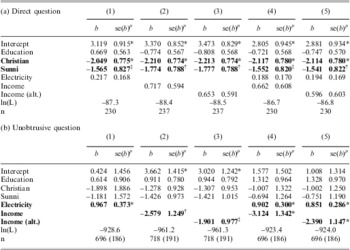
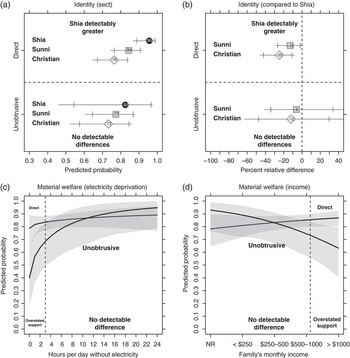
Table 3 summarizes the estimated results from the two models. Mechanically, Hypothesis 1 predicts negative Sunni and Christian coefficients (Shiites are more supportive than others), whereas Hypothesis 2 predicts a positive Electricity coefficient (more deprivation leads to higher support) and a negative Income coefficient (higher income leads to lower support). These results show that although both hypotheses receive empirical confirmation, that support differs in a predicted and qualitatively important way. In particular, H1, positing identity motivations, explains what people are willing to say publicly about illiterate voting rights, whereas H2, positing material motivations, explains what people think privately about those rights. Put simply, if one asks the question directly, one receives a sectarian answer, but if one asks the question unobtrusively, one gets an answer about material deprivation. To ease substantive interpretation, I plotted the key results on a probability scale in Figure 2.Footnote 59
Results

*p ⩽ 0.01; † p ⩽ 0.05; ‡ p ⩽ 0.10
Identity versus material motives: public (direct) and private (unobtrusive)

Figure 2a demonstrates that, when asked directly, Shiites are systematically more likely than their counterparts in the other communities to claim support for illiterate voting rights. Figure 2b shows that they are some 13 per cent more likely than Sunnis to support illiterate voting and 25 per cent more likely than Christians in relative terms. When answering the unobtrusive question, in contrast, community-based differences disappear as the gaps between the sects shrink to indetectable sizes.Footnote 60
Meanwhile, exactly the opposite switch occurs with material influences. Neither Electricity nor Income predicts support for illiterate voting when people answer direct questions. As Figures 2c and 2d reveal, the ‘direct’ effect flatlines across measures of material deprivation. In contrast, both indicators predict support in the anticipated direction when respondents answer unobtrusive questions. The ‘unobtrusive’ effect in Figure 2c shows that people who frequently lose electricity in their homes are significantly more supportive of illiterate voting rights than their better-off peers who rarely lose electricity. The analogous effect in Figure 2d demonstrates that low-income respondents are more supportive of illiterate voting than their wealthier peers.Footnote 61
Finally, the dashed vertical lines in Figures 2c and 2d indicate where people's public claims and private preferences diverge. As anticipated, better-off people are more likely to overstate their support for illiterate voting rights. People who lose electricity three or fewer hours per day – some 16 per cent of the sample – are detectably more supportive of illiterate voting in public than they are in private. Those who never lose electricity are nearly twice as likely to claim support for such rights as they are to support them in private, and those at the 3-hour mark are some 22 per cent more likely in relative terms. Analogously, wealthier people with family incomes over $1,000 a month – about 21 per cent of the sample – are an estimated 37 per cent more likely to publicly claim pro-voting positions as they are to hold them privately. In contrast, there are no detectable public-private differences among people suffering from greater material deprivation.Footnote 62
Discussion: ‘of course it's poor people’
In summary, identity interests do, and material interests do not, have explanatory leverage in accounting for what people say about illiterate voting rights. In explaining what people think about those rights, however, material interests trump identity interests. Better-off people tend to overstate their public support for illiterate voting. Hypotheses 1 and 2 both receive empirical support, but in qualitatively distinct ways: identity interests explain public statements in support of illiterate voting rights, and material interests explain private preferences regarding those rights.
In Lebanese public discourse, it is common for issues not obviously linked to sectarianism to take on a sectarian tone. Those who study ethnic politics elsewhere in the world will likely find this dynamic familiar. Yet how people talk about these issues, and what they actually think about them, are not necessarily the same. When I described the results of the list experiment to one Lebanese party activist, his response was to smile ruefully and exclaim ‘of course it's poor people’. The results also lend credence to an anti-sectarianism campaigner's eloquent observation that ‘for the poor, their belief in bread unifies them, and the few bits of scripture they know do not divide them’.Footnote 63
These results do not, however, imply that Lebanese sectarianism in particular – or ethnic identity more generally – are epiphenomenal of class interests or anything else.Footnote 64 Rather, they simply suggest that people respond contextually to multiple incentives, and that identity does not always trump all other factors. Scholars of ethnic politics sometimes refer to a society's ‘master narrative’, and the Lebanese do indeed narrate sectarianism to each other ad nauseam. There are, however, multiple stories unfolding simultaneously, some of which diverge substantially from that master narrative.
Sectarianism provides the recurring tropes that the Lebanese use to structure their arguments in public discourse. As Scott cautions, however:
Unless one can penetrate the official transcript of both subordinates and elites, a reading of the social evidence will almost always represent a confirmation of the status quo in hegemonic terms.Footnote 65
The list experiment, meanwhile, grants us a ‘privileged peek backstage’ to look beyond the official transcript. The evidence I have presented suggests that Lebanon's sectarian status quo has been built (at least partially) on social pressure and preference falsification.
Conclusion
Are voting rights a class or an ethnic issue in the plural societies of the developing world? This article argues that they are both, but in different contexts: ethnic in public, but class in private. Illiterate voting rights impact people's welfare along a material dimension via taxation and redistribution and along an identity dimension via social status and dignity. Some endowment combinations require trade-offs between the two dimensions, but such trade-offs are asymmetric: people consume material goods privately but identity goods collectively. Social pressure in favour of group solidarity helps mitigate the free-rider problems that otherwise plague the pursuit of collective identity interests, but with an important limitation: social pressure affects what people claim publicly, but not what they think privately. Views on voting rights are thus open to preference falsification.
Explanations of what motivates attitudes in the context of ethnic competition largely distill to arguments about identity versus material interests. Mixed empirical evidence tends to support claims about identity motives, but this article's findings suggest that the empirical record is incomplete and potentially deceptive. In particular, we should take care to consider that people respond to different incentives when claiming versus holding attitudes, and identity-based statements may belie private opinions. The claims that people make in the context of salient ethnic identities are subject to social pressure in favour of group solidarity and unity and against selling out and betrayal. Under such conditions, the individual exit option ‘abruptly changes character… the applauded rational behavior of the alert consumer shifting to a better buy becomes disgraceful defection, desertion, and treason’.Footnote 66 Given these connotations, should we really be surprised if people whose attitudes follow their material interests decline to say so?
The evidence I present in this article confirms the predicted divergence between publicly stated and privately held preferences. Moreover, it demonstrates that we need to go the proverbial extra mile when studying issues, such as illiterate voting, in which we anticipate preference falsification. Prior studies have not asked questions in this way, in part because we lacked the empirical techniques to answer them effectively. Yet a complementary and more subtle reason is that we have had blinders on regarding ethnicity and identity, which are analogous to the class blinders that hampered previous work.
In particular, we have perhaps been too quick to accept people's stated identity-based answers as evidence of identity-based propositions without stopping to question whether we are being spun by our survey respondents and elite interviewees. To the degree that some of this article's claims and findings run counter to our intuitions, it is arguably because those intuitions have been informed inductively by empirical studies that rely on evidence contaminated by preference falsification. That people care about identity interests, and are willing to sacrifice some material interests to pursue them, is by now exceedingly well established. What I am suggesting is more modest and (I hope) more productive: that we discard all of our blinders, both ethnic and class.
We should, however, pause to consider how ‘class conflict’ manifests in developing-world countries such as Lebanon, where parties tends to favour clientelism over political programs.Footnote 67 In stylized form, clientelistic parties reward supporters with contingent, direct payoffs rather than with policy-based redistribution. By distributing material rewards to poor voters, clientelism arguably serves as a tool for managing class conflict – albeit on terms more favourable to the rich – by curtailing the scope of redistribution.Footnote 68 Enfranchising more poor voters, however, obliges politicians to transfer at least some patronage resources to the poor in order to prevent them from supporting political opponents. Even in a purely clientelistic setting, then, illiterate voting rights shift material resources to the poor and away from wealthier clients who might have otherwise received them.
In practice, of course, parties vary their appeal rather than rely solely on clientelistic linkages or programmatic payoffs. Patronage politics persist in a number of developed democracies such as Italy and Japan, while clientelistic parties in the developing world also service their constituencies with program-based redistribution.Footnote 69 Even in societies where electoral clientelism is rampant, many voters resist patronage appeals and cast issue-based votes instead.Footnote 70 To the degree that at least some poor voters cast programmatic ballots, they shift the median voter to the redistributive left. Hence clientelism makes electoral dynamics more complicated, but does not eliminate the basic conflict over material resources so much as provide an additional channel through which to allocate them.
This article examines individual motivations rather than the strategic environment in which people choose parties or the rhetoric employed to persuade voters.Footnote 71 Regardless of what motivates them individually, however, we must still ask related questions about their revealed preferences – that is, aggregate vote outcomes – for ethnically based or class-based parties. Arguably, we should integrate what we know about sincere and strategic voting to answer this broader question. If class (ethnic) appeals are demonstrably non-credible in a given society, we should not expect many people to respond to them even if they agree with the principles espoused, which in turn raises further questions about why such appeals are non-credible.Footnote 72 Further, we should also integrate insights from framing theory to understand how parties frame political cleavages.Footnote 73 Such considerations are especially relevant in societies with coexisting class and ethnic cleavages, as in Melson and Wolpe's classic analysis of ethnic versus class framing in Nigerian elections.Footnote 74 This article thus offers a start rather than a definitive conclusion to this line of inquiry, which awaits systematic comparative research.
In closing, let me highlight two potentially useful extensions to the ideas found in this article. The first extension would vary the collective nature of the identity good being contested. I stated that, theoretically, identity goods are collectively consumed club goods. In practice, however, we can conceive of variations in how perfectly collective they are. Illiterate voting rights approximate a good with collectively consumable identity benefits. In contrast, other goods with identity ramifications may be more subject to private capture – a salient and frequently contested example of which would be highly visible and prestigious state positions. Such jobs, if filled by coethnics, would be identity enhancing for group members because they generate representation and dignity for that group. Yet the positions themselves would be filled by individuals rather than groups, and thus many of the specific benefits of those positions would be privatized, such as salary, perks, job security, personal (as separable from group) prestige and so on.Footnote 75
In fact, we might imagine that rich and poor coethnics could come to a tacit bargain in which the rich expend material resources to generate identity goods, the benefits of which accrue to all members, and the poor compensate the rich for these material expenditures by voting them into lucrative state positions, the material perks of which the rich consume privately.Footnote 76 We might then expect to observe different dynamics among the rich, depending on whether or not some of the benefits of the club good can be captured privately, such as with state positions. If so, we would observe a divergence between what people say and what they think about collectively consumable goods, but no such superficial-versus-sincere divergence for privately capturable goods. Testing this proposition would require additional empirical data that could be collected with a list experiment analogous to the one used in this article, and awaits future research.
The second extension would vary the discursive environment in which people make trade-offs. A telling extension would examine societies in which class dominates public discourse, but that also harbor ethnic cleavages. There are two sets of potential places from which to draw. The first comprises current (and perhaps recent) communist states such as Cuba or Laos that govern populations that are potentially subject to ethnic competition. Mitigating the usefulness of such cases, however, is the practical difficulty of conducting social scientific research in police states, alongside the possibly complicating ideological baggage of Marxism. The second set, potentially more promising, includes Latin American countries such as Bolivia in which indigenous movements, utilizing class-based discourse about a struggle between rich and poor, have either taken power or have fallen just short of doing so.Footnote 77 Scholars with more extensive case familiarity will be better able to judge the merits of such venues and propose alternatives, but the point is that such cases offer an opportunity to examine interest trade-offs in a different discursive environment.
Democracy does not exist without elections, nor elections without voters. Who gets to vote is therefore a core question of both democratic theory and practice. In addition to normative considerations, voting rights can factor into both class and ethnic conflict because of the material and identity ramifications of those rights. Whereas an expansive body of prior studies on ethnic politics has debated whether people's policy preferences respond to material or identity incentives, this article suggests that, at least in the context of illiterate voting rights, both sides of the debate may be correct, but in different contexts. Although the discourse about those rights follows from ethnic competition and identity concerns, what underlies that discourse are prosaic material interests.