INTRODUCTION
Aquatic benthic organisms usually experience high mortality rates during the early stages of their life cycle (e.g. Gosselin & Qian, Reference Gosselin and Qian1997; Hunt & Scheibling, Reference Hunt and Scheibling1997). In marine organisms, the recruitment process (i.e. the addition of new individuals to a local population following settlement of the pelagic larval stage; Caley et al., Reference Caley, Carr, Hixon, Hughes, Jones and Menge1996) is affected by physical and biological factors during the pelagic as well as subsequent stages (e.g. Gaines & Roughgarden, Reference Gaines and Roughgarden1985; Eggleston & Armstrong, Reference Eggleston and Armstrong1995). Among post-settlement processes, predation is a key factor explaining settler or early juvenile mortality (Keough & Downes, Reference Keough and Downes1982; Gosselin & Qian, Reference Gosselin and Qian1997). The most common factor that modifies predation rates is the utilization of spatial refuges during these stages (Gosselin & Qian, Reference Gosselin and Qian1997; Hunt & Scheibling, Reference Hunt and Scheibling1997), being the density of recruits usually much higher in complex habitats (e.g. Fernández et al., Reference Fernández, Armstrong and Iribarne1993a). Settlement selection of secure habitats to avoid predation is often crucial for successful recruitment (Rodriguez et al., Reference Rodriguez, Ojeda and Inestrosa1993). Nevertheless, in some cases, these refuge areas became less secure due to density-dependent processes: dense concentrations of individuals in structured habitats suffer more predation, cannibalism or competition (Blackmon & Eggleston, Reference Blackmon and Eggleston2001; Stevens & Swiney, Reference Stevens and Swiney2005; Pardo et al., Reference Pardo, Palma, Prieto, Sepúlveda, Valdivia and Ojeda2007). Mobile species can respond to these changes in vulnerability and predation by post-settlement migrations (Pardo et al., Reference Pardo, Palma, Prieto, Sepúlveda, Valdivia and Ojeda2007).
In muddy habitats, where the refuges are scarce, ecosystem engineering processes play a major role in the creation of habitats (Jones et al., Reference Jones, Lawton and Shachak1994; Gutierrez & Iribarne, Reference Gutierrez and Iribarne2004). Ecosystem engineers are organisms that directly or indirectly modulate the availability of resources to other species, by causing physical state changes in biotic or abiotic materials (Jones et al., Reference Jones, Lawton and Shachak1994). Burrowing crabs indirectly modify the intertidal flat creating a three-dimensional relief bottom generating habitats and trapping sediment that could serve as food for other species (e.g. Botto & Iribarne, Reference Botto and Iribarne2000). Thus, in flat muddy bottoms, physical ecosystem engineering (i.e. the physical modification, maintenance, or creation of habitats; Jones et al., Reference Jones, Lawton and Shachak1994) is likely to affect the recruitment process because it increases habitat complexity.
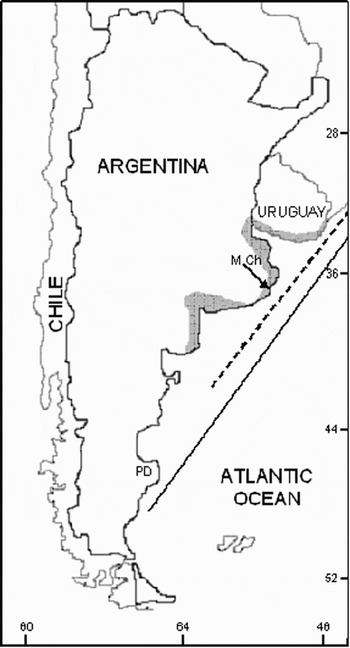
Large parts of the south-western Atlantic soft bottom intertidals are inhabited by the burrowing crab Neohelice granulata (previously known as Chasmagnathus granulatus, family: Varunidae; for recent taxonomic revision see Sakai et al., Reference Sakai, Türkay and Yang2006) and the mud crab Cyrtograpsus angulatus Dana, 1851 (family: Varunidae; e.g. Spivak et al., Reference Spivak, Anger, Luppi, Bas and Ismael1994; Iribarne et al., Reference Iribarne, Martinetto, Schwindt, Botto, Bortolus and Garcia Borboroglu2003). Neohelice granulata excavates and maintains semi-permanent open burrows generating burrowing assemblages (hereafter named ‘crab beds’) of many hectares (e.g. Spivak et al., Reference Spivak, Anger, Luppi, Bas and Ismael1994; Iribarne et al., Reference Iribarne, Bortolus and Botto1997, Reference Iribarne, Bruschetti, Escapa, Bava, Botto, Gutierrez, Palomo, Delhey, Petracci and Gagliardini2005, Botto et al., Reference Botto, Valiela, Iribarne, Martinetto and Alberti2005). Burrow density can exceed 60 crab m−2 extending up to 1 m into the sediment (Iribarne et al., Reference Iribarne, Bortolus and Botto1997), modifying sediment characteristics, infaunal abundance (Botto & Iribarne, Reference Botto and Iribarne1999, Reference Botto and Iribarne2000; Bortolus & Iribarne, Reference Bortolus and Iribarne1999) and habitat use by other crabs, fish (Martinetto et al., Reference Martinetto, Iribarne and Palomo2005, Reference Martinetto, Valiñas, Palomo and Iribarne2007) and shorebirds (Botto et al., Reference Botto, Palomo, Iribarne and Martinez2000). These burrows are funnel shaped, with entrances up to 14 cm on the major axis length (Iribarne et al., Reference Iribarne, Bortolus and Botto1997). Along their distribution range (Figure 1) N. granulata coexists with C. angulatus, another grapsoid crab, which is highly mobile and does not make permanent burrows when N. granulata is present (Botto & Iribarne, Reference Botto and Iribarne1999; Palomo et al., Reference Palomo, Martinetto, Bruschetti and Iribarne2003). While C. angulatus is mainly a subtidal species, N. granulata inhabits the intertidal zones, and the two species overlap only during high tides in this area (Martinetto et al., Reference Martinetto, Valiñas, Palomo and Iribarne2007).
Geographical distribution of Neohelice granulata (dotted line) and Cyrtograpsus angulatus (solid line). Grey area represents shell assemblages (edited from Iribarne et al., 1998, Reference Iribarne, Bruschetti, Escapa, Bava, Botto, Gutierrez, Palomo, Delhey, Petracci and Gagliardini2005). Mch, Mar Chiquita.

For a successful recruitment, both species select particular habitats to settle, a process that seems to drive to habitat differentiation (Spivak et al., Reference Spivak, Anger, Luppi, Bas and Ismael1994; Iribarne et al., Reference Iribarne, Martinetto, Schwindt, Botto, Bortolus and Garcia Borboroglu2003). Cyrtograpsus angulatus settles in structured habitats such as reefs of the suspension-feeder polychaete Ficopomatus enigmaticus (Fauvel, Reference Fauvel1923; Schwindt & Iribarne, Reference Schwindt and Iribarne2000; Luppi & Bas, Reference Luppi and Bas2002), under stones (Spivak et al., Reference Spivak, Anger, Luppi, Bas and Ismael1994), under bivalve shells (Gutierrez & Iribarne, Reference Gutierrez and Iribarne1999) and it has also been observed inside burrows of N. granulata (A. Méndez Casariego, personal observation). There is an ontogenetic change in habitat preferences (Spivak et al., Reference Spivak, Anger, Luppi, Bas and Ismael1994): settlers avoid the presence of conspecific adults (Luppi et al., Reference Luppi, Spivak, Anger and Valero2002), which live in tidal mud flats.
Neohelice granulata has been also observed to settle in F. enigmaticus reefs but they soon disappear (Luppi, unpublished data). The main habitat they select when settling is on conspecific adult burrows where various juvenile size-classes may coexist (Spivak et al., Reference Spivak, Anger, Luppi, Bas and Ismael1994). When megalopae get trapped in burrows, metamorphosis is induced by chemical cues from muddy substrates and adults (Gebauer et al., Reference Gebauer, Walter and Anger1998). These burrows protect settlers from bird and fish predation, and adult presence, from cannibalism by larger juveniles (Luppi et al., Reference Luppi, Spivak and Anger2001). Although both juveniles and adults of N. granulata can prey upon conspecific settlers, the intensity of cannibalism is stronger on juveniles probably due to differences in sizes between prey and predator as it happens for other species (e.g. chelae gape determines prey size range; Lovrich & Sainte-Marie, Reference Lovrich and Sainte-Marie1997) where larger chelae make the settlers inaccessible for the adults to be handled (Luppi et al., Reference Luppi, Spivak and Anger2001).
Both species settle in the same period, from October to March (Spivak et al., Reference Spivak, Anger, Bas, Luppi and Ismael1996), and previous experiments show that when adults of N. granulata are excluded, C. angulatus settles and constructs burrows (Botto & Iribarne, Reference Botto and Iribarne1999). Even though the interaction between these two species is common among their youngest stages, adult populations rarely coexist due to the territorial behaviour of N. granulata, which displace C. angulatus (Iribarne et al., Reference Iribarne, Martinetto, Schwindt, Botto, Bortolus and Garcia Borboroglu2003; Martinetto et al., Reference Martinetto, Valiñas, Palomo and Iribarne2007). In fact, this displacement could be the result of habitat selection during the settlement phase or a high mortality rate upon juveniles of C. angulatus when it settles in burrows of N. granulata.
Our observations suggest that burrows of N. granulata increase habitat complexity potentially facilitating C. angulatus settlement; N. granulata juveniles are expected to prey on a different C. angulatus size-class than adults; and positive interactions usually change with ontogeny of beneficiaries or benefactors (Callaway & Walker, Reference Callaway and Walker1997; Holmgren et al., Reference Holmgren, Scheffer and Huston1997; Miriti, Reference Miriti2006) particularly in this case, changing with ontogeny from facilitation to predation. In this context, the objectives of this work were to determine: (1) if N. granulata burrows facilitate C. angulatus settlement; (2) if predation by N. granulata upon C. angulatus is stage-dependent; and (3) if this influences C. angulatus migration to the subtidal, being an example of a complex network of positive and negative interactions shifting with age of beneficiaries and benefactors.
MATERIALS AND METHODS
Study area
Observations and experiments were performed in the Mar Chiquita coastal lagoon (37°46′S 57°27′W, Argentina). It has an area of 46 km2 and a maximum depth of up to 2 m (Fasano et al., Reference Fasano, Hernandez, Isla and Schnack1982). Intertidal environments at the lagoon comprise mud flats and large areas of cord grass, Spartina densiflora, along the perimeter (Olivier et al., Reference Olivier, Escofet, Penchaszadeh and Orensanz1972; Iribarne et al., Reference Iribarne, Bortolus and Botto1997). Crab beds of the burrowing crab Neohelice granulata are found on most parts of the intertidal flats (e.g. Iribarne et al., Reference Iribarne, Bortolus and Botto1997). The homogeneous muddy substratum is altered by reefs of Ficopomatus enigmaticus (Schwindt & Iribarne, Reference Schwindt and Iribarne2000) and fossil shell assemblages of the stout razor clam Tagelus plebeius (Schnack et al., Reference Schnack, Fasano, Isla and Colquhoun1982).
Burrows facilitate crab recruits
The density of recruits is usually higher in complex habitats (e.g. Fernández et al., Reference Fernández, Armstrong and Iribarne1993a). Hence, we compared the density of Cyrtograpsus angulatus and Neohelice granulata recruits in burrows (complex habitat) versus flat surfaces (less complex habitat) during two summer periods. To achieve this, four to nine plots (0.5 × 0.5 m) randomly selected were sampled monthly from October to March (late spring–summer) in 2004 and from December to March (summer) in 2005. Crabs were collected by hand, carefully digging out the mud. All recruits present of any of these two species were quantified and the carapace width (CW) was measured on each sampling date. Sizes were divided into two classes: settlers (megalopae, and instars I, II and III), and juveniles (considered here from instars IV to VII, which were the largest size found inside burrows). Given that no recruits were found outside the burrows, and that sizes and shapes of burrows from the same intertidal height are similar (Iribarne et al., Reference Iribarne, Bortolus and Botto1997; Martinetto et al., Reference Martinetto, Valiñas, Palomo and Iribarne2007), the density of settlers was expressed as number of settlers per burrow. If facilitation occurs, we expect higher density of settlers inside burrows than in surrounding flat mud. Since no crabs were found outside burrows (densities at the surrounding mud flat x = 0, s2 = 0), t-tests were performed to test if densities inside burrows are different from zero. Interaction between both species inside burrows was tested with correlation analyses. We analysed if juvenile densities (of both species) affect abundance of C. angulatus settlers inside burrows using two correlation analyses separately between C. angulatus settlers and juveniles of C. angulatus or juveniles of N. granulata.
Predation
Predation can be an important factor influencing post-settlement movement of juveniles (Moksnes, Reference Moksnes2002; Moksnes & Heck, Reference Moksnes and Heck2006). Hence, we experimentally evaluated the effect of post-settlement predation of N. granulata upon C. angulatus, using 40 cm side cages and 60 cm height with 15 cm inserted into the sediment to avoid crabs entering. We used a 2 mm mesh that allows the entrance of megalopae and small crabs (instars I, II and maybe III, Luppi et al., Reference Luppi, Spivak, Anger and Valero2002). The experiment lasted 30 days from the beginning of February of 2006 and consisted in four treatments (9 replicates each), each of them with a cage surrounding a single artificial burrow: (1) Control: only an empty burrow inside each cage; (2) Juvenile inclusion: 12 N. granulata juveniles (from 5 to 7 mm) were added inside each burrow; (3) Adult inclusion: one adult male crab (28 to 30 mm) of N. granulata was added inside each burrow; and (4) Adult and juveniles inclusion: 12 juveniles and one adult male of N. granulata were added in each burrow. We used artificial burrows to properly handle the number of juveniles included in each cage. These burrows were made with a core (15 cm diameter, 20 cm depth). All crabs were collected from areas close to the plots. Only adult males were used because in that zone the frequency of females is very low. At the end of the experiment, all C. angulatus recruits present in the cages were counted and size measured. Because juveniles are expected to prey upon smaller sizes than adults, one-way ANOVAs (Zar, Reference Zar1999; one for for all C. angulatus individuals pooled, one for the smallest group of settlers and one for the largest group) were performed to test differences in sizes and densities of C. angulatus between the 4 treatments. To meet the assumption of homoscedasticity, sizes were log transformed. Given that crab mortality under laboratory conditions significantly diminishes when crabs reach more than 5 mm CW (Luppi et al., Reference Luppi, Iribarne and Spivak2000), C. angulatus densities were also analysed considering two size-classes (larger than 10 mm CW and smaller than 5 mm CW) to distinguish the vulnerability of those sizes to predation in the field.
Given that adult N. granulata can also prey on conspecific juveniles (Luppi et al., Reference Luppi, Spivak, Anger and Valero2002), which at the same time can be preying on C. angulatus settlers, they can be indirectly reducing predation on C. angulatus settlers. To determine conspecific predation rates of adults on juveniles, the number of N. granulata juveniles in treatments (2) and (4) were measured at the end of the experiment. A t-test (Zar, Reference Zar1999) was performed to evaluate differences between juvenile densities of N. granulata with and without adults.
Movement
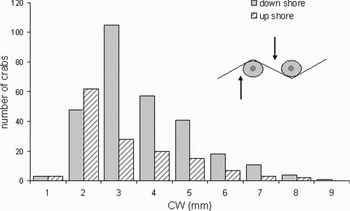
In order to evaluate if there is a post-settlement dispersal of C. angulatus from these crab beds, 10 traps were placed parallel to the shore between the intertidal (with burrows) and the subtidal (without burrows). Each trap consisted of a drift plastic fence (1.5 m long, 30 cm high, 2 mm mesh size), vertically buried into the sediment with a zigzag pattern to detect bi-directional movement (see Figure 5). In each vertex, a pitfall trap with a 5 cm opening was buried to ground level, one in each side of the mesh (2 traps per fence) collecting the crabs that are moving down to the subtidal and the ones that are moving up to crab beds. The crabs were collected daily for five days at the end of the summer and the total number of crabs moving towards each direction was summed. A Chi-square test (Zar, Reference Zar1999) was performed to compare the number of crabs with an expected distribution of no preference in the direction of the movement.
RESULTS
Burrows facilitate crab recruits
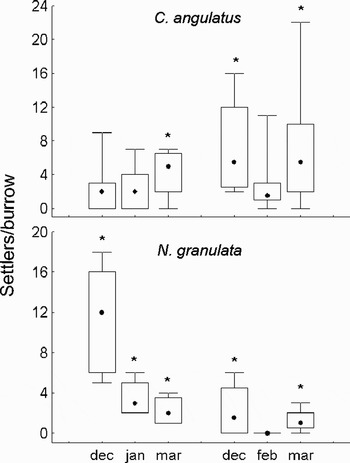
The field sampling showed that both species settle inside burrows of Neohelice granulata, and not outside. During the two summers sampled, first instars of Cyrtograpsus angulatus were present, and in the second year when the recruitment of N. granulata was 75% lower, density of C. angulatus was 2.9 times higher. T-tests for C. angulatus comparing densities inside burrows with the surrounding mud (i.e. if densities inside burrows are different from zero) showed differences for March of both years and December of 2006. Densities of N. granulata were mainly different from zero with the exception of February 2006 (Figure 2).
Number of crabs of Cyrtograpsus angulatus and Neohelice granulata per burrow in 2005 and 2006. Box plots are constructed with limits of boxes being the 75th and 25th percentiles, lines represent 10th and 90th percentiles. Asterisks show differences from densities outside burrows (x = 0).

Correlation analyses showed a negative relationship between densities of C. angulatus settlers and juveniles of N. granulata (r = −0.42, df = 39, P < 0.05). However, a positive correlation was found between densities of settlers and juveniles of C. angulatus (r = 0.52, df = 39, P < 0.01).
Predation
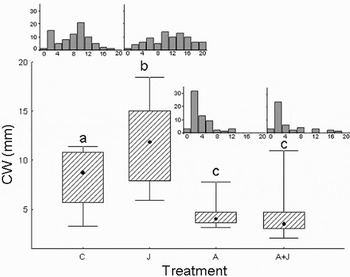
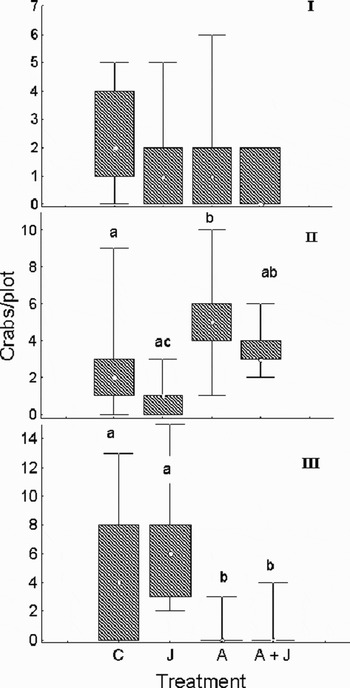
The experiment showed that carapace sizes of C. angulatus were smaller when N. granulata adults were present (Figure 3; F = 44.33, df = 3, 262, P < 0.0001). This experiment also showed that C. angulatus densities did not vary between treatments when all sizes of crabs were pooled (ANOVA: F = 2.38, df = 3, 32; P > 0.05; Figure 4I). However, there were marked differences in C. angulatus densities when divided into two size-classes. The addition of juvenile N. granulata caused a 40% reduction in densities of small C. angulatus (CW< 5 mm; ANOVA: F = 6.83, df = 3, 32; P < 0.005) while the highest densities were found when adult N. granulata were included (Figure 4II). The opposite trend was found when considering the larger C. angulatus juveniles (CW > 10 mm): the lowest densities were found in the treatment with adults, while the juvenile addition showed the highest density (Figure 4III; ANOVA square root transformation: F = 8.42, df = 3, 32; P < 0.0005). Adults of N. granulata also affected density of conspecific juveniles, their density at the end of the experiment being eight times higher without adults (with adults x = 0.33, SD = 0.5; without adults x = 2.88, SD = 2.8, t = 2.61, df = 16, P < 0.01).
Box plot showing sizes of juveniles of Cyrtograpsus angulatus in each treatment: C, control; J, juveniles added; A, one adult added; A + J, juveniles and adult added. Different letters indicate significant differences. Box plots are constructed with limits of boxes being the 75th and 25th percentiles, lines represent 10th and 90th percentiles. Marks inside boxes are medians. Graphs above plots are SFD of each treatment.

(I) Total number of crabs of Cyrtograpsus angulatus present in each treatment; (II) crabs smaller than 5 mm CW; (III) crabs larger than 10 mm CW. C, control; J, juveniles added; A, one adult added; A + J, juveniles and adult added. Different letters indicate significant differences.

Movement
Movement traps showed that 60% of the juveniles of C. angulatus were moving towards subtidal, so the net flux emigrating toward the subtidal from burrowing assemblages is 20% (χ2 = 15.7; P < 0.0001). The size–frequency distribution shows that smaller juveniles were not moving (instar I~1.7 mm CW) or did not have preferences in the direction (instars II and III ~2.1 and 2.8 mm respectively). Considering only from instar IV (3.5 mm) the net flux of direction was 50% down shore, leaving the burrowing assemblage (χ2 = 84; P < 0.0001; Figure 5).
Size–frequency distribution of crabs collected in the movement traps, with a diagram of the trap.

DISCUSSION
Our results show that Neohelice granulata burrows facilitate settlement of both species, but then, N. granulata does not facilitate the survival throughout the juvenile phase. Field experiments show that small recruits are preyed by juveniles of N. granulata and not by adults. In fact, densities in the treatments with adults are higher, suggesting that N. granulata are preying upon larger juveniles of each species, reducing intra and interspecific predation. Nevertheless, when juveniles grow, predation by adults is higher, so they tend to emigrate from the crab beds. Taking all these results together, this study provides a good example of the dynamic of positive and negative interactions between species during ontogeny.
Burrows facilitate settlement
Differences in distribution of estuarine crab species could be the result of habitat selection at settlement (e.g. Fernández et al., Reference Fernández, Iribarne and Armstrong1993b; Eggleston & Armstrong, Reference Eggleston and Armstrong1995; Eggleston & Etherington, Reference Eggleston and Etherington1998), differential mortality between habitats (e.g. Hunt & Scheibling, Reference Hunt and Scheibling1997 for review), dispersal of juveniles to other habitats (e.g. Palmer et al., Reference Palmer, Allan and Butman1996), or a combination of these processes (e.g. Moksnes, Reference Moksnes2002). Several species select particular habitats to settle and in some cases to spend their juvenile stages (Fernández et al., Reference Fernández, Iribarne and Armstrong1993b; Moksnes et al., Reference Moksnes, Pihl and van Montfrans1998). Nevertheless, these habitats usually support high densities of individuals, which could lead to intracohort cannibalism (e.g. Fernández et al., Reference Fernández, Iribarne and Armstrong1993b). However, the coexistence of several size-classes can be reduced due to intercohort cannibalism (see Moknes, Reference Moksnes2004). If these habitats are shared by more species, the predation may increase to a certain point in which the survival is higher in other non-structured habitats (Lipcius et al., Reference Lipcius, Rochelle, Seitz, Seebo and Colon-Carrion2005). Megalopae of Cyrtograpsus angulatus are capable of swimming to find suitable places (Valero et al., Reference Valero, Luppi and Iribarne1999) and actively select or avoid habitats to settle (Luppi et al., Reference Luppi, Spivak, Anger and Valero2002). These selected habitats are always structures with high relief (e.g. shells, artificial sponges and reefs), thus favouring three dimension-structured places. In our case, settlers selected burrows of N. granulata over the surrounding flat sediment. This is a good example of ecosystem engineering, in which crabs create complexity by the construction of burrows that otherwise would be a flat sediment unselected by settlers. Hence, ecosystem engineering by N. granulata has a positive effect upon C. angulatus as it increases survival of C. angulatus settlers.
Burrowing areas can occupy a great portion of intertidal zones in south-western Atlantic estuaries where both species are found (see Figure 1). Even though the study was performed in only one coastal lagoon, the area covered by burrowing assemblages is 40% while in other estuaries can occupy up to 80% or even 100% of the intertidal (Botto et al., Reference Botto, Valiela, Iribarne, Martinetto and Alberti2005; Iribarne et al., Reference Iribarne, Bruschetti, Escapa, Bava, Botto, Gutierrez, Palomo, Delhey, Petracci and Gagliardini2005). The burrow densities are also lower than in other estuaries reaching up to 60 burrows m−2 in Mar Chiquita, while in others can exceed 90 burrows m−2 (see Iribarne et al., Reference Iribarne, Martinetto, Schwindt, Botto, Bortolus and Garcia Borboroglu2003). The mean density of C. angulatus settlers was 8.4 crabs per burrow. Adult burrow density (where juveniles are common) is about 27 burrows m−2 which implies about 227 C. angulatus settlers m−2, suggesting that the burrowing crab has a large positive effect upon recruitment of C. angulatus.
The main settlement habitats for C. angulatus in our particular study site are reefs of the polychaete Ficopomatus enigmaticus. This invasive species was first recorded in Argentina in 1943 (Rioja, Reference Rioja1943), and it has great effects on C. angulatus recruitment. Densities in this habitat can reach up to 10,000 ind m−3 (Luppi & Bas, Reference Luppi and Bas2002). Nevertheless, their distribution range in estuaries from Argentinean coast is restricted to Mar Chiquita lagoon. Cyrtograpsus angulatus also use valve beds as settlement sites. These shell assemblages are distributed in almost the same range where these two species overlap (Figure 1). Density in these native refuges is ~22 juv m−2 (Gutierrez & Iribarne, Reference Gutierrez and Iribarne1999), which is only about a tenth of that found inside burrows. Coupling this with the wide distribution range of the crab beds in south-western Atlantic estuaries highlights the importance of the N. granulata–C. angulatus interactions in this last species recruitment.
Post-settlement predation and the migration to the subtidal
Differences in distribution, then, are the result of later processes taking place as crabs grow. Even though mortality of C. angulatus could be higher inside burrows due to predation by juveniles of N. granulata, there is a control provided by N. granulata adults, which also prey upon conespecific juveniles (T. Luppi, unpublished). However, the major mortality arises when they reach a size large enough to be handled by adults of N. granulata. After reaching that point, juveniles must leave the burrow assemblage for safer places to avoid predation. It is known that C. angulatus settlement success is enhanced when it selects structured habitats, nevertheless, migrations to other habitats may imply larger mortality risk and migration probably happens only when refuges are no longer secure (Méndez Casariego et al., Reference Méndez Casariego, Schwindt and Iribarne2004). Although post-settlement dispersal is an important process for the distribution of organisms (see Palmer et al., Reference Palmer, Allan and Butman1996) it is generally ignored (Moksnes, Reference Moksnes2002). In our case, post-settlement dispersion of C. angulatus plays an important role that allows them to take advantage of using intertidal burrows of N. granulata to increase chances of successful settlement. Here we demonstrated that N. granulata have important positive effects on the settlement of C. angulatus, however, we expect that in south-western Atlantic estuaries with higher burrow densities the magnitude of this interaction should be even higher.
Positive and negative interactions shifts with ontogeny of both species
In this case, juvenile N. granulata negatively affect C. angulatus settlers by preying upon them. However, when N. granulata become adults this facilitates settlement of each species, and by preying upon juvenile N. granulata positively affects C. angulatus settlers. At the same time, as C. angulatus grow, the intensity of this positive effect disappears and turns to a negative effect as they become consumed by N. granulata and forced to migrate to the subtidal. Some examples of shifts between positive and negative interactions with ontogeny can be found in the literature. However, most of the literature describes simple shifts that occur with ontogeny of beneficiaries (Callaway & Walker, Reference Callaway and Walker1997; Holmgren et al., Reference Holmgren, Scheffer and Huston1997; Miriti, Reference Miriti2006) or benefactors (Ervin, Reference Ervin2005; and suggested by Espigares et al., Reference Espigares, López-Pintor and Rey Benayas2004). In general, interactions usually go from positive to negative with ontogeny of beneficiaries (Rousset & Lepart, Reference Rousset and Lepart2000; Leslie, Reference Leslie2005; Miriti, Reference Miriti2006; Alberti et al., Reference Alberti, Escapa, Iribarne, Silliman and Bertness2008), and the opposite usually happens with benefactors (Ervin, Reference Ervin2005; and suggested by Espigares et al., Reference Espigares, López-Pintor and Rey Benayas2004), as in this study. Thus, our results present an interesting new insight, where negative and positive interactions shift following ontogeny of both benefactors (N. granulata) and beneficiaries (C. angulatus).
ACKNOWLEDGEMENTS
This project was supported by the UNMdP, the Fundación Antorchas (Argentina; 13900-13), ANPCyT (PICT03-13527) and CONICET (Argentina PIP5669), all granted to O.I.; A.M.C. and J.A. were supported by a doctoral scholarship from CONICET (Argentina) and this work is part of the doctoral thesis of A.M.C. at the UNMdP.