Introduction
First described in 1991, Kounis syndrome is a hypersensitivity condition characterised as an allergic reaction associated with acute coronary syndrome due to inflammatory mediators. Reference Kounis and Zavras1 The release of inflammatory cytokines and histamine results in coronary artery vasospasm or atheromatous plaque erosion or rupture, thus presenting with symptoms of angina. The incidence of Kounis syndrome is ever increasing, making up 3.4% of patients presenting with symptoms of allergy to the emergency department. Reference Kounis and Zavras1 In an era where overmedication is on the rise, the most common triggers of Kounis syndrome are antibiotic use and insect bites. Reference Abdelghany, Subedi, Shah and Kozman2 To date, there are no special tests to confirm Kounis syndrome, thus diagnosis is based on thorough clinical examination and usual cardiac work-up including blood tests (including troponin), electrocardiogram, echocardiogram, and angiography.
Long QT syndrome is a repolarization disorder that may cause syncope, life-threatening tachyarrhythmia, and sudden cardiac death. In this case report, we describe a unique case of concurrent Kounis syndrome and prolonged QT in a young patient after a single dose of Domperidone and Lansoprazole.
Case
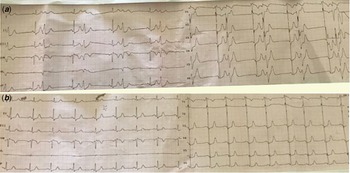
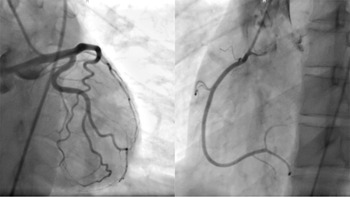
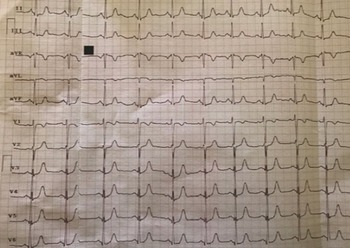
A 27-year-old female presented with symptoms of musculoskeletal backpain to the emergency department. She had no past medical history including no history of atopy or allergies to medication. There was no personal or family history of ischaemic or CHD. Given her symptoms, Phenyramidol (a dual muscle relaxant and analgesic) was given. As gastric protection and to prevent side effects, a combination of 30 mg of Domperidone and 30 mg of Lansoprazole was also administered. An hour after taking these medications, she started having dyspnoea, palpitations, and cardiac sounding chest pain. On examination, her blood pressure was 100/50 mmHg, she had a regular pulse with a heart rate of 70 beats per minute and a normal oxygen saturation above 95% in room air. A 12-lead electrocardiogram demonstrated extrasystoles with bigeminy, no ischaemic changes but did confirm prolonged QTc to 470 ms (Fig 1). Her chest X-ray was normal. Given these findings, she was treated with 5 mg of intravenous metoprolol. Two hours later, her symptoms had improved but still persisted and a repeat electrocardiogram was normal with normal sinus rhythm with an improving QTc interval. Her full blood count demonstrated eosinophilia, electrolytes (including magnesium and calcium), kidney function, thyroid function, and liver function were normal. However, her high-sensitive troponin T was raised from 0.005 to 0.643 ng/ml (cut-off: 0.014 ng/ml). A transthoracic echocardiogram revealed mild mitral regurgitation but no regional wall motion abnormalities. Consequently, as she had ongoing chest pain and a raised troponin acute coronary syndrome protocol was initiated and she was taken to the catheter laboratory which demonstrated normal coronary arteries (Fig 2). Once Domperidone and Lansoprazole were stopped, her symptoms had completely resolved, and she was safely discharged and followed up in clinic a week later where an electrocardiogram demonstrated normal sinus rhythm with a corrected QTc of 386 ms (Fig 3).
ECG demonstrating prolonged QTc.

Angiogram demonstrating normal coronary arteries.

ECG showing resolution of prolonged QTc.

Discussion
There are three subtypes of Kounis syndrome. Type 1 includes patients with no underlying coronary artery disease or cardiac risk factors. The inflammatory mediators induce coronary vasospasm resulting in ischaemia with a clinical picture of acute coronary syndrome. Reference Fassio, Losappio and Antolin-Amerigo3 Whereas, type 2 Kounis syndrome includes patients who have pre-existing coronary artery disease where inflammatory mediators contribute to further erosion or rupture of atheromatous plaque leading to acute coronary syndrome. Reference Fassio, Losappio and Antolin-Amerigo3 Type 3 involves patients with drug-eluding stents who present with acute stent thrombosis associated with eosinophilia and mast cells on histopathological examination. Reference Chen, Hou, Pendyala, Goudevenos and Kounis4
In this case, our patient had type 1 Kounis syndrome as she had no past cardiac history. Interestingly, only after one dose of Domperidone and Lansoprazole, she had dual QTc prolongation and Kounis syndrome. This is evidenced by clinical examination confirming of symptoms of allergy, a normal angiogram, and Transthoracic echocardiogram (TTE) with concurrent symptoms of angina and a troponin leak. Although it is difficult to distinguish between Prinzmetal angina from Kounis syndrome as there are no definitive diagnostic criteria, patients with systemic allergic symptoms with findings in keeping with acute coronary syndrome, a diagnosis of Kounis syndrome should be favoured. Reference Kounis, Kourelis, Hahalis, Manola, Kourelis, Theoharides, Gallo and Jones5 Studies have confirmed prolonged QTc associated with domperidone, likely due to cardiac electrophysiological effects of domperidone on the rapid component of the delayed rectifier potassium channels. Reference Rossi and Giorgi6 Other studies have also confirmed Kounis syndrome after proton pump inhibitor, antibiotic, and pseudophedrine use. Reference Vlahos, Vavilis and Giannelou7-Reference Leibee, Getachew and Ehmann10
The management of Kounis syndrome in the acute setting should be dual fold. First, the allergic reaction is managed with steroids and antihistamines and secondly any coronary lesions are treated by initiating the acute coronary syndrome protocol with the administration of antithrombotic prior to urgent coronary angiography. However, some medication indicated in acute coronary syndrome (mainly aspirin) may itself lead to further allergic reactions and induce anaphylaxis, thus clinicians should be cautious. Reference Kounis, Kouni and Koutsojannis11 Steroid use has been reported previously in successfully treating allergic acute coronary syndrome. Reference Maragkoudakis, Hamilos, Kallergis and Vardas12 In patients with severe anaphylaxis requiring epinephrine use in patients with Kounis syndrome, given its effects of coronary vasospasm may worsen coronary ischaemia. At the same time, clinicians should be aware of the use of beta-blockers with epinephrine in severe anaphylactoid Kounis syndrome and acute coronary syndrome as this could reduce the effectiveness of epinephrine given its pharmacodynamics and kinetics. Reference Maragkoudakis, Hamilos, Kallergis and Vardas12
Conclusion
Our case demonstrates a unique presentation of Kounis syndrome and prolonged QTc after a single dose of Domperidone and Lansoprazole in a young patient managed successfully with beta-blocker use. As the patient’s symptoms settled without corticosteroid or antihistamine use but with cessation of both Domperidone and Lansoprazole, clinicians should be aware of Kounis syndrome in young patients as an atypical presentation. Thus, prompt diagnosis and treatment according to the clinical course should be initiated to help alleviate symptoms earlier. Clinicians should also be aware of other cardiac side effects of the combination of Domperidone and Lansoprazole in young patients such as prolonged QTc.
Acknowledgements
None.
Financial support
This research received no specific grant from any funding agency, commercial or not-for-profit sectors.
Conflicts of interest
None.