Introduction
In recent years, Specialist Perinatal Mental Health Services (SPMHS) have been established in Ireland to address the specific needs of women and their partners during the perinatal period; a time of heightened stress and increased incidence of mental health problems. Perinatal anxiety disorders are common (Regier et al. Reference Regier, Narrow and Rae1990; Rubinchik et al. Reference Rubinchik, Kablinger and Gardner2005) and may be more frequent than anxiety disorders outside the perinatal period (Seng et al. Reference Seng, Rauch, Resnick, Reed, King, Low, McPherson, Muzik, Abelson and Liberzon2010; Henderson & Redshaw Reference Henderson and Redshaw2013; Russell et al. Reference Russell, Fawcett and Mazmanian2013; Wrigley et al. Reference Wrigley2017). A systematic review and meta-analysis in 2017 reported prevalence of antenatal or postnatal anxiety disorders at 15.2% (Dennis et al. Reference Dennis, Falah-Hassani and Shiri2017). Anxiety disorders could be pre-existing or occur de novo during the pregnancy.
In 2016, anxiety-related diagnoses were the most common (342 of 558) type of mental illness diagnoses noted at discharge from Irish hospitals where the admission type was ‘Maternity’ (Wrigley et al. Reference Wrigley2017). In the same year, 62,736 mothers delivered (Health Service Executive, 2017) their babies in Ireland, giving a rate of approximately nine mental health admissions per 1000 mothers delivered. It is worth noting that the Royal College of Psychiatrists recommend, when required, for postpartum mothers to be admitted together with their infant to a specialized Mother-and-Baby Unit (MBU) (Royal College of Psychiatrists, 2015). Ireland does not currently have such a unit and this is a major limitation of the service in this country.
Anxiety specifically related to pregnancy is not specified as an ICD or DSM psychiatric disorder, though tokophobia (pathological fear of pregnancy and childbirth) could be assessed for under criteria for a Specific Phobia in either classification. Nonetheless, higher levels of antenatal anxiety has been related to adverse outcomes (O’Connor et al. Reference O’Connor, Heron, Golding, Beveridge and Glover2002; Gosselin et al. Reference Gosselin, Chabot, Béland, Goulet-Gervais and Morin2016), including an increased risk of postpartum depression (Schetter & Tanner, Reference Schetter and Tanner2012; Wrigley et al. Reference Wrigley2017; Grigoriadis et al. Reference Grigoriadis, Graves, Peer, Mamisashvili, Tomlinson, Vigod, Dennis, Steiner, Brown and Cheung2019), adverse outcomes for children (Schetter & Tanner, Reference Schetter and Tanner2012; Dennis et al. Reference Dennis, Falah-Hassani and Shiri2017; Wrigley et al. Reference Wrigley2017), and various obstetric outcomes such as increased rates of Cesarean section (Zhang et al. Reference Zhang, Huang and Tan2013; Hure et al. Reference Hure, Powers, Chojenta and Loxton2017), increased risk for preterm birth, variation in birth weight, and earlier gestational age (Rubinchik et al. Reference Rubinchik, Kablinger and Gardner2005; Schetter & Tanner, Reference Schetter and Tanner2012; Ding et al. Reference Ding, Wu, Xu, Zhu, Jia, Zhang, Huang, Zhu, Hao and Tao2014; Kaitz et al. Reference Kaitz, Mankuta, Rokem and Faraone2014, Reference Kaitz, Mankuta, Rokem and Faraone2015; Wrigley et al. Reference Wrigley2017; Grigoriadis et al. Reference Grigoriadis, Graves, Peer, Mamisashvili, Tomlinson, Vigod, Dennis, Steiner, Brown and Cheung2018).
University Maternity Hospital Limerick’s (UMHL) is the fifth largest maternity hospital in Ireland and facilitated 4,152 births in 2019 (Health Service Executive, 2019). Its SPMHS was established in April 2018 as one of the first of its kind in Ireland. Antenatal referrals are received from obstetric teams, community mental health teams and General Practitioners.
To date, there has been little description of patients with anxiety diagnoses attending a SPMHS in Ireland, their management and their mental health, obstetric, and neonatal outcomes.
The objectives of this study were to (1) outline characteristics of patients with anxiety diagnoses attending an SPMHS in Ireland, (2) describe the care received by those patients within the SPMHS, (3) describe mental health and obstetric outcomes for those patients, and (4) immediate neonatal outcomes for their babies.
Methods
We performed a retrospective chart review of patients attending the UMHL SPMHS. Data were collected between 15th April 2019 and 30th April 2019. All patients with an anxiety diagnosis documented antenatally in their mental health notes from the commencement of the service to the close of data collection (spanning approximately 1 year) were included. Clinical diagnoses were made, in all cases, by a consultant psychiatrist (MMM) or following discussion with the consultant psychiatrist. Individuals without an anxiety diagnosis, and individuals diagnosed postnatally were excluded.
Data were collected from SPMHS patient charts and obstetric charts on demographics, obstetric and mental health history, mental health assessment, diagnosis and management, and mental health, obstetric, and immediate neonatal outcomes. The diagnosis was taken directly from patient notes. This was typically an ICD-10 or DSM-V diagnosis, except for the diagnosis of Pregnancy-related anxiety, which reflects the ethos of Irish SPMHS of assisting those in the perinatal period with non-criteria-meeting difficulties.
Outcomes were categorized as (1) mental health, (2) obstetric, and (3) neonatal. Mental health outcomes were (a) crisis contacts post SPMHS assessment, and (b) psychiatric admissions post SPMHS assessment. Obstetric outcomes were: (a) miscarriage or stillbirth, (b) major obstetric events (eclampsia, uterine rupture, peripartum hysterectomy, PE), (c) rate of instrumental delivery, (d) rate of induction of labor, and (e) rate of Cesarean section. Neonatal outcomes were: (a) premature delivery, (b) low birth weight, (c) the requirement for admission to the Neonatal Intensive Care Unit (NICU).
Fisher’s Exact Test (2-tailed) was used to assess all outcomes for associations based on gravidity, prior contact with psychiatric services, and whether or not a person was taking psychiatric medication during their pregnancy. Fisher’s Exact Test was chosen over Chi-squared, as it was specifically designed for smaller samples, and would therefore provide a more accurate p-value in this case. p < 0.05 was used to define statistical significance. All data were analyzed in SPSS version 26.
Results
One hundred of 634 (15.8%) individuals referred to the SPMHS had either an anxiety diagnosis in isolation or a diagnosis of Mixed anxiety and depressive disorder. Mental health and obstetric data were collected on these 100 patients. Delivery data was unavailable for one patient due to the patient delivering their baby in another center. Not all demographic data were documented in the clinical notes.
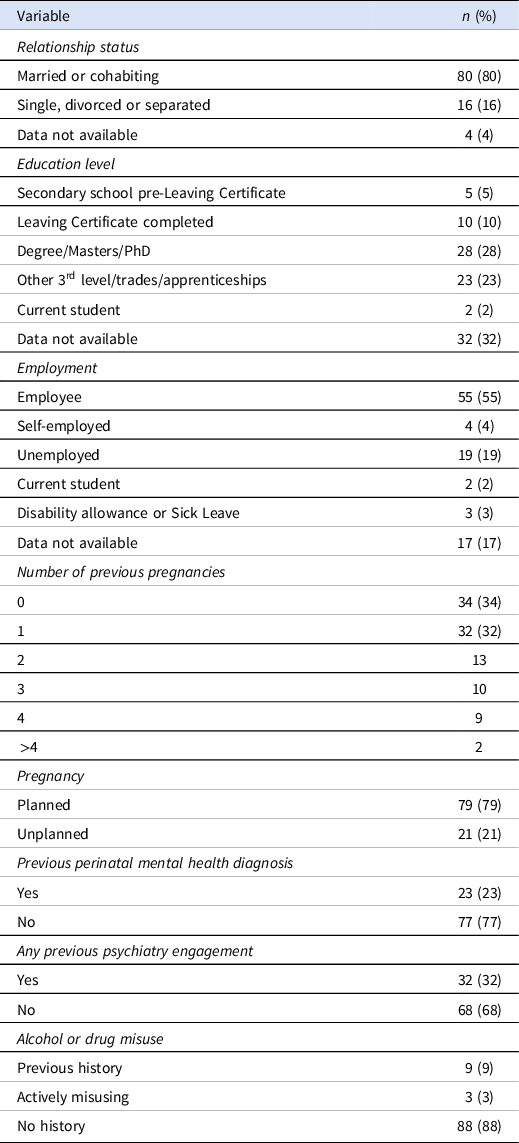
The mean age of patients was 32.4 (19–47, std 6.158). The median gestational age at initial SPMHS assessment was 20 (7–41, IQR 15) weeks. The majority (79%) of pregnancies were planned. The majority of patients were working (65%), and the majority of patients were either married or cohabiting (80%). Thirty-four (34%) individuals were pregnant for the first time. The median number of previous pregnancies was 1 (0–7, IQR 2). Pregnancy achieved via in vitro fertilization was identified in two cases. Twenty-eight individuals (28%) had had at least one previous miscarriage. Previous pregnancy-related trauma was identified in 37/100 (37%). The demographic characteristics of patients is summarised in Table 1.
Eighty-one (81%) patients had a psychiatric diagnosis prior to attending the SPMHS, and 23 (23%) had a previous perinatal psychiatric diagnosis. Sixty (60%) had previously taken psychotropic medication. Thirteen (13%) had a history of either self-harm or at least one attempted suicide. Thirty-two (32%) patients had prior engagement with psychiatry. Seven (7%) had a previous psychiatric admission. Nine (9%) had a history of abuse of alcohol or drugs but were not using while pregnant, and three (3%) admitted to actively using during this pregnancy.
The most common diagnoses were Generalised Anxiety Disorder (29%), Pregnancy-related anxiety (19%), and Mixed anxiety and depressive disorder (15%). Ten (10%) had Reaction to severe stress and adjustment disorders, 5% had Panic disorder, 5% had a Specific phobia including Agoraphobia or Social phobia, and 9% had another anxiety disorder.
Care received from the SPMHS
Following initial assessment, despite an anxiety diagnosis, three patients (3%) were identified as not requiring further follow-up. These were patients with long-standing, well-controlled conditions, and had been referred following routine screening at their obstetric booking visit.
Regarding interventions following assessment, the Mental Health Midwife was involved in the care of 61/100 (61%) patients, a psychiatrist (Consultant or Registrar) was involved in 42/100 (42%), and nine patients engaged with psychology. Forty referrals were made to other services, including Medical Social Work, Bereavement Counselling, Addiction Services, Hypnobirthing, and supportive groups.
Twenty-seven patients (27%) had psychiatric medication either started or changed by the SPMHS.
The most common reason (43.6%) for discharge from the SPMHS was that patients were well. Nineteen (19%) patients were discharged due to either refusing further care or for not attending for subsequent appointments.
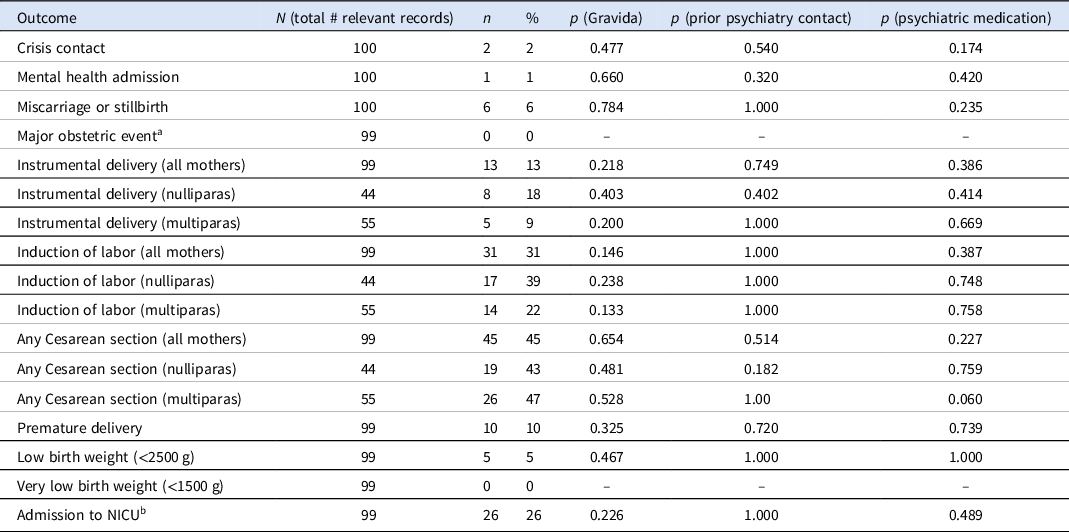
Patient outcomes are summarised in Table 2.
Mental health outcomes
Following their initial assessment with the SPMHS, two patients (2%) presented in mental health-related crisis to emergency services, and one patient (1%) was admitted to an acute psychiatric ward during the same perinatal period.
Obstetric outcomes
Six (6%) mothers had a stillbirth or miscarriage in the pregnancy during which they were seen by the SPMHS. The rates of instrumental delivery and induction of labor were 13% and 31%, respectively, with higher rates for nulliparas than for multiparas women. Forty-five (45%) patients had a Cesarean section.
Neonatal outcomes
Ten of the 99 patients (10%) for whom delivery data was available delivered a premature (prior to 37 weeks gestation) live baby. Five (5%) delivered babies were considered to have low birth weight (< 2500 g). No babies were of very low birthweight (<1500 g). Twenty-six (26%) required admission to the NICU.
Analysis
None of the outcomes were significantly impacted by gravidity, prior contact with psychiatric services, or whether or not a person was taking psychiatric medication during their pregnancy (see Table 2).
Discussion
A significant proportion (19%) of patients in this study had a primary diagnosis of Pregnancy-related anxiety. This diagnosis was included, as noted in the methods section above, due to its relevance to an SPMHS, a diagnosis that would not necessarily be considered appropriate for a General Adult Community Mental Health Team. These patients received a varied set of interventions, often specific to the context of pregnancy.
Notably, the Mental Health Midwife was involved in the care of more patients than any other team member, including the psychiatrists. This is likely reflective of a number of factors: (1) the willingness of the SPMHS to assist patients with difficulties of lower severity than would normally be managed by a CMHT, (2) the significant role that pregnancy and expected delivery played in patients’ anxiety, (3) that the Mental Health Midwife on this team had Masters training in Cognitive Behavioural Therapy, which is likely to be appropriate for individuals with anxiety disorders and for patients with the inherent additional consideration of the potential impact of medication on their child.
The incidences of crisis presentations (2%) and mental health admissions (1%) to hospital were low, though consistent with the national figure noted in the introduction of nine admissions per 1,000 (0.9%) mothers delivered in 2016. It could also be considered that the inclusion of patients with Pregnancy-related anxiety as a significant proportion of the sample potentially reduced the likelihood of crises and admissions. Even low rates of crisis presentations and admissions, however, further highlight the lack of an MBU in Ireland as a gold-standard option of care for perinatal mothers suffering with mental illness.
The pattern of obstetric outcome findings in this study largely align with those of hospital-wide statistics and national statistics for 2018.
The rate of Cesarean section in the patients in this study is higher than for hospital-wide (Health Service Executive, 2018) and national (Health Service Executive et al. 2019) statistics, both for nulliparas (43% v. 38.5%, 35.6%) and multiparas (47% v. 35.3%, 32.6%) women. This aligns with previous findings that rates of Cesarean section can be higher in mothers with anxiety (Zhang et al. Reference Zhang, Huang and Tan2013; Hure et al. Reference Hure, Powers, Chojenta and Loxton2017). It is feasible that this may reflect steps taken to reduce anxiety by reducing unpredictability, or a more paternalistic stance being taken by Obstetricians with individuals with anxiety, either of which could result in a higher rate of elective Cesarean section. A higher rate of elective Cesarean section in nulliparas women would also be in keeping with the rate of instrumental deliveries in nulliparas SPMHS patients (18%) being lower than both the hospital-wide (33.6%) and national (28.7%) rates.
Also, a history of obstetric difficulties can increase anxiety in current pregnancies (Melender, Reference Melender2002; Couto et al. Reference Couto, Couto, Vian, Gregório, Nomura, Zaccaria and Passini2009; Blackmore et al. Reference Blackmore, Côté-Arsenault, Tang, Glover, Evans, Golding and O’Connor2011; Gong et al. Reference Gong, Hao, Tao, Zhang, Wang and Xu2013; Chen et al. Reference Chen, Cai, Liu, Qian, Ling, Zhang, Luo, Chen and Shi2016; Shapiro et al. Reference Shapiro, Séguin, Muckle, Monnier and Fraser2017; Alqahtani et al. Reference Alqahtani, Al Khedair, Al-Jeheiman, Al-Turki and Al Qahtani2018), and so the obstetric history that predisposes patients to Cesarian section may also make it more likely that they attend the SPMHS.
Limitations
The lack of a control group in this study and the small sample size are significant limitations. Future studies could compare groups with anxiety to cohorts with other mental illnesses or to individuals not attending an SPMHS.
It should be noted, too, that when comparing outcomes for these patients with hospital-wide and national data, the authors were forced to use data from overlapping, but not completely aligning time periods. However, we proceeded with the comparison as it provided an important and relevant comparison.
Conclusions
This study highlights how varied the presentation of anxiety is in the perinatal period and the largely positive prognosis. A significant proportion of patients with anxiety attending the SPMHS had primarily Pregnancy-related anxiety. The SPMHS provides a wide range of interventions to patients with anxiety. The Mental Health Midwife was involved with more of these patients than any other specialty. The low rate of inpatient mental health admissions in this group is in keeping with national figures. This reinforces that the bulk of perinatal mental health can be handled in the community, but also may reflect the lack of an MBU in Ireland.
Demographic data

Outcomes of individuals attending the SPMHS with antenatal anxiety (delivery data only available for 99 of the 100 patients); p-values are based on Fisher’s Exact Test.

a Major obstetric event = eclampsia, uterine rupture, peripartum hysterectomy, pulmonary embolism.
b NICU = Neonatal Intensive Care Unit.
Financial support
This research received no specific grant from any funding agency, commercial, or not-for-profit sectors.
Conflict of interest
The authors have no conflicts of interest to disclose.
Ethical standards
The authors assert that all procedures contributing to this work comply with the ethical standards of the relevant national and institutional committee on human experimentation with the Helsinki Declaration of 1975, as revised in 2008. The study protocol was approved by the local ethics committee of the participating institution.