


1. Burleigh's Ass
Hypothetical syllogism is a well-respected (typically derived) principle of deductive logic. The proposition, [[p → q] ∧ [q → r]] → [p → r], is a theorem or tautology of propositional logic, and the corresponding inference rule:
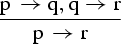
is deductively valid, as students in elementary logic have been taught since ancient times. There is a parallel form of the inference in Aristotelian logic for the presumably deductively valid syllogism in BARBARA:
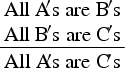
The principle, despite its innocuous appearance, is challenged by an interesting sophisma of the medieval logician and Aristotle commentator Walter Burleigh. In his c. 1323 work, De Puritate Artis Logicae Tractatus Longior (Longer Treatise on the Purity of Logic), under the rubric, ‘Instantiae’, Burleigh writes:
Nam haec consequentiae est bona: ‘Dico te esse asinum, igitur dico te esse animal’, et tamen aliquid sequitur ad consequens, quod non sequitur ad antecedens. Nam sequitur: Dico te esse animal, ergo dico verum; et tamen non sequitur: Dico te esse asinum, igitur dico verum.Footnote 1
An English translation by Paul Vincent Spade renders the passage as follows:
(25) But there are arguments by counterexamples against the rule ‘Whatever follows from a consequent follows from the antecedent’ [(6)].
(26) For the inference ‘I say that you are an ass; therefore, I say that you are an animal’ is a good one, and yet something follows from the consequent that does not follow from the antecedent. For it follows: ‘I say that you are an animal; therefore, I say the truth’. And yet it does not follow: ‘I say that you are an ass; therefore, I say the truth’.Footnote 2
I gloss Burleigh's putative counterexample to hypothetical syllogism in a modified way to facilitate formalization. Since ‘A’ might stand for either ‘ass’ or ‘animal’, I restate the argument in a trivial revision to refer to someone's being a swine (S) rather than an ass, reserving ‘A’ to represent animal. The indexicals in Burleigh's original formulation are evidently not at issue. For ‘I’ and ‘you’ (let's not get personal) we can simply substitute ‘a’ and ‘b’ without obvious prejudice to the logic of Burleigh's inference. The example in other ways remains unchanged. Thus, we can attempt to challenge hypothetical syllogism by the following inference:
[All human beings are animals.]
[b is a human being, and hence an animal, but not (genetically) a swine.]
1 If a calls b a swine, then a calls b an animal.
2 If a calls b an animal, then a speaks the truth.
3 If a calls b a swine, then a speaks the truth (b is a swine).
We have nevertheless assumed that b, whatever his or her hygiene, politics or table manners, is not (genetically, at least) a swine. The assumptions appear true, but the conclusion by hypothesis is false. The form of inference in hypothetical syllogism is, moreover, paradigmatically deductively valid. Hence the sophism.Footnote 3
2. Implications of Burleigh's Paradox
There is a problem here and several potential sources of fallacy. Burleigh's paradox challenges the deductive validity of the apparently innocent inference form of hypothetical syllogism. If Burleigh's argument were correct—and his stated purpose is merely to challenge the student's understanding of logic—, then a fatal blow would be struck not only against hypothetical syllogism, but more generally against formalism, the philosophical thesis by which deductive validity is to be understood as conformity with semantically justified inference forms. According to formalism, a species or specimen of reasoning is deductively valid if and only if it can be obtained by uniform substitution of terms or sentences from an approved deductively valid form, such as hypothetical syllogism is generally considered to be.
With the usual (minimal) bending and stretching to make an argument fit the Procrustean bed of Aristotelian logic, we can also rephrase Burleigh's fallacy in the form of a syllogism in BARBARA:
1 All instances in which I have the property of saying to you that you are a swine are instances in which I have the property of saying to you that you are an animal.
2 All instances in which I have the property of saying to you that you are an animal are instances in which I have the property of speaking truthfully.
3 All instances in which I have the property of saying to you that you are an ass are instances in which I have the property of speaking truthfully.
Thus, the conclusion in these among countless related variations:
You [your name here] are a swine.
You [your name here] are a filthy swine.
You [your name here] are a damn filthy swine.
Etc. (according to an informal lexical-grammatical recursion to be established by field linguistics).
Of these increasingly uncivil formulations, we can amp up the vulgarity increasingly without limit if we choose, as long as we are qualifying a swine as a species of animal. This is part of the fun, and, despite cultural differences over six centuries, part of the interest of Burleigh's fallacy. The challenge is that if we cannot plausibly identify, diagnose and defuse Burleigh's counterexample by exposing it as the fallacy it clearly involves, then we may have no choice but to reject hypothetical syllogism, and therewith all of classical propositional logic. If Burleigh's paradox forces us to make these concessions, however, then formalism, insofar as it licenses uniformly substituting propositionally meaningful expressions into a supposedly deductively valid form like that of hypothetical syllogism salva validitate, will not be defensible as a general theory of deductive validity.
Hypothetical syllogism and formalism cannot be jeopardized by what we recognize as a logical fallacy. We must nevertheless meet a high standard of proof to show convincingly in the single case that Burleigh's reasoning in the counterexample is deductively invalid. Intuitively, something in Burleigh's argument is logically amiss. We might suspect, for example, that the argument trades on some sort of hidden inconsistency.
A useful method of testing some inferences is to see if they go through equally well for their negations or for the complements of key predicates in the propositions they contain. Although in progressive jurisprudence it is assumed that a person is innocent until proven guilty, we might take it upon ourselves in the present context to prove that you [whoever you are] are not a swine. We can always test an argument by seeing whether and how far we can modify it in order to attain the opposite result. This method provides a way of judging at least one dimension of the argument's significance. What is at stake if we accept the argument? What if we can argue with minor adjustments but otherwise logically in exactly the same way to the opposite conclusion? If it turns out that we cannot, then why, exactly, can we not?
What happens now if we try to construct a counterpart argument of Burleigh's inference, to the effect instead that you are not a swine? Certain features of the argument are immediately fixed by the structure of a hypothetical syllogism leading to this contrary conclusion. The antecedent of the first assumption must state ‘If I say that you are not a swine, then…’, while the entire conclusion must state: ‘If I say that you are not a swine, then I speak truthfully (you are not a (damn filthy, etc.) swine)’. Now we narrow down our search space for an argument that through parity of form with Burleigh's fallacy that you are a swine, can with equal justification support the opposite conclusion. Here are some possibilities, none of which is finally satisfactory, with evaluations and brief commentary:
1a. If I say that you are not a swine, then I say that you are not an animal. FALSE! (There are animals other than swine.)
1b. If say that you are not a swine, then I say that you are an animal. FALSE! (There are things other than animals that are also not swine.)
1c. If I say that you are not a swine, then I do not say that you are not an animal. TRUE! (For the same reason that 1b is FALSE!)
The trouble with 1c. is that we then need to bridge an inference to the predetermined conclusion:
1 If I say that you are not a swine, then I speak truthfully (you are not a swine).
The question is how to get from 1c. to 3. It appears that what we need is something like:
2a. If I do not say that you are not an animal, then I speak truthfully. FALSE! (The sentence is false because it is compatible with my not saying that you are not a swine that I not speak at all, truthfully or otherwise.)
These formulations do not work. We can nevertheless reach the desired conclusion by revising the content of the inference to argue as follows: ‘If I say that you are not a swine, then I say that you are not a cloven-hoofed mammal. If I say that you are not a cloven-hoofed mammal, then I speak truthfully. Therefore, if I say that you are not a swine, then I speak truthfully.’ The argument, for the sake of comparison, can now be represented as having this form:
[All human beings are animals.]
[b is a human being, and hence an animal, but not (genetically)
a swine; nor is b for that reason a cloven-hoofed mammal.]
1 If a asserts that b is not a swine, then a denies that b is a cloven-hoofed mammal.
2 If a denies that b is a cloven-hoofed mammal, then a speaks the truth.
3 If a asserts that b is not a swine, then a speaks the truth (b is not a swine).
The syllogistic formulation for this counter application of Burleigh's use of hypothetical syllogism looks like this:
1 All instances in which I have the property of saying to you that you are not a swine are instances in which I have the property of saying to you that you are not a cloven-hoofed mammal.
2 All instances in which I have the property of saying to you that you are not a cloven-hoofed mammal are instances in which I have the property of speaking truthfully.
3 All instances in which I have the property of saying to you that you are not a swine are instances in which I have the property of speaking truthfully.
What should we make of the fact that there can be opposed applications leading to contradictory conclusions of a single argument form apparently instantiating hypothetical syllogism, a cherished logical principle of deductive reasoning? Does the original conclusion that b is a swine get cancelled out somehow by the fact that hypothetical syllogism with different assumptions can also be used deductively validly to conclude that b is not a swine?
I think that Burleigh's defender would be right to object that the question of whether or not b is truly a(n) (etc.) swine was never at issue, that the putative counterexample to hypothetical syllogism depends instead on the fact of b's not being in truth a swine (in the sense of not being a member of a particular species of cloven-hoofed mammal). The problem is not with b's specieshood, but rather with the deductive validity of hypothetical syllogism in all its formal applications. Nor need Burleigh's defender implausibly argue that all applications of hypothetical syllogism as a result of the argument that b is a swine must therefore preclude the opposite conclusion that b is not a swine. There must be such (at least deductively valid) arguments, because in fact it is a truth about b that b is not a swine in the sense of not being a member of the greater porcine family. The trouble is that we can also use hypothetical syllogism validly to deduce the false conclusion that b is a swine from true assumptions. We cannot so easily remove the logical difficulty posed by Burleigh's paradox for all formally executed instantiations of hypothetical syllogism putatively derived by uniform substitution of propositions for propositional variables p, q, in the propositional schema for hypothetical syllogism (or the equivalent for the corresponding deductively valid syllogism).
We must either reject hypothetical syllogism as a valid form of deductive inference, whereby in the same stroke we reject all of classical propositional logic and consequently all of the classical functional calculus or first-order predicate-quantificational logic, along with formalism, or we must argue correctly that Burleigh's fallacy is avoidable in another way. If we can show that Burleigh's effort to instantiate hypothetical syllogism in the paradox is logically impermissible, then we avoid this potential threat to the deductive validity of any and every legitimate instantiation of this unmistakably deductively valid argument form.Footnote 4
3. Critical Analysis of Burleigh's Fallacy
It is essential to recognize that Burleigh's paradox is a sophism rather than a serious counterexample to the deductive validity of hypothetical syllogism. The solution to Burleigh's paradox involves exposing it as or reducing it to an explicit fallacy. We develop such a strategy in the following symbolization, a glossary for which is provided below:
1 ∀x[Sx → Ax]
2 ∀x,y[[Cxϕy∧∀z[ϕz → ψz]] → Cx ψy]
3 CaSb → CaAb
4 CaAb → [Ab → C TaAb] (or, CaAb → [Ab → T ⌈Ab ⌉])
5 Ab
6 CaSb → C TaAb (or, T ⌈Ab ⌉) (HARMLESSLY) VALID!
7 CaSb → C TaSb DEDUCTIVELY INVALID!
8 CaSb → Sb DEDUCTIVELY INVALID!
(Note that C TaAb is not the same as, nor does it entail, nor is it entailed by, T ⌈CaAb ⌉). ‘Calls’ (‘C’) and Calls-true (C T) can be interpreted extensionally as opposed to ‘declares’ or ‘states’ (true), etc., which seem characteristically intensional. The inference on this interpretation breaks down on grounds of intensional non-inferability, if we agree that it is senseless to say that something becomes true merely because someone says or even sincerely believes that it is true.
What is needed to make the inferences in (7) or (8) carry forward is the following evidently false principle:

(Or, equivalently, the same conclusion obtains according to appropriately modified unidirectional conditional versions of the so-called Tarskian or iterative Davidsonian T-schema, ∀xC Txp → p, ∀x,y[Cx ϕy → ϕy]).
The following false assumptions could also uphold the conclusion in a patently unsound inference, if anyone were reckless enough to interpolate them:
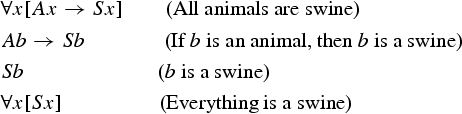
It may be worth reflecting on the intuitive implausibilities that each of these assumptions bears.
The first, ∀x[Ax → Sx], says that all animals are swine. If we were prepared to ignore counterexamples like human beings and hummingbirds and dung beetles, then we could consider accepting such a universal, which in the meantime must remain conceptually and materially false. The second, as a particular instantiation of the corresponding universal generalization, must equally be judged false. We should not expect it to follow from the fact that b in particular is an animal that therefore b in particular is a swine. Thus, we must also reject Ab → Sb.
We likewise obtain our conclusion in a deductively valid way if we simply assume it, by introducing without further ado the assumption that Sb. To conclude from this, as though having shown something worthwhile in a worthwhile way, that therefore b is a swine, is like proving the existence of God by assuming from the outset, albeit in disguised terminology, that God exists. Even worse is the assumption that everything is a swine (God), by which one can only too easily and hence too trivially deductively conclude that b in particular is a swine (God). Thus, if we are interested in the argumentative significance of our reasoning, we will not leap to the otherwise independently insupportable conclusion that ∀x[Sx], on the reasonable assumption that while there may exist swine, there surely also exist things that are not swine.
If there is no other way to support the conclusion that Sb in the present argument context, then we should probably come away from Burleigh's inference as establishing only how badly things can go wrong if we try to instantiate deductively valid argument forms like hypothetical syllogism by subtly equivocal propositions, such as those that seem to be involved in Burleigh's fallacy. We pinpoint the equivocation when we reconsider the original inference.
When a calls b a swine, a, true enough, calls b an animal, on the grounds that a swine is an animal. These truth conditions, nevertheless, are rather different than the truth conditions by which we can with equal justification pronounce it as true that when a calls b an animal, a speaks the truth. Speaker a says something true in that case, not by virtue of b truly being a swine, but by virtue of b's truly being an animal other than a swine. These are altogether different truth conditions that are otherwise obscured in assumptions (1) and (2). We avoid paradox at the same time that we rescue hypothetical syllogism as a deductively valid form of reasoning by refusing to acknowledge the deductive validity of inferring (3) from (1) and (2) where an evident equivocation in the referential meaning of the phrase ‘an animal’ is the inadmissible pivot on which the evidently invalid inference turns.
We can equally say, with less precision, perhaps, but at a more intuitive level, that to speak of ‘an animal’ in assumptions (1) and (2) is in each case to have in mind a very different animal. In the first instance, reference to ‘an animal’ intends something that refers specifically and exclusively to a porcine animal, while in the second instance ‘an animal’ refers to something that is definitely not porcine, but is instead specifically and exclusively only primate or hominid, and ultimately applies only to members of the species homo sapiens sapiens.
Instantiations of hypothetical syllogism according to formalism are guaranteed to be deductively valid only insofar as they involve, not merely uniform substitutions within an approved deductively valid form of ‘syntactically’ identical terms loosely adapted from ordinary language, but only when such substitutions involve referentially univocal terms designating precisely the same objects or properties. Anything less than a scrupulous substitution policy, prohibiting the syntactically uniform but referentially dissonant replacements of terms or sentences within an inference form, reflects at most a gratuitous abuse of formalism rather than the deductive logical validity of such semantically well-founded logical principles as hypothetical syllogism. The fact that in colloquial discourse we can refer by means of the same phrase ‘an animal’ to entirely different kinds of animals should not lead us so far astray that we begin to question the deductive legitimacy of transparently valid inference forms, including hypothetical syllogism. We are well advised accordingly to reject the counterexample to hypothetical syllogism that seems to be implied by Burleigh's paradox, more appropriately categorized on the basis of our analysis as Burleigh's fallacy.
We detect the invalidity in Burleigh's fallacy when we see that it depends on an outright equivocation between two different meanings of the term ‘an animal’. The fact that it is appropriate in completely different circumstances to speak of the object of a certain true predication in two or more cases as ‘an animal’ does not by itself give us any conclusive logical ground for concluding that therefore the predications in question refer in particular to the same kind of animal or to ‘an animal’ of the same biological kind. This is where common sense with a little guidance should also incline, and where common sense for the philosophically trained is likely also to point. We avoid logical paradox in both cases by disambiguating the intent of a term, in this case a phrase, that can be satisfied in any of a number of different ways by rather different subcategories of the same general kind, and from which it would be sheer logical irresponsibility to infer that anything and everything that answers to the general category of being ‘an animal’ must therefore constitute the same kind of animal. Consequently, we have in Burleigh's argument no serious challenge to the deductive validity of hypothetical syllogism, nor to formalism as a metalogical ideology, but at most instead only a cautionary example of how badly things can go wrong if we permit equivocations by which things belonging together in more general kinds are inferred as a result to belong together also in more specific kinds. This entire family of fallacies is readily avoided when we refrain from substituting into the deductively valid form of hypothetical syllogism apparently identical terms or sentences expressing different senses. The slippage in meaning between two applications of ‘an animal’ in Burleigh's inference invalidates the putative counterexample to the general deductive validity of hypothetical syllogism that otherwise seems to be entailed.Footnote 5 Burleigh's paradox is thereby shown to be nothing more than Burleigh's fallacy by equivocation.Footnote 6


