INTRODUCTION
An estimated 2.85 million children in the United States are living with a parent who has been diagnosed with cancer (Weaver et al., Reference Weaver, Rowland and Alfano2010). Moreover, it is estimated that close to 55,000 children experience the death of a parent from cancer each year in the United States (Weaver et al., Reference Weaver, Rowland and Alfano2010). Children and adolescents facing the death of a parent from cancer constitute a vulnerable population often overlooked by healthcare professionals (HCPs) and researchers.
Adolescents are considered the group most susceptible to negative psychosocial outcomes when faced with a parent's illness (Grabiak et al., Reference Grabiak, Bender and Puskar2007). However, there has been extremely limited research on the adjustment of adolescents to advanced cancer in parents (Phillips, Reference Phillips2014). Prior to the conduct of our study, there has been a paucity of research on the adolescent's experience when a parent has advanced cancer, with only eight studies identified that focused on the impact on children and adolescents faced with a parent's advanced cancer. These studies suggest that adolescents living with a parent's advanced cancer show significantly higher levels of distress, anxiety, and depression, as well as lower self-esteem than their peers (Kuhne et al., Reference Kuhne, Krattenmacher and Bergelt2012; Rainville et al., Reference Rainville, Dumont and Simard2012; Siegel, Karus & Raveis, Reference Siegel, Karus and Raveis1996; 1992). In addition, parents reported higher behavioral problems and lower social competence in children with a terminal parent (Kennedy & Lloyd-Williams, Reference Kennedy and Lloyd-Williams2009; Siegel et al., Reference Siegel, Mesagno and Karus1992). Possible factors that affect the adjustment of adolescents to a parent's advanced illness included poor parenting, open communication style, age (early vs. late adolescence), and the parent–child relationship (Christ et al., Reference Christ, Siegel and Sperber1994; Kennedy & Lloyd-Williams, Reference Kennedy and Lloyd-Williams2009; Rainville et al., Reference Rainville, Dumont and Simard2012; Sigal, Perry, Robbins, Gagne & Nassif, 2003). These findings suggest that the end stage of a parent's illness can be a particularly vulnerable period for adolescents.
The prevalence of positive well-being is rarely addressed in the literature on parental cancer. However, in the case of advanced cancer, some positive aspects of the cancer experience seem to consistently emerge. Several of these studies have found, at times unexpectedly, evidence of resilience or protective factors that have led to a positive outlook for these families despite the many challenges they face (Christ et al., Reference Christ, Siegel and Sperber1994; Kennedy & Lloyd-Williams, Reference Kennedy and Lloyd-Williams2009; Sheehan & Draucker, Reference Sheehan and Draucker2011; Sigal et al., Reference Sigal, Perry and Robbins2003).
It is important for healthcare professionals to understand how adolescents experience difficult life circumstances to better meet their psychological and emotional needs. Currently, interventions provided by clinicians to support adolescents dealing with the advanced cancer of a parent lack any empirical basis in the literature (Muriel & Rauch, Reference Muriel and Rauch2003; Foley et al., Reference Foley, Back, Coyle and Bruera2005). There is little information available on how adolescents handle living with a parent with advanced cancer. A critical task in the beginning stages of our research was to ask the adolescents themselves. The aim of our study was to gain an understanding of the experiences of these adolescents in their own words so as to gather pilot data on the needs of this population that could be valuable in developing interventions for adolescents who are facing parental cancer.
METHODS
Study Design
The theoretical framework that guided our study was based on the resiliency model of family stress, adjustment, and adaptation, a stress and coping framework based on a family-systems approach (McCubbin et al., Reference McCubbin, Thompson and McCubbin1996). This strength-based framework assumes that the experience of families facing a crisis such as advanced cancer is normative, not pathological, and has the potential to be buffered by resilience factors. In this qualitative study, in-depth semistructured interviews were employed to inquire about the experience of living as an adolescent with a parent who has been diagnosed with advanced cancer. Qualitative methods have been shown to be effective as preliminary research with understudied populations (Miles & Huberman, Reference Miles and Huberman1994). In addition, qualitative methods are especially well suited to the development of rich data about families and human development (Daly, Reference Daly2007). Hermeneutic phenomenology was the approach chosen because the researchers wished to obtain a description of these adolescents' experiences, and this method provides the most descriptive data (Creswell, Reference Creswell2007). The phenomenological approach allowed us to capture the common experiences of this group as understood by the adolescents themselves.
Sample
After study approval by the institutional review board at a southwestern university, criterion sampling was employed to identify participants who met the inclusion criteria. Families were informed about the research project by a community-based nonprofit that provides psychosocial support for families facing a parent's life-threatening illness. Interested parents and adolescents were then contacted by the researcher. The project was described, questions were answered, and the adolescents were invited to participate in the study.
The study's participants met the following inclusion criteria: (1) adolescents aged 12–18 years at the time of the interview; (2) currently living with a parent diagnosed with advanced or metastatic cancer stage 3 or above; and (3) English speaking. The exclusion criteria were: (1) the parent with cancer was no longer living, and (2) the adolescent did not live in the same household as the ill parent at least 50% of the time.
It is important to note that all of the families recruited for our study were involved with the same agency, which provides interventions for families experiencing a parent's serious illness. This agency aims to increase family communication and enhance the positive coping skills utilized by their clients. The majority of the adolescents in our study (8 of 10) participated in individual or group support for their parent's cancer at a very young age (6–10 years old), when their parent received their initial cancer diagnosis. Although it is not within the scope of this study to evaluate the outcomes of this earlier intervention, it is possible that the family's involvement in these services affected their long-term cancer experiences.
Procedures
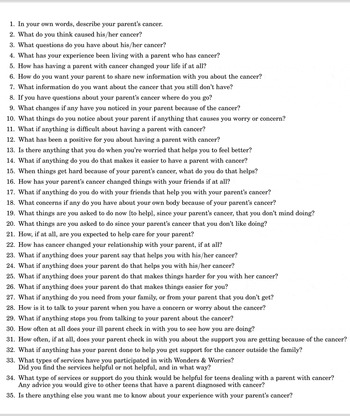
Some 10 adolescents (7 male and 3 female), ranging in age from 14 to 17 years, participated in our study. Parents' diagnoses included brain tumors, breast cancer, and ovarian cancer. The children's age at parent's initial diagnosis of cancer ranged from 3 to 16 years, with a majority of adolescents living with parental cancer for more than 5 years. This article describes the qualitative results acquired from in-depth face-to-face interviews with these adolescents. The participants were informed that the study aimed to learn about the experiences of adolescents dealing with parental cancer with the hope to create interventions to help other youths in similar situations. They were informed of how their personal story would assist researchers and clinicians improve their work with this population. It is important to note that many of the subjects were able to candidly and in great detail discuss their experiences with the desire of helping other adolescents. After signed informed consent was obtained, interviews were conducted using the interview guide presented in Table 3. This guide was adapted from a previous study by Lewis and colleagues (Reference Lewis and Darby2003) and was developed to elicit rich descriptions from participants. The researcher is a child-life specialist with extensive experience working with families in many medical settings, including work with children and adolescents who have an ill parent. Semistructured interviews took place largely in the family's home or at another convenient private location identified by the subjects. Interviews lasted an average of 45 to 60 minutes and were digitally recorded. The recordings were transcribed verbatim. All transcripts were reviewed for accuracy before being processed with Atlas (v. ti 6) software.
Data Analysis
The researcher employed a combination of the various approaches to phenomenological analysis as described by Moustakas (Reference Moustakas1994). Organization of data began when the researcher carried out a naïve reading and studied the entirety of the data, including all transcribed interviews. However, the researcher's position as a clinician involved with this population and agency cannot be ignored and was addressed through adhering to the phenomenological procedures of writing assumption statements, bracketing, writing field notes throughout the analysis process, and peer review. Prior to performing the interviews, the researcher recorded a list of assumptions about the population being studied in an effort to address the research with a “fresh perspective” (Creswell, Reference Creswell2007). Analysis began by listing every expression relevant to the cancer experience (Moustakas, Reference Moustakas1994). As the researcher gained an overview of the participants' experiences, the data were reduced by listing all statements and eliminating those that were repetitive, vague, or redundant. This process allows the researcher to obtain the meaning units or invariant constituents (Moustakas, Reference Moustakas1994).
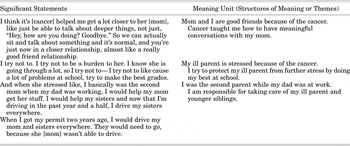
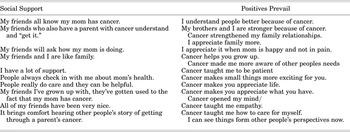
These meaning units were then clustered or categorized into themes. The researcher uncovered common threads or concepts that linked participant experiences together to create these themes, which were again reduced by removing overlapping or repetitive statements. The themes were validated by checking them against the complete transcriptions, making sure they were either explicitly expressed or compatible. The reliability of the themes were assessed through peer checking using a panel of experts on qualitative methods (Padgett, Reference Padgett1998; Rolfe, Reference Rolfe2006). In hermeneutic phenomenology, validity refers to the fact there are no internal contradictions within a study (Armour et al., Reference Armour, Rivaux and Bell2009). Significant statements were extracted from the 10 verbatim transcripts. Table 1 includes selected examples of these statements and their formulated meaning units. Arranging these meaning units into clusters resulted in the four basic themes. Table 2 contains two examples of theme clusters that emerged from their meaning units. These validated themes were labeled as the core of the experience and were employed to develop textural descriptions. The textural descriptions are considered “what” the participants experienced with the phenomena and include verbatim examples from the transcribed interviews (Creswell, Reference Creswell2007). Next, the structural descriptions or “how” the experience happened was formed by reflecting on the setting and context in which the phenomenon was experienced (Creswell, Reference Creswell2007). Finally, from the integration of the textural and structural descriptions into the meanings and themes of the experience, the essence of the phenomena was constructed. This final synthesis of the data and creation of a composite description of the lived experience for the group as a whole was the ultimate goal of this phenomenological study.
Selected Examples of Significant Statement and Related Meaning Units

Example of two theme clusters and their associated meaning units

Adolescent interview schedule

RESULTS
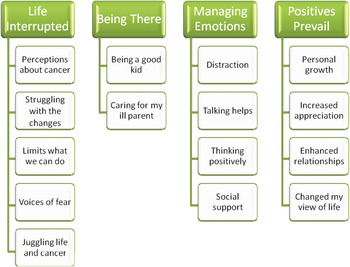
There were 4 essential themes and 16 subthemes about adolescents living with a parent's advanced cancer that emerged from our analysis: “life interrupted,” “being there,” “managing emotions,” and “positives prevail.” All themes and subthemes are discussed below and summarized in Figure 1.
(Color online) Themes and subthemes.

Theme 1: Life Interrupted
The majority of these adolescents describe “growing up” with cancer and explain how because “we have dealt with it for so long (…) it seems normal.” Cancer interrupted their family's life trajectory, and things would never be the same. Although they describe observations of the considerable effects of cancer on their family, they also treat the disease as an inevitable part of their lives—an interruption they now “just have to deal with.” There was a certain amount of uncertainty and lack of control weaved into their present lives and how they viewed the future.
1.1. Perceptions About Cancer
The subjects reported having a firm grasp of what their parent's cancer was, often citing the correct medical terminology of the diagnosis, treatments, tests, and medications. However, on further inquiry, many misconceptions and unanswered questions arose. The most common was the cause of their parent's cancer. Many responded with vague answers such as, “It's just one of those things you get, like, you know, you catch a cold,” as reflected in the following quotes:
I don't know—just the disease got in her somehow from some exposure. She got to something. It could be anything that causes cancer. P2
I mean, there's so many myths and so many different things—like some people say it's air pollution; some people say it just shows up. In my opinion, I really, I just like to think that it just showed up. P9
Others had firm theories about the causes of their parent's cancer, such as not breastfeeding, using cellphones, genetics, or air pollution. Regardless, when asked they all had lingering questions that remained unanswered, such as “Why is it there?” “How do we get rid of it?” “Will it ever go away?” “What is actually happening in her body?” “How do the drugs work?” “Genetics is so broad (…) I still don't know what actually causes it.”
1.2. Struggling with the Changes
Participants shared observations of the effects of the cancer experience on their family members, particularly on their relationship with their parents. They described a limited availability of parents, strained relationships, and physical and emotional changes in their ill parent.
Parents Unavailable
The demands of the illness caused both the ill and well parent to be routinely unavailable to their children. They claimed that such requests as help with homework or play were ignored because, “One parent was always helping the other parent out with whatever was going on.” This led to frustrations for some children, noting they did “not have a soccer mom that could drive you around.” Regardless of their reaction to the changes, they all noticed this shift in caregiving roles once cancer became part of their family's reality, as reflected in the following quotes:
Mom used to drive us to school every morning. Then she would like pack our lunches. And then we would start having to have like people drive us to school and like someone would bring us dinners, and it was like just totally different. My mom and dad would be gone from the house a lot at nights when we would get home, and we would have someone like spend the night with us. P8
It's harder. Like, you don't have a mom that like can do as much. She can't like do as much for you, so you kind of have to fend for yourself, and like there's a lot of parents that like make meals all the time. P5
I don't have a car, so like if [mom's] out somewhere with dad at the doctor's and I can't— I can't go anywhere stranded at home, and it can be tough when you know parents were gone. I mean (…) stuff like sports, your parents always, can't always come. P1
Some adolescents described a shift in their relationship with their ill parent that seemed unavoidable because of the progression of the disease, the side effects of medication, and the new time constraints. One 16 year old described how his father's brain tumor impacted their relationship:
I mean, we're pretty distant now because [dad's] not the same person, obviously. He's really confused, and you know, it's like, you can't really have a serious conversation with him because he can't always grasp it, so it's kind of tough. P1
Mom works full time, and she also has to deal with cancer, so she can't do a lot of stuff, so that kind of, sometimes it can turn into like arguments, and sometimes you don't have enough time with her to just like talk about like how her days were, like how our life is, and that can be hard sometimes. You lose, like touch. P5
Changes in Ill Parent
Adolescents shared all the physical and emotional changes brought about by the cancer and its treatment on their parent. They seemed acutely aware of the pain their parents were experiencing, describing symptoms such as fatigue (“She's exhausted from it [the cancer],” “She can't sleep, but she lays in bed a lot,” and “You can tell she is sick (…) she has dark circles around her eyes”). They also described such other side effects as being confused, losing hair, loss of memory, headaches, trouble speaking, difficulty moving around, and pain. As one teen stated, “[the hardest part] is like seeing her in pain, and there is nothing you can do to help her.” In addition, there were emotional and personality changes in the parents that that came about because of the medications and surgeries. According to one adolescent, “I think she gets mad easily. I think it's like the pills or something. She just acts more mean,” as seen in the following statements:
I mean, my dad's changed a lot, you know. After each surgery, he's becoming— obviously, you're going to be a different person. I mean, he's kind of gone through a lot of different moods, I guess. And, you know, and he's been— He's just changed. He's not the same person he was that I remember when I was six. P1
[Mom] not understanding jokes at all or sarcasm, so when I try to be sarcastic and she thinks it's mean and she gets all mad, but that kind of stuff, small things. P10
1.3. Limits What We Can Do
Participants also reported that cancer limited what they could do together as a family, the time spent with friends, time spent on school work, and extracurricular activities. They described having to “sacrifice doing something fun to stay home and help,” as these quotations indicate:
If I wanted to go over to see friends, but my mom wasn't feeling well, I had to stay here with her. I couldn't go, and all my friends out doing stuff, and I had to stay here with my mom. P1
I had to help out, like especially around the time of her surgeries, like if she wanted company I'd have to not do what I had to do for school, and then I sometimes skip dance classes too (…) because my dad still had his job too (…) and that was the harder part. P9
Some felt that family resources such as time and money were spent on the illness rather than on the children:
Maybe it's limited what we can do, like sometimes I can't go to certain places because she has to have an appointment to go to the doctors, so I think that's the only one, like it limits me on what I can do. P4
Because of all the doctor bills, I mean, we're not that financially well off, and I mean it's kind of frustrating going to my school. Everyone has got a lot of money, and we don't have any money because of my dad's expensive bills. So I mean that can be pretty frustrating. P1
At times, their activities were limited because of fears of infection while the ill parent was immunosuppressed:
I don't know why the real reason is, but she thinks that I'll probably get sick, and I couldn't go to any one of those things [activities with friends], because I could get sick, and my mom can't— couldn't like risk getting sick, too, with like chemotherapy. P6
1.4. Voices of Fear
All of our adolescents reported a certain amount of worry and anxiety related to their cancer experience. These included fear of their parent's health deteriorating as well as concerns for their own health. Some reflected on their fear of separation: “When I was really young, it was hard for me to be away from my mom because I was always afraid something would happen to her.” They described how it was “hard (…) living with that uncertainty,” about what the future would hold and an awareness that it was beyond their control. They described the cancer as “unpredictable and vicious, like everything else is going great in your life (…), but you have that one thing hanging over your head.” Another elaborated thus:
That she would die like just all of a sudden or just I don't know how far she is from death, like it's just— It's just the question of whether she would— like how far away she is from it [death]. It seems like it would be easier like it's harder to live with that hanging over your head than just to lose someone all of a sudden. P5
Some reported how the experimental cancer treatments concerned them. They talked about how their parent tried one drug after another: “I don't believe that, because I know that can't keep going on forever.” Another offered this:
We're so in the dark with science and cancer. There is not really a lot of things, I mean, with my dad they're just experimenting in everything, like doctor, like, oh, let's try this, and we can't give you anymore surgeries, but we'll try this. So I mean it's just sad and they— I don't know if they have a full conscious realization of what's going on all the time, you know. They're doing their best. P1
Throughout these young people's lives, they have had cancer lurking in the background, and they felt that the cancer “tried to be the thing that's going to stop your happiness almost all at once, but it doesn't.” But this unease is never absent for long according to one teen:
Well, just like over time, I just don't even think about [the cancer] after a while because it just feels so normal (…), and then what's hard is when I started to think about it again because something like— It feels like everything is going fine like and normal, and then all of a sudden cancer jumps out in your face. P5
The future remains uncertain for these young people as they share concerns they have for their own health: “Am I prone to it [cancer]?” or “Is there a recessive gene in me?” and wondering, “Is the overall long-term stress, what's it going to end up doing to me later on?” Another offered,
I know that our family has a long line of history of, like heart attacks, (…) and when I hear that, then I start to think that, maybe our family also has a long history with the cancer that I don't know about, and maybe like one of us could get it. P3
1.5. Juggling Life and Cancer
Some participants described the added pressure cancer placed on their lives and “the stress [placed] on the whole family.” Cancer was “a really trying thing” that made it hard to “just relax and live in the moment.” They reported the added responsibilities as one of the things that made cancer challenging, as the next statements exemplify:
The difficulty between like everyday issues and then like comparing it with cancer and stuff, I guess it's— it's hard to like get things done everyday when you still have that kind of in the back of your mind, kind of juggling like life and then the cancer. P7
It's harder as a teenager, because you know more stuff about life than when you are a kid. You basically have like no responsibilities and no worries. But then when you get to being a teenager, you have more responsibilities and more stuff to worry about. P2
Several adolescents felt that their schoolwork was affected by their parent's cancer as well:
Some of the things that [mom] makes us do— If we have to clean, then I worry more about cleaning than like the assignments I have to do for school. P4
I remember at school last year, it was really hard to get like all my assignments, you know, in on time. P6
Just like the emotions they can go through. I used to worry more about her [mom] than like my grades. P4
Theme 2: Being There
It was very important for these adolescents to believe they were contributing to their family's well-being. They had a desire to help relieve the stress and burden on their parents and willingly took on extra responsibilities by filling practical and emotional roles.
2.1. Being a “Good Kid”
The adolescents described doing their best to “try not to be a burden” and to “try not to cause a lot of problems.” They described helping out by “not causing a lot of drama in the house” and “just needing to leave her alone basically” and “let her be.” They described things like “not complaining” and “trying to make the best grades at school” as the best ways to care for their ill parent. One adolescent reflected on why his behavior was so important:
I'm less defiant, I guess. like I don't want— like, there are a lot of people that don't care about their parents, but like I don't want to hurt my mom because I'm afraid that she could be gone anytime so I don't want to mess up our relationship, so I'm very careful about that. P5
One teen described his role in the house as follows:
Mostly you just make sure [mom] is not stressed, make sure if there is anything that might bother her is messed up or you just fix it, so she's not stressed. That's really the main thing. P9
2.2. Caring for My Family
Some also commented on the direct caregiving they provided for an ill parent. Older teens especially described a great deal of responsibility for their parent's care: “taking her to urgent care when it [the pain] gets really bad” or “giving her shots for the really bad headaches.” Another commented,
She's a lot more independent now and up a lot more, but when she was in bed probably the first four years after surgery, it was me taking care of my mom and sisters. P9
According to another adolescent, the cancer
makes it hard for her [mom] sometimes, like if she has to think things through a little bit more before doing things. She has a hard time remembering a lot of things, so me and my brother just kind of have to help her through a lot of stuff. P10
In addition to caregiving, adolescents explained all the household responsibilities they acquired as a result of the cancer. One reported,
I was kind of the second parent, the second mom. My dad was there still but— So taking care of everyone and just making sure the house is running okay, with help on laundry, help with anything they really needed to be done, feed the dogs, or just the small things [so that they could] de-stress [mom]. P9
Another offered this:
I just kind of help out with anything that like anyone needs help with, kind of like, if there is something that needs to be done that anyone else can't do, then I kind of have to fill in and do that. P7
Theme 3: Managing My Emotions
Adolescents described a variety of coping strategies employed to deal with the emotions and frustrations brought about by their parent's advanced cancer. Many employed several different types of strategies to manage their emotions at different times. These included: distraction, talking about it, having a positive outlook, spending time with friends and family, and using existing spiritual and social support systems.
3.1. Distraction
All teens described using a form of distraction at some point to help “get my mind off of [the cancer].” Another stated, “I like to watch funny shows on Netflix or like go work out or swim or something, hang out with friends, you know,” and “I just go sit down and play my trumpet—anything, just to get my mind off of it.” Some described reading, music, sports, and “focusing on different things” to help them manage their emotions.
3.2. Talking Helps
Talking about their frustrations or sadness was also a common way these teens coped: “Just talking it out is always really good.” “I think it [talking] like releases the stress or like the thoughts that are in my head.” “I will talk to my brother about it [cancer] sometimes, just kind of like, see if we are going through the same things mentally.”
Another aspect of this subtheme was the need for some to explain why parents' attempts to “protect them” by not sharing information about the cancer was detrimental. Many reported how open communication about the cancer was essential to their continued ability to cope. They took the time to explain how not being told about the cancer caused more distress in the end. As one teen explained,
I mean, it's no use hiding it because you figure out, like, if your parents don't tell me, tell you and you, look at your dad and he's stumbling around. You ask what happened? Then they will have to tell you, and then you cry even more. But if they tell you straight up, you like cry, and then you just get on with it. P2
Another shared how he felt when his mother tried to protect him from information about her cancer:
It's hard to ask her because it seems like she just dismisses me really quickly, because she doesn't want it to hurt me, but it's just like the wondering about it feels like it hurts me more than just knowing what's actually going on. P5
3.3. Thinking Positively
Some suggested that having a positive attitude is vital to managing the cancer experience. While recognizing that their situations were difficult, some teens found it beneficial to avoid negative thoughts: “Cancer makes it really hard to be happy with my dad's condition. But I have to make myself be happy and like, yeah, just be happy.” Another expressed it this way:
I mean, [the cancer is] kind of frustrating, but I mean just adding you gotta think positively (…) This isn't the end of the world. I mean, it's sad, but you know, we're going to get through it. P2
Some shared how they learned their positive attitude from their parents: “I mean, I have seen how positive they're about it, and it's helped me learn a lot about that.” Another reported how his family's faith helped keep him think positively:
My mom has always taught me and my brothers, God does things for a reason, and I believe that. So if she ever does go there, I know that it was for a good reason. P3
3.4. Social Support
Support from friends, family, church, and school was another vital element of adolescents' well-being. Most described having people in their lives who cared deeply for them and understood the challenges they faced. This is illustrated in the following statements:
I feel a lot more comfortable talking with my friends, especially who understand and I can trust. P3
I did have a lot of support, and people were always asking me how things are going with my mom. I didn't really think people cared, and I thought people were just really narcissistic, but when I let people know that my mom had cancer, then that kind of proved my theory wrong, and I learned that people really do care and that they can be helpful. P6
Many of these adolescents' friends were unique in that they also had a parent with cancer. They reported how “They can kind of comfort you, like they made it through, and you can do it, too.” These distinct friendships clearly offered a considerable amount of support:
I have many friends whose parents also have had cancer, and then we share information on many things— (…) It's like, it's totally different because we can relate. P9
I think like me and my friends, we pretty much become a family together because their parents have cancer. So we are able to talk about like things that bother us, and so we built like a relationship with my friends. P4
Theme 4: Positives Prevail
All the young people interviewed were able to describe positive aspects of their cancer experience and how the cancer experience had transformed them. Most spontaneously reported incidences of growth, appreciation, stronger relationships, and lessons learned by their journey through their parent's advanced cancer. These instances of optimism and encouraging remarks were uncovered throughout the data and came across as a remarkable aspect of their adolescent experience.
4.1. Personal Growth
Some expressed instances when they felt the cancer had “made the three of us [brothers] stronger.” They felt they had become more mature and now had an enhanced sense of independence because of their parent's cancer, as the following remarks indicate:
You should just know that if you have a parent with cancer, like the main thing I've said 100 times, you will learn patience. I think that's the main thing: patience and responsibility. P9
[Cancer]—it has kind of taught me a lot of things that I mentioned before, like how to take care of myself. P7
It totally changed how I was younger, like all adults always told me, I was more mature than any kid. I didn't really believe it. I still don't sometimes. Like, “You're so mature!” “I don't think so.” But adults think I am, and I guess I'm able to take responsibility for things and be a leader. P9
I mean I've had to (…) grow up a little faster, you know, so I'd be there for my brother. P1
I'm more mature than I would have been because I, at a young age, I learned how to like take care of my mom more and, like, take on responsibilities most younger kids wouldn't have. P8
Another aspect of this positive growth was the fact that some became more sensitive to other people's feelings and needs, as illustrated by the following:
I guess [the cancer] has just made me kind of realize, like everyone else— like different needs of different people, like I just kind of have to pay more attention to that kind of stuff. (…) You don't understand people until you get to know them and understand what they have done, what they have gone through. P7
4.2. Increased Appreciation
Some described themselves as different from their peers in terms of their ability to appreciate life and be “thankful for what we have.” Several teens spoke of this sense of appreciation:
I would say [cancer is] more of a challenge, but it like helps you kind of grow up more and appreciate everything you have and appreciate life, and kind of changes the way you look at things and makes like some of the smaller things more exciting for you. P8
[Cancer] made me a lot more aware of like so many kids take their parents for granted, and like its hard for me to do that because I know that she could be gone like any day. P5
I go to family camp, so getting to go with my mom and see her happy, it would make me really happy, because she wasn't in pain, but other people see their moms happy like every day, so it's like seeing her happy would make me happy. P10
4.3. Enhanced Relationships
Some reflected on their family's close relationships and how experiencing an obstacle such as cancer allowed them to strengthen their bonds:
[Mom and I have] become like really good friends now. It's really good (…) You just trust each other. P1
Like I said, like we built like a stronger relationship. Like I notice with other people, they are not very close to their parents, and they don't really talk a lot to their parents, but we all talk to our mom a lot. P4
I think it's helped me get a lot closer to [mom], like just be able to talk about deeper things not just, “Hey, how are you doing?” “Good bye.” So we can actually sit and talk about something, and it's normal, and you're just now in closer relationship almost like a really good friend relationship. P10
Some adolescents also reflected on their relationships outside the family: “I feel like more loved by more families because of [the cancer], and I got closer to a lot of other families,” and “I think me and my friends have gotten closer, kind of like with my family.”
4.4. Changed My View of Life
Many adolescents explained how their parent's cancer provided them with a fresh outlook on life and a perspective that is more optimistic. They felt that the cancer had “opened me up to talk to people,” “opened my mind,” and “makes me look at life from a different angle, being more an optimist.” Cancer allowed them to “totally look at life in a different way,” as one reported:
I feel like my life could have been a lot different. I feel like I could have cared less about things or been really impatient, but after going through all that I'm really patient with everybody. P9
The Lived Experience of Adolescents Who Have a Parent with Advanced Cancer
The four themes—“life interrupted,” “being there,” “managing my emotions,” and “positives prevail”—constitute the essence of these adolescents' experience with their parent's advanced cancer. Overall, they report living full lives and using positive coping skills to make meaning of their family's cancer experience. They shared many stories of how their “normal” lives were interrupted and forever changed by their parent's cancer diagnosis. Their family life had to bear a steady amount of stress, frustration, fear, anxiety, and uncertainty about the future. They made every attempt to moderate this distress for their family by being there and helping out when needed. Most strived to manage their negative emotions by using multiple coping strategies such as distraction, communication, positive outlook, and peer support. Ultimately, they were able to integrate their parent's cancer into their lives, find meaning in the experience, and create value from a devastating life situation. The experience of growing up alongside a parent with advanced cancer helped shape these emerging adults into strong and compassionate individuals with an increased sense of appreciation and gratitude for not only their personal relationships but for their lives as a whole.
DISCUSSION
These finding represent the essence of the adolescent's experience of living with a parent with advanced cancer. The results of this study underscore the significant impact an advanced cancer diagnosis can have on a family unit. Moreover, they provide insight into factors that can play a role in adolescents' well-being.
These results are consistent with previous research which found that open communication and the parent–child relationship are important factors in the emotional and behavioral adjustment of children to a parent's advanced cancer (Kennedy & Lloyd-Williams, Reference Kennedy and Lloyd-Williams2009; Sigal et al., Reference Sigal, Perry and Robbins2003). This study also supported previous findings that adolescents might experience high levels of stress and anxiety when confronted with a parent's terminal cancer (Rainville et al., Reference Rainville, Dumont and Simard2012; Siegel et al., Reference Siegel, Karus and Raveis1996). Furthermore, adolescents reported increased household responsibilities and a lack of parental support for daily tasks, similar to previous studies (Christ et al., Reference Christ, Siegel and Sperber1994; Kennedy & Lloyd-Williams, Reference Kennedy and Lloyd-Williams2009). Adolescents in our study reported significant upheaval and stress in their lives as a result of their parent's cancer, yet they concurrently described strategies used to deal with these challenges. The coping strategies mirrored those found in the literature and included distraction, communication about the cancer, social support from peers, optimism, and a search for meaning (Christ et al., Reference Christ, Siegel and Sperber1994; Kennedy & Lloyd-Williams, Reference Kennedy and Lloyd-Williams2009; Sheehan & Draucker, Reference Sheehan and Draucker2011; Thastum et al., Reference Thastum, Johansen and Gubba2008). However, our study adds further insight into the mechanisms by which these strategies are effective. For example, adolescents in our study were able to articulate how a lack of communication about the cancer increased their distress: “The wondering (…) hurts me more than just knowing what's actually going on.” Our study also extends previous findings that a parent's metastasized cancer can have positive consequences in the form of less disruptive behavior by the adolescent (Sigal et al., Reference Sigal, Perry and Robbins2003). The adolescents interviewed were able to articulate their efforts to “be a good kid” by not causing problems or complaining, and doing well in school as a way to decrease their parent's stress related to the cancer.
Having a parent with advanced cancer is especially challenging for adolescents and in some ways subverts normal developmental tasks. Adolescents are typically developing their sense of self and striving for increased autonomy from parents (Lewis, Reference Lewis2007; Ohannessian, Reference Ohannessian2007). In addition, they are cognitively better able to understand the long-term consequences of a diagnosis of advanced cancer (Spira & Kenemore, Reference Spira and Kenemore2000). Many studies have focused on the negative impact of a parent's cancer diagnosis on the adolescent (Grabiak et al., Reference Grabiak, Bender and Puskar2007; Huizinga et al., Reference Huizinga, Visser and van der Graaf2011; Visser et al., Reference Visser, Huizinga and van der Graaf2004). Ours offers a description of the experience and reveals how these adolescents simultaneously face uncertainty and fear and at the same time identify areas of positive growth as a result of their parent's cancer. Furthermore, these findings indicate that adolescents are able to find meaning in these difficult circumstances, which helps shape their growing identity. The theme of “positives prevail” is closely aligned with other findings on personal growth and the positives gained from the experience of a parent's life-threatening illness (Kissil et al., Reference Kissil, Niño and Jacobs2010; Wong, Cavanaugh, MacLeamy, Sojourner-Nelson & Koopman, 2009). These outcomes have been discussed in the literature as posttraumatic growth and take place when children are able to thrive despite the challenges they face during their cancer experience (Arpawong et al., Reference Arpawong, Oland and Milam2013; Wong et al., Reference Wong, Cavanaugh and MacLeamy2009). The current study suggests that the effect of “growing up” with cancer as an almost constant part of childhood has allowed these adolescents to achieve a certain level of posttraumatic growth while in the midst of trauma.
Our findings reinforce previous results that suggest the importance of family and peer support, a positive attitude, and open communication when a family is coping with advanced parental cancer. Understanding how adolescents gain strength from their relationships with family and peers offers healthcare professionals an opportunity to have services and strategies in place to foster such relationships, encouraging parents to initiate conversations about how their children are coping with the illness as well as providing support and guidance about how to handle these difficult conversations. Moreover, healthcare professionals can offer adolescents a way to connect informally with peers at school, online, or through other avenues to allow opportunities for them to form relationships with peers who are facing parental cancer.
Healthcare professionals should assist adolescents in identifying the impact of their experience of their parent's cancer so that they can begin to formulate meaning. The ability to find benefits in a traumatic experience has been positively related to resilience and growth and negatively related to depressive symptoms (Fredrickson et al., Reference Fredrickson, Tugade and Waugh2003). Healthcare professionals and researchers can draw on these results to inform practice and help develop interventions that focus on enhancing adolescents' ability to make meaning and appreciate the positivity of life while coping with a parent's serious illness. HCPs can only begin to develop programs that meet the needs of families facing advanced cancer if more studies identify the needs and concerns unique to this population. Longitudinal studies are required that utilize quantitative and qualitative methods to assess the causal and long-term effects of advanced parental cancer on children's adjustment over time. In addition, studies should seek to assess adolescents' quality of life and not just levels of clinical psychopathology. Finally, existing services for children and families who have a parent with cancer must evaluate their interventions using comparison groups and validated measures to assess the efficacy of these programs. Although a parent's advanced cancer diagnosis can be both a devastating and traumatic experience for adolescents, the current study suggests that the experience might also have the potential of creating opportunities for growth and well-being.
FUNDING
Funding was provided in part by a dean's postdoctoral fellowship from the University of Texas at Austin's School of Social Work awarded to the author.
DISCLOSURE STATEMENT
The author states that there are no conflicts of interest to declare.
ACKNOWLEDGMENTS
I thank Barbara Jones, Francis M. Lewis, V. Lynn Tankersley, Paula Gerstenblatt, and Diane McDaniel Rhodes for their invaluable contributions to this study. In addition, I thank the adolescents who had the courage to share their stories with us. We are forever grateful for their selflessness.