


I. Introduction: The Underrepresentation of Women in Philosophy
The question “Why are there so few women in philosophy?” has recently attracted a lot of attention in the literature (for example, Reference AntonyAntony 2012; Reference Hutchison and JenkinsHutchison and Jenkins 2013; Reference PapineauPapineau 2015; Reference Ratcliffe and ShawRatcliffe and Shaw 2015). The relatively low number of women in philosophy has been a great source of puzzlement, mainly because women are either equally or overrepresented in almost every field of study within the humanities with the exception of philosophy, which still remains—as all empirical findings show—a male‐dominated field.
Let us review briefly some of the most widely discussed findings regarding women's representation in philosophy. In a relatively recent study, Molly Paxton, Carrie Figdor, and Valerie Tiberius investigated the representation of women across academic levels in US philosophy departments (Reference Paxton, Figdor and TiberiusPaxton, Fidgor, and Tiberius 2012). Their findings, from a sample of fifty‐six institutions, suggested that there is a decline in the proportion of women in philosophy as one moves up the academic hierarchy, with the most significant drop occurring between introductory undergraduate courses (where women made up 43% of the student population) and majoring in philosophy (only 35% of philosophy majors in the study were women). Evidence from UK philosophy departments revealed a similar decline: women constitute 46% of undergraduate students, 37% of Master's students, 31% of PhD students, and 24% of permanent academic staff, with the most significant drop‐off between the undergraduate and Master's levels (Reference Beebee and SaulBeebee and Saul 2011). In Australia, data obtained by the Australasian Association of Philosophy indicated that although women make up more than 60% of enrollments in undergraduate philosophy courses, they comprise only 44% of philosophy major completions, and 42% of doctorate completions (Reference GoddardGoddard 2008).
The above research findings clearly suggest that there is a gender gap in philosophy. However, can these findings regarding women's (under)representation in philosophy be generalized, and more important, are they applicable to non‐Anglophone philosophy? To put it differently, is the lack of women in philosophy a universal phenomenon or is it just a problem unique to Anglophone philosophy?Footnote 1 In order to address this question, more data are needed, first, regarding the representation of women in philosophy in non‐Anglophone countries (for example, in continental Europe), and second, to establish if, and more important, when women in non‐Anglophone countries leave philosophy. By broadening the scope of inquiry beyond Anglophone philosophy, and by comparing the situation in Anglophone philosophy departments with the situation in non‐Anglophone philosophy departments, we can gain a better understanding of (both the nature and the extent of) the problem, which might lead in turn to new—and perhaps more effective—solutions in order to address it.
With the above end in view, within the context of a broader research project investigating the sociological and academic profile of philosophy students in Greece, we decided to conduct a study focusing specifically on this issue, namely the representation of women in Greek departments of philosophy. The two questions that guided our research were:
1 What is the gender distribution of philosophy students and philosophy faculty members in Greek departments of philosophy?
1 At which academic level do women in Greece leave philosophy?
Our aim in this paper is to present and interpret the empirical findings of this study, thereby contributing to the ongoing discussion regarding women's representation in philosophy.
II. Method
Preliminary research indicated that there are six departments in Greece where students can pursue undergraduate and graduate studies in philosophy. These departments—we will call them “philosophy departments” for reasons of convenience throughout the paper—are:
The Department of Philosophy, Education, and Psychology at the National and Kapodistrian University of Athens (UoA)
The Department of Philosophy, Education, and Psychology at the University of Ioannina (UoI)
The Department of Philosophy and Education at the Aristotle University of Thessaloniki (AUTH)
The Department of Philosophy and Social Studies at the University of Crete (UoC)
The Department of Philosophy and History of Science at the National and Kapodistrian University of Athens (UoA)
The Department of Philosophy at the University of Patras (UPatras)
It is worth noting that although all of the abovementioned departments offer graduate degrees in philosophy, they differ in the type of undergraduate degrees that they offer. More specifically, the Department of Philosophy (UPatras) is the only department in Greece where philosophy is (almost) exclusively studied throughout the four‐year undergraduate program leading to a bachelor's degree in philosophy. The other five departments offer four‐year undergraduate programs that can lead to a bachelor's degree with a major in philosophy, if undergraduate students select philosophy—instead of other subjects (for example, psychology, education, social studies, history of science)—as their main subject in the second (or the third) year of the program.Footnote 2
Once we had identified the departments in Greece that offer undergraduate and graduate degrees in philosophy, in October 2015 we contacted the registrars' offices as well as the heads of philosophy departments informing them about our research, and requesting the following information: (a) the total number of philosophy students in their undergraduate program (that is, the number of undergraduate students who were pursuing philosophy as their main subject) and their distribution by gender, (b) the total number of students in their philosophy graduate program, and their distribution by gender, (c) the total number of philosophy faculty members, and their distribution by gender. Since for the purposes of our study we needed only demographic data (that is, number of students/faculty members and their gender distribution), students' as well as faculty members' privacy was protected.
Within three months, that is, by December 2015, all departments had responded positively to our request by sending the information we had asked for. Consequently, the findings presented in the following section are based on a complete enumeration of the individuals studying or teaching philosophy in Greek philosophy departments in the academic year 2015–16.
III. Findings
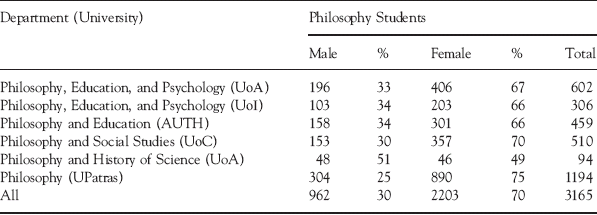
According to the data we collected, in the academic year 2015–16 there were 3,165 undergraduate and graduate philosophy students in Greek philosophy departments, with 2,203 of them (or 70%) female and 962 of them (or 30%) male. As philosophy students we defined all students enrolled in Greek philosophy departments who were pursuing philosophy as their main subject, namely the undergraduate and graduate students enrolled in the Department of Philosophy (UPatras), as well as the philosophy majors and philosophy graduate students enrolled in the other five departments of philosophy (undergraduate students comprised 80% of the total number of philosophy students in the study, and graduate students comprised 20%). Table 1 shows in detail the gender distribution of undergraduate and graduate philosophy students in each of the six departments of philosophy in the academic year 2015–16.
Gender distribution of undergraduate and graduate philosophy students by department (academic year 2015–16). UoA = National and Kapodistrian University of Athens, UoI = University of Ioannina, AUTH = Aristotle University of Thessaloniki, UoC = University of Crete, UPatras = University of Patras
| Department (University) | Philosophy Students | ||||
| Male | % | Female | % | Total | |
| Philosophy, Education, and Psychology (UοΑ) | 196 | 33 | 406 | 67 | 602 |
| Philosophy, Education, and Psychology (UοΙ) | 103 | 34 | 203 | 66 | 306 |
| Philosophy and Education (AUTH) | 158 | 34 | 301 | 66 | 459 |
| Philosophy and Social Studies (UοC) | 153 | 30 | 357 | 70 | 510 |
| Philosophy and History of Science (UoA) | 48 | 51 | 46 | 49 | 94 |
| Philosophy (UPatras) | 304 | 25 | 890 | 75 | 1194 |
| All | 962 | 30 | 2203 | 70 | 3165 |
Contrary to previous findings in the literature regarding the representation of female students in (Anglophone) philosophy, the data listed in Table 1 indicate that in Greece, female philosophy students outnumber their male counterparts in nearly all departments of philosophy.Footnote 3 For every male student pursuing studies in philosophy in the academic year 2015–16, there were, on average, 2.3 female students.
To determine whether gender (male, female) was associated with field of study (philosophy, other), we performed a chi‐square test of independence, comparing the gender distribution of philosophy students with the gender distribution of all students enrolled at Greek universities who were pursuing studies in other academic fields.Footnote 4 The results indicated that gender and field of study were related, X² (1, N = 257194) = 224.3, p <.001. There were significantly more female than male students in philosophy, compared to other academic fields as a whole.Footnote 5
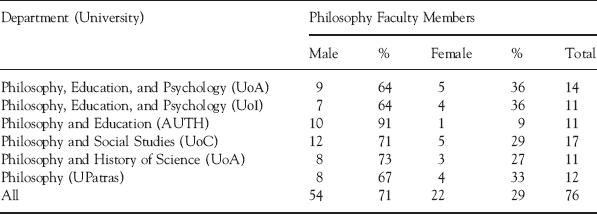
The situation, however, was completely different at the professional level. As Table 2 shows, in the academic year 2015–16 there were seventy‐six philosophy instructors in Greek philosophy departments, with fifty‐four (or 71%) male and only twenty‐two (or 29%) female.
Gender distribution of philosophy faculty members in Greek departments of philosophy (academic year 2015–16). UoA = National and Kapodistrian University of Athens, UoI = University of Ioannina, AUTH = Aristotle University of Thessaloniki, UoC = University of Crete, UPatras = University of Patras
| Department (University) | Philosophy Faculty Members | ||||
| Male | % | Female | % | Total | |
| Philosophy, Education, and Psychology (UοΑ) | 9 | 64 | 5 | 36 | 14 |
| Philosophy, Education, and Psychology (UοΙ) | 7 | 64 | 4 | 36 | 11 |
| Philosophy and Education (AUTH) | 10 | 91 | 1 | 9 | 11 |
| Philosophy and Social Studies (UοC) | 12 | 71 | 5 | 29 | 17 |
| Philosophy and History of Science (UoA) | 8 | 73 | 3 | 27 | 11 |
| Philosophy (UPatras) | 8 | 67 | 4 | 33 | 12 |
| All | 54 | 71 | 22 | 29 | 76 |
In order to assess whether there was a statistically significant relationship between the gender of faculty members (male, female) and their academic discipline (philosophy, other humanities), we used a chi‐square test of independence, comparing the gender distribution of faculty members in philosophy with the gender distribution of faculty members in all the other humanities disciplines.Footnote 6 The results indicated that the two variables were related, X² (1, N = 845) = 12.1, p < .001. There were significantly fewer female than male faculty members in philosophy, compared to other humanities disciplines as a whole.
Nevertheless, both the fact that women were underrepresented among philosophy faculty members and the fact that they comprised, on average, only 29% of academic philosophers came as no surprise. These findings were in fact consistent with the findings of all previous studies, which indicated that the proportion of female faculty members in (Anglophone) philosophy ranges between 20% and 30% (Reference Bishop, Beebee, Goddard, Rini, Hutchison and JenkinsBishop et al. 2013). Apparently, Greece is not an exception in this regard.
To sum up, based on the data we collected, the vast majority of philosophy students in Greece are female, whereas the vast majority of philosophy faculty members are male. But how can women make up 70% of philosophy students and only 29% of philosophy faculty members? Is the drop in the participation of women in philosophy something that occurs suddenly at the professional level, or is it a piecemeal process occurring as women move up the academic ladder?
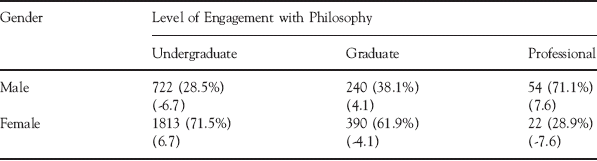
To address these questions, we examined the proportion of women at three different levels of engagement with philosophy, namely the undergraduate, the graduate, and the professional level. The results suggested that the proportion of women decreases as they move from one level to the next. More specifically, women comprised, on average, 72% of philosophy undergraduate students, 62% of philosophy graduate students, and 29% of philosophy faculty. A contingency table analysis of gender (male, female) with level of engagement with philosophy (undergraduate, graduate, professional) revealed a statistically significant relationship between the two variables, X² (2, N = 3241) = 78.7, p <.001. Examination of adjusted standardized residuals indicated that there were significantly more women than expected among philosophy undergraduate students, and significantly fewer women than expected among philosophy graduate students and philosophy faculty members (see Table 3).
Cross‐tabulation of Gender and Level of Engagement with Philosophy (academic year 2015–16). Χ² = 78.7, df = 2. Column percentages appear in parentheses next to group frequencies. Adjusted standardized residuals appear in parentheses below group frequencies. *p < .001
| Gender | Level of Engagement with Philosophy | ||
| Undergraduate | Graduate | Professional | |
| Male | 722 (28.5%) (‐6.7) | 240 (38.1%) (4.1) | 54 (71.1%) (7.6) |
| Female | 1813 (71.5%) (6.7) | 390 (61.9%) (‐4.1) | 22 (28.9%) (‐7.6) |
To sum up, despite the significant drop in the proportion of women as they move up the academic ladder, our data suggest that women in Greece—contrary to women in Anglophone countries—are overrepresented in philosophy at all academic levels, apart from the professional level, where they are strongly outnumbered by their male peers.
IV. Discussion
Until now, given the lack of women in Anglophone philosophy, the discussion regarding the representation of women in philosophy has focused mainly on the causes that might be driving women away from philosophy.Footnote 7 The results of the present study, however, force us to shift attention to the factors that may be motivating women to enter and persist in philosophy. Thus the first question that needs to be addressed is: Why do so many women in Greece pursue (undergraduate and graduate) studies in philosophy?
Furthermore, the findings of the present study force us to rethink the causes of the poor participation of women in philosophy at the faculty level. The underrepresentation of women among philosophy faculty members in Anglophone countries is frequently attributed to the low number of women at lower academic levels. In other words, it has been argued that the underrepresentation of women in (Anglophone) philosophy is a “pipeline problem” that can be fixed by adding more women in the philosophy pipeline. Once gender parity is achieved at lower academic levels (and especially at the undergraduate level), gender disparities at the end of the pipeline, namely the faculty level, will disappear (or so it is assumed). But why are women in Greece underrepresented at the faculty level, given that the majority of (undergraduate and graduate) students in the philosophy pipeline are female? In what follows, we will address each of these “why” questions in turn, starting from the reasons for the overrepresentation of female students in philosophy.
Why Do So Many Women in Greece Pursue Studies in Philosophy?
Women in Greece have always shown a strong preference for the humanities. Regardless of whether there are social reasons or an intrinsic aptitude that pushes them toward these disciplines, the fact remains: women in Greece are more likely to pursue a degree in the humanities than a degree in the so‐called STEM fields (that is, science, technology, engineering, and mathematics). Evidence from the Hellenic Statistical Authority (ELSTAT), over a period of fifteen years indicates that female students represent between 76% and 83% of first‐year undergraduate students in humanities disciplines, but only between 39% and 42% of first‐year undergraduate students in STEM disciplines.Footnote 8 Thus, given that philosophy is included in the humanities, this could explain why female undergraduate students are overrepresented in philosophy in Greece.
It could be objected, however, that this explanation alone is not sufficient. Philosophy may be a humanities discipline, but it is also a discipline that is strongly associated with maleness. For example, Sally Haslanger and Cheshire Calhoun have repeatedly argued that there is a conflict between the schema for “women” and the schema for “philosophy/philosopher” (Reference HaslangerHaslanger 2008; Reference CalhounCalhoun 2009), and Joseph Forgas has shown that in people's minds a philosopher is more likely to be a middle‐aged, bespectacled man than a young woman (Reference ForgasForgas 2011). So, why are young women in Greece more willing than young women in Anglophone countries to pursue studies in philosophy?
The most likely reason is that women in Greece are exposed to philosophy during (both lower and upper) secondary education. More specifically, all students in both private and public high schools in Greece are required to take one introductory course in ancient philosophy (that is, “Anthology of Philosophical Texts”) during lower secondary education, and one course that introduces students to the main areas of philosophy (that is, “Principles of Philosophy”) during upper secondary education. Moreover, senior high‐school students who are interested in pursuing studies in the humanities are also required to take the (more advanced) course “Ancient Greek: Philosophical Logos,” which is featured in the PanHellenic exams for university admission. This course combines philosophy with philology, and introduces students to selected works of Plato (Protagoras and The Republic) and Aristotle (Nicomachean Ethics and Politics) in ancient Greek. Finally, the Greek high‐school curriculum includes two elective philosophy courses offered to high‐school seniors, namely “Philosophical Problems” and “Logic: Theory and Practice.”
But how can the teaching of philosophy at the secondary level make young women in Greece more willing to pursue studies in philosophy? Given that women's first encounter with philosophy in Greece takes place in high‐school classrooms with (usually) female philosophy instructors,Footnote 9 most of the conditions that have been assumed to drive young women in Anglophone countries away from philosophy (for example, lack of familiarity with the subject, majority‐male philosophy experts, lack of female role models, male‐dominated philosophy classrooms, male schema for “philosophy/philosopher,” “chilly” climate, stereotype threat) are less likely to be met.Footnote 10 Consequently, female high‐school students in Greece develop an altogether different perception of philosophy (that is, as a familiar subject that is not unsuitable for—or hostile to—women), so this might be why they are more willing to pursue it in college.
At this point it could be objected that secondary‐level exposure to philosophy may explain why female students in Greece are more willing to study some philosophy in college, but it doesn't actually explain why they decide to major or to pursue graduate studies in philosophy. After all, even if young women in Greece enter college with the perception that philosophy is a familiar and female‐friendly (or at least not antifemale) discipline, doesn't the fact that the vast majority of philosophy experts in academia are male change their perception of the field?
First, we are not sure if the low numbers of women in philosophy at the faculty level alone is enough to alter female students' perception of the field. For example, female students would still perceive philosophy as a familiar subject. In fact, compared to the other subjects that are offered as majors in Greek philosophy departments (for example, psychology, education, social studies, history of science), philosophy is the only one that female students have enough precollege experience in, so they might feel more prepared to major in it. What's more, women are less likely to feel uncomfortable or threatened in environments where there are many women. Thus, given that women constitute the majority of students in Greek philosophy departments, female students might continue to perceive the philosophy classroom as a safe and welcoming intellectual environment, despite the fact that their instructor is in this case (most likely) a male—instead of a female—philosopher. However, even if we assume that female students' perception of philosophy changes gradually once they enter college (and this is a matter that requires further research), our data still indicate that in Greece the majority of students who pursue philosophy as their main subject at both the undergraduate and the graduate levels are female. So why do female students in Greece persist in philosophy, despite the obvious lack of female philosophers in academia? The teaching of philosophy at the secondary level may once again be the reason.
More specifically, studies have shown that women are more likely (a) to major in subjects that they consider useful in terms of getting a job (Reference Dougherty, Baron and MillerDougherty, Baron, and Miller 2015), and (b) to pursue careers in fields where they can have an impact on other people's lives (Reference CalhounCalhoun 2015). In these respects, philosophy may be considered an impractical major and career choice for female students in Anglophone countries. Even if they believed that they could make a difference in other people's lives through teaching philosophy, given the underrepresentation of females among academic philosophers, they might be discouraged by the fact that it would be hard for them either to get a job or to advance in such a male‐dominated environment. In Greece, however, female students may be able—at least in principle—to accomplish both goals by persisting in the field. This is because the teaching of philosophy in Greece is not limited to the (male‐dominated) university domain, but it is also part of (female‐dominated) secondary education. So female students in Greece who consider majoring (and pursuing a teaching career) in philosophy may not be discouraged by the fact that the majority of academic philosophers in Greece are male, because academic teaching is not their only option; they can continue in philosophy and become high‐school instructors.
To sum up, the teaching of philosophy at the secondary level may not only lead to the perception that philosophy is a familiar and female‐friendly (or at least not antifemale) discipline, but also to the perception that it is useful to women for achieving their career goals.Footnote 11 Accordingly, this might explain female students' commitment to philosophy across the educational pipeline. However, if that is the case, how can the decline in the proportion of women between the undergraduate (72%) and the graduate (62%) levels be explained?
Evidence from the Hellenic Statistical Authority suggests that the drop in the proportion of women between the undergraduate and the graduate levels is neither unique to philosophy nor more severe in philosophy compared to the other humanities disciplines in Greece (that is, Greek language, foreign languages, history and archaeology, theology). For example, in the academic year 2015–16, namely the year we conducted our study, women comprised 76% of all undergraduate students enrolled in the other humanities disciplines (ELSTAT 2015a), but they comprised 59% of all graduate students (ELSTAT 2015b). So, why do some women in all humanities disciplines drop out of the pipeline once they complete their bachelor's degrees?
First, a large majority of women who earn humanities degrees work (or intend to work) as teachers in public or private high schools. For example, in 2014, women constituted 84% of full‐time humanities teachers in lower secondary education (ELSTAT 2014c), and 77% of full‐time humanities teachers in upper secondary education (ELSTAT 2014d). Thus, since having a graduate degree (master's or doctorate) is not a necessary requirement to be employed as a secondary‐school teacher in Greece, some women may opt for entering the workforce immediately after graduation, instead of pursuing a more advanced (and perhaps time‐consuming) degree in the humanities.Footnote 12 Second, it is quite common for women in Greece who are between the ages of twenty‐five and twenty‐nine to get married and/or have children.Footnote 13 Accordingly, given the lack of university support for expectant parents or students with children, it is reasonable to assume that some women (in all academic disciplines and thus in the humanities) give up on their studies once they complete their bachelor's degrees, either because they start a family, or because they want to enter the workforce early so that they can afford to start a family.
In light of the above points, the drop in the proportion of women in philosophy between the undergraduate and the graduate levels might not signal women's lack of commitment to philosophy, but merely their lack of interest (or motivation) for pursuing a graduate education altogether. That being said, more research is needed in order to determine the proportion of women who have both majored in philosophy and pursued a graduate degree, but in a field other than philosophy.
Why are Women in Greece Underrepresented in Philosophy at the Faculty Level?
The striking overrepresentation of women at both the undergraduate and the graduate levels makes their low participation at the faculty level even more mysterious, since it clearly cannot be attributed to the low flow of women in the philosophy pipeline.Footnote 14 So how should we explain the fact that the proportion of women in philosophy in Greece drops dramatically between the graduate (62%) and the faculty level (29%)?
One possible explanation for this could be that most women in Greece study philosophy to become high‐school teachers, not academic professors. So it could be argued that for the majority of women pursuing undergraduate and graduate philosophy degrees in Greece, the end of the pipeline is not the faculty level (as one might mistakenly assume), but secondary‐level education, where women are indeed overrepresented among high‐school teachers. Given that there are many possible reasons for women preferring to be employed in secondary education compared to academia (for example, more female‐friendly and less competitive working environment, fewer working hours and work‐related trips, being closer to students, better work‐family balance), this explanation certainly has merit.
However, if that were the sole reason for women's underrepresentation in philosophy at the faculty level, namely that the majority of female philosophy graduates self‐select out of academia because they prefer to become secondary‐school teachers, then one would expect to find a similar drop in the proportion of women between the graduate and the faculty level in the other humanities disciplines as well, given that these subjects (that is, Greek language, foreign languages, history, theology) are also part of the Greek high‐school curriculum. But evidence from the Hellenic Statistical Authority indicates that this is not the case. Interestingly, women in other humanities fields comprise, on average, 59% of graduate students (ELSTAT 2015b), and 51% of faculty members (ELSTAT 2015c).Footnote 15 So why are women in philosophy more likely to leave academia?
We can think of two possible reasons (both of which merit empirical investigation in future research). The first one is that the majority of women who enter philosophy graduate programs with the intention to complete a doctoral degree and pursue a faculty career encounter barriers during their graduate studies that force them to reevaluate—and ultimately give up on—their initial career goals. Studies have shown that there are many factors that make it difficult for students, and especially for female students, to complete advanced degrees. Lack of financial support, lack of encouragement, under‐ or over‐supervision, feelings of isolation, unwanted sexual advances, loss of self‐confidence, lack of childbirth and pregnancy policies, and problems balancing research and family‐care responsibilities are some of the key factors that deter female students from completing their doctorates (Reference Moyer, Salovey and Casey‐CannonMoyer, Salovey, and Casey‐Cannon 1999; National Academy of Sciences, National Academy of Engineering, and Institute of Medicine 2007; Royal Society of Chemistry 2008). However, important though these factors are, we don't have reasons to believe that they influence more—or that they are more intense for—women in philosophy compared to women in other humanities disciplines. So there must be some additional factor that makes it more likely for women in philosophy to leave academia.
One obvious difference between philosophy and other humanities disciplines is the fact that philosophy is heavily male‐dominated at the faculty level, and this might influence female philosophy graduate students in a number of ways. First, during the critical years of graduate school when female philosophy students are wondering whether they can combine motherhood and an academic career in philosophy (or whether they will be forced to sacrifice one for the other), they have fewer successful female role models to look up to than their female peers in other humanities disciplines. Second, the lack of women in philosophy faculty could lead female philosophy graduate students to believe that there is a “glass ceiling” for women in philosophy, and that academic philosophy is just for men. This means that although female philosophy graduate students in Greece might be free of a “male philosopher” schema due to their high‐school exposure to philosophy, they might not be free of a “male academic philosopher” schema due to the severe underrepresentation of women in academic philosophy. Third, the fact that philosophy faculty members are predominantly male could lead female philosophy graduate students to believe that it would be disproportionately difficult for them to get hired and advance in academia. All of the above might make the prospect of an academic career less appealing to women in philosophy, so this could be the reason that they are more likely to (reevaluate their career goals during graduate school and thus) leave academia.
The second possible reason that women in philosophy are more likely to leave academia is that they face more severe barriers when they try to enter academia than their female peers in other humanities disciplines. First of all, philosophy is a small academic discipline. So, given that there are fewer permanent faculty positions in philosophy compared to other humanities disciplines in Greece,Footnote 16 the competition among doctoral graduates for a faculty position in philosophy is fiercer to begin with (all other things being equal). Second, Eric Schwitzgebel and Carolyn Jennings have suggested that women are better represented in some areas of philosophy (for example, moral, political, social, feminist) instead of others (Reference Schwitzgebel and JenningsSchwitzgebel and Jennings 2017). So if women in Greece tend to specialize in subject areas that are (wittingly or unwittingly) marginalized in Greek philosophy departments' curriculaFootnote 17 and/or are rarely sought by hiring philosophy departments in Greece, then female philosophy doctoral graduates have in principle fewer chances of entering academia. Finally, given women's low participation in philosophy faculty, women are more likely to be severely underrepresented in—or even totally absent from—philosophy departments' selection committees. And if the members of a mostly male selection committee are more likely to hold a “male philosopher” schema, and thus to consider male candidates as a better “fit” for the department, female philosophy doctoral graduates have fewer chances of actually being hired.
To sum up, the striking overrepresentation of female students in philosophy at both the undergraduate and the graduate levels makes the lack of female participation in philosophy faculty not only a matter of concern, but also a matter requiring further investigation. The results of this study indicate that we should examine the pipeline between graduate school and job entry more closely in order to determine the reasons that women in philosophy are more likely to opt out or to be “forced” out of academia than their female peers in other humanities disciplines. Moreover, our findings suggests that although interventions at lower levels (for example, at the secondary‐school level or early at the undergraduate level) are indeed necessary if Anglophone countries want to increase the number of women in the philosophy pipeline, these interventions alone might not narrow the gender gap at the faculty level (as many might believe). The case of Greece shows that special attention must also be paid to the barriers experienced by women in philosophy at higher academic levels, because they might be doing more damage than many have assumed.
V. Conclusion: Lessons Learned and Future Research Directions
The present study has led to many valuable insights regarding the representation of women in philosophy. First, our findings indicate that the underrepresentation of female students in philosophy is not a universal phenomenon, since female students in Greece are overrepresented in philosophy at both the undergraduate and the graduate levels. This might imply that there is nothing intrinsic in philosophy that pushes females away, and that the causes of female students' poor representation in Anglophone philosophy should be looked for elsewhere, such as in the way that female students in Anglophone countries perceive philosophy. We argued that the teaching of philosophy at the secondary level may lead to an altogether different perception of philosophy (that is, as a familiar, female‐friendly, and useful subject), and therefore motivate female students not only to enter, but also to persist in philosophy. If our hypothesis is correct and philosophy teaching in high school is the main reason for female students' overrepresentation in philosophy in Greece, then one would expect to find similar results in other European countries where philosophy is included as a mandatory course in the high‐school curriculum (of course, the same might also be true in countries where philosophy is included as an elective course in the high‐school curriculum). Therefore, we urge researchers from these countries to conduct studies on the gender composition of students in their departments of philosophy in order to test our hypothesis.
Moreover, our findings indicate that the underrepresentation of women in philosophy at the faculty level is not a problem unique to Anglophone philosophy. Women comprise, on average, 51% of faculty members in other humanities disciplines in Greece, but they comprise only 29% of philosophy faculty members. Since, in the case of Greece, the lack of female philosophers in academia cannot be attributed to the low number of female students in the philosophy pipeline, more research is needed in order to understand the reasons that women in philosophy are more likely to opt out or to be “forced” out of academia than their female peers in other humanities disciplines.


