I. INTRODUCTION
Ti-6Al-4V, the workhorse titanium alloy for aerospace and medical applications, has attractive properties, including excellent corrosion resistance and biocompatibility as well as high specific strength and stiffness.Reference Boyer1–Reference Abkowitz3 These mechanical properties, as well as abrasion resistance and hardness, can further be improved by incorporation of stable reinforcing ceramic particles such as TiC with high modulus and hardness.Reference Abkowitz, Abkowitz, Fisher and Schwartz4–Reference Lu, Qin, Chen, Zhang, Lu and Zhang6 Titanium metal-matrix composites are usually processed by powder metallurgy, using pressure to densify metal/ceramic blends via hot pressing, hot isostatic pressing, or extrusion.Reference Abkowitz, Abkowitz, Fisher and Schwartz4,Reference Taylor, Dunand and Mortensen7–Reference Ranganath9 Since residual porosity adversely affects ductility of these and most other MMCs, the densification of titanium/ceramic powder blend has been the subject of various studies. Densification modeling using continuum approachesReference Taylor, Dunand and Mortensen7,Reference Wilkinson and Ashby10–Reference Schuh, Noel and Dunand13 considers plastic deformation of individual powders in the initial stage (for a relative density of up to 90%), and the collapse of individual pores within a continuous matrix in the final stage (for a relative density above 90%). Usually, densification occurs at constant temperature where the main mechanism for powder deformation is dislocation (or power-law) creep.Reference Taylor, Dunand and Mortensen7,Reference Wilkinson and Ashby10–Reference Helle, Easterling and Ashby12 Ti-6Al-4V has a reversible transformation between its α and β phases, which spans a wide range of temperatures but occurs principally from 860 to 1000 °C.Reference Schuh and Dunand14 Enhanced densification kinetics of Ti-6Al-4V powders can be obtained during hot pressing while cycling about the phase transformation range of Ti-6Al-4V,Reference Ye, Matsen and Dunand15 as it activates transformation-mismatch plasticity which is a deformation mechanism more rapid than dislocation creep at low stresses.Reference Schuh, Noel and Dunand13,Reference Greenwood and Johnson16–Reference Schuh and Dunand19 Powder densification modeling has been extended to transformation-mismatch plasticity of pure Ti and Ti-6Al-4V powdersReference Schuh, Noel and Dunand13,Reference Schuh and Dunand14 and Ti with zirconia powder reinforcement.Reference Schuh, Noel and Dunand13 In the latter case however, chemical reaction between the metal and the ceramic inhibited the densification and made the modeling difficult. A better choice of ceramic reinforcement is titanium carbide, which is at chemical equilibrium with Ti and Ti-6Al-4V.
We present here an experimental study of densification of blends of Ti-6Al-4V and TiC powders under thermal cycling (860–1020 °C) where the transformation plasticity is dominant in Ti-6Al-4V or isothermal conditions (at 1020 °C) where dislocation creep controls the deformation of β-Ti-6Al-4V. These experimental densification kinetics data are compared to predictions from continuum models and finite element (FE) simulations.
II. EXPERIMENTAL PROCEDURES
A. Materials
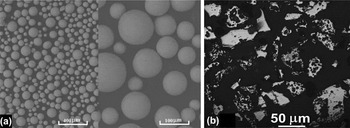
Spherical Ti-6Al-4V powders produced by the plasma rotating electrode process were purchased from Starmet Corp. (Concord, MA). These ELI (Extra Low Interstitial) Ti-6Al-4V powders had a size of ∼80 μm [Fig. 1(a)] and the following composition (in wt%, as provided by the supplier): 6.07% Al, 3.81% V, 0.192% O, 0.18% Fe, 0.02% C, 0.02% Si (ASTM F136). Angular TiC powders, purchased from CERAC, Inc. (Milwaukee, WI), had a size of ∼44 μm (−150/+325 mesh) and contained high porosity, as shown in Fig. 1(b). Since in this work, the only concern was consolidation kinetics of the Ti-6Al-4V matrix, TiC porosity was not considered a problem; however, fully dense TiC powders would be beneficial to MMC used in load-bearing applications.
SEM images of (a) spherical Ti-6Al-4V powders and (b) angular, porous TiC powders polished in the cross-section.

The Ti-6Al-4V/TiC blends with target TiC volume fractions 5, 10, 15, and 20% were prepared by measuring specific masses of Ti-6Al-4V and TiC rather than volumes, assuming TiC and Ti-6Al-4V densities of 4.93 and 4.43 g/cm3, respectively. The TiC powder was however found to have an intrinsic porosity of 28.6% from both image analysis and data analysis, as described in the following section. The nominal (dense) TiC volume fractions of 5, 10, 15, and 20% in the composites thus correspond to higher actual (porous) TiC volume fractions of 6.8, 13.5, 19.8, and 25.9% (rounded to 7, 14, 20, and 26%).
B. Composite densification
The Ti-6Al-4V and TiC powders were thoroughly blended in a custom-made cylinder container with a single axially-located baffle.Reference Ottino and Lueptow20,Reference Shi, Abatan, Vargas and McCarthy21 The hot pressing procedure is described in detail in Ref. Reference Ye, Matsen and Dunand15 and is summarized here. 14.5–15.5 g of Ti-6Al-4V/TiC powder blend was poured in a cylindrical TZM molybdenum alloy die coated with boron nitride, with inner and outer diameters of 25.4 and 63.5 mm, and a height of 34.3 mm. Powders were not tapped to avoid possible segregation. Both TZM piston and die walls were separated from the powder by two 125 μm thick stainless steel foils coated with boron nitride. The powder temperature was monitored by a K-type thermocouple in contact with the center of the TZM piston.
The evacuated TZM die/powder/piston assembly was induction-heated from ambient to densification temperature at a heating rate of ∼1 K/s, with the powders subjected to a small compressive stress of ∼0.4 MPa to maintain load train continuity. In the isothermal experiments, the densification stress was applied to the powders when the temperature reached 1020 °C (in the β-field of Ti-6Al-4V) and the stress and temperature were maintained constant throughout the experiment. In the thermal cycling experiments, the densification stress was applied when the temperature reached 850 °C at which point the stress remained constant while the temperature was cycled between 860 and 1020 °C with a heating time of 96 s and a cooling time of 95 s (i.e., ∼3 min cycle). At these lower and upper temperatures, the equilibrium volume fraction of β-phase is 22 and 100%, respectively.Reference Schuh and Dunand14 A vacuum level of at least 5 × 10⁻⁵ Torr (6.7 mPa) was maintained throughout the experiment. The temperature was recorded every 2 s, together with the piston displacement measured at the cross-head by a displacement transducer with an accuracy of ±3 μm. At the end of densification, the sample was cooled under a small ∼0.4 MPa stress in a vacuum to room temperature within 2 h.
The density of the sample, with a height of ∼7 mm and a diameter of 25.4 mm, was measured by the Archimedes method in deionized water. The sample relative density (with an error about 0.3%) during the densification experiment was then calculated using the measured final density and the piston displacement data. Densification was conducted for each Ti-6Al-4V/TiC blend with different TiC volume fraction and densification kinetics was measured on separate sample for each blend condition. Metallographic samples were prepared as described in Ref. Reference Ye, Matsen and Dunand15.
III. RESULTS
A. Microstructure and composite density
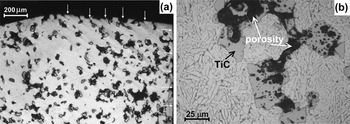
The microstructure of the densified composite with the highest TiC volume fraction (26 vol%) is shown in Figs. 2(a) and 2(b) after densification at 1020 °C under 20 MPa for 7500 s. A low-magnification cross-section [Fig. 2(a)] shows a uniform distribution of TiC particles, even near the edge of the die [marked by arrows in Fig. 2(a)]. A high-magnification cross-section [Fig. 2(b)] shows an intimate contact between matrix and particles and the absence of the reaction product, as expected. A Widmanstätten or “basket weave” structure is visible in the Ti-6Al-4V phase, as well as extensive porosity within the TiC powders [Fig. 2(b)].
Cross-sections of densified Ti-6Al-4V/20TiC composites with the loading direction oriented vertically: (a) low magnification showing overall distribution of TiC particles (edge of the composite marked by arrows), (b) high magnification with etched Ti-6Al-4V microstructure (TiC particles and porosities from sintering are marked by arrows).

Figure 2(b) and all other metallographic sections show that the rigid TiC particles were not crushed during densification below 20 MPa and maintained their high initial porosity. This suggests that TiC is rigid during the densification with an applied stress below 20 MPa. The apparent density of the porous TiC powders was determined by plotting the measured density of four fully densified composites against their nominal TiC volume fractions (5, 10, 15, and 20%). The resulting straight line yields an apparent TiC density of 3.52 g/cm3, corresponding to a TiC porosity of 28.6%. Image analysis of cross-sections of individual TiC particles confirmed this value.
B. Thermal cycling and isothermal densification
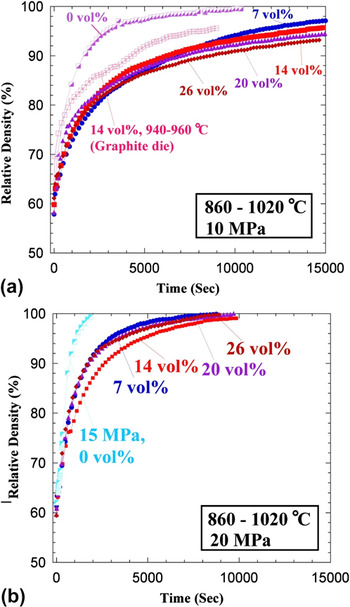
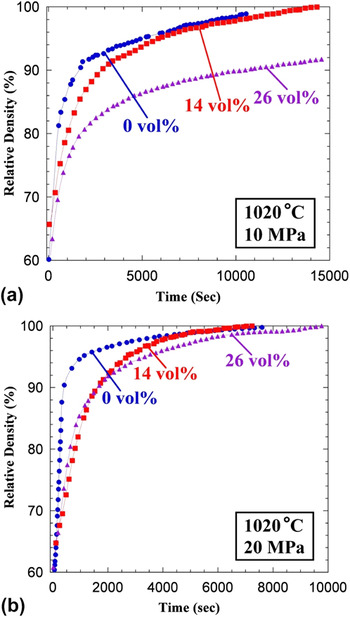
Densification curves (relative density versus time) for blends with TiC volume fractions of 0, 7, 14, 20, and 26% densified under thermal cycling conditions (860–1020 °C) at 10 and 20 MPa applied stress are shown in Figs. 3(a) and 3(b), respectively. Similar densification curves for isothermal densification at 1020 °C for 10 and 20 MPa are shown in Figs. 4(a) and 4(b), respectively for 0, 14, and 26% TiC. Under thermal cycling conditions [Figs. 3(a) and 3(b)], addition of 7 vol% TiC strongly delays densification kinetics as compared to pure Ti-6Al-4V; increasing the TiC volume fraction further to 14, 20, and 26% leads to a comparatively much smaller retarding effect. By contrast, under isothermal conditions [Figs. 4(a) and 4(b)], the presence of 14 vol% TiC affects the densification kinetics, as compared to TiC-free powders, only at the start of densification, but the times to achieve full densification are similar. When the TiC volume fraction is 26%, the decrease in densification kinetics is however very significant, particularly at the lower stress of 10 MPa.
Powder densification kinetics of Ti-6Al-4V with various TiC fractions under thermal cycling densification (860–1020 °C) with an applied stress of (a) 10 MPa and (b) 20 MPa.

Powder densification kinetics of Ti-6Al-4V with various TiC fractions under isothermal densification (1020 °C) with an applied stress of (a) 10 MPa and (b) 20 MPa.

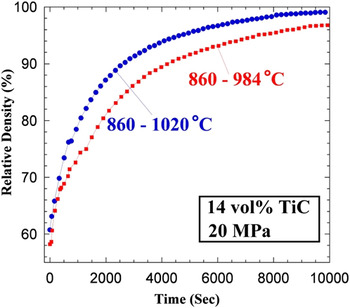
During thermal cycling, densification is controlled by transformation-mismatch plasticity which is proportional to the mismatch occurring during the α/β transformation of Ti-6Al-4V and thus the range of β-phase variation. As expected, Fig. 5 shows that partial cycling (860–984 °C), which corresponds to the equilibrium volume fraction of β-phase of 22 and 90%, respectively,Reference Schuh and Dunand14 results in lower densification kinetics than full cycling (860–1020 °C, or 22–100% β-phase).
Powder densification kinetics of Ti-6Al-4V with 14 vol% TiC composite under thermal cycling densification (860–984 °C and 860–1020 °C).

IV. DISCUSSION
A. Powder densification under thermal cycling and isothermal conditions
Under thermal cycling, when deviatoric stresses are low, densification occurs primarily by transformation-mismatch plasticity while, under isothermal conditions, power-law dislocation creep is the dominant deformation mechanism. For a bulk material subjected to an uniaxial stress σx, the average strain rate  ${{\dot \varepsilon }}$ due to creep under isothermal conditions is:
 $${{\dot \varepsilon }} = C \cdot {\rm{\sigma }}_x ^{\,\,\,n} \quad,$$
where n is the creep stress exponent (for β-Ti-6Al-4V) and C is a constant incorporating an Arrhenius temperature dependence: for Ti-6Al-4V, C = 4.8 × 10⁻⁷ MPa−2.8/s at 1020 °CReference Schuh and Dunand14,Reference Li, Chen, Bice and Dunand22 with n = 2.8,Reference Li, Chen, Bice and Dunand22 while for Ti, C = 3.86 × 10⁻⁹ MPa−4.3/s at 870 °C and C = 6.74 ×10⁻⁶ MPa−4.3/s at 980 °C with n = 4.3Reference Taylor, Dunand and Mortensen7,Reference Frost and Ashby23,Reference Schuh and Dunand24 . Similarly, the average uniaxial strain rate  ${{\bar \dot \varepsilon }}$ due to transformation-mismatch plasticity under thermal cycling isReference Greenwood and Johnson16:
 $${{\bar \dot \varepsilon }} = {4 \over 3} \cdot {{5 \cdot n} \over {4 \cdot n + 1}} \cdot {{\Delta V} \over V} \cdot {1 \over {\Delta t}} \cdot {{{\rm{\sigma }}_x } \over {{\rm{\sigma }}_0 }}\quad,$$
where ΔV/V is the volume mismatch for full α/β phase transformation (ΔV/V = 0.96% for Ti-6Al-4VReference Schuh and Dunand14), Δt is the thermal cycle duration from heating and cooling and σ0 is the average internal stress generated during the phase transformation (σ0 = 7.4 MPa for Ti-6Al-4VReference Schuh and Dunand14).
In dense composites, the uniaxial strain rate from dislocation creep is significantly reduced by rigid reinforcing ceramic particles due to the constrained matrix flow and load transfer from the matrix to the rigid particles (when there is good bonding between the two phases).Reference Zhu, Liaw, Corum and McCoy25,Reference Daymond, Lund, Bourke and Dunand26 For transformation superplasticity, additional mismatch between the transforming matrix and the non-transforming matrix can enhance the creep rate of composites.Reference Dunand and Myojin27–Reference Frary, Schuh and Dunand31 For densification of metal-ceramic powder blends, addition of rigid ceramic particles reduces densification rates under isothermal conditions, where powders deform by creep, due to the constraining effect of the ceramic particles on the creep deformation of the metal powdersReference Taylor, Dunand and Mortensen7,Reference Schuh, Noel and Dunand13,Reference Besson and Evans32 ; furthermore, at high reinforcement fractions, the presence of a load-bearing percolating network of ceramics can strongly inhibit metal densification. Although the densification rates of blends of Ti powders with 1, 5, or 10 vol% ZrO2 particles were higher under thermal cycling than under isothermal conditions, the densification kinetics of the 5 and 10 vol% ZrO2 blends were typically much reduced as compared to those of pure Ti.Reference Taylor, Dunand and Mortensen7,Reference Schuh, Noel and Dunand13 This was attributed to the dissolution of the ZrO2 particles which strengthens the Ti matrix and prevents phase transformation.Reference Taylor, Dunand and Mortensen7,Reference Schuh, Noel and Dunand13
The percolation effect becomes important in a metal matrix composite only when the volume fraction is above 30% or so.Reference Martin and Bouvard33,Reference Olmos, Martin and Bouvard34 However, even when the volume fraction is low as much as 5%, the reduced densification kinetics was observed.Reference Olmos, Martin and Bouvard34 The delay in densification kinetics is not significantly affected by the percolation effect and elastic constants of the rigid particles, but the friction effect between the powdersReference Martin and Bouvard33 which is equivalent to lower applied stress.
An additional issue associated with composite densification during thermal cycling is the thermal conductivity of the ceramic reinforcement. While thermal conductivity of titanium and Ti-6Al-4V increases with temperature and is 20–25 W/(m·K) above 800 °C, the thermal conductivity of ceramics typically decreases with temperature and are 5.6 W/(m·K) for TiCReference Shackelford and Alexander35 and 2 W/(m·K) for ZrO2Reference Dura, Bauer, Vazquez and Lopez de la Torre36 above 800 °C. The ceramic powders thus reduce the heat transfer from and to the die, resulting in thermal gradients in the preform and thus gradients in thermal amplitude (and mismatch and transformation superplasticity), which reduce overall densification.
B. Continuum modeling of Ti-6Al-4V/TiC densification
Modeling of powder densification includes the first stage (for relative density ρ < 90%) and the final stage (for relative density ρ > 90%). Under isothermal conditions, the first-stage densification rate  ${{\dot \rho }}$ based on power-law dislocation creep [Eq. (1)] can be expressed asReference Arzt, Ashby and Easterling11,Reference Schuh, Noel and Dunand13,Reference Ye, Matsen and Dunand15 :
 $${{\dot \rho }} = 3.06 \cdot C \cdot {\bigg(}{{1 - {\rm{\rho }}_0 } \over {{\rm{\rho }} - {\rm{\rho }}_0 }}{\bigg)}^{n - 1/2} \cdot {{{\rm{\rho }}_{\rm{0}} ^{1/3} } \over {{\rm{\rho }}^{2n - 2/3} }} \cdot {\bigg(}{{B_i \cdot {\rm{\sigma }}} \over 3}{\bigg)}^n \quad,$$
where σ is the uniaxial applied stress on the die piston, B i = 1.1Reference Schuh, Noel and Dunand13 is a dimensionless constant taking into account the compaction geometry, ρ0 = 0.6 is the initial relative density of the compact. The final-stage densification rate is given by:
 $${{\dot \rho }} = {3 \over 2} \cdot C \cdot {{{\rm{\rho }} \cdot (1 - {\rm{\rho }})} \over {(1 - (1 - {\rm{\rho }})^{1/n} )^n }} \cdot \bigg({{3 \cdot B_f \cdot {\rm{\sigma }}} \over {2 \cdot n}}\bigg)^n \quad,$$
where the constant B f = 1.8Reference Schuh, Noel and Dunand13 is related to the stress state in the die.
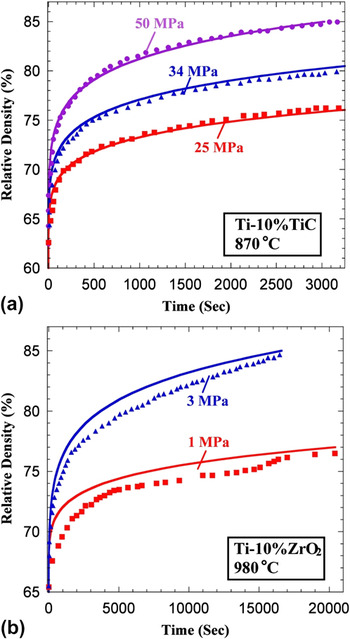
Since there is no fundamental change of the densification mechanism with the addition of reinforcement ceramic powder such as TiCReference Taylor, Dunand and Mortensen7 and ZrO2Reference Schuh, Noel and Dunand13 to the titanium powders, Eqs. (3) and (4) can still be used for modeling the densification process in composite blends, although a knock-down factor (f) multiplies the right-hand expression in these equations to take into account the reduced densification kinetics of metal/ceramic blends discussed in Sec. IV. A, as well as possible die/piston friction effects. Comparisons between calculations using Eq. (3) and experimental observations are shown in Fig. 6 for Ti-10 vol% TiC at 870 °CReference Taylor, Dunand and Mortensen7 with a knock-down factor f = 0.14, and Ti-10 vol% ZrO2 at 980 °CReference Schuh, Noel and Dunand13 with f = 0.33 at 1 MPa and f = 0.24 at 3 MPa. The knock-down factor for Ti-10 vol% TiC is similar to that usedReference Ye, Matsen and Dunand37 to model densification of pure titanium. However, the knock-down factor decreased in Ti-10% ZrO2 with respect to pure titanium hot pressing at 980 °C at both 1 MPa (f = 1) and 3 MPa (f = 0.6).
Comparison between continuum modeling [solid lines, calculated from Eq. (3)] and densification measurements (symbols, from experimental measurements reported in Refs. Reference Taylor, Dunand and Mortensen7,Reference Schuh, Noel and Dunand13) for (a) Ti-10 vol% TiC at 870 °C and (b) Ti-10 vol% ZrO2 at 980 °C.

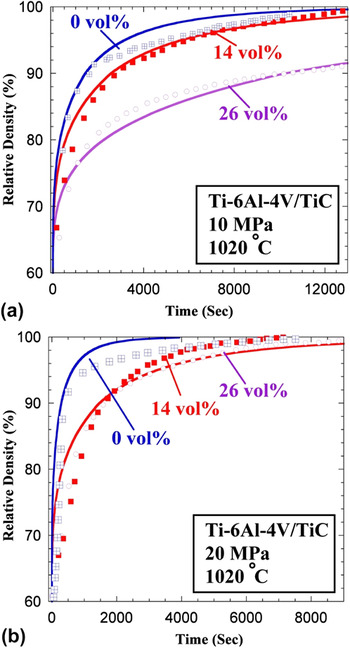
Similar comparisons between continuum modeling and densification measurements are shown in Fig. 7 for the present Ti-6Al-4V/TiC composite. The knock-down factors at 10 MPa [Fig. 7(a)] are f = 1, 0.67 and 0.46 for 0, 14 and 26 vol% TiC respectively. At 20 MPa, the knock-down factors are f = 0.77 and 0.47 for 0 and 14 vol% TiC [Fig. 7(b)].
Comparison between continuum modeling [solid lines, calculated from Eq. (3)] and densification measurements (symbols) for Ti-6Al-4V with 0, 14 and 26 vol% TiC densified at 1020 °C at pressures of (a) 10 MPa and (b) 20 MPa.

C. Finite element simulation of Ti-6Al-4V/TiC densification
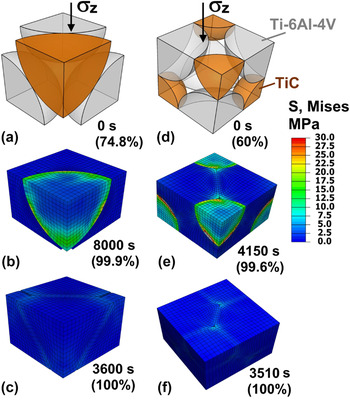
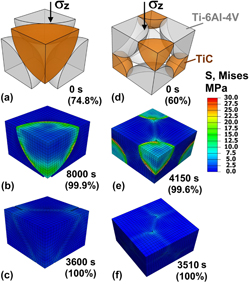
FE simulations to describe the densification of the present Ti-6Al-4V/TiC composite were conducted following the methods described in detail in Ref. Reference Ye, Matsen and Dunand37 for two configurations with periodic boundary conditions, simulating an infinite array of spherical powders: face-centered cubic (fcc) with four 1/8 spheres of the same radius in the unit cell, and simple cubic (sc) with eight 1/8 spheres with two radii in the unit cell [Figs. 8(a) and 8(d)]. In the fcc configuration with an initial packing density of 74.8%, three of the spheres are Ti-6Al-4V and one is TiC, the volume fraction of which is thus 25% [Fig. 8(a)]. In the sc configuration, the diameter of spherical TiC spheres was 63.4% of that of the Ti-6Al-4V spheres, so that the initial packing density was 60% and the TiC volume fraction is 20% [Fig. 8(d)], close to the experimental values. Given the low applied stress and low temperature (as compared to the TiC melting point) used during powder composite densification, it was assumed that TiC was elastic with a Young's modulus of 450 GPa and Poisson's ratio of 0.2.Reference Chang and Graham38 The Ti-6Al-4V powders were assumed to deform by transformation-mismatch plasticity [Eq. (2)]. For thermal cycling with a 860–1020 °C temperature range and a 191 s cycle duration, Eq. (2) reduces to Eq. (1) with n = 1 and C = 1.045 × 10⁻⁵ MPa/sec. This creep type behavior was modeled as the rate-dependent plasticity via the “static” procedure in ABAQUS/Standard 6.7–3 (Dassault Systemes, Vélizy-Villacoublay, France). For fast convergence rather than via the “visco” procedure, as described in more detail in Ref. Reference Ye, Matsen and Dunand37. The densified or deformed state of the unit cells is shown in Figs. 8(b) and 8(e). The plastic matrix flow around the elastic TiC particles during densification and load transfer [visible as regions of higher stress in the particles in Figs. 8(b) and 8(e)] takes place from the compliant, plastic matrix to the stiff, elastic particles. Load transfer is nearly absent at the end of densification when the composite is under near perfect hydrostatic pressure conditions [Figs. 8(c) and 8(f)], but the lack of deformation of the TiC particles leads to incomplete densification at the triple line where one TiC and two deformed Ti-6Al-4V spheres meet. By contrast, when all powders in the unit cell are plastically deforming Ti-6Al-4V, the powders deform uniformly and have faster densification kinetics, as reported in Ref. Reference Ye, Matsen and Dunand37.
FE simulation of Ti-6Al-4V/TiC powder composite densification with the fcc configuration: (a, b) initial and densified states of Ti-6Al-4V with 25 vol% TiC, (c) Densified state of Ti-6Al-4V without TiC. Same with the sc configuration: (d, e) initial and densified states of Ti-6Al-4V with 20 vol% TiC, (f) densified state of Ti-6Al-4V without TiC.

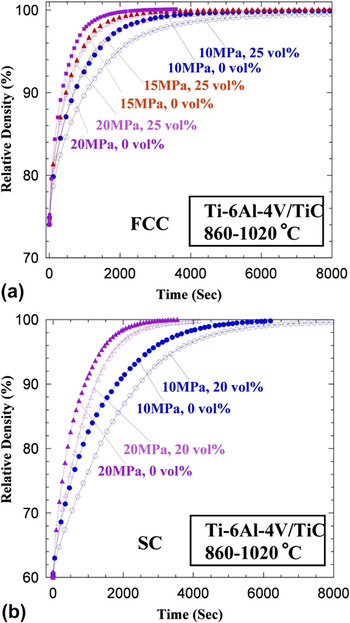
FE simulation results for powder densification kinetics are shown in Fig. 9(a) for the fcc configuration under an applied stress of 10, 15, and 20 MPa and in Fig. 9(b) for the sc configuration under 10 and 20 MPa. A comparison of densification curves between Ti-6Al-4V with and without TiC shows that densification becomes faster with the increasing applied stress and slower with the addition of TiC. At 20 MPa, 99.8% relative density is predicted after 50 min for Ti-6Al-4V and after 69 min for Ti-6Al-4V/20TiC for the sc configuration, and after 44 and 137 min, respectively, for Ti-6Al-4V/25TiC in the fcc configuration. These values are similar to those measured experimentally for Ti-6Al-4V [35 min, Fig. 3(b)] and Ti-6Al-4V/25TiC [147 min, Fig. 3(b)]. Thus, despite the drastic simplifications used, the FE model can provide semi-quantitative predictions for the densification kinetics of metal and metal/ceramic powder blends. More complex models capturing the non-spherical shape, the size distribution and the non-periodic distribution of powders are needed for improved results.
Densification kinetics of Ti-6Al-4V and Ti-6Al-4V/TiC powder composites as determined by FE simulations: (a) fcc configuration (0 and 25 vol% TiC) with an applied stress of 10, 15, and 20 MPa and (b) sc configuration (0 and 20 vol% TiC) with an applied stress of 10 and 20 MPa.

Significant differences between pure Ti-6Al-4V powders and the blends of TiC and Ti-6Al-4V powders in densification kinetics are found for a relative density >99% from different densification states due to the lack of synergy in TiC and Ti-6Al-4V [Figs. 8(c) and 8(f) and Fig. 3]. This may partially explain the insignificant difference in densification kinetics with respect to different TiC compositions at a specified load (Fig. 3).
V. CONCLUSIONS
The densification kinetics of Ti-6Al-4V/TiC powder blends were measured under hot pressing conditions for various TiC powder volume fractions, applied external stresses and temperature schedules (thermal cycling or isothermal). The following main conclusions are reached:
(1) Densification kinetics increases with applied external stress in both thermal cycling and isothermal conditions.
(2) Under isothermal conditions, the addition of 14 vol% TiC powder does not affect densification appreciably. However, when the TiC volume fraction reaches 26 vol%, densification is strongly delayed.
(3) Under thermal cycling conditions, densification rates were similar for TiC volume fractions of 7–26% although they were much slower than pure Ti-6Al-4V without TiC additions.
(4) General agreement is found between experimental measurements of densification kinetics, models using a continuum approach and simulation by the finite-element method with powder-level FE.
ACKNOWLEDGMENT
This research was supported by a grant from the Boeing Corp.